Systems Provisioned in the Cloud
Doctoral Dissertation submitted to the
Faculty of Informatics of the Università della Svizzera Italiana in partial fulfillment of the requirements for the degree of
Doctor of Philosophy
presented by
Mathias Björkqvist
under the supervision of
Prof. Walter Binder
Prof. Rolf Krause Università della Svizzera Italiana, Switzerland
Prof. Cesare Pautasso Università della Svizzera Italiana, Switzerland
Prof. Heiko Schuldt University of Basel, Switzerland
Prof. Giuseppe Serazzi Politechnico di Milano, Italy
Dissertation accepted on 11 February 2015
Research Advisor PhD Program Director PhD Program Director
I certify that except where due acknowledgement has been given, the work presented in this thesis is that of the author alone; the work has not been submit-ted previously, in whole or in part, to qualify for any other academic award; and the content of the thesis is the result of work which has been carried out since the official commencement date of the approved research program.
Mathias Björkqvist
Service providers seek scalable and cost-effective cloud solutions for hosting their applications. Despite significant recent advances facilitating the deployment and management of services on cloud platforms, a number of challenges still remain. Service providers are confronted with time-varying requests for the provided ap-plications, inter-dependencies between different components, performance vari-ability of the procured virtual resources, and cost structures that differ from con-ventional data centers. Moreover, fulfilling service level agreements, such as the throughput and response time percentiles, becomes of paramount importance for ensuring business advantages.
In this thesis, we explore service provisioning in clouds from multiple points of view. The aim is to best provide service replicas in the form of VMs to various service applications, such that their tail throughput and tail response times, as well as resource utilization, meet the service level agreements in the most cost effective manner. In particular, we develop models, algorithms and replication strategies that consider multi-tier composed services provisioned in clouds. We also investigate how a service provider can opportunistically take advantage of observed performance variability in the cloud. Finally, we provide means of guar-anteeing tail throughput and response times in the face of performance variabil-ity of VMs, using Markov chain modeling and large deviation theory. We employ methods from analytical modeling, event-driven simulations and experiments. Overall, this thesis provides not only a multi-faceted approach to exploring sev-eral crucial aspects of hosting services in clouds, i.e., cost, tail throughput, and tail response times, but our proposed resource management strategies are also rigorously validated via trace-driven simulation and extensive experiments.
Contents iii
1 Introduction 1
1.1 Overview of Service Systems and Cloud Computing . . . 2
1.1.1 Service Systems . . . 2
1.1.2 Cloud Computing Models for Service Providers . . . 2
1.2 Deployment of Multi-Tier Services in Clouds . . . 3
1.3 Deployment of Services in Public Cloud . . . 3
1.3.1 Performance Variability . . . 4
1.3.2 Cost Structure . . . 5
1.3.3 Tail Response Times . . . 6
1.4 Load Balancing of Replicated Services . . . 6
1.5 Problem Statement . . . 8
1.6 Outline of Proposed Solution . . . 10
1.7 Contributions . . . 13
2 State of the Art 17 2.1 Replication of Services in Clouds . . . 17
2.2 Provisioning of Services in Public Clouds . . . 18
2.3 Tail Response Times . . . 21
2.3.1 Modeling Tail Response Times . . . 21
2.3.2 Optimizing for Tail Response Times in Cloud . . . 23
2.4 Load Balancing of Service Clusters . . . 23
2.4.1 Load Balancing of Atomic Services . . . 24
2.4.2 Load Balancing of Composed Services . . . 24
3 Provisioning of Two-tier Services in the Cloud 27 3.1 System Model . . . 28
3.1.1 Client Requests and Composite Services . . . 29
3.1.3 Front-end Service Replicas . . . 30
3.1.4 Replication Manager . . . 30
3.1.5 Average End-to-end Request Response Time, Ra . . . 31
3.2 Optimizing Performance of Front-end and Back-end Service Replicas 32 3.2.1 Monitoring and Predicting Workloads . . . 32
3.2.2 Controlling Replicas . . . 33
3.2.3 Bounding Analysis on Front-end Performance . . . 36
3.3 Service Selection . . . 37
3.4 Evaluation . . . 38
3.4.1 Simulator and System Configuration . . . 38
3.4.2 System Scenario I . . . 41
3.4.3 System Scenario II . . . 42
3.5 Assumptions and Limitations . . . 43
3.6 Summary . . . 44
4 Leveraging Performance Variability for Service Provisioning 47 4.1 System Model . . . 48
4.1.1 System Architecture and Dynamics . . . 48
4.1.2 VM Replica Provisioning . . . 50
4.2 Opportunistic Replication Policy . . . 51
4.2.1 Control Window and Overhead . . . 51
4.2.2 Number of Replica VMs . . . 52
4.2.3 Turning on-off, Replacing, and Reconfiguring VMs . . . 53
4.3 Evaluation . . . 55
4.3.1 System Configuration . . . 56
4.3.2 The Workloads: Invocation Requests . . . 57
4.3.3 Two Services . . . 59
4.3.4 Four Services . . . 60
4.4 Assumptions and Limitations . . . 62
4.5 Summary . . . 63
5 Providing Tail Throughput QoS Guarantees 65 5.1 Capacity Variability of Service VM Configuration . . . 66
5.1.1 Experiment Setup . . . 67
5.1.2 (In)sensitivity of Capacity Variability . . . 68
5.1.3 A Really Noisy Daemon . . . 69
5.2 Markov Chain Model for Service Cluster . . . 70
5.2.1 Single VM node . . . 70
5.2.3 Trade-off between Cost and Service Availability . . . 72
5.3 Choosing a VM Configuration . . . 76
5.3.1 Typical Case: Weaker VM Means a Bigger Cluster . . . 76
5.3.2 Counter Example: A Cluster of Weaker VMs Can Be Smaller 78 5.4 Assumptions and Limitations . . . 78
5.5 Summary . . . 79
6 Optimizing for Tail Response Times 81 6.1 System Model . . . 83
6.2 Tail Response Times of G/G/1/PS(φ) Queues . . . . 85
6.2.1 Workload Distribution . . . 85
6.2.2 Approximating Tail Response Times . . . 86
6.3 Mean-based Approximation . . . 88
6.3.1 Conditional Distribution of Number of Jobs . . . 88
6.3.2 Special Case: Degenerate Hyperexponential Work . . . 90
6.3.3 Tail Response Time Approximation . . . 92
6.4 Experimental Results . . . 93
6.4.1 Experiment Setup . . . 93
6.4.2 Accuracy and Sensitivity Analysis . . . 94
6.4.3 Optimizing for Cloud Clusters . . . 96
6.5 Assumptions and Limitations . . . 98
6.6 Summary . . . 98
7 Conclusions 99 7.1 Contributions . . . 99
7.2 Limitations and Future Work . . . 101
Introdu tion
Providers of service-oriented systems aim at delivering satisfactory performance in a cost-effective manner, which today often means taking advantage of the cloud computing paradigm in one way or another. On the one hand, the oper-ational cost is proportional to the number resources deployed, such as physical machines or virtual machines (VMs) hosting service replicas. For fast-growing en-terprises, or for services experiencing large time variability, provisioning some or all of these resources in clouds can provide significant benefits in terms of ease-of-management or cost. On the other hand, system performance, e.g., response time and resource utilization, hinges on the capability of the provisioned resources in processing time-varying requests and the balancing of the load across replicas. Related studies[Zhang et al., 2008; Singh et al., 2010] show that striking a good balance between conflicting objectives, i.e., operational cost and performance, is not an easy task, especially in multi-tier systems. Statically providing a maximum number of resources may guarantee the performance at a high operational cost, whereas unbalanced loads and under-provisioned resources could lead to a sig-nificant performance degradation. Dynamically and accurately adjusting service capacities, i.e., the number and size of physical or virtual machines, depending on the workload, has been shown to be effective in solving the dilemma of balancing between performance targets and operational cost. The ease of dynamically ad-justing resources is one of the key advantages of clouds, which is why more and more service providers are turning to them for their service provisioning needs [Chen et al., 2005; Lin et al., 2013].
The rest of this chapter gives an overview of the key relevant service provi-sioning aspects from the perspective of service providers and the cloud comput-ing paradigm. Section 1.1 gives a general description of service systems and the cloud computing paradigm. Provisioning of replicated, multi-tier and composed
services in clouds is presented in Section 1.2. The public cloud, and how ser-vice providers can make use of it, is introduced in Section 1.3. This section also touches upon two of the key properties of public clouds, namely the performance variation, and their cost structures from a service provider’s perspective. Load balancing of replicated and distributed systems is presented in Section 1.4. In Section 1.5, the problem statement is introduced, followed by an overview of the rest of the thesis in Section 1.6 and the contributions in Section 1.7.
1.1 Overview of Servi e Systems and Cloud Computing 1.1.1 Servi e Systems
Service-oriented systems are commonly composed of distributed web services [Alonso et al., 2004; Papazoglou et al., 2008]. Applications’ requests, consisting of multiple invocations of web services, show a strong time varying behavior, e.g., time of day and day of the week effects[Arlitt and Jin, 2000; Chen et al., 2005; Singh et al., 2010; Stewart et al., 2007]. Such systems process requests either as atomic services, or by invoking the corresponding service compositions, which are often represented as business processes or as workflows of services, and which are typically deployed upon startup of the system. To maintain the target service level agreement (SLA) and continuous availability of services, multi-ple replicas of resources need to be deployed. This includes both back-end service nodes that execute the requests, as well as front-end nodes which are dedicated engines that invoke the corresponding services.
1.1.2 Cloud Computing Models for Servi e Providers
Cloud computing is an emerging computing paradigm, featuring elastic capac-ity provisioning and ease of operational management for a wide range of ser-vices. Resources, such as processors, storage, and network, are provided in an on-demand fashion to multiple service providers (i.e., clients of the cloud), who may deploy multiple services exhibiting disparate workload patterns. Essentially, cloud platforms enable resource sharing among multiple service providers, as well as among multiple services deployed by the same provider. Typically, the basic computing unit in compute clouds is the virtual node, on which different services can be deployed in an on-demand fashion. Depending on the specific cloud architecture, virtual nodes can correspond to either virtual machines or physical machines.
The NIST model of cloud computing[Mell and Grance, 2011] encompasses three different service models — Infrastructure as a Service (IaaS), Platform as a Service (PaaS), and Software as a Service (SaaS). Service providers can use four types of cloud deployment models — private cloud, community cloud, public cloud, and hybrid cloud. The first three deployment models are ordered from the least to the most dynamic in terms of provisioning elasticity, and the hybrid cloud is a mix of resources from two or more of the other models.
1.2 Deployment of Multi-Tier Servi es in Clouds
Various service replication strategies [Salas et al., 2006; Zheng and Lyu, 2008, 2009; Dustdar and Juszczyk, 2007] have been developed for fault-tolerant service-oriented systems. Often, only the replication of atomic services has been consid-ered and the optimal number of replicas for composed services has been over-looked. Consequently, to optimize SLA and operational cost, the optimal provi-sioning of service replicas has mainly been shown in the context of simple
single-tierweb hosting systems[Lin et al., 2013] , i.e., clients send requests directly to services. For multi-tier web hosting systems, most existing studies [Singh et al., 2010; Zhang et al., 2008] design replication polices independently for each tier. In reality, the provisioning of front-end replicas depends on the performance of the second-tier service layer, due to the blocking I/O which is a result of the processing of consecutive service invocations within a composition. The perfor-mance of the service replicas depends on the invocations dispatched by front-end replicas and the corresponding load balancing among back-end service replicas. It is very challenging to dynamically provide resources in systems with multiple tiers, i.e., front-end and back-end service tiers, which encounter time-varying and -correlated workloads, such that the cost is minimized without compromis-ing performance.
1.3 Deployment of Servi es in Publi Cloud
Public clouds are clouds from which customers can obtain resources, e.g., virtual machines in compute clouds for provisioning web services. Deploying services in public compute cloud environments is an attractive solution, due to cost and ease of management advantages. In a public cloud, a set of preconfigured VM instances is available at different costs for different sizes, and their correspond-ing hardware-related performance metrics are provided at best effort[Ristenpart et al., 2009].
Hosting services in a cloud relieves the service provider from maintaining an expensive computing infrastructure. Thanks to on-demand virtual resource provisioning, cloud operators provide on-demand computing capacity, enabling elastic service provisioning. Another advantage of cloud environments is their pay-as-you-go billing feature. The service provider can thus request the necessary computing capacity in the unit of VMs from the cloud operator, according to the workload. Consequently, hosting services in a cloud — in conjunction with an effective service replication policy — can achieve significant cost savings for the service provider.
1.3.1 Performan e Variability
When migrating various applications onto cloud platforms, one of the common weaknesses observed in public cloud environments is the higher performance variability compared to private platforms. In particular, VMs with the same spec-ifications (i.e., incurring the same costs for the user) show significant perfor-mance variability in terms of throughput; some VMs are faster and some are slower. The observed higher performance variability also holds true for the re-sponse time, which fluctuates significantly, and tail latency degrades due to the heterogeneity of the underlying hardware and the workloads co-located on the same physical hosts. The effects of resource sharing that result from consoli-dating multiple VMs on the same physical hosts, are dynamically changing de-pending on varying workloads and on workload management actions taken by the cloud operator, such as VM consolidation and VM migration. Furthermore, hardware features such as dynamic frequency scaling can have an impact on performance depending on the workloads and on VM consolidations. As a con-sequence, the computing capacity of individual VMs fluctuates, and so does the aggregated capacity of all provisioned VMs of a service provider.
Although virtualization enables the efficient multiplexing of workloads across the ample hardware resource, performance isolation is limited, especially for ap-plications that are not CPU intensive. While the performance variability persists in cloud platforms, little is known about the sensitivity of services on different VM configurations in terms of capacity, i.e., the maximum number of service re-quests that can be processed sustainably, and the aggregate impact of the capacity variability of a single VM on the QoS of the entire service cluster. VM provision-ing of service systems is typically based on the average capacity, which in turn is a good indicator for systems experiencing low variability and providing simple
Quality of Service (QoS) guarantees, such as average throughput over a certain threshold. To avoid performance penalties due to variability in the cloud,
se-lecting VMs with desirable performance becomes of paramount importance not only to reduce performance variability, but also to optimize cost. Consequently, empirical approaches are proposed to acquire VMs with higher capacities. How-ever, due to the empirical nature of the proposed VM selection strategies, a QoS promise of satisfying a given target throughput is only attained at best effort. Moreover, the resulting cost minimization may be arbitrary, depending on the workload dynamics of the underlying cloud platform.
1.3.2 Cost Stru ture
In addition to the performance variability, another distinguishing difference be-tween private systems and public cloud platforms is the cost structure and restric-tions imposed by the billing contract. On a private platform, turning a VM on and off is not restricted by any billing contract, whereas VMs requested in a cloud are typically charged for pre-defined billing periods such as an hour. Therefore, in a cloud it can be wasteful to turn VMs on and off without considering billing constraints. Moreover, frequently turning VMs on and off may cause not only additional costs but also some capacity loss because of the time overhead asso-ciated with the VM control actions. System performance (i.e., service response times) can fluctuate greatly during the transition of turning VMs on and off.
On the one hand, cloud platforms provide several cost advantages for elas-tic service provisioning. On the other hand, system dynamics become much more complex than in private platforms and pose several new challenges. Purely workload-driven service replication policies have been shown effective on pri-vate platforms [Chen et al., 2005; Lin et al., 2013; Singh et al., 2010; Stewart et al., 2007], implementing simple control actions such as turning service repli-cas on and off. However, such policies can fall short in optimizing the trade-off between cost and performance in a cloud, due to the lack of consideration of the variability in VMs’ performance and billing contracts. For example, in a cloud, a lower number of faster VMs may have the same aggregate capacity as a higher number of slower VMs, but typically cost less, particularly if the faster and the slower VMs are not distinguished by the billing contracts. To optimize service provisioning costs and service performance simultaneously, the service replica-tion policy in the cloud needs to choose not only the right number of VMs but also the VMs with better performance. As such, a broad range of criteria, such as workload, heterogeneity of VM performance, and billing contracts, needs to be taken into consideration when designing service replication algorithms for cloud environments.
1.3.3 Tail Response Times
Several empirical studies [Xu et al., 2013; Schad et al., 2010; Casale and Trib-astone, 2013] point out a common pitfall in clouds: the execution speed of an application within a virtual machine (VM) fluctuates significantly due to the het-erogeneity of the underlying hardware and the workloads co-located on the same physical host. Although virtualization enables efficient multiplexing of work-loads across ample hardware resources, performance isolation is limited [Chen et al., 2012; Björkqvist et al., 2013]. The resulting exogenous variability not only hampers the satisfaction of the users, but also results in non-negligible busi-ness losses associated with the violation of service level agreements (SLAs) often specified in terms of tail response times.
The degradation of tail response times in the cloud is further exacerbated when deploying cluster-based applications [Xu et al., 2013], i.e., relying on a large number of VMs. Web[Dean and Barroso, 2013] and big data services [Reiss et al., 2012] are typical examples requiring such cluster deployments. In addition to the modulated execution speed and cluster size, the distribution of response times, particularly the tail, is also affected by the load balancing algorithm dis-tributing the load across VMs and the processor scheduling mechanism at each VM. Typically, a simple round robin algorithm is widely adopted, such as the one used in the Amazon EC2 cloud[EC2, 2014]. Requests are executed in a Processor Sharing (PS) fashion on individual VMs, which are typically hosted on separate physical servers. Overall, when deploying application clusters on today’s cloud, three aspects are crucial for capturing the distribution of workloads and response times: the modulated execution speed of VMs, the load balancing algorithm, and the processor scheduling.
1.4 Load Balan ing of Repli ated Servi es
Since service systems are normally provisioned using multiple replicas, distribut-ing the incomdistribut-ing load among the available resources is critical. By keepdistribut-ing the utilization level of the provisioned resources high, fewer resources are needed, leading to lower costs. A number of approaches for balancing the loads exist, and some are more suitable for certain scenarios than others.
Load balancing schemes can be categorized into two types: load oblivious and load aware. The former, such as random selection and round-robin selec-tion, distributes requests to available front-end and back-end service replicas, independent of their loads. On the contrary, the latter dispatches requests
de-pending on the monitored loads of the front-end and back-end service replicas. Join the shortest queue (JSQ), where incoming requests are dispatched to the server with the least number of outstanding requests [Whitt, 1986], is one of such load balancing schemes, which are shown effective in systems with low variation in loads; however, its scalability is limited due to the implementation overhead of continuously monitoring the load. On the other hand, a dynamic lot-tery balancing scheme, combining the advantages of load oblivious and aware, is extensively applied for scheduling in operating system[Waldspurger and Weihl, 1994] and service system contexts [Mosincat and Binder, 2009].
To ensure scalability, today’s web services are replicated and hosted on dis-tributed systems that experience regular resource upgrades and are thus com-prised of heterogeneous servers. The employment of virtualization technology further amplifies the server heterogeneity, especially on hosting platforms shared with different service providers such as computing clouds. Web service applica-tions are characterized not only by disparate resource requirements (e.g., CPU-intensive browsing service vs. I/O-intensive transaction service), but also by time-varying request workloads [Zhang et al., 2005]. Consequently, the over-all system workloads fluctuate in terms of mixes of applications and the volume of requests[Singh et al., 2010]. The heterogeneity of servers, together with di-versified applications with different workload characteristics, further exacerbates the challenges of load balancing.
There is a large body of load balancing studies[Zhang et al., 2005; Cardellini et al., 1999; Cherkasova and Ponnekanti, 2000] that mainly focus on homoge-neous systems and consider a single bottleneck resource where queues build up. The JSQ policy has been shown very robust theoretically [Gupta et al., 2007] and practically[Apache, 2014], in distributing the entire load across distributed servers. In a heterogeneous system experiencing time-varying application mixes, such a policy can potentially lead to the situation where servers receive similar amounts of requests but servers with powerful CPU (resp. disk) process a lot of IO- (resp. CPU-) intensive requests. Clearly, depending on the received applica-tion mix, the use of servers with different bottleneck resources can result in very different performance, such as response times. Therefore, it is imperative for the load-balancing policy to distribute the server load evenly as well as the resource load, which is influenced by the application mix received at individual servers.
1.5 Problem Statement
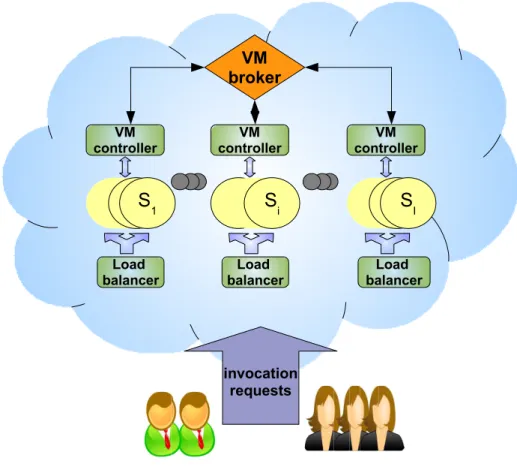
In this thesis, we consider service systems provisioned in the cloud, from a ser-vice provider’s point of view. These systems provide serser-vices which, either by themselves or together with other services, form applications. Clients send re-quests to the applications, with strong time variability patterns. The application requests are directed to the appropriate entities, and on the way possibly broken down into multiple internal service requests, resulting in complex workloads. A high-level overview of the considered system can be seen in Figure 1.1.
Figure1.1. Appli ation lientsa essing servi es provisionedin the loud
Essentially, an application is composed of services which are hosted on cloud VMs. Due to the nature of resource sharing and the trend of using heterogeneous hardware in the cloud, VMs tend to exhibit performance variability, i.e., VMs with the same specification experience different execution speeds. The main perfor-mance metrics of interest are resource utilization as well as the percentiles of throughput (in terms of requests per second) and response times, which are chal-lenging to predict. All in all, the difficulty of resource management arises from the complexity of workloads, cloud systems, and the sophisticated performance metrics. The general research question that we try to answer is the following:
How should service providers dynamically provision cloud resources, in terms of VMs, so that various service objectives, especially the high percentile throughput and response times, can be fulfilled in a cost effective manner?
Furthermore, we examine different aspects of complexity in the aforemen-tioned question — service provisioning in clouds — and dive into a subset of the problem space. In the following, we introduce the particular subproblems and argue for their relevance:
• Two-tier Application Provisioning
Many service providers build their services using two or more tiers, e.g., front-end web servers and back-end databases. Understanding the interac-tions between the different tiers is critical for efficient provisioning. Tools and services exist for determining resource usage of individual replicas and for dynamically adjusting the amount of provisioned resources, such as the number of replicas, but for more complex, multi-tier deployments they might lead to underutilization of resources, underprovisioning of unidenti-fied bottlenecks, or both. The major challenge with provisioning of multi-tiered systems is understanding the interaction and dependencies between the different tiers, and their impact on provisioning decisions. For this par-ticular problem, the research question we want to answer is:
How should resources for two-tier cloud applications be effi-ciently provisioned?
• Opportunistic Provisioning
The cloud infrastructure providers host the VMs on a plethora of different types of physical servers, dispersed among multiple data centers in dif-ferent parts of the world. This often means that the physical hardware running two identical VMs can vary greatly, and this can manifest as per-formance variability for the cloud service providers. Provisioning for dif-ferent application and service types requires understanding of the resource usage, and its variance over time. When independent application and ser-vice types are operated by the same serser-vice provider, there is potential for exploiting the different usage patterns in terms of more efficient resource usage and cost savings. One big challenge for cloud service providers is therefore how to efficiently provision multiple applications and services when faced with performance variability of VMs. To address this issue, the research question becomes:
How can cloud service providers take advantage of perfor-mance variability in the cloud when provisioning multiple ap-plications and services?
• Tail Throughput in the Cloud
Cloud services are often governed through Service Level Agreements that defined the Quality of Service that is to be provided. An example of such a requirement is that the throughput shall be above a certain number of requests per second for a certain percentage, e.g., 99% of the time. Provi-sioning for average throughput requirements is relatively straight-forward, but provisioning resources in a way that satisfies tail throughput requiments in a cost-efficient manner is not a trivial task. Therefore, our re-search question related to the tail throughput is:
How should cloud service providers provision resources to ef-ficiently provide tail throughput guarantees?
• Tail Response Times in the Cloud
For interactive cloud services, an even more important performance metric than the throughput is the response time. As is the case for the throughput, predicting and provisioning for the average response time is not overly difficult. However, predicting the tail response time is a very complex and difficult problem:
How should cloud service providers provision resources to ef-ficiently provide tail response time guarantees?
1.6 Outline of Proposed Solution
Due to the complexity of the system, e.g., multiple application and service types, multiple replicas, performance variability, and workload variability, it is not pos-sible to address all pospos-sible aspects in a single, comprehensive setting. Thus, we resort to considering different subproblems in isolation. This is also the ap-proach taken in other studies, but the related work often falls short by consid-ering oversimplified scenarios, e.g., in terms of architecture, system model, or performance requirements. Our focus is on models and algorithms that are eval-uated on simplified scenarios, but which can be expanded to accommodate more details obtained from real systems.
A summary of how our approach of tackling subproblems in isolation has been structured into separate chapters is shown in Table 1.1. We first focus on tack-ling complex workloads, i.e., time-varying composed services in two-tier systems. Thereafter, we consider the challenges introduced by the system complexity that
Chapter Workload System Performance
3 Composed services Two-tier systems,
homogeneous servers
Simpler performance metrics; utilization
4 Atomic services,
multiple service types
Spatial variability, i.e.,
heterogeneous servers Best effort
5 Atomic services Temporal variability Tail throughput
6 Atomic services Temporal variability Tail response time
Table 1.1. Summaryof hapters.
is inherent, but not limited to, the cloud, i.e., spatial and temporal performance variability of servers. Finally, we focus on deriving sophisticated performance metrics, particularly for the tails, i.e., tail throughput and distribution of tail re-sponse times.
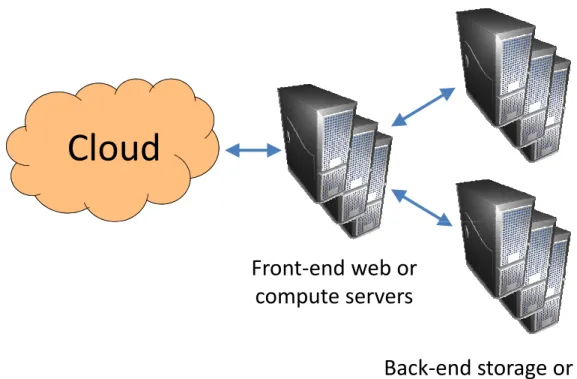
To handle workloads and application requests that vary over time, the ser-vice provider must be able to adjust the amount of resources used to provide the services. Figure 1.2 shows an example of a service system with two tiers, serv-ing application requests for composed services. We investigate how to efficiently provision such two-tier service systems in clouds in Chapter 3. An example of a two-tiered service system is a front-end web server that serves requests by query-ing a back-end database server. We analyze the system from the point of view of a service provider that offers multiple different types of composed services. As service demands fluctuate, the service provider needs to adjust the amount of resources used to provision the services, while taking into account the dependen-cies between the system tiers. To simplify the analysis of the two-tiered service system scenario, we assume homogeneous servers that can be turned on or off whenever necessary.
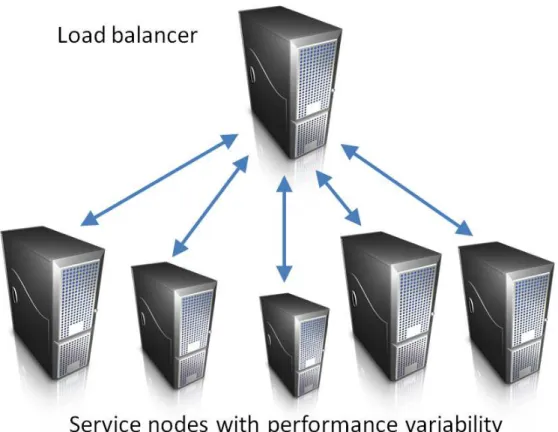
While the initial work is agnostic of the underlying platform and assumes that all replicas run on identical systems, the work described in Chapter 4 looks at how to optimize service provisioning in public clouds. To efficiently provide cloud computing services in public clouds, the cloud service providers co-locate multiple tenants on the heterogeneous hardware located in data centers around the globe. Figure 1.3 shows a scenario where multiple identical servers, in terms of specification and cost, are used to provision services on top of public cloud computing platforms. In practice e.g., the underlying hardware and co-located workloads, mean that the observed performance is not always identical. For a service provider providing services, this presents both challenges and
opportu-Cloud
Back-end storage or
database servers
Front-end web or
compute servers
Figure1.2. Servi e provisioning inmultiple tiers, e.g., front-end and ba k-end
nities. We investigate how a service provider can leverage the observed perfor-mance variability in order to achieve better perforperfor-mance, in terms of throughput capacity, at a lower cost. We simplify the problem by looking at systems with single-tiered services of multiple different service types. Another assumption that we make is that while the performance may be different for individual VMs provisioned on the public cloud platform, the performance of a VM does not vary over the observation period. The shorter the observation period, the more valid the assumption.
The analysis in Chapter 4 assumes that the performance variability among VMs with identical specifications is constant over time, and shows how to effec-tively take advantage of this. However, the observed performance variability in public cloud platforms may also vary over time, e.g., due to VM migrations, or varying system utilization of VMs co-located on the same physical machine. In Chapter 5 we first show the performance impact that co-located VMs can have on a VM running a wiki service, and thereafter attempt to take this temporal performance variability into account when deciding on how to provision services in the cloud. We model the system using a Markov-chain model, and further show that provisioning a system based on the observed average capacity fails to
Figure1.3. Servi e nodes with performan e variability
avoid tail performance degradation, which has an impact on the fulfillment of QoS promises.
While it is useful to be able to provision systems with QoS guarantees based on the throughput capacity, it is more common for interactive web services to have QoS SLAs written in terms of response times. Providing tail response time guarantees (e.g., the response time for 99.99% of requests must be below 2s), however, is a more complex problem to solve. In Chapter 6, we approach the problem using large deviation analysis and use an approximation scheme to ob-tain the tail response times, which are then used for provisioning decisions.
1.7 Contributions
This dissertation is based on several published and submitted pieces of work. The contributions regarding the provisioning of two-tier services in the cloud (Chapter 3) are threefold: (1) a model and analysis capturing many key features of two-tier service-oriented systems: time-varying workloads, execution
paral-lelism, and the inter-dependency between the two tiers; (2) a novel replication policy, simultaneously controlling the number of provisioned resources in the two interdependent tiers, based on monitored workload and performance met-rics; and (3) bounding analysis on effective and nominal utilization for resources in the first tier. This work was published in:
• Mathias Björkqvist, Lydia Y. Chen, and Walter Binder. Dynamic replication in service-oriented systems, Proceedings of the 2012 12th IEEE/ACM
Inter-national Symposium on Cluster, Cloud and Grid Computing (CCGrid), IEEE Computer Society, pp. 531-538.
The original scientific contribution of the work on leveraging performance variability for service provisioning in public clouds (Chapter 4) is a novel service replication policy, which is specially designed to explore the temporal variability of VM performance on public cloud platforms. Compared to replication poli-cies oblivious to the unique characteristics in public clouds, e.g., performance variability, pay-as-you-go billing periods, the proposed opportunistic replication policy is shown to achieve lower cost and better performance when optimizing not only for a single service type, but for a service providers entire set of resources provisioned in a public cloud. This work was published in:
• Mathias Björkqvist, Lydia Y. Chen, and Walter Binder. Opportunistic service provisioning in the cloud. Proceedings of the 2012 5th IEEE International
Conference on Cloud Computing (CLOUD), pp. 237-244.
The contributions related to providing throughput QoS guarantees for ser-vices provisioned in public clouds (Chapter 5) are twofold: (1) quantitative char-acterization of the capacity variability of a VM running a wiki service when co-located with another VM running various different workloads, and (2) a Markov-chain model to avoiding tail throughput performance degradation. Based on our experiments and model, a cluster of VMs can be properly dimensioned using appropriate VM configurations, such that the best trade-off between cost and throughput QoS fulfillment is achieved. This work was published in:
• Mathias Björkqvist, Sebastiano Spicuglia, Lydia Y. Chen, and Walter Binder. QoS-Aware Service VM Provisioning in Clouds: Experiences, Models, and Cost Analysis. Service-Oriented Computing, Springer, pp. 69-83.
In the work on optimizing for tail response times for services provisioned in public clouds (Chapter 6), the contributions can be summarized as follows: First,
the workload distribution is derived for hard-to-analyze systems that capture the key characteristics of today’s cloud systems, i.e., renewal arrivals, highly varying job sizes, Markov-modulated execution speeds, processor sharing, and round-robin load balancing. Second, an approximation scheme for the tail response times is developed, as these are one of the critical SLA parameters, and this is used to further optimize the cluster size.
During the course of the PhD studies, I was also involved in related work resulting in the following publications:
• Mathias Björkqvist, Lydia Y. Chen, Marko Vukoli´c, and Xi Zhang. Minimiz-ing Retrieval Latency for Content Cloud. ProceedMinimiz-ings of 2011 IEEE
INFO-COM. pp. 1080-1088.
• Mathias Björkqvist, Lydia Y. Chen, and Walter Binder. Optimizing service replication in clouds. Proceedings of 2011 Winter Simulation Conference. pp. 3312-3322.
• Mathias Björkqvist, Lydia Y. Chen, and Walter Binder. Cost-driven Service Provisioning in Hybrid Clouds. Proceedings of 2012 IEEE Service-Oriented
Computing and Applications (SOCA). pp. 1-8.
• Sebastiano Spicuglia, Mathias Björkqvist, Lydia Y. Chen, Giuseppe Serazzi, Walter Binder, and Evgenia Smirni. On load balancing: a mix-aware algo-rithm for heterogeneous systems. Proceedings of 2013 ACM/SPEC
Interna-tional Conference on Performance Engineering (ICPE). pp. 71-76.
• Robert Birke, Mathias Björkqvist, Lydia Y. Chen, Evgenia Smirni, and Ton Engbersen. (Big)data in a virtualized world: volume, velocity, and variety in cloud datacenters. Proceedings of 2014 USENIX Conference on File and
State of the Art
Related studies exist in all the different areas related to service provisioning in clouds. Section 2.1 explores work done regarding replication of service systems in clouds, data centers, or similar scenarios, and both atomic and composed ser-vices are addressed. Studies on service provisioning in public clouds in Sec-tion 2.2 deal with QoS, cost optimizaSec-tion, and the performance variability ob-served specifically in public clouds. Section 2.3 summarizes relates work in the field of modeling and optimizing for tail response times in clouds. Related studies in Section 2.4 cover most related aspects of load balancing of service systems.
2.1 Repli ation of Servi es in Clouds
The related work regarding replicated web services in the cloud context is mainly discussed in two contexts: fault tolerant services, and resource provisioning.
Fault-tolerant services: In order to provide highly dependable service-oriented
systems, various service replication framework and strategies have been devel-oped in different system scenarios. Many studies [Salas et al., 2006; Zheng and Lyu, 2008, 2009; Dustdar and Juszczyk, 2007] consider the replication of atomic services and do not address the issues of optimal number of replicas. Salas et al. [Salas et al., 2006] developed a replication framework, WS-Replication, which enables the deployment in a set of sites. In particular, WS-Replication respects web service autonomy and exclusively uses SOAP to interact across sites via WS-Multicast. Zheng and Lyu [Zheng and Lyu, 2008, 2009] compare different combinations of passive and active replication strategies, using their proposed evaluation framework. Their focus is on selecting a suitable replication strategy such that the performance threshold and failure threshold are met. Dustdar and Juszczyk [Dustdar and Juszczyk, 2007] studied service replication strategies on
mobile ad-hoc networks, whose topologies vary over time. They developed a passive replication strategy and validated it on a simulation prototype.
In contrast, You et al. [You et al., 2009] consider the replication for com-posed services. They replicate services that have the longest response time and deploy them on the nodes with maximum available capacity. Via simulation, their proposed strategy decreases the response time of composite service as well as balances the load. We consider both the replication of the composition execu-tion engine and the atomic services, and focus on deriving the optimal number of replicas for optimizing system resources and performances.
Resource efficient services: To design a scalable and cost-effective
service-oriented system, dynamic resource provisioning is very critical, especially when encountering time-varying workloads. A comparison of different web service provisioning architectures is presented in [Pautasso et al., 2008]. A number of studies[Chen et al., 2005; Lin et al., 2013] focus on a single tier web server sys-tem, whereas others[Singh et al., 2010; Zhang et al., 2008; Stewart et al., 2007] address tier web server systems. Resource provisioning strategies in multi-tier systems often consider each multi-tier independently from other multi-tiers. Petrucci et al. [Petrucci et al., 2011] implement a dynamic service provisioning policy to optimize power consumption on a heterogeneous cluster. While most provision-ing studies monitor the request rate, Sprovision-ingh et al. [Singh et al., 2010] monitors not only the request rate but also the mix of applications. Pautasso et al. [Pau-tasso et al., 2007] design an engine for autonomic resource provisioning that can dynamically reconfigure resources to different tasks as conditions change. The autonomic, self-optimizing replica placement module proposed by Serrano et al. [Serrano et al., 2008] dynamically places data copies on servers close to clients.
2.2 Provisioning of Servi es in Publi Clouds
Cloud computing is an emerging platform for commercial and scientific appli-cations, due to advantages in the pay-as-you-go business model and elasticity capacity provision. The services offered by public clouds are a good fit for ap-plications and services with growing or fluctuating demand, as the provisioned capacity can be adjusted based on workload observations or predictions.
To better understand how to best go about provisioning services and appli-cations in the cloud, many studies have looked at the replication aspect — how are replicated services best provisioned in the cloud, how are they migrated from existing systems, and what are the differences compared to local data centers or clouds. The observed performance variability has been investigated from many
points of view, such as architectural and platform differences, as well as the im-pact of co-located VMs. For deciding whether or not to move a system into the cloud, the actual migration from existing systems also needs to be taken into ac-count. Guaranteeing reliability and performance for services provisioned in the cloud is also not always straight-forward, and related studies also look at the QoS-aspects of such services.
Migrating services to the cloud: The focus of related studies regarding
migration of service-oriented applications from existing systems to the cloud is widely spread: From a summary of the practical experiences [Chauhan and Babar, 2011], to frameworks for automating and easing the migration process [Mietzner et al., 2009], and cost optimization [Trummer et al., 2010; Fehling et al., 2010]. Chauhan and Babar [Chauhan and Babar, 2011] report practical experiences of migrating an open source software framework, Hackystat, to the cloud. One of the key findings is that it is easier to migrate software systems consisting of stateless components to IaaS clouds.
Performance variability: Various studies [Kossmann et al., 2010; Jackson, Ramakrishnan, Runge and Thomas, 2010; Jackson, Ramakrishnan, Muriki, Canon, Cholia, Shalf, Wasserman and Wright, 2010; Ueda and Nakatani, 2010; Nurmi et al., 2009] present performance studies and report their experiences on migra-tion of various applicamigra-tions to commercial cloud platforms. A common observa-tion is the high variability in the quality of service. Kossmann et al. [Kossmann et al., 2010] present a comprehensive evaluation of database applications under different cloud architectures. They conclude that the cost and performance of the services vary significantly depending on the workload. Jackson et al. [Jack-son, Ramakrishnan, Muriki, Canon, Cholia, Shalf, Wasserman and Wright, 2010; Jackson, Ramakrishnan, Runge and Thomas, 2010] port various scientific ap-plications, such as SNFactory pipeline, to Amazon [EC2, 2014]. Their results show that the performance of EC2 is more variable and slower than non-cloud computing platforms, due to the limitation of interconnects on EC2. Ueda and Nakatani evaluate a wiki workload and Apache daytrader using two open-source cloud platforms, OpenNebula[OpenNebula, 2015] and Eucalyptus [Nurmi et al., 2009]. The two platforms give very different performance results, e.g., in terms of VM provisioning, response time, and throughput, compared to Amazon EC2.
Most existing studies on the performance variability of applications hosted in the cloud are based on empirical experiments, especially in terms of average and 95th percentile response time
[Xu et al., 2013; Schad et al., 2010], and aim to discover the root cause of such a phenomenon [Kossmann et al., 2010; Jack-son, Ramakrishnan, Runge and Thomas, 2010; Mao and Humphrey, 2012]. The observations made from cloud experiments are mainly based on a single type of
configuration and simple benchmarks. A few studies[Spicuglia et al., 2013; Xu et al., 2013; Schad et al., 2010] focus on multiple types of VM configurations and try to quantify the variability in their response times. Moreover, the variability in throughput is largely evaluated under a particular workload intensity, instead of using the maximum sustainable throughput, i.e., the capacity.
Reliability: Various service replication strategies have been developed and
evaluated for guaranteeing the reliability [Zheng and Lyu, 2009; Dustdar and Juszczyk, 2007] or performance under time-varying workloads [Chen et al., 2005; Lin et al., 2013; Singh et al., 2010; Stewart et al., 2007; Petrucci et al., 2011]. To deliver highly dependable service systems, Zheng and Lyu[Zheng and Lyu, 2009] compare different combinations of replication strategies, using their proposed evaluation framework. Their objective is to select a suitable strategy such that the performance threshold and failure threshold are met. Dustdar and Juszczyk [Dustdar and Juszczyk, 2007] developed a passive replication strategy on mobile ad-hoc networks, whose topologies vary over time, and validated it on a simu-lation prototype. As for workload driven replication strategy, both single-tier [Chen et al., 2005; Lin et al., 2013] and multiple-tier [Singh et al., 2010; Stew-art et al., 2007] web server systems in a non-cloud platform are well addressed. Petrucci et al. [Petrucci et al., 2011] implement a dynamic service provisioning policy to optimize power consumption on a heterogeneous cluster. While most provisioning studies monitor the request rate, Singh et al. [Singh et al., 2010] monitor not only the request rate but also the mix of applications.
Consistency: Data consistency is another aspect that becomes more relevant
in public clouds. There is often a non-trivial trade-off between cost, consistency, and availability [Kraska et al., 2009]. Weak consistency is often considered suf-ficient for applications deployed in public clouds[Fetai and Schuldt, 2012]. This weak consistency may result in increased operational costs, e.g., due to over-selling products in a web shop. On the other hand, providing stronger consis-tency comes at the expense of higher costs, both in performance and monetary terms. These aspects also need to be taken into account when deciding whether or not to deploy applications in the cloud.
QoS: Recent studies on QoS analysis for cloud services[Zheng et al., 2011;
Ye et al., 2012; Tsakalozos et al., 2011] are mainly driven by service composi-tions and service selection, using a Markovian decision process[Ramacher and Mönch, 2012] or a Baysian network model [Ye et al., 2012]. In contrast, studies focusing on constant QoS value, e.g., Zheng et al. [Zheng et al., 2011] proposed a calculation method to estimate the probabilistic distribution of QoS. Toffetti et al. [Toffetti et al., 2010] use Kriging surrogate models for approximating the performance profile of virtualized, multi-tier Web applications, including
analyz-ing collected data to diagnose potential SLA violations. However, the impact on the QoS due to the underlying performance variability of the cloud is to a large extent overlooked.
Reducing variability: Meanwhile, another set of studies focus on developing
solutions to reduce the performance variability in a best effort manner, from the perspective of service providers. Particularly, Farley et al. [Farley et al., 2012] propose opportunistically selecting VMs which have high capacity, while discard-ing VMs with low capacity. Another type of solution is to try to figure out the underlying hardware and neighboring workloads, so as to select similar physical hosts[Schad et al., 2010] and influence the neighboring VMs [Ristenpart et al., 2009]. As the methodology is trial and error, the QoS of the target application, e.g., the service availability, is not always guaranteed. Moreover, the cost analysis is over-simplified, without considering the performance variability. CopperEgg provides a tool [AWS Sizing Tool, 2014] that tracks your current system usage and recommends optimal Amazon EC2 instance sizes. Whether or not they take the observed variability of VMs into account is not clear, as it is not shown in any of the metrics in the product presentation.
2.3 Tail Response Times
In this section, we discuss the related work in two directions: the modeling work on predicting the tail response times for complex queueing systems that show a great resemblance to real systems, and the optimization work that tries to miti-gate the response time degradation due to exogenous variability in the cloud.
2.3.1 Modeling Tail Response Times
Given a vast amount of research on estimating the average response times, ob-taining the entire distribution of response times is no mean feat for non-Markovian systems, in terms of arrival and service processes. An example of this are M /G/1/PS queueing systems[Kleinrock, 1975; Gautam, 2012], which are widely adopted to model various computing systems executing highly varying job sizes with a fixed speed in a processor sharing discipline. The introduction of cloud computing pin-points another dimensionality of the modeling challenges, i.e., varying execution speed. The state-of-the-art deals with two causes of varying execution speeds: state-dependent and exogenous/environmental variability. The former [Gupta and Harchol-Balter, 2009; Rege and Sengupta, 1985; Zhang and Zwart, 2008] models the execution speed based on the current state of the system, i.e., the
combination of the number of jobs and the multiprogramming levels. The latter [Mahabhashyam and Gautam, 2005; Casale and Tribastone, 2013; Zhang and Zwart, 2012; Dorsman et al., 2013] models the transition of execution speeds as Markov-modulated speed for single queue and multiple queues.
In terms of the impact of arrival process, prior studies efficiently model the average response times of bursty workloads using a Markovian Arrival process [Casale et al., 2008; Sansottera et al., 2013], particularly for multi-tier appli-cations [Mi et al., 2008]. The Markov-modulated execution speed for single queues is discussed in [Gautam, 2012; Baykal-Gursoy and Duan, 2006; Boxma and Kurkova, 2001]. While both Zhou and Gans [Zhou and Gans, 1999], as well as Boxma and Kurkova[Boxma and Kurkova, 2001], study two execution speeds, they employ different assumptions on when the changes of execution speed take place, i.e., only after the completion of job execution and during the job execu-tion. Moreover, Boxma et al. consider an M /G/1 queue where the speed of the server alternates between two values with high speed periods having exponen-tial distribution and low speed periods having a general distribution. Another related article is one by Massey[Massey, 2002], where the author focuses on de-riving the queue process and the time-varying aspect, in particular an Mt/Mt/1
queueing system. In[Mahabhashyam and Gautam, 2005], the authors general-ize the execution speed to any Markov process, and also the tail distribution of the workload in steady state. However, all the aforementioned analysis requires the arrival process to be Markovian.
There are a few studies that consider multiple queues with Markovian-modu-lated speeds. Dorsman et al. [Dorsman et al., 2013] obtain the heavy-traffic ap-proximation for a steady distribution of workloads, queue lengths, and response times for parallel queueing networks with Markov-modulated service speeds, by combining a functional central limit theorem approach and matrix-analytic meth-ods. However, the impact of different traffic intensities and renewal arrivals are not considered there. To efficiently approximate the mean performance indexes, i.e., throughput and response time, Casale et al. [Casale and Tribastone, 2013] propose a generalized blending algorithm to model any number of execution speeds experienced by servers in the cloud. They are based on solving the or-dinary differential[Kurtz, 1970] that defines an approximate transient analysis method for queueing network models. Their approach is limited to queueing networks with Markovian arrivals and Coxian jobs size distribution.
To the best of our knowledge, the tail distribution of response times of many queue scenarios with execution speed modulated according to exogenous envi-ronmental processes and renewal arrivals are yet to be explored.
2.3.2 Optimizing for Tail Response Times in Cloud
Recognizing the importance and challenges of mitigating the performance vari-ability in cloud computing, various reactive and proactive optimization strategies have been proposed. The reactive strategies center on obtaining a set of VMs that are of the same configurations but provide better performance, i.e., faster execution speed. To such an end, Farley et al. [Farley et al., 2012] use testbed ex-periments whereas Björkqvist et al. [Björkqvist et al., 2012] leverage simulation. Krebs et al.[Krebs et al., 2014] quantify the performance isolation of cloud-based systems using different metrics. Kraft et al.[Kraft et al., 2011] model the impact of workload consolidation on VM disk IO response times. Schad et al. [Schad et al., 2010] focus on the exogenous variability resulting from the underlying heterogeneous hardware and develop strategies to select VMs that are hosted on the same platform as to reduce the variability of the execution speeds. As for proactively mitigating the performance degradation, Björkqvist et al. [Björkqvist et al., 2013] leverage a continuous Markovian model to capture the distribution of tail throughput and further optimize the cloud cluster that fulfills the target tail throughput at minimal cost. Sansottera et al. [Sansottera et al., 2012] provide a consolidated model that considers power, performance and reliability aspects when estimating the impact of hardware virtualization on the operational cost and performance of data centers. The model developed by Casale et al. [Casale and Tribastone, 2013] is meant to enable efficient exploration of the decision space for cloud deployments, but with focus on the average performance index. In summary, the optimization strategies for tail response times fall short in providing SLA guarantees, i.e., they only promise best effort. Our study adopts the proactive approach to model various important aspects of cloud clusters and further optimize the cluster size so that the tail response times specified in SLAs are statistically guaranteed.
2.4 Load Balan ing of Servi e Clusters
The related work in the area of load balancing of service clusters can be divided into two areas: composed and atomic services. Composed services deal with scenarios where a single client invocation of a composed service leads to an ex-ecution of one or more exex-ecutions of other services that provide functionality necessary for being able to complete the composed service. The order and num-ber of times each individual service is executed depends on the composed service request. In studies on load balancing of composed services, the binding of
ser-vice replicas is one of the key issues investigated. For atomic serser-vices, the related work mainly focuses on how to distribute load between service replicas that are, for the most part, functionally equivalent. More specifically, addressed issues in-clude heterogeneous hardware, separating incoming requests based on param-eters such as the size, and to what degree the time-varying aspect of incoming requests is taken into account.
2.4.1 Load Balan ing of Atomi Servi es
There is a large body of related studies of load balancing for various conventional service systems[Cardellini et al., 1999; Cherkasova and Ponnekanti, 2000; Riska et al., 2002; Zhang et al., 2005] and modern cloud systems [Dejun et al., 2011]. Cardellini et al. [Cardellini et al., 1999] qualitatively classified existing load balancing schemes at web server systems into four approaches, namely client-based, DNS-client-based, dispatcher-client-based, and server-based. Cherkasova and Pon-nekanti [Cherkasova and Ponnekanti, 2000] developed FLEX, a locality-aware load balancing solution, especially for efficient memory usage. Riska et al. [Riska et al., 2002] proposed a load balancing scheme where incoming requests are sent to replicated server back-ends based on the request size. Zhang et al. [Zhang et al., 2005] expands on the earlier work [Riska et al., 2002]. Dejun et al. [Dejun et al., 2011] benchmark individual VMs obtained from cloud providers such as Amazon[EC2, 2014]. This information is then used to both balance the load within a tier (e.g., front-end or database), as well as to decide which tier a new VM is best suited for. Singh et al. [Singh et al., 2010] leveraged the idea of application mixes and proposed a mix-aware resource allocation for data centers. Most of the aforementioned studies focus on balancing loads on homogeneous servers with a single resource type, i.e., CPU.
2.4.2 Load Balan ing of Composed Servi es
There is also a substantial amount of work done in the field of dynamic binding of composition execution engines and on scheduling algorithms. Most of the related work in the area addresses dynamic binding for compositions expressed in BPEL, that is, for business processes, since BPEL is a de facto standard and there are many implementations of BPEL engines. While BPEL supports dynamic binding by partner link assignment, it is neither possible to add new services at runtime, nor to change the service selection algorithm at runtime. Furthermore, in BPEL, dynamic binding is coupled with process business logic.
VieDAME[Moser et al., 2008] is a service monitoring and selection system based on aspect-oriented programming that intercepts SOAP messages and is able to dynamically replace services used in a business process. Dynamo[Baresi et al., 2007] relies on an aspect-oriented engine extension of ActiveBPEL engine to support monitoring and failure recovery. RobustBPEL2[Ezenwoye and Sad-jadi, 2008] provides dynamic binding with proxies. An approach to optimize system performance, taking hardware resources into account, is presented in [Zhang et al., 2007]. In [Mosincat and Binder, 2009], BPEL processes are au-tomatically transformed to interact with a separate system that handles dynamic binding. Lottery scheduling in operating systems is presented in [Waldspurger and Weihl, 1994].
Provisioning of Two-tier Servi es in the Cloud
Service-oriented systems, consisting of atomic back-end services utilized by front-end servers to provide composed services, are commonly deployed to deliver web applications. As the workloads of applications fluctuate over time, it is economi-cal to autonomously and dynamieconomi-cally adjust system capacity, i.e., the number of replicas for back-end and front-end services. In this chapter, we propose a novel replica provisioning policy which adjusts the number of front-end and back-end service replicas periodically based on the predicted workloads, such that all repli-cas are well utilized at the target values. In particular, our proposed replica provi-sioning policy models the workload balance and dependency between front-end and back-end service replicas by estimating the probability that threads of front-end replicas are not blocked by I/O. Moreover, we derive the analytical bounds of effective front-end replica utilization and illustrate the cause of low nominal utilization at front-end replicas. We evaluate our proposed replica provision-ing policy on a simulated service-oriented system, which hosts front-end and back-end service replicas on multi-threaded servers. The evaluated workload is derived from utilization traces collected from production systems. Through sim-ulation, we demonstrate that our proposed replica provisioning policy effectively reduces the number of required replicas, while maintaining target utilization and lowering the response times of requests.
Our proposed replica provisioning policy dynamically adjusts the number of front-end and back-end service replicas periodically in slotted control windows. The workload and performance statistics are monitored in a control window of predefined length, and our replica provisioning policy aims to maintain the target utilization of the front-end and back-end service replicas by using the obtained
measurement data to adjust the number of service replicas. In particular, we esti-mate the nominal and effective utilization of front-end service replicas, which ex-plicitly factors in inter-dependency among front-end and back-end service repli-cas using the derived non-blocking probability at front-end service replirepli-cas. Our simulation results show that our proposed replica provisioning achieves cost-effective provisioning of replicas, whose cost-effective utilization is well maintained at the target value, and which deliver satisfactory end-to-end response time.
The contributions of this chapter are threefold; first, our model and analy-sis of two-tier service-oriented systems capture many key features: time-varying workloads, parallelism of replicas, i.e., thread pools, and the dependency be-tween front-end and back-end service replicas. Second, we develop a novel repli-cation manager, which considers the aforementioned features and dynamically controls front-end and back-end service replicas based on the monitored work-load and performance metrics. Third, we provide bounding analysis on effective and nominal utilization for front-end service replicas, which essentially need to be kept less utilized than the back-end service replicas by a factor of the non-blocking probability of the front-end service replica threads.
This chapter is organized as follows: The system architecture is explained in Section 3.1. The service replication manager and service selection policy are described in Section 3.2 and Section 3.3, respectively. Section 3.4 contains the experimental results. The assumptions and limitations of this work are detailed in Section 3.5, and Section 3.6 summarizes the chapter.
3.1 System Model
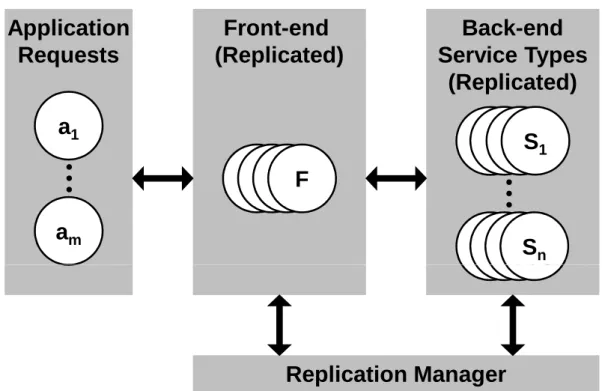
In this chapter we consider a service-oriented system as depicted in Figure 3.1.
Composed services, built using one or more atomic back-end services, are de-ployed and provided by the front-end servers and exposed through service in-terfaces to various client applications. When a service composition is invoked by a client, the front-end creates an instance of the composition and executes it. During the execution, atomic back-end services are invoked. We assume a ser-vice provider that hosts both the serser-vice compositions (in a front-end) and the atomic back-end services that are invoked when compositions are executed. We assume that client do not directly invoke the atomic back-end services; clients only invoke the exposed service compositions. In our model, both the front-end and back-end services can be replicated.
Front-end
(Replicated)
Back-end
Service Types
(Replicated)
S1
Sn
Application
Requests
a
1a
mS1
S1
S
1Sn
Sn
S
nF
Replication Manager
Figure 3.1. Ar hite ture overview
3.1.1 Client Requests and Composite Servi es
For each service composition deployed in the front-end, we assume that the client requests generated from different applications may consist of disparate service compositions and have different workload characteristics (i.e., time-varying ar-rival rates). Here we consider only sequential service compositions where atomic back-end services are invoked in a given order. Here we do not model different workflow patterns[van Der Aalst et al., 2003] such as parallel split. For example, consider a system with two types of atomic back-end services, denoted by S1and
S2. Two possible service compositions are 〈S1, S2〉 and 〈S2, S2〉. For the first
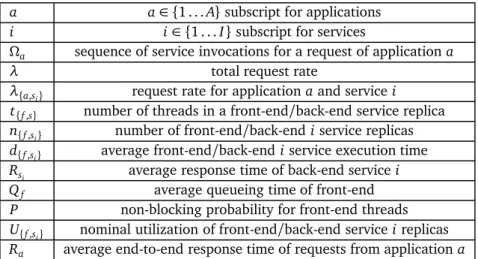
com-position, S1 is first invoked and then S2, whereas in the second composition, S2 is invoked twice consecutively. Each service composition corresponds to an ap-plication a, and Ωadenotes the sequence of service invocations for application a.
For the two examples above, Ωa=〈S1, S2〉, respectively Ωa=〈S2, S2〉.
3.1.2 Atomi Ba k-end Servi es
The system hosts I types of atomic back-end services, subscripted by i ∈ {1 . . . I}. There may be multiple replicas, nsi, for each service type. All service types are
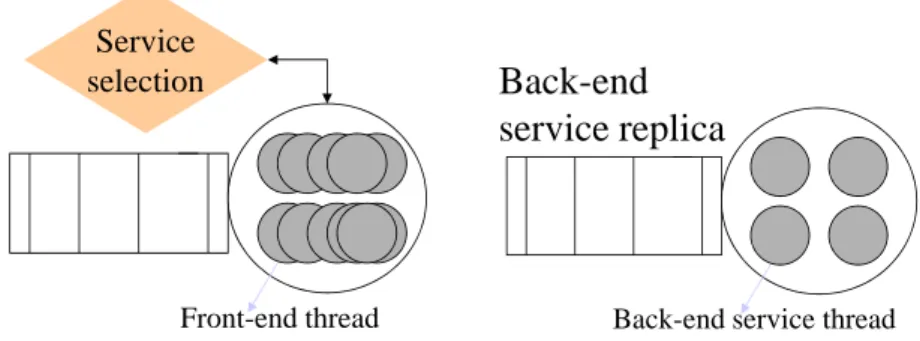
considered stateless, i.e., for each invocation of an atomic back-end service by a front-end replica, a different replica may be bound. Each back-end replica has a queue for incoming requests (i.e., service invocations by the front-end) and maintains a thread-pool of fixed size, tsi, for processing these requests.
Concur-rent service invocations can be processed in parallel as long as there are threads available, i.e., sequential code sections in service replicas are not modeled.
We model each back-end service replica as a queueing system with one queue and multiple servers, each of which represents a single core/thread. An active replica processes service invocation requests sent by a front-end replica in a first come, first served (FCFS) manner, and the service i execution time per thread is a random variable with mean dsi. The response time of a service invocation is
the sum of the queueing time and the execution time. We denote the average response time of service i by Rsi.
3.1.3 Front-end Servi e Repli as
There are nf front-end replicas, each of which is a distributed queueing system.
A front-end replica queues incoming client requests that are then processed in a FCFS order. We let the average queueing time at a front-end replica be Qf. The
front-end replica has a thread-pool of fixed size, tf, for executing client requests in a parallel fashion. Each front-end replica thread processes one request after the other, executing the corresponding service composition. For an invocation of service i, each thread selects a replica of service i, according to a load bal-ancing scheme. The average execution time for a front-end replica to process a service invocation is assumed df. The invocations of atomic back-end services
are handled using blocking I/O: a single thread is used for the entire execution of an instance of a service composition, and this thread will block while wait-ing for the results of invoked atomic back-end services. Since each instance of a service composition is executed sequentially by a single thread, we model only sequential compositions.
3.1.4 Repli ation Manager
The replication manager determines the number of front-end replicas, nf(t), and
the number of back-end service replicas for each service type, nsi(t), in discrete time windows of fixed length. We assume that each replica is deployed on a separate machine (i.e., resource contention between replicas on the same node need not be considered in this simplified model). In total, the provider has N machines to host all replicas. For all the windows, nf(t) +Pinsi(t) ≤ N . The