HAL Id: hal-02550835
https://hal.archives-ouvertes.fr/hal-02550835
Submitted on 28 Aug 2020
HAL is a multi-disciplinary open access
archive for the deposit and dissemination of
sci-entific research documents, whether they are
pub-lished or not. The documents may come from
teaching and research institutions in France or
abroad, or from public or private research centers.
L’archive ouverte pluridisciplinaire HAL, est
destinée au dépôt et à la diffusion de documents
scientifiques de niveau recherche, publiés ou non,
émanant des établissements d’enseignement et de
recherche français ou étrangers, des laboratoires
publics ou privés.
Self-consistent quasi-static parallel electric field
associated with substorm growth phase
O. Le Contel, R. Pellat, A. Roux
To cite this version:
O. Le Contel, R. Pellat, A. Roux. Self-consistent quasi-static parallel electric field associated with
substorm growth phase.
Journal of Geophysical Research Space Physics, American Geophysical
Union/Wiley, 2000, 105 (A6), pp.12945-12954. �10.1029/1999JA900499�. �hal-02550835�
JOURNAL OF GEOPHYSICAL RESEARCH, VOL. 105, NO. A6, PAGES 12,945-12,954, JUNE 1, 2000
Self-consistent quasi-static parallel electric field
associated with substorm growth phase
O. Le Contel
Centre d'Etude des Environnements Terrestre et Planetaires, Vdizy, France
R. Pellet
Centre de Physique Th•orique, Ecole Polytechnique, Palaiseau, France
A. Roux
Centre d'Etude des Environnements Terrestre et Planetaires, Vdizy, France
Abstract. A new approach
is proposed
to calculate
the self-consistent
parallel
electric field associated
with the response
of a plasma to quasi-static
electromagnetic
perturbations
(co
< kllVA,
where
vn is the Alfv•n
velocity
and kll the parallel
component
of the wave vector). Calculations
are carried out in the case of
mirror
geometry,
for co < coo
(coo
being
the particle
bounce
frequency).
For the
sake of simplification
the 3 of the plasma
is assumed
to be small. Apart from this
restriction,
the full Vlasov-Maxwell
system
of equations
has been solved
within the
constraints
described
above
(co
< kllVA
and
co
< coo)
by [Le Contel
et al., this
issue]
(LC00,
hereafter),
who describe
self-consistently
the radial
transport
of particles
during
the substorm
growth
phase.
LC00 used
an expansion
in the small
parameter
T•/T• (T•/T• is typically
0.1 to 0.2 in the plasma
sheet)
to solve
the quasi-neutrality
condition
(QNC). To the lowest
order
in T•/T• < 1, they found
that the QNC implies
(1) the existence
of a global
electrostatic
potential
(k0 which
strongly
modifies
the
perpendicular
transport
of the plasma
and (2) the parallel
electric
field vanishes.
In the present
study, we solve
the QNC to the next order in T•/Ti and show
that
a field-aligned
potential
drop proportional
to T•/Ti does develop. We compute
explicitly this potential drop in the case of the substorm
growth phase
modeled
as in LC00. This potential drop has been calculated
analytically for two regimes
of parameters,
cod
< co and w• > co (•-j being the bounce
averaged
magnetic
drift
frequency
equal
to ky•-•,
where
ky is the wave
number
in the y direction
and •-• the
bounce
averaged
magnetic
drift velocity).
The first regime
(•-j < co)
corresponds
to
small
particle
energy
and/or small
ky, while
the second
regime
(•-j > co)
is adapted
to large
energies
and/or large
ky. In particular,
in the limit co•
< co
and Iv•l <
where
uv is the diamagnetic
velocity
proportional
to the pressure
gradient,
we find
a parallel electric
field proportional
to the pressure
gradient
and directed
toward
the ionosphere
in the dusk sector
and toward the equator
in the dawn sector. This
parallel electric
field corresponds
to a potential
drop of a few hundred
volts that
can accelerate
electrons
and produce a differential drift between
electrons
and ions.
1. Introduction
A proper description of the transport of the plasma during the growth phase is a prerequisite to the un- derstanding of what triggers substorm breakup. Yet, in a mirror geometry like the Earth's magnetosphere,
there are serious difficulties when the frequency co of the
magnetic field variations is lower than the bounce fre-
Copyright 2000 by the American Geophysical Union.
Paper number 1999JA900499.
0148-0227/00 / 1999J A900499 $ 09.00
quency
of the particles
cot
(see,
for instance,
Rosenbluth
and Varma
[1967],
Rutherford
and Frieman
[1968],
An-
tonsen
and Lane [1980],
and Hurricane
et al. [1994]).
A new kinetic formalism has been developed by Pel-
latet al. [1994]
to describe
the time-dependent
trans-
port associated
with low-frequency
electrostatic
pertur-
bations
for
a plasma
confined
in a multipole-type
config-
uration. Hurricane et al. [1995] extended this formalism to electromagnetic perturbations, satisfying co > co,, •d
(co, being the diamagnetic
drift frequency
and •-• be-
ing the bounce
averaged
curvature-gradient
magnetic
drift frequency), with the purpose of describing insta-
12,946 LE CONTEL ET AL.: SELF-CONSISTENT QUASI-STATIC PARALLEL ELECTRIC FIELD
bilities that could develop in the far tail. In all cases
[Pellat et al., 1994; Hurricane et al., 1995; Le Contel et al., this issue, hereinafter referred to as LC00], the
solution of Vlasov and quasi-neutrality equations was
shown to contain a new contribution to the perturbed electrostatic potential. This new term is constant on a
given magnetic field line but varies across the magnetic field. It develops in response to an externally applied perturbation. Using an expansion in the small parame-
ter Te/Ti (Te/• being the ratio between the electronic and ionic temperatures), LC00 calculated explicitly this
potential without any assumption on the frequency of the perturbations. LC00 showed that the electrostatic
field (corresponding to the new contribution of the per- turbed electrostatic potential) tends to reduce/shield
the inductive part of the electric field. Owing to this partial shielding, the azimuthal electric field is expected to be small during the growth phase, a situation that corresponds to observations. This electrostatic poten- tial cannot be obtained from MHD and requires a ki-
netic approach. Thus the perpendicular transport of the
plasma, for the conditions prevailing during the growth phase, can be interpreted as the response of the plasma to quasi-static perturbations when the QNC is enforced. In the particular case of the magnetic field variations during the substorm growth phase, LC00 found that the azimuthal electric field changes direction with latitude; it is directed eastward close to the magnetic equator, whereas off-equator it is directed westward. Finally, LC00 showed that enforcing the QNC implies there is no field aligned potential drop to the lowest order in In the present paper, we further develop this ap- proach by considering the terms of the order T•/Ti in the expansion of the QNC. The main purpose is to ex-
amine whether the parallel electric field remains null to
the order T•/Ti in the case of a time-dependent trans-
port, for quasi-static
conditions
w < kllVA
(kll being
the
parallel component of the wave vector and vA being the
Alfvdn velocity), w < wb and kxp < 1 (kx being the per-
pendicular component of the wave vector and p the Lar-
mor radius of the particles). During substorms, there
are some strong, though indirect evidences, for paral- lel electric fields. In particular, large potential drops
have been found above the auroral ionosphere within
an altitude range of 5000-15,000 km, causing energiza- tion of the electrons responsible for the aurorae. In this region the parallel electric field may be very large.
Other locations, where parallel electric fields are ex-
pected, are reconnection regions and current disruption
regions. An indirect evidence is provided by electron
beams observed near the magnetic equator during and
after substorm breakup [Mcllwain, 1975; Parks et al., 1977]. The above examples show that parallel electric
fields are often present, but these examples correspond
to extreme situations where the integrated parallel elec-
tric field (Ell = -Vii(I)- OAii/Ot,
where
(I) is the elec-
trostatic
potential,
All is the parallel
component
of the
magnetic vector potential, and t is the time) is so large
that the variation in the electron energy is of the order
of, or exceeds, their thermal energy (a few keV). In the
present paper we limit ourselves to a simpler situation
where the potential drop is less than the electron ther-
mal energy, which allows a linearization of the problem. Such small field-aligned potential drops corresponding to relatively quiet periods are likely to occur in the tail as suggested by recent observations of low-energy elec-
tron beams (100-300 eV) during a dusk-dawn crossing of the near-Earth magnetotail (10 RE, RE being the Earth radius) by Geotail [Frank et al., 1996]. Also, for the sake
of simplification, we do not take into account the effect of the ionosphere; the low-altitude electric fields are not
described. Yet we show that the quasi-neutrality of the
plasma implies the existence of a parallel electric field, even in the linear regime; a situation which is likely to occur during substorm growth phase as previously
noted by Koskinen et al. [1996]. In the present paper,
we use the solution of Amp•re's law obtained in LC00 to
describe the stretching of the magnetic field lines dur- ing the growth phase and solve the QNC to the next
order in (T•/Ti), this is done in section 2. The par-
allel electric field is calculated analytically for various
parameter regimes in section 3. Finally, in section 4 we discuss which regime is well adapted to the character- istic conditions of the substorm growth phase.
2. Quasi-neutrality
Condition
For long perpendicular wavelength electromagnetic
perturbations
(k_l_,•D
<< 1 where
/•D ---•
V/eokBT/(noq
2)
is the Debye length, e0 is the vacuum permittivity, kB
the Bolztmann constant, T the temperature, no the
density, and q the charge of particles), the Gauss's
equation reduces to a local charge neutrality condition. LC00 showed that after a gyrophase integration, sum- mation over streaming and antistreaming particles, with
the usual wavelength ordering kxpj < I (pj being the Larmor radius of the particles of species j), with the gauge SAy - 0 and in the limit T• < T/, the QNC can
be written as
where foj is the equilibrium distribution function of species j (j = i, e), assumed to be a Maxwellian distri-
bution
function
( foj - noj
[mj
/(27rTj
)]a/2
exp
-(E/Tj ) ).
The temperature and mass are noted Tj, rnj, respec-
tively.
The
variable
• is defined
by • - i• ft dl•SAill,
co•i: kyUyi is the ion diamagnetic drift frequency where uy is the diamagnetic drift velocity and ky is the wave
LE CONTEL ET AL.' SELF-CONSISTENT QUASI-STATIC PARALLEL ELECTRIC FIELD 12,947
number in the y direction (azimuthal), coal = kuVdi
is the ion gradient-curvature magnetic drift frequency where vai is the ion magnetic drift velocity. The inte- gral over velocity space has been written in local field-
aligned
cylindrical
coordinates:
day = 4rrBdEdlu/(rn
2
•rnv•
+ •B is the kinetic
energy
I
where
E - •
and •- •mv•/B is the magnetic
moment.
We have
assumed that the electromagnetic perturbation is peri-odic in time and in space (across the magnetic field)
ß
exp
[i(•. •+wt)]. (2)
For simplicity, the hat symbol and the exponential
tot have been omitted. The bar in (1) indicates bounce averaging. The hnction Ei is defined by Ei: wdi•/w
i•SBii/qi. LC00 showed
that the quasi-neutrality
of
the flux tube requires the existence of a new contribu- tion, •0, of the perturbed electrostatic potential which
is constant for a given magnetic field line (but varies across the equilibrium magnetic field). This potential
is calculated selLconsistently from the magnetic field
variations and is given by (14) in LC00. This potential
strongly modifies the transport of the plasma; namely, it reduces the effect of the inductive component of the perpendicular electric field. Furthermore, LC00 showed
that the parallel electric field vanishes to the lowest or-
der in T•/•.
To determine the field-aligned potential drop which
can exist to the first order in (Tell), we have to solve the QNC to this order. Thus, in this case, 5•(l)+2(l) •0 +5•(l), where 5•(1) is a first-order term proportional to (Tell). Equation (1) becomes
f 4•BdEd• _ T• 4•BdEd•
(• + •) • + •i
Provided that c0 < cob, (3) is valid for any quasi-static
or low-frequency perturbations. Thus a parallel electric field will be present in response to electromagnetic per- turbations applied in a mirror geometry like the near- Earth magnetic tail. Therefore parallel electric fields
should exist not only during active periods (breakup) or at low altitudes (inverted V) but also during rela-
tively quiet periods such as the substorm growth phase, as will be seen in the next sections. Unfortunately, it is not possible to find a general analytical solution of the
integral equation (3) except when ions and electrons
are stochastic. In such a case, it can be shown that
the right-hand side (RHS) of (3) cancels exactly due to
fast pitch-angle scattering on the two species. There- fore there is no parallel electric field for a completely stochastic plasma.
It will be shown in the next section that an analyti- cal solution can be obtained for the region close to the
Earth. In this region, electrons and ions are in an adia- batic regime and the fi of the plasma can be assumed to be small therefore the local currents can be neglected. Thus the magnetic field line stretching can be mod- eled as the effect of a forcing current located farther in the tail on the quasi-dipolar equilibrium magnetic
field (see LC00 for more details). We show that a self-
consistent parallel electric field, developing in response to the quasi-static change of the magnetic field lines, can
be calculated in the near-Earth plasma sheet (NEPS). Using the two-dimensional (2-D) dipole [Huang and Birmingham, 1994] to describe the equilibrium mag-
netic field close to the Earth, LC00 solved Amp•re's law in the quasi-static limit with an external forcing current given by
•jext(L,
ky, O,
co)
= •jeq(ky,
co)•(L
- Lc) sin
2n
0
ß [(2n + 1)cot20- 1], (4)
where 0 is the colatitude, L is the equatorial crossing distance of the relevant field line, Lc is the radial loca-tion of the forcing current, n determines the degree of
localization
near the magnetic
equator,
and 5j,q(ky, co)
is the Fourier transform of the current. The time vari-
ation and the dependence along the y direction of the real electrical current have been chosen to correspond to
observations carried out during the growth phase (see LC00 for a more detailed discussion):
5j•q(y,
t) -- •
do: dkySj•q(ky,
co)
ß
exp [i (kyy + wt)l
y2
= 8j,•
exp(-•)exp(3,t).
(5)
In the limit IklZ > 1 and Iky(L- Lc)l < 1, they ob-
tained for A
Ar•(L,
ku,O,
co)
•0 Ar•eq
[Cr•(L,
ku)
+ (sin
2 0)•+•] ,
(6)
where we have defined
Cr•(L,
ku)= (n + 1)!/(-[kv(L-
L•)I) "+• and
A, eq
=
ß
L•L. The other component
of the perturbed
magnetic
field is given by
t_toSj•q(ky,co)
L•
sin2•
O
[(2n
+ 1)
dBII
- -
2
L
- (2n
+
2)sin
2
0]
{H(L-
L•)-
H
[-(L
- L•)]),
(7)
where H denotes the Heaviside function. The nonlocal bounce-averaged terms at the RHS of (3) have been computed in LC00 (see Appendix B):.(1
r•+•
i•C
• (2k-
1)!!
12,948 LE CONTEL ET AL.' SELF-CONSISTENT QUASI-STATIC PARALLEL ELECTRIC FIELD
•o --(c,• q- &•)A,•eq,
(9)
where Sr• is defined by•+•
(2•-
s,,
-
+
•(-•)•G2•-•(/+•)•
•+ (j+2) ' (•0)
j=0 'LC00
showed
that in the limit [ky[L
> 1 1•5Bll/q
<
waX/w; therefore we take
•a zll / q -• O
.
( • • )
In the next section, we solve the QNC to the next order
in (Te/T•) and give explicit analytical
expressions
for
the field-aligned potential variation.
3. Self-consistent Parallel Electric Field 3.1. General Case
Equation
(3) defines
the solution
to the order
T•/Ti
of the QNC, in response
to a perturbation
defined
by
(6), (7), and (9). Taking
into account
(8) and (11), M,
the RHS term of (3), becomes
M_
T•
•
/ 4•rBdEdl
lvll
I foi • (w
• [W
(Wdi--W*i)]
4-
Wai)
"+• (2/•-
1)•
s. - 2
+ 2),,)
E 1
+ k•Beq
E•neq.
(12)
Remembering
that for a 2-D dipole,
the bounce-averaged
curvature-gradient magnetic drift frequency does not depend on the magnetic moment •, the first term be-
tween
brackets
of the expression
of M in (12) is also
independent
of •. Therefore
the • integration
in (12)
can easily
be performed
thanks
to the relation
(D2) of
LC00. We obtain
M - noiKi (•n - 2•n)
where ]•i is defined by
Ki-
Te
1 / 4•r¾2mi
and R,, by EdE fog (•3)w(w+Tai)
' (lq)
LC00 have shown that, basically, the transport depends very little on n. The only change introduced by modif-
ing n is the degree of localization, close to the equator.
For larger n the perturbation is localized closer to the magnetic equator and therefore the properties of the
transport also change more rapidly along the field line. For simplicity, in the following calculations, we fix the value of n to zero. We consider a Fourier decomposition
of 50 with respect to the colatitude 0'
5'•
- • (ap
cosp0
+ bpsinpO)
.
(16)
p=l
The term p = 0 is not included because the structure
of the left-hand
side (LHS) of (3), (X- •), leads
to
the cancellation of any constant term. Thus the first
nonzero terms begin for p = 1. The RHS term, M, can
be written as a function
of cos
pO;
for n = 0 it is simply
given by
1 1
1 ]
M - noiKi
• + • cos
20
- 6-•
cos
40 Aocq.
(•7)
We notice
that (1) the RHS of (17) contains
only even
powers
of cos
pO,
and (2) the highest
value
ofp in (17) is
4; higher harmonics vanish. We therefore assume that
•0 only contains
terms
in cos
20 and cos
40; an assump-
tion that will be verified later, therefore the solution obtained from this expansion is exact. With this ex-
pansion the field-aligned perturbed potential •5 writes
2
5'-•
-- • a,t
cos
210.
(18)
/--1
The bounce average value of 5•5 is
(•'•--
11Beq
E[a2q-2a4
(1 311Beq)]
2 E ' (19)The remaining
double
integral,
in the LHS of (3), can
be calculated
from (D2) of LC00 and by taking into
account the following identity'
oo
Eu-1/2e
-E/•'dE
2• (2k- 1)!!
, (k>_ 1). (20)Combining
(18), (19), and (20), one gets
4rrBdEdlt
foe•'•--õno•-•-
2 Beq
ß a•+•a4 •-a4
. (•1)
With the help of the simple
relation
B•q/B - sine• -
(1- •ose0)/e, t• •xp•ssion (el) •om•s
LE CONTEL ET AL.' SELF-CONSISTENT QUASI-STATIC PARALLEL ELECTRIC FIELD 12,949
1 1
4•rBdEdl.
t foe•'•
- -hoe a:2
+
õ
cos20
--•a2
+ •a4 + cos40
remembering that 5• + A - •0 + 5•5, where •0 is inde- pendent of 1 and that dl- -Ldt), we obtain
]
1 0 •-' 1 e'
a4 . (22)
5Eli-
•-•(5c))-
•ICi (t)),
(32)
We notice that the first two even terms in cos pt) consid- ered in the Fourier series do not provide terms in sin nor terms in cos pt) with p odd, nor terms in cos pt) with
p _> 4. Thus the higher-order terms (p > 4), which
have not been considered in the above expansion, are solution of the following system of equations'
- 0,
(23)
p
where Xp - bp, a2/+l, a2l. A trivial solution is
(24)
b - 0 (vp),
- 0 (vt),
0 (t > 2).
It was therefore justified to neglect terms with p > 4 as
well as terms in sin pt) and cos pt) (p being odd). There- fore (17) and (22) allo•v us to write (3), as a function of
cos 2t) and cos 4t), in the following form:
n0e
a:2
cos
2t)
q-
a4
cos
40
+ •a:2
q-
•a4
q-cos2t)
--•a2
q- •--•a4
+cos4t)
--•a4
-- noii¾i
ß •-•+cos2t)
l• q-cos40
-•-• .
Taking n0• - n0i at the equilibrium, (25), which shouldbe satisfied for any value of t), is equivalent to a system
of three equations: 1 1 1 2 2 1 -a2 q- a4 -- ICi (27) a ' 4 1
•a4 -- -- •-•ti'i.
(28)
Finally, from (27) and (28), we find immediately: a4:-Ki/48 and a2 = 5Ki/48. Equation
(26) is then iden-
tically verified. The perturbed electrostatic potential,
obtained from the QNC to the first order in (T•/Ti), is
therefore
50- Kie(O), (29) where we have defined the function e(0) - A2 cos 20 + A4 cos40, with A2 - 5/48 and A4 - -1/60. The par-
allel electric field is given by
0A Ol' (30) (31)
0 (ao)- 0 (aA)
azl--57
05Ell-
-• (•o
- A
+ •"•)
where e'(t)) is the derivative of e(0) with respect to
0. We have also performed the calculation for n - 2
and, in Figure 1, we plot the functions e(0) and e'(0)
for these two values of n. As already mentioned, the results depend little upon n. Indeed, we note that
whatever the value of n, e'(0) goes to zero at the
equator and has two symmetrical extrema off-equator.
The parallel electric field, hmvever, is more localized
as n increasesß In the following discussion, we will as- sume that we are located in the Northern Hemisphere
(0 _< 0 _< •r/2 • e'(0) < 0). To go further and
perform the energy integration, we need to simplify the term between brackets intervening in the expression
(14) of Ki. We consider successively two extreme cases
for which we are able to compute completely the par-
allel electric field. First, in subsection 3.2, we assume
that the curvature-gradient magnetic drift frequency is
smaller than the frequency of the perturbation. Since
W• - ky•--•, where •-2 is proportionM to the particle en-
ergy, this assumption is equivalent to consider that the particle energy is small or that the scale length of the
perturbation in the y direction (2•r/ky) is large. Sec-
ond, in subsection 3.3 we assume that W• is larger than w which correspo.nds to high-energy particles or to per- turbations highly localized in longitude.
3.2. Low Magnetic Drift Limit (W• <
We assume that the particles, that ensure the quasi-
neutrality, are low energy particles satisfying o: > W•.
This assumption means that the characteristic time for
particles to escape from the perturbed region under the effect of their magnetic drift velocity •, is long corn-
0.6 0.4 0.2 0.0 -0.2 -0.4 -0.6 0 50 100 150 Colat, itude 0 (degrees)
Figure 1. Functions e(0) plotted with solid line
(dashed
line) for n - 0 (n-2) and e'(0) plotted with
dotted line (dotted-dashed
line) for n:0 (n-2).
12,950 LE CONTEL ET AL.: SELF-CONSISTENT QUASI-STATIC PARALLEL ELECTRIC FIELD
pared to the duration of the perturbation. For instance, at the geostationary orbit, thermal ions wi•h 10 keV in the plasma sheet have a magnetic drift velocity of the
order of 5 km/s. If the perturbed region has a width of
4 RE in the y direction, thermal ions need 90 min to cross the stretched region. This time exceeds the dura- tion of the growth phase. Therefore, in this limit, the
term between brackets of ti'i in (14) can be written:
•di
(•di
--
•i) •'•
-•'•i
(1--
•i )
'(33)
From (20) the energy integration in (14) is performed,and we obtain
/( )
Ki -- 15Te_2 1 2 Uy
i
ky/kOeq
.
4 •ii
v•t•i 5
V•t•i •:• (34)
In order to know whether the particles are accelerated
toward the magnetic equator or toward the ionosphere, we compute an inverse Fourier transform in space and
time for the parallel electric field (32). From the expres- sions (34) of Ki, (6) and (5), we obtain (see Appendix ^)
/
dEll(L
, y,
O,
t) - -e•(O)
--•ii v•t•i i 5 V•t•i
.
yodj,•
L•
exp(7t
) (_ •p
{ 1
f
where
Pf denotes
the Cauchy
principal
value,
[•V(()
-
1/(v/• ) f_• dV exp(-V•)/(V - () is the Fried-Conte
function, and ( - y/A. Close to midnight, ( - y/A •
1, in this limit, the Fried-Conte function can be approx-
imated
by Pf(12V(())
_• -2( + O((s) and
we obtain
5E,
l(L
' ' 'y O
t)--e•(O)
[-1•-5
•. V•t•i
(1 2 uyi
5 •dthi)]
In the inverse
limit • > 1 (far away
from the midnight
meridian),
the expansion
of the Fried-Conte
function
is
-1/( and the parallel
electric
field goes
to zero:
From (36), we note that the parallel electric field changes
sign between the dawnside and the duskside and is max-
imum for y - +A/x/•, inside
the stretched
magnetic
field line region
lYl < A/x/• (see
LC00). In the follow-
ing discussion, we will assume that we are located close
to midnight (( < 1). We distinguish between two cases:
5
15e• ]
.luodjm
Lc
• exp(7t)(•)I1
- (•)•]. (38)
The parallel electric field is negative (positive), directed toward the equator (toward the ionosphere) in the dusk- side (in the dawnside). As a consequence, electrons will
be accelerated toward the ionosphere in the duskside and toward the equator at the dawnside.
5
Case
B' ]uyl > •l•a]
5Ell
'" 3d(O)
•dt•iuy
In •his c•se, the p•rMlel electric field direction depends
on •he direction of •he pressure gradient. In •he m•g- nefic •M1 where •he pressure gr•dien• is directed e•r•h- w•rd, electrons •re •cceler•ed •ow•rd •he equ•or in
•he duskside •nd toward the ionosphere in the d•wn-
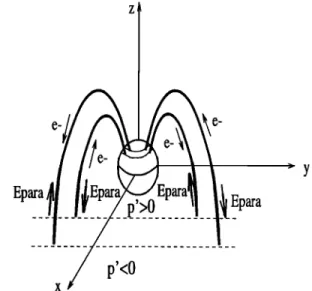
side. Gomp•red to c•se A, •he situation is reversed. On •he o•her h•nd, in regions closer •o •he R•r•h, where •he pressure gr•dien• m•y be directed •ow•rd •he tM1, e•ch of •he •bove direction is reversed. C•se B is presented in Figure 2 where we h•ve •ken in•o •ccoun• •he change of direction of •he pressure gr•dien• when we move closer
•o •he R•r•h. The direction of •he expected electron precipitations is summarized in T•ble 1.
3.3. Large Magnetic Drift Limit (• > w)
Now, we consider the opposite assumption •a ) w, which corresponds to a very low frequency perturbation
or to a very large k• (an highly localized
perturbation
in longitude). In this limit, the term between brackets of Ki in (14) can be approximated by:
Epara
Epara
.
x
Figure 2. Variation of the direction of the parallel elec- tric field and of the electron precipitations as a function
of y and of the pressure gradient (case B). The config-
LE CONTEL ET AL.' SELF-CONSISTENT QUASI-STATIC PARALLEL ELECTRIC FIELD 12,951
Table 1. Table of Electron Precipitations in the Dusk-
side (y < 0) in the Limit 7d < w
• p• <0
p >0
• Eq (Io) means that electrons are accelerated equator- ward (toward the ionosphere).
•'di
(•'di
--
•*i)
""•
•'di
(1--
•*i
)
ß(40)
c0(w+•i) - w •iTherefore, after an integration on the energy E, the
expression (14) of Ki, in the limit 7a > •, writes
3Te
Ki : 2 • •dthi
1 3 •dthi •
'
(41)
which gives for the parallel electric field, after an inverse
Fourier transform in space and time (see Appendix A for the method):
dEll(L
, y,
O,
t) -
ß
YødJ•L•exp(vt){l+(Pf[•(()]}
(42)
Close to midnight, ( = y/A < 1, we obtaindell
(L,
y,
O,
t) -
[ Y ] (43)
.
In the opposite limit ( > i (far aww from the midnight meridian), the expansion of the Fried-Conte function is -1/( and the parallel electric field goes to zero:
dell (L, y, 0, t) m 0.
(44)
Equation (43) shows that the parallel electric field does
not change sign in the region where the magnetic field
lines
are stretched
(lyl < A/x/r) ß In the following
dis-
cussion, we will consider a location close to midnight
(( < 1). We distinguish again between two cases:
3
Cse c'
<
Epar
Y
x
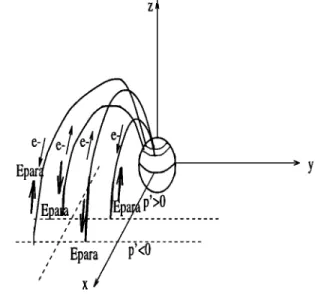
Figure 3. Variations of the direction of the parallel
electric field and of the electron precipitations in the
duskside as a function of the pressure gradient (case D).
The dawnside configuration is obtained by symmetry
around the noon/midnight meridian.
3
ii uyi
ß/•odj,,
L•
2 exp(.7t)
1 - 2
(4e)
In this last case, we find again a pressure gradient de- pendence of the parallel electric field. In the plasma sheet, where the pressure gradient is directed earthward
(p• is negative), the parallel electric field is directed to-
ward the equator and the electrons are accelerated to- ward the ionosphere around midnight. In the flanks
the situation is reversed. Closer to the Earth, the pres- sure mw be directed tailward, then all the results are reversed; electrons move toward the ionosphere at mid-
night and toward the equator in the flanks (Figure 3).
The directions of the expected electron motion are sum-
marized in the Table 2.
4. Discussion
The duration of the growth phase is of order 30 min and the ion thermal energy is around 10 keV
3½!
•ii •dt
hi
ß
t•ø5J"*
L•2
exp('7t)
[
1-2(X
) . (45)
rable 2. Table of Electron Precipitations in the Region
Around
the Noon/Midnight
Meridian
(lyl < A/v/•) in
the Limit 7d > w
• p' <0
p>0
The parallel electric field is positive around midnight,
directed toward the ionosphere. Thus electrons are ac-
celerated toward the equator in the region where the magnetic field lines are more stretched. They are ac- celerated toward the ionosphere in the morning and
evening
sectors
for lyl >
7a > w. • Eq ---• Eq 7• < w. • Eq • Io
• Eq (Io) means that electrons are accelerated equator- •vard (toward the ionosphere).
12,952 LE CONTEL ET AL.: SELF-CONSISTENT QUASI-STATIC PARALLEL ELECTRIC FIELD
in the NEPS. Moreover, dual-satellite studies suggest that the scale length of the perturbation associated with the formation of the current sheet during the growth phase cannot be smaller than one Earth ra-
dius. Therefore the assumption •-• < co seems reason- able. Furthermore, from the azimuthal asymmetry of
the ion flux (between duskward/dawnward directions) measured aboard a geostationary spacecraft [e.g., Korth et al., 1991], we know that the scale length, Lj>, of the ion pressure gradient is relatively small (Lj> __ 0.5- 1
R•). Since we have u•/•'• • L/Lp •_ 6- 10, we can
consider
that [uu[
>
close
to the geosynchronous
region. Thus it seems that the most appropriate case for the substorm growth phase is case B, since in this case the particles that ensure the QNC verify 7• < coand lull > I•d[. Therefore
we expect
the parallel
elec-
tric field to be directed toward the ionosphere in the duskside, whereas it should be directed toward the mag-
netic equator in the dawnside. As a consequence, cold ionospheric electrons should be accelerated toward the
equator at dusk, whereas hot plasma sheet electrons will move toward the ionosphere at dawn. This result is linked to the assumption that the perturbation associ- ated with the magnetic field lines stretching is localized along the y direction. The magnitude of the parallel electric field during the growth phase can be estimated.
In (39), we assume (1) the timescale for the growth phase of • 30 minutes, (2) the characteristic increase of the radial component of the magnetic field of 30 nT, (3) the radial extent of the current sheet of 1 Rs, and (4)
the forcing current L• is at 7 Rs. Remind that the dia-
magnetic
dift velocity
is u s = p'/(qno) - T/(qL•B•q)
and that the bounce-averaged curvature-gradient mag-
netic drift velocity
is •atn = -2T/(qLB•q). We use the
following parameters: 1 keV for the electron tempera-
ture and 10 keV for the ion temperature. The scale, A,
of the perturbed region is taken to be 4 Rs, L•, the
scale length of the ion pressure gradient is 2 Rs, (much larger than values estimated by Korth et al. [1991]),
then the parallel electric field at the geostationary orbit
L _ 6.6 BE, given
by (39), is Ell _• 1.6 x 10-SVm
-•
with e'(O) ___ 0.1. A smaller scale for the ion pressure
gradient would result in a larger parallel electric field. For a distance between the ionosphere and the mag- netic equator equal to rrL/2, we obtain a field-aligned potential drop of a few hundred volts, which is far from negligible. We suggest that this parallel electric field produces a parallel drift velocity between electrons and ions. It has been shown elsewhere that the drifting elec- trons can generate electromagnetic waves, observed at
substorm breakup [Pertaut et al., 1993] with frequencies of the order of the proton gyrofrequency (FH+ --- 1 Hz). More recently, Pertaut et al. [1998] have shown that
these waves are produced via a current-driven instabil- ity when the parallel drift velocity of electrons with re-
spect to ions is large enough (a fraction of the ion ther- mal velocity). Since they are able to diffuse spatially
the thermal ions and to suppress locally the pressure
gradient, these waves may cause the disruption of the
current observed in the near-Earth magnetotail (7-12 %).
Present results seem to contradict those of Koskinen
(compare
Figure 3 of Koskinen
et al. [1996]
with our
Figure 3). But as Koskinen pointed out: "the paral-
lel field of Fig. 3 is not the real electric field in the plasma. Due to their high parallel mobility charged particles quickly compensate the parallel component of the slowly evolving inductive field". In fact, dur- ing the growth phase, we have the following ordering co&• > co&i > co. Thus, the field-aligned potential drop
results from the differences between the bounce aver-
age responses of electrons and that of ions, due to their different temperature. In the limit T•/T• < 1, this dif- ference is small and therefore the field-aligned potential is small too. This is why the lowest order of the QNC gives 5• + A = const, which means that to the low-
est order in (T•/T•), the inductive component of the
parallel
electric
field OAii/Ot = OA/Ol is balanced
by
the electrostatic component 05•/0l. Thus the paral-
lel electric field found by Koskinen et al. [1996], from a
non self-consistent approach, does not develop because the particle response tends to cancel it. Notice that the high parallel mobility, corresponding to large ion and electron temperatures, does not cancel the paral- lel electric field in a mirror geometry for low-frequency perturbations. In the present paper, we have shown, for the simple case where T• < T/, that a parallel electric field proportional to T• /T/ develops. The present study shows the importance of ensuring QNC while imposing magnetic field variations. Finally, we point out that
LC00 solved the full Vlasov-Maxwell system of equa-
tions only in the quasi-static limit, notably the solution of Amp•re's law is valid only in this limit. However, the results obtained from the lowest order in T•/Ti of the QNC in LC00 and to the first order in the present pa- per are basically valid for low-frequency perturbations
co<cob.
Although the above results allow a self-consistent de- scription of the origin of parallel electric fields, there are
some limitations that should be stressed. The present
calculation has been carried out with the low-/• assump- tion since the 2-D dipole has been used to solve the Amp•re's law with a forcing current in LC00 and to obtain the explicit expression for the parallel electric field in the present paper. This limit is not a priori valid for the plasma sheet, especially for large radial distances. However, even with this restrictive assump- tion we have taken into account the pressure gradient effect to the lowest order. For higher values of/• we expect the general trend to be the same, but another equilibrium should be used which would preclude any analytical approach.
Another limitation is the fact that we do not take into account the ionosphere/magnetosphere coupling. The
QNC for the magnetotail plasma is likely to be modified by the presence of the ionospheric plasma. Keeping in
LE CONTEL ET AL.' SELF-CONSISTENT QUASI-STATIC PARALLEL ELECTRIC FIELD 12,953
mind the above limitations, the present model provides a self-consistent kinetic description of the generation of parallel electric fields in a mirror geometry for quasi-
static perturbations
(co
< kllvA
and co
< cob).
5. Conclusion
The linear response of the plasma to quasi-static per-
turbations
(co < k[[vA
and co < cob)
has been studied
and the full Vlasov-Maxwell system of equations has been solved. In particular, the QNC has been solved
via an expansion in the small parameter T•/Ti. To the
lowest order in T•/Ti, the QNC implies the existence of a new contribution to the perturbed electrostatic po- tentiM which modifies the perpendicular transport of the plasma. To the lowest order in T•/Ti, the paral- lel electric field can be neglected. To the next order in T•/Ti, the QNC enables an analytical calculation of the residual field-aligned potential drop proportional to T•/Ti. Only in the particular case of the substorm growth phase, did we explicitly compute this parallel electric field. Using the solutions of Ampare's law ob-
tained in LC00, we found that in the case where we can
assume
• < co
and
< luyl, a field-aligned
potential
drop of a few hundred volts develops during the growth
phaseß The associated parallel electric field is directed toward the ionosphere in the dusk sector and toward
the equator in the dawn sector. This parallel electric field is able to produce a parallel drift velocity between electrons and ions. The drifting electrons may generate electromagnetic waves, observed at substorm breakup
[Pertaut et al., 1993] with frequencies of the order of the proton gyrofrequency (FH+ "0 1 Hz), via a current-
driven instability when the drift velocity exceeds the thermal ion velocity.
Appendix A' Inversion of the Fourier
Transform
In this appendix, we do not omit the Fourier nota-
tions; therefore we have
(al)
and the real component
dell writes
Using
the expression
of A.•q - 1/[4(n q- 1)]0([kul/ku)
ß
waj•q(kv,w)L•L
for n- O, we write
ß
exp[i(kyy+cot)]. (A4)
The co integration is straightforward and gives
For the ky integration we note that
where FT denotes a one dimension Fourier transform
and P f the Cauchy principal value. The perturbed magnetic field component becomes
Moreover, the convolution theorem gives
f ,g- f .•<--> f ,g-FT
-•
.
.
(A9) Therefore we obtain
dEll(L
, y,
0,
t) - ½'(0)
•-•iiv•tni
i 5 V•thi
ß 4rr
dy' dtdj•q(y',
t)
'Pf( 2 ) (AX0)
(y_ f)a ß
Finally, we can write
5Ell(L
'y,
O
't)_e,(O
) .l•5_•.•thi
(1 2 Uyi
5 •dt hi)]
12,954 LE CONTEL ET AL.: SELF-CONSISTENT QUASI-STATIC PARALLEL ELECTRIC FIELD
Using the expression
of 5jeq(Y,
t),
5jeq(Y,
t) = 5jm
exp
(_y2/A2)
exp
7t,
(A12) we defined the variables Y = y•/A and ( = y/A, the
parallel electric field becomes
where we have performed the temporal integration. Then, after two integrations by parts, we obtain
where
W(•) - 1/(x/-
• f_• dV exp(-V2)/(V-(') is the
Fried-Conte function.
Acknowledgments. We thank G. Belmont and D. Le
Qudau for useful discussions. This work was partially sup- ported by University of Versailles St Quentin and by a post-
doctoral fellowship funded by CNES.
Michel Blanc thanks Liu Chen and another referee for
their assistance in evaluating this paper. References
Antonsen, T. M., Jr., and B. Lane, Kinetic equations for low
frequency instabilities in inhomogeneous plasmas, Phys.
Fluids, 23, 1205, 1980.
Frank, L. A., W. R. Paterson, K. L. Ackerson, S. Kokubun,
and T. Yamamoto, Plasma velocity distributions in the near-Earth plasma sheet: A first look with the Geotail spacecraft, J. Geophys. Res., 101, 10,627, 1996.
Huang, T. S., and T. J. Birmingham, Kinetic and thermody- namic properties of a convecting plasma in a two dimen- sional dipole field, J. Geophys. Res., 99, 17,295, 1994. Hurricane, O. A., R. Pellat, and F. V. Coroniti, The kinetic
reponse of a stochastic plasma to low frequency perturba- tions, Geophys. Res. Lett., 21, 253, 1994.
Hurricane, O. A., R. Pellat, and F. V. Coroniti, A new ap- proach to low-frequency "mhd-like" waves in magneto- spheric plasmas, J. Geophys. Res., 100, 19,421, 1995. Korth, A., Z. Y. Pu, G. Kremser, and A. Roux, A statisti-
cal study of substorm onset conditions at geostationnary orbit, in Magnetospheric Substorms, Geophys. Monogr. Set., edited by J. R. Kan, T. R. Potemra, S. Kokobun, and T. Iijima, vol. 64, p. 343, AGU Washington, D.C.,
1991.
Koskinen, H. E. J., P. K. Toivanen, and T. I. Pulkkinen, Parallel electric fields during the substorm growth phase, in Third International Conference on Substorms, edited by E. J. Rolfe and B. Kaldeich, p. 167, ESA, Noordwijk, The Netherlands, 1996.
Le Contel, O., R. Pellat, and A. Roux, Self-consistent quasi- static radial transport during the substorm growth phase, J. Geophys. Res., this issue.
McIlwain, C. E., Auroral electron beams near the magnetic
equator, in Physics of the Hot Plasma in the Magne- tosphere, edited by B. Hultqvist and L. Stenflo, p. 91, Plenum, New York, 1975.
Parks, G. K., C. S. Lin, B. Mauk, S. DeForest, and C. E. McIlwain, Characteristics of magnetospheric particle in- jection deduced from events observed on august 18, 1974,
J. Geophys. Res., 82, 5208, 1977.
Pellat, R., O. A. Hurricane, and F. V. Coroniti, Multipole stability revisited, Phys. Plasmas, 1,3502, 1994. Pertaut, S., A. Morane, A. Roux, A. Pedersen, R. Schmidt,
A. Korth, G. Kremser, B. Aparicio, and R. Pellinen, Char-
acterization of small scale turbulence observed at sub-
storm onsets: Relationship with parallel acceleration of
particles, Adv. Space Res., 13(•i), 217, 1993.
Perraut, S., A. Roux, O. Le Contel, R. Pellat, A. Peder-
sen, and A. Korth, Evidence for a substorm trigger, in
Fourth International Conference on Substorms, edited by S. Kokubun and Y. Kamide, p. 349, Kluwer Academic Publishers, Dordrecht, London, Boston, 1998.
Rosenbluth, M. N., and R. K. Varma, Approximate equa- tions for plasmas in mirror machines, Nucl. Fusion, 7, 33,
1967.
Rutherford, P. H., and E. A. Frieman, Drift instabilities in
general magnetic field configurations, Phys. Fluids, 11,
569, 1968.
O. Le Contel and A. Roux, Centre d'Etude des Environ-
nements Terrestre et Plandtaires, 10-12 avenue de l'Europe,
F-78140 V•lizy, France. ([email protected])
R. Pellat, Centre de Physique Th•orique, Ecole Polytech- nique, F-91128, Palaiseau, France.
(Received June 10, 1998; revised September 3, 1999; accepted November 30, 1999.)