HAL Id: hal-02550837
https://hal.archives-ouvertes.fr/hal-02550837
Submitted on 11 Jan 2021
HAL is a multi-disciplinary open access
archive for the deposit and dissemination of
sci-entific research documents, whether they are
pub-lished or not. The documents may come from
teaching and research institutions in France or
abroad, or from public or private research centers.
L’archive ouverte pluridisciplinaire HAL, est
destinée au dépôt et à la diffusion de documents
scientifiques de niveau recherche, publiés ou non,
émanant des établissements d’enseignement et de
recherche français ou étrangers, des laboratoires
publics ou privés.
Self-consistent quasi-static radial transport during the
substorm growth phase
O. Le Contel, R. Pellat, A. Roux
To cite this version:
O. Le Contel, R. Pellat, A. Roux. Self-consistent quasi-static radial transport during the substorm
growth phase. Journal of Geophysical Research Space Physics, American Geophysical Union/Wiley,
2000, 105 (A6), pp.12929-12944. �10.1029/1999JA900498�. �hal-02550837�
JOURNAL OF GEOPHYSICAL RESEARCH, VOL. 105, NO. A6, PAGES 12,929-12,944, JUNE 1, 2000
Self-consistent quasi-static radial transport
during the substorm growth phase
O. Le Contel
Centre d'Etude des Environnements Terrestre et Planetaires, Vdizy, France
R. Pellat
Centre de Physique Th•orique, Ecole Polytechnique, Palaiseau, France
A. Roux
Centre d'Etude des Environnements Terrestre et Planetaires, Vdizy, France
Abstract. We develop a self-consistent description of the slowly changing magnetic
configuration
of the near-Earth plasma
sheet (NEPS) during substorm
growth phase.
This new approach
is valid
for quasi-static
fluctuations
co
< kllv
• (v• being
the
Alfv•n velocity), with characteristic
frequency
lower than the bounce
frequencies
of
electrons
•nd ions (co
< w•i,w•,), •nd for spatial scales
l•rger th•n the ion L•rmor
radius. The basic equations are obtained from a linearization of the cyclotron and bounce-averaged Vlasov equation, together with Maxwell equations. The Vlasov- Maxwell system of equations is solved for the quasi-dipolar NEPS region. Using a 2-D dipole for the equilibrium, we calculate analytically the perturbed components of the electromagnetic field as a function of an external forcing current. The
quasi-neutrality
condition (QNC) is solved
via an expansion
in the small parameter
T,/Ti (T,/Ti is the ratio between
the electronic
and ionic temperatures). To the
lowest order in T,/Ti, we find that the enforcement
of QNC implies the presence
of
a global electrostatic potential which is constant for a given magnetic field line but varies across the magnetic field. The corresponding electric field shields the effect of the inductive component of the electric field, thereby producing a partial reduction of the motion that would correspond to the inductive electric field. Furthermore, we show that enforcing the QNC implies a field;aligned potential drop which is
computed
to the next order in T,/Ti in a companion
paper [Le Contel et al., this
issue]. In the present paper, we show that the direction of the azimuthal electric
field varies along the field line, thus the equatorial electric field cannot be mapped
onto the ionosphere.
Furthermore
during the growth phase,
the (total) azimuthal
electric field is directed eastward, close to the equator, and westward, off-equator.
Thus large equatorial pitch angle particles drift tailward, whereas small pitch angle
particles drift earthward.
1. Introduction
The process(ses) by which the plasma is transported in the Earth's magnetosphere is a critical issue, and
there is no consensus yet about its exact nature. Earlier
models are generally based on simple assumptions: a static magnetospheric electric field (i.e., an electric field derived from a scalar potential), driving a steady earth- ward "convective" motion (e.g., Cowley and Ashour-
Oa. tt.
..a
low
velocities deduced from the measurements of coherent
Copyright 2000 by the American Geophysical Union.
Paper number 1999JA900498.
0148-0227 / 00 / 1999 J A 900498 $09.00
and incoherent scatter radar tend to support the view
that there is a regular earthward convective motion no-
tably prior to substorms
[e.g., Forme et al., 1998]. In
the case of incoherent scatter radar, however, the Earth rotation is used to build maps of the flow velocity in the ionosphere, thus a steady state (over one Earth ro- tation) is implicitly assumed. However, electric field and/or flow velocity measurements, carried out in the magnetosphere on board several spacecraft, are not easy
to reconcile with the simple view of a steady convec-
tion. Huang and Frank [1986] carried out a statisti- cal survey of plasma flows, measured on ISEE 1, in- side the plasma sheet. In their survey they excluded flow velocities above 150 km/s. Their results show that
the average flow is too small to account for the rate
12,930 LE CONTEL ET AL.: SELF-CONSISTENT QUASI-STATIC RADIAL TRANSPORT
expected by steady convection models. Baumjohann
et al. [1989] conducted a survey of slow and fast flows
from AMPTE/IRM data. While slow flows were ob- served most of the time, in agreement with Huang and
Frank [1986], Baumjohann et al. [1989], taking advan-
tage of a better time resolution, gave evidence for tran-
sient bursts of fast flows, with speeds above 300 km/s, generally directed earthwards (at least inside of 19 RE being the Earth radius). Conversely, the slow flows have no preferred direction. Angelopoulos et al. [1992] further analyzed the fast flow bursts and defined bursty bulk flows (BBFs); these authors suggest that most of the radial transport of the flux could be effected through
these short lasting but intense flow bursts. These mea- surements indicate that there is not a unique regime. These results and other similar results, not described
here, have led Ifennel [1995], to introduce the possibil-
ity of a bimodal plasma sheet flow, to stress the differ- ence between the morphology of fast laminar flows and slow turbulent flows. The standard convection models, based on a constant potential electric field, do not de-
scribe these complex situations characterized either by a high temporal variability of the fast transient BBFs,
or by slow flows with no obvious preferred direction. Thus "one wonders if steady uniform convection has
ever been found" [Kennel, 1995, p. 22].
In the present paper we do not assume any static convection electric field. We adopt a different view point and investigate the transport under the influence of an externally applied electromagnetic perturbation that mimics the variation induced by the solar wind. What is the difference between a steady convection and
a time-dependent transport? In a steady state mag-
netosphere the electric field can only be electrostatic. Then, the assumption of the absence of a parallel elec-
tric field Ell is equivalent
to consider
the magnetic
field
lines
as equipotentials
(Ell = -O•/O1 -- 0 ,e--5 the po-
tential electrostatic • is independent of 1 the distance
along the magnetic field line). Conversely, in a non-
stationary
approach,
Ell:-0•/01-
O/OtAll- 0
ß +O/Ot
f dlAll
- const,
where
5All
in the parallel
com-
ponent of the vector potential. Therefore the absence of parallel electric field does not imply the equipotentiality of the magnetic field lines but only that the variation along the field line of the electrostatic component of the electric field cancels the inductive component. Thus, for a time-dependent perturbation the mapping between the equatorial and the ionospheric electric fields is not granted. Here we investigate the relation between time-dependent transport and the formation of thin cur-
rent sheets (TCS) during the substorm growth phase.
For the sake of simplicity, in the rest of the paper, we will call "convection" a steady motion driven by a con-
stant (e.g., dawn to dusk) electric field, derived from
a constant scalar potential. The term "transport" will be used to describe the effect of time varying perturba- tions, associated for instance with a growing current in
the tail.
The theoretical basis of standard convection mod- els also deserves some discussion. Most of the mod-
els rely upon the assumption
that convecting
particles
are moving in a given magnetic
field; in other words,
no attempt is made to take into account the effect the
particles have on the fields; the approach is not self-
consistent, which introduces serious limitations on the
significance
of the results.
MHD is a priori
more
appeal-
ing, because
it is self-consistent,
and provides
a simple
description
of plasma
dynamics
[Schindler
and Birn,
1982; Erickson,
1992]. The validity of the MHD ap-
proach,
however,
is also
subject
to restrictions.
Indeed,
MHD approach is only valid for perturbations whose
the frequency
is greater
than kllVe
(kll being
the par-
allel component of the wave vector and ve the thermal
velocity
of the electrons).
In a magnetic-mirror
geom-
etry as the NEPS, particles are trapped between mir- ror turning points. Therefore the validity condition of
MHD writes
w > woe
- ve/Lll (Lll being
the magnetic
field length) or equivalently the characteristic timescale
• < roe, the bounce
period of electrons.
In the NEPS,
at 7 RE, •'• is typically
1 s for energetic
electrons
(1
keV). Thus
MHD is not a valid
approximation
for long-
period fluctuations (see, for instance, Rosenbluth and
Varma
[1967],
Rutherford
and Frieman
[1968],
Anton-
sen and Lane [1980],
and Hurricane
et al. [1994]).
The
bounce
resonance
is only one of the nonlocal
processes
that limit the validity
of MHD; the magnetic
field gra-
dient, the pressure gradient, also introduce nonlocal ef-
fects,
as will be discussed
in the course
of the paper. See
also discussions on the importance of these resonances
by Chen
and
Hasegawa
[1988,
1991],
Cheng
[1982],
and
Cheng and Johnson [1999].
Plasma transport can also be achieved via low-
frequency
hydromagnetic
waves,
as discussed
by John-
son and Cheng
[1997]
and by Chen
[1999].
These
works
are based
on a quasi-linear
formalism
applied
to the gy-
rokinetic
equations;
hence
the rate of transport
is pro-
portional
to the square
of the amplitude
of these
hydro-
magnetic waves. Observations carried out in the near-
Earth plasma sheet (NEPS), for instance, by GEOS-2
[Roux
et al., 1991],
show
that during
the growth
phase,
the amplitude
of hydromagnetic
waves
is very weak.
Thus wave-induced
transport
is unlikely
to play an im-
portant role during the growth phase. While periodic
oscillations are negligible, one regularly observes a slow change in the magnetic configuration that will be mod-
eled as a quasi-static
perturbation.
Therefore,
in the
present
paper we describe
a linear selLconsistent
ap-
proach
to the transport
of the plasma
in the NEPS,
in response
to quasi-static
variations
of the magnetic
field. We use an approach
developed
for electromag-
netic perturbations with a frequency lower than the
bounce
frequency
of electrons
and ions
(w < woi,wo•)
and for spatial scales larger than the ion Larmor ra-
dius (kñp < 1), but we neglect
Alfv•n waves,
assum-
ing w < kllV
A. The present
approach
is based
on the
linearized
response
of the plasma
to low frequency
dec-
LE CONTEL ET AL.: SELF-CONSISTENT QUASI-STATIC RADIAL TRANSPORT 12,931
tromagnetic perturbation (w < w0) obtained by Pellat
from the Vlasov equation by assuming conservation of
the first adiabatic invariant [Pellat, 1990]. The response
of the plasma is completed by Maxwell equations. For
long perpendicular wavelength electromagnetic pertur-
bations
(k_cAD
<< 1, where
/•D- V/eokBT/(noq
2) is
the Debye length, e0 is the vacuum permittivity, kB the Bolztmann constant, T the temperature, no the den-
sity, and q the charge of particles), the Gauss's equation
reduces to the QNC. Yet, owing to the low frequency of the perturbations, we need to take into account the existence of nonlocal terms. For instance, in the elec- trostatic case, for a multipole, the QNC implies the ex- istence of an electrostatic perturbed potential (I'0 con-
stant along the field line [Pellat et al., 1994]. This result
has been extended to electromagnetic perturbations by
Hurricane et al. [1995b] for w > w.,•d (w, being the diamagnetic drift frequency and •d being the bounce- averaged magnetic drift frequency), and applied to the
magnetotail. In section 2.2 we solve the QNC to the
lowest order in T,/Ti < 1 and give a generalization of
Hurricane 's result valid for perturbations with arbitrary frequencies.
Finally, the system is completed by the parallel and p,•rpendicular projections of the AmpSre's law. Unlike substorm injection which is known to be a sudden pro-
cess
(w >_ wt>i)
with a small spatial scale (ky --> c•),
the buildup of a tail-like configuration is a slow process
(•_ 30 rain) affecting
a large fraction
of the tail (small
ky). Thus the applied
electromagnetic
perturbation
is
not considered as being the consequence of a local inter-
nal instability (as it is probably the case for breakup).
The change from a dipole to a tail-like configuration, in- stead, is considered as the result of the response of the
magnetotail to a quasi-static forcing caused by varia- tions in the solar wind [e.g., Jacquey, 1996]. The full
treatment of this problem is very difficult since it would
require a full description of the forcing caused by the so- lar wind, taking into account the boundary conditions
imposed at the magnetopause. Moreover, the way the solar wind drives the stretching of the magnetic field lines is still not completely understood. To simplify, we assume that the change of the dipolar field close to the
Earth is due to an increase of the westward current far-
ther in the tail [e.g., Jacquey, 1996], neglecting the local electrical currents (low/3 assumption, /3 being the ra-
tio between the kinetic pressure and the magnetic pres-
sure). Thus, for the equilibrium,
Amp•re's law gives
• x • - -•. Perturbing
the
equilibrium
with
an
exter-
nal current
located
far from
the dipqlar
re, on,
we
solve
the
linearized
Amp•re's
law
gives
• x 5t{ = luoS-•ext
to obtain the perturbed components of the magnetic
field.
The above few lines suggest the following questions,
to be discussed in the course of the paper: (1) What
are the consequences of enforcing the QNC in a time-
dependent situation? (2) What is the role of the time
varying
electric
fields (associated
with electromagnetic
perturbations) on the transport of the plasma inside the plasma sheet? (3) Can we map the electric field from
the equatorial magnetosphere, down to the ionosphere during the growth phase?
The linearized response of the plasma is described in subsection 2.1 and the QNC is solved in subsection 2.2. In subsection 2.3 we build a Green function and solve the linearized Amp•re's equation to obtain the perturbed magnetic field from the external current. In order to allow an analytical approach, a simple mag-
netic field model, a two-dimensional (2-D) dipole, is
used. This model is also presented in subsection 2.3. In section 3 we give the spatial profile of the azimuthal electric field along the field line and show the implica- tions on the transport of the plasma across magnetic field lines during the growth phase. The solution of the
QNC, to the first order in (Te/Ti), will be described in a companion paper [Le Contel et al., this issue], to-
gether with its consequences, namely the development of a finite parallel electric field.
2. Linearized Vlasov-Maxwell
System of
Equations
2.1. Solution of the Bounce-Averaged Vlasov Equation
Assuming that the electromagnetic perturbation is
periodic in time (t) and in space (across the magnetic
field)
we take
the_Derturbing
electrostatic
(5(•) and
magnetic vector (5.4) potentials as
5•( r-•,
t), 5--•(•,
t)
-- •'•(•,
cv,
l),
•(•, w,
l)exp
[i(•. • + wt)],
where
• (•)is the position
vector
(the
wave
vec-
tor) and ß denotes the component perpendicular to themagnetic field. For the sake of simplicity we omit the hat symbol and the exponential factor in the following formulas, then the linearized response 5f is given by
5
f - q• 5• - u•SA•
+ (1
+ •)Ae
-is-
(1
+ •)g], (1)
where fo(E, py) is the equilibrium distribution function (E is the particle energy and py the canonical momen-
tum), uy is the diamagnetic
drift velocity,
w• = ky'uy
is
the diamagnetic drift frequency, ky is the wavenumber in the y direction (azimuthal). We work in local field-
aligned coordinates defined by the triad of unit vectors:
In this frame, the velocity becomes
12,932 LE CONTEL ET AL' SELF-CONSISTENT QUASI-STATIC RADIAL TRANSPORT
To obtain the linear response (1), a change of vari-
ables
(v½, %, vii
) --• (E, p, •) has been
made,
where
•mVll
q-/•B is the kinetic
energy,
/• •mv_c
is the magnetic moment, and • is the gyrophase angle.
The elementary
volume
in velocity
space
becomes
dav=
•o--x,+x Bd•d•d•/("•21v,
l), where
cr- sign(vii
) (for
more details, see Rutherford and Frieman [1968], Hur-
ricane [1994],
and Hurricane
eta!. [1995a,
b]). In (1)
the function g contains the nonlocal wave-particle inter- action. To first order in w/coo, the function g becomes
-is
• •
+ (rico
I-•111
H-
co+cod J,
(4)S-
k_cv_c
sin(ak- •)/i2, ak - Arctan(k½/ku),
i2 is
the cyclotron frequency, cod - kuvd is the gradient-
curvature drift frequency, the upper bar denotes bounce averaging and H is given by
(o:
+ o:•)
,X
H - Jo (•4> - vddAy) +
(5)
where
,k - ico
ft dl/JoSAl[
and
,h, are
Bessel
functions
of argument kzlvz[/l•. In the next section we sub-stitute the linearized solution of the Vlasov equation into the QNC. The bounce-averaged linear solution of Vlasov equation obtained here is similar to those devel-
oped and used by different authors [e.g., Antonsen and Lane, 1980; Uheng, 1982; Chen and ttasegawa, 1991].
2.2. Quasi-neutrality Equation
In this subsection, we solve the QNC via an expansion in the small parameter T•/Ti. The validity of this ex- pansion is suggested by several observations indicating that this ratio is small in the magnetotail. For instance,
Lui et al. [1992] presented a statistical study of cur-
rent disruptions from AMPTE/CCE when the space- craft was in the near-Earth current sheer. They showed that the electron to proton [emperature ratio is in [h.e range of 0.11 to 0.57. They poin[ed out that these val- ues are higher than those reported by Baumjohann et al.
[1989] based on IRM data. Indeed, Baumjohann et al. [1989] obtained average plasma properties, notably an
electron to proton [emperature ratio in the range: 0.09- 0.18. These authors also noticed that this ratio is nearly
the same as the one found by Slavin et al. [1965] a[ distances of 1x1:30-60 P,E. More recently, during a
dusk-dawn crossing of the near-Ear[h tail by Geotail, during a relatively quiet period, a ratio around 0.2 was
measured [Frank et al., 1996]. It is therefore possible to consider T•/T/as a small parameter over a wide range of
radial distances from the Earth, and for different levels of a.ctivity.
From the linear response of the plasma (equations (1)
to (5)) and assuming
that f0 is a Maxwellian
distribu-
tion
function
(fo -no [m/(2•rT)]a/2xp-(E/T)),
the
QNC'
Ej=i,e
qj f d3 5 fj __•
0 can
be written
i • q
J 1 4
•r
B
d
E
d
/u
(• +•* •+•*•'i•o]
+ & • O, (6)
where we have performed the gyrophase integration and summed over streaming and antistreaming velocities. This latter operation cancels out the part of 5f that is
an odd function of rr. The above relation was derived earlier by Hurricane ½t al. [1995b], where more details are given about the derivation. The gauge SAy = 0
has been chosen. Since we are interested in large-scale
perturbations (the growth phase), the usual wavelength ordering k_cpj << i is made. In this limit, the Bessel functions become J0 -• 1 and J• •_ k_clv_cl/2i2, and the
expression for H simplifies; we get
H - 54> + • + • (7) where E - codA/co- ilukydA½/q. Then, after some alge-
braic manipulations, the QNC can be written as
• -•" (• + x) - • + •" (•)
(8) where the terms co.j,X cancel between electrons and ions, because ttyi/• } q- ttye/Te -- O, [Hurricane et al.,1995b]. Note that the diamagnetic drift frequency and the purely magnetic drift frequency of electrons can easily be related to the corresponding terms for ions:
-t6
- -•/•/T/
(where
cod•(oz)
-- -T•/• •')(•) and •.•
•.i
th means thermal quantities and • denotes the particle
pitch angle). The QNC becomes
f 4•BdEd•
•'•;•i fo•
(• - •) + (• - x)
+ • ((• -•)+ (x- •))
: •
m7lvlll
foi •(•
- ]
+ •.,- •, (•) . (•)
Since the right-hand side (RHS) term of (9) is propor-
LE CONTEL ET AL.' SELF-CONSISTENT QUASI-STATIC RADIAL TRANSPORT 12,933
J 4rcBdEdl•
+ - X)]
- 0
+
A •rivial solution of (10) is + - y) +
where •0 is constant for a given magnetic field line. This constant component of the perturbed electrostatic
potential is always taken to be equal to zero (5•+h - 0) in studies based on MHD. An external electrostatic
field, modeling the convection, is often added to the inductive part of the electric field in order to better fit
the data [e.g., Sauvaud et al., 1996]. In the present pa-
per, we show that the quasi-neutrality over the volume of the flux tube implies that •0 is different from zero. We compute •0 in a self:consistent manner, as a func- tion of the electromagnetic perturbation defined by h
and 5Bii. Integrating
the QNC (9) over the volume
of
the flux tube, we find
m7lvl
fog
(• + 7•i ) • + 7•i '
where the left-hand side (LHS) term of (9) has vanished
thanks
to the identity
f dl/B f dav(X - •) - O, valid
for any function X(E, •, l). Finally, •0 writes
f f
0iL
ß 0 =
[,
[
]'
f •
4••
foi •"•(•*•-•"•
(13)
Now, we can calculate the self-consistent perturbed electric field. Taking in•o account the implications of
•he QNC (11) [o the lowest order in T•/Ti,. [he per-
ubed daic
i.
y direction, becomes (remembering •ha• $Av - 0)'
-
-
Thus the complete perpendicular electric field associ- ated with the perturbation is the sum of an inductive
component
(,•) plus an electrostatic
component
((I>0)
de-
termined from the QNC. This electric field will produce a transport of the plasma. Notice that this transport is different from a steady convection; it is associated
with an electromagnetic perturbation (see discussion in introduction). The electrostatic component, associated
with •0, tends to reduce the effect of the inductive com-
ponent of the electric field ,•, thereby producing a par-
tial shielding of the motion that would correspond to
the inductive electric field (if it was not shielded). This
effect can explain why large bulk flows are not detected in the NEPS during the growth phase.
The
expression
I - iw
ft dl•dAll
shows
that
the
par-
tial derivative of I with respect to 1 is equal to the in-
ductive component of the parallel electric field (Ol/Ol =
05All/Or
). Thus locally
and in the limit Te < Ti, (11)
implies that the inductive component of the parallel
electric
field OdAll/Ot
is balanced
by the parallel
gra-
dient of the perturbed electrostatic potential Odq)/Ol. Hence (11) is equivalent to the usual MHD approxima-
tion, where one assumes the absence of a parallel electric
field (Ell: -0/0l(5• + A) = 0). In the present
study,
the absence of a parallel electric field is not an assump-
tion but an (approximate) result, obtained by solving
the QNC in the limit Te < iF/. We show, however, in a
companion paper [L½ Contel et al., this issue], that the solution of the QNC to the first order in (T•/T/) allows
us to compute a finite parallel electric field.
Studying low-frequency perturbations, Chcn and
Hasegawa [1991] considered a magnetospheric plasma consisting of two populations: a core (100 eV) and an energetic component (10 keV). In their work the core
population is denser than the energetic population and therefore plays a key role in the QNC. For this popu- lation, 0:b• > 0: > wbi. They obtained d• + l = 0, i.e.,
no parallel
electric
field (dEll : -0t(d(I)+ A) - 0). In
the present work carried out for 0:•,0:•i > 0:, we also
find dell •- 0 in the limit T• < T/ since
we have ob-
tained &I) + l: (I)0(g', y) where 4)o is constant along a
field line. However, this constant potential (I)0 modifies the perpendicular transport of tile plasma as already
mentioned.
Finally, one should notice that the perpendicular elec-
tric field (14) varies along the field line even when there
is no parallel electric field. Thus, in the quasi-static limit, the absence of a parallel electric field does not im- ply that the equatorial perpendicular electric field can be mapped onto tile ionospheric electric field. This is
true only in the purely electrostatic case (steady convec- tion); an assumption which is certainly not valid during
the growth phase. In the next subsectiOn, we solve the Ampare's law to determine the magnetic field pertur-
bation.
2.3. Ampare's Law
Close to the Earth, we can neglect the local elec-
trical currents which corresponds to assuming/7 < 1. Thus we can approximate the field by a dipole. To al-
low us to carry out analytical calculations, we use a
two-dimensional (2-D) dipole [Huang and Birmingham,
1994]
to describe
the equilibrium
magnetic
field. Using
cylindrical coordinates (r,O,y) where 0 is the colatitude,
the 2-D magnetic field model is defined by
/) (cos
Ou-?
+ sin
Ou---•),
(15)
where
• is the dipolar
moment.
The magnetic
field
12,934 LE CONTEL ET AL.' SELF-CONSISTENT QUASI-STATIC RADIAL TRANSPORT
B- Beq
sin
2 0'
(16)
where
Beq
-- iS/L
2, is the equatorial
magnetic
field
strength, L is the equatorial-crossing distance of the relevant field line. For the 2-D dipole the local coordi- nates become
½- -15/L,y,x- bcotO/L.
(17)
It follows
that
•- X• x e-•y,
and
the
magnetic
field
strength is
B-
;)2
(•8)/• sin
2 [arccot
(-X/O)]
The bounce
period and the bounce
average
curvature-
gradient magnetic drift velocity are
2rrL / dl -2E
rt, -
• -
--v-'•
- •
e-•. (19)
v '
vii
qLBeq
Then, we perturb
the dipolar
equilibrium
by an external
current, flowing in the westward direction and located
far in the tail. The linearized AmpSre's law becomes
• x • - luo5j•te-•y.
(20)
We assume that
5---•(-½r
, t) -- •(O, ky,
l, w)
exp
[i(kyy
+ wt)],
for the sake of simplicity
we omit the hat symbol
and
the exponential
factor in the following
formulas. The
external current 5j•t is defined by
5j•t(L, ky, O,
co): (Sjeq(ky,
co)(5(L
- Lc)
ß
sin
"•0[(2n+l)cot
20-1]. (21)
We have assumed that the current is highly localized in radial distance, and we choose for simplicity a Dirac function 5(L-Lc), where Lc is the radial location of the
forcing current. Therefore we are interested in L values
between
0 < L < L• where
the 2-D dipole
assumption
is
valid. Along the field line, we have chosen a class of forc- ing current whose the dependence allows us to obtain
easily
the magnetic
field perturbation
and corresponds
to an increase
in the equatorial
current
as suggested
by the observations
[e.g.,
Sauvaud
and Winckler,
1980;
Scrgecv
et al., 1993]. This class
is labeled
by an index
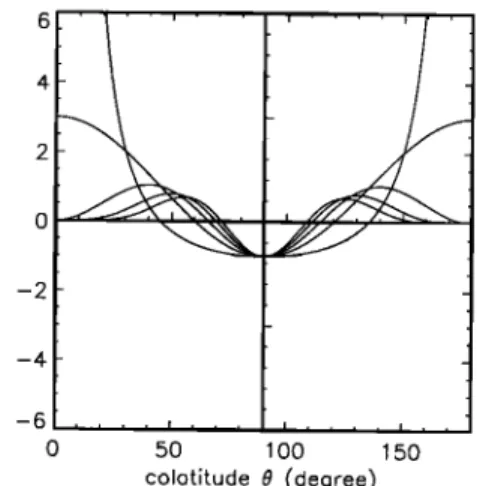
n, the larger n, the more localized
is the perturbation
close
to the magnetic
equator
(see
Figure
1). Compari-
son
between
results
obtained
for various
n gives
insight
on how sensitive
the results
are to the 0 dependence
of
the forcing
current. For n = 0 the perturbed
current
is divergent at high latitudes but as we will check later
on, this divergence
does
not modify the results
because
the perturbed
components
of the electromagnetic
field
do not diverge.
For the sake
of simplicity,
in the course
6 4 2 0 -2 -4 -6 0 50 100 150 colotitude 0 (degree)
Figure
1. Variation
of the external
current
(Sjyezt(O)
OC
sin
2"
0 ((2n
+ 1)cot
2 0- 1) versus
the colatitude
0 for
n - 0, 1, 2, 3, 4.of the paper, we often use the case n - 0 to obtain
estimates
of the various
characteristic
quantities.
After
some
algebra
(described
in Appendix
A) and,
in
the limit Iky[L
> 1 and Iky(L- Lc)l < 1, the perturbed
components of the magnetic field write
5B½ - -
..olkvlaj•q(k
v.
w) (sin
2r•+1
0
cos
O)
2 '
For A, we obtain
(Appendix
A)
(22)
(23)
A..(L.
kv.O.w
) - A,•q
[c•(L.
kv)
q- (sin
2 0)•+1],
(24)
where
we
have
defined
c•(L,
ky)- (n +
L•)[)
•+1 and
A•,q
-- 1/[4(n+
1)]po([kv[/kv)•dj•q(kv,•)
ß
L•L.To
obtain
the real
components
of •he perturbed
magnetic field, we have •o perform an inverse Fourier
tra,nsform
in time
and
in y. We
find
(see
Appendix
B)
-
coO)
5j•q(y'.?
Pf(l•dy'(::;;•-) (25)
2 L- (2n
+ 2)sin2
0]
{H(L-
L•)
- H[-(L-
L•)]}
(26)
Now, we have to specify the variation of the current in
LE CONTEL ET AL.' SELF-CONSISTENT QUASI-STATIC RADIAL TRANSPORT 12,935
servations close to midnight [McPhemvn, 1979; Sauvaud and Winckler, 1980; Roux et al., 1991] show that the
magnetic field changes from a dipole-like configuration
to a tail-like configuration. The equatorial value of the magnetic field decreases, whereas, off-equator, the ra- dial component increases. The duration of this vari- ation is typically •_ 30-45 min. Moreover, breakup is usually observed to start close to midnight in a longitu- dinally narrow sector, while the rest of the magnetotail keeps on stretching [Nagai, 1991]. These observations
suggest
that while the reconfiguration
at breakup
is lo-
calized in longitude, the formation of the current sheet during the growth phase is more homogeneous in lon-
gitude. Thus, while the limit ky -+ cxv
is adapted
to
study breakup, the formation of the current sheet can be better described by a finite ky. Therefore we consider
an external current localized around the noon-midnight
meridian, flowing eastward and slowly increasing with
the time as
y2
5jeq(y,
t) -- 5j,•
exp(-•¾)exp('/t),
(27)where
5jr• is the initial magnitude
of the current, 1/7
is the characteristic time scale of the growth phase, and A is the characteristic scale along y where the tail cur- rent increases. The complete expression of the external
current becomes
5je•t(L, y, O,
t) - 5j•q(y, t)5(L - L•)
ß
sin
2n
t9
[(2n
+ 1)cot
2 0 -- 1].
(28) We verify that for 19 : rr/2 (magnetic equator), the forcing current flows westward as suggested by observa- tions. Then, we can compute the •) component of theperturbed magnetic field which gives
5B½ =
ttodj,•
_ Lc2 (sin2,,+z
0cos0)
V'•
ß
(29)where
I•V(C)
- 1/(x/•) f-•o dV exp(-V2)/(V-()is the
Fried-Conte function and we have defined 1/ - y•/A and • - y/A. Close to midnight, • < 1, and in this limit, the Fried-Conte function can be approximated
by Pf(r7V(•'))
"• -2• + O(• a) and
we obtain
yo6j.•
Vff Lo
2 (sin2,•+•
0
cos
O)
]
ß
]-- 1-2(X)
A2 ß
(30)One should notice that in the opposite limit ( > 1 (far
away
of the lnaxm•um
of the current
in the y direction),
the expansion
of the Fried-Conte
function
is -1/( and
5B• = 0. Finally,
close
to lnidnight
(( < 1), the two
perturbed components of the magnetic field write
O Z
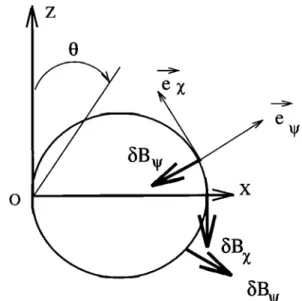
5B
x
Figure 2. Schematic diagram of the electromagnetic perturbation applied on a 2-D dipole field to model the change of configuration which occurs during the growth phase. As indicated by the arrows, the magnetic field perturbation tends to produce a tail-like configuration.
5B½: Po6j,•
• L•
2 (sin2,•+•
0cos
O)
ß
511--
05q(V, 0 + 1)
2 L- (2n
+ 2)
sin2
01{H(L-
L•)
-H[-(L-L•)]}.
(32)
We verify that for a forcing current directed westward
(5j,• > 0) at the magnetic
equator (19: rr/2), the ra-
dial component of the equilibrium magnetic field in- creases off-equator, whereas the equatorial component decreases, which corresponds to observations carried
out during the growth phase (see Figure 2).
3. Transport of the Plasma
In the previous subsections 2.1, 2.2, and 2.3, we have V, asov-Maxwell system of equa- completely solved the
tions
in the quasi-static
limit, (w < kllVA
and
In (5), only the terms
w•/w and it•kySA
½/q - -SB[/q
appear. It is useful to compare the size of these two
terms. Remembering
that w•tA/w •_ ky¾•,Aneq/CO
and
1•8Bil/q
-- -t•B}>/q •' E[-2(n u,_
l):•,•q]/•/b/q
1/(kyL)ky7•A•q/W, we c•.•t conclude
that, in the limit
IklL >
we have t•6BiI/• < waA/w. Thus the term
containing
dBii can be neglected.
In this case
the lin-
earized Vlasov equation, which describes the behavior
12,936 LE CONTEL ET AL' SELF-CONSISTENT QUASI-STATIC RADIAL TRANSPORT
the same but the expression (5) of H becomes Then, in the limit • < 1 we obtain
+ )
H - J05(I>
+
A ,
(33)
5Ey - 5Eœ,y,t(L,
y, t)
where 5(I) is given by the QNC (9) that implies 5(I) =
(I)0- A, with (I)0 given
by (13), and A and 5Bii given
by
(24) and (32) (from the Ampare's law solved in the limit
> 1
< 1). Now, obtain
the self-
consistent perpendicular electric field associated with the magnetic field perturbations, we need to compute the constant part, (I)0, of the perturbed electrostatic
potential.
Taking
into account
that/USBll/q
the expression, (13), of (I)0 becomes
l [s,•
- (sin2
0)
'•+1]
n+l
(41)
where we have defined
5E•:
,,y t(L
,,y t) - _/•odj,•7L•L
21
'X
X
exp(7t). (42)The colatitude 0 where the perpendicular electric field changes sign is given by
f •_.
{f 4•rBdEd/•
.•fl•,l fo•
(34) From the expression (24) of • we obtain (see Appendix C)
1 I
u
Beq
E1
+ k
lu
Beq
E (35)Then, we compute the expression of (I)0 (see Appendix
D) and obtain
'I'o- (c• + S•)A.•q, (36)
where we have defined
(37) Now, from (14), the self-consistent perpendicular elec- tric field writes
00
- arcsin
(S,•w•+•)
.
(43)
Because S,• is always smaller than unity, the direc- tion of the perpendicular electric field changes along the field line even in the absence of a parallel elec-
tric field (see Figure 3). As noted in section 2.2,
5Ey is directed
eastward
(positive)
close
to the equa-
tor, it is null for 0 = 00, and it is directed west-
ward (negative) for 0 < •0. The larger n, the larger is •0 therefore the region where 5Ey is eastward gets thinner (as n increases). As an example, for n = 0,
S0: 5/6, A0 = (c0
+ sin
2 e) A0•q,
•0: (c0
+ 5/6)A0•q,
and 6Ey : 6E•(L, y,t) (5/6 - sin
2 0). The elec[ric
field •Es is directed eas[ward (positive) close •o the
equa[or,
iC is null for 0 = arcsin(5/6)
1/2 and is directed
westward
(negative)
for e < arcsin(5/6)
•/• From
(42)
we can estimate the intensity of the perpendicular elec- tric field during the growth phase. For instance, the characteristic variation of the equatorial magnetic field
a[ the geostationary orbk (L• 2 L = 6.6 R•) is of order
of 30 nT for a duration of the growth phase of 30 min.
We assume thaC the radial scale of the current sheet is
m 1R•; therefore
t*o•J• • 30 x 10-9/(6.4 x 10•)T/m.
In the • direction we assume [hat [he spatial scale A is • 4R•. We ob[ain for the inductive component of
the perpendicular elec[ric field (without the conCribu-
5Ey
-- -ikyAneq
[Sn
-- (sin
2
(38)After an inverse Fourier transform, we obtain
(39) 'raking into account the expression of the current (27), we find 5E'y = (40) 1.0 0.5 0.0 -0.5 -1.0 0 Ey(8) _ 50 1 O0 150 colotitude •?(degres)
Figure 3. Variation
of A and
5Ey versus
the colatitude
LE CONTEL ET AL.: SELF-CONSISTENT QUASI-STATIC RADIAL TRANSPORT 12,937
tion of (I>0),
5•'L,y,t 'm'_
2.5 mV/m which is reduced
to
0.4 mV/m at the equator due to the contribution of the electrostatic component (I>0 (S, in (41)). As we have
previously mentioned, the effect of the (I>0 is to decrease the magnitude of the total electric field compa,red to the inductive component. Therefore the plasm.• transport
is also reduced.
Next, we can compute the bounce average electric drift to study the motion of the particles along • as a function of their pitch angle. We obtain (see Appendix
__
n Ivll
i / dl
I B
5Ey
_ 5E•,u,t(L,
Beq n + 1
y,
t) 1
"+•
(2k- 1)•
-
k=0. •(_1)•C• pB•q . (44)
Ej=0
We note that the bounce average electric drift, associ-
ated with 5Eu, depends on the magnetic moment. TO
simplify, we can consider two extreme cases: equatorial
pitch angle particles of 900 (pBeq/E • 1) and equa- torial pitch angle particles of 0 ø (pB•q/E 2 0). We
obtain
p,,+2
5EL,u,t/Beq S•/2-•u=0(-1
•
), - 0
o,
•
.Ch+,(2•-
1)•/(•)• •
5EL,y,t/Beq(Sn- 1), •eq-- 900
,
where
5EL,y,t,
given
by (42) is always
negative
close
to
the midnight meridian (y < A). Since S, is always
smaller than unity the bounce average electric drift of
900 particles and that of 0 ø particles have opposite di-
rections. The 900 particles drift tailward, whereas 0 ø
particles drift earthward, during the magnetic field line
stretching. When n increases, the perturbation is more and more localized close to the equator and S, de-
creases. Therefore, from (45) we deduce that 900 parti-
cles drift more and more tailward, whereas 0 ø particles remain almost at rest. Again for n = 0, we find
1/24(5E•,u,t(L,
y,
t)/Beq),
Geq
: 0
90
ø,
o.
Thus the correct treatment of the QNC implies a per- pendicular motion in response to a quasi-static elec-trornagnet,
ic perturbation
(w < kl!VA
and
•%t, because the perpendicular electric field direction varies with the positicr). :xlong the field line, the bounce- averaged motion is dii[•rent for different pitch angles. Ninety degrees pitch angle particles, which mirror close to tb.e equator drift tailward while zero degree parti-
cles ,•:'•ft e•rthward. This result is very different h'om
the results of Huang and t)•rmingham [1994], who con-
sider a static magnetic field and impose an electrostatic field to ensure the convection of the plasma toward the Earth. In the present work, the transport is due to the response of the plasma to the quasi-static perturbation and to the necessity of enforcing the quasi-neutrality.
4. Conclusion
In the present paper, we have given a self-consistent description of the quasi-static transport of the plasma, during the growth phase, in response to an external forcing. The full linearized Vlasov-Maxwell system of equations has been solved for quasi-static electromag-
netic perturbations,
satisfying
0: < kllvn and 0: < 0:s. In
order to get a simple equilibrium the pressure gradient
has been assumed to be small. Thus the local current is
small, and the local perturbation of the magnetic field is due to currents flowing farther in the tail. From Am- p•re's law we have obtained the perturbed components of the electric and magnetic fields as functions of the external forcing current. For the sake of simplicity, this current is assumed to be localized close to the mag- netic equator and around the noon-midnight meridian. It flows in the east-west direction, as expected during the growth phase. Using a 2-D dipole model to describe
the region close to the Earth (the NEPS), we have built a Green function to relate the fields in the NEPS with
this external driving current. Thus the solutions for the fields, in the plasma sheet, have been obtained as the products of the Green function by the forcing current. Using the linear bounce-averaged solution of the Vlasov equation obtained by P½llat [1990], the QNC has been
solved. To the lowest order in T•/• (T•/• < 1), we
found the following:
1. The QNC imposes the existence of a component
•0, given by (13), of the perturbed electrostatic po-
tential. This component •0 is constant along the field line and varies in the azimuthal direction, thereby con- tributing to the azimuthal electric field. This electric field tends to reduce the effect of the inductive compo- nent of the electric field, which explains why no large bulk flows are associated with large timescale electro-
magnetic perturbation (r > rb) like the growth phase.
Unlike what is done for the particle test and MHD ap- proaches, in the present paper, the electrostatic compo- nent of the azimuthal electric field is not assumed; it is determined, in a self-consistent manner, by the response of the plasma and related to an externally applied elec- tromagnetic perturbation. ¾Ve point out that the ex- istence of the component (I)0 is a purely kinetic effect occuring for co < co•. In a forthcoming paper we will show that the component (I)0 exists as long as co < In all cases it cannot be described by MHD.
2. The total azimuthal electric field (14), which is
the sum of these two components, varies in amplitude and direction, as a function of the position along the
12,938 LE CONTEL ET AL.' SELF-CONSISTENT QUASI-STATIC RADIAL TRANSPORT
field line. The changes in amplitude and in direction of the azinmthal electric field implies a bounce-averaged
transport of the particles (44) that strongly depends on
the pitch angle.
3. The parallel electric field is null to the order
Te/• < 1 (see (11)), therefore the residual parallel elec-
tric field should be calculated from the QNC developed
to the order Te/Ti. This calculation is presented in a
companion paper.
Notice that the full Vlasov-Maxwell system of equa- tions has been solved only in the quasi-static limit, no-
tably the solutions of Ampare's law, (31) and (32), are
valid only in this limit. However, the results obtained
to the lowest order in Te/Ti from the QNC (summa- rized above) are, also basically valid for low-frequency
perturbations co < cob. Furthermore, for the sake of sim- plicity and because in the NEPS the effect of magnetic drift. are expected to be more important than the finite larmor radius effects, the present calculations have been performed in the long wave length limit. However, we can easily include these effects if necessary since they are retained in the expression of the perturbed distri-
bution function (5).
For the magnetic field variations corresponding to the
growth phase, namely for a slow decrease (increase) of
the component of the magnetic field, perpendicular to
the equatorial plane (radial), the azimuthal electric field
is explicitly computed. It is found to be directed east- ward, close to the equator and westward off-equator.
As a consequence, during the growth phase, large equa-
torial pitch angle particles, which mirror near the equa-
tor, drift tailward, whereas small equatorial pitch angle
particles, which mirror far away from the equator, drift earthward. Furthermore, this result suggests that the mapping between the perpendicular electric field in the equatorial region and the electric field in the ionosphere
where J is the Jacobian of the change of coordinates
between the cartesian and the local frame (see also the Appendix A of Hurricane et al. [1995b]). We assume that
•---•(•r
, t) - 5--•(½,
kv,l,
co)
exp[i(kvy
+cot)],
for the sake of simplicity we omit the hat symbol and the exponential factor in the following formulas. Defining
two variables
X - ky•/co and Y - ikySAo/B as Bern-
ste•n et al. [1958], interchanging the partial derivatives,
O•(JBOt) - JBOtO•, (see Hurricane
et al. [1995b]
for
details about the interchange of the partial derivatives)
when necessary, the Amp•re's law writes
is not simple;
a self-consistent
approach,
including
non- One
can
show
that (A4) can
be obtained
from
(A2) and
local kinetic effects associated with the bounce motions (A3); therefore the system is reduced to these two latter
of particles,
is needed
to sort out the consequences
of a equations.
Inserting
(A2) to (A3), we obtain
time-dependent transport. The corresponding charac- teristic azimuthal electric field is of order of 0.4 mV/m
at the magnetic equator. In order to test these theoret- ical results it would be necessary to have electric field
and/or plasma flow data organized as a function of the distance from the center of the current sheet, during the
growth phase.
Appendix A' Solution of the Linearized
Ampre's
Law
Using the local field-aligned coordinates and with the
gauge
aA
v = 0, the
curl
of • gives
-• x '•
'• -' • •
O
y J
B
O
x • •
0½
(A5)
Again,
we interchange
the partial
derivatives
(O½(JBOt)
: JBOtO•), divide by B and integrate
along
the field
line which yields
(A6)
Therefore we hav'e to solve the following system of equa-
LE CONTEL ET AL.' SELF-CONSISTENT QUASI-STATIC RADIAL TRANSPORT 12,939
~ i 0 (0• 02X)
ki•_B
O1 '-•
aloe ' (A7)
(AS)
To go
further,
we
assume
a priori
that
O•"/O1
< 02X/O1
0• (and will check
it afterwards)
which
corresponds
to
assume
that the variation
of 5Bll along
the field line is
smaller than the variation of 5B½ in the radial direction. This assumption is well adapted to the choice of an external current highly localized in the radial direction.
The system becomes
10X
k• a• • a•a½
'
1 o B
• 0½
oto½
j.
:/-to •(•jyext
.
(A10)Defining
a new variable,
U- ax/az, (A10) becomes
02U
0 In JB 20U kv
2
B••,
(10dB)]
I•okv2/dl
(All)Assuming
that the perturbation
varies
faster
in the • di-
rection
than the equilibrium,
the second
term of (All)
can be neglected.
Moreover,
in the limit Ikyl
œ > 1 the
term between
parenthesis
is equivalent
to unity. There-
fore
(All) can
be rewritten
in a classical
form
of a linear
second-order differential equation: 02U 2
ky
U- S(•
B 2 ' (A12)
where
S(½,
k v, l, w) - -(luokuU/B)
f[dl/BSj•t(½,
kv,
l,
w)] is the forcing
tern,. To solve
(A12), we have
to
build a Green functie• l-kom the solutions of the ho-
mogeneous
equation;
U• - exp
(1•1 f d½/•) and
U2 -
' ,se• e.g Zwillinger, 1989]. Taking into account the properties of the 2-D dipole model it
is more convenient to use the variables L and 0 defined
by (17). While L and 0 are not strictly
speaking
inde-
pendent
variables,
we can consider
them as such
in the
-
•2L
sin
2 0 f d0sin
20dje.rt(L
where
S(L, ky, O,
w) poky
,
0, o:). Now, the solutions
of the homogeneous
equation
becorne
U1 - exp
[ky]L
sin
2 0 and
U2 - exp-Ik•,lL
sin
2 0.
The Green function is defined by
Ui(L)U2(Lo) W(Lo)
exp([ky[(L-Lo)sin29)
--
W(L0)
,0 <_
L _<
L0;
Ui(Lo)U2(L) W(Lo)_ exp(-[kul(L--Lo)
sin
•0) Lo
• L • oo
-- W(Lo) ....where
W(Lo) - -2lkul•in
2 o, is the Wronskian
of U1
and U2. The Green function becomes
exp
(--la•(• - •0)1
sin2
O)
2lkyl
sin
2 0
(A14)The complete solution of (A13) writes (omitting to specify all the dependences)
v (•) -
d•0•(•, •0),S'(•0
),
(A15)
which yields (specifying
all the spatiotemporal
depen-
dences)
U(L,O, ky,•)
_ •01a•l d•0•0
2½xp
(-la•(•
- •0)1
sin2
O)
ß
• dOsin
2
OSj•t(Lo,O,k•,•).
(A16)
Taking
into account
[he expression
(21) of the ex[ernal
curren[, the complete solution for this class of current
is
U•(L
kv,O,•)-
polkvlZj•q(kv,•)
2
ß
exp(-,ky(L-L•)'
sin2
O)
ß
(sin
2•+• 0 cos
0 + C(ky,
½)), (A17)
where
we have
used
the integrM
f dO
sin
2•+2
0[(2n
+ 1)
ß cot
20- 1] : sin
2•+x0cos0+C(ky,½). Weimpose
U = OX/O1
= dB½
= 0 at the equator
(0 = w/2) which
implies C = 0. From (A17) we obtain