Application of Risk Management Frameworks to Medical Device Production
Development
by
Emily Templin Kehne
B.S. Mechanical Engineering, University of Virginia, 2014
Submitted to the Mechanical Engineering Department and the MIT Sloan School of Management in Partial Fulfillment of the Requirements for the Degrees of
Master of Science in Mechanical Engineering and
Master of Business Administration
in conjunction with the Leaders for Global Operations Program at the MASSACHUSETTS INSTITUTE OF TECHNOLOGY
June 2019
0 2019 Emily Templin Kehne. All rights reserved.
The author hereby grants to MIT permission to reproduce and to distribute publicly paper and electronic copies of this thesis document in whole or in part in any medium now known or
hereafter created.
Signature of Author
Signature redacted
MIT Department of Mechanica9 Engineering, MII Sloan Schoo f Management
/
/
//May 17, 2019Signature redacted
Certified by
Warren Seering, Thesis upervisor Weber-Shaughness Pjpfessor of Mechanicalgineering
Certified by
Signature redacted
I
Retsef Levi, Thesis Supervisor J. Spencer Standish (1945) Pifessor of Operations Management MIT Sloan School of Management Accepted by Accepted by e lsCR35YTSINSTITUTE _ 1A WDLOGYJuR
13
2019 Nicolas Hadjiconstantinou Chair, Mechanical Engineering Com3 theopn Gragiate StudentsSignature redacted
Maura Herson Assistant Dean, MBA Program, MIT Sloan School of Management
Application of Risk Management Frameworks to Medical Device Production Development
by
Emily Templin Kehne
Submitted to the MIT Sloan School of Management and the MIT Department of Mechanical Engineering on May 17, 2019 in Partial Fulfillment of the Requirements for the Degrees of
Master of Science in Mechanical Engineering and Master of Business Administration
Abstract
Effective risk management is critical when manufacturing medical products to avoid any potential impact to patients due to supply disruptions or quality excursions. As Flex LTD, an end-to-end manufacturing solutions provider, continues to grow its medical device portfolio, they have a need to take a more proactive and systematic approach to managing project risks. This research applies several project risk management frameworks and interventions to one of Flex's medical device programs as a pilot study. First the current state of existing risk
management practices is evaluated. The frameworks and interventions are then implemented over a period of 6 months and their effectiveness analyzed at the end of the study.
The results found that the interventions and frameworks applied during the pilot study improved overall understanding of fundamental risk management concepts. It also showed that key activities, such as training workshops and the intervention of a risk management "champion"
impacted risk tracking activities and were effective for overcoming adoption barriers. In applying the Risk Driver framework to the data generated during the pilot study, it was determined that identifying commonalities and trends across risk drivers can be used to
proactively inform risk management decision-making and establish new metrics. These results also show that useful insights can be derived from risk drivers without knowing the outcome of the risk event. The study concludes that while risk management has both cultural and structural components, changes to the structural aspects (tools and processes) enable cultural change. Additionally, it concludes that frameworks can be used facilitate proactive risk management if they are integrated into a robust overarching risk management process.
Recommendations for future work include improving training programs to educate team
members about project risk management, as well as the development of simple frameworks that are integrated into the overall risk management process to enable more proactive risk
management. Certain risk management interventions such as trainings and having an assigned "Champion" for risk management are effective in the near term, but further study is needed to
evaluate their impact on long-term sustainability. Thesis Supervisor: Retsef Levi
Title: J. Spencer Standish (1945) Professor of Operations Management Thesis Supervisor: Warren Seering
Acknowledgements
I would like to acknowledge the support of my MIT academic advisors, Professor Retsef Levi and Professor Warren Seering, for their guidance throughout the process of structuring, executing, and communicating the research described in this thesis. I would like to thank Paul Humphries at Flex, who championed this project, as well as Tim Howell and Jim Duncan for their invaluable support and mentorship. I'd also like to acknowledge Amanda Lurie and JB Coles for their mentorship and friendship during my time at Flex.
I'd like to thank the Leaders for Global Operations staff and my classmates for their guidance, ideas, encouragement, and support through this process. Finally, I would like to specially
acknowledge my family for their love, support, and inspiration, and without whom I would have never achieved my dream of earning a graduate degree at MIT.
Table of Contents
A bstract ... 3
A cknow ledgem ents... 5
Table of Contents... 7 List of Figures... 10 I Introduction ... ... 13-1.1. Project Context... 13 1.2. Project M otivation... 15 1.3. Problem D efinition... 16 1.4. Research Questions... 17 1.5. Research M ethods ... 18
1.6. Thesis R esults & Contributions ... 19
1.7. Thesis O utline ... 19
2 Literature Review ... ... 21
2.1. Introduction ... 21
2.2. Industry Standards for Risk M anagem ent... ... 21
2.3. Review of Risk M anagem ent Fram ew orks... 23
2.4. System ic R isk A pproaches... 27
2.4.1. Leading Indicators and STAM P ... 28
2.4.2. Risk D river M odel ... 28
2.5. Principles as a Foundation for Fram ew orks... 30
2.6. Chapter Sum m ary... 30
3 Current State of Risk Management at Flex... 31
3.1. Introduction ... 31
3.2. TheCG M Program... 31
3.3. Research A pproach... 32
3.4. Organizational -Level Assessment... 32
3.4.1. SH IELD.... p .a ... 32
3.4.2. M edical PM 2.0 A....sess .... ... ... 37
3.4.4. Integration of Tools and Initiatives... 40
3.5. CGM Program A ssessm ent ... 41
3.6. Chapter Sum m ary... 43
4 A pplication of Risk M anagem ent Fram ew orks... 45
4.1. Introduction ... 45
4.2. Pilot Study A pproach ... 45
4.2.1. Pilot Study Tim eline ... 46
4.2.2. D efining Risk M anagem ent ... 47
4.2.3. A pplying Fram ew orks ... 48
4.2.4. "Cham pion" for Risk M anagem ent ... 54
4.2.5. Communicating Changes and Educating Team Members... 55
4.3. Risk Driver A nalysis M ethodology ... 57
4.3.1. Risk D river M odel ... 57
4.3.2. Risk D river Identification ... 58
4.3.3. Risk Driver A nalysis... 58
4.4. Chapter Sum m ary... 59
5 Pilot Study Results... 61
5.1. Evaluation Criteria ... 61
5.2. Evaluation M ethodology ... 62
5.2.1. SH IELD Risk Register H istorical Data ... 62
5.2.2. Evaluation Surveys ... 64
5.3. Effectiveness of Interventions ... 64
5.3.1. "Cham pion" for Project Risk M anagem ent ... 64
5.3.2. Risk W orkshops ... 66
5.4. Process & Tool A doption ... 68
5.4.1. Project Risk M anagem ent Process... 69
5.4.2. SH IELD Tool... 70
5.5. Sustainability of Im proved Practices... 73
5.5.1. Stakeholder Buy-in ... 73
5.5.2. Understanding of Fundam ental Principles... 75
5.6. Chapter Sum m ary... 77
6 Risk Driver Analysis Discussion... 79
6.1. Introduction ... 79
6.2. Quality of Input Data... 79
6.3. Analysis of Com m on Risk Drivers ... 80
6.3.1. A ggressive Schedule... 81
6.3.2. Cross-functional Dynam ics... 82
6.3.3. Custom er Knowledge Transfer ... 85
6.3.4. Lack of Technical Experience ... 85
6.4. Im plications for Flex ... 87
6.5. Chapter Sum m ary... 88
7 Conclusions ... 89
7.1. Review ... 89
7.1.1. Fram ew orks... 89
7.1.2. Pilot Im plem entation... 89
7.1.3. Risk Drivers ... 89
7.2. Future W ork ... 90
7.2.1. Assigning a "Champion" to Future Change Management Projects... 90
7.2.2. Incorporate Fram eworks into Tools... 90
7.2.3. Validate Risk Driver Analysis ... 91
8 Bibliography ... 93
Appendix 1: Flex Risk Register Tem plate... 95
Appendix 2: W orkshop I Evaluation Survey Questions ... 96
Appendix 3: Pilot Study Final Evaluation Survey Questions ... 100
Appendix 4: Risk Driver Definitions... 106
List of Figures
Figure 1. W orldw ide Flex locations... 13
Figure 2. Flex's organizational structure ... 15
Figure 3. The ISO 31000 risk management process [6] ... 24
Figure 4. The ISO 14971 standard risk management process [7]... 25
Figure 5. The benefits of using risk registers to record risks [17]... 27
Figure 6. The R isk D river M odel... 29
Figure 7. Risk priority matrix in SHIELD based on probability and impact... 35
Figure 8. SH IELD Risk Register entry fields ... 35
Figure 9. Current state of HRS program management roles and responsibilities... 38
Figure 10. Proposed GTPM program management roles and responsibilities ... 39
Figure 11. The PM Prime training modules for program managers ... 40
Figure 12. Opportunities to incorporate new risk management tools and initiatives ... 41
Figure 13. Examples of non-risk entries in CGM Program risk registers ... 42
Figure 14. Risk entry modifications made between January and June of 2018... 43
Figure 15. The CGM Program project risk management process flow diagram... 49
Figure 16. Expanded Risk D river M odel... 51
Figure 17. The R isk D river M odel... 51
Figure 18. A sim ple decision protocol... 53
Figure 19. A decision protocol for distinguishing between a risk or an issue ... 53
Figure 20. An expanded decision protocol for distinguishing between a risk or an issue... 54
Figure 21. Workshop 2 Risk Response Planning Activity ... 57
Figure 22. The R isk D river M odel... 58
Figure 23. The SHIELD historical data traceability function... 63
Figure 24. Example of historical data recorded in SHIELD for Risk ID #1967 ... 63
Figure 25. CGM Program risk entry modifications over time... 65
Figure 26. Risk management process understanding before and after the first Risk Workshop.. 66
Figure 27. The CGM Program team's assessment of the first Risk Workshop ... 67
Figure 28. The CGM Program team's assessment of Risk Workshop 1 and 2 ... 67
Figure 29. Risk management practice sustainability after the workshops... 68
Figure 30. The CGM Program team's assessment of risk management ability... 69
Figure 31. New CGM Program risks recorded over time ... 71
Figure 32. CGM Program risks closed over tim e ... 72
Figure 33. The CGM Program team's ability to use SHIELD to track risks ... 73
Figure 34. Engagement with SHIELD Risk Register after interventions ... 74
Figure 35. Effectiveness of SHIELD and the Risk Management process ... 75
Figure 36. The CGM Program team's assessment of the value of risk management... 75
Figure 37. The CGM Program team's ability to distinguish between risks and issues ... 76
Figure 38. The CGM Program team's understanding of the risk management process ... 76
Figure 39. The frequency of occurrence of risk drivers for the CGM Program ... 80
Figure 40. CGM Program cross-functional and total risks categorized by functional area... 84
Figure 41. Risk linkages between functional areas... 84
Figure 42. Map of new technologies, processes, and people... 87
Glossary
These terms may not be explicitly defined in the text but are useful in the context of the research presented.
Definitions
Concern - A matter that causes feelings of unease, uncertainty, or apprehension. In the context of this work, it is used to represent ideas that have not yet been sufficiently defined to be
classified as risks, issues, or problems.
Decision Protocol - A decision support tool that model conditional decisions and their possible consequences.
Issue - An event that has already happened and has impacted or is currently impacting project objectives. In the context of this work, this definition is expanded to include events that have not yet occurred but are certain or almost certain to occur.
Outcome Drivers - Conditions of the environment, the system and the people in the system, that affect the magnitude of the outcome of a risk event if it occurs.
Pilot Study - A sustained engagement over a period of time, during which specific interventions are implemented and studied.
Problem - An event or condition that has already occurred, negatively impacts project objectives, and can be mitigated by individuals who understand what actions to take.
Program - A highly complex project or a group of related projects managed in a coordinated way.
Risk - The effect of uncertainty on outcomes. In the context of this work, risk is defined more narrowly as a specific uncertain event that, if it occurs, has a positive or negative effect on a project's objectives. The severity of the event combined with the probability that the event will occur determines the level of risk.
Risk Drivers - General conditions of the system, stakeholders, and environments that contribute to a heightened state of risk.
Risk Event - A specific uncertain event that might occur.
Risk Outcome - A potential outcome that will result if a risk event does occur.
SHIELD - An online program management tool developed internally by Flex's High Reliability Solutions group. Its purpose is to provide a centralized location for documenting and tracking the progress of a program from beginning to end. It includes features for program management such as volume targets, milestone and action item trackers, and risk registers.
Abbreviations
Continuous Glucose Monitor CGM
Electronics Manufacturing Services EMS
Food and Drug Administration FDA
Global Account Manager GAM
Global Technical Program Manager GTPM
High Reliability Solutions HRS
International Organization for Standards ISO
New Product Introduction NPI
Original Equipment Manufacturer OEM
Process Failure Mode Effects Analysis PFMEA
Program (Project) Manager PM
Project Management Body of Knowledge PMBOK
Project Risk Management PRM
Simplified Handshake to Inform, Execute, Launch, and Deliver SHIELD
Surface Mount Technology SMT
1
Introduction
1.1. Project Context
Historical Background
Flex LTD is a multinational manufacturing company that provides design, engineering,
production, and supply chain services and solutions to original equipment manufacturers. Flex, formerly Flextronics, Inc., was founded in Silicon Valley in 1969 and started out making circuit boards. It became a publicly held company in 1981 and grew from a million to a multi-billion-dollar business during the 1990s. In 2015, Flex officially shed "-tronics" from their name, signaling both a growing focus on business outside the electronics industry and an expansion of services to include product design. Rebranding their new strategy as Sketch-to-Scale TM, Flex reflected in their 2018 Annual Report that "Over the past several years, we have evolved beyond a traditional Electronics Manufacturing Services ("EMS") company, and now consider Flex to be a provider of a full range of Sketch-to-ScaleTM services." Today, Flex employs roughly 200,000 people at more than 100 sites in 30 different countries and earns over $25 billion in annual revenue. They serve many different industries, doing more than $1 billion worth of business with the Medical Devices, Automotive, Consumer Products, and Energy industries, among others. [1]
Figre . orlwid Fe locaiton
Northi North Ocean Ocean io is ANILA. M,48.9ascalh Irfla~ff
9ot
h South - - Ocean Pacific Alni.Ocean Ocean OAtN
Flex has over 30 years of experience in the medical industry. In the 2000s, Flex focused on developing their medical business as part of their overall growth strategy. In their 2005 Annual Report, Flex stated that "we believe that there are significant growth opportunities for EMS providers to win additional business from OEMs in certain markets or industry segments that have yet to substantially utilize EMS providers, such as the Japanese market and the industrial, medical and automotive industry segments." In 2003, less than 7% of Flex's revenues were derived from customers in the industrial, medical, and automotive industries. [2] These industries generated 15% of total revenue by 2007, and as of 2018 generated over 40% of Flex's total revenue [1].
Organizational Structure
Flex's organizational structure is highly decentralized, defined by lean corporate management and a network of factories around the world that operate almost entirely independent from one another. Flex's business with certain strategic industry partners are managed by the High
Reliability Solutions (HRS) group and Integrated Solutions group, with HRS focusing on Health Solutions and Automotive. Some of Flex's factories report up through Flex's HRS Operations group, while others report up through Flex's Global Operations group. There are also dotted-line reporting relationships between some factories and HRS Operations or Global Operations. Flex's high-level organizational structure is outlined in Figure 2.
I
EqtEh.eSr
r Eo7ibFctoy1
Figure 2. Flex's organizational structure
1.2. Project Motivation
Effective risk management is key in almost any industry. It is particularly critical in the
manufacture of medical products. Not only is it essential to avoid any potential impact to patients due to supply disruptions and quality excursions, but also medical device manufacturing
processes are highly regulated by the Food and Drug Administration (FDA) and must meet stringent compliance parameters. Failure to adhere to these standards could have major cost and reputation implications for a company. Additionally, risk management can help avoid cost increases due to unanticipated events, scope changes, problems, and delays. Even anticipated issues can add cost if they are not appropriately evaluated and mitigated. Many medical device companies elect to manufacture their own products, and in scenarios where they do outsource, they expect the external entity to demonstrate robust and reliable risk management systems.
I
I igh Reliabikty
Solutions
Flex has decades of experience working with the medical and health industry, focusing on medical devices, drug delivery solutions, and diagnostic and medical equipment. Flex's medical business is managed under the High Reliability Solutions (HRS) group, which includes both the Health Solutions and Automotive groups. In recent years, the Health Solutions group has been increasing their medical device business, both in terms of revenue and proportion of Flex's overall business. Additionally, Flex has been engaged by one of their major customers in the medical device industry to design, construct, and operate what is likely one of the largest medical device manufacturing systems ever outsourced to a contract manufacturer. As HRS continues to take on larger-scale medical projects and expand its portfolio, their leadership has identified a need to take a more proactive and systematic approach to managing risk.
1.3. Problem Definition
The problem this thesis will address was initially presented as a need for Flex's Health Solutions group to develop a culture of proactive risk management. This problem definition was refined to a need for Flex to develop frameworks to enable proactive risk management. At the outset of the project, it was necessary to define the scope of the project approach and specify the meaning of risk management within the context of the problem.
Project Scope
In January of 2018, Flex began product development on a high-volume medical device program for one of their largest customers in the medical industry. The product, a disposable continuous glucose monitor (CGM), was to be made at one of Flex's HRS factories in the Chicago area and expected to be launched within the next 18 months. It was decided to implement and evaluate improved risk management practices on this particular program as a pilot study. The key factors that made the program an appropriate choice include the relatively high risk-level of the
program, due to its scale, complexity, and aggressive timeline, and the criticality of mitigating risks to help ensure an on-time product launch, so as to meet patient demand. Since the program was in production development at the time of the project, this project focuses on the application of risk management to the production development phase of manufacturing. Learnings from the pilot are used to develop a model that will be scalable across the Health Solutions group and other organizations across Flex.
Problem Statement
Due to the particular risks intrinsic to the medical device industry and Flex's growing medical business, it is critical for the Health Solutions group to have a robust system of risk management, and particularly project risk management. The problem statement can be defined more clearly in the following parts:
" Flex's decentralized organizational structure inhibits standardization and knowledge-sharing across factory sites, which has led to (i) a lack of common language and frameworks to define and assess risks and (ii) limited standardized risk management processes and tools common to Flex or the Health Solutions organization.
* Flex's perceived existing culture of reactive problem-solving without clear
prioritization is a barrier to establishing risk management practices and accountability in the Health Solutions group.
In summary, Flex's ultimate goal is to establish and pilot improved project risk management practices, with a particular focus on the Health Solutions group. In order to accomplish this, it is necessary to overcome the existing cultural and organizational barriers.
1.4. Research Questions
The remainder of this thesis will address the following research questions within the context of the organizational environment at Flex:
Project Risk Management Frameworks
What are the critical elements to establish foundations for an effective project risk management system in a medical device manufacturing environment? How can frameworks be utilized to clarify fundamental principles and inform decision-making in a timely manner for relevant
stakeholders? Will clear definitions of risk and risk management improve understanding of the fundamental concepts and importance of managing risk?
Effective Interventions
Can a "champion" for risk management create behavioral change that is effective and
use this information to develop a strategy for continuing to implement change in other parts of the organization?
Risk Management Culture
Is risk management a function of organizational culture? If so, can changes to risk management tools, processes, and frameworks drive changes in culture? By developing structured ways to address and manage risks, will Flex leadership be able to more effectively communicate risk management priorities across the organization?
1.5. Research Methods
The overall methodology of this research follows the Action Research method. This method is described by Westbrook (1995) as a variation of case research, in which the researcher is a participant in the implementation of a system as well as an evaluator of a specific intervention technique [3]. The Action Research method is employed here in order to simultaneously develop a solution and understand its effects in practical deployment. The phases of this methodology are described below:
1. Current State Analysis - a current state analysis is performed in order to document the baseline project risk management activities already in use by Flex's program
management teams at the factory site as well as at the corporate level.
2. Development of Frameworks - a series of frameworks are developed to facilitate the implementation of improved project risk management practices through the clarification of fundamental risk management concepts and processes.
3. Pilot Implementation - the developed interventions are implemented on a particular medical device program in the production development phase. The purpose of the pilot study is to both implement improvements to risk management processes, tools, and methodologies as well as evaluate the effectiveness of the interventions through surveys and data analysis.
4. Risk Driver Analysis - risk data derived from the pilot implementation phase is further analyzed using the Risk Driver framework to identify risk driver trends and evaluate how this information can be used to inform decision-making.
5. Integration - provide recommendations for integration of frameworks into company-wide processes and tools.
1.6. Thesis Results & Contributions
This thesis applies both existing and new ideas in a new environment. Specifically, it applies existing frameworks, such as decision protocols and the Risk Driver Model, in new ways to increase the effectiveness of risk management interventions. It also applies established interventions via a pilot study, such as process flow maps, training, and an individual
"Champion" to drive change, and analyzes their effectiveness within the Flex medical device production development environment. The results show a correlation between the interventions implemented during the pilot study by the "Champion" to increased and more regular risk management activity. The results also show that the interventions and applied frameworks improved overall understanding of fundamental risk management concepts. One major
conclusion of this thesis is that frameworks can be used facilitate proactive risk management if they are integrated into a robust overarching risk management process. Certain risk management interventions such as trainings and having an assigned "Champion" for risk management are effective in the near term, but further study is needed to evaluate their impact on long-term sustainability.
Additionally, instead of retroactively assessing risk drivers after a risk event has occurred, this thesis seeks to understand whether risk drivers can be proactively assessed in order to inform risk management before a risk event has occurred. A key finding is that certain risk drivers, such as
an aggressive project schedule and highly cross-functional team dynamics, can be common to many different risks. This commonality enables insights to be applied broadly both as risk
interventions as well as to inform decision-making and the establishment of new metrics. These results also show that useful insights can be derived from risk drivers without knowing the outcome of the risk event.
The thesis is organized into seven chapters. Chapter 2 provides an overview of the prior work and literature that the thesis foundation is built on, including academic literature, professional standards, and prior theses. This literature review covers three main topic areas: Industry Standards, Frameworks, and the Risk Driver Model.
Chapter 3 discusses the current state of risk management at Flex, including the evaluation methodology and results. This chapter also includes background information about the CGM Program.
Chapter 4 provides an overview of the approach taken to apply risk management frameworks to a medical device program in the production development phase. This approach encompasses two primary components: the pilot study, which is implemented on the CGM Program, and Risk Driver analysis.
Chapter 5 contains the pilot study evaluation methodology and results. The analysis of the results focuses on the effectiveness of the interventions implemented during the pilot study, the level of process and tool adoption as a result of the pilot study, and the likelihood that the improved practices established during the pilot study will be sustained.
Chapter 6 discusses the Risk Driver analysis performed on the risk data generated during the pilot study. Risk Drivers common across many individual risks are identified, and those with the highest frequency of occurrence are assessed to derive insights that may inform risk management decision-making.
Chapter 7 provides a conclusion as to what can be derived from the results of this research and recommendations for future work based on the findings in this thesis.
2 Literature Review
2.1. Introduction
The development and application of the risk management frameworks for this research builds on existing work related to project risk management standards and tools and their applications. Project risks affect outcomes in many industries, including the medical device industry [4]. Risk management is a means of improving the likelihood of success for highly complex engineering projects [5], such as medical device product development. Yet studies show that the adoption of risk management practices by project managers is varied [6]. The findings of Olechowski et al
(2016) reinforce that risk management is a critical element of engineering project management and enables structured decision making [5]. The following chapter reviews the characteristics and limitations of existing standards, processes, and tools that provide frameworks for risk management and decision-making.
2.2. Industry Standards for Risk Management ISO 31000
The ISO 31000:2009 Standard was prepared by the ISO Technical Management Based Working Group on risk management [6]. It introduces a working definition of risk and eleven risk
management principles that, if complied with, will lead to effective risk management. Risk is defined as "the effect of uncertainty on objectives." Since the uncertainty and the objectives are
specific to the context, the risk management system should be tailored to a specific application in every case. The guidance provided asserts that risk management provides infonnation to help managers make appropriate decisions between alternative actions. Additionally, the risk management system should also be systematic and structured such that the strategy can be implemented into a standard system providing efficient and consistent results. The eleven risk management principles are:
1. Risk management creates value
2. Risk management is an integral part of organizational processes 3. Risk management is part of decision making
5. Risk management is systematic, structured and timely
6. Risk management is based on the best available information 7. Risk management is tailored
8. Risk management takes human and cultural factors into account 9. Risk management is transparent and inclusive
10. Risk management is dynamic, iterative and responsive to change 11. Risk management facilitates continual improvement.
ISo 14971
The ISO 14971 Standard is an international standard for risk management specifically devised for the development of medical devices [7]. The standard is intended to help manufacturers to establish a full risk-management process that includes the identification of hazards, the
assessment of the related risks, and the implementation of risk control measures. A specific risk management standard for medical devices is required due to the unique risks that can expose the patient, the operator, the caregiver, and the environment to hazards. ISO 14971 introduces a risk management process and is organized in the following parts:
Part 1-Establishing the scope of the standard; Part 2-Defining terms;
Part 3-Establishing a risk management framework; Part 4-Performing the risk analysis;
Part 5-Evaluating risk for each identified hazardous situation.
Part 6-Developing risk control measures when risks are unacceptable; Part 7-Evaluating the residual risk posed by risk control measures; Part 8-Reviewing risk management process and reporting on the review; Part 9-Monitoring device during production and postproduction.
PMBOK
The Project Management Body of Knowledge (PMBOK) is a document created by the Project Management Institute to provide a set of standard terminology and guidelines for project management. The PMBOK is widely used by project management practitioners in industry. These guidelines generally consist of a list of so-called "best practices" in risk management, assumed to be captured from experience and lessons learned over time; however, the guidelines
fail to include evidence to support the effectiveness of their prescriptions [5]. A study
investigating specific methods extracted from it found that risk-related methods were found to be the least used of 10 knowledge areas. The authors found a significant difference in the level of use of risk management methods between the successful and unsuccessful projects in the study, suggesting that even though infrequently used, the more risk management, the better project outcomes. This trend is attributed to project managers' tendency to focus more on areas that are better established than risk, such as time, cost, and scope, and to avoid thinking about what could go wrong with a project [8].
2.3. Review of Risk Management Frameworks
This section provides a general overview of two of the most commonly used frameworks for project risk management in industry: the risk management process and the Risk Register. There are many other standards, tools, and processes used for risk management. Raz and Michael (2001) identify 28 tools that are used by organizations in support of project management performance [9]. Examples of such tools include simulation, brainstorming, and checklists. These tools are not mutually exclusive, and it is not uncommon for a combination of frameworks to be employed [7].
Risk Management Processes
There are several versions of the project risk management process. According to Boehm (1991), there are two phases: 1) risk assessment, which includes "identification, analysis and
prioritization; and 2) risk control, which includes risk management planning, risk resolution and risk monitoring planning, tracking and corrective action" [10]. Fairley (1994) specifies seven steps as "(1) Identify risk factors; (2) Assess risk probabilities and effects; (3) Develop strategies to mitigate identified risks; (4) Monitor risk factors; (5) Invoke a contingency plan; (6) Manage the crisis; (7) Recover from the crisis" [11]. The ISO 31000 Standard defines the risk
management process (Figure 3), which includes the following components:
* Communication and consultation takes place throughout the process and involves information sharing with the various internal and external stakeholders.
* Establishing the context requires the organization to set the objectives and boundaries of the risk management system with a reasonably implementable scope.
* The risk assessment process is comprised of three steps, identification, analysis, and evaluation. In this process, all of the various risks should be identified, their magnitudes estimated and compared, and ultimately prioritized for action.
" Risk treatment involves the selection of certain mitigation actions which are designed to reduce the likelihood or consequences of specific risks and are implemented according to their residual risk priority. Risk treatment also includes the acceptance of risks which have low likelihood and/or consequences.
" Monitoring and review can be periodic or triggered by certain events but should involve an assessment of the risk management system, identification of emerging risks, re-evaluation of the current assessments, and monitoring of the outputs of the system. Lastly, the risk management system should be recordable to provide a mechanism for the decisions made to be traced to the risk evaluation outputs and justified based on rationale. [12]
. risk aaluagm e (5A[4)
The FDA-approved ISO 14971 standard specifies a risk management process (Figure 4) specifically tailored to medical device manufacturers. This process is applied to manage risks associated with the product rather than the overall project, which is an important distinction from the more general risk management process defined in ISO 31000. Another key differentiation between the ISO 31000 risk management process is that the main elements of the risk
management process, i.e. risk analysis, risk evaluation, risk control and postproduction
information, are generally documented in a risk management file. This risk management file is required prior to product launch to get FDA approval to bring a medical device to market. Using the risk management process outlined in ISO 14971 standard as a guideline to manage risk can ensure the design and deployment of a safe product, with an acceptable level of risk. This process can be applied to non-medical fields as well. While this thesis investigates the
application of risk management processes at a system-level as opposed to the product-level, the relationship between system-level and product-level risk should be considered. [13]
Risk analysis
" Intended uselintended purpose identification
" Hazard identification
" Risk estination Risk
~ assessment
t
Risk evaluation
9 Risk acceptability decisions
R ls k management Risk control " Option analysis * Implementation " Residual nsk evaluation " Overall risk acceptance
Post-production information
" Post-production expenence
" Review of risk management experience
One feature missing from the risk management processes described in this section is a link to timing and cadence. While the ISO 31000 process suggests periodic or event-triggered monitoring and review, it does not include guidelines for how long the period should be.
Additionally, neither process incorporates guidelines for when to identify risks (whether periodic or event-triggered identification) or when risk management should begin for a project.
Risk Register
A risk register serves as a centralized database for organizations to track, monitor, and reduce risks. A risk register can be used to manage risks identified both during initial safety assessments and during ongoing operations [14]. Risk registers are used in a variety of industries, including medical. Cooke-Davies (2002) found that the adequacy with which a visible risk register was maintained was one of the key success factors for project management [15]. Patterson and Neailey (2002) highlight the importance of the risk register as a method to enable all stakeholders to "consciously evaluate and manage the risks as part of a decision making process" [16]. Figure 5 shows the results from a study done by M.C. Leva et al (2017) on the benefits of risk registers [17]. The most important functions include data trending of risks, facilitating risk reporting to senior management, and communicating the risk management process.
MC Leva et aL/Safety Science 100 (2017) 143-156
Risk Register Benefits
influencing risk awareness Data trending of risks Support periodic reporting against KPI Helps clarify whether control measures...-Support evaluation of Identified control..
Consequence rating is applicable Frequency rating is applicable Account for aN possible consequences Accounts for short term emerging risks Helps make our risk mgt more consistent Helps identify and plan
adequate.-Accounts for aN potential risks Helps senior mgt to feed back to stations Helps report risks to senior mgt Helps us to better manage risk
Process communicated Good overview of risk
151 * -* - j El U* - U* -U-,.
* -4
* -4
* - I 1 2 3 4 Sfg. 5. Results of evaluation of questionnaire responses from stations on overall perception of benelits of the Risk Register (1 -strongly disagree: 5 - strongly agree).
Figure 5. The benefits of using risk registers to record risks [17]
However, Kutsch and Hall (2010) warn of the danger of risk registers becoming 'tick-box' exercises when the owners and contributors do not have a real ability to influence the risks [18]. Other potential concerns regarding risk registers include the failure to account for "unknown unknowns", too many risks listed that become hard to prioritize, individual and ad hoc
consideration of events instead of system-level consideration, and its static nature. Despite the widespread use of risk registers in industry and their benefits, there is very little guidance on their development and implementation. [19]
2.4. Systemic Risk Approaches
In complex systems, risk causality includes more complex causes than single-point or chain-of-event failures. A systems-thinking approach is required to identify factors that indirectly
contribute to risk level. This research builds on the System-Theoretic Accident Model and
Processes (STAMP) and leading safety indicators approach [20] as well as the Risk Driver model developed by Dr. Retsef Levi at MIT.
2.4.1. Leading Indicators and STAMP
Leveson (2015) proposes a method of prospective risk avoidance in the form of an approach to identify leading indicators for safety risks. This approach is based on the System-Theoretic Accident Model and Processes (STAMP), which is a model of accident causation that includes non-linear and indirect relationships and is based on systems theory rather than reliability theory. Like the Risk Driver model, the motivation for the use of leading indicators is a belief that major risk events do not result only from a set of proximal, physical events but from an organizational environment that has shifted to a heightened state of risk over time. This shift occurs as a result of safeguards and controls being relaxed over time due to conflicting goals and tradeoffs. [20]
2.4.2. Risk Driver Model
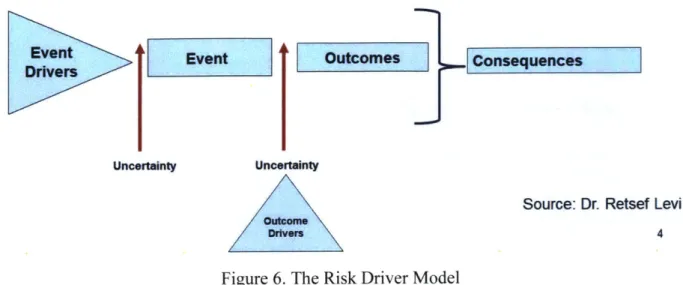
The Risk Driver model (Figure 6) describes the impact of risk event and outcome drivers on the uncertainty surrounding a risk event and its potential outcome, respectively. Risk drivers are defined as general conditions of the system, stakeholders, and environments that contribute to a heightened state of risk. This model is based on the widely accepted definition of risk as the severity of an event combined with the probability that the event will occur [20]. The model also employs the following terms to describe certain key aspects: Risk Events, Risk Outcomes, Risk (or Event) Drivers, and Outcome Drivers. These terms are defined as follows:
- Risk Event: the specific uncertain event that might occur
- Risk Outcome: the potential outcome(s) that will result if the risk event does occur
- Risk/Event Drivers: conditions of the environment, the system and the people in the system, that affect the likelihood of the risk event to occur
- Outcome Drivers: conditions of the environment, the system and the people in the system, that affect the magnitude of the outcome of the risk event if it indeed occurred [21]
Event Event Outcomes
Consequences rivers
Uncertainty Uncertainty
Source: Dr. Retsef Levi Outcome
DrIvers 4
Figure 6. The Risk Driver Model
Yiqun Hu (2017) uses a car accident as an example to illustrate the concepts of Event Drivers and Outcome Drivers:
"In general, a specific accident could be due to a variety of direct reasons such as loss of control of vehicle, failure to stop or the existence of foreign object on the road. Event drivers in this case could be road conditions, badly maintained car or tired driver. These are examples of event drivers related to the condition of the environment, the system, and the people in the system, respectively, which increase the likelihood of a car accident to occur. On the other hand, lack of safety features in the car could affect the magnitude of the injury from the crash, and is considered as an outcome driver." [21]
Risk driver analysis is distinct from root cause analysis. The root cause of an event is an initiating cause of either a condition or a causal chain that leads to an outcome or effect of interest [21]. The Risk Driver model is based on the assumption that there are relatively few risk drivers which are common to many risk events in a given system [22]. By eliminating and monitoring risk drivers, it is possible to reduce the likelihood of a variety of risk events simultaneously [21].
The existing literature on the Risk Driver model applies it in a hospital environment, but there are opportunities to apply this model in other industries. Additionally, both Traina and Hu use the Risk Driver model to analyze risk events that have already occurred. Hu identifies a
prospective approach to use current information to predict future risks as an opportunity for future work.
2.5.
Principles as a Foundation for Frameworks
Basic principles and concepts of risk management can establish a foundation for risk
management tools and frameworks. Olechowski et al (2016) propose that the eleven ISO 31000 principles should be used as an alternative to more rigid standardization. Uzulans (2016) claims that the correct use of the definition of risk and risk management concepts can promote the
development of project risk management documents [23]. Building a foundation based on principles can foster an improved shared understanding of risk management best practices. [5]
2.6. Chapter Summary
The literature cited in this chapter discusses existing industry standards for risk management and their commonalities, as well as common tools and frameworks that are used in research and
industry to enable effective risk management. There is a general consensus around the aspects of the risk management process, but researchers have raised questions around how effectively these theoretical procedures can be translated into practice. Additionally, the Risk Driver model has been proven to be effective in identifying risk drivers based on risk events that have occurred, but the Risk Driver model may be used to prospectively reduce risk. Existing literature posits that a strong understanding of risk management fundamentals may promote improved practices over simply repeating the steps of the established processes. The work done as part of this thesis
investigates the implementation of the risk management process at a specific contract
manufacturing company. The company's level of engagement in different practices is evaluated empirically. It explores how tools and frameworks can be used to build a foundation for risk management based on fundamental principles.
3 Current State of Risk Management at Flex
3.1. Introduction
At the initiation of this project, there were no standard processes at Flex for project risk
management that were consistently applied, even only within the HRS organization or the Health Solutions group. Some individual factory sites or teams did have defined project risk
management processes, tools, and practices, but these were generally not shared with other sites and teams. Flex did have some established standards for other areas of risk management, such as contract and inventory risk management. This chapter discusses the methodology used to
evaluate the current state of risk management in HRS and the resulting insights. The current state was evaluated both for the CGM Program specifically and also at the broader organization level.
3.2. The CGM Program
As mentioned in Chapter 1, Flex has recently begun production development on a new program to make continuous glucose monitors (CGMs) for one of their largest customers in the medical device industry. Due to the high risk-level, urgency, and new technical aspects of the program, it was chosen as the focus for this research project to identify areas for risk management
improvement and to pilot new processes and tools. In 2015, Flex won the contract to produce this CGM product in the United States. After several years of delays, development began at one of Flex's sites in the Chicago area in January 2018. The site is relatively new compared to some of Flex's other factories-it was purchased by Flex approximately 5 years ago and was originally used to produce precision plastic parts. The CGM Program requires significant investment in structural additions to the factory, including the installation of steel mezzanine levels and a concrete sterilization bunker, as well as specialized machinery and equipment. The customer and Flex's management have prioritized launching the program as quickly as possible in order to meet patient needs. The target date to start producing sellable units is in the fall of 2019. The program management team for the CGM Program is led by the Director of Program
Management, who is responsible for the overall program delivery as well as presenting out at a high-level to both senior management and in customer-facing meetings. He is supported by the
lead Program Manager (PM), who is responsible for managing various day-to-day activities such as tracking action items and team meetings. The lead PM is also responsible for understanding the technical details of the end-to-end production process. Both the Director of Program
Management and the lead PM are supported by a team of PMs that are each responsible for one of the key functional areas of the project. The functional areas include Automation, Sterilization, Facilities, Surface Mount Technology (SMT), Conveyor, Molding, IT, and Quality Systems.
3.3. Research Approach
The current state of project risk management practices in the HRS organization was assessed by evaluating the existing initiatives and tools related to risk management that are deployed across HRS at the corporate level.as well as the risk management practices currently in use on the CGM Program. At the organizational level, the current state of risk management standardization was assessed by interviewing key stakeholders on the Global Program Management and Strategy teams. For the CGM Program, this involved interviewing the program management team and reviewing the risk management data. The data came from two primary sources: Excel files used for logging identified risks and an online program management tool.
3.4. Organizational-Level Assessment
Several initiatives related to project risk management were ongoing within HRS at the corporate level at the time of the current state assessment. They include SHIELD, an online program management tool that includes risk-tracking functionality, the Medical PM 2.0 initiative, which established a new program manager role specifically for medical-related programs whose
responsibilities would include end-to-end project risk management, and PM Prime, a new online training program for Flex program managers.
3.4.1. SHIELD
The "Simplified Handshake to Inform, Execute, Launch, and Deliver", or SHIELD, is an online program management tool that was developed "in-house" by the HRS Global Program
Management team. The initial purpose for the tool was to give executive leaders real-time visibility into the financial information and status of the ongoing HRS programs across the
different Flex sites and to the facilitate the hand-off of projects from the commercial team (which negotiates the initial business proposal) to the factory team. SHIELD also provides a centralized location to record and update information related to each program from the initial planning phase through mass production. It also serves as a database for program data and as a form of
standardization for program management practices across different programs. SHIELD usage was mandated for all HRS programs, but adoption levels remained low. Users complained that the tool was frustrating to use because of its unintuitive user interface and slow response time. PMs preferred to use tools that they were familiar with, such as Microsoft Project, Excel, and PowerPoint. Even some executive leaders, for whom the tool was originally created, did not regularly reference the data in SHIELD.
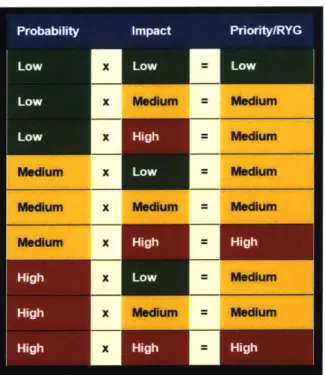
One of SHIELD's key features is a program homepage that has tabs for differcnt program trackers, including a Risk Register (for design and manufacturing), an Action Tracker, and Milestone Trackers. These tabs are updated by the program managers from program kick-off through mass production. The format of the SHIELD Risk Register is shown in Figure 8. It includes fields for a risk description, drop-down selections of High, Medium, or Low for risk probability and impact, and a field for a description of the risk response plan. The definitions of High, Medium, and Low probability and impact ratings as defined within the SHIELD tool are as follows:
- Low Probability: Unlikely to occur, but could
- Medium Probability: May occur
- High Probability: Likely to occur
- Low Impact: Minor impact on the project, and would create minor customer dissatisfaction
- Moderate Impact: Moderate impact on the project, and would create customer dissatisfaction
- High Impact: Major impact on the project, and would create significant customer dissatisfaction
One failure of these definitions is the lack of specificity and associated quantification, such as a percentage range assigned for each probability level. Another disadvantage of generalizing the
definition of low, moderate, and high probability level is the failure to involve any group
discussion of the underlying assumptions on which the probabilities are based. This could lead to differing interpretations of the risk levels across team members and misunderstanding of the true risk level. The matrix that defines the priority level for each risk based on the probability and impact rating is shown in Figure 7. The SHIELD tool is programmed so that a person entering a risk can select the probability and impact ratings from a drop-down menu, and the tool
automatically assigns a priority based on the matrix.
Figure 7. Risk priority matrix in SHIELD based on probability and impact While these are common features of risk register templates, the SHIELD risk register also includes additional functionality. For example, every time a change is made to a risk entry in the tool, the time and person making the edits is recorded and can be referred to later.
Mhstwm Tb Amu RNIG ta plan RAL5CJ.
Frm
PVV IRt
-1
As a risk management tool, SHIELD could be confusing for users. PMs who had been using the tool reported that they used the Risk Register to log both risks and issues, since there was no Issue Log feature built into SHIELD. A PM in the Automotive group, which had a higher rate of SHIELD adoption than the Health Solutions group, commented that typically only 5-10 risks would be tracked in the risk registers at a time for smaller programs. As a result, very little time was spent focusing on risk management.
3.4.2. Medical PM 2.0
The HRS Corporate Strategy team is leading an initiative called "Medical PM 2.0" to create a new Global Technical Program Manager (GTPM) role for high volume, highly technical medical programs. This initiative was driven by the need for improved continuity across the different phases of a program, from bidding for the contract to project scoping to development. In order to define the responsibilities for this new role, the Corporate Strategy team interviewed experienced PMs across Flex's different organizations and sites to identify existing gaps and potential
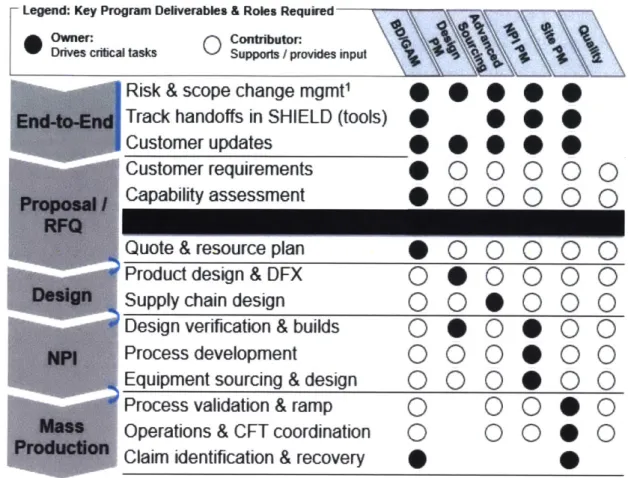
opportunities. Figure 9 shows the current state of program management roles and responsibilities as determined by this assessment. The key program deliverables (listed in the horizontal
categories) are distributed across multiple different individual roles over the end-to-end life of a program (listed in the vertical categories), including the Global Account Manager (GAM), Design PM, NPI PM, and Site PM. The chart in Figure 9 shows which roles are either owners or contributors for each key program deliverable. Risk management responsibilities are a subset of key program deliverables and are represented in Figure 9 by the "Risk and scope change mgmt" category, which is defined as robust assessment of risks and balancing tradeoffs between budget, schedule, and quality. Feedback from the PMs surveyed indicated that the distributed
accountability and hand-offs between different owners led to ineffective assessment of risks and tradeoffs. This failure to effectively assess program risks ultimately compromised the program schedule, as well as product cost and quality.
F
Legend: Key Program Deliverables & Roles Required* Owner: Q Contributor
Drhves criicd tasks Supports / provides input
End-to-En
Proposal IRFQ
Design
NPI
Mass
Production
dI
Risk & scope change mgmt Track handoffs in SHIELD (tools) Customer updates
Customer requirements Capability assessment
Quote & resource plan
@00000
@ 0000
0
() () 0
@ 0 0 0 00
Product design
&
DFX0
S 0 0 0
Q
Supply chain design
0
0
*
0
0
0
Design verification & builds
0
S
0*
0 Q
Process development
0
0
0
00
0
Equipment sourcing & design
0
0
0
00
0
Process validation & ramp
0
0 0
0
0
Operations & CFT coordination
0
0
0
0
0
Claim identification & recovery 0 4
1) Robust assessment of risks, baIsncing budge, quality, and timeline
+ updirng al irernal stakeholders oil changes apprpritely
Figure 9. Current state of HRS program management roles and responsibilities
Figure 10 shows the same roles and responsibilities table as Figure 10 but with the addition of the GTPM role. One of the key changes made is the centralization of ownership for all end-to-end program risk management responsibilities to the GTPM.
0
r)3
Legend: Key Program Deliverables & Roles Required * Dr nesr: C ontributor:
Drives crifical tasks Supports / provides input
End-to-End
Proposal I
RFQ
Design
NPI
Mass
Production
Risk & scope change mgmt' Track handoffs in SHIELD
Synchronized customer updates 0 0
0
00
0
00
0 0 0 0 00
0 Customer requirements*
0 0 0 0 0 0 Capability assessment*
0
0
0
0
0 0
Quote & resource plan
*
00
0
0
Q
*
Product design
&
DFXQ
Q Q Q Q
Supply chain design
Q Q
*
Q Q Q
*
Design verification & builds
Q
*
Q
*
Q Q
*
Process development
0
0
0
*
0 0
0
Equipment sourcing & design 0 0 0
*
0 0
*
Process validation & ramp
Q Q
0Q
*
0
Operations & CFT coordination
Q Q Q Q
*
Q
Claim identification & recovery
Figure 10. Proposed GTPM program management roles and responsibilities
3.4.3. PM Prime
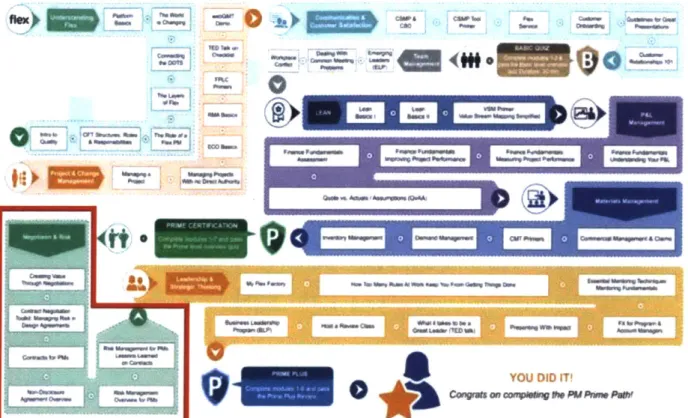
At Flex's factory sites, training programs are primarily developed and administrated by a Site Training Coordinator. Flex also develops company-wide trainings at the corporate level for subject areas that require or are suited to a higher level of standardization. Flex recently initiated an overhaul of internal program management training resources. The PM Prime training program was developed as part of this initiative. It provides a training roadmap (Figure 11) and materials related to fundamentals of program management, including risk management. The Risk
Management training module is outlined in red in Figure 11. This module occurs late in the training program and is intended only for advanced project managers. It mostly pertains to risk
management for contracts and non-disclosure agreements; while these subjects are related to project risk management, the training program fails to explicitly present project risk management


![Figure 4. The ISO 14971 standard risk management process [7]](https://thumb-eu.123doks.com/thumbv2/123doknet/14042067.459079/25.917.249.658.542.1036/figure-iso-standard-risk-management-process.webp)
![Figure 5. The benefits of using risk registers to record risks [17]](https://thumb-eu.123doks.com/thumbv2/123doknet/14042067.459079/27.917.164.684.147.530/figure-benefits-using-risk-registers-record-risks.webp)