Publisher’s version / Version de l'éditeur:
The Journal of Physical Chemistry C, 122, 8, pp. 4403-4408, 2018-02-07
READ THESE TERMS AND CONDITIONS CAREFULLY BEFORE USING THIS WEBSITE. https://nrc-publications.canada.ca/eng/copyright
Vous avez des questions? Nous pouvons vous aider. Pour communiquer directement avec un auteur, consultez la
première page de la revue dans laquelle son article a été publié afin de trouver ses coordonnées. Si vous n’arrivez pas à les repérer, communiquez avec nous à [email protected].
Questions? Contact the NRC Publications Archive team at
[email protected]. If you wish to email the authors directly, please see the first page of the publication for their contact information.
NRC Publications Archive
Archives des publications du CNRC
This publication could be one of several versions: author’s original, accepted manuscript or the publisher’s version. / La version de cette publication peut être l’une des suivantes : la version prépublication de l’auteur, la version acceptée du manuscrit ou la version de l’éditeur.
For the publisher’s version, please access the DOI link below./ Pour consulter la version de l’éditeur, utilisez le lien DOI ci-dessous.
https://doi.org/10.1021/acs.jpcc.7b12312
Access and use of this website and the material on it are subject to the Terms and Conditions set forth at
CO2 adsorption on PIMs studied with 13C NMR spectroscopy
Moore, Jeremy K.; Marti, Robert M.; Guiver, Michael D.; Du, Naiying;
Conradi, Mark S.; Hayes, Sophia E.
https://publications-cnrc.canada.ca/fra/droits
L’accès à ce site Web et l’utilisation de son contenu sont assujettis aux conditions présentées dans le site LISEZ CES CONDITIONS ATTENTIVEMENT AVANT D’UTILISER CE SITE WEB.
NRC Publications Record / Notice d'Archives des publications de CNRC:
https://nrc-publications.canada.ca/eng/view/object/?id=7e26dbfb-60a8-494f-b44f-e582d25251f8 https://publications-cnrc.canada.ca/fra/voir/objet/?id=7e26dbfb-60a8-494f-b44f-e582d25251f8
CO
2
Adsorption on PIMs Studied with
13
C NMR Spectroscopy
Jeremy K. Moore,
†Robert M. Marti,
†Michael D. Guiver,
§,∥Naiying Du,
⊥Mark S. Conradi,
‡,#and Sophia E. Hayes
*
,††
Department of Chemistry and‡
Department of Physics, Washington University, One Brookings Drive, Saint Louis, Missouri 63130, United States
§
State Key Laboratory of Engines (SKLE) and ∥Collaborative Innovation Center of Chemical Science and Engineering, Tianjin University, Tianjin 300072, China
⊥National Research Council Canada, Ottawa, Ontario K1A OR6, Canada #
ABQMR, 2301 Yale Boulevard SE, Albuquerque, New Mexico 87106, United States
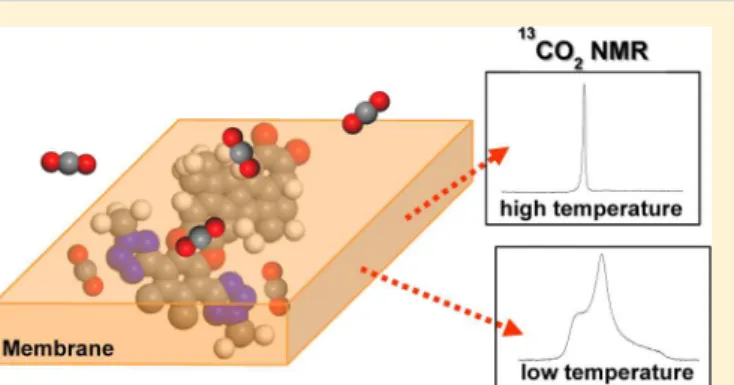
ABSTRACT: Polymers of intrinsic microporosity (PIMs) can be functionalized with nitrogen-bearing groups, such as a nitrile group for PIM-1 and a methylated tetrazole group for MTZ-PIM, to physisorb CO2. Static 13C NMR spectroscopy
was used to investigate CO2 dynamics by analysis of
one-dimensional spectra and T2 relaxation times at temperatures
ranging from 6 to 295 K. Each polymer had two different loadings of CO2 to determine the dominating relaxation
mechanism at lower temperatures and deduce the identity of the weaker secondary adsorption site on the rigid polymer backbone. Both polymers, with a high loading of CO2,
experience a narrowing of the 13C NMR line width as the
samples are warmed to 80 K, which is the onset of the weakly adsorbed CO2hopping on and off the polymer backbone.
■
INTRODUCTIONThe process of CO2capture is a set of strategies for reducing
the emissions of carbon dioxide, with the goal of mitigating increased concentrations of atmospheric CO2.1−5Studies have
focused on capturing CO2 from mobile sources, such as
automobiles, and large emitters, including power plants and cement factories.6,7 The materials utilized here have potential applications as membrane capture materials for high-concen-tration emission sources, such as flue gases from power plants that burn hydrocarbon fuels. For coal-fired plants, these gas mixtures are typically composed of ∼70% N2, ∼15% CO2, and
∼10% H2O.6
Current technologies for removing CO2 from flue gas
primarily use liquid amines,6,8−10 in which CO
2 is bubbled
through the solution, where it dissolves and reacts to form a chemisorbed product with the amine-bearing molecules. The solution-state capture materials have drawbacks such as amine leaching, chemical degradation, and high energy requirements for desorption and regeneration.6 Solid adsorbents that physisorb CO2, such as those studied here, have been proposed
as future carbon capture technologies because they will be able to avoid some of the limitations of current technologies.
Solid adsorbent materials exploit physisorption interactions to capture CO2. Physisorption of nitrogen-bearing sorbents
relies on van der Waals interactions between an electron-rich adsorbing group and the electron-deficient carbon on the gas molecule to adsorb CO2 molecules onto a surface. These
interactions restrict (and likely stop) the motion of the
adsorbed CO2 molecules but do not disrupt its electronic
structure. Physisorption interactions have been shown to occur with CO2 by metal−organic frameworks (MOFs)11−14 and
polymers of intrinsic microporosity (PIMs).15−20 The PIMs studied here are depicted in Figure 1, which differ in the substitutions of the aryl backbone at two sites. Methyl tetrazole (MTZ)-PIM is prepared by a simple two-step reaction from PIM-1.18
Materials that exhibit CO2physisorption can be utilized as
membrane capture technologies,15,21−25 where CO
2 is
sepa-rated from flue gas by attracting CO2preferentially through the
Received: December 14, 2017 Revised: February 6, 2018 Published: February 7, 2018
Figure 1.Structures of PIM-1 (left) and MTZ-PIM (right) polymers. PIM-1 has a nitrile-binding unit, whereas MTZ-PIM has a methyl tetrazole unit for adsorption of CO2.
pubs.acs.org/JPCC
material. Physisorption materials typically have a low energy requirement for regeneration of the adsorbing material due to the minimal energy required to overcome weak van der Waals interactions that attract the CO2 molecules. As membrane
capture materials, they can be used as efficient CO2 capture
technologies by balancing the selectivity and permeability of the material to allow preferential passage of CO2.
Solid-state NMR spectroscopy has been used to study a series of PIM adsorption materials. The polymers have micropores that allow for high gas permeability due to a combination of the rigid backbone and sites of contortion in the polymer chain that does not allow efficient chain packing. Once CO2gas has entered the pore space, it can be captured
through interactions with the electron-rich adsorbing groups on the PIMs. Each sample has at least two adsorbing groups per repeating unit of polymer, which are randomly oriented within the polymer sample due to the contorted chain packing. PIM-1 has an electron-rich nitrile group that adsorbs CO2 by
interaction with the carbon in carbon dioxide, which is electron-deficient. Similar interactions have been modeled from ab initio studies and show an in-plane configuration of CO2with the nitrogen unit.26This interaction for both PIMs is
depicted inFigure 2.
The nitrile on PIM-1 can be replaced with more CO2-philic
groups, such as tetrazole (TZ-PIM)15 or methyl tetrazole (MTZ-PIM).18 TZ-PIM was synthesized by a [2 + 3] cycloaddition postpolymerization reaction that has been previously described,15 and MTZ-PIM was synthesized by methylating the tetrazole group of TZ-PIM.18 MTZ-PIM, shown inFigure 2(right), is able to adsorb CO2through the
methyl tetrazole group at the 3-position, which is electron-rich. In the present work, in situ13C NMR spectroscopy was used
to study the adsorption of CO2on PIMs because it can detect
and distinguish the gas-phase and adsorbed-phase13CO 2within
the material and report on dynamics using T2measurements.
The study was done over a range of temperatures and with two loadings of13CO2for each of the PIM materials. The13C NMR
line shapes and T2 relaxation times were analyzed to give
insights into the adsorption interactions present over the temperature and CO2-loading ranges. Combining information
on the adsorption interactions from in situ 13C NMR
spectroscopy with macroscopic studies, including permeability, isotherms, and selectivity, will assist in improving current CO2
separation technologies.
■
MATERIALS AND METHODSPIM samples underwent a bake-out procedure at 80 °C under vacuum for 24 h for degassing the polymer. Approximately 100−200 mg of the polymer sample was used for the NMR experiments. A known quantity, determined from iso-therms,15,18 of 99% 13C-enriched CO
2 gas (Sigma-Aldrich)
was introduced to the PIM samples for adsorption. To allow for thermal contact during the low-temperature experiments, 0.9 atm of helium gas was also introduced to the samples. After all of the gas was introduced to the sample, the tube for each sample was flame-sealed.
Variable-temperature13C NMR below 150 K was performed in a Kadel helium research dewar with a laboratory-built NMR probe. NMR studies above 150 K were performed with a second laboratory-built NMR probe, where cooling was provided by a temperature-regulated stream of evaporated liquid nitrogen. All data for the NMR studies were acquired using a Hahn echo27sequence with a π pulse length of 12 μs. Depending on the temperature, a last delay of 5−35 s was used to acquire 64 transients for all spectra. The spectra were obtained via an echo pulse spacing (τ delay) of 50 μs. The lower signal-to-noise ratio in the low-loading samples arises from having fewer13C nuclei as fewer 13CO2 molecules were
introduced to these samples.
■
RESULTS AND DISCUSSIONThe adsorption interactions were investigated by variable-temperature, static 13C NMR spectroscopy with high and low
CO2-loaded polymer samples. The “low-loading” samples of
PIM-1 and MTZ-PIM were prepared with x = 0.33 and 0.34, respectively, where x represents the number of CO2molecules
per binding unit of the PIMs, to generate a state where each CO2 molecule has an available adsorbing site. The
“high-loading” samples were loaded with x = 1.5 for both samples, to provide an excess of CO2such that the gas molecules had to
compete for the electron-rich adsorbing sites. An analysis of the pore size distribution of the related PIM-1 powder28shows the existence of microporous and mesoporous pores in a broad distribution of sizes ranging from approximately 0.6 to 12 nm. We anticipate only moderate differences between PIM-1 and MTZ-PIM; thus, we assume MTZ-PIM has a relatively similar pore size distribution as PIM-1. The packing of the polymer and the small pore sizes together result in a crowding effect that causes some adsorbing units to be sterically hindered and inaccessible for adsorption. However, the CO2-to-adsorbing
unit ratio was calculated for the idealized condition that every adsorbing group in the sample is accessible. Therefore, there are additional CO2 molecules present as compared to the
available binding sites. Any CO2molecules that are not able to
interact with an electron-rich adsorbing site will be forced to adsorb to less favorable adsorption sites within the polymer.
The temperature range studied was 6−295 K for each sample, where it can be assumed that a near-constant concentration of adsorbed CO2 is covering the polymer
(fixed quantity of 13CO
2 in a sealed tube). This assumption
can break down at higher temperatures, where some of the adsorbed CO2molecules could occupy the gas phase. However,
the assumption of constant concentration can be made here because the void space volume within the sample tube, where gas-phase molecules can inhabit, is minimized. The setup here allows for an efficient study of adsorbed dynamics. In addition to constant CO2 loading, the presence of the polymer
Figure 2. Depiction of nitrile unit from PIM-1 (left) and methyl tetrazole unit of MTZ-PIM (right) in van der Waals contact with CO2.
The dashed line is a representation of the adsorption interaction.
The Journal of Physical Chemistry C Article
DOI:10.1021/acs.jpcc.7b12312 J. Phys. Chem. C 2018, 122, 4403−4408
concentrates CO2 in the sample space, meaning that the13C
NMR signal intensity is much larger in the presence of the polymer than that in an identical tube filled only with 13CO
2
gas.
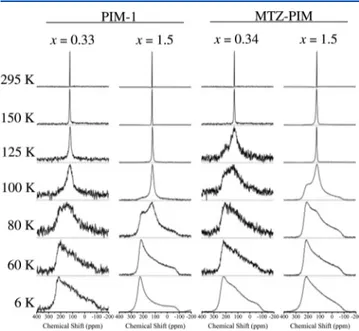
Figure 3depicts13C NMR spectra for the samples described
above at representative temperatures from the study. Overall,
each sample is observed to have13C NMR line shape narrowing
at increased temperatures. All measurements were conducted with a known amount of 13CO
2, equal number of scans, and
under fully relaxed quantitative conditions (5 × T1, the spin−
lattice relaxation time). Typical indications of physisorption in NMR spectra include an enhancement in signal (relative to gas alone filling the NMR sample space, indicating that the polymer concentrates the 13CO
2 present) and a broadening of the
resonance, both with no change in the isotropic chemical shift. These observable spectral features are due to the physisorption van der Waals interaction, which slows the motion of the CO2
gas molecules without perturbing the CO2molecules’ electronic
environment. Compared to the line width of CO2gas, there is
possibly some portion of the line broadening due to a minor effect from the magnetic susceptibility differences introduced by the PIM materials, particularly at high temperature, where the line is the narrowest.
The analysis of the13C NMR line shape data must begin by
considering the nuclear spin interactions that can broaden the resonance of adsorbed13CO
2. The line broadening of adsorbed 13CO
2 is dominated by three such interactions. One is the
chemical shift anisotropy (CSA),29 which is characteristic of linear CO2molecules. The other two interactions are dipolar
coupling interactions:1H−13C dipolar coupling between13CO 2
and the hydrogen atoms on the adsorbent polymer and
13C−13C homonuclear dipolar coupling between two adsorbed 13CO
2molecules.
The dominant line-broadening mechanism at low temper-atures, where CO2 is static (not rotating on the NMR time
scale of 10−4s), is the CSA. At 6 K, as described below, an
additional source of line broadening is present. At low temperatures, all four samples have an axially symmetric
powder pattern in the13C NMR spectrum. This line shape is
indicative of adsorbed CO2 molecules on the PIM materials,
and it arises because the13C tensor for the CO
2molecule has
only two unique principal values (δxx = δyy and δzz): two perpendicular to the C−O−C bond and one parallel to this bond. Previously, randomly oriented solid13CO
2has been seen
to exhibit a characteristic line shape,30,31which is similar to the resonance of the adsorbed 13CO
2. Therefore, it can be
recognized that the orientation of adsorbed CO2 molecules
on the NMR time scale (10−4s) is nearly fixed with respect to
the magnetic field. The 13CO
2molecules can have a random
orientation because the PIM chain orientation is random in nature and the functional groups on the PIM samples have a fixed orientation with respect to the backbone. This means that the orientation of the functional groups is randomly distributed with respect to the magnetic field. Therefore, when CO2
molecules are adsorbed on the polymer, they have a fixed molecular orientation with an isotropic distribution with respect to the magnetic field, which results in an axially symmetric CSA powder pattern.
To best describe the spectra below 80 K, the width of the CSA powder pattern, Δσeff, should be measured. For both the
PIM-1 and MTZ-PIM samples at 60 K, the Δσeff values are
similar, 324.2 and 325.2 ppm, respectively. This is similar to the previously reported values for physisorbed CO2 on TZ-PIM
(290 ppm)32and an MOF (315.3 ppm)12−14 as well as solid CO2(325 ppm).30A slight narrowing of the line shape in this
temperature range is due to librational motions (orientational “wiggling”) within the adsorption site.32,33 The librational motion is defined by the angle θ, which is defined as that between the long axis of the CO2molecule and the axis of the
energetically-preferred direction when adsorbed at the given site. Increasing the temperature creates a distribution of θ values due to motion of the adsorbed CO2molecules within the
adsorption site. This motion leads to a time-averaged CSA and a narrowing of the13C NMR spectra. The width of the CSA,
Δσeff, can be calculated byeq 1because the line broadening is
dominated by the CSA interaction.34
σ σ θ Δ = Δ ⎜⎛ − ⎟ ⎝ ⎞ ⎠ 3 2cos 1 2 eff 2 (1)
where Δσ is the full width of the CSA powder pattern when CO2is orientationally static. At the lowest temperatures, θ = 0
(neglecting quantum zero-point motion) and Δσeff is equal to
Δσ. When θ increases as the temperature increases, thecos2θ
term decreases and the width of the CSA powder pattern slightly narrows. It is worth noting here that a “head-to-tail” flip of the adsorbed CO2molecule adds π to the angle θ, leaving the
cosine-squared term unchanged. Therefore, this flipping motion has no effect on the width of the CSA.
As the temperature is increased further, the adsorbed CO2
molecules begin to reorient through translational hopping from one adsorption site to another. Figure 4 depicts the translation−reorientation hopping motion. Because every adsorption site has a unique alignment with respect to the magnetic field, the CO2molecules change orientation when the
hop occurs. Therefore, the CSA powder pattern is averaged due to the motion. This narrowing due to the hopping motion is evident starting at 80−100 K in the samples. The line narrowing that occurs due to joint translation−reorientation hopping has been studied previously in solid CO2,30α-CO,35
Figure 3.13C variable-temperature solid-state NMR spectra of CO2
adsorbed on PIM-1 (left) and MTZ-PIM (right) samples, where x represents the number of CO2molecules per binding unit.
N2O,36 and benzene37 as well as CO2adsorbed on an MOF
material12−14and TZ-PIM.32
As the temperature is increased further, the hopping motion becomes rapid on the NMR time scale, which time-averages the CSA interaction essentially to zero. With rapid CO2 hopping
between the orientationally random adsorption sites, the 13C
NMR spectrum is a single, symmetric resonance. This symmetric resonance continues to narrow as the temperature is increased further, indicating that the hopping motion continues to become more rapid. As the temperature increases, the van der Waals interactions that adsorb the CO2molecule to
the electron-rich adsorbing group become smaller relative to the thermal energy of the system.
When adsorbed CO2 molecules are tightly bound, at low
temperatures, the line width is nearly constant for the CSA powder pattern. After the CO2molecules begin the site-to-site
hopping mechanism, around 100 K, the line width decreases rapidly. The line width in both of the high-loading samples begins to narrow at a lower temperature (compared to the low-loading samples) and is slightly narrower during the onset of hopping because there are more weakly sorbed CO2molecules
in these samples (the strongest binding sites are fully occupied, forcing some CO2to adsorb on weaker sites). Above 100 K, the
high-temperature regime, the line width decreases due to rapid CO2reorientations that accompany the translational hopping
mechanism. It is therefore unsurprising that the narrowing occurs at the lower temperature for both high-loading samples relative to the low-loading samples. MTZ-PIM retains more of a CSA-broadened component at 100−125 K, suggestive of stronger adsorption interactions relative to PIM-1 at those temperatures.
The13C NMR line shape analysis of CO
2adsorbed on
MTZ-PIM is similar to that seen previously on TZ-MTZ-PIM.32 CO2
adsorbed on PIM-1 has similar trends but clearly does not adsorb CO2as strongly as MTZ-PIM. This is evidenced by the
narrowing of the13C resonance in the low-loading samples by
100 K in the PIM-1 sample as opposed to 125 K in the MTZ-PIM sample. The variable-temperature study indicates
differ-ences in the hopping between the low- and high-loading samples for both polymers. The onset of site-to-site hopping for the low-loading samples of both PIM materials studied here occurs in a single step. These data indicate that each of the CO2
molecules are adsorbed on similar sites, which must be the more favorable adsorbing sites because the first molecules will go to the lowest-energy sites. Alternatively, the high-loading samples have two steps to fully narrow the resonance, with the first near 80 K and the second near 125 K. This finding indicates that the high-loading samples have two subsets of CO2 molecules, one that is more tightly adsorbed than the
other. The more tightly adsorbed CO2molecules continue to
be detected as a CSA powder pattern resonance. Because the two subsets have different affinities for CO2, it is presumed that
they access two different adsorption sites.
At the lowest temperature, 6 K, the13C resonance broadens
by a mechanism other than the CSA interaction and has an increase in signal-to-noise ratio (due to the 1/T nuclear magnetization). The general shape of the CSA powder pattern can still be seen, but there is an overall broadening of the features; this is most obvious in the high-loading MTZ-PIM sample (compare 6 and 60 K spectra). At these temperatures, the broadening mechanism is not able to be ascribed to molecular motions because they are frozen out at 80 K. Therefore, we attribute this broadening to the magnetic susceptibility of electrons in the material, as described for CO2adsorption on TZ-PIM32and seen in Mg-MOF-74.12−14
Probably, this is from paramagnetic impurity centers.
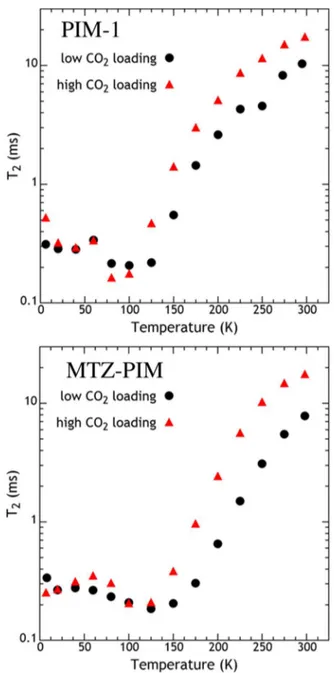
The 13C spin−spin (transverse) relaxation time, T2, was
measured across the same temperature range to assist in determining the mechanisms of line narrowing at each temperature.30,38These data are shown inFigure 5, and both plots look very similar.30,38
The dipolar coupling interactions (1H−13C and 13C−13C)
and molecular motions both contribute to the measured T2for
adsorbed CO2. When dipolar coupling is present, it is observed
by NMR spectroscopy through echo attenuation, which leads to a shorter T2. Alternatively, if the dipolar coupling is averaged
to zero, the signal is not attenuated and the T2remains long. In
the low-temperature range, the relaxation is determined by the
13C−13C dipolar coupling between adsorbed13CO
2molecules
and the 13C−1H dipolar coupling between an adsorbed CO 2
molecule and hydrogen from the adsorbing group. There is no apparent change in T2with different loadings of CO2, indicating
that the 1H−13C dipolar interaction dominates the relaxation
mechanism. In this temperature range, there are no CO2
translations to average out these dipolar interactions, as has been previously described.32From 6 to 60 K, the T
2values in
all samples are consistent, indicating that the dipolar coupling is not changing with temperature because the CO2 hopping
motion is frozen out in this temperature range.
Around 60 K, the T2relaxation begins to decrease due to the
onset of CO2 reorientational motion.30,35 This temperature
regime from 60 to 125 K, the strong collision regime,35,39is defined by a CO2molecule undergoing a single reorientation,
which causes the 13C spin to lose coherence, changing the
frequency and therefore attenuating the echo signal, resulting in a decreased T2. The mean time between hopping events is
approximately the T2 relaxation time in this intermediate
temperature range. T2 stops decreasing when molecular hops
occur approximately once during the rigid-lattice free induction decay, which is approximately 100 μs.30For higher hop rates, line narrowing occurs and T2increases. The high-loading PIM
Figure 4. Translational−reorientation hopping of CO2 from one
methyl tetrazole binding unit to another on MTZ-PIM. A similar depiction can be shown for PIM-1, where CO2 undergoes
transla-tional−reorientation hopping from one nitrile binding unit to another.
The Journal of Physical Chemistry C Article
DOI:10.1021/acs.jpcc.7b12312 J. Phys. Chem. C 2018, 122, 4403−4408
samples show an earlier onset of increase of T2relaxation time
(i.e., at a lower temperature) compared to the low-loading PIM samples. This lower-temperature threshold is due to the subset of CO2molecules that are adsorbed on the weaker adsorption
sites and therefore begin hopping at a lower temperature. The T2values for the PIM-1 samples begin to increase around 100
K, whereas those for the MTZ-PIM samples begin to increase around 125 K. This difference is caused by the greater strength of adsorption for the methyl tetrazole-adsorbing groups.
In the high-temperature regime (above 125 K), the CO2
molecules undergo fast reorientational hopping as well as translational hops. This motion causes the T2to increase as the
temperature rises. The mechanism of site-to-site hopping is confirmed when the T2value surpasses the low-temperature T2
plateau, near 150 K. The plateau was determined by dipolar coupling, which required the CO2molecule to be located at a
single adsorption site. These dipolar couplings are averaged to zero by the fast translational hopping at these temperatures.
In both PIM samples, the onset of hopping from the weakly adsorbed CO2molecules is evident at 80 K and the hopping
occurs rapidly at 100 K. This result is demonstrated by the CSA powder pattern being averaged to zero. Because weakly adsorbed CO2 molecules on both PIM-1 and MTZ-PIM
exhibit a comparable hopping mechanism, also shown for TZ-PIM previously,32the second adsorption site on each polymer must be similar. When comparing the structure of these polymer samples, as shown inFigure 1, the consistent moiety in each sample is the polymer backbone. Hence, we conclude that the functional group is not responsible for the binding of the secondary adsorption site and that the weakly adsorbed CO2
molecules are binding to the polymer chain. If this site would have also been on the adsorbing unit, it would be expected to be absent on at least the PIM-1 samples, as the nitrile group would not support two adsorbed CO2molecules.
■
CONCLUSIONSIn this variable-temperature NMR study, it has been shown that CO2undergoes translation−reorientation hopping between the
adsorption sites of PIM-1 and MTZ-PIM. The data show that the site-to-site hopping starts with infrequent jumps at 80 K for the PIM-1 sample and at 100 K for the MTZ-PIM sample. This finding indicates that CO
2 is more tightly adsorbed in the
methyl tetrazole-containing sample as opposed to PIM-1. The
13C NMR CSA powder pattern is time-averaged above 150 K,
which indicates that above this temperature the hopping mechanism has become rapid (faster than 105 s−1) for all
samples. It can also be seen in the lower-temperature range that a second adsorption site is found in both samples when there is an excess of CO2 introduced to the polymer sample. This
second adsorption site does not bind CO2as tightly, evidenced
by the13C resonance narrowing at a lower temperature due to
hopping. From these data, it is apparent that the second adsorption site is conserved between both PIM-1 and MTZ-PIM materials. The conserved moiety in these samples, as well as the previously studied TZ-PIM,32 is the PIM backbone. Therefore, the data suggest that the weakly adsorbing site is an electron-rich region of the polymer itself (likely the benzodioxane ring), as opposed to being on the functional groups that distinguish these three materials (polymers) from one another.
■
AUTHOR INFORMATIONCorresponding Author
*E-mail: [email protected]. Phone: 314-935-4624.
ORCID
Robert M. Marti:0000-0003-0334-4135
Michael D. Guiver:0000-0003-2619-6809
Sophia E. Hayes:0000-0002-2809-6193 Notes
The authors declare no competing financial interest.
■
ACKNOWLEDGMENTSThis work was supported, in part, by the Center for Understanding and Control of Acid Gas-Induced Evolution of Materials for Energy (UNCAGE-ME), an Energy Frontier Research Center funded by the U.S. Department of Energy, Office of Science, Basic Energy Sciences under Award No. DE-SC0012577.
Figure 5. Semilogarithmic plot of T2 relaxation times (ms) vs
■
REFERENCES(1) Didas, S. A.; Kulkarni, A. R.; Sholl, D. S.; Jones, C. W. Role of Amine Structure on Carbon Dioxide Adsorption from Ultradilute Gas Streams such as Ambient Air. ChemSusChem 2012, 5, 2058−2064.
(2) Hicks, J. C.; Drese, J. H.; Fauth, D. J.; Gray, M. L.; Qi, G.; Jones, C. W. Designing Adsorbents for CO2 Capture from Flue
Gas-Hyperbranched Aminosilicas Capable of Capturing CO2Reversibly. J.
Am. Chem. Soc. 2008, 130, 2902−2903.
(3) Samanta, A.; Zhao, A.; Shimizu, G. K. H.; Sarkar, P.; Gupta, R. Post-Combustion CO2Capture Using Solid Sorbents: A Review. Ind.
Eng. Chem. Res. 2012, 51, 1438−1463.
(4) Choi, S.; Drese, J. H.; Jones, C. W. Adsorbent Materials for Carbon Dioxide Capture from Large Anthropogenic Point Sources. ChemSusChem 2009, 2, 796−854.
(5) Schuiling, R. D.; de Boer, P. L. Six Commercially Viable Ways to Remove CO2from the Atmosphere And/or Reduce CO2Emissions.
Environ. Sci. Eur. 2013, 25, No. 35.
(6) Bhown, A. S.; Freeman, B. C. Analysis and Status of Post-Combustion Carbon Dioxide Capture Technologies. Environ. Sci. Technol. 2011, 45, 8624−8632.
(7) Jones, C. W. CO2Capture from Dilute Gases as a Component of
Modern Global Carbon Management. Annu. Rev. Chem. Biomol. Eng. 2011, 2, 31−52.
(8) Sharma, S.; Azzi, M. A Critical Review of Existing Strategies for Emission Control in the Monoethanolamine-Based Carbon Capture Process and Some Recommendations for Improved Strategies. Fuel 2014, 121, 178−188.
(9) Yang, Q.; Bown, M.; Ali, A.; Winkler, D.; Puxty, G.; Attalla, M. A Carbon-13 NMR Study of Carbon Dioxide Absorption and Desorption with Aqueous Amine Solutions. Energy Procedia 2009, 1, 955−962.
(10) Mani, F.; Peruzzini, M.; Stoppioni, P. CO2 Absorption by
Aqueous NH3 Solutions: Speciation of Ammonium Carbamate,
Bicarbonate and Carbonate by a 13C NMR Study. Green Chem.
2006, 8, 995−1000.
(11) Queen, W. L.; Brown, C. M.; Britt, D. K.; Zajdel, P.; Hudson, M. R.; Yaghi, O. M. Site-Specific CO2 Adsorption and Zero Thermal
Expansion in an Anisotropic Pore Network. J. Phys. Chem. C 2011, 115, 24915−24919.
(12) Kong, X.; Scott, E.; Ding, W.; Mason, J. A.; Long, J. R.; Reimer, J. A. CO2Dynamics in a Metal-Organic Framework with Open Metal
Sites. J. Am. Chem. Soc. 2012, 134, 14341−14344.
(13) Lin, L.-C.; Kim, J.; Kong, X.; Scott, E.; McDonald, T. M.; Long, J. R.; Reimer, J. A.; Smit, B. Understanding CO2Dynamics in
Metal-Organic Frameworks with Open Metal Sites. Angew. Chem., Int. Ed. 2013, 52, 4410−4413.
(14) Marti, R. M.; Howe, J. D.; Morelock, C. R.; Conradi, M. S.; Walton, K. S.; Sholl, D. S.; Hayes, S. E. CO2Dynamics in Pure and
Mixed-Metal MOFs with Open Metal Sites. J. Phys. Chem. C 2017, 121, 25778−25787.
(15) Du, N.; Park, H. B.; Robertson, G. P.; Dal-Cin, M. M.; Visser, T.; Scoles, L.; Guiver, M. D. Polymer Nanosieve Membranes for CO2
-Capture Applications. Nat. Mater. 2011, 10, 372−375.
(16) Budd, P. M.; Elabas, E. S.; Ghanem, B. S.; Makhseed, S.; McKeown, N. B.; Msayib, K. J.; Tattershall, C. E.; Wang, D. Solution-Processed, Organophilic Membrane Derived from a Polymer of Intrinsic Microporosity. Adv. Mater. 2004, 16, 456−459.
(17) Budd, P. M.; Ghanem, B. S.; Makhseed, S.; McKeown, N. B.; Msayib, K. J.; Tattershall, C. E. Polymers of Intrinsic Microporosity (PIMs): Robust, Solution-Processable, Organic Nanoporous Materials. Chem. Commun. 2004, 230−231.
(18) Du, N.; Robertson, G. P.; Dal-Cin, M. M.; Scoles, L.; Guiver, M. D. Polymers of Intrinsic Microporosity (PIMs) Substituted with Methyl Tetrazole. Polymer 2012, 53, 4367−4372.
(19) Gemeda, A. E.; De Angelis, M. G.; Du, N.; Li, N.; Guiver, M. D.; Sarti, G. C. Mixed Gas Sorption in Glassy Polymeric Membranes. III. CO2/CH4Mixtures in a Polymer of Intrinsic Microporosity (PIM-1):
Effect of Temperature. J. Membr. Sci. 2017, 524, 746−757.
(20) Wang, S.; Li, X.; Wu, H.; Tian, Z.; Xin, Q.; He, G.; Peng, D.; Chen, S.; Yin, Y.; Jiang, Z.; et al. Advances in High Permeability Polymer-Based Membrane Materials for CO2 Separations. Energy
Environ. Sci. 2016, 9, 1863−1890.
(21) Guiver, M. D.; Lee, Y. M. Polymer Rigidity Improves Microporous Membranes. Science 2013, 339, 284−285.
(22) Du, N.; Park, B.; Dal-Cin, M. M.; Guiver, M. D. Advances in High Permeability Polymeric Membrane Materials for CO2. Energy
Environ. Sci. 2012, 5, 7306−7322.
(23) Lin, H.; Freeman, B. D. Materials Selection Guidelines for Membranes That Remove CO2 from Gas Mixtures. J. Mol. Struct.
2005, 739, 57−74.
(24) Merkel, T. C.; Lin, H.; Wei, X.; Baker, R. Power Plant Post-Combustion Carbon Dioxide Capture: An Opportunity for Mem-branes. J. Membr. Sci. 2010, 359, 126−139.
(25) Shao, P.; Dal-Cin, M. M.; Guiver, M. D.; Kumar, A. Simulation of Membrane-Based CO2 Capture in a Coal-Fired Power Plant. J.
Membr. Sci. 2013, 427, 451−459.
(26) Vogiatzis, K. D.; Mavrandonakis, A.; Klopper, W.; Froudakis, G. E. Ab Initio Study of the Interactions between CO2and N-Containing
Organic Heterocycles. ChemPhysChem 2009, 10, 374−383. (27) Hahn, E. L. Spin Echoes. Phys. Rev. 1950, 80, 580−594. (28) Polak-Kraśna, K.; Dawson, R.; Holyfield, L. T.; Bowen, C. R.; Burrows, A. D.; Mays, T. J. Mechanical Characterisation of Polymer of Intrinsic Microporosity PIM-1 for Hydrogen Storage Applications. J. Mater. Sci. 2017, 52, 3862−3875.
(29) Fukushima, E.; Roeder, S. B. W. Experimental Pulse NMR: A Nuts and Bolts Approach; Addison-Wesley Publishing Company, 1981. (30) Liu, S. B.; Doverspike, M. A.; Conradi, M. S. Combined Translation-Rotation Jumps in Solid Carbon Dioxide. J. Chem. Phys. 1984, 81, 6064−6068.
(31) Ratcliffe, C. I.; Ripmeester, J. A.1H and13C NMR Studies on
Carbon Dioxide Hydratet. J. Phys. Chem. 1986, 90, 1259−1263. (32) Moore, J. K.; Guiver, M. D.; Du, N.; Hayes, S. E.; Conradi, M. S. Molecular Motions of Adsorbed CO2on a Tetrazole-Functionalized
PIM Polymer Studied with13C NMR. J. Phys. Chem. C 2013, 117,
22995−22999.
(33) Bayer, H. Theory of Spin-Lattice Relaxation in Molecular Crystals. Z. Physik 1951, 130, 227−238.
(34) Mehring, M. Principles of High Resolution NMR in Solids, 2nd ed.; Springer, 1983.
(35) Liu, S.; Conradi, M. S. Combined Translational-Rotational Jumps in Solid Alpha-CO. Phys. Rev. B 1984, 30, 24−31.
(36) Ouyang, B.; Conradi, M. S. Nuclear-Magnetic-Resonance Determination of the Mechanism of Molecular Reorientation in Solid N2O. Phys. Rev. B 1991, 44, No. 9295.
(37) Gullion, T.; Conradi, M. S. Anisotropic Diffusion in Benzene:
13C NMR Study. Phys. Rev. B 1985, 32, No. 7076.
(38) Rothwell, W. P.; Waugh, J. S. Transverse Relaxation of Dipolar Coupled Spin Systems under Rf Irradiation: Detecting Motions in Solids. J. Chem. Phys. 1981, 74, 2721−2732.
(39) Slichter, C. P. Principles of Magnetic Resonance, 3rd ed.; Springer, 1990.
The Journal of Physical Chemistry C Article
DOI:10.1021/acs.jpcc.7b12312 J. Phys. Chem. C 2018, 122, 4403−4408