HAL Id: hal-01709021
https://hal.archives-ouvertes.fr/hal-01709021
Submitted on 14 Feb 2018HAL is a multi-disciplinary open access
archive for the deposit and dissemination of sci-entific research documents, whether they are pub-lished or not. The documents may come from teaching and research institutions in France or abroad, or from public or private research centers.
L’archive ouverte pluridisciplinaire HAL, est destinée au dépôt et à la diffusion de documents scientifiques de niveau recherche, publiés ou non, émanant des établissements d’enseignement et de recherche français ou étrangers, des laboratoires publics ou privés.
Towards a new oxidation process using ozone to
regenerate coked catalysts
Romain Richard, Carine Julcour-Lebigue, Marie-Hélène Manero
To cite this version:
Romain Richard, Carine Julcour-Lebigue, Marie-Hélène Manero. Towards a new oxidation process using ozone to regenerate coked catalysts. Ozone: Science & Engineering, 2017, vol. 39 (n° 5), pp. 366-373. �10.1080/01919512.2017.1326005�. �hal-01709021�
O
pen
A
rchive
T
OULOUSE
A
rchive
O
uverte (
OATAO
)
OATAO is an open access repository that collects the work of Toulouse researchers and
makes it freely available over the web where possible.
This is an author-deposited version published in :
http://oatao.univ-toulouse.fr/
Eprints ID : 19531
To link to this article : DOI:
10.1080/01919512.2017.1326005
URL :
https://doi.org/10.1080/01919512.2017.1326005
To cite this version :
Richard, Romain
and Julcour, Carine
and Manero,
Marie-Hélène
Towards a new oxidation process using ozone to
regenerate coked catalysts. (2017) Ozone: Science & Engineering,
vol. 39 (n° 5). pp. 366-373. ISSN 1547-6545
Any correspondence concerning this service should be sent to the repository
administrator:
[email protected]
Towards a New Oxidation Process Using Ozone to Regenerate Coked Catalysts
Romain Richard , Carine Julcour, and Marie-Hélène ManeroLaboratoire de Génie Chimique, Université de Toulouse, CNRS, INPT, UPS, 31432 Toulouse, France
ABSTRACT
This work focuses on the regeneration of a zeolite catalyst from industry deactivated by fouling with coke. To replace high temperature combustion, a common and energy intensive process, an oxidation process under milder conditions (50 °C–200 °C) has been investigated using ozone. Coked zeolite has been oxidized by an ozone stream in a fixed bed reactor, and regeneration kinetics was followed by analyzing carbon content of the particles and ozone concentration at the outlet. The effects of temperature, time on stream and ozone inlet concentration on carbon removal efficiency were studied. Moreover, elemental analysis showed that a maximum of 74.3% of carbon could be removed from the coked catalyst after 6.5 h. Moreover, the total specific surface area, the pore size distribution and the total pore volume (mainly mesopores) have been evaluated on coked and regenerated samples.
KEYWORDS
Ozone; Coke; Heterogeneous Catalyst; Oxidation; Regeneration; Zeolite
Introduction
Approximately 80% of industrial processes currently use heterogeneous catalysts because of their various advantages, the most significant being the possible reuse of these solid catalysts, either immobilized in the reactor or easily separated from the reaction med-ium by filtration. Zeolites are largely used as hetero-geneous catalysts in many industrial processes because of their unique properties of molecular sieving, acidity, high thermal stability and shape selectivity (Weitkamp and Puppe 1999). Heterogeneous catalysts are used in various applications, such as petrochemicals and fine chemicals or air/wastewater treatment. However, one major drawback is their unavoidable deactivation, which can occur over variable time scales (from sec-onds to several years).
This phenomenon results from several mechanisms (Bartholomew2003): poisoning (chemisorption of impu-rities or by-products on active sites), fouling (carbon or coke deposition) and/or degradation (chemical, physical or mechanical). Coke deposition can involve (i) the block-ing of pores from reactblock-ing molecules, (ii) the poisonblock-ing of active acid catalytic sites (Ivanov, Sobolev, and Panov 2003; Magnoux and Guisnet 1988; Moljord, Magnoux, and Guisnet 1994), (iii) the reduction of heat transfer in reactors, and (iv) an increase of pressure drop and possi-bly even reactor plugging. Therefore, catalysts must be changed or regenerated. This study focuses on the
regeneration of a zeolite catalyst that has been deactivated by fouling with coke (Guisnet2002).
The most common process to remove coke is thermal treatment or combustion, generally carried out with air, oxygen or nitrous-oxide-containing mixtures (López et al. 2011; Magnoux and Guisnet1988). Oxidative treatments using oxygen usually operate under severe conditions (between 400 °C and 600 °C), which may result in irre-versible chemical modification of the zeolites through hydrothermal processes with generated water vapor (Copperthwaite et al.1986; Hughes and Parvinian1989). To a lesser extent, other regeneration processes have been developed. Among them, a way to regenerate coked cat-alysts consisted of burning their carbonaceous content in the presence of air or molecular oxygen-containing gas with the addition of an alcohol such as methanol or ethanol (Shimizu et al.1991).
Depending on catalysts and/or reactions, tempera-tures varied from 350 °C to 600 °C. The nature and amount of carbonaceous species deposited onto the catalysts also influenced the regeneration time (several hours). Moreover, the regeneration of coked catalysts via reduction with H2was investigated (Chen2003): the
process was also performed at high temperatures (427 ° C and then 482 °C for several hours), and results similar to the oxidative treatment were obtained. Other works (Shiriyazdanov 2011; Zhang, Zong, and Qiao 2009) carried out experiments with supercritical
CONTACTRomain Richard [email protected] Laboratoire de Génie Chimique, 4 Allées Emile MONSO, CS 84234, 31432 Toulouse Cedex 4, France. Color versions of one or more of the figures in the article can be found online atwww.tandfonline.com/BOSE.
fluids due to their unique properties, such as a high dissolving power with respect to heavy organic sub-stances (including coke precursors) and a low viscosity. They showed that high pressures allowed the regenera-tion of two different catalysts and a quite good restora-tion of their activity.
The aim of our work was to study the possibility of replacing all these high energy consuming processes by an oxidation under milder conditions. Previous studies showed that a high oxidizing molecule such as ozone (Boyle1993; Mariey et al.1996) could be used to attack adsorbed compounds on zeolites in gaseous phase (Alejandro et al. 2012; Brodu et al. 2013; Masuda, Fukuyama, and Fujii 2001; Monneyron et al. 2003; Zaitan, Manero, and Héctor 2016), and particularly at room temperature for zeolite-supported metal oxide nanoparticles (Huang et al.2015).
However, very few publications can be found on the regeneration of coked catalysts by ozone (Copperthwaite et al.1986; Khangkham et al.2013). Such a process could be used for thermosensitive catalysts such as Cu/ZnO/ Al2O3 catalysts involved in methanol synthesis, for which
treatment temperature must be below 300 °C (Twigg and Spencer 2003). This work focused on the regeneration of an industrial coked zeolite with ozone. The objective of the study was to investigate the feasibility of the process in a fixed bed reactor and to study the influence of operating parameters in order to propose paths to a future optimi-zation of the process.
Materials and methods Materials
Coked zeolite catalyst was provided by a chemical company (confidential information) in the form of 1 mm × 4 mm extrudates. This catalyst was used in a petrochemical process. No data was given concerning the chemical structure of this zeolite. Dry air or pure gaseous oxygen (99.99% purity from Air Liquide) was used to carry out these experiments. Moreover, potas-sium iodide (KI) was purchased from Sigma Aldrich, and was used as a trap to destroy ozone.
Characterization of the coked and regenerated zeolites
Several techniques were used to determine the physi-cochemical properties of the coked and regenerated catalysts. To characterize the modifications of the cat-alyst surface and catcat-alyst pores, N2
adsorption/deso-rption isotherms were performed at a temperature of −196 °C (on Micromeritics ASAP 2010). For these
analyses, the samples were crushed using a mortar and pestle, prior to N2 sorption, and resulting solid
samples were degassed at 200 °C. The mean pore dia-meter (DP) and the specific surface area were calculated
from Brunauer-Emmett-Teller (BET) plot at relative pressures between 0.01 and 0.2 (Brunauer, Emmett, and Teller 1938). The mesoporous volume (VP) was
estimated from gas porosimetry measurements accord-ing to the Barrett–Joyner–Halenda method (Barrett, Joyner, and Halenda1951).
Moreover, the amounts of carbon, hydrogen and nitrogen present in the catalyst were determined by CHN elemental analysis (on Perkin Elmer 2400 series II analyzer). Complete and instantaneous oxidation of the sample was carried out by “flash combustion” at a temperature of about 1300 °C in pure oxygen. Prior to analysis, the samples were also crushed using a mortar and pestle.
Experimental setup and procedures
Coked zeolite was cut into two equal pieces: one kept as reference and the other loaded into the reactor for the experiment. The reference halves were crushed and mixed, to give the initial content of carbon in the coked zeolite, which was 10.6 ± 0.1 wt %. Moreover, the initial BET surface of coked samples was about 122 m2/g.
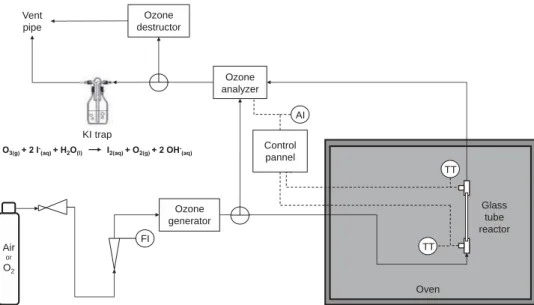
The regeneration tests were carried out in a tubular glass reactor (4 mm internal diameter, 6 mm external diameter, 20 cm length), which was loaded as a fixed bed reactor with the other halves of zeolite. Oxidation treatment was applied using ozone at low temperatures, between 50 °C and 200 °C. The effects on carbon removal efficiency of temperature, time on stream and ozone inlet concentration were studied. Moreover, experiments were led using air or pure dioxygen to produce ozone (seeFigure 1).
A lab-scale ozone generator (HTU-500 ozone gen-erator, Azcozon) was used to produce ozone in the range of 4–25.4 g/m3. Air was used to produce ozone at low concentrations (4–10 g/m3), whereas oxygen was used for higher ones (10–25.4 g/m3). After passing through the ozone generator, a three-way valve allowed the gas to flow (i) directly to the ozone analyzer (Ozone Analyzer BMT 964) to determine the inlet ozone centration or (ii) in the reactor to analyze ozone con-centration in the outlet stream. The reactor was placed in a controlled temperature oven (Heratherm oven OGS60), and temperature at the reactor inlet and outlet was measured by thermocouples. After the regeneration process, ozone was destroyed before being vented to the
atmosphere, by a high temperature destructor or by reaction with KI (Van de Wiel et al.1979).
At the beginning of the experiment, the sample was heated under air or oxygen flow (up-flow mode) until the desired temperature (within 50–200 °C range) was reached. Flowrate was varied from 10 to 46 L/h (corre-sponding to superficial velocity from 0.221 to 1.017 m/s and residence time from 0.9 to 0.2 s). Thereafter, the ozone generator was turned on and the gas flow was switched to O3containing mixture, keeping same
flow-rate. Regeneration time was between 2 and 8.5 h. To determine the process efficiency, instantaneous ozone consumption was measured with the ozone ana-lyzer and remaining carbon on zeolite was determined a posteriori by elemental analysis (after crushing). The experimental data were displayed in terms of carbon removal (%) given by the following equation:
%C removal ¼Cref Cs Cref
Where Cref is reference carbon content and Cs is the final carbon content after the regeneration experiment.
Results and discussion
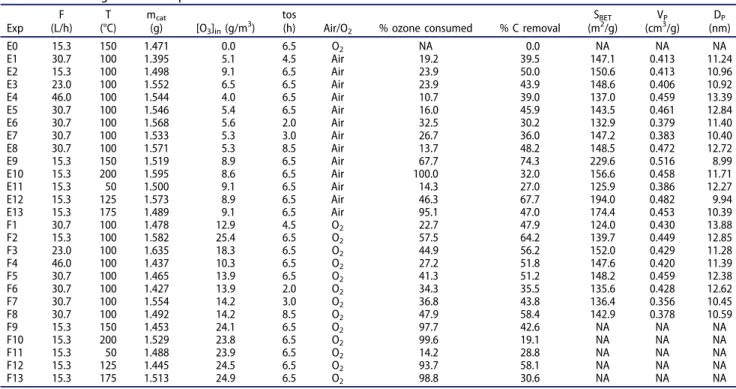
Several experiments were performed in order to approach the optimal parameters for the regeneration process, using ozone produced either from air or oxy-gen. The following table (Table 1) reports the operating parameters that were varied for the tests: temperature (T), time on stream (tos), nature of the feed gas, flow-rate (F) and mass of catalyst loaded inside the reactor before starting the regeneration process (mcat).
Reference conditions were: total flowrate of 15.3 L/h, temperature of 150 °C and time on stream of 6.5 h.
First of all, a blank experiment (E0) was carried out with pure oxygen. It can be checked that absolutely no coke was removed from the zeolite, meaning that coke removal in further experiments will be exclusively due to ozone. This confirmed that low temperature O2 is
not efficient to remove coke.
Influence of regeneration time
Regeneration kinetics was first examined for both gas feeds by varying time on stream (tos). The temperature was set at 100 °C, whereas the total gas flowrate was set at 30.7 L/h. On one hand, for experiments with O3
made from air (E1, E5–E8), the mean inlet concentra-tion of O3 was 5.3 g/m3, which gave a mean mass
flowrate of O3 (Qm,O3) of 0.16 g/h. On the other
hand, for experiments with O3 made from O2
(F1, F5–F8), the mean inlet concentration of O3 was
13.8 g/m3, which gave an ozone flowrate of 0.42 g/h. Figure 2depicts the corresponding evolution of regen-eration efficiency as a function of tos, calculated from these experiments.
For both the gas feeds, oxidation kinetics almost reached a plateau after 3 h, resulting only in partial catalyst regeneration after the maximum fixed dura-tion of 8.5 h (to achieve experiment within a single day). Despite large differences in ozone content (Qm,O3= 0.16 vs. 0.42 g/h), it is noticeable that both
sets of experiments resulted in rather similar carbon removal at given tos of 8.5 h: 48.2% for air stream vs. 58.4% for oxygen stream. Concerning ozone con-sumption during regeneration process, trends were
FI Ozone generator Ozone analyzer Air or O2 Ozone destructor Control pannel TT TT Oven AI Glass tube reactor Vent pipe KI trap
O3(g) + 2 I-(aq) + H2O(l) I2(aq) + O2(g) + 2 OH-(aq)
Figure 1.Scheme of the lab-scale regeneration of coked catalyst using ozone.
different depending on inlet gas composition. According to Table 1, O3 conversion increased with
time on stream for concentrated gas mixture (ozone generated from oxygen), meaning that it was more readily converted on regenerated zeolite. Conversely, at low concentration (ozone generated from air), O3
consumption was higher at the beginning of the pro-cess and decreased—following the evolution of
residual carbon content—up to a plateau. This sug-gests different dominant mechanisms in each case: low concentrated oxidant is mainly consumed by reaction with coke, while noncontributive decompo-sition pathway should prevail at higher O3
concen-tration as described in the following results. Accounting for kinetics slowdown, the following experiments only lasted 6.5 h only.
Figure 2.Influence of time on stream on carbon removal for two different gas feeds: Qm,O3= 0.16 g/h (ozone from air, blue points) and Qm,O3= 0.42 g/h (ozone from oxygen, red points) at 30.7 L/h and 100 °C.
Table 1.Set of regeneration experiments.
Exp F (L/h) T (°C) mcat (g) [O3]in(g/m3) tos
(h) Air/O2 % ozone consumed % C removal
SBET (m2/g) (cmV3P/g) (nm)DP E0 15.3 150 1.471 0.0 6.5 O2 NA 0.0 NA NA NA E1 30.7 100 1.395 5.1 4.5 Air 19.2 39.5 147.1 0.413 11.24 E2 15.3 100 1.498 9.1 6.5 Air 23.9 50.0 150.6 0.413 10.96 E3 23.0 100 1.552 6.5 6.5 Air 23.9 43.9 148.6 0.406 10.92 E4 46.0 100 1.544 4.0 6.5 Air 10.7 39.0 137.0 0.459 13.39 E5 30.7 100 1.546 5.4 6.5 Air 16.0 45.9 143.5 0.461 12.84 E6 30.7 100 1.568 5.6 2.0 Air 32.5 30.2 132.9 0.379 11.40 E7 30.7 100 1.533 5.3 3.0 Air 26.7 36.0 147.2 0.383 10.40 E8 30.7 100 1.571 5.3 8.5 Air 13.7 48.2 148.5 0.472 12.72 E9 15.3 150 1.519 8.9 6.5 Air 67.7 74.3 229.6 0.516 8.99 E10 15.3 200 1.595 8.6 6.5 Air 100.0 32.0 156.6 0.458 11.71 E11 15.3 50 1.500 9.1 6.5 Air 14.3 27.0 125.9 0.386 12.27 E12 15.3 125 1.573 8.9 6.5 Air 46.3 67.7 194.0 0.482 9.94 E13 15.3 175 1.489 9.1 6.5 Air 95.1 47.0 174.4 0.453 10.39 F1 30.7 100 1.478 12.9 4.5 O2 22.7 47.9 124.0 0.430 13.88 F2 15.3 100 1.582 25.4 6.5 O2 57.5 64.2 139.7 0.449 12.85 F3 23.0 100 1.635 18.3 6.5 O2 44.9 56.2 152.0 0.429 11.28 F4 46.0 100 1.437 10.3 6.5 O2 27.2 51.8 147.6 0.420 11.39 F5 30.7 100 1.465 13.9 6.5 O2 41.3 51.2 148.2 0.459 12.38 F6 30.7 100 1.427 13.9 2.0 O2 34.3 35.5 135.6 0.428 12.62 F7 30.7 100 1.554 14.2 3.0 O2 36.8 43.8 136.4 0.356 10.45 F8 30.7 100 1.492 14.2 8.5 O2 47.9 58.4 142.9 0.378 10.59 F9 15.3 150 1.453 24.1 6.5 O2 97.7 42.6 NA NA NA F10 15.3 200 1.529 23.8 6.5 O2 99.6 19.1 NA NA NA F11 15.3 50 1.488 23.9 6.5 O2 14.2 28.8 NA NA NA F12 15.3 125 1.445 24.5 6.5 O2 93.7 58.1 NA NA NA F13 15.3 175 1.513 24.9 6.5 O2 98.8 30.6 NA NA NA
Influence of inlet O3 concentration
Besides, other sets of experiments (E2–E5 for O3made
from air, and F2–F5 for experiments with O3 made
from O2) were run, keeping the same temperature
(100 °C) and the same time on stream (6.5 h), but varying total gas flowrates, thus O3concentration.
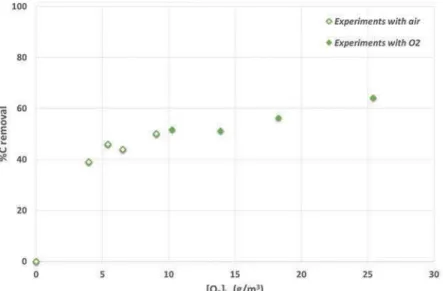
Corresponding results are gathered in Figure 3, where carbon removal is plotted as a function of result-ing ozone concentration.
It is clear that the increase in O3 concentration
out-weighed the decrease in total gas flow rate, resulting in a net benefice for the regeneration efficiency. The highest carbon conversion (64.2%) was achieved with a flowrate of 15.3 L/h using O3made from O2(lower flowrates could
not be used due to technical limitations of our equipment). These results thus indicate that the oxidation process should not be limited by external mass transfer. Moreover, as concentration and total gas flowrates were varied, the amount of ozone consumed during this set of experiments did not show a clear tendency.
Influence of temperature
The last parameter investigated in this study was the temperature. It was varied from 50 °C to 200 °C (experiments E2, and E9–E13 with air resulting in ozone flowrate of 0.14 g/h, and experiments F2, and F9–F13 with oxygen and ozone flowrate of 0.37 g/h). Results are presented inFigure 4.
In both cases, carbon removal profiles exhibited a max-imum with respect to temperature. However, its location
depended on the gas composition: 150 °C and 100 °C for ozone generated from air and oxygen, respectively. This kind of trend is very atypical and should be the results of different competing effects. First, ozone is degraded ther-mally into oxygen (Benson and Axworthy1957; Michael 1971), resulting into an ozone loss between 10 and 35% on 100–180 °C range for oxygen stream at about 12.7 L/h and O3inlet concentration of 48 g/m3(Khangkham et al.2013).
Moreover over regenerated catalytic sites, ozone could be decomposed into free radicals, which either recombine or attack the coke deposit. As these radicals exhibit a very short lifetime, they would only react with close vicinity species, which means that internal diffusional effects are critical for the catalyst regeneration. Indeed, it can be noticed that the percentage of O3consumed (Table 1) is close to 100% for
experiments with temperatures over 150 °C, which means that a consequent part of O3 was degraded because of
thermal effect and/or radical recombination.
Then, the difference in optimal temperatures may be explained by the higher ozone concentrations obtained from pure oxygen (24.4 g/m3 compared to 8.9 g/m3): more radicals were present, which implied that their recombination was favored and thus, diffu-sion limitation effects started at earlier temperatures (100 °C instead of 150 °C for lower concentrations). This recombination of radicals, which is favored at higher concentrations, could also explain why the maximum carbon removal was lower (64.2%) at 24.4 g/m3 than at 8.9 g/m3 (74.3%). Therefore, in the regeneration process with ozone, a compromise between ozone concentration and temperature has to be found.
Figure 3.Influence of inlet concentration of O3(at varying total gas flowrates) on carbon removal for two different gas feeds: air (empty green points) and O2(filled green points), at 100 °C and tos of 6.5 h.
Physical properties of regenerated samples
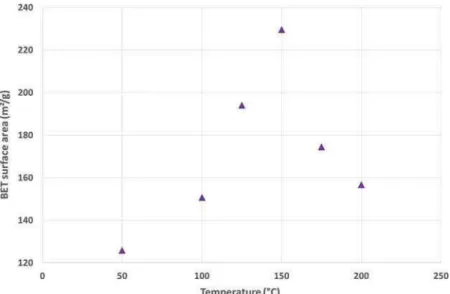
As indicated inTable 1, the mean pore diameter of all samples, determined by BET method, ranged between 9 and 14 nm, which indicates that the particles were essentially mesoporous (pore size between 2 nm and 50 nm). As a result, the total pore volume was approxi-mately the mesoporous volume calculated by BJH method. VP was 0.365 cm3/g for the coked samples,
but it did not show any clear trends for the regenerated samples with respect to the different investigated con-ditions (cf.Table 1).
BET surface area was not significantly affected by the variations of tos or inlet O3 concentrations, but the
effect of temperature was much more important.
Figure 5 shows the corresponding results for experi-ments with air (E2, and E9 to E13) which as expected exhibit the same trend as carbon removal, and in par-ticular the same optimal value of 150 °C. It was possible to improve the BET surface area from 121.6 m2/g for the coked samples to 229.6 m2/g in best conditions, which represents an increase of about 89%.
Conclusions and outlooks
Regeneration of coked zeolite of 4 mm diameter was successfully achieved using an ozone-enriched air or oxygen stream. At 150 °C, up to 74.3% of coke was removed in the applied conditions (Qv,tot = 15.3 L/h,
Figure 5.Influence of treatment temperature on the BET surface area of regenerated samples (Qm,O3= 0.14 g/h at 15.3 L/h and tos of 6.5 h).
Figure 4.Influence of temperature on carbon removal for two different gas feeds: Qm,O3= 0.14 g/h (air, purple points) and Qm, O3= 0.37 g/h (oxygen, yellow points) at 15.3 L/h and tos of 6.5 h.
[O3] = 8.9 g/m3, Qm,O3= 0.14 g/h and tos = 6.5 h). The
decoking rate was improved by an increase of O3
con-centration in the investigated range (4.0–25.4 g/m3). Temperatures higher than 150 °C were not beneficial due to the strong limitation of ozone diffusion inside the zeolite particles and its fast decomposition. Concerning physical properties, a maximum increase of 89% was obtained for the BET surface area at the optimal temperature. Future experiments will be car-ried out to better understand mechanisms of decoking.
Acknowledgments
The authors would like to express their grateful acknowledg-ments to Laboratoire de Chimie de Coordination (Toulouse) for elemental analysis and SAP for surface area analysis.
ORCID
Romain Richard http://orcid.org/0000-0002-6037-8254
References
Alejandro, S., H. Valdés, M.-H. Manero, and C. A. Zaror. 2012. “BTX Abatement Using Chilean Natural Zeolite: The Role of Brønsted Acid Sites.” Water Science and Technology 66 (8):1759–65. doi:10.2166/wst.2012.390. Barrett, E. P., L. G. Joyner, and P. P. Halenda. 1951. “The
Determination of Pore Volume and Area Distributions in Porous Substances. I. Computations from Nitrogen Isotherms.” Journal of the American Chemical Society 73 (1):373–80. doi:10.1021/ja01145a126.
Bartholomew, C. 2003. “Catalyst Deactivation and Regeneration.” In Kirk-Othmer Encyclopedia of Chemical Technology. Hoboken, NJ: John Wiley & Sons, Inc. Benson, S. W., and A. E. Axworthy Jr. 1957. “Mechanism of
the Gas Phase, Thermal Decomposition of Ozone.” The Journal of Chemical Physics 26 (6):1718–26. doi:10.1063/ 1.1743610.
Boyle, J. P., (Baton Rouge, LA). 1993. Ozone Regeneration of Platinum, and Polymetallic Platinum Reforming Catalysts. Florham Park, NJ: Exxon Research and Engineering Company. Brodu, N., M.-H. Manero, C. Andriantsiferana, J.-S. Pic, and V. Héctor. 2013. “Role of Lewis Acid Sites of ZSM-5 Zeolite on Gaseous Ozone Abatement.” Chemical Engineering Journal 231:281–6. doi:10.1016/j. cej.2013.07.002.
Brunauer, S. P., H. Emmett, and E. Teller. 1938. “Adsorption of Gases in Multimolecular Layers.” Journal of the American Chemical Society 60 (2):309–19. doi:10.1021/ ja01269a023.
Chen, C.-Y., (Kensington, CA). 2003. Catalyst Regeneration via Reduction with Hydrogen. San Ramon, CA: Chevron U. S.A. Inc.
Copperthwaite, R. G., G. J. Hutchings, P. Johnston, and S. Walter Orchard. 1986. “Regeneration of Pentasil Zeolite Catalysts Using Ozone and Oxygen.” Journal of the Chemical Society, Faraday Transactions 1: Physical
Chemistry in Condensed Phases 82 (3):1007–17. doi:10.1039/F19868201007.
Guisnet, M. 2002. ““Coke” Molecules Trapped in the Micropores of Zeolites as Active Species in Hydrocarbon Transformations.” Journal of Molecular Catalysis A-Chemical 182 (1):367–82. doi:10.1016/s1381-1169(01) 00511-8.
Huang, H., W. Huang, Y. Xu, X. Ye, M. Wu, Q. Shao, G. Ou, Z. Peng, J. Shi, J. Chen, Q. Feng, Y. Zan, H. Huang, and P. Hu. 2015. “Catalytic Oxidation of Gaseous Benzene with Ozone over Zeolite-Supported Metal Oxide Nanoparticles at Room Temperature.” Catalysis Today 258 (Part 2):627– 33. doi:10.1016/j.cattod.2015.01.006.
Hughes, R., and M. Parvinian. 1989. “Regeneration Kinetics of Coked Silica-Alumina Catalyst.” Journal Name: Prepr. Pap., Am. Chem. Soc., Div. Fuel Chem.; (United States); Journal Volume: 34:1; Conference: Symposium on the Fundamentals of Gasification, Dallas, TX, USA, Apr 9–14; Univ. of Salford (England).
Ivanov, D. P., V. I. Sobolev, and G. I. Panov. 2003. “Deactivation by Coking and Regeneration of Zeolite Catalysts for Benzene-To-Phenol Oxidation.” Applied Catalysis A: General 241 (1–2):113–21. doi:10.1016/ S0926-860X(02)00462-3.
Khangkham, S., C. Julcour-Lebigue, S. Damronglerd, C. Ngamcharussrivichai, M.-H. Manero, and H. Delmas. 2013. “Regeneration of Coked Zeolite from PMMA Cracking Process by Ozonation.” Applied Catalysis B: Environmental 140–141:396-405. doi:10.1016/j. apcatb.2013.04.041.
López, A., I. de Marco, B. M. Caballero, A. Adrados, and M. F. Laresgoiti. 2011. “Deactivation and Regeneration of ZSM-5 Zeolite in Catalytic Pyrolysis of Plastic Wastes.” Waste Management 31 (8):1852–8. doi:10.1016/j. wasman.2011.04.004.
Magnoux, P., and M. Guisnet. 1988. “Coking, Ageing and Regeneration of Zeolites.” Applied Catalysis 38 (2):341–52. doi:10.1016/S0166-9834(00)82836-5.
Mariey, L., J. Lamotte, T. Chevreau, and J. C. Lavalley. 1996. “FT-IR Study of Coked HY Zeolite Regeneration Using Oxygen or Ozone.” Reaction Kinetics and Catalysis Letters 59 (2):241–6. doi:10.1007/bf02068119.
Masuda, J., J. Fukuyama, and S. Fujii. 2001.“Ozone Injection into an Activated Carbon Bed to Remove Hydrogen Sulfide in the Presence of Concurrent Substances.” Journal of the Air & Waste Management Association 51 (5):750–5. doi:10.1080/10473289.2001.10464310.
Michael, J. V. 1971. “Thermal Decomposition of Ozone.” The Journal of Chemical Physics 54 (10):4455–9. doi:10.1063/ 1.1674697.
Moljord, K., P. Magnoux, and M. Guisnet. 1994. “Evidence for a Participation of Zeolite Acid Sites in the Coke Removal through Oxidative Treatment.” Catalysis Letters 25 (1–2):141–7. doi:10.1007/BF00815423.
Monneyron, P., S. Mathé, M. H. Manero, and J. N. Foussard. 2003. “Regeneration of High Silica Zeolites via Advanced Oxidation Processes—A Preliminary Study about Adsorbent Reactivity toward Ozone.” Chemical Engineering Research and Design 81 (9):1193–8. doi:10.1205/026387603770866371. Shimizu, S., (Hyogo, JP), T. Niwa (Osaka, JP), N. Abe (Nara,
JP), M. Doba (Osaka, JP), A. Iguchi (Kyoto, JP), H. Ichihashi (Osaka, JP), and M. Kitamura (Osaka, JP). 1991.
Regeneration of Catalysts by Burning in the Presence of Alcohols. Osaka, Japan: Sumitomo Chemical Co., Ltd. Shiriyazdanov, R. R. 2011. “Regeneration of
Zeolite-Containing Catalysts of Alkylation of Isobutane with the Butane-Butene Faction in Supercritical Carbon Dioxide.” Russian Journal of Physical Chemistry B 5 (7):1080–3. doi:10.1134/s1990793111070086.
Twigg, M. V., and M. S. Spencer. 2003. “Deactivation of Copper Metal Catalysts for Methanol Decomposition, Methanol Steam Reforming and Methanol Synthesis.” Topics in Catalysis 22 (3):191–203. doi:10.1023/ a:1023567718303.
Van de Wiel, H. J., H. F. R. Reunders, R. Seifert, H. Gies, R. W. Lanting, and W. Rudolf. 1979. “International Comparative Programme on Ozone Reference Methods.”
Atmospheric Environment (1967) 13 (4):555–7. doi:10.1016/0004-6981(79)90151-3.
Weitkamp, J., and L. Puppe. 1999. “Shape-Selective Catalysis in Zeolites.” In Catalysis and Zeolites: Fundamentals and Applications, edited by J. Weitkamp, and L. Puppe, 327–76. Berlin, Heidelberg: Springer Berlin Heidelberg.
Zaitan, H., M. H. Manero, and V. Héctor. 2016. “Application of High Silica Zeolite ZSM-5 in a Hybrid Treatment Process Based on Sequential Adsorption and Ozonation for Vocs Elimination.” Journal of Environmental Sciences 41:59–68. doi:10.1016/j.jes.2015.05.021.
Zhang, X., B. Zong, and M. Qiao. 2009. “Reactivation of Spent Pd/AC Catalyst by Supercritical CO2 Fluid Extraction.” Aiche Journal 55 (9):2382–8. doi:10.1002/aic. v55:9.