Chapter 2. Basic Atomic Physics
Academic and Research StaffProfessor Daniel Kleppner, Professor David E. Pritchard, Dr. Kristian Helmerson, Dr. Wolfgang Ketterle Visiting Scientists and Research Affiliates
Dr. Tomaz Catunda, Dr. Theodore W. Ducas,1 Dr. Chun-ho lu, Dr. Alexander Martin, Dr. H. Joerg Schiedmeyer
Graduate Students
Kevin R. Boyce, Pin P. Chang, Michael W. Courtney, Kendall Davis, Frank DiFilippo, Christopher R. Ekstrom, Troy D. Hammond, Jeffrey R. Holley, Hong Jiao, Michael A. Joffe, David W. Keith, Robert P. Lutwak, Marc-Oliver Mewes, Vasant Natarajan, Scott N. Paine
Undergraduate Students
John E. Berberian, Charles G. Freeman, James A. Grimm, Matthew J. Marjanovic, David Mitchell, Wan Morshidi, Lee-Peng Ng, Quentin A. Turchette, Peter S. Yesley
Technical and Support Staff Carol A. Costa
2.1 The Diamagnetic Rydberg
Atom
Sponsors
National Science Foundation Grant PHY 89-19381
U.S. Navy - Office of Naval Research Contract N00014-90-J-1322 Project Staff
Dr. Chun-ho lu, Michael W. Courtney, Dr. Tomaz Catunda, Hong Jiao, Professor Daniel Kleppner, David Mitchell, Lee-Peng Ng
A highly excited hydrogen atom in a strong mag-netic field, the so-called "diamagmag-netic hydrogen atom," is among the simplest nonseparable systems in quantum mechanics. Understanding it can be expected to provide a key to the more general aspects of nonseparable systems. The problem is also attracting attention in the context of nonlinear dynamics because its classical behavior displays a transition from orderly to disor-derly motion as the energy is increased in a fixed magnetic field. One can study the quantum struc-ture of the system in this regime both theoretically and experimentally. Thus, the diamagnetic hydrogen atom provides an ideal testing ground
for studying the relation between quantum struc-ture and disorderly classical motion, a subject sometimes called "quantum chaos."
We have developed techniques for carrying out high resolution laser spectroscopy on the lithium atom in a strong magnetic field. The difference between lithium and hydrogen is minor for Rydberg atoms.
The experiment uses a lithium atomic beam which is excited by two c.w. lasers. The first laser excites the atoms from the 2S state to the 3S state by a two-photon transition and the second laser excites the atoms to Rydberg states. The excited atoms are detected by electric field ionization. We typi-cally operate in magnetic fields near 6T. We can determine the energy within 10- 3 cm- 1
, and the magnetic field within 5 gauss.
The Hamiltonian for the diamagnetic hydrogen atom, in atomic units, is
2 1 H= 2 r 1 1 B22 + - LzB + 1B p. 2 8
There are no general solutions to this problem, and perturbation theory is not applicable in the positive energy regime. In previous years, our experimental
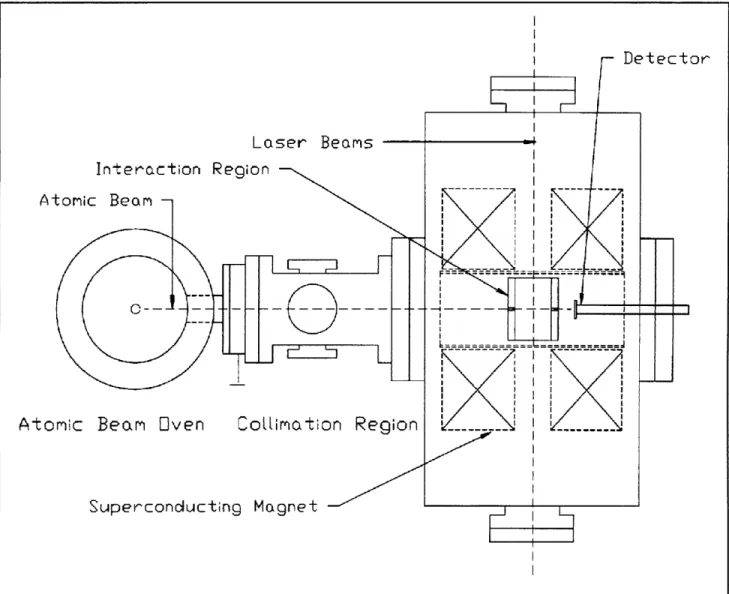
results2 have helped to stimulate theoretical advances, However, the productivity of the research was limited by difficulties associated with our antique superconducting magnet. Our major effort during this past year has been to rebuild the apparatus with an up-to-date magnet that was provided by the National Science Foundation. Figure 1 presents a schematic diagram of the apparatus.
The new magnet employs a split coil configuration and provides 7T. The four inch bore allows a sig-nificantly larger interaction region and more
con-venient optical access than previously possible. Rydberg atoms are sensitive to stray electric fields, and stray fields were a limiting factor in our pre-vious work. Figure 2 shows the new interaction region in which stray electric fields are greatly reduced because the surfaces are farther from the interaction volume. In addition, stray electric fields parallel to the magnet axis can be cancelled by an applied field. In addition, an electric field can be applied as an additional probe of the system. Another improvement in the interaction region is the collection of light from the fluorescent decay of the intermediate 2P state. One mirror focuses light onto a fiber bundle. Another doubles the area of collection by focusing light back to the point of interaction.
A scintillator and fiber bundle have replaced the surface barrier diode for detection of Rydberg atoms. After the atoms are ionized, they are accel-erated to the scintillator by a 15 KV potential. The light is carried to a photomultiplier by the fiber bundle. This detection method permits reliable counting of single ions. As a result, our signal is highly linear to the number of Rydberg atoms pro-duced.
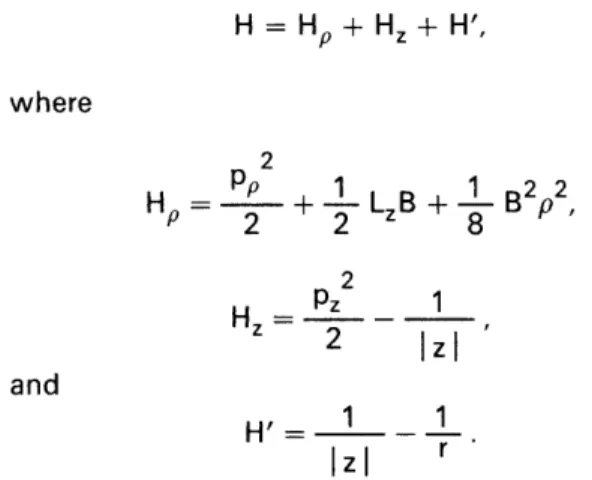
We have observed that in a certain regime the system displays one-dimensional behavior. It is useful to write the Hamiltonian for the diamagnetic hydrogen atom as H = Hp + Hz+ H', where 2 H p p P 2 2 and 1 B2p22 LzB + Bp 8' H P 1 z 2
Izl
1 1 H' =Izl
rH, is the Hamiltonian of an electron in a magnetic field, Hz is the Hamiltonian of one-dimensional Hydrogen, and H' is a perturbation to the other-wise trivial Hamiltonian. Although the perturbing potential is not small (in fact it is singular for the entire z = 0 plane) it has been shown3 that parts of the experimental spectrum can be understood simply in terms of the unperturbed Hamiltonian as a superposition of the spectra of one-dimensional
Hydrogen and an electron in a magnetic field. Using the stray electric field in the old apparatus, we have studied the Stark splitting of the one-dimensional hydrogen atom that is approximated by magnetic confinement of the electron transverse to the magnetic field. Figure 3 shows an example of the Stark splitting. The levels correspond to the Rydberg level of n = 70. The electric field was about 80 mV/cm. The predicted Stark splitting is 0.050 cm- 1, and the measured splitting from figure 3 is 0.047 cm- 1. This observation of the one-dimensional Stark splitting further confirms the regular behavior of the quantum system. We plan to measure the Stark splitting in a variety of elec-tric fields to see how closely our system resembles one-dimensional hydrogen.
2 D. Delande, A. Bommier, and J.C. Gay, Phys. Rev. Lett. 66: 141 (1991); C. lu, G.R. Welch, Kleppner, D. Delande, and J.C. Gay, Phys. Rev. Lett. 66: 145 (1991).
Figure 1. Superconducting magnet and atomic beam apparatus.
Publications
Theses
lu, C., G.R. Welch, M.M. Kash, D. Kleppner, D. Delande, and J.C. Gay. "The Diamagnetic Rydberg Atom: Confrontation of Calculated and Observed Spectra." Phys. Rev. Lett. 66: 145 (1991).
Kleppner, D., C. lu, and G.R. Welch. "Positive Energy Spectroscopy of the Diamagnetic Lithium System." Comments At. Mol. Phys.
25: 301 (1991).
lu, C. Energy Level Structure of Atoms in
Mag-netic Fields. Ph.D. diss. Dept. of Physics, MIT,
1990.
Mitchell, D. The Onset of Chaos for a
Semi-Classical Alkali Atom in a Uniform Electric Field. B.A. thesis, Dept. of Physics, MIT, 1991.
Detector
Interction Region
Figure 2. Interaction region.
-19.7
-
-19.8-Q
-19.9
-205.95
6.00
6.05
6.10
6.15
6.20
Field [tesla]
Figure 3. One-dimensional Stark splitting near 6 T, n = 70. The electric field is approximately 80 mV/cm.
- Atomic Beam
Mirrors
Field Pltes
S P[astic Scintillator
Filoer
Bundlte
Laser Beams (into page)
2.2 Millimeter-Wave Frequency
Measurement
of the Rydberg
Constant
Sponsors
Joint Services Electronics Program Contract DAAL03-89-C-0001 Contract DAAL03-92-C-0001 National Science Foundation
Grant PHY 89-19381
Project Staff
Pin P. Chang, Jeffrey R. Holley, Robert P. Lutwak, Scott N. Paine, Dr. Theodore W. Ducas, Professor Daniel Kleppner
The Rydberg constant, R,, relates the wavelengths of the spectrum of atomic hydrogen to practical laboratory units. As such, R, is the natural unit for measurements of numerous atomic properties. Experiments using laser spectroscopy have deter-mined R, to nearly 1 part in 1010.4 Although R, is the most accurately measured fundamental con-stant, high-precision experiments which depend on R, as an auxiliary constant demand a more accurate determination. For example, new exper-iments to determine the Lamb shift in the ground state of atomic hydrogen will be limited by uncer-tainties in R,. The accuracy of optical measure-ments has reached the limit of precision of wavelength metrology. Further progress in meas-uring R, requires a frequency measurement, making use of the modern definition of length in terms of time intervals and the defined speed of light.
We are attempting to advance the accuracy of Rc, by directly measuring cR, , the "Rydberg fre-quency." By initially preparing highly excited "Rydberg" states of atomic hydrogen, we are able to measure millimeter-wave transitions to nearby states with the full precision of frequency
metrology.
The goal of our experiment is three-fold. First is the evaluation of cR, . Second is the measure-ment of the ground state Lamb shift. Because our measurements involve high angular momentum states for which the Lamb shift is extremely small, a comparison of our results with optical measure-ments of transitions between low-lying states will yield an improved measurement of the Lamb shift.
Third is the precise frequency calibration of the spectrum of hydrogen to provide an independent check on forthcoming optical frequency measure-ments based on laser spectroscopy.
Our experiment is performed in an atomic beam configuration to provide a long interaction time and reduce Doppler and collisional perturbations. Atomic hydrogen is excited to the state (n=29,
m=0) by two-photon stepwise absorption. The atoms are then transferred to the longer lived "cir-cular" state (n=29,m=28) by the method of crossed electric and magnetic fields.5 The atoms then enter a region of uniform fields in which the frequency of the transition (n=29,m=28) --(n=30,m=29) is measured. The atoms interact with the millimeter-wave radiation at two locations in a Ramsey separated oscillatory fields geometry. The final state distribution of the atoms is meas-ured by a state-selective electric field ionization detector. The resonance signal is observed as a transfer of atoms from the n=29 state to the n=30 state as the millimeter wave frequency is tuned across the transition.
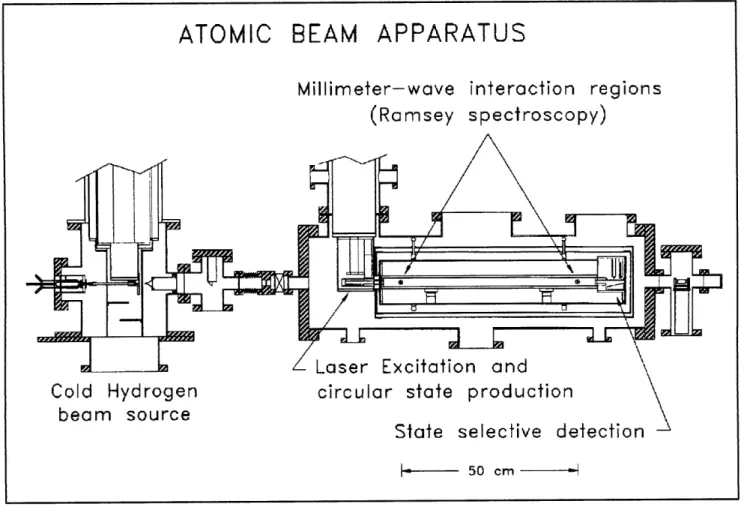
Figure 4 illustrates the main features of the appa-ratus. Atomic hydrogen or deuterium is produced by dissociation of H2 or D2 in a radio frequency discharge. The beam is cooled by collisions with the walls of a cryogenically cooled thermalizing channel in order to slow the beam and thereby increase the interaction time. The atoms are excited to the state (n=29,m=28) by two-photon stepwise excitation in the circular state production region. The development of the hydrogen beam and optical systems was described in the 1990
RLE Progress Report Number 133. The magnetic
field necessary to transfer the atoms to the circular state is provided by permanent magnets. The elec-tric field is produced by an arrangement of strip electrodes that causes the direction of the field to rotate. A detector in the circular state production region monitors the efficiency of the laser excita-tion and momentum transfer processes.
After the atoms are prepared in the circular state, the beam enters the interaction region. Because Rydberg atoms interact strongly with external fields, accurate measurement of the energy level structure requires careful control of the interaction environment. Thermal radiation is reduced by cooling the interaction region to - 10 K by a
liquid helium flow system. The ambient magnetic field is shielded by a double-wall high permeability
4 M.G. Boshier et al., Phys. Rev. A 40: 6169 (1989); P. Zhao et al., Phys. Rev. A 39: 2888 (1989); F. Biraben et al.,
Phys. Rev. Lett. 62: 621 (1989).
shield. The small electric field, necessary to define the quantization axis of the atoms, is applied with high uniformity by field plates with corrective strip electrodes along the sides. The millimeter waves intersect the atomic beam at two locations sepa-rated by 50 cm. The millimeter-wave optics were described in the 1990 RLE Progress Report
Number 133.
The state distribution of the atoms emerging from the interaction region is analyzed by an electric field ionization detector. The atoms enter a region of increasing electric field produced by a ramped plate held at constant potential. The atoms in the state (n=30), which ionize at lower field, are col-lected in the first detector, while atoms in the state (n=29), which ionize at higher field, are collected at the second detector. An important feature of the detector is that it provides time resolution. The atomic beam is pulsed, and the time-resolved
signal from the detector allows different velocity classes to be observed independently.
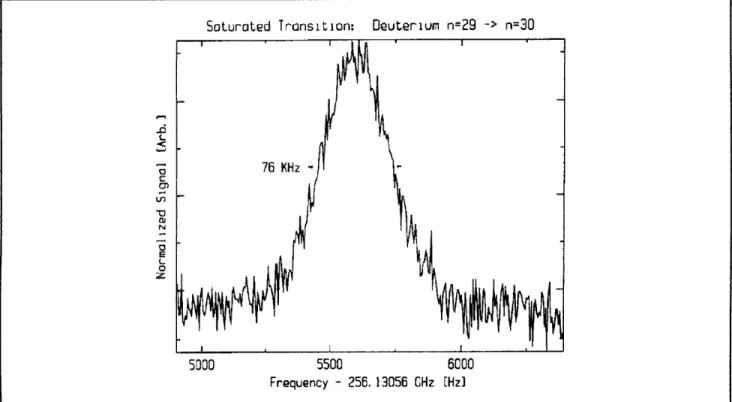
During this past year we have observed millimeter wave transitions in each of the two millimeter wave beams. In this fashion, we have observed the (n=29 --+ n=30) transition in both hydrogen and deuterium, as well as the (n=27 -+ n=28) transition in hydrogen. A typical resonance signal is shown in figure 5. In addition, we have observed "Rabi oscillations" in each of the milli-meter wave beams. Recently, we have begun experiments to study signals from interactions with both millimeter-wave beams in the Ramsey sepa-rated oscillatory fields geometry. Sample interfer-ence data is shown in figure 6.
Improvements to increase the signal-to-noise ratio are underway, and we anticipate starting on high accuracy measurements in the coming year.
Figure 5. Typical signal for the (n=29,m=28) --+ (n=30,m=29) transition in atomic deuterium. The width of the resonance line is close to the time-of-flight limit as the atoms cross the millimeter wave beam.
Figure 6. First results for the
deuterium.
a narrow linewidth "Ramsey" fringe for the transition n=29,m=28 - n=30,m=29) in
Soturoted Transition: Deuterium n=29 -> n=30
S76 KHz -C .v, N 5000 5500 6000 Frequency - 256.13056 CHz [Hz) D 29-*30 circular transition 0.10 -5 o 0.05 0 0 -0.05 colculOion - negqle normalized and trr -0.10 0 0.25 0.50 0.75 1.00 v - 256.371765120 GHz [x104 Hz] 1.25
2.3 Atom Interferometry
SponsorsJoint Services Electronics Program Contract DAAL03-89-C-0001 Contract DAAL03-92-C-0001 U.S. Army Research Office
Contract DAAL03-89-K-0082 U.S. Navy - Office of Naval Research
Grant N00014-89-J-1 207 Project Staff
John E. Berberian, Christopher R. Ekstrom, Troy D. Hammond, David W. Keith, Marc-Oliver Mewes, Dr. H. Joerg Schiedmeyer, Quentin A. Turchette, Professor David E. Pritchard
During 1991, we demonstrated the first atom inter-ferometer.6 Using transmission gratings, which we fabricated,7 as optical elements for atom deBroglie waves, we constructed a three grating atom inter-ferometer which physically separates atom waves before recombining them. Our demonstration was closely followed by two demonstrations of atom interferometers which used laser light as the beam splitters.8
Atom interferometers will make possible quali-tatively new types of experiments involving inertial effects, studies of atomic and molecular properties, and tests of fundamental physics, and may ulti-mately open the way to making ultra-small struc-tures using atom holograms.
The relatively large mass and low velocity of atoms makes atom interferometers especially sensitive to inertial effects such as rotation, acceleration, and gravity. Sagnac rotation has been observed in agreement with theoretical predictions,9 and sensitivity to gravitational acceleration at the 3 x 10⁻⁶ level has been demonstrated.10 Atom interferometers may become the best absolute accelerometers and gravimeters in the next few years.
* Atom interferometers can be applied to a number of experiments in fundamental physics: tests of quantum mechanics such as the Aharonov-Casher effect," measurement of the equality of proton and electron charges, and a precise measurement of the momentum of a photon. This latter measurement should produce a new high precision value for the fundamental constants NAh.
* Interferometers for atoms and molecules will offer more accurate ways to measure intrinsic properties of these particles, like their polariza-bility. They will also open up new areas of study, such as measurements of the "index of refraction" of a gas for a particle beam which passes through it.
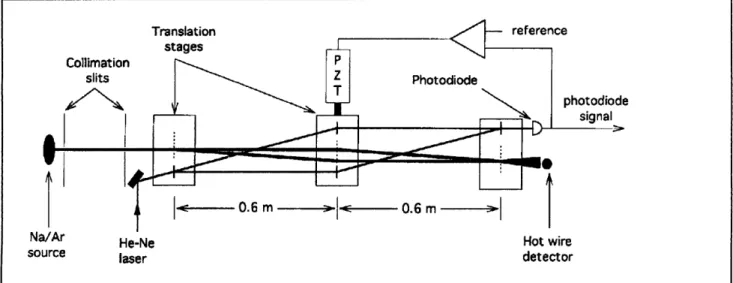
Our interferometer consists of three 400 nm period transmission gratings, mounted 0.66 m apart on separate translation stages inside the vacuum envelope. During operation, the 0th and 1s' order beams from the first grating strike the middle grating (which is 140 jim wide) where they are diffracted in the 1st and -1 st orders so that they converge at the third grating. At the second (middle) grating the beams have widths of 30 ym
(FWHM) and are separated by 27 /im. The first two gratings form an interference pattern in the plane of the third grating, which acts as a mask to sample this pattern. The detector, located 0.30 m beyond the third grating, records the flux trans-mitted by the third grating. Figure 7 shows the design of the interferometer.
The data necessary to determine the interferometer phase contrast are acquired by modulating the position of one grating relative to the other two and simultaneously recording the signal from the atom counting electronics as well as the signal from an optical interferometer used to measure the relative position of the gratings. After removing data obscured by noise spikes from the hot wire, the atom count rate data are averaged into bins according to relative grating position, resulting in the fringe pattern shown in figure 8.
6 D.W. Keith, C.R. Ekstrom, Q.A. Turchette, and D.E. Pritchcard, Phys. Rev. Lett. 66: 2693 (1991). 7 D.W. Keith and M.J. Rooks, J. Vac. Sci. Technol. B 9: 2846 (1991).
8 F. Riehle, T. Kisters, A. Witte, J. Helmcke, and J. Borde, Phys. Rev. Lett. 67: 177 (1991); M. Kasevich and S. Chu, Phys. Rev. Lett. 67: 181 (1991).
9 F. Riehle, T. Kisters, A. Witte, J. Helmcke, and J. Borde, Phys. Rev. Lett. 67: 177 (1991). 10 M. Kasevich, S. Chu, Phys. Rev. Lett. 67: 181 (1991).
Translation reference stages Collimation P slits Z Photodiode T photodiode signal
I
-:
0.6
m
0.6 m
Na/Ar He-Ne Hot wire
source laser detector
Figure 7. Our current atom interferometer with laser interferometer stabilization system (Not to scale).
The peak-to-peak amplitude of our interference signal is 70 Hz, which enables us to determine the interferometer phase to a precision of 0.1 rad in 1
min. The excellent long-term stability of our posi-tion stabilizaposi-tion system provides measured atom-interferometer phase drift of less than 0.1 rad over 10 minutes.
The key component of our interferometer is the set of three matched transmission diffraction gratings which we constructed during two visits at the National Nanofabrication Facility (NNF) at Cornell University. The first trip resulted in the develop-ment of a new process for fabricating atom optics. The process allows fabrication of precisely posi-tioned openings in thin silicon nitride membranes mounted in silicon frames. The pattern created in the membrane is determined by an electron beam writer, making the process quite versatile. This process was used to create the diffraction gratings used in the interferometer. In addition, several zone plates (atom lenses) were also built and suc-cessfully demonstrated later. During our second trip, we devised ways to reduce the electron beam writing time. This decreased thermal drift during the writing period assured higher overall accuracy and also increased our overall productivity. We made a wide variety of diffraction gratings with various heights and periods between 100 and 300 nm as well as an assortment of single and double slits.
We have recently started construction of an inter-action region that will allow us to perform several experiments including measurement of the Aharonov-Casher phase shift, the electric polariza-bility of the ground state of sodium, and the index
of refraction for sodium passing through noble gas atoms.
The scientific future of atoms interferometers looks bright: (1) Atom beam sources are inexpensive and intense relative to other particle beams/sources (e.g., neutrons, electrons), (2) several techniques have now been demonstrated to make interferometers for them, and (3) the atoms which may be used in them come with a wide range of parameters such as polarizability, mass, and magnetic moment. This assures the applicability of these instruments to a wide range of measurements of both fundamental and prac-tical interest.
400 -200 0
Position in nm
200 400
Figure 8. Interference signal from 400 seconds of data. Hot wire detector background of 40 Hz is sub-tracted. The solid line is a least squares fit to the data with a 400 nm period. The error bars are purely statis-tical and slightly underestimate the super-Poissonian character of the hot wire background.
Publications
Keith, D.W., C.R. Ekstrom, Q.A. Turchette, and D.E. Pritchard. "An Interferometer for Atoms." Phys.
Rev. Lett. 66: 2693 (1991).
Keith, D.W., and M.J. Rooks. "Free-standing Gratings and Lenses for Atom Optics." J. Vac. Sci. Technol. B 9: 2846 (1991).
Pritchard, D.E. "Atom Interferometers." Opt.
Pho-tonics News, p. 1 9 (November 1991).
Pritchard, D.E. "Atom Optics." In Atomic Physics
12. Ed. J.C. Zorn, R.R. Lewis, and M. Weiss.
New York: American Journal of Physics, 1991, pp. 165-170.
Turchette, Q.A., D.E. Pritchard, and D.W. Keith. "Numerical Model of a Multiple Grating Inter-ferometer." Submitted to J. Opt. Soc. Am. B
(1991).
Theses
Keith, D.W. An Interferometer for Atoms.
diss. Dept. of Physics, MIT, 1991. Turchette, Q.A. Numerical Model of a
Grating Interferometer for Atoms. S.B.
Dept. of Physics, MIT, 1991.
2.4 Cooling and Trapping
Neutral Atoms
Sponsors
Joint Services Electronics Program Contract DAAL03-89-C-0001 Contract DAAL03-92-C-0001 U.S. Navy - Office of Naval Research
Grant N00014-90-J-1642
Ph.D.
Three
thesis.
12 P.S. Julienne and J. Vigu, "Cold Collisions of Ground-4464 (1991).
Project Staff
Dr. Kristian Helmerson, Dr. Alexander Martin, Dr. Wolfgang Ketterle, Kendall Davis, Charles G. Freeman, Michael A. Joffe, Wan Morshidi, Peter S. Yesley, Professor David E. Pritchard
Our current objective is to develop an intense source of slow atoms which will be used in studies of cold collisions, atom optics and atom interferometry. Slow atoms sources typically have fluxes of a few times 109 atoms/sec. Improve-ments by two to three orders of magnitude seem feasible and are crucial for many experiments.
Experiments with dense samples of cold neutral atoms promise new exciting discoveries in basic and applied physics. Due to the considerably reduced thermal motion of atoms they are ideal for high resolution spectroscopy and for more accu-rate atomic frequency standards.
* Collisions of ultra-cold atoms in such samples are characterized by a long deBroglie
wave-length and dominated by weak long-range interactions. Since the collision duration for slow atoms greatly exceeds the radiative decay time, stimulated and spontaneous radiative transitions can take place during the collision. Slow collisions are therefore radi-cally different from fast collisions studied so far and will become an exciting new field of atomic physics.12
* High density samples of atoms open possibil-ities for observing quantum collective effects such as Bose-Einstein condensation and col-lectively enhanced or suppressed radiative
decay.
In 1991, we designed and built two sources of cold atoms based on two different principles: a "Diffuse Light Slower" and an "Inverted Zeeman Slower." We also completed the data analysis and modeling of the laser spectroscopy and laser cooling experiments performed in a magnetic trap.13 In addition, one of us (K. Helmerson)
com-pleted his doctoral dissertation.14
The following discusses in more detail the pro-gress made in the three areas mentioned above.
and Excited-state Alkali-metal Atoms," Phys. Rev. A 44:
13 K. Helmerson, A. Martin, and D.E. Pritchard, "Laser and rf Spectroscopy of Magnetically Trapped Neutral Atoms," submitted to J. Opt. Soc. Am. B; K. Helmerson, A. Martin and D.E. Pritchard, "Laser Cooling of Magnetically Trapped Neutral Atoms," submitted to J. Opt. Soc. Am. B.
2.4.1 Slowing Atoms with Diffuse
Light
We have demonstrated a new technique for slowing and brightening atomic beams which uses isotropic monochromatic laser light detuned to the red of the atomic resonance. The atoms compen-sate for the changing Doppler shift as they decel-erate by absorbing photons at a variable angle in accordance with the Doppler resonance condition. The use of isotropic light and the automatic angle selection method of compensating for the changing Doppler shift distinguish diffuse light slowing from other light slowing schemes realized so far, and is technically simpler to implement.
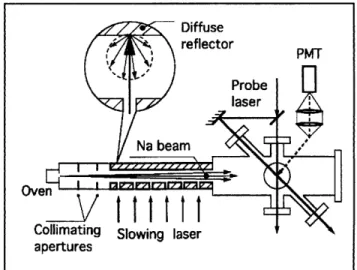
In our experiments isotropic light was generated by shining laser light into a tube of diffusely reflecting material around the atomic beam (figure 9). Sodium atoms were slowed from approximately 300 m/s to below 100 m/s resulting in a contin-uous slow beam with a flux of greater than 109 atoms/s.15 This performance is comparable with other slowing schemes and is limited by the light losses in the diffuse reflector. We are currently working on ways to reduce the loss in the diffuse
reflector well below its current 1 per cent.
Since isotropic light cools all components of the velocity, a diffuse light slower produces a slow beam with a smaller divergence. Other advantages of diffuse light slowing are the simple experimental realization, tolerance to laser jitter, and absence of an intense slowing laser beam collinear with the slowed atoms which can interfere with subsequent experiments.
2.4.2 Inverted Zeeman Slower
In a Zeeman slower the changing Doppler shift as an atom slows is compensated by the Zeeman shift in an inhomogeneous magnetic field. This method has the advantage of producing a continuous beam of slow atoms and featuring practically unlimited velocity capture range. The original implementation of Zeeman slowing, however, encountered difficulties in producing beams of atoms with velocities lower than 200 m/s. The major problems were off-resonant slowing of atoms after they left the slower and substantial
Figure 9. Schematic diagram of the experimental setup. A thermal sodium beam passes through the bore of a tube of diffusely reflecting material which is filled with laser light via six equally spaced small aperatures. Fluorescence-excitation spectra produced by laser beams perpendicular and at 450 to the atomic beam are used to observe the velocity distribution of the atoms as they emerge from the diffuse light cavity.
spreading of the slow atomic beam due to trans-verse heating.
To solve the first problem we chose the I F=2,m=2 > - I F=3,m=3 > cycling transition to slow sodium atoms. The transition requires a mag-netic field increasing along the atoms trajectory (Inverted Zeeman slower). The magnetic field drops off rapidly after reaching its maximum thus quickly shifting atoms out of resonance and reducing off-resonant slowing. It seems therefore possible to perform subsequent atomic optics experiments without undue interference from the intense slowing laser beam.
We have built and tested an inverse Zeeman slower which allows for optical access to the slow atoms inside. Transverse laser cooling will increase the brightness of the resulting slow atom beam. Experiments are still in progress but preliminary results indicate that the performance is better than any other slower demonstrated so far. We have slowed about 50 per cent of the thermal beam down to velocities between 40 m/s and 100 m/s. After optimization we intend to use the slower for
efficient loading of an atom trap.
15 W. Ketterle, A.G. Martin, M. Joffe and D.E. Pritchard, "Slowing Atoms with Diffuse Laser Light," postdeadline paper, Seventh Interdisciplinary Laser Conference (ILS), Monterey, California, September 22-26, 1991.
2.4.3 Laser Cooling and
Spectroscopy of Magnetically
Trapped Neutral Atoms
During 1991, we concluded the data analysis and modeling of the experimental results obtained pre-viously in a superconducting magnetic trap. This work can be divided into two parts:
1. Laser and rf spectroscopy of the trapped atoms:
Laser absorption, fluorescence and rf spectra of the trapped atoms were modeled and inter-preted to extract the energy distribution of the trapped atoms. The results of our model show that the atoms, when loaded into the trap, had an effective temperature of ~ 50 mK, compa-rable to the actual trap depth. We have shown how the rf spectra can give the energy distribution of the trapped atoms without prior knowledge of the shape of the trapping field potential. For our experiments, the energy distribution of the trapped atoms was well described by a Boltzman distribution, trun-cated at the energy corresponding to the highest energy trapped atom.16
2. Laser Doppler cooling of the trapped atoms: Our experiments have shown also how simple one-dimensional optical molasses can reduce the temperature of the trapped atoms to ~ 1 mK. The motion transverse to the cooling laser is cooled by the coupling between the different translational degrees of freedom pro-vided by the trap. The cooling process was modeled, and the theoretical results show good qualitative agreement with the exper-imental data. The measurements indicated, and the model confirms, that for cooling rates that are low compared to the trap coupling time, ultimate temperatures a few times the
Doppler limit can be achieved.17
Publications
Gould, P.L., P.J. Martin, G.A. Ruff, R.E. Stoner, J-L. Picque, and D.E. Pritchard. "Momentum Transfer to Atoms by a Standing Light Wave; Transition from Diffraction to Diffusion." Phys.
Rev. A 43: 585 (1991).
Helmerson, K., A. Martin, and D.E. Pritchard. "Laser and rf Spectroscopy of Magnetically Trapped Neutral Atoms." Submitted to J. Opt. Soc. Am. B.
Ketterle, W., and D.E. Pritchard. "Trapping Ground State Atoms in Static Fields." Submitted to
App. Phys. B.
Ketterle, W., A. Martin, M. Joffe, and D.E. Pritchard. "Slowing Atoms with Diffuse Laser Light." Submitted to Phys. Rev. Lett.
Theses
Freeman, C.G. Diffuse Slowing of a Beam of
Neutral Sodium Atoms. S.B. thesis. Dept. of
Physics, MIT, 1991.
Helmerson, K. Laser Cooling and Spectroscopy of Magnetically Trapped Atoms. Ph.D. diss. Dept.
of Physics, MIT, 1991.
2.5 Precision
Mass
Spectroscopy of
Ions
Sponsors
Joint Services Electronics Program Contract DAAL03-89-C-0001 Contract DAAL03-92-C-0001 National Science Foundation
Grant PHY 86-05893 Grant PHY 89-21769 Project Staff
Kevin R. Boyce, Frank DiFilippo, James A. Grimm, Matthew J. Marjanovic, Vasant Natarajan, Pro-fessor David E. Pritchard
In 1991, we continued our program to substan-tially improve our precision mass measurement experiment. These improvements should allow us to reach a precision of about 10-11 in our mass measurements of individual atomic and molecular ions, the next step toward our ultimate goal of a few parts in 1012. This capability will allow us to do a variety of experiments which address issues in both fundamental and applied physics, including:
16 K. Helmerson, A. Martin, and D.E. Pritchard, "Laser and rf Spectroscopy of Magnetically Trapped Neutral Atoms,"
submitted to J. Opt. Soc. Am. B.
* The 3H+ - 3He+ mass difference, important in ongoing experiments to determine the electron neutrino rest mass;
* Determination of excitation and binding ener-gies of atomic and molecular ions by weighing the small decrease in energy,
Am = Ebind/C 2;
* Determination of Avogadro's number NA, by
weighing y-rays-its accurate determination would permit the replacement of the "artifact" mass standard by an atomic mass standard; and
* Improvement of many traditional applications of mass spectroscopy by orders of magnitude improvement in both accuracy and sensitivity. Our experimental approach is to measure ion cyclotron resonance on a single molecular or atomic ion in a Penning trap, a highly uniform magnetic field with axial confinement provided by weaker electric fields. We monitor the ion's
oscil-lation along the magnetic field lines by detecting the currents induced in the trap electrodes. Working with only a single ion is essential because space charge from other ions leads to undesired frequency shifts. This work in trapping and preci-sion resonance draws on techniques developed by Hans Dehmelt at the University of Washington and Norman Ramsey at Harvard, for which they shared the 1989 Nobel Prize.
We have developed techniques for driving, cooling, and measuring the frequencies of all three normal modes of Penning trap motion. Thus we can manipulate the ion position reproducibly to within 30 microns of the center of the trap,
cor-recting for electrostatic shifts in the cyclotron fre-quency to great accuracy. We use a i-pulse method to coherently swap the phase and action of the cyclotron with the axial modes.18 Therefore, although we detect only the axial motion directly,
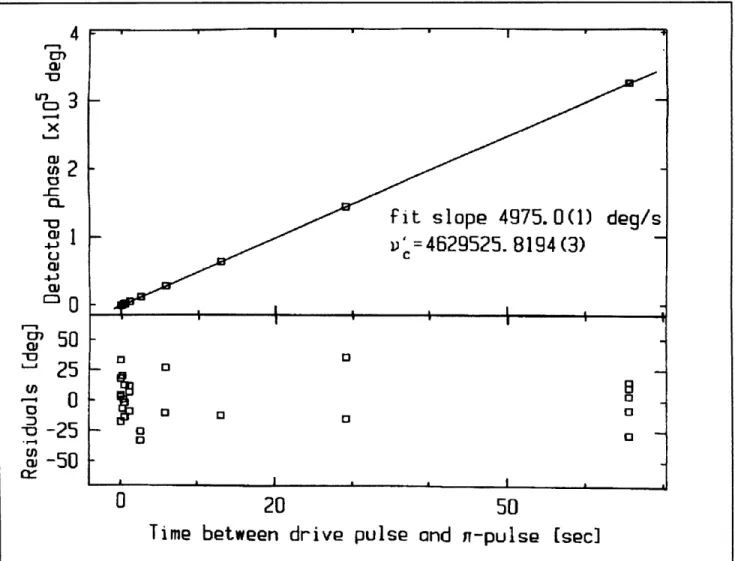
we can determine cyclotron frequency by meas-uring the phase accumulated in the cyclotron motion in a known time interval (figure 10). In the past two years, we have built an entirely new Penning trap and detector, including a higher-Q resonant circuit and quieter RF SQUID, these have improved our signal-to-noise ratio by a factor of two. We have also constructed a new highly stable DC electric field supply, and added a pressure regulator to the liquid helium bath of our superconducting magnet to help stabilize the field. In addition, we have begun construction of ion optics and an external ion source that will allow us to make the ions in a discharge at room temper-ature and then load them into the trap. This will eliminate the problem of residual neutral gas in the trap when using volatile species such as hydrogen and helium, and should permit rapid cycling between two different ions which will dramatically increase measurement precision.
With all the improvements to the system, we foresee being able to resolve the existing 10 eV discrepancy between measurements of
m(3H) - m(3He) in the next year. In addition, we plan to demonstrate a classical squeezing tech-nique which should reduce the thermal fluctu-ations of our measurement by a factor of three to five. After that, we plan to continue development
of techniques to measure two ions of different mass simultaneously. The two-ion technique in combination with the various improvements made over the last two years should lead to precision in the range of 10-11.19
Publications
Cornell, E.A., K.R. Boyce, D.L.K. Fygenson, and D.E. Pritchard. "Two Ions in a Penning Trap: Implications for Precision Mass Spectroscopy."
Phys. Rev. A. Submitted for publication.
18 E.A. Cornell, R.M. Weisskoff, et al., Phys. Rev. A 41: 312 (1990).
4
cuU 3
C12
Wr-fit slope
4975.0(1)
deg/s
"-
v'
=
4629525. 8194 (3)
Co
0S50
S025
0
B
T-25
3 Lu-500
20
50
Time between drive pulse and n-pulse Isec]
Figure 10. For each plotted point, we perform the following experiment: The initially cold ion is pulsed into a
cyclotron orbit of known initial phase and then allowed to evolve "in the dark" for an indicated amount of time, t. Then a pulse is applied which exchanges cyclotron and axial motions, bringing the ion's cyclotron action and phase into the axial mode. As the ion's axial motion rings down, its phase is detected. The appropriate multiple of 3600 is added, and a line is fitted to the points. The slope of the line is the frequency difference between the frequency generator and the trap cyclotron frequency.