Introduction – Objectives
Diakher H.Madioune
1,2@; Serigne Faye
1,Alain Dassargues
2, Jacques Mudry
4, Piotr Maloszewski
3, Willibald Stichler
3, Eric Pirard
51
Department of Geology, Faculty of Sciences and Techniques, Cheikh Anta DIOP University Dakar/Senegal
[email protected]
2
Hydrogeology and Environmental Geology, GEO³, Dpt ArGEnCo, Aquapole, University of Liege, Belgium
3
GSF-Institute of Groundwater Ecology, D-85764, Neuherberg, Germany
4
UMR 6249 Chrono-Environnement, interactions et transferts dans la biogéosphère, Université de Franche-Comté, Besançon/France
5
GeMMe, Dpt ArGEnCo, University of Liege, Belgium
Use of environmental isotopes to infer flow in the highly
exploited aquifer system of the Diass region (Senegal)
Data and methods
The environmental isotopic composition of water (δ18O,
δ2H and Tritium) measured in April 2007 (before rainy
season), November 2007 (after rainy season) and June 2008 (before rainy season), and few data of13C and14C measured
in groundwater samples are considered to infer groundwater flow. Samples were taken in wells that are continuously pumped to guarantee that the sampled groundwater would be representative of the geological formations. Sampling were performed from the Paleocene and the Maastrichtian aquifers using standard procedure. Samples for14C were
taken in each pumping field. Rainfall waters were sampled in six representative raingages.
Groundwater in the system is hosted in two main reservoirs, namely the confined/unconfined karstic Paleocene limestone configurated into two compartments (Sebikotane and Pout) and the central part where the Maastrichtian aquifer, made of sands and sandstones outcrops towards the south. The general structure lies out as an anticline horst system with interconnected compartments limited by normal faults.
Geology and Hydrogeology
Figure 1: Location of the study area, geological map (a) and cross section (b)
Isotope composition gives:
for
δ
18O -
7.2‰ to -2.6‰ with a mean value of -5.3 ‰ and forδ
2H
-47.2 ‰ to -12 ‰ with a meanvalue of -32.1 ‰ for
Rainfall
which defines a Local Meteoric Water Line (LMWL) of :Y = 7.23 δ
18O + 5.9
(figure 2). Tritium values range between 1.3 and 3.9, with a mean value of2.5TU,
for
δ
18O :
-5.8 ‰ to -5‰ and between -38.2‰ to -30.5‰forδ
2H,
with mean values of -5.5‰ and-35.2‰ for the
Paleocene aquifer
,for the
Maastrichtian aquifer δ
18O
values range between 5.9 ‰ and 4.3‰ and 38.4‰ to-26.3‰forδ2H with mean values of -5.1‰ and -32.1‰ respectively.
Tritium contents are very low and generally approach the detection limit (<0.7 TU), however values between 0.8 and 3.2TU are observed in some boreholes in the Paleocene and Maastrichtian aquifer.
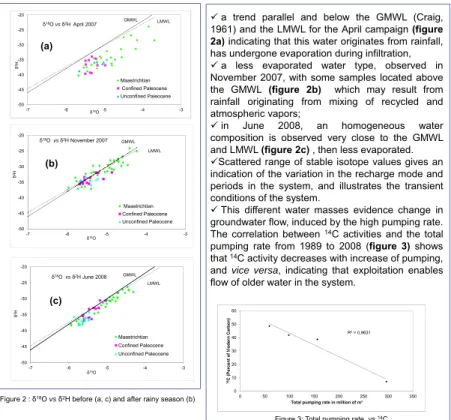
a trend parallel and below the GMWL (Craig, 1961) and the LMWL for the April campaign (figure
2a) indicating that this water originates from rainfall,
has undergone evaporation during infiltration, a less evaporated water type, observed in November 2007, with some samples located above the GMWL (figure 2b) which may result from rainfall originating from mixing of recycled and atmospheric vapors;
in June 2008, an homogeneous water composition is observed very close to the GMWL and LMWL (figure 2c) , then less evaporated. Scattered range of stable isotope values gives an indication of the variation in the recharge mode and periods in the system, and illustrates the transient conditions of the system.
This different water masses evidence change in groundwater flow, induced by the high pumping rate. The correlation between14C activities and the total
pumping rate from 1989 to 2008 (figure 3) shows that14C activity decreases with increase of pumping,
and vice versa, indicating that exploitation enables flow of older water in the system.
Figure 2 : δ18O vs δ2H before (a, c) and after rainy season (b) LMWL -50 -45 -40 -35 -30 -25 -20 -7 -6 -5 -4 -3 δ 2H δ18O δ18O vs δ2H April 2007 Maastrichtian Confined Paleocene Unconfined Paleocene GMWL -50 -45 -40 -35 -30 -25 -20 -7 -6 -5 -4 -3 δ 2H δ18O δ18O vs δ2H November 2007 Maastrichtian Confined Paleocene Unconfined Paleocene (b) -50 -45 -40 -35 -30 -25 -20 -7 -6 -5 -4 -3 δ 2H δ18O δ18O vs δ2H June 2008 Maastrichtian Confined Paleocene Unconfined Paleocene (c)
Plotted in the conventional δ18O vs. δ2H diagram (figure 2), the three campaigns displayed three
different trends reflecting different water masses inflow characterised by different isotopes signatures to the system.
Results and discussion
The horst system of the Diass region located 50 km east of Dakar (Senegal) has experienced intensive groundwater abstraction during the last 30 years to supply continously an increasing water demand for the Capital city. Water production from the five pumping fields is destined mainly to the city of Dakar and few other localities. Production is at present as high as 109.0000 m3/d. This high yield has caused a continuous
groundwater level decline (more than 30 m) in some parts of the system, a change in the flow regime and quality patterns evidenced by salinization of few boreholes located at Sebikotane and Mbour pumping fields. The present study aims to an improved understanding of groundwater dynamics to foster a more appropriate groundwater management R² = 0,9631 0 10 20 30 40 50 60 0 50 100 150 200 250 300 350 14C (P ercen t o f M ode rn C arbon)
Total pumping rate in million of m³
Figure 3: Total pumping rate vs14C
The Diass horst multilayered aquifer constitutes a complex hydrogeological system. But stable isotopes are illustrated to be powerful tools for clarifying the origin of recharge water, and the groundwater dynamics due to high exploitation of the system. Used with3H and14C, data confirms
that most of the investigated groundwater are palaeowaters. Pumping has an impact on groundwater flow evidenced by the different water isotope compositions that illustrates the transient conditions of the system. Mixing of old waters and recently recharged (tritiated) waters occurs in some exploited boreholes, indicates lateral flow to the pumping field through the main groundwater flow directions.
Conclusions
LMWL GMWL
LMWL GMWL
Craig, H., 1961. Isotope variations in meteoric waters. Science 133,1702–1703.
Gabora,M Campana M.E (2003) Groundwater flow, recharge rates and mean ages in the roswell basin, southeastern new mexico, Isotopic Assessment of Long Term Groundwater Exploitation Proceedings of a final research coordination meeting IAEA-TECDOC-1507
Spatial distribution of isotopes follows the main groundwater flow paths. Samples located in the high piezometric level had the lowest δ18O, δ2H and tritium values, while those in piezometric
depression near the pumping field are more enriched and tritiated. These results are likely to occur since groundwater migrates along flow paths and mixes with water from faster recharge components. These ones have typically enriched δ18O and δ2H values, as a result of evaporation or condensation
processes at warmer temperature (Gabora & Campana, 2003).
Bibliographie
(a)(a)