TRANSIENT STABILITY-CONSTRAINED OPTIMAL POWER FLOW
A.L. Bettiol *, D. Ruiz-Vega, D. Ernst, L. Wehenkel, M. PavellaUniversity of Libge, Department of Electrical Engineering, Sart Tilman B28, B-4000 Likge, Belgium
* On leave from University of Vale do Itajai (UNIVALI), Brazil
Abstract
-
This paper proposes a new approach able to maximize the interface flow limits in power systems and to find a new operating state that is secure with respect to both, dynamic (transient stability) and static security constraints. It combines the Maximum Allowable Trans- fer (MAT) method, recently developed for the simulta- neous control of a set of contingencies, and an Optimal Power Flow (OPF) method for maximizing the interface power flow. The approach and its performances are il-lustrated by means of simulations carried out on a real world power system.
Keywords: On-line transient stability assessment and control; real time preventive control; dynamic security con- strained optimal power flow; SIME; available transfer capa- bility.
1. SUMMARY
Nowadays, the on-line determination of the system stabil- ity limits is necessary because some scenarios encountered in real time operation cannot be anticipated. The need for this on-line analysis has also been increased because some power systems are being operated in more stressed conditions, as a consequence of the environmental and/or economical restric- tions for building new electric facilities near load centers, and the deregulation process that is being applied to permit inde- pendent power producers to sale electric energy [ 1,2,3].
In the past, some authors have proposed techniques for solving this very challenging problem [4, 51. Other authors have tried to find a more comprehensive solution that com- bines security and economy, by coupling a transient stabil- ity assessment program with an Optimal Power Flow (OPF) program [6 to 91. This paper describes an efficient method that maximizes interface power limits and finds a new power system operating state that is secure with respect to transient stability and static constraints. This approach combines the
Maximum Allowable Transfer (MAT) method and an OPF
program [lo, 111. The MAT method [12] is an efficient it- erative on-line process that has been recently developed for maximizing the interface power flow transfer limits. This method is shown to be compatible with requirements for real- time preventive monitoring and control, and is able to en- counter stringent needs of the present competitive generation market.
It relies on the Single Machine Equivalent (SIME) method [ 13,141 for identifying, from a very large list of contingen- cies, the set of dangerous ones, finding the critical machines on which a preventive control action (generation reschedul- ing) should be applied for stabilizing the system, and com- puting the amount of the active power change that should
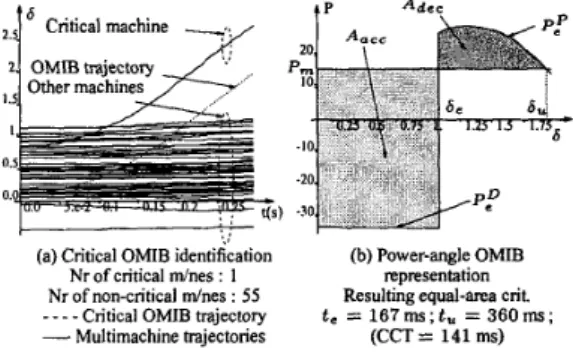
be performed on each critical generator. Figure 1 shows the time-domain trajectories of the multimachine system and the corresponding One Machme Infinite Bus (OMIB) equivalent. After obtaining these useful data fiom SIME, the MAT method computes a control action that should be applied to the critical generators in order to stabilize the whole set of dangerous contingencies simultaneously. Once the control actions are applied, a generation rescheduling and a power flow are performed, a new operating state is obtained, and another iteration of the MAT method is carried out for veri- fying that the new system operating state is stable for the set of critical contingencies. If the system is stable for all the contingencies, a new power flow limit has been found; if this is not the case, the MAT method computes a new preventive control action, and so on. In general, t h e e to four iterations are sufficient to converge to the solution.
In this paper, the MAT method is improved by adding an OPF function to perform the generation rescheduling. The OPF objective function is set to maximize the interface power flow in some selected tie lines, while respecting, at the same time, the values given by the MAT method and the bus voltage and power line limits. In this way, the new power flow transfer limit obtained by the MAT method is secure with respect to both, the dynamic and the static security con- straints.
(a) Critical OMIB identification Nr of critical dries : 1
Nr of non-critical dries : 55
- - -
-
Critical OMIB trajectory-
Multimachine hajectories(b) Power-angle OMIB representation Resulting equal-area crit. t. = 167 ms ; t , = 360 ms ;
(CCT = 141 ms)
Figure 1. Time-domain machines’ and OMIB’s trajectories; resulting equal-area criterion. A real-world case
This coupling of the MAT method and the OPF program is tested using a model of the South-southeast Brazilian power system with 16 areas, 11 85 buses, 1391 lines, 599 transform- ers and 56 machines; the voltage levels range fiom 138 to 765 kV. The initial base case was established in 1995 and cor- responds to a heavy load scenario of 33,299 MW forecasted for 1998.
- 6 2 -