O
pen
A
rchive
T
OULOUSE
A
rchive
O
uverte (
OATAO
)
OATAO is an open access repository that collects the work of Toulouse researchers and
makes it freely available over the web where possible.
This is an author-deposited version published in :
http://oatao.univ-toulouse.fr/
Eprints ID : 20144
To cite this version : Guo, Jianwei and Laouafa, Farid and Quintard,
Michel
A Large-Scale Model for Dissolution in Heterogeneous
Porous Media. (2018) In: Computational Methods in Water Resources,
3 June 2018 - 7 June 2018 (Saint-Malo, France). (Unpublished)
Any correspondence concerning this service should be sent to the repository
administrator:
[email protected]
A Large-Scale Model for Dissolution in Heterogeneous Porous Media
J. Guo, Southwest Jiaotong University, China
F. Laouafa, INERIS, France
M. Quintard, IMFT, Universit´
e de Toulouse, CNRS, France
Key words: upscaling, Large-scale model, Darcy-scale heterogeneity, Dissolution
Abstract
Dissolution of pore-scale soluble substances occurs in applications from environmental hydrogeology to CO2 storage. Development of Darcy-scale models has been widely discussed. This paper proposes an upscaling algorithm to develop large-scale models taking into account Darcy-scale heterogeneities. The theory is based on a comparison between the characteristic length-scale of the Darcy-scale heterogeneities and the length-scale of the dissolution front controlled by a Darcy-scale Damkhler number. The obtained large-scale model is shown to confront favorably to Darcy-scale direct numerical simulations.
Introduction
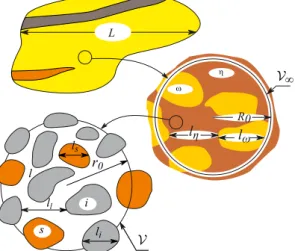
In this paper we consider the dissolution of a soluble material (NAPL, deposited mineral) trapped in a porous structure as illustrated Fig. 1. The first upscaling development leading to a Darcy-scale description has received a lot of attention in the literature. The reader may refer to the theoretical work in [1, 2] for the development of local non-equilibrium models involving several Darcy-scale effective properties, in particular an active dispersion tensor and a source term corresponding to the mass exchange between the two Dary-scale continua (liquid and soluble material). This latter term involves an exchange coefficient that will determine, through a Darcy-scale Damkhler number, the thickness of the dissolution front propagating into the porous medium.
lη R0 L ω η lω � 𝓥∞ s l i 𝓥 r0 ll ls li
Figure 1: Multiple-scale features and averaging volumes
We consider here a simple version of this Darcy-scale model corresponding to the following Darcy-scale equations: ∇ · (εT(1 − S) Ul) = 0 (1) ∂ (εT(1 − S)Cl) ∂t + ∇ · (εT(1 − S) UlCl) = −α (Cl− Ceq) (2) εT ∂S ∂t = ρl ρs α (Cl− Ceq) (3)
The large-scale model is obtained in the case of a separation of scales characterized the following inequality li, ls, ll lω, lη ld L (4)
where li, ls, llrefers to the pore-scale, lω, lη to the Darcy-scale heterogeneities, ldto the thickness of the
theory allows to develop a large-scale model involving large-scale averages denoetd by a starred variable. For illustration, the large-scale mass balance equation is given by
∂ ∂t({εT} (1 − S ∗) C∗ l) + ∇ · ({εT} (1 − S∗) U∗l C ∗ l) = −α ∗ (C∗ l − Ceq) (5)
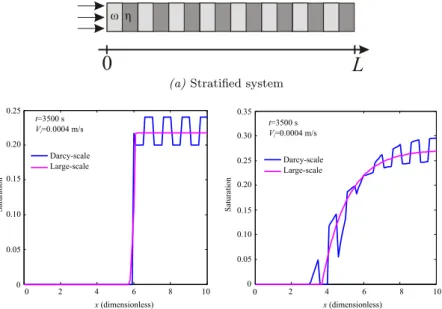
where the large-scale coefficient α∗ is obtained from the resolution of a special closure problem. The theory is tested over different types of heterogenous media. An example of the application to a stratifed porous system is shown Fig. 2 which represent the direct Darcy-scale numerical results and the large-scale prediction. On sees that the large-scale prediction works very well, even for very sharp fronts, i.e., larger Damkhler numbers that one would expect from the constraint Eq. 4.
ω
0
L
η
(a) Stratified system
4 t=3500 s Vl=0.0004 m/s Darcy-scale Large-scale x (dimensionless) 0 2 6 8 10 Saturation 0 0.05 0.10 0.15 0.20 0.25
(b) Case of local equilibrium dissolution, high Da t=3500 s Vl=0.0004 m/s Darcy-scale Large-scale 4 x (dimensionless) 0 2 6 8 10 Saturation 0 0.05 0.10 0.15 0.20 0.25 0.30 0.35
(c) Case of local non-equilibrium dissolu-tion, low Da
Figure 2: Dissolution of a partially soluble stratified porous medium
References
[1] M. Quintard and S. Whitaker. Convection, dispersion, and interfacial transport of contaminants: Homogeneous porous media. Advances in Water Resources, 17, 221–239, (1994).
[2] J. Guo, M. Quintard, and F. Laouafa. Dispersion in Porous Media with Heterogeneous Nonlinear Reactions. Transport in Porous Media, 109, 541–570, (2015).