2 HOELBEEK
The use of French au travers (de) for
describing a movement along a curved
surface: peripheral membership or
anomaly?
∗∗∗∗A
BSTRACTThis paper aims at providing a thorough analysis of a rare use where French au
travers (de) (meaning ‘way through’ or ‘across’) expresses a movement along a
curved surface. I try to determine whether this use should be considered a peripheral member of a prototypical category or an anomaly. After a short methodological section, the entire group of expressions containing French
travers ‘through’ is briefly presented; particular attention is devoted to the
different uses of au travers (de). Subsequently, I rely on precise analytical tools in order to carry out an in-depth analysis of the utterances under study (all dating from the 16th Century) and to compare them with semantically close examples from the same period. Finally, I come to the very subject of this contribution: I argue that the flatness of the surface is a fundamental characteristic of the category at hand, which entails that the tokens analysed should be viewed as anomalous side steps that did not involve any real extension of the category.
Keywords: spatial prepositions, au travers (de), historical semantics, diachronic
linguistics, cognitive linguistics, corpus linguistics
1. I
NTRODUCTIONIn this paper, I propose a thorough analysis of a rare use of French au travers
(de) ‘way through’/‘across’ that is documented for the 16th Century only. Though this phenomenon may look, at first sight, as a mere curiosity, its study contributes to a better comprehension of the past and present semantic structure of the entire group of expressions containing travers.
During my work on large French corpora, I noticed that the preposition au
travers (de) was used, on very rare occasions, for describing the movement of
an entity along the surface of a curved reference entity whose roundness is clearly expressed and even emphasized. Such a phenomenon proves all the more remarkable since language, when describing space, usually resorts to an idealisation by assuming the soil level of the reference entity to be a flat surface. This particular use shares features with the very frequent case where the moving entity moves along a flat reference entity. Since the exceptional use became almost immediately obsolescent, one may wonder whether one should
∗ I would like to thank Marc Dominicy, Annick Englebert and Dirk Vanden Berghe for their
3 HOELBEEK
consider its occurrences as members of a prototypical category or as anomalous side steps.
After a short methodological section, I will briefly present the entire group of expressions that contain French travers; I will devote particular attention to the different uses of au travers (de). Subsequently, I will analyse the utterances under study, and compare them with semantically close examples from the same period. Finally, I will come to the very subject of this contribution, by trying to determine whether the use of French au travers (de) for describing a movement along a curved surface should be considered a peripheral member of a prototypical category or an anomaly. I will argue that the tokens at hand should be viewed as anomalous side steps that did not involve any real extension of the category.
2. M
ETHODOLOGICAL REMARKSFirst of all, let us define some concepts that will be used in this contribution. For the sake of clarity, I will illustrate my theoretical assumptions by means of Modern French examples and my English translations of them.
In the theoretical framework of cognitive linguistics I am adopting here, two entities are distinguished when describing space: the reference entity (the object of the spatial relation) and the located entity (the subject of the spatial relation). In Talmy’s (1983) terminology, which I will adopt in this paper, the located entity is the Figure and the reference entity is the Ground.
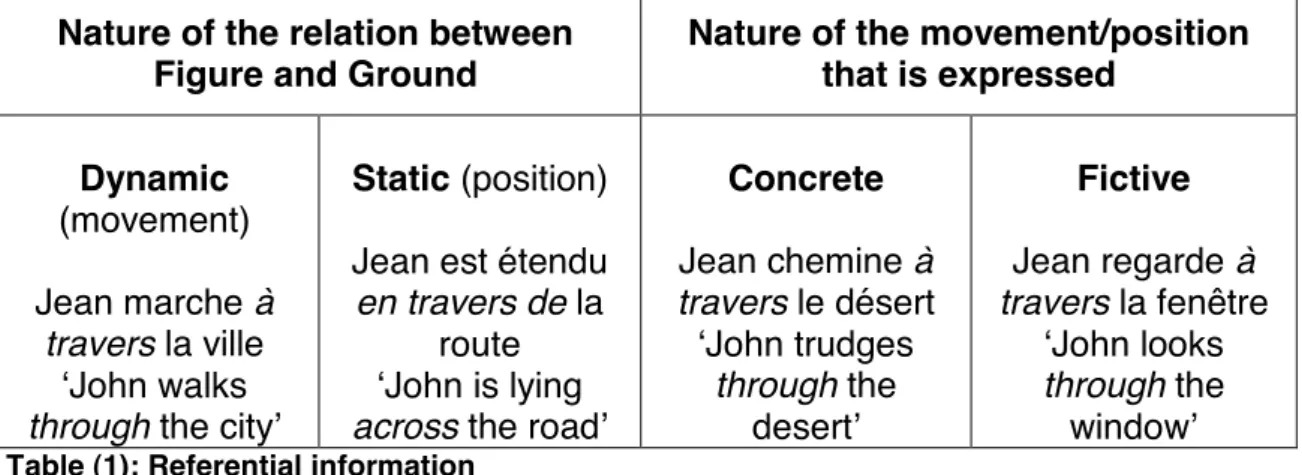
In order to distinguish and categorise the different uses observed, I rely on different kinds of parameters, such as grammatical information (the syntactic property of the analysed expressions), referential information (see Table 1 below), the level of abstraction (see Table 2 below) and functional parameters (the functional character of the Ground – section 4 – and the functional notion that best describes the expressed relationship – sections 5 and 6). This way of analysing the data allows me to reformulate in fine-tuned terms the more conventional categorisation of spatial, perceptual and metaphorical uses adopted, for example, by Stosic (2002a). I will comment in more detail on the terminology I am using (see Tables (1) and (2) below) as far as it proves relevant for the present contribution. The Tables contain examples with the Modern French prepositions à travers and en travers (de) (the former often meaning ‘through’, the latter rather ‘across’).
Table (1) shows that the relation between Figure and Ground can be Dynamic (the Figure moves) or Static (the Figure occupies a stable position). Contemporary French à/au travers (de) does not express Static relations anymore, but in the past it was able to convey them. The Table also indicates that a movement or a position can be of a Concrete or Fictive nature. A Concrete movement is a spatial configuration that involves an actual transition from one place to another, while a Fictive movement (see Talmy 2000:99-175) applies to a static scene where a movement is only suggested (e.g. because the Figure is a Fictive entity).
4 HOELBEEK
Nature of the relation between Figure and Ground
Nature of the movement/position that is expressed Dynamic (movement) Jean marche à travers la ville ‘John walks
through the city’
Static (position)
Jean est étendu
en travers de la
route ‘John is lying
across the road’
Concrete Jean chemine à travers le désert ‘John trudges through the desert’ Fictive Jean regarde à travers la fenêtre ‘John looks through the window’ Table (1): Referential information
Talmy distinguishes a large range of configurations with Fictive motion. Concerning perceptual uses, as illustrated by the example in Table (1) above, he speaks of ‘axial fictive motion along the line of sight’ (2000:110) and defines the line of sight as a ‘visual path’ belonging to the category of ‘sensory paths’ (2000:115). Moreover, he distinguishes between two types of sensory paths – the ‘Experiencer as Source’ path and the ‘Experienced as Source’ path – depending on the direction of the Probe (from the Experiencer to the Experienced or vice versa) (Talmy 2000:115-116). However, this distinction is not relevant to the data discussed here.
Meaning of the verb (or verbal
derivatives) Interpretation of a sentence
Concrete
Jean court à
travers la salle
‘John runs
through the hall’
Abstract
Jean est passé à
travers beaucoup de difficultés ‘John went through many difficulties’ Literal Jean a évité le combat en se sauvant à travers champs ‘Jean has avoided
the fight by running away
across the fields’
Figurative
Jean ne répond pas à la question:
il se sauve à
travers champs
‘John does not answer the question: he
avoids the question (literally,
he escapes
across the fields)’
Table (2): Level of abstraction
Table (2) illustrates the different levels of abstraction I distinguish in this paper, starting from the ideas that: (i) the concrete, spatial domain is the source-domain for the expressions analysed and the verbs they combine with; and (ii), that a metaphorical mapping onto another (target-)domain can take place. To deal with the uses that involve such a mapping, I make a distinction between Concrete and Abstract Verb meaning. When an abstract relation is expressed, it is similar to a spatial one, but the verb acquires ‘a metaphorical
5 HOELBEEK
meaning where the semantics are less defined in terms of spatial context’ (Wallentin et al. 2005:222). This means that the Figure and the Ground fail to entertain a spatial relationship with each other within a three-dimensional medium.
Finally, whole sentences (defined here as containing the Figure, the verb, the expression and the Ground) can convey a figurative meaning when the literal, spatial meaning it normally conveys is clearly not corresponding to the abstract domain of the context. The semantic structure of such a sentence is constituted by a concrete (literal) action that serves ‘as a vehicle for abstract (figurative) mental states and events’ (Cacciari and Glucksberg 1995:43).
3. T
HE SPECIFICITY OF AU TRAVERS(
DE)
Au travers (de) is an analytic preposition that belongs to the limited group of the
main markers of spatial dynamic relations with a medial polarity (any movement includes the initial phase of departure, a medial phase, and the final phase of arrival). Similar to French par ‘through’ and via ‘via’ (Borillo 1998), au travers
(de) has a directional meaning that involves reference to a path.
This expression exhibits very specific usage patterns which give rise to subtle differences with the use of similar prepositions. For example, both au
travers (de) and par can introduce the medial Ground of a movement. However, au travers (de), unlike par, does not take in consideration the relations of that
entity with other elements of the environment and does not presuppose that the motion verb involves some kind of alteration of such relations. Aurnague and Stosic (2002) argue that the same holds true for a travers (de).
The first difference can be illustrated by example (1), where the medial Ground (the glass canopy) is not a connecting entity. This raises no problem for the use of au travers (de) but par proves unacceptable:
(1) La tuile s’est décrochée du toit et est allée s’écraser sur le sol au
travers de/*par l’auvent de verre.
‘The tile came loose from the roof and crashed to the ground
through the glass canopy.’
The second difference can be illustrated by example (2). Although the verb expresses a movement, the relation between the Figure and the Ground does not change (Aurnague and Stosic characterise these kinds of verbs by stating that they can introduce a change of location, but do not obligatory do so; they thus involve only a potential change of location (2002:118)). Again, par is not compatible with this kind of configuration (except in archaizing language):
(2) Jean a marché pendant deux heures au travers de/?*par la forêt. ‘John walked for two hours across the forest.’
4. T
HE DIFFERENT USES OF AU TRAVERS(
DE)
6 HOELBEEK
4.1. Concrete uses (mostly movements) with Concrete verb
meaning
The category of concrete uses with concrete verb meaning is the largest and the best-know group of uses of au travers (de). In this category, we have to distinguish between various types of configurations. The following overview takes its main inspiration from the typology established by Stosic (2002a), who proposed a systematic inventory of the synchronic uses of Modern French à
travers. We find, among others:
- Grounds that are functionally designed for passage (pipes, tunnels,
holes, etc.);
- Grounds that are not functionally designed for passage (cities, countries,
forests, etc.);
- Grounds that do not constitute or include obstacles (open plains,
deserts, empty rooms, etc.);
- Grounds whose constitution or composition creates an evident frontal opposition to a movement (crowds, walls, windows, etc.).
4.2. Fictive uses (mostly perceptual) with Concrete verb
meaning
The various configurations observed in the category of fictive uses with concrete verb meaning are very similar in Fictive uses (mostly perceptual uses dealing with sight, hearing or touch), but au travers (de) selects different kinds of Grounds. Stosic (2002a:240-247) remarks that it is not always easy to distinguish between Figure and Ground when analysing perceptual utterances, because the Figure often remains unexpressed. This means that a sentence like (3), repeated from Table (1), does not contain an NP that would be able to denote the moving entity to which one could attribute the role of a Figure:
(3) Jean regarde à travers la fenêtre. ‘John looks through the window.’
As mentioned before, Talmy (2000:99-175) deems this phenomenon Fictive Motion. In the case of visual perception, the Fictive movement follows the line of sight. Schwarze (1989:312) observes that if the perception is not visual, a connection similar to the line of sight is fictively postulated between the organ of perception and the perceived object.
When distinguishing between different types of Grounds, we have to take into account the presence vs absence of a physical barrier which the line of perception is fictively assumed to go through. Indeed, some Grounds include a real physical barrier (although, this does not prevent perception), while others exhibit gaps or interstices through which the line of perception may fictively pass. Example (3) above illustrates the former situation, example (4) the latter:
(4) Jean regarde à travers le tuyau. ‘John looks through the pipe.’
7 HOELBEEK
4.3. Concrete uses with Abstract verb meaning
In contrast to uses with Concrete verb meaning, uses with abstract verb meaning involve at least one abstract entity (the Ground or the Figure). We find the same kinds of configurations as above, that is:
- Grounds that are not functionally designed for passage (mankind,
feelings, etc.);
- Grounds whose constitution or composition creates an evident frontal opposition (virtual obstacles to the continuation of an existence: long
period, crisis, etc.).
4.4. Fictive uses with Abstract verb meaning
As these configurations are Fictive movements interpreted in a Figurative way, they select the Grounds I have mentioned earlier for Fictive uses with Concrete verb meaning (section 4.2.).
5. T
HE NOTION OFG
UIDANCEThe functional approach I am adopting here belongs to the tradition of cognitive linguistics, as illustrated by scholars like Herskovits (1986) and Vandeloise (1991). In this approach, space is described by means of functional concepts inspired in naive physics and human bodily experience, like access to perception, potential meeting, and general vs lateral orientation. These concepts ‘are tied to the extralinguistic knowledge of space shared by the speakers of one language’ (Vandeloise 1991:13).
In order to capture the semantics of Modern French à travers, Stosic (2002a:106) has introduced the notion of Guidance as an alternative to the notion of an obstacle. The former notion also helps provide a functional analysis of the (spatial) semantics of au travers (de). This functional concept corresponds to the lateral control that is exerted on the located entity (the Figure) by the reference entity (the Ground) where the movement takes place.
Stosic elaborates on Talmy’s (2000) Force Dynamics in order to define the Figure as an Agonist that exerts a positive force with respect to the Ground, which plays the role of an Antagonist and thus opposes a passive force of resistance. He claims that, in contemporary French, the preposition à travers is used when this tension between force and counterforce takes place on the lateral axis. This means that the frontal opposition is not a crucial factor and that what is required is the presence and salience of the two poles that are defined with respect to the lateral orientation (Stosic 2002a:104-106). Even if the expressions à travers and au travers (de) cannot be considered to be synonyms (cf. Dominicy and Martin 2005; Martin and Dominicy 2001), their semantics are very similar, so that the notion of Guidance will prove useful for the description of au travers (de) as well.
6. T
HE DATAAll the examples discussed below contain the group au travers (de). This means that I will not dwell on the peculiarities of the other existing expressions with travers (viz. à travers (de), en travers (de), de travers (à), par le travers
8 HOELBEEK
(de), par à travers (de)). As said before, the expression au travers (de) can
describe the movement of an entity (the Figure) along the surface of a curved reference entity (the Ground), in this case the earth.
Herskovits (1986:61) analyses the role of geographical object as grounds, where a geographical object is defined as an object that ‘is or includes a part of the earth’s crust.’ She claims that English through ‘implies movement in a volume,’ which is generally the case with French au travers (de) as well, except in specific contexts where Figure and Ground are conceived as two-dimensional geometric entities such as lines and points. A sentence like (5) illustrates the fact that the meadow is viewed, here, as a three-dimensional Ground that includes part of the aerial space above the soil. It is in this three-dimensional volume that the Figure moves by following a trajectory parallel to the soil line.
(5) Le chat marche au travers du pré. ‘The cat walks through the meadow.’
The relevant data are taken from the Frantext (under development) database, containing more than 4000 texts from 1500 until today. I searched Frantext as well as the sub-database Frantext Moyen Français (1330-1500) for combinations like au travers + terre ‘earth’ and au travers + monde ‘world’ in order to find additional examples of the use concerned, with negative results. This seems to indicate that the tokens I am interested in here illustrate a highly marked use of au travers (de).
6.1. Two exceptional tokens of au travers (de)
The Frantext corpus records two examples from the 16th Century that contain
au travers (de) and describe a movement along the surface of a curved
reference entity. Both are written by the same author (Jacques Grévin, c. 1539 –1570) and appear in the same work (César, 1561):
(6) [...] icy sera veu la mort tragique d’un des plus braves guerriers de son temps, assavoir d’un Empereur des Romains nommé César, lequel s’est fait voye au travers de ceste rondeur du monde, [...] ‘[...] here will be seen the tragic death of one of the bravest
warriors of his time, namely of a Roman Emperor named Caesar, who has made his way through the roundness of this world, [...]’ (Jacques Grévin, César, 1561:97)
(7) Aborder un César, qui […]
S’est faict voye au travers de ceste masse ronde, Arrondissant son heur par la rondeur du monde! ‘Deal with a Caesar, who [...]
Made his way through this round mass,
Achieving (literally, rounding) his fortune all over the roundness of the world!’
9 HOELBEEK
These tokens fit in the category of uses where the Ground is not functionally designed for passage. Indeed, the world, or a part of the world, is not an object of the Channel-type (pipes, circuits, channels); it does not belong to the category of communication-channels conceptualised as Bordered (tunnels,
streets, trails, paths), nor to the category of Openings (hole, opening, open window, etc.). This means that the Figure itself has to create a passage in a
Ground that may include obstacles, but does not necessarily block its movement. In other words, the Figure manages to choose a path more or less freely, by using the space between the potential obstacles that the Ground may contain.
Stosic (2002b:150) states that this kinds of Grounds can be described as ‘surmountable obstacles’. According to him, they are conceptualised as obstacles in the speakers’ shared knowledge while allowing the Figure to move from one place to another; that is, to reach a point located on the other side of the obstacle. This can be due to the properties of the Ground or to the properties of the Figure. The Ground can be either Spatial (crack in a shutter,
groove, door) or Material (window, glasses, membranes, partition, wall). Even
when it is Spatial, the Ground is conceptualised as an obstacle because of its existential dependency on a physical entity (e.g. a window existentially depends on a wall). Moreover, Stosic (2002b:151) reminds us of the well-known fact that the same word may designate, according to the context, either the Spatial or the Physical part of its referent (cf. Kleiber 1999; Vandeloise 1995).
6.2. The notion of Sweeping
Besides uses expressing a path, Stosic distinguishes those expressing Sweeping, applying to a spatial configuration where the Figure occupies the entire extent of the Ground, due either to the plurality of its (dispersed) elements or to its meandering movement, full of twists and turns (Stosic 2002a:94). This concept adds a significant parameter, but it proves necessary to distinguish between two different types of Sweeping. In the first case, a singular Figure that does not consist of a plurality of elements exhibits a meandering movement; example (8) illustrates this use, which I will call sweeping of a singular Figure:
(8) il n’était pas possible [ …] qu’il se promenât à travers tout le royaume.
‘it was not possible [...] that he might walk across the entire kingdom.’
(Jean Guéhenno, Jean-Jacques, 1952)
In the second case, the Figure consists of a plurality of elements; I will call this use sweeping of a plural Figure; see example (9):
(9) [...] une très grande rivière [...] se répand au travers les basses terres.
‘[...] a very big river [...] spreads through the lowlands.’ (Gauthier de Lapeyronie, Voyage en Islande, 1802)
10 HOELBEEK
The tokens that concern us here belong to the first kind of Sweeping: in examples (6) and (7) above, Caesar is a singular Figure that makes several movements and thus sweeps the Ground. Obviously, Caesar was accompanied by his legions, but their joint movement can be seen as the movement of one single entity, since they did not disperse but stayed together all the time.
The notion of Guidance seems to describe these attestations in a quite accurate way. Caesar naturally met resistance during his campaigns, in the form of natural obstacles or enemies, but the Ground did not succeed in stopping him, and he made his way through it by creating a passage for himself. In accordance with Stosic’s hypothesis, Caesar’s actions assign the status of salient lateral poles to potential points of frontal resistance: objects in the Ground that might constitute obstacles are transformed into lateral forces that control the movement on the lateral rather than frontal axis. Yet Stosic does not address the fact that, when describing space, speakers usually assume the world to be flat. Vandeloise does notice this phenomenon when stating: ‘Even though the earth is round, no one takes into account the curve of the earth’s surface in a linguistic description of space’ (1991:14). In fact, even though we know the earth is round, a sentence like (10) encodes a mental scheme where the moving entity follows a more or less straight, horizontal line in the aerial space above a flat soil:
(10) Nous voyageons au travers de la France. ‘We travel through France.’
Obviously, hills or mountains can alter the course of the Figure, but its trajectory is defined with reference to the soil level of the Ground, which always remains a flat surface. It follows that examples (6) and (7) appear as strange exceptions to this general rule.
6.3. Semantically close uses
As I mentioned before, the use illustrated by examples (6) and (7) above shares features with the very frequent construction where the Figure moves along a flat Ground. I have selected some tokens from the same period that convey this much more common meaning. The prevailing idea, here, is that of a movement, a change of place, a transversal trajectory of the Figure from one extremity to the other within or along a Ground that may be a place, a medium or a surface:
(11) Plutarque exaltant l’excellence de l’homme escrit, qu’Archimedes traina d’une seule main et d’une seule corde au travers du marché de Syracuse, un grand navire chargé de marchandise, [...]
11 HOELBEEK
‘Plutarch, extolling the excellence of mankind, writes that
Archimedes dragged with one hand and a single rope, through the Syracuse market, a large ship loaded with goods, [...]’
(Pierre Boaistuau, Bref discours de lexcellence et dignité de
l’homme, 1558:58)
(12) Ou comme on voit couler la neige des montagnes, Et les ruisseaux glacez au travers des campagnes; […]
‘Or as we see the snow flowing from the mountains, And the icy streams [flowing] through the lands;’ […]
(Étienne Jodelle, Didon se sacrifiant, 1573:187)
It can be noticed that, except for the flatness of the reference soil, these tokens exhibit (almost) all the properties present when the Figure moves along a curved surface: (i) the Ground is not functionally designed for passage, (ii) the Ground belongs to the ‘agglomeration’ or ‘country’ type and (ii) the Figure is singular (in example (12) this is not the case though).
7. D
ISCUSSIONIt is difficult to determine a priori whether Jacques Grévin’s examples should be interpreted as peripheral members of a prototypical category or as sheer anomalies. Yet several arguments support the idea that we are faced with an anomalous use.
First of all, the tokens at hand are due to one author only. Since I did not find other examples, it is possible that Grévin developed this innovation by himself, and that he may have been aware of its incorrectness and produced it on purpose. Indeed, the diction of (7), in particular the paronymic collocation of
ronde ‘round’ - arrondissant ‘rounding’ – rondeur ‘roundness’ ––, strongly
suggests that a poetic motivation is at work. Notice, furthermore, the wordplay involved in the use of arrondissant ‘rounding, rounding off, achieving’.
As said before, speakers normally consider the earth flat when describing space in ordinary language. It follows that the anomaly of Grévin’s examples does not stem from the choice of the Ground (a part of the earth and part of the corresponding aerial space), but from the fact that he emphasizes the roundness of that Ground so explicitly, maybe due to the poetic motivation just mentioned. He (maybe deliberately) refrains from applying the usual idealisation of a curved Ground as a flat one, and doing so produces an anomalous use. As Traugott and Dasher (2002:20) have said, in producing speech or writing “linguistic material may be used in novel ways”. Yet innovative uses are often considered incorrect (or at least idiosyncratic) at their first appearance, and it takes time for a linguistic community to accept them. Traugott and Dasher (2002:34) recall as well the frequent case where innovation “do not spread to other speakers”, which is exactly what happened in this particular case where the new use never got accepted by the community.
12 HOELBEEK
The apparition of a new use is not surprising in itself. In the past, as today, a certain liberty existed in matters of linguistic expression. For example, I pointed out elsewhere (Hoelbeek 2007) that 16th-Century French allowed for more combinatory possibilities than Modern French regarding the use of the preposition de, which could be combined with au travers or à travers, while neither au travers in its prepositional function nor à travers de exist in Modern French anymore. However, the fact that Grévin’s innovative use was not adopted by other speakers might suggest that the expressions with travers where not judged suitable to express such a meaning. The very marginal status of this meaning could indicate that the preserved prototypical characteristics were not numerous enough, or not strong enough, to make the new use an acceptable member of the category. As I argued elsewhere (Hoelbeek 2010), the shift from one domain to another should be interpreted in terms of a preservation of a so-called ‘image-schematic structure’ (Sweetser 1988:390), which in this case could be formulated as follows: ‘The internal phase of a movement of a Figure that runs across a Ground.’ The novelty of a curved Ground seems to have gone one bridge too far, which means that the flatness of the Ground is a fundamental characteristic of this category.
8. C
ONCLUSIONThis contribution is part of a broader research project that belongs to the research tradition of Romance historical semantics and aims at giving a complete diachronic-semantic description of all uses of the total set of expressions containing French travers and Italian traverso. By relying on insights provided by various semantic descriptions and personal elaborations of them, I attempt to provide answers to questions such as: In what measure were the analysed expressions subjected to a grammaticalisation process? Why did
à travers become significantly more frequent from the 18th Century on (see
Hoelbeek 2007)? What are the differences between the evolutions of the expressions at hand in the two languages?
The uses examined in this paper are characterised in terms of the functional concept of Guidance and the functional notion of Sweeping. The interest of the exceptional examples discussed here stems, quite paradoxically, from the fact that we have to qualify them as isolated anomalies. Indeed, the marginality and the poetic overtones of the use of au travers (de) for describing a movement along a curved Ground (only two tokens, limited to one author) allow us to consider those contexts which involve a non-idealised, explicitly curved Ground as unsuited for an encoding by au travers (de). Consequently, the flatness of the Ground should be considered a fundamental characteristic of the relevant category.
R
EFERENCESAurnague, Michel and Stosic, Dejan (2002) La préposition ‘par’ et l’expression du déplacement. Vers une caractérisation sémantique et cognitive de la notion de trajet. Cahiers de Lexicologie 81:113-139.
13 HOELBEEK
Borillo, Andrée (1998) L’espace et son expression en français. Gap/Paris: Éditions Ophrys.
Cacciari, Cristina and Glucksberg, Sam (1995) Imaging Idiomatic Expressions: Literal or Figurative Meanings? In: Everaert, Martin (ed.) Idioms: structural
and psychological perspectives. Routledge: Lawrence Erlbaum Associates.
43-56.
Dominicy, Marc and Martin, Fabienne (2005) ‘À travers’ et ‘au travers de’. Des emplois perceptuels aux emplois spatiaux. In: Dendale, Patrick (ed.) Le
mouvement dans la langue et la métalangue. Recherches Linguistiques, 27.
Metz: Université de Metz. 151-190.
Frantext, CNRS – ATILF (Analyse et Traitement Informatique de la Langue Française – Computer Processing and Analysis of the French Language, joint research unit of CNRS and University Nancy 2), Nancy:
http://www.frantext.fr/. Last accessed: 2nd September 2010.
Herskovits, Annette (1986) Language and spatial cognition: An interdisciplinary
study of the prepositions in English. Cambridge: Cambridge University
Press.
Hoelbeek, Thomas (2007) Le développement diachronique des emplois des
locutions dérivées du mot ‘travers’. Master dissertation. Brussels: Vrije
Universiteit Brussel.
Hoelbeek, Thomas (2010) The temporal uses of ‘à travers (de)’ and ‘au travers de’: metaphorical transfer or cancellation of the spatial sense? In: Tabu Dag
2010 (3-4 June 2010). Conference Abstracts. Groningen: University of
Groningen. 64.
Kleiber, Georges (1999) Problèmes de sémantique: la polysémie en questions. Lille: Presses Universitaires du Septentrion.
Martin, Fabienne and Dominicy, Marc (2001) ‘À travers’, ‘au travers (de)’ et le point de vue. In: Kupferman, Lucien, Katz, Eva and Asnès, Maria (eds.) La
preposition. Travaux de Linguistique 42-43(1):211-227.
Schwarze, Christoph (1989) Polysemie als Prozedur, am Beispiel von Frz. ‘à travers’ und ‘chez’. In: Habel, Christopher, Herweg, Michael and
Rehkämper, Klaus (eds.) Raumkonzepte in Verstehensprozessen.
Interdisciplinäre Beiträge zu Sprache und Raum. Tübingen: Niemeyer. 310–
338.
Stosic, Dejan (2002a) ‘Par’ et ‘à travers’ dans l’expression des relations
spatiales: comparaison entre le français et le serbo-croate. Doctoral
dissertation. Toulouse–Le Mirail: Équipe de Recherche en Syntaxe et Sémantique, Université de Toulouse–Le Mirail.
Stosic, Dejan (2002b) Les prépositions spatiales ‘par’ et ‘à travers’ –
convergences et divergences. In: Kupferman, Lucien (ed.) La préposition
française dans tous ses états – 4. Scolia 15. 143-156.
Sweetser, Eve E. (1988) Grammaticalization and semantic bleaching. In: Axmaker, Shelley, Jaisser, Annie C. and Singmaser, Helen (eds.)
Proceedings of the Fourteenth Annual Meeting of the Berkeley Linguistics Society (February 13-15, 1988). Berkeley Linguistics Society 14. 389–405.
Talmy, Leonard (1983) How language structures space. In: Pick, Herbert L. and Acredolo, Linda P. (eds.) Spatial orientation: Theory, research, and
14 HOELBEEK
Talmy, Leonard (2000) Toward a cognitive semantics. Volume 1: Concept
structuring systems. Cambridge (Mass.)/London: The MIT Press.
Traugott, Elizabeth C. and Richard B. Dasher (2002) Regularity in semantic
change. Cambridge: Cambridge University Press.
Vandeloise, Claude (1991) Spatial prepositions: a case study from French. Chicago: University of Chicago Press.
Vandeloise, Claude (1995) De la matière à l'espace: la préposition ‘dans’.
Cahiers de Grammaire 20:123-145.
Wallentin, Mikkel et al. (2005), Concrete spatial language: See what I mean?
Brain and Language 92(3):221-233.
Thomas Hoelbeek is currently working on a joint PhD at the Centre for
Linguistics (CLIN) of the Vrije Universiteit Brussel and the Centre for Literary, Philological and Textual studies (PHILIXTE) of the Université Libre de Bruxelles, Belgium. He obtained a Master's degree in Language and Literature (French and Italian) at the Vrije Universiteit Brussel in 2007, defending a Master's thesis entitled "Le développement diachronique des emplois des locutions dérivées du mot 'travers'". Consequently, he did a post-graduate degree in Italian Linguistics in Italy at the Università di Pisa. His main research interests are semantics, cognitive linguistics and historical linguistics.