HAL Id: hal-01958610
https://hal.sorbonne-universite.fr/hal-01958610
Submitted on 18 Dec 2018HAL is a multi-disciplinary open access archive for the deposit and dissemination of sci-entific research documents, whether they are pub-lished or not. The documents may come from teaching and research institutions in France or abroad, or from public or private research centers.
L’archive ouverte pluridisciplinaire HAL, est destinée au dépôt et à la diffusion de documents scientifiques de niveau recherche, publiés ou non, émanant des établissements d’enseignement et de recherche français ou étrangers, des laboratoires publics ou privés.
Revealing pH-Dependent Activities and Surface
Instabilities for Ni-Based Electrocatalysts during the
Oxygen Evolution Reaction
Chunzhen Yang, Maria Batuk, Quentin Jacquet, Gwenaëlle Rousse, Wei Yin,
Leiting Zhang, Joke Hadermann, Artem Abakumov, Giannantonio Cibin,
Alan Chadwick, et al.
To cite this version:
Chunzhen Yang, Maria Batuk, Quentin Jacquet, Gwenaëlle Rousse, Wei Yin, et al.. Revealing pH-Dependent Activities and Surface Instabilities for Ni-Based Electrocatalysts during the Oxygen Evolution Reaction. ACS Energy Letters, American Chemical Society 2018, 3 (12), pp.2884-2890. �10.1021/acsenergylett.8b01818�. �hal-01958610�
1
Revealing pH-Dependent Activities and
Surface Instabilities for Ni-Based
Electrocatalysts during the Oxygen
Evolution Reaction
Chunzhen Yang,a Maria Batuk,b Quentin Jacquet,a Gwenaëlle Rousse,acd Wei Yin,a
Leiting Zhang,a Joke Hadermann,b Artem M. Abakumov,e Giannantonio Cibin,f Alan
Chadwick,g Jean-Marie Tarascon,acdh and Alexis Grimaud*acd
a
Chimie du Solide et de l’Energie, Collège de France, UMR 8260, 75231 Paris Cedex
05, France
b
EMAT, University of Antwerp, Groenenborgerlaan 171, B-2020 Antwerp, Belgium
c
Réseau sur le Stockage Electrochimique de l‘Energie (RS2E), CNRS FR3459, 33
rue Saint Leu, 80039 Amiens Cedex, France
d
Department of Chemistry, UPMC, 4 Place Jussieu, 75005 Paris, France
e
Skoltech Center for Electrochemical Energy Storage, Skolkovo Institute of Science
and Technology, Moscow 143026, Russia
f
Diamond Light Source, Harwell Science and Innovation Campus, Didcot,
Oxfordshire OX11 0DE, U.K.
g
School of Physical Sciences, University of Kent, Canterbury, Kent CT2 7NH, U.K.
h
ALISTORE-European Research Institute, FR CNRS 3104, 80039 Amiens, France
2
Abstract
Multiple electrochemical processes are involved at the catalyst/electrolyte interface
during the oxygen evolution reaction (OER). With the purpose of elucidating the
complexity of surface dynamics upon OER, we systematically studied two Ni-based
crystalline oxides (LaNiO3-δ and La2Li0.5Ni0.5O4) and compared them with the
state-of-the-art Ni-Fe (oxy)hydroxide amorphous catalyst. Electrochemical
measurements such as rotating ring disk electrode (RRDE) and electrochemical quartz
microbalance microscopy (EQCM), coupled with a series of physical
characterizations including transmission electron microscopy (TEM) and X-ray
absorption spectroscopy (XAS) are conducted to unravel the exact pH effect on both
the OER activity and the catalyst stability. We demonstrate that for Ni-based
crystalline catalysts the rate for surface degradation depends on the pH and is greater
than the rate for surface reconstruction. This behavior is unlike for amorphous Ni
oxyhydroxide catalyst which is found more stable and pH independent.
3
Water splitting is considered as a promising strategy to store energy from renewable
energies in the form of a fuel (H2) and has therefore attracted tremendous attention in
recent years. 1-2 Nevertheless, the sluggish kinetics of the half reaction occurring at
the anode, namely the oxygen evolution reaction (OER), currently limits the
efficiency of the overall process, hence calling for the development of better
electrocatalysts. Despite recent successes at designing earth-abundant crystalline or
amorphous transitional metal oxides and oxyhydroxides,3-6 our understanding of the active catalysts’ structure and structural stability is still insufficient.
The activity of lattice oxygen for participating the in the OER has previously been investigated by isotopic labeling experiments coupled with differential electrochemical mass spectroscopy (DEMS) on RuO27 and on Au electrode8. Results showed that O-O bonds could be formed between the lattice oxygen and surface absorbed oxygen, following a mechanism which can be compared to the well-known Mars-Van Krevelen (MvK) mechanism previously described for gas phase catalysis.9 Recent discoveries further pointed towards common intermediates responsible for the involvement of lattice oxygen into the OER mechanism7-8 but also into the surface degradation.6, 10-13 Moreover, triggering the redox activity of lattice oxygen was found to often be associated with a strong pH dependence for the
anodic current,14-17 suggesting either a decoupled proton-electron-transfer mechanism
for which the rate-determining step is shifting from the formation of O-O bonds to the
deprotonation of OH(ads) or OOH(ads), or the chemical formation of pre-catalyst as
being rate limiting. In any case, it was further demonstrated that the proton transfer
kinetics at the catalyst/electrolyte interface becomes limiting for a wide variety of
OER catalysts.18-19 However, when the kinetics for refilling oxygen vacancies is slow,
instability for oxide catalysts is often observed.3, 20-21 This instability originates from
cation dissolution which is triggered by the lowering of their coordination, hence
4
oxidation state for the transition metal on the surface, which led researchers to term
these catalysts as redox active.22-23 From these recent findings, understanding the
delicate equilibriums existing on the surface of crystalline transition metal oxides
appears to be vital for the development of efficient and stable OER catalysts. This is
particularly true following recent knowledge developed for electrodeposited catalysts
such as Co phosphate (CoPi)24-25 or Ni-Fe oxyhydroxide (Ni1-xFexOOH)17, 26 for which
a constant dissolution/redeposition process involved in the OER, also often poised as
self-healing mechanism, places them at the border between solid heterogeneous and
molecular homogenous catalysts.
In detail, the rapid surface reconstruction occurring for some oxide catalysts during
the OER may involve multiple steps, including water adsorption and oxidation
followed by oxygen release27, catalyst degradation and cation dissolution induced by
the evolution of lattice oxygen, the subsequent re-deposition process and the
formation of amorphous surface with a structure often resembling that of
(oxy)hydroxide-like species. So far, the complexity of the surface dynamics and our
poor knowledge of the kinetics associated with each step hampered our understanding
of the OER mechanism28, hence calling for a protocol to accurately study these
catalysts. This is especially true regarding the exact effect of pH which, by modifying
the different equilibriums occurring at the catalyst/electrolyte interface, can impact
both the activity and the stability of the catalysts.17
With the purpose of unveiling the pH effect on the underlying OER mechanism, we
developed a redox active OER catalyst La2Li0.5Ni0.5O4±δ (LLNO) with
Ruddlesden-Popper (RP) structure in which Li+ serves as sacrificial cation that
leaches out under OER conditions to activate the redox activity of the surface and
initiate further surface degradation that we aim at studying in this work. This RP-type
5
previously suggested to undergo lattice oxygen oxidation and evolution.21 We then
systematically studied the physical and electrochemical properties of these two
Ni-based crystalline oxides and compared them with the state-of-the-art Ni-Fe
(oxy)hydroxide (Ni1-xFexOOH) amorphous catalyst26, 29 (Supplementary Figure S1).
Coupling electrochemical tools such as rotating ring disk electrode (RRDE)30-31 and
electrochemical quartz microbalance microscopy (EQCM) with physical
characterizations such as X-ray diffraction (XRD), transmission electron microscopy
(TEM), and X-ray absorption spectroscopy (XAS) at Ni K-edge, we discuss in this
study the exact effect of pH on both the OER activity and the catalyst stability for
each of these different classes of compounds.
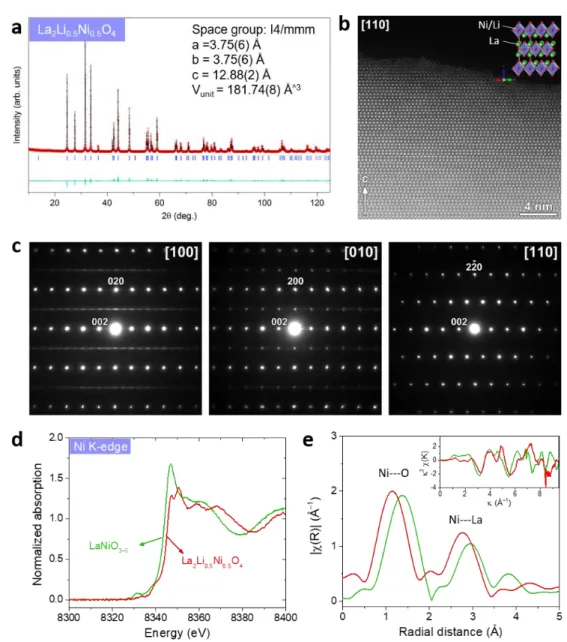
The structures of LLNO and LaNiO3-δ were first examined using Rietveld refinements
of data from laboratory XRD measurements (Figure 1a and Figure S1). The LLNO
compound shows the Ruddlesden-Popper structure with a space group of I4/mmm,
indicative of a disordering of NiO6 and LiO6 octahedra sharing corners and forming
layers along the ab plane in between which La3+ cations occupy a position with 9-fold
coordination.32 LaNiO3-δ possesses the rhombohedral perovskite structure with 3D
arrangement of corner-shared NiO6 octahedra. In contrary, the amorphous and
electrodeposited Ni (oxy)hydroxide is composed of units of less than 10 edge-shared
NiO6 octahedra with terminal under-coordinated oxygen, as previously refined by
6
Figure 1. Structural characterizations of La2Li0.5Ni0.5O4. (a) X-ray powder diffraction
pattern with Rietveld refinement. (b) [110] high-resolution HAADF-STEM image showing the structure of La2Li0.5Ni0.5O4. (c) Electron diffraction patterns along [100],
[010], and [110] directions for La2Li0.5Ni0.5O4. (d) Ni K-edge XANES absorption spectra
recorded for La2Li0.5Ni0.5O4 and LaNiO3–δ. (e) Magnitude of Fourier transform of
K3-weighted EXAFS oscillations for the pristine La2Li0.5Ni0.5O4 and LaNiO3–δ. In inset is
shown the EXAFS oscillations in k-space.
Following this structural determination, the Ni oxidation state for crystalline LLNO
7
1d-e). When compared to LaNiO3-δ, a slight shift towards higher energy for the Ni
K-edge was measured for LLNO, suggesting a slightly higher Ni oxidation state
which could be explained by the presence of oxygen vacancies in LaNiO3-δ, as often
reported for as synthetized compound.35 The crystal structure of LLNO was further
confirmed by TEM: high-angle annular dark-field scanning transmission electron
microscopy (HAADF-STEM) images visualize the cations arrangement in the LLNO
structure (Figures 1b, S2 and S3) and show a clean surface with only a very thin
amorphous layer of 0.5 nm. Furthermore, while laboratory XRD was showing an
average disordering of Li and Ni, electron diffraction patterns (Figure 1c) shows
crystallites with a local ordering of NiO6 and LiO6 octahedra, confirming the Ammm
symmetry and lattice parameters previously proposed. Finally, the 0kl: k+l=2n+1
reflections in the [100] patterns are due to twinning with [010].
Figure S4-S5 shows the electrochemical activity under OER conditions normalized by
surface area as deduced by Brunauer, Emmet, Teller (BET) measurements for LLNO
and LaNiO3-δ and compared to the one measured for the nickel (oxy)hydroxide film as
normalized by geometric surface area. Similar anodic currents as well as Tafel slopes
were obtained for LLNO and LaNiO3-δ after the first cycle, suggesting similar OER
mechanism and kinetics for these two crystalline Ni-based compounds.
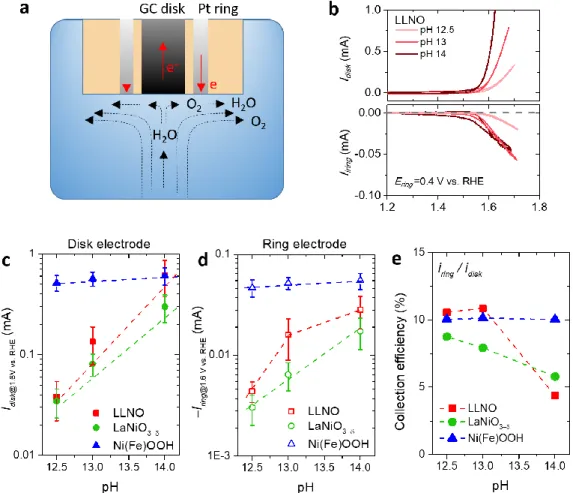
RRDE measurements30-31 were further carried out to better understand the effect of
pH on the anodic current, and more specifically the current resulting from the oxygen
evolution on the surface of the catalyst from the contribution arising from catalyst
degradation (Figure 2 and Figure S6). By calculating the collection efficiency at a fixed potential (E = 1.6 V vs. RHE) at which the oxygen
evolution occurs, the effective current contributing from oxygen evolution can thus be
estimated.30 The RRDE study reveals that the OER activity for both LLNO and
8
film (Figure 2c). The collection efficiency for both LLNO and LaNiO3-δ was found to
decrease with pH from around 10% at pH 12.5 to around 5% at pH 14 (Figure 2e). In
contrast, while the collection efficiency was also found to be close to 10% at pH 12.5
for the Ni(Fe)OOH film after 10 cycles, very stable OER performances and
contribution from the oxygen evolution to the anodic current were found for this
catalyst at every pH (Figure 2e).
Figure 2. pH dependent activity and O2 evolution efficiency studied by the RRDE
measurement. (a) scheme for the RRDE experiment. (b) Results obtained for LLNO at pH 12.5, 13 and 14. (c) pH dependent OER activities with stabilized current measured by the disk electrode after activation for 10 cycles at a working potential of 1.6 V vs. RHE. (d) the corresponding ring current, and (e) the collection efficiency
. The collection efficiency (η) of the RRDE system is estimated to be around 10
% as obtained on the electrodeposited Ni(Fe)OOH film catalyst (see methods in the Supplementary Information).
9
Observing that the anodic current for LLNO was found to increase with cycling at pH
13 while it was found stable for the two other Ni-based catalysts at every pH (Figure
S7), we further investigated the effect of cycling on the collection efficiency as a
function of pH (Figure 3). The three Ni-based model catalysts were found to
demonstrate contrasted stability features when cycling at different pH. For the LLNO
sample, an activation process at pH 12.5 and pH 13 during the initial 10 cycles is
observed, with the collection efficiency (η) increasing from ~6% up to 12%. The low
collection efficiency in the initial 1-3 cycles may be ascribed to the redox process
induced by the gradual leaching of cations from the LLNO structure, whereas the high
value of η obtained after activation would be a strong indication for a stable oxygen
evolution current. However, when cycling LLNO at pH 14, poor oxygen evolution
with a collection efficiency lower than 5% was found, suggesting that the main
contribution to the anodic current originates from parasitic oxidation/corrosion
phenomenon. We could further detect a continuous loss of electrochemically active
surface area for LLNO at pH 14 as seen by the gradual decrease of the
pseudocapacitive contribution upon cycling (Figure S9-10). For the LaNiO3-δ sample,
after an initial drop for the first few cycles, the ring current for oxygen detection and
the collection efficiency are found relatively stable at each pH during cycling,
suggesting that the rate for parasitic oxidative reaction during OER is very slow.
Nevertheless, the overall collection efficiency was found to decrease with pH which
suggests that the pH affects the degradation rate which gets stronger at higher pH. On
the other hand, for Ni(Fe)OOH the disk current, ring current and the collection
efficiency are found fairly stable upon cycling and they show no dependence on the
10
Figure 3. Electrochemical stability for the three nickel bases catalysts versus cycling
and pH: LLNO, LaNiO3–δ, and Ni(Fe)OOH. The disk current (a), ring current (b), and the
collection efficiency (c) are plotted vs. the cycling number. The low collection efficiency (η < 8%) is ascribed to the significant degradation process such as cation dissolution.
Therefore, the anodic current measured for the amorphous film arises from oxygen
evolution, whereas for crystalline nickel-based oxides a non-negligible part of the
current originates from a catalyst degradation process which is enhanced at high pH.
We could finally show that the decreased collection efficiency found for LLNO and
LaNiO3-δ with pH is not arising from the use of carbon additive by showing that the
collection efficiency measured for Ni(Fe)OOH is not affected by the addition of
11
current decreases for LLNO with cycling (Figure S9-10) while the collection
efficiency is found rather constant (Figure 3c), indicative of a reduction of the
electrochemically active surface area due to surface degradation while the part of the
anodic current arising from the OER remains almost constant.
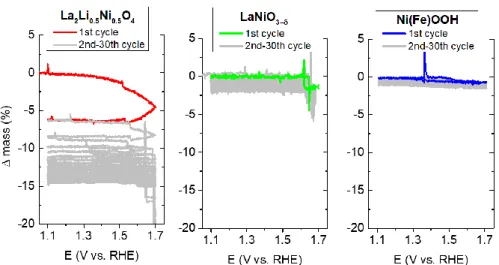
We further probe the degradation process occurring for these catalysts by the means of
electrochemical quartz crystal microbalance (EQCM) (Figure 4). Using this
weight-sensitive technique, we could conclude that the LaNiO3-δ catalyst shows only a
very limited mass loss during OER cycling at pH 13, with a slight drop of its mass
observed at high potential. Similar observation was made for the amorphous
Ni(Fe)OOH film. On the contrary, a severe mass loss is recorded for LLNO, this loss
being potential-dependent and occurring above 1.5 V vs. RHE in the water oxidation
region. Overall, a mass loss higher than 10 wt.% could be observed after 30 cycles,
the first cycle accounting for most of this loss which gradually slows down during the
subsequent cycles. Repeating these EQCM measurements at varied pH for LLNO
(Figure S12), it is observed that the mass loss increases with pH. This observation is
consistent with the RRDE results discussed above, and indicates that surface
degradation is pH dependent for this nickel-based Ruddelsden-Popper oxide. A
reversible evolution of lattice oxygen, the mechanism often proposed for the redox
active compounds, would be counter-balanced by water adsorption and should not
lead to any mass loss. Our results clearly show that this redox process is accompanied
12
Figure 4. Comparison of the mass loss of LaNiO3–δ, La2Li0.5Ni0.5O4 and Ni(Fe) hydroxide
catalysts upon cycling in KOH solution (pH = 13) recorded by electrochemical quartz crystal microbalance (EQCM).
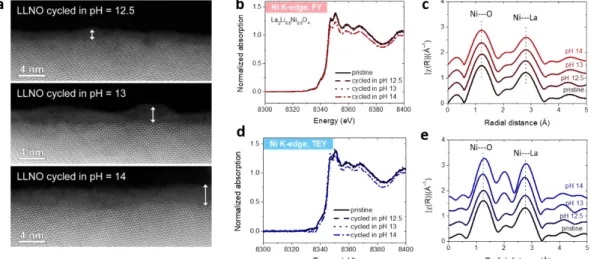
We further studied the surface properties of the cycled LLNO and LaNiO3-δ samples
by HAADF-STEM and XAS at the Ni K-edge (Figure 5). A thin amorphous layer was
observed on cycled LLNO samples (after 30 CV cycles), as revealed by
HAADF-STEM (Figure 5a), the thickness of which grows from ≈ 2 to 6 nm when
increasing the pH from 12.5 to 14. To grasp more information about the surface
amorphization process, XAS at Ni K-edge was conducted in both bulk-sensitive
fluorescence yield (FY) mode and surface-sensitive total electron yield (TEY) mode
(Figure 5b and 5d, respectively). No significant modification of the Ni oxidation state
after cycling is observed at each pH when compared to the pristine sample, unlike
what could be observed for other redox active perovskites such as
Ba0.5Sr0.5Co0.8Fe0.2O3-δ6, 37 The corresponding EXAFS spectra also confirmed that the
atomic local environment on the surface of this oxide is maintained upon cycling,
with the apparition of a new feature at around 2 Å in reduced distances which would
correspond to an edge-shared octahedra coordination growing with pH. EDX analysis
13
amorphous film (Figure S13). When compared to the bulk crystals, the amorphous
layer shows similar elemental distributions including Ni, La, and O. Recrystallization
process of the surface is observed under the electron beam (Figure S13), with only a
loss of long range order possibly due to atomic defects (vacancies) formed upon
cycling. This observation indicates that not only Li is leached out during cycling, but
that La and Ni cations are also continuously lost on the surface leading to a drastic
loss of mass as shown by EQCM. Hence, these results show that the amorphous thin
layer formed on the LLNO surface mostly originates from the redox activity of the
surface, suggesting that the edge-shared octahedra motifs observed by EXAFS grow
farther from the surface of the particles. Nevertheless, this result cannot explain the
loss of more than 10% in mass of catalyst as recorded by EQCM (Figure 4a). Bearing
in mind that the solubility of nickel in alkaline conditions is rather small, we
hypothesize that clusters of nickel hydroxides could be formed in solution away from
the electrode and do not deposit onto the surface of crystalline LLNO.
Figure 5. Surface deconstruction of La2Li0.5Ni0.5O4 catalyst. (a) HAADF-STEM images of
cycled LLNO catalysts in KOH solutions at different pH. (b-e) Ni K-edge X-ray absorption spectra and the corresponding EXAFS oscillations recorded for LLNOafter cycling in KOH solutions at different pH. (b) and (c) are recorded in the bulk-sensitive fluorescence mode (FY), (d) and (e) are recorded in surface-sensitive total electron
14
yield (TEY) mode.
As suggested in this work, the electrochemical activity and stability of oxide catalysts
are related to their crystal and electronic structures but also to the pH of the
supporting electrolyte. Using LLNO as a model compound, we show that pH
dependence for the anodic current measured with crystalline compounds can be
associated with severe surface degradation and lower oxygen evolution efficiencies,
unlike for amorphous catalysts. Combining post mortem analysis, we could explain
this phenomenon in terms of surface instability and degradation related to cations
leaching at high potential. Therefore, we believe that in order to accurately evaluate
the intrinsic OER activities of highly active oxide catalysts which may involve the
redox activity of lattice oxygen, it is essential to decouple the contributions of the
water oxidation and the oxygen evolution from the degradation processes associated
with catalyst degradation under anodic current. Toward this perspective, the use of
RRDE experiments appears as a promising strategy for accurately assessing the true
oxygen evolution contribution to the anodic current.31 In addition to RRDE, more
efforts should be devoted to developing proper characterizations for online detection
of gas evolution38, mass dissolution39, and intermediates formation by surface-enhanced Raman spectroscopy40 to provide more in-depth information about the complex surface dynamics involved during the OER. We believe that this work will set up future
strategies to assess the real performances of potential OER catalysts and we can
foresee that catalyst structuration, which has been critical for developing advanced
oxygen reduction reaction (ORR) catalysts,41 will become even more important for
designing stable and active OER catalysts.
15
C.Y., J.-M.T. and A.G. acknowledge funding from the European Research Council
(ERC) (FP/2014)/ERC Grant-Project 670116-ARPEMA. A.G. acknowledges
financial support from the ANR MIDWAY (Project ID: ANR-17-CE05-0008). We
acknowledge Diamond Light Source for time awarded to the Energy Materials BAG
on Beamline B18, under Proposal sp12559.
Supporting Information
The Supporting Information is available free of charge on the ACS
Publications website at DOI: XXXX
Experiment description, more physical characterizations and electrochemical data
analyses are presented in the supporting information.
References
(1) Hunter, B. M.; Gray, H. B.; Muller, A. M., Earth-Abundant Heterogeneous Water Oxidation Catalysts. Chem. Rev. 2016., 116 (22), 14120-14136.
(2) Dau, H.; Limberg, C.; Reier, T.; Risch, M.; Roggan, S.; Strasser, P., The Mechanism of Water Oxidation: From Electrolysis via Homogeneous to Biological Catalysis.
ChemCatChem 2010, 2 (7), 724-761.
(3) Grimaud, A.; May, K. J.; Carlton, C. E.; Lee, Y. L.; Risch, M.; Hong, W. T.; Zhou, J.; Shao-Horn, Y., Double Perovskites as a Family of Highly Active Catalysts for Oxygen Evolution in Alkaline Solution. Nat. Commun. 2013, 4, 2439.
(4) Mefford, J. T.; Rong, X.; Abakumov, A. M.; Hardin, W. G.; Dai, S.; Kolpak, A. M.; Johnston, K. P.; Stevenson, K. J., Water Electrolysis on La1-xSrxCoO3-δ Perovskite
Electrocatalysts. Nat. Commun. 2016, 7, 11053.
(5) Yagi, S.; Yamada, I.; Tsukasaki, H.; Seno, A.; Murakami, M.; Fujii, H.; Chen, H.; Umezawa, N.; Abe, H.; Nishiyama, N.; Mori, S., Covalency-reinforced Oxygen Evolution Reaction Catalyst. Nat. Commun. 2015, 6, 8249.
(6) Fabbri, E.; Nachtegaal, M.; Binninger, T.; Cheng, X.; Kim, B.-J.; Durst, J.; Bozza, F.; Graule, T.; Schäublin, R. et al., Dynamic Surface Self-reconstruction is the Key of Highly Active Perovskite Nano-electrocatalysts for Water Splitting. Nat. Mater.
2017, 16 (9), 925-931.
16
RuO2 and Ru0.9Ni0.1O2−δ Electrodes – DEMS Approach to Reaction Mechanism
Determination. Electrochem. Commun. 2009, 11 (10), 1865-1868.
(8) Diaz-Morales, O.; Calle-Vallejo, F.; de Munck, C.; Koper, M. T. M., Electrochemical Water Splitting by Gold: Evidence for an Oxide Decomposition Mechanism.
Chem. Sci. 2013, 4 (6), 2334-2343.
(9) Doornkamp, C.; Ponec, V., The Universal Character of the Mars and Van Krevelen Mechanism. J. Mol. Catal. A: Chem. 2000, 162 (1-2), 19-32.
(10) Grimaud, A.; Demortiere, A.; Saubanere, M.; Dachraoui, W.; Duchamp, M.; Doublet, M.-L.; Tarascon, J.-M., Activation of Surface Oxygen Sites on an Iridium-Based Model Catalyst for the Oxygen Evolution Reaction. Nat. Energy
2016, 2 (1), 16189.
(11) Costentin, C.; Nocera, D. G., Self-healing Catalysis in Water. Proc. Natl. Acad. Sci.
U.S.A. 2017, 114 (51), 13380-13384.
(12) Chang, S. H.; Danilovic, N.; Chang, K.-C.; Subbaraman, R.; Paulikas, A. P.; Fong, D. D.; Highland, M. J.; Baldo, P. M.; Stamenkovic, V. R.; Freeland, J. W. et al., Functional Links Between Stability and Reactivity of Strontium Ruthenate Single Crystals during Oxygen Evolution. Nat. Commun. 2014, 5. 4191
(13) Kasian, O.; Grote, J.-P.; Geiger, S.; Cherevko, S.; Mayrhofer, K. J. J., The Common Intermediates of Oxygen Evolution and Dissolution Reactions during Water Electrolysis on Iridium. Angew. Chem., Int. Ed. Engl. 2018, 57 (9), 2488-2491. (14) Giordano, L.; Han, B.; Risch, M.; Hong, W. T.; Rao, R. R.; Stoerzinger, K. A.;
Shao-Horn, Y., pH Dependence of OER Activity of Oxides: Current and Future Perspectives. Catalysis Today 2016, 262, 2-10.
(15) Grimaud, A.; Hong, W. T.; Shao-Horn, Y.; Tarascon, J. M., Anionic Redox Processes for Electrochemical Devices. Nat. Mater. 2016, 15 (2), 121-126.
(16) Yang, C.; Laberty-Robert, C.; Batuk, D.; Cibin, G.; Chadwick, A. V.; Pimenta, V.; Yin, W.; Zhang, L.; Tarascon, J. M.; Grimaud, A., Phosphate Ion Functionalization of Perovskite Surfaces for Enhanced Oxygen Evolution Reaction. J. Phys. Chem. Lett.
2017, 8 (15), 3466-3472.
(17) Trześniewski, B. J.; Diaz-Morales, O.; Vermaas, D. A.; Longo, A.; Bras, W.; Koper, M. T. M.; Smith, W. A., In Situ Observation of Active Oxygen Species in Fe-Containing Ni-Based Oxygen Evolution Catalysts: The Effect of pH on Electrochemical Activity. J. Am. Chem. Soc. 2015, 137 (48), 15112-15121.
(18) Hong, W. T.; Stoerzinger, K. A.; Lee, Y.-L.; Giordano, L.; Grimaud, A.; Johnson, A. M.; Hwang, J.; Crumlin, E. J.; Yang, W.; Shao-Horn, Y., Charge-transfer-energy-dependent Oxygen Evolution Reaction Mechanisms for Perovskite Oxides. Energy & Environmental Science 2017, 10 (10), 2190-2200. (19) Yang, C.; Fontaine, O.; Tarascon, J. M.; Grimaud, A., Chemical Recognition of
17
Active Oxygen Species on the Surface of Oxygen Evolution Reaction Electrocatalysts. Angew. Chem. Int. Ed. Engl. 2017, 56 (30), 8652-8656.
(20) Spoeri, C.; Kwan, J. T. H.; Bonakdarpour, A.; Wilkinson, D.; Strasser, P., The Stability Challenges of Oxygen Evolving Electrocatalysts: Towards a Common Fundamental Understanding and Mitigation of Catalyst Degradation. Angew.
Chem. Int. Ed. Engl. 2017, 56, 5994.
(21) Rong, X.; Parolin, J.; Kolpak, A. M., A Fundamental Relationship between Reaction Mechanism and Stability in Metal Oxide Catalysts for Oxygen Evolution.
ACS Catalysis 2016, 6 (2), 1153-1158.
(22) Han, B.; Stoerzinger, Kelsey A.; Tileli, V.; Gamalski, Andrew D.; Stach, Eric A.; Shao-Horn, Y., Nanoscale Structural Oscillations in Perovskite Oxides Induced by Oxygen Evolution. Nat. Mater. 2016, 16 (1), 121-126.
(23) Chang, S. H.; Connell, J. G.; Danilovic, N.; Subbaraman, R.; Chang, K.-C.; Stamenkovic, V. R.; Markovic, N. M., Activity–Stability Relationship in the Surface Electrochemistry of the Oxygen Evolution Reaction. Faraday Discuss. 2014, 176, 125-133.
(24) Kanan, M. W.; Nocera, D. G., In situ Formation of an Oxygen-evolving Catalyst in Neutral Water Containing Phosphate and Co2+. Science 2008, 321 (5892), 1072-1075.
(25) Kanan, M. W.; Surendranath, Y.; Nocera, D. G., Cobalt–phosphate Oxygen-evolving Compound. Chem. Soc. Rev. 2009, 38 (1), 109-114.
(26) Trotochaud, L.; Young, S. L.; Ranney, J. K.; Boettcher, S. W., Nickel–Iron Oxyhydroxide Oxygen-Evolution Electrocatalysts: The Role of Intentional and Incidental Iron Incorporation. J. Am. Chem. Soc. 2014, 136 (18), 6744-6753. (27) Man, I. C.; Su, H.-Y.; Calle-Vallejo, F.; Hansen, H. A.; Martínez, J. I.; Inoglu, N. G.;
Kitchin, J.; Jaramillo, T. F.; Nørskov, J. K.; Rossmeisl, J., Universality in Oxygen Evolution Electrocatalysis on Oxide Surfaces. ChemCatChem 2011, 3 (7), 1159-1165.
(28) May, K. J.; Carlton, C. E.; Stoerzinger, K. A.; Risch, M.; Suntivich, J.; Lee, Y.-L.; Grimaud, A.; Shao-Horn, Y., Influence of Oxygen Evolution during Water Oxidation on the Surface of Perovskite Oxide Catalysts. J. Phys. Chem. Lett. 2012,
3 (22), 3264-3270.
(29) Friebel, D.; Louie, M. W.; Bajdich, M.; Sanwald, K. E.; Cai, Y.; Wise, A. M.; Cheng, M.-J.; Sokaras, D.; Weng, T.-C.; Alonso-Mori, R. et al., Identification of Highly Active Fe Sites in (Ni,Fe)OOH for Electrocatalytic Water Splitting. J. Am. Chem.
Soc. 2015, 137 (3), 1305-1313.
(30) Köhler, L.; Ebrahimizadeh Abrishami, M.; Roddatis, V.; Geppert, J.; Risch, M., Mechanistic Parameters of Electrocatalytic Water Oxidation on LiMn2O4 in
18
Comparison to Natural Photosynthesis. ChemSusChem 2017, 10 (22), 4479-4490.
(31) Filimonenkov, I. S.; Istomin, S. Y.; Antipov, E. V.; Tsirlina, G. A.; Savinova, E. R., Rotating Ring-Disk Electrode as a Quantitative Tool for the Investigation of the Oxygen Evolution Reaction. Electrochimica Acta 2018, 286, 304-312.
(32) Abou-Warda, S.; Pietzuch, W.; Berghöfer, G.; Kesper, U.; Massa, W.; Reinen, D., Ordered K2NiF4 Structure of the Solids La2Li1/2M1/2O4 (M(III)=Co, Ni, Cu) and the
Bonding Properties of the MO6 Polyhedra in Various Compounds of This Type.
Journal of Solid State Chemistry 1998, 138 (1), 18-31.
(33) Goerlin, M.; Chernev, P.; Ferreira de Araujo, J.; Reier, T.; Dresp, S.; Paul, B.; Kraehnert, R.; Dau, H.; Strasser, P., Oxygen Evolution Reaction Dynamics, Faradaic Charge Efficiency, and the Active Metal Redox States of Ni-Fe Oxide Water Splitting Electrocatalysts. J. Am. Chem. Soc. 2016,138 (17), 5603–5614.
(34) Goldsmith, Z. K.; Harshan, A. K.; Gerken, J. B.; Vörös, M.; Galli, G.; Stahl, S. S.; Hammes-Schiffer, S., Characterization of NiFe Oxyhydroxide Electrocatalysts by Integrated Electronic Structure Calculations and Spectroelectrochemistry. Proc.
Natl. Acad. Sci. U.S.A. 2017, 114 (12), 3050-3055.
(35) Zhou, W.; Sunarso, J., Enhancing Bi-functional Electrocatalytic Activity of Perovskite by Temperature Shock: A Case Study of LaNiO3−δ. J. Phys. Chem. Lett.
2013, 4 (17), 2982-2988.
(36) Wang, W.; Luo, J.; Chen, S., Carbon Oxidation Reactions Could Misguide the Evaluation of Carbon Black-based Oxygen-evolution Electrocatalysts. Chem.
Commun. 2017, 53 (84), 11556-11559.
(37) Risch, M.; Grimaud, A.; May, K. J.; Stoerzinger, K. A.; Chen, T. J.; Mansour, A. N.; Shao-Horn, Y., Structural Changes of Cobalt-Based Perovskites upon Water Oxidation Investigated by EXAFS. J. Phys. Chem. C 2013, 117 (17), 8628-8635. (38) Grimaud, A.; Diaz-Morales, O.; Han, B.; Hong, W. T.; Lee, Y. L.; Giordano, L.;
Stoerzinger, K. A.; Koper, M. T. M.; Shao-Horn, Y., Activating Lattice Oxygen Redox Reactions in Metal Oxides to Catalyse Oxygen Evolution. Nat. Chem. 2017,
9 (5), 457-465.
(39) Schmies, H.; Bergmann, A.; Drnec, J.; Wang, G.; Teschner, D.; Kühl, S.; Sandbeck, D. J. S.; Cherevko, S.; Gocyla, M.; Shviro, M. et al., Unravelling Degradation Pathways of Oxide-Supported Pt Fuel Cell Nanocatalysts under In Situ Operating Conditions. Adv. Energy Mater. 2018, 8 (4), 1701663.
(40) Yeo, B. S.; Klaus, S. L.; Ross, P. N.; Mathies, R. A.; Bell, A. T., Identification of Hydroperoxy Species as Reaction Intermediates in the Electrochemical Evolution of Oxygen on Gold. ChemPhysChem 2010, 11, 1854-1857.
19
Danilovic, N.; Stamenkovic, V.; Erlebacher, J.; Snyder, J.; Markovic, N. M., Balancing Activity, Stability and Conductivity of Nanoporous Core-shell Iridium/Iridium Oxide Oxygen Evolution Catalysts. Nat. Commun. 2017, 8 (1), 1449.