HAL Id: tel-00814620
https://tel.archives-ouvertes.fr/tel-00814620
Submitted on 17 Apr 2013HAL is a multi-disciplinary open access
archive for the deposit and dissemination of sci-entific research documents, whether they are pub-lished or not. The documents may come from teaching and research institutions in France or abroad, or from public or private research centers.
L’archive ouverte pluridisciplinaire HAL, est destinée au dépôt et à la diffusion de documents scientifiques de niveau recherche, publiés ou non, émanant des établissements d’enseignement et de recherche français ou étrangers, des laboratoires publics ou privés.
Songbo Song
To cite this version:
Songbo Song. Advanced personalization of IPTV services. Economics and Finance. Institut National des Télécommunications, 2012. English. �NNT : 2012TELE0001�. �tel-00814620�
Thèse n° 2012TELE0001
Thèse présentée pour l’obtention du diplôme de
Docteur de Télécom & Management SudParis
Doctorat conjoint Télécom & Management SudParis et Université Pierre et Marie Curie
Spécialité : informatique et réseaux
Par Songbo SONG
Advanced Personalization of IPTV Services
Soutenue le 06/01/2012 devant le jury composé de :
Pascal LORENZ Rapporteur University of Haute Alsace Ken CHEN Rapporteur University of Paris 13
Guy PUJOLLE Examinateur University of Pierre et Marie Curie Gilles BOURDON Examinateur Orange France
Stéphane BETGE-BREZETZ Examinateur Alcatel Lucent Bell Labs France Laurent RUCKENBUSCH Examinateur France Telecom - Orange Labs Hassnaa MOUSTAFA
Hossam AFIFI
Co-Directeur de thèse France Telecom - Orange Labs Directeur de thèse Institut Telecom SudParis
Thèse n° 2012TELE0001
Thèse présentée pour l’obtention du diplôme de
Docteur de Télécom & Management SudParis
Doctorat conjoint Télécom & Management SudParis et Université Pierre et Marie Curie
Spécialité : informatique et réseaux
Par Songbo SONG
Individualisation Avancée des Service IPTV
Soutenue le 06/01/2012 devant le jury composé de :
Pascal LORENZ Rapporteur University of Haute Alsace Ken CHEN Rapporteur University of Paris 13
Guy PUJOLLE Examinateur University of Pierre et Marie Curie Gilles BOURDON Examinateur Orange France
Stéphane BETGE-BREZETZ Examinateur Alcatel Lucent Bell Labs France Laurent RUCKENBUSCH Examinateur France Telecom - Orange Labs Hassnaa MOUSTAFA
Hossam AFIFI
Co-Directeur de thèse France Telecom - Orange Labs Directeur de thèse Institut Telecom SudParis
Internet Protocol TV (IPTV) delivers television content to users over IP-based network. Different from the traditional TV services, IPTV platforms provide users with large amount of multimedia contents with interactive and personalized services, including the targeted advertisement, on-demand content, personal video recorder, and so on. IPTV is promising since it allows to satisfy users experience and presents advanced entertainment services. On the other hand, the Next Generation Network (NGN) approach in allowing services convergence (through for instance coupling IPTV with the IP Multimedia Subsystem (IMS) architecture or NGN Non-IMS architecture) enhances users’ experience and allows for more services personalization. Although the rapid advancement in interactive TV technology (including IPTV and NGN technologies), services personalization is still in its infancy, lacking the real distinguish of each user in a unique manner, the consideration of the context of the user (who is this user, what is his preferences, his regional area, location, ..) and his environment (characteristics of the users’ devices ‘screen types, size, supported resolution, …’ and networks available network types to be used by the user, available bandwidth, ..’) as well as the context of the service itself (content type and description, available format ‘HD/SD’, available language, ..) in order to provide the adequate personalized content for each user. This advanced IPTV services allows services providers to promote new services and open new business opportunities and allows network operators to make better utilization of network resources through adapting the delivered content according to the available bandwidth and to better meet the QoE (Quality of Experience) of clients.
This thesis focuses on enhanced personalization for IPTV services following a user-centric context-aware approach through providing solutions for: i) Users’ identification during IPTV service access through a unique and fine-grained manner (different from the identification of the subscription which is the usual current case) based on employing a personal identifier for each user which is a part of the user context information. ii) Context-Aware IPTV service through proposing a context-aware system on top of the IPTV architecture for gathering in a dynamic and real-time manner the different context information related to the user, devices, network and service. The context information is gathered throughout the whole IPTV delivery chain considering the user domain, network provider domain, and service/content provider domain. The proposed context-aware system allows monitoring user’s environment (devices and networks status), interpreting user’s requirements and making the user’s interaction with
the TV system dynamic and transparent. iii) Personalized recommendation and selection of IPTV content based on the different context information gathered and the personalization decision taken by the context-aware system (different from the current recommendation approach mainly based on matching content to users’ preferences) which in turn highly improves the users’ Quality of Experience (QoE) and enriching the offers of IPTV services.
The proposed solutions in this thesis are implemented in a real IPTV platform as a proof of concept and their performance is evaluated through several metrics defined within the thesis work.
Acknowledgements
This dissertation marks the end of my journey as a student at INT. My accomplishment over the past three years is indebted to many people. Especially, I want to thank my supervisor,Prof. Hossam Afifi, for hispatience with all my questions andstupendous effort on guiding my research and reviewing my papers. Thank you, Prof. Hossam Afifi, I am very grateful.
I am also deeply indebted to co-supervisor Dr.Hassnaa Moustafa. She is a great advisor and a fantastic friend, and in my mind, she is very nice and rigorous. It was with her that I first learned how to do research and how to write scientific papers. She gives me extremely valuable remarks regarding the style and scientific contributions of this thesis. Her favorite quote “Do not be nervous, we will find the solution" encouraged me a lot when I do research.
I owed much to my committee members. Thank you, Pascal LORENZ, Ken CHEN, Guy PUJOLLE, Gilles BOURDON, Stéphane BETGE-BREZETZ and Laurent RUCKENBUSCH for accepting to review my dissertation and to be member of my Phd defense jury.
I also extend my thanks to all my colleagues and group members in Orange R&D lab. In particular I appreciate Laurent RUCKENBUSCH for giving me the opportunity to work in Orange R&D lab and his availability for support and help. I also want to thank Aurélien Violet, Didier Gorges and Jean-Baptiste Hennequin, from whom I have picked up much knowledge on IPTV.
Coming to study in France was a turning point in my life. I would like to thank my parents for the tremendous sacrifices they have made. They have done everything possible to ensure that I had a good education. For this and much more, I am forever in their debt. Thank you, Mom and Dad.
Contents
Résumé ... 9
Introduction ... 23
Part 1 IPTV services personalization through context-awareness ... 28
Chapter 1 Background and State of the art ... 28
1.1 Overview on IPTV ... 28
1.2 IPTV architecture ... 30
1.3 IPTV service personalization ... 32
1.4 Context-awareness ... 34
1.5 IPTV service Personalization Requirements ... 36
1.6 Existing personalization approaches and their limitations ... 38
1.7 Related standardization efforts ... 43
1.8 Conclusion ... 47
Chapter 2 Context information types and modelling for IPTV service ... 50
2.1 Context information for IPTV services ... 50
2.2 Context Modelling ... 54
2.3 Conclusion ... 61
Chapter 3 Personalized IPTV through context-awareness ... 63
3.1 Existing IPTV architecture ... 63
3.2 Proposed Context-Aware System (CAS) ... 68
3.3 Context-aware IPTV/IMS solution... 70
3.4 Context-aware IPTV/non-IMS solution ... 76
3.5 Implementation and Performance Analysis ... 80
3.6 Conclusion ... 85
Part II Personalized Users’ Access ... 88
4.1 Identification & authentication in NGN: General overview and related work 88
4.2 Users Identification and authentication in NGN 4.2.1 Users identification .. 89
4.3 SA-IBC (Service Authentication based on Identity Based Cryptography) Solution ... 94
4.4 Implementation and performance analysis ... 98
4.5 Conclusion ... 104
Chapter 5 SA-IBC Modelling and Performance improvement ... 107
5.1 Introduction ... 107
5.2 Overview of BCMP queuing network ... 107
5.3 Modelling SA-IBC through BCMP queuing network... 109
5.4 Proposed Clustering Algorithm ... 113
5.5 Performance Analysis ... 115
5.6 Conclusion ... 118
Part III Context-awareness based Content Recommendation for IPTV services ... 120
Chapter 6 Context-aware IPTV Content Recommendation Service ... 120
6.1 Introduction and Related work and Problem Statement ... 120
6.2 General overview of the proposed content recommendation system ... 123
6.3 Metadata for recommendation ... 124
6.4 Generation of recommendation ... 125
6.5 Architecture of the context-aware recommendation system ... 128
6.6 Content recommendation for group of users ... 130
6.7 Implementation and performance analysis ... 130
6.8 Conclusion ... 134
Conclusion ... 136
Reference ... 142
List of Figure
1-1 High-level NGN IPTV Functional Architecture ………..………17
1-2 IPTV service personalization……….………...19
2-1 IPTV service domain and context type………..…………...35
2-2 MPEG-7 main elements………...……….43
2-3 IPTV context data structure model………..….44
3-1 IMS IPTV Functional Architecture………...………...49
3-2 IMS architecture………..……….50
3-3: NGN IPTV Functional Architecture………...51
3-4 Proposed Context-aware system………..53
3-5 Proposed context-aware IPTV/IMS architecture……….56
3-6 User context information……….58
3-7 Context-Publish message for the User context transmission………...59
3-8 Context-Publish message for the service context transmission………..59
3-9 Context-Publish message for the network context transmission………..60
3-10 Context-Publish message for the dynamic network context transmission………60
3-11 Proposed context-aware IPTV/Non-IMS architecture………...61
3-12 User context information...63
3-13 User/Device Dynamic Context Information Transmission...63
3-14 Context-Publish message for the service context transmission……….64
3-15 Context-Publish message for the network context transmission………65
3-16 Context-Publish message for the dynamic network context transmission……...65
3-17 Implementation platform architecture………66
3-18 Delay of the personalized content selection………...68
3-20 EPG Browsing time………70
4-1. Relationship between IMS Identities……….75
4-2 Authentication to the IMS during Users’ Registration………76
4-5 GBA authentications for services access in IMS………78
4-4 Functions in IBC………..81
4-5 SA-IBC Authentication solution……….82
4-6 Overview of the implemented architecture………..84
4-7 Average processing time………..89
4-8 Average resources consumption………..89
5-1 Queuing Network Topology………95
5-2 NAF Utilization……….101
5-3 HSS Utilization………..101
5-4 BSF Utilization………..102
5-5 Authentication Delay……….102
6-1 Aggregation of metadata for recommendation service………..107
6-2 Recommendation request and delivery………..107
6-3 Context-awareness based recommendation system………...108
6-4 Layer based approach………111
6-5 Architecture of the context-aware recommendation system………..114
6-6 Delay of the recommendation………117
Résumé
Individualisation Avancée des Service IPTV
1 Introduction
Le monde de la TV est en cours de transformation de la télévision analogique à la télévision numérique, qui est capable de diffuser du contenu de haute qualité, offrir aux consommateurs davantage de choix, et rendre l'expérience de visualisation plus interactive. IPTV (Internet Protocol TV) présente une révolution dans la télévision numérique dans lequel les services de télévision numérique sont fournis aux utilisateurs en utilisant le protocole Internet (IP) au dessus d’une connexion haut débit. Les progrès de la technologie IPTV permettra donc un nouveau modèle de fourniture de services. Les fonctions offertes aux utilisateurs leur permettent de plus en plus d’autonomie et de plus en plus de choix. Il en est notamment ainsi de services de type ‘nTS’ (pour ‘network Time Shifting’ en anglais) qui permettent à un utilisateur de visionner un programme de télévision en décalage par rapport à sa programmation de diffusion, ou encore des services de type ‘nPVR’ (pour ‘network Personal Video Recorder’ en anglais) qui permettent d’enregistrer au niveau du réseau un contenu numérique pour un utilisateur. D'autre part, l'architecture IMS proposée dans NGN fournit une architecture commune pour les services IPTV.
Malgré les progrès rapides de la technologie de télévision interactive (comprenant notamment les technologies IPTV et NGN), la personnalisation de services IPTV en est encore à ses débuts. De nos jours, la personnalisation des services IPTV se limite principalement à la recommandation de contenus et à la publicité ciblée. Ces services ne sont donc pas complètement centrés sur l’utilisateur, alors que choisir manuellement les canaux de diffusion et les publicités désirées peut représenter une gêne pour l’utilisateur. L’adaptation des contenus numériques en fonction de la capacité des réseaux et des dispositifs utilisés n’est pas encore prise en compte dans les implémentations actuelles. Avec le développement des technologies numériques, les utilisateurs sont amenés à regarder la télévision non seulement sur des postes de télévision, mais également sur des smart phones, des tablettes digitales, ou encore des PCs.
En conséquence, personnaliser les contenus IPTV en fonction de l’appareil utilisé pour regarder la télévision, en fonction des capacités du réseau et du contexte de l’utilisateur représente un défi important.
Trois étapes sont nécessaires pour réaliser la personnalisation de services IPTV, comme l'illustre la figure 1:
Figure 1 La personnalisation de services IPTV
Pour offrir un service personnalisé, le système a besoin d'être conscient des identités des utilisateurs actuels en face de la télévision. Différents techniques d’identification et d'authentification peuvent être appliquées au système IPTV, par exemple : l'identification biométrique, identification par radiofréquence (RFID), ou simple avec l'ID utilisateur et mot de passe.
Après l’identification de l'utilisateur, le système sélectionne les contenus personnalisés pour l'utilisateur. Les sélections des contenus personnalisées doivent non seulement tenir compte des préférences de l'utilisateur, mais aussi besoin de considérer les contextes. Par exemple, si un utilisateur choisit de regarder la télévision dans un dispositif qui ne supporte pas la HD, le système de recommandation ne devrait pas
2 Information collections 1 Identification & Authentication User 3 Personalized content selection and delivery
Content Provider Application Server
proposer des contenus HD pour lui. Aussi, l'adaptation de contenu doit être assurée de manière dynamique avec les changements des contextes différents. Pour la personnalisation des services IPTV, un système sensible au contexte sur le dessus de l'architecture IPTV rassemble dynamiquement les informations de contexte différent lié à l'utilisateur, dispositifs, réseaux et services.
La prise en compte du contexte pourrait permettre une personnalisation des services IPTV adaptée à chaque utilisateur (d’une manière différenciée), and adaptée à l’environnement de l’utilisateur (dispositif et réseau). Selon les préférences utilisateur et les contextes, des contenus personnalisés sont sélectionnés par le système. Le Guide du Programme électronique personnalisé est utilisé pour informer l'utilisateur sur l'ensemble des contenus qui sont appropriés pour lui. Lors de la livraison des contenus, le format du contenu peut être automatiquement adapté à la capacité du réseau et le dispositif utilisé. En outre, le service de notification pourrait être utilisé pour avertir l'utilisateur qu'un meilleur contenu est disponible (plus adapté à l'utilisateur selon ses préférences ou des informations de contexte).
2 La personnalisation de services IPTV à travers la sensibilité au contexte
Des systèmes sensibles au contexte jouent un rôle très important dans les systèmes informatiques modernes. Hull et coll. [Hull 97] a défini la sensibilité au contexte comme la capacité du système à détecter et à interpréter les informations dans l'environnement et adapter les services à ces informations. Donc une application IPTV sensible au contexte est une application qui s'exécute dans un environnement IPTV et qui adopte l'utilisation des contextes pour fournir des services.
2.1 Les types des informations de contexte pour IPTV
Pour la personnalisation des services IPTV, les types des informations de contexte doivent couvrir toute la chaîne IPTV, y compris le domaine de l'utilisateur, le domaine du fournisseur de réseau, le domaine du fournisseur de service et le domaine du fournisseur de contenu. Donc il y a quatre types d’informations de contexte pour IPTV sensible au contexte :
Informations de contexte d’utilisateur : comprennent des informations sur l'utilisateur qui pourraient être des informations statiques, des informations dynamiques et des informations inférées. Des informations statiques représentent les informations personnelles de l'utilisateur qui ne change pas pendant une longue période et stockées dans la base de données, y compris le profil de l'utilisateur, les préférences statiques de l'utilisateur. Ces informations sont explicitement données par l'utilisateur lors de l'abonnement au service. Les informations dynamiques changent fréquemment, et y comprennent la position de l'utilisateur, l'agenda et l'émotion de l'utilisateur, etc. Les informations dynamiques sont capturées par des capteurs ou par d'autres services. Les informations inférées sont les contextes de plus haut niveau qui sont acquises par l’analyse des autres informations.
Informations de contextes de dispositif : présentent les informations sur les dispositifs qui pourraient être la taille des écrans, la capacité de connectivité (GPRS, 3G, Wi-Fi), sa proximité avec les utilisateurs ainsi que l’état des dispositifs (éteint ou non). Information de contexte de réseaux : présentent les informations sur les réseaux qui
pourraient être le type de réseau d'accès, bande passante disponible et l'état de charge de réseau (gigue, taux de perte de paquets, retard, etc),
Information de contexte de service : présentent les informations concernant la description du contenu et du media. La description du contenu fournit des informations générales sur le contenu, comme le titre, mot clé, réalisateur, acteur, genre, durée, et la langue. La description du media représente le format codec de contenu (par exemple format MPEG2, MPEG4, AVC ou AVS), résolution (haute définition ou standard définition), etc.
Une modélisation graphique pour modéliser ces informations de contexte est proposée dans la thèse. Cette modélisation définit un certain nombre de classes et les attributs qui présentent les informations de contexte utilisés pour les services d'IPTV qui couvrent toutes les chaînes de service IPTV: utilisateur, dispositif, réseau et services.
2.2 Architecture générale d’un système sensible au contexte
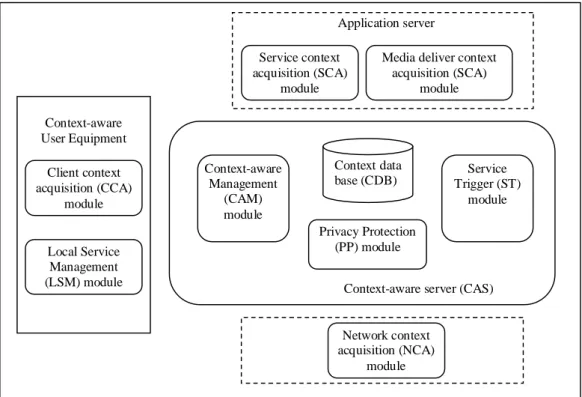
Une architecture générale d’un système sensible au contexte est proposée dans la thèse qui contient quatre parties comme l'illustre la figure 2.
1) Dans le cœur de réseau de l’opérateur, un server centrale (CAS, Context-aware Server) est situé de façon centrale) est utilisé pour contrôler les contextes et permettre des services personnalisés pour l’utilisateur. Le CAS comprend quatre modules:
un module de gestion prenant en compte le contexte (CAM, Context-Aware Management Module). Ce module rassemble les informations de contexte obtenues de l’utilisateur, du dispositif, du serveur applicatif et du réseau, et dérive des informations de contexte de plus haut niveau par inférence de contexte.
un module de base de données de contexte (CDB, Context DataBase). Ce module stocke les informations de contexte rassemblées et obtenues par inférence, et fournit une interface de requête à un module de déclenchement de service (ST).
un module de déclenchement de service (ST Service Trigger). Ce module offre deux fonctions: personnalisation de services établis, en fonction des diverses informations
Service context acquisition (SCA)
module
Media deliver context acquisition (SCA) module Context-aware Management (CAM) module Context data base (CDB) Privacy Protection (PP) module Service Trigger (ST) module
Context-aware server (CAS)
Network context acquisition (NCA) module Local Service Management (LSM) module Client context acquisition (CCA) module Context-aware User Equipment
de contexte, et découverte et configuration de services personnalisés pour les utilisateurs en fonction des différents contextes. Le module ST communique dynamiquement avec le module CDB pour observer les informations de contexte. Avant de déclencher les services, il communique avec le module de protection de la vie privée (PP) pour vérifier si les services peuvent utiliser les informations de contexte ou s’il existe des contraintes de vie privée.
un module de protection de la vie privée (PP Privacy Protection). Ce module effectue des contrôles pour déterminer quelles données peuvent être utilisées en vérifiant si les services prêts à être activés ont l’autorisation d’accéder aux informations de contexte requises ou à un sous ensemble, en fonction de différent de niveaux de protection de la vie privée.
2) Dans l’équipement utilisateur il y a deux modules : Le module CCA (Client Context Acquisition) découvre les sources de contexte dans la sphère locale et collecte l’information de contexte brute (information de contexte d’utilisateur et de contexte de dispositif) puis l’envoie au module CAM situé dans le serveur CAS; Le module LSM (Local Service Management) contrôle et gère l’exécution des services locaux à l’aide du suivi du module CCA et de la comparaison dynamique du contexte avec ses règles stockées, de façon à activer un service correspondant de façon personnalisée.
3) Les modules de domaines de services situés au niveau des serveurs applicatifs comprennent un module d’acquisition de contexte de service (SCA Service Context Acquisition) qui collecte de l’information de contexte de service et la transmet au module CAM, et un module d’acquisition de contexte de fourniture de media (MDCA Media Delivery Context Acquisition) qui observe la fourniture de contenu et acquiert dynamiquement de l’information de contexte réseau durant la fourniture de service et l’envoie au module CAM.
(4) Dans le domaine réseau, un module d’acquisition de contexte réseau (NCA Network Context Acquisition) collecte de l’information de bande passante en consultant le sous-système de contrôle de ressource et d’admission (RACS, Resource and Admission Control Sub-System) avant l’établissement de chaque session de service et envoie l’information acquise au module CAM.
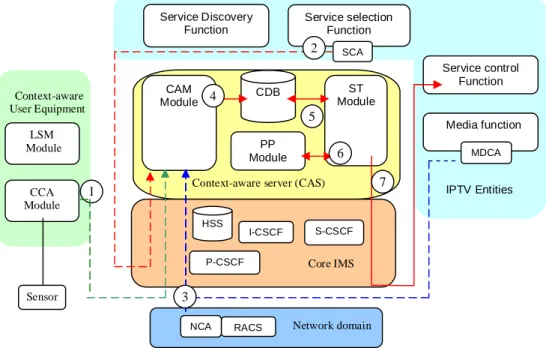
2.3 Système de personnalisation de service IPTV basée sur IPTV/IMS architecture La figure 3 représente une extension d’une architecture IPTV/IMS par intégration d’un système sensible au contexte pour personnaliser des services IPTV.
Figure 3 Système de personnalisation de services IPTV basé sur IPTV/IMS architecture Cette architecture utilise le HSS pour stocker les statiques informations de l’utilisateur, qui contient informations personnelles de l'utilisateur (âge, sexe ...), les services auxquels il est abonné, ainsi que ses préférences
Le module SCA est intégré dans l'IPTV Service Selection fonctionnels (SSF) module et acquiert les informations de contexte de service utilisant un guide de services électronique (ESG Electronic Service Guide) reçu par le module SSF de la part d’un fournisseur de contenus, et qui inclut une description du contenu et du média.
Le module d’acquisition de contexte de fourniture de média MDCA est intégré dans la fonction média (MF) pour acquérir dynamiquement des informations sur le réseau. Le module MF emploie le protocole RTCP (Real Time Transport Control Protocol) pour contrôler la fourniture de contenu en rassemblant dynamiquement des statistiques
ST Module CAM Module CDB PP Module Context-aware server (CAS) Service Discovery Function Service selection Function Service control Function Media function IPTV Entities SCA MDCA RACS P-CSCF I-CSCF Core IMS S-CSCF HSS NCA LSM Module CCA Module Sensor Context-aware User Equipment 1 2 3 4 5 6 7 Network domain
d’informations réseau pour une session média, par exemple des informations concernant les pertes de paquets, la gigue, ou le temps aller-retour (round-trip delay), qui reflétant le contexte réseau.
D'autre part, le module d’acquisition de contexte réseau NCA est intégré au sein d’un sous-système de contrôle de ressources et d’admission (RACS) afin de collecter les informations de contexte initiales (telles que la bande passante).
Le module d’acquisition de contexte client CCA et le module de gestion de services locaux LSM est mise en place au sein de l’équipement utilisateur UE (smart phone, etc.).
Après chaque acquisition d’informations de contexte (liées par exemple à l’utilisateur, au dispositif, au réseau et aux services offerts) (étapes 1-3), le module CAM dans le serveur CAS stocke les informations collectées dans la base de données de contexte CDB (étape 4). Le module de déclenchement de service ST peut communiquer de façon continue avec le module CDB pour suivre l’évolution information de contexte et découvrir un besoin de personnaliser des services établis ou de configurer de nouveaux services (étape 5). Et puis, le module ST obtient des informations de contexte stockées dans la base de données de contexte CDB et les utiliser lors du déclenchement d’un service correspondant. Avant de déclencher le service, le module ST communique avec le module PP (privacy protection) pour vérifier si le service correspondant peut complètement utiliser l’information de contexte existante (étape 6). S’il n’existe pas de contrainte de protection de la vie privée, le module ST envoie à la fonction de commande de service (SCF) d'un message pour déclencher le service, en encapsulant les informations de contexte nécessaires à ce message (étape 7).
2.2 Système de personnalisation de service IPTV basée sur IPTV/Non-IMS architecture
Dans le système IPTV sensible au contexte basé sur IMS, le cœur IMS est responsable du contrôle de la signalisation et du transfert de l’information de contexte vers le serveur. Le cœur IMS facilite le déploiement. Cependant la solution basée sur l’IMS s’appuie sur le protocole SIP, ce qui limite son application en excluant les applications non-SIP et impose le déploiement d’une architecture IMS. En effet, avec le développement des services IPTV NGN, la
coopération entre les opérateurs de réseaux et les fournisseurs de services devient cruciale. L’architecture générale basée sur la plateforme IPTV est très importante. Ne pas se lier à une architecture IMS qui est basée sur le protocole SIP permet d’accroître les possibilités de coexistence de différents systèmes IPTV appartenant à différents opérateurs de réseaux et fournisseurs de services. Cela améliore la compatibilité des services IPTV.
Figure 4 Système de personnalisation de services IPTV sans IMS
La figure 4 représente une extension d’une architecture IPTV/Non-IMS par intégration d’un système sensible au contexte pour personnaliser des services IPTV. Dans cette architecture, le protocole HTTP est utilisé comme protocole de signalisation pour transmettre l’information de contexte et pour contrôler les services. Le module serveur de profil utilisateur (UPSF) est utilisé pour stocker les statiques informations de contexte de utilisateur, telles que l’âge ou le sexe de l’utilisateur, les services auxquels il est abonné, ainsi que ses préférences. Le module SCA (Service Context Acquisition) est intégré dans le module Découverte et sélection de services (SD&S) et acquiert des informations de contexte de service utilisant un guide de services électronique (ESG Electronic Service Guide) reçu par le module SD&S de la part d’un
1. User and device context information and transmission 2. Service context information and
transmission
3. Network context information and transmission
4. Context information storage in the CDB.
5. ST communication with the CDB for monitoring context information and services discovery.
6. ST communicates with the PP for privacy constraints verification. 7. ST requests to trigger the
personalized services. 8. Adapted content to the UE
CAM Module
CDB
PP Module
Context-aware server (CAS)
SD&S UPSF IPTV control Function Media function SCA MDCA Network RACS NCA CCA Module LSM Module Senso r Context-aware User Equipment 1 1 3 4 5 7 Customer Facing IPTV Application
ST Module 2 3 8 8 7 NGN Application layer 6
fournisseur de contenus, et qui inclut une description du contenu et du média. Le module d’acquisition de contexte de fourniture de média MDCA et le module d’acquisition de contexte réseau NCA sont intégrés dans le Media Function (MF) et d’un sous-système de contrôle de ressources et d’admission (RACS).
Cette solution est mise en œuvre sur une plate-forme IPTV. Une évaluation de la performance est faite. Des résultats intéressants sont obtenus en termes des délais de sélection de contenu personnalisé et d'initiation de service ainsi que le temps de navigation d’EPG. Les résultats prouvent la réussite du système proposé.
3 Nouvelle identification et authentification pour les services IPTV
Pour personnaliser des services IPTV, le système a besoin de connaître l'utilisateur qui est en train de regarder la télévision. Identifier chaque utilisateur permet au système IPTV de savoir « qui est en train de regarder la télévision » et de personnaliser les contenus en conséquence. En effet, l'identité d’utilisateur est une partie du contexte de l'utilisateur.
L'identification des utilisateurs et la solution d'authentification doivent être appliquées à l'IPTV système afin d'identifier chaque utilisateur et personnaliser son accès. Authentification et la protection de l’information observent beaucoup d'attention dans les réseaux NGN, où l'authentification des utilisateurs à l'IMS a lieu via le protocole AKA (Authentication and Key Agreement). L'GBA (Generic Bootstrapping Architecture) est utilisé pour authentifier les utilisateurs avant d'accéder à des services multimédias via HTTP. Cependant l'attachement de l'authentification de l’utilisateur à son équipement limite la personnalisation des services et ne permet pas d'identification unique pour chaque utilisateur si plusieurs utilisateurs partagent le même équipement. Pour résoudre ce problème, une nouvelle identification et authentification solution utilisant la technologie RFID et de l'IBC (Identity Based cryptography) est proposé dans cette thèse.
La solution d'authentification SA-IBC est basé sur le GBA architecture. qui se compose de quatre entités: l’UE (User Equipment), le NAF (Network Application Function), le BSF (Bootstrapping Server Function) et le HSS (Home Subscriber Server). Le lecteur RFID est intégré dans l'UE, où chaque utilisateur a besoin du RFID pour s'identifier au système.
L'identité de l'utilisateur (UserID) et mot de passe sont stockés sur le étiquette RFID. Lorsque l'étiquette est lue par un lecteur RFID, l'identité de l'utilisateur et mot de passe sont transférés de l'étiquette RFID au lecteur RFID et puis au dispositif.
L'IBC mécanisme est utilisé pour générer les clés privées de l'UE au lieu d'utiliser des mécanismes AKA pendant la GBA authentification pour personnaliser les services. IBC est un cryptosystème dans lequel la clé publique est générée en utilisant l'identité de l'utilisateur. Il a une autorité de confiance centrale nommée PKG (Private Key Generator) qui utilise un secret maître pour générer des clés privées des utilisateurs. Chaque utilisateur doit s'authentifier à l'PKG et obtenir la clé privée pour déchiffrer les messages reçus, qui sont cryptés avec la clé publique de l'utilisateur. Dans la solution proposée, le PKG est intégré dans le Home Subscriber Server (HSS), sans modifier la fonction traditionnelle d’HSS.
La performance est un facteur important à considérer lors de la conception des protocoles d'authentification. l'Open BCMP (Baskett Chandy Muntz Palacios) modèle est employée pour évaluer la performance de la solution d'authentification proposée. Afin d'améliorer les performances de la solution d'authentification, un algorithme de clustering est également proposé qui distribue les serveurs d’authentification au sein de l'architecture SA-IBC selon le taux de service du système. Le modèle BCMP pour SA-IBC est implémenté sous Matlab et la performance est évaluée par la mesure de l'utilisation des services et le délai d'authentification. Il est observé que l'augmentation du nombre de clients a un impact sur l'utilisation des serveurs et le délai d'authentification. Par ailleurs, on observe que le BSF représente un goulot d'étranglement dans le processus d'authentification de service, où l'algorithme de clustering proposée est prouvé pour améliorer les performances du système.
4 Système de recommandation de contenus sensible au contexte
On assiste aujourd’hui à une explosion de la télévision numérique sur Internet (ou IPTV pour Internet Protocol TeleVision) et aux services associés, comme par exemple les services d’enregistrement de programmes numériques personnalisés (nTS network Time Shifting ou nPVR pour network PersonalVideo Recorder).
Compte-tenu de la multitude de programmes audiovisuels numériques diffusés chaque jour sur Internet, il est difficile pour un utilisateur d’identifier rapidement un programme adapté à
ses goûts et à son environnement. Pour faciliter le choix de l’utilisateur, les opérateurs envisagent la mise en place de services de recommandation de programmes, destinés à proposer à l’utilisateur une liste de programmes personnalisés.
Un système de recommandation de contenus est proposé dans cette thèse, qui génère une liste de recommandation en prenant en compte les préférences de l’utilisateur (définies explicitement par l’utilisateur lors de la souscription au service de recommandation ou extraites à partir d’un historique des programmes précédemment visualisés par l’utilisateur), ainsi que l’impact du contexte de visualisation dans lequel se trouve l’utilisateur sur les contenus qu’il visualise (ex. moment de la journée, localisation de l’utilisateur, etc.). Cet impact reflète la préférence de l’utilisateur pour un type de contenus en fonction du contexte dans lequel il se trouve.
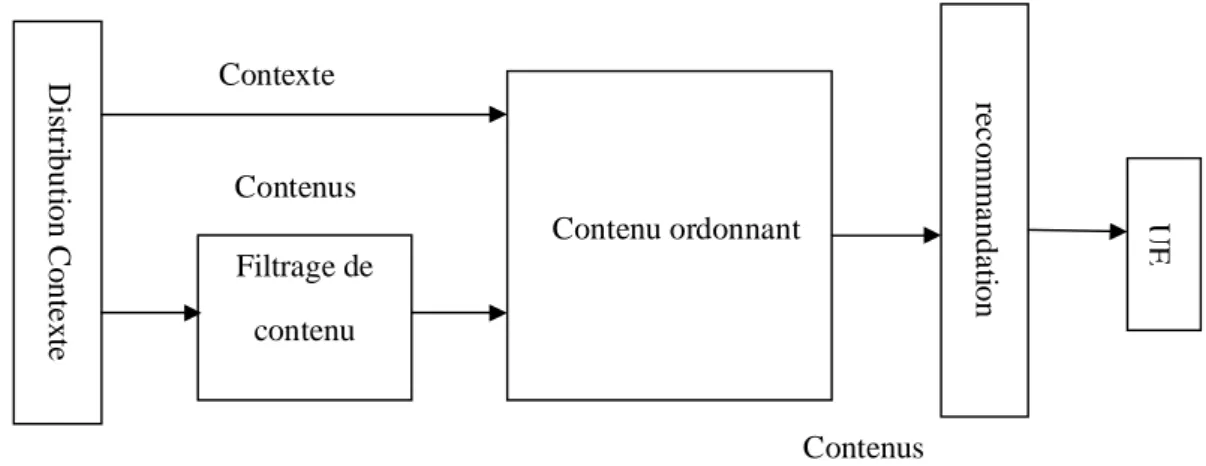
La figure 5 illustre l'architecture du système proposé, qui contient quatre éléments: un module de distribution de contexte, le module de filtrage de contenu, le module de contenu ordonnant et le module de recommandation.
Le module de distribution de Contexte : il collecte des informations concernant un contexte de l’utilisateur à partir du serveur sensibles au contexte et les envoie au module de filtrage de contenu.
Le module de filtrage de contenu : il s’agit d’établir un filtrage des contenus audiovisuels numériques proposés à l’utilisateur en prenant en compte des informations statiques liées à l’utilisateur ou à son environnement qui sont
Figure 5 Système de recommandation de contenussensible au contexte
D is tri buti on Co nt ex te Filtrage de contenu Contenu ordonnant rec o mm a ndati on UE Contexte Contenus Contenus
susceptibles de conditionner l’accès aux contenus par l’utilisateur, comme son âge, la capacité de ses équipements, la capacité du réseau, la souscription ou non à des chaînes payantes, etc. Par exemple, si les capacités des équipements de l’utilisateur ne supportent pas la télévision Haute Définition, tous les contenus comprenant cette caractéristique sont éliminés. De façon similaire, tous les contenus qui ne sont pas autorisés pour l’utilisateur, par exemple de l’âge de l’utilisateur ou d’un accès restreint de l’utilisateur à certaines chaînes (ex. chaîne payante), sont supprimés. A la fin de filtrage, ce module envoie les contenues restes au module de contenu ordonnant.
Le module de contenu ordonnant : il réalise un classement des contenus par ordre de préférence « implicites » de l’utilisateur. Par « préférences implicites », on entend ici des préférences qui ne sont pas explicitement définies par l’utilisateur (notamment lors de la souscription au service), mais estimées par le module de contenu ordonnant à partir de l’historique de visualisation de l’utilisateur. Les préférences « implicites » de l’utilisateur aussi reflet les relations entre les préférences de utilisateur et les contextes (i.e. de la situation) dans lequel l’utilisateur se trouve. Par exemple :
o l’utilisateur regarde rarement la télévision numérique à 4 heures ; toutefois quand il regarde la télévision à 4 heures, il regarde un journal d’informations ; et
o l’utilisateur regarde fréquemment la télévision dans le salon ; et la plupart du temps, quand il regarde la télévision dans le salon, il regarde des films.
Le module de recommandation : Il génère le Guide du Programme personnalisé électronique (EPG) et l'envoie à l'utilisateur.
Ce système est mis en œuvre et il est évalué sur deux aspects: le retard de la recommandation qui mesure le temps passé pour la recommandation et la précision de la recommandation de contenu qui indique si le système pourrait recommander le bon contenu à l'utilisateur et reflète la satisfaction des utilisateurs pour une recommandation donnée.
5 Conclusion
Le domaine de la personnalisation des services IPTV est un vaste. Cette thèse a enquêté sur plusieurs problèmes qui sont importants pour offrir des services IPTV personnalisation et a présenté plusieurs contributions à la recherche de ces problèmes. Cette thèse présente des solutions visant à améliorer la personnalisation de services IPTV à partir de trois aspects:
1) Nouvelle architecture IPTV intégrée et comportant un système de sensibilité au contexte pour le service de personnalisation.
2) Nouvelle identification et authentification pour services IPTV
3) Nouveau service de recommandation de contenu en fonction des préférences de l’utilisateur et aussi des informations contextes.
Les perspectives pour les travaux futurs sont :
Développement d’un modèle d'OpenTV : le système sensible au contexte proposé peut être intégré dans les autres systèmes de télévision tels que la télévision sur Internet ou la télévision sur mobile.
Plus de moyens de personnalisation du service peut être considérés : par exemple, (1) le serveur de médias pourrait adapter le format du contenu dynamiquement selon les informations de contexte de réseau ; (2) le contenu personnel d’un utilisateur peuvent être transférées à partir d'un terminal à un autre terminal sans interrompre le service en fonction du changement de la position de l'utilisateur ; (3) le IPTV système sensible au contexte pourrait aussi coopérer avec d'autres services (par exemple le service de présence ou les applications des réseaux sociaux) pour fournir des services personnalisés avancés.
Introduction
TV is being transformed from the analog TV to the digital TV, which is able to stream content to high-quality, offer consumers more choice and make the viewing experience more interactive. IPTV (Internet Protocol TV) presents a revolution in digital TV in which digital television services are delivered to users using Internet Protocol (IP) over a broadband connection.
The advances in IPTV technology enable a new model for service provisioning, moving from traditional broadcaster-centric TV services to a new user-centric TV model which allows users not only to access new services and functionalities from their providers, but also to become active parts in the content personalization through contributing in building their dynamic profiles. With the consolidation of services, such as network Time Shifting (nTS) and network Personal Video Recorder (nPVR), users are allowed to record their own content and could also make them available to other users. On the other hand, the Next Generation Network (NGN) approach in coupling IPTV with the IP Multimedia Subsystem (IMS) architecture allows for services' convergence through using the IMS common architecture in providing a platform for interactive TV services.
In this context, IPTV has become increasingly focused on personalization and individualization, which allows content/service providers and networks operators to create new business opportunities and to promote smart and targeting services, while enhancing users’ interaction with the IPTV system and the Quality of Experience (QoE) which in turn increases users’ satisfaction and services acceptability.
The existing IPTV system shows some limitations at the level of services personalization. Although the rapid advancement in IPTV technologies, choosing the desired channel and the corresponding user profile in a manual mean could disturb the viewer. Users need to take a long time to find a content in which they are interested. Providing personalized service through the distinguishing of each user in a unique manner and the consideration of the context of the user and his environment (devices and network) still presents a challenge.
Contribution
This thesis aims to investigate the challenges and solutions allowing the enriched personalization of IPTV service, which seeks to cope with the current IPTV system limitations through distinguishing each user in two main manners: i) a context-aware manner considering the user context as well as the network, the terminals, and services contexts; and ii ) an individual manner applying advanced and appropriate identification techniques, which are user-friendly and do not demand continuous intervention of the users. The main contributions contains:
1) Context-Aware IPTV architecture for enriched personalization
To provide new IPTV service and improve the user experience, this thesis proposes a context-aware IPTV architecture that extends the existing IPTV/IMS and IPTV/non-IMS architectures through integrating a context-awareness system. In this architecture, rich context information related to the user, device, network and service are considered and organized through a new IPTV context data structure model. The context acquisition and transmission processes are defined, which give a guide line for the implementation. This new architecture allows the operator to provide a personalized TV service in an advanced manner, adapting the content and allowing for advanced IPTV service personalization considering rich context information related to the user daily life (user preference, location, proximity to devices, his available networks and their proximity, service context, … etc).
2) New user identification and authentication solution for IPTV service
The tight attachment of the subscriber authentication to the user equipment limits the personalization of the services. To solve this problem, a new identification and authentication mechanism using RFID and the Identity Based cryptography (IBC) is proposed, which allows service personalization through authenticating users in a personal manner during services access. Then the Open BCMP (Baskett Chandy Muntz Palacios) model is employed to evaluate the performance of the proposed authentication solution. In order to improve the performance of the authentication solution, a clustering algorithm is proposed which distributes the authentication related servers according to the service rate of the system. Through the implementation and performance analysis, the proposed clustering algorithm is proved to effectively improve the performance of the system.
3) Context-Aware Content Recommendation
Content recommendation systems should not consider only the user's preference and consumed history as the criteria, however the general context information should also be considered (like device capacity, network states, location, time, user’s activity…etc), which takes an important role for the recommendation service because the user's preference on IPTV content is not fixed and it changes depending on certain context such as time, location, activity, etc. Furthermore, certain contents are accessible based on some conditions. A new content recommendation system is proposed in this thesis, which considers not only the user’s explicit preferences but also his implicit preferences through introducing the relationship between user's watching behaviors and the context information. This makes the recommendation more accurate and personalized. This proposed recommendation system is implemented and interesting results are shown concerning the recommendation performance and accuracy. Thesis Organization
The thesis is divided into three parts: part I focuses on IPTV personalization through chapters 1-3. Then, part II presents a user identification and authentication solution through chapters 4-5. Finally, part III focuses on a new recommendation solution based on context-awareness through Chapter 6.
In part I of the thesis: Chapter 1 gives an overview on the general concept, services, architectures aspects of IPTV and IPTV personalization. Different existing contributions that employ context-awareness as a mean to allow IPTV personalization are presented. The applications of those contributions are analyzed based upon some requirements defined for enabling advanced IPTV services personalization, and a technical comparison is proposed aiming to give some guidelines. In Chapter 2, the context-awareness principle used in services personalization is presented together with the context information that can be used in the IPTV services and the different modeling means. Also a context data structure model for the IPTV service is proposed in this chapter. Chapter 3 proposes a context-aware system for IPTV and integrates it into the IPTV/IMS architecture and IPTV/Non-IMS architecture to allow IPTV service personalization in a standard manner allowing the consideration of different context information. Implementation and the performance results are also presented in this chapter.
In part II of the thesis: Chapter 4 presents a new authentication solution for services authentication for the personalized service. The proposed solution is implemented on top of emulated GBA (Generic Bootstrapping Architecture) architecture and the performance analysis is given. Chapter 5, uses Open BCMP queuing network as a mathematical model to evaluate the performance of the proposed authentication solution. A clustering algorithm is also proposed to improve the performance of the authentication solution through distributing the servers within the architecture according to the service rate of the system.
In part III of the thesis: In chapter 6, a novel solution for content recommendation in a context-aware mean is presented allowing for customized IPTV content in an advanced mean considering each user and the different context of his environment. Implementation and the obtained performance results are also presented.
Finally, the thesis ends by the conclusion and future work presenting a summary of the research contributions carried out and indicating areas of possible future work.
Part 1 IPTV services personalization through
context-awareness
Chapter 1 Background and State of the art
1.1 Overview on IPTV
Digital Television, also known as Digital TV, is the most significant advancement in television technology since the medium was created over a century ago. Digital TV offers consumers more choice and makes the viewing experience more interactive. Today, most TV operators have deployed advanced digital platforms to migrate their subscribers away from traditional TV services to more sophisticated digital services. Following the deployment of home Internet access services (digital subscriber line - based), most of the major European telecom service providers started providing triple-play (telephone, Internet access, and TV) services. One service package with video, voice, and data services is to be provided by common IP-based networks. Quadruple play also appears through adding with access to this package. Internet Protocol television (IPTV) is the process of transmitting and broadcasting television programs through the IP-based networks. A broadband connection is used as the medium of transmission for IPTV, which is very efficient compared to earlier transmission modes. From a service provider’s perspective, IPTV encompasses the acquisition, processing, and secure delivery of video content over an IP based private networking infrastructure. The official definition of IPTV is approved by the International Telecommunication Union focus group on IPTV (ITU-T FG IPTV) as: «multimedia services such as television /video /audio /text /graphics /data delivered over IP based networks managed to provide the required level of quality of service and experience, security, interactivity and reliability."
1.1.1 IPTV services
Compared to traditional TV services in which all the content is pushed to the users, IPTV offers a two-way communication between operators and users. The two-way commutation capability allows service providers to deliver interactive TV applications (for example, interactive games, and high speed Internet browsing) and also allows end users to personalize
their TV viewing habits by allowing them to decide what they want to watch and when they want to watch it. The following services are provided by the IPTV system [Xiao 07]:
Linear broadcast television: Linear broadcast television (or live television) is the most
common form of television which is similar to the traditional television broadcast provided by cable TV or satellite TV. However the distribution method is different: IPTV broadcast television uses multicast IP transport.
Video On Demand (VOD): VoD services are interactive television services where the
end-users select and watch video content at any point of time. The content is stored on the provider's VoD server. Clients typically have the ability to pause, play, rewind, fast forward the content, or even stop viewing it and return to it at a later time when using this service.
Near Video on Demand: Near VoD is a video service where multiple copies of a program
are broadcast at short time intervals (typically 10–20 minutes) on different television channels. The end users can watch the program without needing to tune in at a scheduled point in time.
Personal Video Recorder (PVR): The Personal Video Recorder service is an
end-user-controlled electronic device service that records linear TV and stores it in digital storage equipment, either in standalone set-top boxes or in the network. This service can support "time shifting".
Time shifting : Time shifting is the recording of programs to a storage medium to be
viewed or listened to at a time more convenient to the user. If the contents are stored in local hard drive, this is defined as "end-user-based time-shifting service". If the hard drives are located in the service provider's domain as opposed to the end-user's set-top box, this is defined as “network-based time-shifting service". In the network-based time-shifting service, the broadcasting traffic is transformed into on-demand traffic.
Multiple screens Access : Viewing of IPTV content is not limited to televisions.
Consumers often use their PCs and mobile devices to access IPTV services.
Session mobility service: This service allows an on-going multimedia session to be
1.1.2 IPTV versus Internet TV
Currently there are a lot of web-based video services called Internet TV. IPTV is sometimes confused with the delivery of Internet TV. Although both environments rely on the same core base of technologies, their approaches in delivering TV are different. Internet TV does not offer managed delivery of multimedia services and do not give any QoS guarantees. The video content is retrieved by the consumer using an Internet connection, without any guarantees regarding delivery, latency or availability. For instance, the popular video service YouTube offers user contributed videos on-line, but the delivery of these videos is not controlled or managed by YouTube or a related Service Provider. As the name suggests Internet TV leverages the public Internet to deliver video content to end users. IPTV, on the contrary, uses secure dedicated private networks to deliver video content to consumers. These private networks are managed and operated by the provider of the IPTV service. Furthermore, IPTV services perform the access and admission control. Before a user can use an IPTV service, authorization is used to check if the user has access rights to the content. The service will only be offered when there is sufficient bandwidth for the service (if not the service will be rejected). Using managed IP based networks and QoS guarantees leads to a distinction between IPTV services and Internet TV.
1.2 IPTV architecture
The developments of IPTV bring an entertainment revolution, where service providers worldwide consider the introduction of IPTV in their next-generation networks (NGN). In this section, we give the overview on NGN IPTV architecture. At the functional level, IPTV is mainly constituted of six functional groups. Figure 1-1, presents a high-level NGN IPTV functional overview illustrating the different functional groups [ETSI TS 182 028].
End User Functions: Provide user connection to networks as well as control over the services. They also take charge of multimedia processing which include requesting multimedia asset in supported encoded format, decoding and presenting it to the user in acceptable format.
Application Functions: Include IPTV and NGN application functions. IPTV applications can be regarded from two aspects: i) customer facing applications, providing service provisioning, selection and authorization of IPTV services, and ii) operator facing applications, providing operator control over IPTV subsystem in NGN,
content preparation and media management, content licensing, and subscriber management. On the other hand, NGN applications provide the user with rich multimedia services distributed across multiple NGN subsystems, for example, messaging exchange between fixed and mobile terminals. In addition, NGN applications provide the operators with centralized NGN management interfaces to multiple subsystems for content management, charging, and interactions with others services (as IMS related services).
IPTV Service Control and Media Delivery Functions: Enable the operation of NGN IPTV services, through taking charge of media distribution, selection and IPTV session control and management. They also manage the interactions with other NGN components for admission control as well as collecting the charging and QoS information.
Transport Functions: Include the transport control functions which provide policy control, resource reservation, IP address provisioning, network level user authentication and access network configuration. They also include transport processing functions which are in charge of IP links and data transmission.
Management Functions: Include the required functions to fulfil the IPTV services to the end-user, to assure the IPTV services provision, and to ensure the proper billing to the end-user for the delivered IPTV services.
Content Provider Functions: Include the functions provided by the entity that owns or is licensed to sell contents. These are normally the sourcing of contents, metadata, and usage rights.
1.3 IPTV service personalization
1.3.1 Personalization
Personalization is the tailoring of services to individual users' characteristics or preferences and making interactions faster and easier. In a marketing environment, the purposes of personalization are defined [Bowen 04] as:
1) Better serve the customer by anticipating needs;
2) Make the interaction efficient and satisfying for the customers and service providers; 3) Build a relationship that encourages the customer to return for subsequent purchases. User satisfaction is the objective of personalization. Personalization involves a process of gathering user-information during interaction with the user, which is then used to deliver appropriate content and services according to the user’s needs. Information about the user can be obtained from a history of previous sessions or from the interaction with the other applications in real time. "Needs" may be those stated by the customer as well as those defined by the service provider. Once the user’s needs are established, rules and techniques are used to decide what content might be appropriate. The aim is to improve the user’s experience for a service.
1.3.2 IPTV service personalization
The rapid growth of IPTV services results in enormous expansion of options for users. IPTV services provide hundreds of television (TV) channels with thousands of TV programs every day, in addition to the content available on Video on Demand (VoD) and catch-up TV stores. The amount of contents served in IPTV system far surpasses the consumption capability of consumers. Under these circumstances, recognizing what the user may like or want to enjoy becomes a challenging task for successful IPTV services. Personalization is a promising solution for this challenge. It lets IPTV services recognize a specific user, select automatically the contents that are appropriate for that user and enable the users to access and consume them
in a personalized way. Moreover, the personalization of service allows providing more value added services making the IPTV service worthwhile.
Three steps are necessary to realize the IPTV service personalization, as illustrated in Figure 1-2:
Figure 1-2 IPTV service personalization
1. User identification: To provide personalized service, the system needs to be aware of the identities of the current users in front of the TV. Different user identification and authentication techniques can be applied to IPTV system. These include biometric identification, for example speaker verification, face recognition, fingerprint; radio-frequency identification (RFID) tags; or a simple login session with user id and password.
2. Information collection: After user identification, the application server selects the personalized contents for the user. The personalized contents selection, not only need to consider the user's preferences, but also need to consider the environmental information (like device and network). For example, if a user chooses to watch TV through a terminal which does not support HD, the recommendation system should not propose the HD content for him. Also, content adaptation should be dynamically assured with the different contexts changes.
3. Personalized contents selection and delivery: According to user’s preference and the environment information, personalized contents are selected by the system. The Personalized Electronic Program Guide (PEPG) is used to inform the user about all the
2 Information collections 1 Identification & Authentication User 3 Personalized content selection and delivery
Content Provider Application Server
contents which are appropriate for him. During the content delivery, the format of the content could be automatically adapted to the capacity of network and devices. Furthermore, the notification services could be used to notify the user that a better content (more suitable for the user according to his preference or context information) is available.
Context-awareness [Schilit 94] paradigm is promising in simplifying the viewer's life, through allowing content adaptation according to the user's needs and to the surrounding environment.
1.4 Context-awareness
1.4.1 Context definition
The idea of utilizing environment information in computing systems was advocated by Mark Weiser [Weiser 91]. He first introduced the term ‘pervasive’ which refers to the seamless integration of devices into the users’ everyday life. The term “context” was first named by Schilit et al. [Schilit 94] and described as “location of use, the collection of nearby people and objects, as well as the changes to those objects over time”. Much of the early work on context-aware systems used similar extensional definitions which defined context by enumerating the constituting parameters. Brown et al. [Brown 97] enumerate “location, time of day, season of the year, and temperature”. These definitions are very special and only reflect the types of information that has been used by the researchers in their context-aware applications.
A general definition of context was proposed by Chen and Kotz [Chen 00]:“Context is the set of environmental states and settings that either determines an application behavior or in which an application event occurs and is interesting to the user.” Considering the IPTV service, context can be considered as any information that can be used to characterize the situation of an entity related to the IPTV service and to influence the working of the IPTV system. An entity could be a person, a device, or any object that is related to the interaction between a user and the IPTV service.
1.4.2 Context-Aware Application
Context-aware systems now play a very important role in modern software systems. Hull et al. [Hull 97] defined the context-aware as the ability of computing devices to detect, sense,
interpret and respond to aspects of a user's local environment and the computing devices. So a context-aware IPTV application is an application which runs in an IPTV environment and which makes use of context information to provide an improved IPTV user experience. To accomplish this objective the context-aware system must:
Gather the information from the environment or the user’s situation. Translate this information into the appropriate format.
Combine or interpret context information to generate a higher context. A higher context is context information that is derived as a result of the merger of other context information or it is context information that results from interpretation of a low level context (e.g. conversion of geographic coordinates of a location received from satellite based positioning systems into street names). The main methods of context inference are logic-based reasoning and user-defined rule-based reasoning. The logic-based inference is able to infer logical consequences from a set of asserted facts or axioms. For example John is currently located in his Living Room, the context interpreter can conclude that John is located at his home since Living Room is a part of Home, logically we can infer that John is in home now. User-defined Rule-based reasoning most like patterns matching [Albin 01], in which an inference engine searches for patterns in the rules and compare with the pattern of the context.
Store the context information and make the information accessible to other applications. There are two principal approaches of context storage and use; centralized and distributed. Centralized context storage approach provides a persistent storage for distributed context sources and guarantees integrity of context. Distributed context storage approach stores in multiple computers that are geographically dispersed and are connected via LAN or Internet to share information.
Automatically trigger actions based on the context information and monitoring of the actions. An application discovers a change of context and adapts itself to this change (for example content adaptation service) or uses the information to change the status of other applications (for example content recommendation service).
1.5 IPTV service Personalization Requirements
This section lists the different requirements to achieve efficient and enriched personalization for IPTV services. These requirements help in evaluating the suitability and adaptability of the existing research contributions on personalized IPTV services;
1) Context-Awareness Requirements:
To generate a context-aware IPTV, the following requirements are necessary:
a) Context information flexibility and extension: For efficient IPTV service personalization, context information types should be flexible and extensible to cover the whole IPTV value chain including user domain, network provider domain, service provider domain and content provider domain. In practical, the network provider domain and service provider domain could intersect, especially in the case of integrated operators where the network provider also plays the role of the service provider. Consequently, the IPTV system should be capable of including four types of context information: i) User Context Information: presenting the information about the user, which could be static information describing the user's subscription information (ex, user's subscribed services, age, preferences, ..) or dynamic information dynamically captured by sensors or by other services (ex, user's location, agenda, available devices in his proximity, available network types and network type in use), ii) Device/Terminal Context Information: presenting the information about the devices/terminals that could be the device identity, activity status (on or off, volume), capacity, and its proximity to the user, iii) Network Context Information: presenting the information about the network such as the bandwidth and the network charge state (jitter, packet loss rate, delay, etc), iv) Content context Information: presenting the information about the content itself including the content description (content type, start time and stop time, language) and the media description (codec type, image size and resolution).
b) Dynamic context gathering and update: to allow gathering and updating in a dynamic manner the different context information on the user and his environment to be able to personalize the content accordingly.
c) Context-Awareness architectural integration: Two architectural approaches exist in context-aware systems: i) distributed context-aware systems, constituted by several distributed entities having the capacity to acquire, process, store the context information, and cooperate with each other to provide the context-aware services, and ii) centralized context-aware systems, treating and storing the collected context information in a centralized server. Distributed
systems can support mobility, but they are unable to have a global view of the context information and their processing/storage capacities that are limited to the distributed terminals capacities. On the other hand, centralized systems give a global view of the context information helping nomadic service access; however the frequent and continuous communication between the devices and the server needs adequate network resources. Consequently, the IPTV architecture is required to have a hybrid context-aware system, with distributed entities to collect the context information in the local sphere and provide some simple service adaptation (for instance volume adaptation according to the environment, content transfer among different terminals), while complex service adaptation (for example the content adaptation) should be accomplished at the centralized server.
2) Mobility requirement: As mobile TV represents a value-added service, mobility
becomes an important feature that should be supported in an IPTV system to allow the user to enjoy his personal TV content anytime and anywhere. Mobility includes terminal mobility allowing the terminal to change its location without services disruption, and session mobility allowing the user to start a media session on one terminal and to continue it on another one. Consequently, the IPTV system should be able not only to continuously collect the different context information, but also to integrate appropriate mechanisms for continuous devices discovery and continuous location discovery for the user.
3) Nomadism requirement : With the new model of TV systems, users should be able to
enjoy their personalized TV content through any terminal. Consequently, we define a new scope for nomadism to allow each user to access his personalized TV content from any terminal not belonging to him (for instance, through the TV screen in a friend’s home), though any access network (for instance, VoD in a hotel), and to pay on his own bill. Consequently, the IPTV system, besides acquiring the user identification, should also be capable of acquiring other context information as ‘location, connectivity type …’.
4) Security and Privacy Requirements: The privacy protection is the capability of a
user or group of users to secure their personal information. Since personalized service is concerned to a great extent with personal information (user context information), the privacy protection is necessary. If peoples’ privacy is threatened, then services acceptability would not be guaranteed. In TV environment, the privacy protection is mainly related to the following points: controlling the personal information sharing (e.g., presence information within the presence service); not publishing the content information that the user is accessing (e.g. mastering the content sharing); user context storage and manipulation should not take place by



![Figure 1-1: High-level NGN IPTV Functional Architecture [ETSI TS 182 028]](https://thumb-eu.123doks.com/thumbv2/123doknet/8247647.277564/36.892.171.787.166.490/figure-high-level-ngn-iptv-functional-architecture-etsi.webp)
![Figure 3-3: NGN IPTV Functional Architecture [ETSI TS 182 028]](https://thumb-eu.123doks.com/thumbv2/123doknet/8247647.277564/72.892.176.763.385.720/figure-ngn-iptv-functional-architecture-etsi-ts.webp)