RESEARCH OUTPUTS / RÉSULTATS DE RECHERCHE
Author(s) - Auteur(s) :
Publication date - Date de publication :
Permanent link - Permalien :
Rights / License - Licence de droit d’auteur :
Bibliothèque Universitaire Moretus Plantin
Institutional Repository - Research Portal
Dépôt Institutionnel - Portail de la Recherche
researchportal.unamur.be
University of Namur
Quantitative Analysis of Athenian Coinage by PIXE
Flament, Christophe; Lateano, Olga; Demortier, Guy
Published in:Proceedings of the 4th Symposium of the Hellenic Society of Archaeometry. National Hellenic Research Foundation, Athens, 28-31 May 2003
Publication date:
2008
Document Version
Early version, also known as pre-print
Link to publication
Citation for pulished version (HARVARD):
Flament, C, Lateano, O & Demortier, G 2008, Quantitative Analysis of Athenian Coinage by PIXE. in
Proceedings of the 4th Symposium of the Hellenic Society of Archaeometry. National Hellenic Research Foundation, Athens, 28-31 May 2003 . Archaeopress, Oxford, pp. 445-450.
General rights
Copyright and moral rights for the publications made accessible in the public portal are retained by the authors and/or other copyright owners and it is a condition of accessing publications that users recognise and abide by the legal requirements associated with these rights. • Users may download and print one copy of any publication from the public portal for the purpose of private study or research. • You may not further distribute the material or use it for any profit-making activity or commercial gain
• You may freely distribute the URL identifying the publication in the public portal ? Take down policy
If you believe that this document breaches copyright please contact us providing details, and we will remove access to the work immediately and investigate your claim.
Proceedings of the
4th Sympos
i
um of the Hellen
i
c
Soc
i
ety for Archaeometry
National Hellenic Research Foundation, Athens
28-31 May 2003
Edited by
Yorgos Facorellis
Nikos Zacharias
Kiki Polikreti
BAR International Series 1746
2008
This title published by Archaeopress
Publishers of British Archaeological Reports Gordon House
276 Banbury Road Oxford OX2 7ED England
[email protected] www.archaeopress.com
BAR S1746
Proceedings of the 4th Sympos
i
um of the Hellen
i
c Soc
i
ety for Archaeometry.
National Hellenic
Research Foundation, Athens, 28-31 May 2003
© the individual authors 2008
ISBN 978 1 4073 0188 4
Printed in England by Synergie Basingstoke
All BAR titles are available from: Hadrian Books Ltd 122 Banbury Road Oxford OX2 7BP England [email protected]
The current BAR catalogue with details of all titles in print, prices and means of payment is available free from Hadrian Books or may be downloaded from www.archaeopress.com
445
Q
uantitativea
nalysis ofa
thenianC
oinage byP
ixeCh. Flament
Aspirant du FNRS, Faculté de Philosophie & Lettres, Collège Érasme, UCL, B-1348 Louvain-la-Neuve, Belgium, [email protected]
O. Lateano
Facoltà di Fisiche, University La Sapienza, 2 Piazzale A. Moro, 1-00185 Rome, Italy
G. Demortier
Département de Physique, Laboratoire LARN-FUNDP, 61 rue de Bruxelles, 6000 Namur, Belgium
Abstract: By joining the competences of both physicists and numismatists, the main aim of this research is to solve a problem for which the traditional methods of numismatics are useless; the classification of the Athenian coinage during the second half of the 5th century
B.C. Hundreds of coins have been analysed by the PIXE method at low incident proton energy in order to determine minor trace elements in the silver rich alloy. By this way, we hope firstly to find in this abundant coinage traces of historical events and secondly, that the determination of metal composition will enable us to identify the ancient imitations of Athenian coins struck at the end of the 5th century B.C. One of the main results of those analyses is that the metallic composition of several coins usually taken as ancient
imitations of Athenian money does not actually differ from that of the genuine ones.
Περιληψη: Συνδυάζοντας τις προσπάθειες φυσικών και νομισματολόγων, ο κύριος στόχος της έρευνας αυτής είναι η λύση ενός προβλήματος για το οποίο οι παραδοσιακές μέθοδοι της νομισματικής είναι άχρηστες: η ταξινόμηση των Αθηναϊκών νομισμάτων κατά τη διάρκεια του 5ου αιώνα π.Χ. Εκατοντάδες νομισμάτων έχουν αναλυθεί με PIXE με πρωτόνια χαμηλής ενέργειας με σκοπό να καθοριστούν δευτερεύοντα ιχνοστοιχεία στο πλούσιο σε χαλκό κράμα. Με αυτόν τον τρόπο, ελπίζουμε αρχικά ότι θα βρούμε μέσα σε αυτήν την πληθώρα νομισμάτων ίχνη ιστορικών γεγονότων και κατόπιν, ότι με τον καθορισμό της σύστασης του κράματος θα μπορέσουμε να ταυτοποιήσουμε τις αρχαίες απομιμήσεις Αθηναϊκών νομισμάτων που εμφανίζονται στο τέλος του 5ου αιώνα π.Χ. Ένα από τα κύρια αποτελέσματα των αναλύσεων είναι ότι η σύσταση του μετάλλου αρκετών νομισμάτων που συχνά θεωρούνται ως αρχαίες απομιμήσεις Αθηναϊκών χρημάτων δεν διαφέρουν από εκείνη των αυθεντικών.
The Athenian “owls” certainly constitute one of the most famous coinages of Ancient Greece. Thus, people generally consider those prominent coins to be well studied and classified. But archaeologists know well how far this assertion is from the truth. Indeed, if this coinage is, without any doubt, the largest of the Classical Greece, it is also perhaps the one that still escapes the numismatist’s traditional methods of work.
The main reason for these difficulties lies in the fixity of the Athenian monetary type during more than two centuries (see fig. 1): head of Athena turning right on the obverse, owl standing on the reverse. Those famous types probably
originated in the last quarter of the 6th century B.C. After
the Persian invasion in 480 B.C., a minor change affected the design of Athena and her owl: on the obverse, the helmet wore then a wreath of olive leafs and a moon’s crescent was added on the reverse, just above the neck of the bird. After these, no more change is recorded until the beginning of the next century. Then, on the obverse, the coins no longer had the full-face eye but a profile eye. E.S.G. Robinson, the famous British numismatist, thought that this stylistic break took place during a period that
silver currency was not issued: the end of the 5th century
and the beginning of the 4th B.C. (Robinson 1947). The
“old style” coinage of Athens had been issued until the 3rd
century B.C. with only minor changes in the design of the helmet’s floral ornament (Theodorou 1996).
For the moment, we focus only on silver coinage issued
during the second half of the 5th century. Currently, there
is simply no satisfactory classification for this currency. The only work available for modern scholars is the Corpus
of Athenian Coins composed by J. Svoronos(Svoronos 1975), but this famous Greek numismatist unfortunately died before having added his precious commentaries explaining his method of classification. Why could numismatists not achieve an accurate classification? Some calculations will help us to understand. C. Conophagos estimated the production of the Laureion’s Mines at 14 tons annually during the 5th century, that is to say 1400
tons for the whole century (Conophagos 1980). With such an amount, the Athenian Mint could have issued about 80 million tetradrachms, the main Athenian denomination. And it is obvious that almost half of these coins have been struck in the latest part of the century because of the war against Sparta. So, without any point of reference, it is quite impossible to arrive at an accurate classification. But another phenomenon also encumbers the study of this classical coinage: the ancient imitations of Athenian coins (Nicolet 1986). The traditional explanation for this phenomenon is as follows; because of their faultless weight and the quality of their metal, the Athenian “owls” became quickly the international currency of the ancient Mediterranean world. So, one may think that people living in countries that did not issue monetary currencies - like Egypt for example - adopted the owls as mean of payment,
Ch. Flament, O. Lateano and G. Demortier
446 not perhaps for daily transactions, but for international trade. But at the end of the 5th century, because of the
Peloponnesian War, Athens retained her own currency to sustain the war effort. So, there was no more coin available for the foreign markets. This is why E.S.G. Robinson thought that these foreign users issued themselves the coins that were lacking (Robinson 1937). The existence of these ancient imitations is firmly attested by historical documents. In the 1970s, an Athenian decree had come to light during excavations in the Athenian Agora. This text regulates the use of Athenian currency in Athens and speaks of “foreign currency which has the same device as the Attic” (Stroud 1974).
How can a modern numismatist identify these imitations? This is a huge problem. In some cases, imitations bear a distinctive mark or legend that identifies the issuer. There is a famous emission of imitations that bear an inscription in Egyptian demotic instead of the Athenian ethnic on the reverse (Mørkholm 1974). This inscription can be read as “Pharaoh Artaxerxes III” (see fig. 2), the Persian ruler between 359 and 338 B.C., and those coins were probably issued after the Persian re-conquest of Egypt in 343 B.C. Beside this kind of imitation, there are a lot of other specimens similar to the genuine in every way as regards the weight and the quality of the metal (Buttrey 1982). The only criterion that allows numis matists to identify them as imitations is the style of the die engraver. So, specialists usually take the ugly style of a coin as an evidence for its non-Athenian origin. But in fact, this criterion rests on what is no more than an assumption. Nowadays, numismatists sometimes arrive at the conclusion that there are more imitations than genuine coins! We give here pictures of two series of imitations called “Buttrey’s style B and M”, from the name of the numismatist who studied these imitations. For these reasons – huge amount of coins issued, fixity of monetary types and the existence of ancient imitations – the problems raised by the study of the Athenian silver coinage constitute a breaking point for the traditional methods of numismatics and, therefore, a representative case for which the results of metallic analysis can considerably help numis matists. So, we hope that collaboration with analytical physicists can give some clues that will enable us to improve our knowledge of Athenian currency. What kind of information can numismatists get from such collaboration? Firstly, we hope to find traces of historical events in the metallic composition of coins that enable us to classify and date the Athenian coins more accurately. This research will also help numismatists to determine if the mint procedure and refining methods used by the ancient Athenians had suffered changes during the period cove red by the “owl’s” coinage. Secondly, we analysed coins usually taken as imitations in order to determine if their metallic composition is actually different from that of the genuine ones.
What kind of historical events can we trace from the
metallic composition of Athenian coins in the second half
of the 5th century? It is a well-known fact to numismatists
that the Athenian silver came from the mining district of Laureion. But in at least two instances, the Athenian Mint may have used silver bullion from other sources. After 480 B.C., Athens and other Greek cities created a League whose purpose was to prevent a new Persian attack. So each member had to provide ships or money for the maintenance of the naval fleet that have to protect the Greek cities. The monetary reserve of this league was first kept in the temple of Apollo at Delos, so historians called this confederacy “the Delian League”. But in 454 B.C. Athens, the most powerful city, ordered the transfer of this treasury to Acropolis. This treasury certainly consisted of a considerable amount of foreign currencies – more than 200 tons of silver, according to Diodorus of Sicily (XII, 38.1-3) – not made of Laureion’s silver. So, numismatists, such as C.G. Starr, supposed that those coins were certainly melted down in order to issue Athenian coins (Starr 1970). Another opportunity for using foreign silver bullion is provided by the famous Athenian Coinage Decree (Inscriptiones Graecae I³ 1453) whose date and political significance are still matters of dispute between modern scholars (Figueira 1998). This text enforces uniformity of coinage, weights and measures to the Athenian allies
Figure 1 Illustrations of classical Athenian Coins (from Kraay 1976)
Figure 2 Illustrations of ancient imitations of Athenian Coins (from Mørkholm 1974, Buttrey, 1982)
Quantitative Analysis of Athenian Coinage by Pixe
447 and is usually seen as an important demonstration of Athenian imperialism. Once again, we may expect that Athenian coins were then produced by recoining the others “demonetised” currencies.
Another historical event may have left traces in the metallic composition of Athenian coins. At the end of the Peloponnesian War, on Alcibiades’s advice, the Spartan army occupied and fortified an Attic town called Decelea and this position enabled them to take control of the Laureion’s mines (Thucydides VII, 27, 3-5). Deprived of her main source of silver supply, Athens was forced to use all its coined reserves kept in the Acropolis (Giovaninni 1990). When those reserves were exhausted, Athenians melted down the silver dedications made by worshippers. But this sacrilege would not be sufficient. In 406 B.C., Athens issued silver plated coins because there was no more silver available (Kroll 1976). It is therefore highly probable that Athens did not change from coins made of almost pure silver to plated coins without any transition. We may thus expect that coins made of debased silver have been struck. In Antiquity it is usually copper that was added to silver. But in the case of Athens, we may also expect adulteration with lead because this metal was available to coiners in huge quantities.
How can metallic composition of coins enable us to identify coins struck at these different events? To answer this question, we will now have to make a brief assessment of the analysis already performed on Athenian coins. Firstly, it must be said that the metallic composition of Athenian coins is a question with which scholars have been concerned with for a long time, as we can deduce from one of the oldest analyses known, performed in 1759 (Barthelemy 1759). Almost all the investigational methods available were applied to the Athenian owls: chemical analysis (Rauch 1874, Christomanos 1905, Hammer 1908, Elam 1931), spectrography (Allin and Wallace 1954, Wallace 1962, Starr 1970), neutron and proton activation analysis (Kraay 1958 & 1959, Emeleus and Kraay 1962, Diebolt and Nicolet 1977, Nicolet 1985 & 1998), lead isotopes analyses (Gale, Gentler and Wagner 1980), XRF (Conophagos, Badecca and Tsaimou 1976, Paszthory and Hurter 1981, Paszthory 1982) and high-energy PIXE
(Mommsen and Schmittinger 1981).
Unfortunately, most of the results are useless, because the publications often give no picture of the coins submitted to analysis and a description obviously has no value for an Athenian coin. C.M. Kraay and V. Emeuleus performed the first significant study. With NAA, they could determine that the Laureion’s silver is characterised by a low gold and copper content. But neutron activation is not able to determine lead concentration. Other measurements, like
those performed by C. Conophagos by XRF for example,
have revealed that lead constitutes an important trace element in Laureion silver.
So, each of the three main impurities in silver (Cu, Au, Pb) will help us to achieve our objectives. First, gold will be an indicator of the origin of silver used. Because this metal does not oxidize when ore is melted down to obtain silver, one considers generally the gold/silver ratio of the coin to reflect those of the ore. And as we know that the concentration of gold is very low in the Laureion’s silver, a high concentration of gold may indicate a foreign provenance of the metal. But experiences have proved that the gold/silver ratio sometimes varies from one emplacement to another in the mining district of Laureion (Thompson 1960). So, with due care, we may say that coins with a high level of gold must draw attention of the numismatists who have then to take into consideration the other elements in silver, such as lead. The high amount of lead in Laureion’s metal can be explained by the fact that this silver is obtained by refining lead extracted from a galena. Because the silver was originally in lead, the concentration of that metal in the coin remains important and the Ancient Greeks were not apparently able to remove it totally. So, if we find a coin with a high level of gold and a low level of lead, we may suspect it has been issued with foreign silver.
But the concentration of lead can also be an indicator of the efficiency of the technology used (Clay 1988). We can deduce from a high concentration of lead that the process of cupellation, or the control on this process, was less efficient. We can also infer an adulteration performed by monetary authorities. But if we suspect adulteration, we must also take into consideration the amount of copper. It is clear that a slightly higher amount of lead and copper is more probably evidence for deficient technology or corrosion than adulteration. But it is very difficult to draw a line between what is voluntary and what is not.
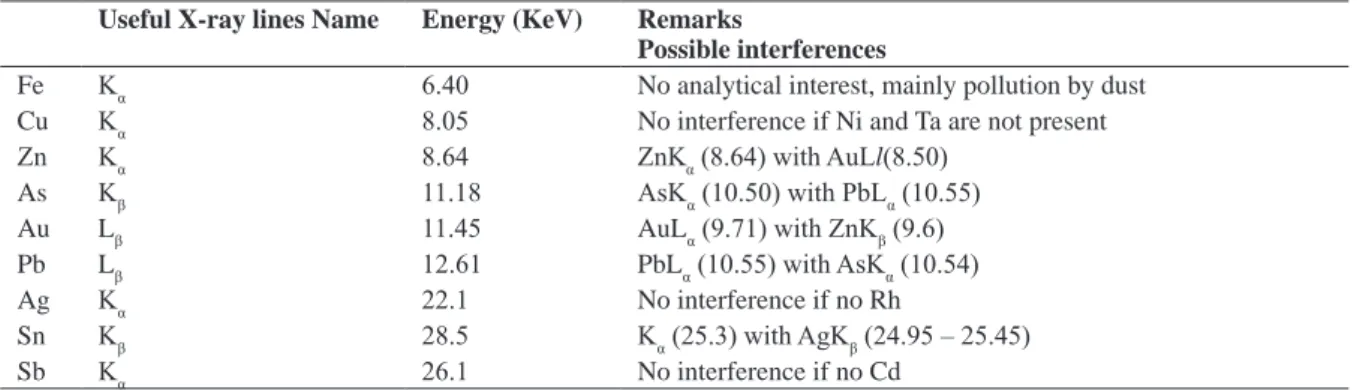
We have these considerations in mind when we undertake our measurements. We use PIXE at low incident proton energy, which enable us to determine the absolute concentrations of copper, silver, lead and gold as to point out the presence of trace elements like Zn, As, Bi, Sn, Sb. The presence of Fe is generally attributed to external pollution with dust incrusted at the surface of the metal. The analytical procedure takes advantage of the linear trajectory of protons in materials. The total range of 3 Mev protons in metals varies from 20 to 40 micrometers (µm). If the incident beam of protons hits a thin foil of Al (10µm thick), it crosses it and could travel through the air over a distance of 20 cm (see fig. 3). The coin is introduced in the external beam of protons, at 2 cm from exit Al foil. The ionization of atoms in the coin gives rise to the emission of characteristic X-rays of elements. Those X-rays are collected in a solid state detector giving rise to signals of various amplitudes depending on the atomic number of the collided atom. Characteristic X-rays of elements of interest in this study are given in Table 1. The quantitative analysis is performed by using the comparison of the emission rates of each characteristic element in the
Ch. Flament, O. Lateano and G. Demortier
448 coin and in a reference sample containing those elements in a known concentration. Reference samples and coins are irradiated in the same experimental geometry in order to avoid taking into account parameters that do not belong to the samples. The lowest limit of detection of useful chemical elements lies in the region of 100 parts per million or 0.01%. The accuracy of the measurement depends only on counting statistics. Main elements (Cu, Pb, Ag) are analysed with relative accuracy of 2%. The accuracy of the analysis of traces elements is about 5% relative for absolute concentrations of 0.1%, and about 20% relative for elements at a lower level (0.01%). The depth analysed in each case lies between 5 to 8 µm below the surface. Several analyses are made on the same sample to check its homogeneity. Details on the analytical method may be found in G. Demortier’s bibliography. We know that PIXE is doubtless not the most accurate technique to determine the absolute concentration of trace elements, but it is certainly a suitable method to lead a preliminary inquiry on such a huge coinage, as it is rapid and non-destructive. So we were able to analyse about hundred coins in order to mark exemplars that show an abnormal feature.
The coins analysed come from part of a hoard discovered somewhere in Egypt, usually called the “Tell el-Maskhouta Hoard” (Naster 1948), now kept in the Cabinet des
Médailles in Brussels. The majority of the coins in this
hoard have been issued during the second half of the 5th
century. Among those coins, there are many exemplars usually taken as imitations. But the Belgian collection includes indeed few specimens struck before 480 B.C. and
during the 4th century, exemplars that were also integrated
in our analysis program. As far we know, the program undertaken by LARN deals with the most numerous exemplars of coins issued during the second half of the
5th century. Because we are just at the beginning, we can
only give you some preliminary results and some points we hope to develop in the future.
We have analysed eighteen coins usually taken as imitations; twelve exemplars of Buttrey’s style B and six of Buttrey’s style M (Flament 2001) (see fig. 4). It appears
that the metallic composition of these coins, especially the amount of gold, is not different from the com position of the other Athenian specimens struck during the first half of the century that were certainly genuine. Those analyses confirm what we have inferred from numismatic sources; these coins, despite their careless style, are genuinely Athenian, probably struck during a period corresponding to a huge production of the Athenian Mint - the Peloponnesian War (Flament 2003). In fact, on the basis of the gold and lead concentrations, no coin seems to have been made of foreign silver, except one (II.37.326) for which the two measurements taken at the surface show a high concentration of gold, circa 1%, and a low level of lead. But the style of this coin is quite fine and nothing can allow a numismatist to suspect an imitation. So it is perhaps an exemplar issued during one of the two periods
Figure 3 Experimental arrangement for Nonvacuum PIXE in LARN (Namur-Belgium)
Figure 4 Ternary diagram of Cu, Pb and Au concentrations in coins usually taken as imitations, in coins struck during the first half of the 5th century and in a coin with a high concentration of gold
Figure 5 Coin II.37.496
Quantitative Analysis of Athenian Coinage by Pixe
449 when Athens used foreign silver. But to avoid precipitate conclusions, we must try to analyse other similar coins. In the future, we envisage also analysing foreign coins, those
struck by Thracians during the 5th century for example, in
order to determine how the PIXE method is accurate to distinguish silver from two distinct ores.
Concerning the technological evolution, we must say directly that the sample of coins sub mitted to investigation is far too disproportionate to draw solid conclusions, as
coins of the second half of the 5th are the most numerous.
But it seems that one of the archaic coins analysed showed a relatively high concentration of gold that is perhaps, given its date of minting, characteristic of the upper level of the third contact exploited for the issuing of the owls, or reflective of a more deficient refining method. But it is a matter of fact that this point necessitates more investigations.
Fig. 4 also shows a high range of variability in the amount of the other impurities, although the purity of silver remains around 95 %. There are some coins, not plotted in this diagram, that show a higher amount of copper, above a limit
of 2% we can arbitrarily draw.1 However, this phenomenon
is certainly due to corrosion affecting the surface of the coin, because other measurements on the same exemplars show a concentration below 2%. If we look at some of the incriminated coins (fig. 5), it is easy to deduce from their external aspect the source of such variations. In order to be sure that the variations are due to this phenomenon, we envisage using protons of different energy in the same point of the coin. The depth of pene tration will be different and we will see if the concentration of copper affects variations. If so, we may affirm that the variation in the amount of copper is probably due to corrosion.
Another coins show a high concentration of lead. Fifteen of
them have their two mea surements above 2%.2 So, surface
corrosion may not be an appropriate explanation. But, as there is nothing common to those coins, neither style nor
1 II. 37.285, II. 37.286, II.37.289, II.37.365, II.37.455, II.37.473,
II.37.496, II.37.515
2 II.37.291, II.37.297, II.37.300, II.37.304, II.37.330, II.37.348,
II.37.355, II.37.387, II.37.393-395, II.37.408, II.37.421, II.37.502
external aspect, we may con sider that the tolerance level for this impurity ought to be higher than this of copper because silver was extracted from galena. But, for one of these coins (fig. 6), the two measurements taken both show the same high level of lead (5,3 %) and may so perhaps be taken as an exemplar issued with debased silver at the end of the Peloponnesian War.
So, for the time being, we are avoiding the consideration that the presence of impurities is due only to voluntary adulteration, although it appears that in some cases this last possibility cannot be refuted. As the results of our preliminary enquiry are encouraging, further analysis will probably help us to go farther in our comprehension of Athenian coinage.
References
Allin, E.J., and Wallace, W.P., 1954, Impurities in Euboean Monetary Silver, American Numismatic Society. Museum
Notes, 6, 35-67.
Barthelemy, J.-J., 1759, Voyage du jeune Anacharsis en Grèce
dans le milieu du quatrième siècle avant l’ère vulgaire, Paris,
154.
Buttrey, T.V., 1982, Pharaonic Imitations of Athenian
Tetradrachms, in Proceedings of the 9th International Congress
of Numismatics, Bern, September 1979, Louvain-la-Neuve,
137-140.
Christomanos, A.K., 1905, Aνάλυση Αρχαίων Νομισμάτων,
Journal international d’archéologie numismatique, 8,
115-120.
Clay, t., 1988, Metallurgy and Metallography, Quaderni Ticinesi
di Numismatica e Antichit lassiche, 17, 341-352.
Conophagos, C., Badecca, H., and Tsaimou, C., 1976, La technique athénienne de la frappe des monnaies à l’époque
classique, Nomismatika Chronika, 4, 4-33.
Conophagos, C., 1980, Le Laurium antique, Athens, 1980, 341 (notes).
Demortier, G., 1985. Analyse non-destructive de monnaies par les techniques PIXE et XRF, Bulletin de l’institut archéologique
liégeois, 107, 371-394.
Diebolt, J., and Nicolet, h., 1977, Recherches sur le métal de tétradrachmes à types athéniens, Revue suisse de
numismatique, 56, 70-91.
Elam, C.F., 1931, An Investigation of the Microstructures of Fifteen silver Greek Coins (500-300 B.C.) and Some
Forgeries, Journal of the Institute of Metal, 45, 57-69.
Emeleus, V., and Kraay, C.M., 1962, The Composition of Greek
Silver Coins. Analyses by Neutron Activation, Oxford.
Useful X-ray lines Name Energy (KeV) Remarks
Possible interferences
Fe Kα 6.40 No analytical interest, mainly pollution by dust
Cu Kα 8.05 No interference if Ni and Ta are not present
Zn Kα 8.64 ZnΚα (8.64) with AuLl(8.50) As Kβ 11.18 AsKα (10.50) with PbLα (10.55) Au Lβ 11.45 AuLα (9.71) with ZnKβ (9.6) Pb Lβ 12.61 PbLα (10.55) with AsKα (10.54) Ag Kα 22.1 No interference if no Rh Sn Kβ 28.5 Kα (25.3) with AgKβ (24.95 – 25.45) Sb Kα 26.1 No interference if no Cd
Ch. Flament, O. Lateano and G. Demortier
450 Figueira, T., 1998, The Power of Money. Coinage and Politics in
the Athenian Empire, Philadelphia.
Flament, Ch., 2001, À propos des styles d’imitations athéniennes définis par T.V. Buttrey, Revue belge de Numismatique, 147, 39-50.
Flament, Ch., 2003, Imitations athéniennes ou monnaies
authentiques, Revue Belge de Numismatique, 149, 1-10.
Gale, N.H., Gentler, W., and Wagner, G.A., 1980, Mineralogical
and Geographical Silver Sources of Archaic Greek Coinage,
in Metallurgy in Numismatics (eds. D.M Metcalf and W.A.
Oddy), vol. 1, London: 3-49.
Giovannini, A., 1990, Le Parthénon, le trésor d’Athéna et le tribut
des alliés, Historia, 39(2), 129-148.
Hammer, J., 1908, Der Feingehalt der griechischen und römische
Münzen. Ein Beitrag zur antiken Münzgeschichte, Zeitschrift
für Numismatik, 26, 70-71.
Kraay, C.M., 1958, Gold and Copper Traces in Early Greek Silver, Archaeometry, 1, 1-2.
Kraay, C.M., 1959, Gold and Copper Traces in Early Greek Silver - II, Archaeometry, 2, 1-16.
Kraay, C.M., 1976, Archaic and Classical Greek Coins, London.
Kroll, J.h., 1976, Aristophanes’ ponera chalkia: A Reply, Greek,
Roman and Byzantine Studies, 17, 329-341.
Meyer, M.-A., and Demortier, G., 1990, Nonvacuum Analyses of Silver Coins (9th to 15th Century A.D.), Nuclear Instruments
and Methods in Physics Research, 49, 300-304.
Mommsen, H., and Schmittinger, T., 1981, Test Analysis of ancient Au and Ag Coins using High Energy PIXE, Archaeometry,
23(1), 71-76.
Mørkholm, o., 1974, A Coin of Artaxerxes III, Numismatic
Chronicle, 7th ser., 14, 1-4.
Naster, P., 1948, Un trésor de tétradrachmes athéniens trouvé à
Tell el-Maskhouta, Revue Belge de Numismatique, 94, 5-14.
Nicolet, h., 1985, Monnaies archaïques d’Athènes sous Pisistrate
et les Pisistratides (c. 545 - c. 510), Revue numismatique, 27, 23-44.
Nicolet- Pierre, H., 1986, L’oiseau d’Athéna, d’Égypte en Bactriane, Quelques remarques sur l’usage d’un type monétaire à l’époque classique, in Iconographie classique et
identités régionales (ed. L. Khal, C. Augé and P. Linant de
Bellefonds), BCH Suppl. 14, Paris, 365-375.
Nicolet, h., 1998, Autour du décadrachme athénien conservé à
Paris, in Studies in Greek Numismatics in Memory of Martin
Jessop Price (ed. R. Ashton, S. Hurter et al.,), London,
293-299.
Paszthory, E., and Hurter, S., 1981, Metallurgische Untersuchungen an archaischen Münzen aus Athens, Gazette
de numismatique suisse, 124, 77-86.
Paszthory, E., 1982, Archäometrische Untersuchungen an archaischen Münzen Athens, Gazette de numismatique suisse,
125, 30-36.
Rauch, 1874, Über den inneren Gehalt und den Metallwerth griechischer und römischen Silbermünzen nach preussichem
Gelde, Zeitschrift für Numismatik, 32.
Robinson, E.S.G., 1947, The tell El-Maskhouta Hoard of Athenian
Tetradrachms, Numismatic Chronicle, 6th ser., 8, 119-120.
Robinson, E.S.G., 1937, Coins from Excavations at El-Mina
(1936), Numismatic Chronicle, 5th ser., 17, 189.
Theodorou, J., 1996, Athenian Silver Coins: 6th-3rd centuries B.C.
The Current Interpretation, in Mneme Martin Jessop Price, Athens: 51 ff.
Starr, C.g., 1970, Athenian Coinage, Oxford.
Stroud, R.S., 1974, An Athenian Law on Silver Coinage,
Hesperia, 43, 157-188.
Svoronos, J., 1975, Corpus of the Ancient Coins of Athens, Chicago (reprint).
Thompson, M., 1960, Gold and Copper Traces in Late Athenian
Silver, Archaeometry, 3, 10-15.
Wallace, W.P., 1962, The Early Coinages of Athens and Euboia,