
Revue Scientifique et Technique Forêt et Environnement du Bassin du Congo Volume 4. P. 20-33 , Avril (2015)
An extended endochronic theory formulation of plastically deformed damaged indian
bamboo under uniaxial compression
Fozao D. S.1, Foudjet A. E.2, Fokwa D.3, Kouam A.4 (1) Ministry of Public Works Yaoundé, Cameroon / e-mail : [email protected]
(2) CRESA Forêt-Bois, University of Dschang, Cameroon (3) Department of Civil Engineering, ENSET, University of Douala (4) ENSTP, Yaoundé, Cameroon
Abstract
This paper presents a series of uniaxial compressive loading tests carried out on cylindrical samples of Indian bamboo, in order to develop stress-strain models. The bamboo species Oxytenanteraabyssinica from the Congo Basin forest was used for these tests. The non-linear behaviour of Indian bamboo may be attributed to two distinct mechanical processes, plasticity and damage.
These two degradation phenomena are described best by the theories of plasticity and continuum damage mechanics. Thus a multi-dissipative model that accounts for both plasticity and damage is necessary. The mathematical
model is produced using the endochronic theory of plasticity coupled with isotropic damage as well as the principle of equivalent strain. The major experimental parameters used to obtain the proposed model were obtained from the tests results. The cyclic and monotonic loading regimes were employed to investigate this nonlinear behaviour of Indian bamboo under uniaxial monotonic compression loading. The proposed stress-strain model was compared to the tests results and the comparison showed that the predicted model provides a good agreement with the test data.
Keywords: modeling, uniaxial compression, isotropic damage, bamboo, endochronic theory of plasticity, continuum
damaged mechanics, plastic strain, principle of equivalent strain.
Résumé
Cet article présente une série d’essais de compression axiale sur les essences de bambou de Chine en vue de développer un modèle de contrainte - déformation. L’essence de bambou, Oxytenanteraabyssinica du Basin de Congo, a été utilisée pour réaliser ces essais. Le comportement non-linéaire du bambou sous l’effet de la compression uni-axiale peut être attribué à deux processus mécaniques distincts. Il s’agit de la plasticité et de l’endommagement.
Ces deux phénomènes de dégradation du bambou peuvent être mieux décrits par la théorie de la plasticité et celle de la mécanique de l’endommagement des milieux continus. Le model multi-dissipatif qui tient compte de la plasticité et de l’endommagement est nécessaire pour cette modélisation. Le modèle mathématique est produit en
appliquant de la théorie ”endochronique” de la plasticité couplée avec l’endommagement isotropique ainsi que le principe de la déformation équivalente. Les paramètres expérimentaux essentiels utilisés pour proposer ce modèle ont été obtenus des résultats des essais de laboratoire. Le chargement cyclique (chargement-déchargement-chargement) et le chargement monotonique ont été utilisés pour étudier le comportement non-linéaire du bambou de Chine en compression uni-axiale.
Le modèle proposé pour les relations contrainte-déformation a été comparé aux résultats des essais de laboratoire et cette comparaison a montré que ce modèle s’accorde très bien avec les résultats des essais.
Mots clés: modélisation, compression uni-axiale, endommagement isotropique, bambou, théorie de la plasticité
endochronique, mécanique de l’endommagement des milieux continus, déformation plastique, principe de la déformation équivalente.
Bamboo is a fast growing fibrous plant available in
abundance on the earth. It is inexpensive, fast growing, easily available, and having comparable physical and mechanical properties to wood (Chaowana, P., 2013). 1. Introduction
Their culms can grow to their full height of 3-30m within a few months due to the expansion of individual internodes already present in the buds. It consists of cellulosic fibres embedded in a lignin matrix cellulose. Fibres are aligned along the length of the tree. It is considered as a unidirectional composite, with a maximum tensile flexural strength and rigidity in that direction. Over 1200 species have been identified globally. Bamboo has a very long history with human beings. It has been used widely for household products and extended to industrial applications due to advances in processing technology and increased marked demand (Fokwa et al, 2012).
The major morphological characteristic of bamboo is divided into the rhizome and the culm. The rhizome or the subterranean stem is the underground part of the bamboo while the culm is the upper ground part that contains the wood material. The culm is straight, hollow and cylindrical in shape having nodes and internodes. The function of the nodes is to prevent buckling. In the internodes, the cells are strongly oriented axially with no radial cell elements; therefore the transversal interconnection is provided only by the nodes. Bamboo is a composite material with long and parallel cellulose fibers in its structure. Its growth rate is very high with most of the growth occurring during the first year and growth ceasing by the fifth year (Amada, S. et al, 2001). The strength of bamboo increases with age. The maximum strength occurs at the age of about 3-4 years (Amada, S. et al., 2001) and after this age, the strength begins to decrease
The aim of the present study is to understand the behavior of bamboo, Oxytenantera abyssinica,
under monotonic uniaxial compressive loading and a mathematical model obtained from the endochronic theory of plasticity coupled with damage will be proposed. No such model has been used in the literature to explain the behaviour of Indian bamboo under uniaxial compressive loading.
Mathematical modeling of engineering materials is important in the design of engineering structures. The model should be able to explain, in the best way, the mechanical behaviour of the material and should be as simple as possible to facilitate its use. The model produce in this article satisfies these requirements. Uniaxial compression tests carried out on Indian bamboo specimens have shown that the behaviour of the material is nonlinear. This nonlinear may be attributed to two distinct mechanical processes, which are plasticity and damage. These two degradation phenomena are described best by the theories of plasticity and continuum damage mechanics. Thus a multi-dissipative model that accounts for both plasticity and damage is necessary. This is accomplished by adapting two potential functions, one for plasticity and the other for damage. The endochronic theory of plasticity coupled with isotropic damage is used to explain the behaviour of materials under uniaxial compression. In this article, the behaviour of Indian bamboo under uniaxial compression is explained using this model.
The endochronic theory of plasticity, developed by Valanis (Watanabe, O. et al., 1986 ; Jain, S.K., 2000 ; Erlicher, S. et al., 2006 ; Erlicher, S. et al., 2008) in the first seventies, allows the plastic behaviour of materials to be represented by introducing the notion of intrinsic
time that governs the rate independent evolution of stress and strain in materials (Erlicher, S. et al., 2006). This theory was later modified to introduce the effect of damage. In this paper, the endochronic theory of plasticity together with isotropic damage is used to explain the behaviour of Indian bamboo under uniaxial compression.
The model is formulated within the framework of thermodynamics and implements a strong coupling between plasticity and damage. The constitutive equations for the damaged material are written according to the principle of strain equivalence between the virgin Indian bamboo material and the damaged material. In this approach. The damaged Indian bamboo is modelled using the constitutive laws of the effective undamaged material the nominal stresses being replaced by the effective stresses (Abu Al-Rub, R. K et al., 2003).
Assumptions:
In the study of the behaviour of Indian bamboo under uniaxial compression using the coupling between plasticity and damage, the following assumptions will be made:
• There is coupling between elasto-plasticity and damage;
• Deformations are considered to be small; • Isothermal conditions are considered;
• The elastic strain vanishes when failure takes place; • The total strain (ε) can be decomposed into the elastic (εe) and plastic (εp) strains;
• The envelope curves are similar to the stress-strain curves under monotonic uniaxial compressive loading.
2. Material and Methods
The major objective of this research work is to propose
empirical relations to simulate the general stress strain behaviour of Indian bamboo under monotonic uniaxial compressive loading. This model is produced from the extended endochronic theory (that is the endochronic theory of plasticity coupled with damage). The proposed models are initiated to provide flexibility of mathematical expression and thebehaviour of this material is very well described by this model.
Material
The experiments carried out were performed using the bamboo species, Oxytenantera abyssinica, from the Congo basin rain forest. The specimens were obtained from dry soil. After harvesting the bamboo culm, the growth buds were carefully trimmed off for each species.
The bamboo culms were divided into three portions, the lower, the middle and the upper parts. The specimens were randomly selected and used for the experiments. Round hollow culms were used.
Some specimens had nodes within the culms while others were obtained from the internodes. The ends of the specimens were sanded to make them smooth. The green bamboo was left in the laboratory for five (5) months for seasoning. After air drying, some specimens were soaked in water for forty three (43) days before testing.
The geometrical characteristics of the Oxytenantera abyssinica specimens used are found on table 1.
Methods (Experimental Program):
A series of uniaxial compressive tests have been carried out to study the plastic behavior of Indian bamboo. The stress strain curves obtained for various specimens as well as theenvelope curves obtained from the cyclic uniaxial unloading and reloading tests carried out on other specimens are presented and analyzed to calibrate the analytical model.
Table1: Geometrical characteristics of the Oxytenantera abyssinica specimens used
No Specimen Diameter (mm) Length (mm) Remarks
External (d1) Internal (d2)
01 T1 Bottom without node (Fig.4) 35.25 28.54 190
Samples air dried before testing 02 T4 Bottom with node (Fig.5) 34.25 24.65 184
03 T4 Middle without node (Fig.6) 33.3 26.3 184 04 T5 middle without node (Fig.7) 36.45 27.6 184 05 T6 Bottom without node (Fig.8) 38.5 32.75 186
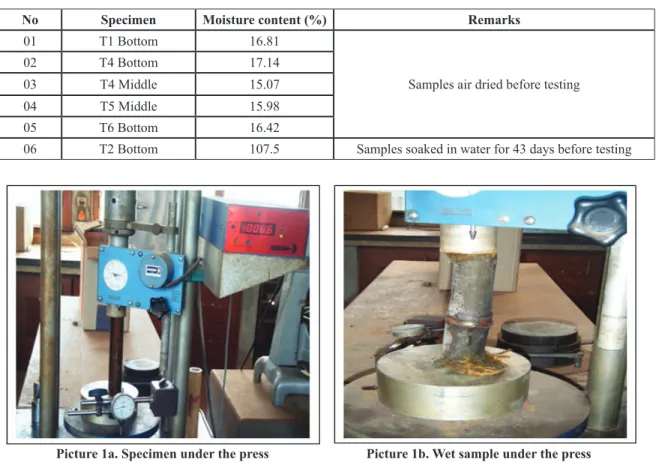
The moisture contents of some of the samples used for experiments are found on table 2 After cutting the specimens from the culm, the ends
were sanded to make them smooth. Each specimen was placed in the testing machine and the compression load applied parallel to the grain.
For the monotonic loading, the specimens were loaded continuously until they were completely damaged while for the cyclic compression loading, the specimens were loaded till the first crack and then unloaded to zero load, then reloaded again. Reloading and unloading cycling was continued until the specimen was completely damaged.
Two testing machines were used. The 5000kN universal press with adjustable speed was used for some specimens while the 50kN CBR press with a minimum speed of 1.27mm/s and an incorporated digital micrometer, was used for others. The deformations were monitored using the digital micrometer and loads were read after every 0.2mm of deformations. The test set up is shown on pictures 1a and 1b.
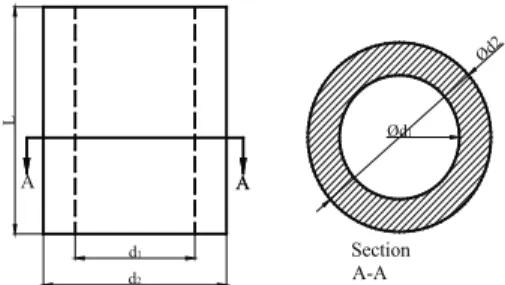
The stresses and strains were calculated using the original specimen dimensions and using the conventional expressions for these quantities. The bamboo culm was modeled as a hollow cylinder as shown on figure 2. Stress-strain diagrams plotted for six (06) specimens tested are shown on the diagrams from figures 3 to 10.
Modeling of the monotonic uniaxial compression loading of Indian bamboo.
The curve shown in figure 6 is a typical curve showing the results of a cyclic uniaxial unloading and reloading test on a specimen of bamboo. It is used to explain the parameters that are used to predict the unloading and the reloading paths of the curves.
In this section, analytical expressions for stress strain relations for bamboo subjected to monotonic uniaxial compression loading are developed. The models developed are based on constants which are functions of the strength of the bamboo species and they can be acquired from experimental results.
Picture 1a. Specimen under the press Picture 1b. Wet sample under the press Pictures.1 : Specimens under the press for testing
Table 2: Moisture contents
No Specimen Moisture content (%) Remarks
01 T1 Bottom 16.81
Samples air dried before testing 02 T4 Bottom 17.14
03 T4 Middle 15.07 04 T5 Middle 15.98 05 T6 Bottom 16.42
d1 d2 L Ød2 Ød1 A A A Section A-A
Figure 2: Typical bamboo culm modelled as a hollow cylinder
Figure 3 : Typical stress-strain diagram (cyclic curves together with envelope curve)
Figure 4 : Indian Bamboo under uniaxial monotonic compressive loading
the behavior of Indian bamboo under uniaxial monotonic compressive loading. These parameters are:
- the modulus of elasticity ;
- the value of the slope of the tangent curve at large strains E’t ;
- the intercept of the asymptote curve σ0 at large
values of ε with the stress axis, represented on the diagram by So S0;
- the strain at yield ε0, represented on the diagram
by e0.
The residual (or non-recoverable) strains also known as the plastic strains are the strains corresponding to zero stress level on the reloading or unloading stress-strain curves.
Endochronic theory of plasticity :
The endochronic theory of plasticity was developed by Valanis from the thermo-mechanical theory of internal variables. The word endochronic is a Greek word meaning intrinsic (or internal) time. The deformation history is represented by a monotonically increasing time-like parameter ζ known as the endochronic (or intrinsic) time (Han-Chin Wu 2005). This endochronic time accounts for the intrinsic material properties (Han-Chin Wu 2005).
The system to study is an irreversible system and the principles of irreversible thermodynamics are applied. The first law of thermodynamics (or the statement of conservation of energy) is widely used in the development of the internal variable theory. The system possesses an internal energy with an internal energy density.
The change of the internal energy of the system may be accomplished through a purely thermal process or an adiabatic process. The thermal process will change the temperature of the system while the adiabatic process, through the work done will change the position of the boundary of the system, causing the system to deform. Therefore temperature and strain are measures of the internal energy of the system and are known as state variables since they serve to define the state of the system (Han-Chin Wu, 2005). The internal energy is one of the state functions that is used to represent the thermodynamic state of the system. The other state functions used are the specific entropy and the Helmholtz free energy.
In irreversible systems, the state functions are not uniquely determined by the state variables strain and temperature. Other parameters, which are representative of the internal structure of the material The constants from the experimental stress strain
diagrams that are used for this modeling are shown on figure 4. The strain at the elastic limit, the modulus of elasticity, the slope of the stress strain curve at large strains as well as the intercept of the asymptotic curve at large strains are used.
The parameters shown in figure 4 are important parameters from the test data that are used to predict
are required. These parameters are called internal (or intrinsic) variables.
It is assumed that sufficient additional state variables can always be found to describe the thermodynamic state of an irreversible system (Han-Chin Wu, 2005). These additional variables are known as internal variables. Therefore for an irreversible system, the state functions are functions of strain, temperature, and internal variables (Han-Chin Wu, 2005).
One of the original ideas of Valanis was to develop a theory that describes the stress-strain curve without a yield surface (Han-Chin Wu, 2005). The stress-strain curve of Indian bamboo under uniaxial compression does not show any apparent yield point.
Valanis used the principles of thermodynamics of internal variable and the concept of intrinsic time to develop a theory that did not have a yield point and that could also be used to describe the softening behaviour of materials. This theory therefore can be used to describe the behaviour of Indian bamboo under uniaxial compression.
The simple endochronic theory developed by Valanis had so many advantages because of its mathematical simplicity in calculation (Han-Chin Wu, 2005). Experimental phenomena such as cross hardening, cyclic hardening and initial strain problems that could not be explained by the classical plasticity theory could be explained by the endochronic theory of plasticity (Watanabe, O. et al., 1986) and (Han-Chin Wu, 2005). The endochronic theory, however had some drawbacks and Valanis proposed the improved endochronic theory of plasticity in which the plastic strain was used to define the intrinsic time.
Theoretical formulation of the simple endochronic theory.
In the simple endochronic theory, Valanis used the total strain to measure the endochronic (or the intrinsic) time. This theory is derived for small isothermal deformations.
The expression for the endochronic time used in the theoretical formulation of the simple endochronic theory as (Han-Chin Wu, 2005):
d =
ζ
d
ε
Eq. 1Using the endochronic theory, the stress in the elastic plastic solid under uniaxial compression can be determined by using the convolution integral found in equation (2) (Watanabe, O. et al., 1986) and Han-Chin Wu, 2005):
(
)
d
z
z
d
d
z
z
E
z′
′
′
−
=
∫
ε
σ
0 Eq. 2In the expression above, dε is the total strain rate, z is the intrinsic time scale and E(z) is the kernel function. The intrinsic time scale can be determined from equation (3).
( )
ζ
ζ
f
d
dz =
Eq. 3 In equation (3) aboveζ
is the intrinsic (or the endochronic) time andf
( )
ζ
is the scaling factor which is identified as the isotropic hardening or isotropic softening function. The case of corresponds to no isotropic hardening or softening. The function( )
ζ
f
is a monotonically increasing function (Watanabe, O. et al., 1986 and (Han-Chin Wu, 2005): The kernel function may be given by the function in equation (4) (Watanabe, O. et al., 1986 and Han-Chin Wu, 2005):( )
z
E
e
( )zE
=
−δ0 Eq.4
where is a material constant and is Young’s modulus of the material.
The softening function can be given by equation (5) (Watanabe, O. et al., 1986) and (Han-Chin Wu, 2005):
Eq. 5 where is the softening or hardening coefficient. Therefore we have:
Eq. 6 For materials with softening behaviour such as Indian bamboo, the coefficient β is negative, (i.e β ≤ 0) Damage of materials
An isotropic damage model, formulated within the thermodynamic framework, is considered. In the Continuum Damage Mechanics modelling of the material, the constitutive equations for the damaged material were written according to the hypothesis of strain equivalence.
In order to use the principle of continuum damage mechanics to derive these constitutive equations, use is made of a fictitious undamaged continuum, which is mechanically equivalent to the actual damaged continuum. In the fictitious undamaged configuration, all types of damages including both voids and cracks are removed from the element being studied.
Principle of strain energy equivalence and strain equivalence:
Isotropic scalar damage theories are very often used in the study of Continuum Damage Mechanics. In these theories, use is made of the effective stress concept, where the stress is given as:
D
−
=
1
ˆ
σ
σ
Eq. 7In equation (7),
σ
ˆ
is the effective stress applied on the fictitious undamaged bamboo material,σ
ˆ
is the stress on the actually damaged material while D is the classical damaged variable introduced by Kachanov in 1958, defined as the ratio between the cross sectional area occupied by cracks together with voids and the total cross sectional area (Olsson, M et al, 2005) and (Han Chin Wu 2005).Strain energy equivalence principle:
The principle of strain energy equivalence introduced by Cordebois and Sideroff (1957) is widely used in Continuum Damage Mechanics to develop a class of damage representation theories (Hansen, N.R. et al., 1994). This principle states that the elastic strain energy of the damaged material is the same in form as that of an undamaged material except that the stress and the strain are replaced by the effective stress and the effective strain (Hansen, N.R. et al., 1994, Abu Al-Rub, R.K. et al., 2003, Han Chin Wu 2005).
The stored elastic energy W, in the damaged Indian bamboo material is given as:
E
W
2
σ
=
Eq. 8where E is the stiffness of the damaged material. The stored elastic energy in the fictitious undamaged Indian bamboo material is as:
0
2
ˆ
E
W
=
σ
Eq. 9 where E0 is the stiffness of the undamaged material. Using the principle of elastic energy equivalenceand applying equation (7), the relationship between the stiffness of the actually damaged Indian bamboo material E and the stiffness of the undamaged material E0 can be given as:
0 2
)
1
(
D
E
E
=
−
Eq. 10Strain equivalence principle:
The principle of strain equivalence as postulated by Lemaitre (1971) is also widely used by some researchers to develop damaged theories in Continuum Damage Mechanics. The concept of strain equivalence relies on the assumption that there exists an undamaged fictitious material, whose response functions serve to establish the corresponding functions for the real damaged material by setting in relation the elastic strain quantities. As such the effective stress variables have to be used for the undamaged fictitious material.
The principle of strain equivalence states that the strain associated with a damaged state under an applied stress is equivalent to the strain associated with its undamaged state under an effective stress. With this principle, the effective material behaviour is represented in the effective stress and the actual strain space (Hansen, N.R. et al., 1994). An equivalent energy state does not exist and effective strains are not employed (Hansen, N.R. et al., 1994).
The strain relation is given as follows:
0
ˆ
E
E
eσ
σ
ε
=
=
Eq. 11Using this relation and equation (7), we have:
0
)
1
(
D
E
E
=
−
Eq. 12From studies made by Olsson and Ristinmaa in 2003 (Olsson, M. et al., 2005), shortcomings exist for the strain and strain energy equivalence principles. These shortcomings are:
- The elastic strain will not be equal to zero when failure takes place;
- The damage rate at some point will decrease with increasing loading, and as a consequence, D will approach unity when the strain approaches infinity (i.e. D=1 is an asymptotic value)
In order to find a formulation for elasto-plasticity coupled with damage, that removes the shortcomings identified with the strain and energy equivalence postulates, the strain equivalence postulate can be
modified by modifying the equation relating the stiffness of the actually damaged material and the stiffness of the undamaged material.
Therefore the stiffness of the damaged material is given by introducing a material constant,q, according to the works of Mattias Olsson and Ristinmaa in (2005), (Olsson, M. et al., 2005) as:
Eq. 13 where q is a material constant.
Coupled damage/plasticity (Endochronic theory coupled with Isotropic damage):
The non-linear behaviour of Indian bamboo may be attributed to two distinct mechanical processes. These are plasticity and damage. These two degradation phenomena are described best by the theories of plasticity and continuum damage mechanics. Thus a multi-dissipative model that accounts for both plasticity and damage is necessary. This is accomplished by adapting two potential functions, one for plasticity and the other for damage.
After the introduction of the standard endochronic theory by Valanis within the early 70s, many researchers have tried to modify it by the introducing a damage variable.
Many models estimating the micro-damage accumulation in materials have been published. Some of these models are based on damage micro-mechanics (known as micro-mechanical damage models) while others, based on the continuum damage theory, are known as phenomenological damage models (Abu Al-Rub, R.K. et al., 2003).
Phenomenological models, which are applied in this article to explain the damage mechanics of Indian bamboo, are based on the initial concept of Kachanov (1958) who was the first to introduce the one dimensional damage variable for the isotropic case. The damage variable may be interpreted as the effective surface density of micro-damages per unit volume (Hansen, N.R. et al., 1994 ; Abu Al-Rub, R.K. et al., 2003). Kachanov pioneered the subject of continuum damage mechanics by introducing the concept of effective stress. Therefore the concept of effective stress is the foundation of Continuum Damage Mechanics (Hansen, N.R. et al., 1994). This concept is based on considering a fictitious undamaged configuration of a body and comparing it with the actual damaged configuration. Quite often, materials undergo a strong plastic deformation, which has a major influence on the
damage evolution and vice versa (Abu Al-Rub, R.K. et al., 2003). Many models have been introduced with coupling between damage and plasticity. In this study, it is assumed that there is coupling between plasticity and damage. Therefore, in carrying out the studies on the behaviour of Indian bamboo under uniaxial compression, the principles of Continuum Damage Mechanics coupled with elasto-plasticity will be adopted.
Consequently, in this section, the endochronic theory coupled with isotropic damage is used to explain the nonlinear behaviour of Indian bamboo subjected to uniaxial compression loading.
The additive decomposition of total strain (ε) into elastic (εe) and plastic strains (εp) will be used.
Consequently we have:
p
e
ε
ε
ε
=
+
Eq. 14In equation (14), the plastic strain also includes the strain induced by damage (Olsson, M. et al., 2005). In this case, the damage portion of the strain (εd) is not explicitly identified. It is incorporated in the plastic portion of the strain.
Formulation of the evolution laws for elasto-plasticity coupled with damage:
The formulation of the evolution laws for elasto-plasticity coupled with damage is based on two approaches as suggested by Mattias Olsson and Ristinmaa (Olsson, M. et al., 2005). It is either assumed that damage evolution takes place only during plastic loading as assumed by Lemaître in 1985 or that damage evolution can evolve independently of the plastic loading as assumed by Chow and Wang in 1987 Olsson, M. et al., 2005). In this study, it is assumed that the plasticity process evolves in the effective continuum hence the effective stress is the essential mechanism by which theories of elasto-plasticity are coupled with damage theories. Consequently a proper effective stress relation is very necessary (Hansen, N.R. et al., 1994).
Using the simple endochronic theory, the effective stress on the fictitious continuum can be determined. This will be done by substituting equations (3), (4), (5) and (6) in equation (2) and simplifying to give the equation below (Han Chin Wu, 2005).
+
=
β
δ
1
n
Eq. 16In equation (15), ε is the total strain and β is the softening coefficient that can be determined as follows.
The asymptote at large ε is found from equation (15) to give:
Eq. 17
From the intercept of this asymptote with the stress axis (i.e. at ε = 0,σ = σ0), we have:
Eq. 18
The expression of n can be determined from the slope of equation (15), E’t at large values of ε. Therefore
we have: t
E
E
n
=
0 Eq. 19 whereE
t=
m
E
t′
Eq. 20 m is a material constant.It can be concluded that equation (15) may be used to model the nonlinear stress-strain relation of Indian bamboo under uniaxial compression. However, it must be realised that this model is not suitable to model the constitutive relation of Indian bamboo because micro-cracks exist on the Indian bamboo specimens before they are loaded. When the loading is small, the micro-cracks are stable and the Indian bamboo behaves essentially as a linear elastic material until a certain threshold strain εm is reached when the
material behaviour becomes nonlinear. This threshold strain can be assumed to be equal to the strain at the elastic limit ε0.
From equations (7), (13) and (15) the stress on the actually damaged material is given as: Eq. 21
Where
D 1
=
−
α
e
−γε Eq. 22Therefore
Eq. 23 Before the stress threshold, the material Indian bamboo behaves elastically but after the threshold,
the material behaviour becomes inelastic. Therefore the stress equation is given below as:
Eq. 24
The value of α can be determined by equating the two expressions in equation (24) at ε = ε0. From this we
have:
Eq. 25 Substituting equation (25) in the second expression of equation (24), we have: Eq. 26 Where 0 0
ε
ε
=
k
Eq. 27 Eq. 28 3. ResultsSeveral cylindrical specimens from the Indian bamboo species Oxytenanteraabyssinica were tested either under the monotonic uniaxial compression testing regime or under the uniaxial cyclic compression regime. Stress strain curves were plotted.
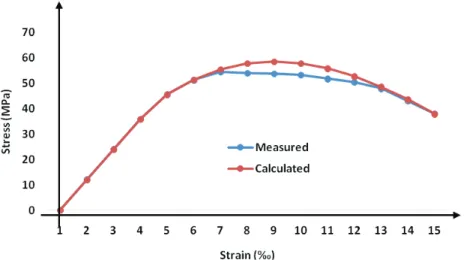
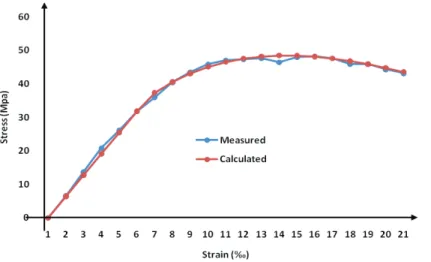
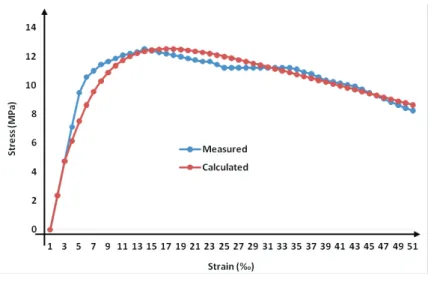
The graphs in figures 6 and 7 are obtained from monotonic uniaxial compression tests while the graphs in figures 4, 5, 8 and 9 are obtained from the envelope curves obtained from the cyclic uniaxial compression tests.
A mathematical expression, derived from the simple endochronictheory of plasticity and the principles of ContinuumDamage Mechanicshas been provided to explain the behaviour of Indian bamboo subjected to monotonic uniaxial compression loading. Tests data and data obtained using this mathematical expression are compared. The results are shown on the diagrams from figures 4 to 9.
n
E
0 0σ
β =
The parameters used in the mathematical expression for the six specimens modeled are represented on table 3.
Figure 5 : Measured and calculated data compared (T1 Bottom without node)
Figure 6 : Measured and calculated data compared (T4 Bottom with node) Parameter
Specimen E0 (MPa) ε0 (x10-3) Et (MPa) α σ0 (MPa) m n β γ
T1 Bottom 12291.5 3.26 -1298.21 0.96 90 2.35 -9.47 -14.42 0.5 T4 Bottom 10978.67 3.26 -5152 1.05 108.58 1.12 -2.13 -47.45 0.85 T4 Middle 7349 2.11 -633.14 1.12 52.08 0.56 -11.61 -12.16 0.85 T5 Middle 5677.8 9.78 -2316.35 1.06 83.5 2.75 -2.45 -27.74 3.5 T6 Bottom 6048.8 5.26 -1130.62 1.05 55 1.0 -5.35 -20.56 0.85 T2 Bottom 2231.41 2.13 -108.43 0.94 13.7 0.58 -20.58 -7.91 0.6
Figure 7 : Measured and calculated data compared (T4 Middle without node)
Figure 8 : Measured and calculated data compared (T5 Middle without node)
Figure 10 : Measured and calculated data compared (T2 Bottom with node) 4. Discussions
Comparison of test result and proposed models From the stress-strain diagrams plotted above, it can be seen that bamboo exhibits plastic behaviour, since permanent or residual strains are observed when the loads are removed as shown on the diagram on figure 3. Analytical expressions based on the endochronic theory of plasticity coupled with anisotropic damage have been proposed to model the behaviour of bamboo subjected to uniaxial compression loading. The proposed model is compared with experimental results.
A Mathematical model has been proposed which can be used to predict the behaviour of Indian bamboo under monotonic uniaxial compression loading. The figures shown above are used to compare the data obtained from the mathematical model to the experimental results. It is observed that the overall stress-strain behaviour of the proposed model and tests results show similar configuration to each as well as fit very well with each other.
Plasticity in Bamboo:
It can be seen from the curves that after the proportional limits, the behavior of Indian bamboo deviates from the linear proportionality behaviour and becomes nonlinear.
Indian bamboo contains a large number of micro cracks even before any load has been applied. This property is very decisive for the mechanical behavior of bamboo. The micro cracks may be caused by thermal expansion and shrinkage during temperature fluctuations. The nonlinear behavior and the s-shape
stress-strain curves of bamboo under uniaxial compressive stress can be associated with micro cracks propagation during load and stress- induced plastic flow in the specimen.
Permanent residual strains are produced in the material after the proportional limit. These strains are not lost after the load is removed. The stress at which these permanent strains are produced is known as the yield stress. In this work, the yield stress is taken to be equal to the proportional limit of the material. The value of the yield stress for each specimen tested has been determined.
5. Conclusion
A constitutive model is proposed to predict the non-linear behaviour of Indian bamboo under monotonic uniaxial compression loading. The experiments carried out were performed using the bamboo species, Oxytenantera abyssinica, from the Congo basin rain forest.
The non-linear behaviour of Indian bamboo may be attributed to two distinct mechanical processes, which are plasticity and damage. These two degradation phenomena are described best by the theories of plasticity and continuum damage mechanics.
The model proposed in this article is produced from the extended endochronic theory of plasticity (that is endochronic theory of plasticity coupled with isotropic damage). The test data from experimental investigations are compared to this model. The principle of equivalent strain has been used to produce the mathematical model. Two different loading regimes were employed to investigate this nonlinear behaviour of Indian bamboo
under uniaxial monotonic compression loading. From the tests results, the major experimental parameters for the proposed analytical expression were obtained. From the study, the following conclusions can be made.
- The nonlinear behavior of Indian bamboo can be modeled using the principles of endochronic theory of plasticity coupled with isotropic damage. Therefore Continuum Damage Mechanics principles are a powerful tool than can be used to analyse the behavior of Indian bamboo under uniaxial monotonic compression loading,
- When compared with the experimental results, the model show satisfactory agreement with the experimental results;
- The asymptote curve as well as the slope of the tangent curve at large strains for the experimental curves are important elements that have been used in producing the model;
- All the input data required for the models are obtained from monotonic as well as cyclic compression tests results.
Acknoledgement
Many thanks go to Pr. Nkeng George Elambo, Director of the National Advanced School of Public Works Yaoundé, for permitting us to use the civil engineering laboratory of his school to carry out these experiments. Sincere thanks also go to Dr. Tchiengue Barthelemy for helping to identify the specimens, Mr. Thierry and Mr. Roland Forghap of the metallic workshops of the National Advanced Schools of Public Works Yaoundé and Buea Annex respectively for assisting in the preparation of the specimens not forgetting Koagne Tamba Chamberlin for assisting during the testing of the materials.
Bibliography
Abu Al-Rub, R. K. and Voyiadjis, G. Z., 2003. On the coupling of anisotropic damage and plasticity models for ductile materials. International Journal of Solids and Structures pp. 2611-2643.
Amada, S. and Untao, S., 2001. Fracture properties of bamboo composites. Composites: Part B 32 pp. 451-459.
Bahn, B. Y. and Hsu, T.T.C., 1998. Stress-Strain Behaviour of Concrete under Cyclic Loading. ACI Materials Journal, Vol. 95, no. 2 pp. 178-193.
Bhalla, S., 2009. Scientific Design of Bamboo Structures. Department of Civil Engineering, Indian
Institute of Technology Delhi, HauzKhas, New Delhi – 110016.
Brekelmans, W. A.M., Schreurs P.J.G. and de Vree J.H.P., 1992. Continuum Damage Mechanics for softening of brittle materials. ActaMechanica,Springer-Verlag pp. 133-143.
Chaowana, P., 2013. Bamboo: An alternative raw material for wood and wood based composites. Journal of Material Science Research, vol.2, No2, pp90-102.
Chung, K.F., and Yu, W.K., 2002. Mechanical properties of structural bamboo for bamboo scaffoldings, Engineering Structures 24 pp. 429-442. Ekh, M., Menzel, A., Runesson, K. and Steinmann, P., 2003. Anisotropic damage with the MCR effect coupled to plasticity. International Journal of Engineering Science vol. 41 pp.1535-1551.
Erlicher, S., and Point, N., 2006. Endochronic theory, non-kinematic hardening rule and generalized plasticity: a new interpretation based on generalized normality assumption. International Journal of Solids and Structures 43 pp. 4175-4200.
Erlicher, S., and Point, N., 2008. Pseudopotentials and Loading Surfaces for an Endochronic Plasticity Theory with Isotropic damage.Journal of Engineering Mechanics Vol. 134 No. 10 pp. 832-842.
Fokwa, D., Ngapgue, F., Mpessa, M., and Tatietse, T.T. 2012. Physical Characterization of two Cameroon bamboo species: Arundinariaalpina and Oxytenanteraabyssinica. International Journal of Engineering and Technology (IJET) vol.4, No.2 pp.82-92.
Grammenoudis, P., and Tsakmakis, C., 2006. Properties of a class of continuum damage models. Proceedings of the 2006 IASME/WSEAS International Conference on Continuum Mechanics, Chalkida, Greece pp. 186-190.
Han-Chin Wu, 2005. Continuum Mechanics and Plasticity. Chapman and Hall/CRC Press Company. Hansen, N.R., and Schreyer, H.L., 1994. A Thermodynamically Consistent Framework for Theories of Elasto-Plasticity Coupled with Damage. International Journal of Solids and Structures, Vol. 31 No.3 pp.359-389.
Jain, S.K., 2000. Advancement of Endochronic Theory in Engineering Mechanics. European Congress
on Computational Methods in Applied Sciences and Engineering ECCOMAS 2000 Barcelona.
Janseen J.J.A., 2000. Designing and building with bamboo, Technical University of Eindhoven, the Netherlands. Technical Report No. 20. International Network of Bamboo and Rattan.
Janssen, J. J. A., 1985. The Mechanical Properties of Bamboo. Technical University of Eindhoven PostPus. 513, 5600-Eindhoven, Netherlands Proceedings of International Bamboo Workshop, China pp. 250-256. Kaware, A., Awari, U.R., and Wakchaure, M.R., 2013. Review of bamboo as reinforcement material in concrete structures. International Journal of Innovative Research in Science, Engineering and Technology, vol. 2 issue 6, pp. 2461-2464.
Kouzell, M., Weber, L., Marchi, S.C. and Mortensen, A., 2001. Influence of damage on the tensile behaviour of pure aluminium reinforced with more than 40 volume PCT alumina particles, ActaMaterialia 49 pp.3699-3709.
Lubliner, J., 1990. The Plasticity Theory, Macmillan Publishing Company.
Naik, N.K., 2004. Mechanical and Physico-Chemical properties of bamboo carried out by Aerospace Engineering Department, Indian Institute of Technology Bombay, Technical report no. IITB/AE/ NKN/TIFAC/BAMBOO/02/2003m I.I.T. Bombay. Olsson, M., and Ristinmaa, M., 2005. A Physically Motivated Modification of the Strain Equivalence Approach. International Journal of Damage Mechanics, vol. 14 pp 25-50.
Sabbir, M. A., Hog, A. S. M., and Fancy, S.F.C., 2011. Determination of tensile property of bamboo using
as potential reinforcement in concrete: International Journal of Civil and Environmental Engineering IJCEE-IJENS vol. 11 No. 05 pp. 47-51.
Seabra, M.R.R., de Sa J.M.A.C., Andrade, F.X.C., and Pire, F.F.M.A., 2010. Continuous-discontinuous formation for ductile fracture. International Journalof material forming
Šumaroc, D., Medjo, B., Trišović, N., 2008. Hysteretic behaviour modeling of elasto-plastic materials. Theoretical Applied Mechanics. Vol.35, No. 1-3 pp. 287-304.
Tada, T., Hashimoto, K., and Shimabukuro, A., 2010. On characteristics of bamboo as a structural material. Challenges, opportunities and Solutions in structural Engineering and Construction-Ghafoori (ed). Taylor and Francis Group, London ISBN 978-0-415-56809-8, pp. 527-532.
Verma, C.S., and Chariar, V.M. 2012. Studies of some mechanical properties of bamboo laminates. International Journal of Metallurgical and Materials Science and Engineering (IJMMSE), vol.2, Issue 2 pp 20-37.
Watanabe, O., and Atluri, S.N., 1986. Constitutive Modeling of Cyclic Plasticity and Creep, Using an Internal Time Concept. International Journal of Plasticity, Vol. 2 No. 2 pp107-134
Willam, K.J., 2002. Constitutive models for Engineering Materials Science. Encyclopedia of Physical Science and Technology, third edition, vol.3. PP. 603-633.
Zhao, R.D., and Che H.M., 1993. An endochronic-damage constitutive model ofconcrete extended to biaxial stresses. Elsevier Science Publishers B. V. pp. 259-264.

![[PDF] Tutorial général sur les bases de FileMaker Pro | Formation informatique](data:image/gif;base64,R0lGODlhAQABAIAAAP///wAAACH5BAEAAAAALAAAAAABAAEAAAICRAEAOw==)