HAL Id: hal-02476639
https://hal.inria.fr/hal-02476639v2
Submitted on 16 Nov 2020
HAL is a multi-disciplinary open access
archive for the deposit and dissemination of
sci-entific research documents, whether they are
pub-lished or not. The documents may come from
teaching and research institutions in France or
abroad, or from public or private research centers.
L’archive ouverte pluridisciplinaire HAL, est
destinée au dépôt et à la diffusion de documents
scientifiques de niveau recherche, publiés ou non,
émanant des établissements d’enseignement et de
recherche français ou étrangers, des laboratoires
publics ou privés.
Towards Validating Structural Connectivity in the
Human Language System: An Intraoperative
Cortico-Cortical Stimulation Experiment
Patryk Filipiak, Fabien Almairac, Théodore Papadopoulo, Denys Fontaine,
Lydiane Mondot, Stéphane Chanalet, Maxime Descoteaux, Rachid Deriche,
Maureen Clerc, Demian Wassermann
To cite this version:
Patryk Filipiak, Fabien Almairac, Théodore Papadopoulo, Denys Fontaine, Lydiane Mondot, et al..
Towards Validating Structural Connectivity in the Human Language System: An Intraoperative
Cortico-Cortical Stimulation Experiment. 27th Annual Meeting & Exhibition of the International
Society for Magnetic Resonance in Medicine (ISMRM 2019), May 2019, Montreal, Canada.
�hal-02476639v2�
Towards Validating Structural Connectivity in
the Human Language System: An Intraoperative
Cortico-Cortical Stimulation Experiment
Patryk Filipiak1, Fabien Almairac2, Th´eodore Papadopoulo1, Denys Fontaine2,
Lydiane Mondot2, St´ephane Chanalet2, Maxime Descoteaux3,
Rachid Deriche1, Maureen Clerc1, and Demian Wassermann1,4
1
INRIA Sophia Antipolis-M´editerran´ee, Universit´e Cˆote d’Azur, Valbonne, France [email protected]
2 Centre Hospitalier Universitaire de Nice, Universit´e Cˆote d’Azur, Nice, France, 3
Sherbrooke Connectivity Imaging Lab (SCIL), University of Sherbrooke, Sherbrooke, QC, Canada
4
INRIA, CEA, Universit´e Paris-Saclay, Paris, France
Abstract. We aimed to validate structural connectivity measures based on diffusion MRI with Direct Electrical Stimulation (DES) of the human brain cortex. For this, we combined white matter fiber tractography with propagation of Cortico-Cortical Evoked Potentials (CCEPs) induced by intrasurgical DES in the language system of brain tumor patients. Our results showed high correlation (Pearson’s coefficient 0.5-0.9) between de-lays of CCEPs and pathways connecting stimulation sites with recording electrodes. Our approach outperformed earlier study based on Diffusion Tensor Imaging. This potentially indicates that probabilistic tractogra-phy is an effective tool to quantify cortico-cortical communication non-invasively.
1
Introduction
We aimed to validate structural connectivity measures based on diffusion Mag-netic Resonance Imaging (dMRI) with Direct Electrical Stimulation (DES) of the human brain cortex. For this, we combined probabilistic tractography with propagation of Cortico-Cortical Evoked Potentials (CCEPs) induced by intrasur-gical DES in the language system of brain tumor patients. Our results showed high correlation (Pearson’s coefficient 0.5-0.9) between delays of CCEPs and pathways connecting stimulation sites with recording electrodes. Despite the use of low-current 2.0-3.5 mA DES and a small-sized stimulating electrode, our find-ings were in accordance with the studies performed in different schemes [1–4], where higher current intensities and larger electrodes ensured better signal-to-noise ratio.
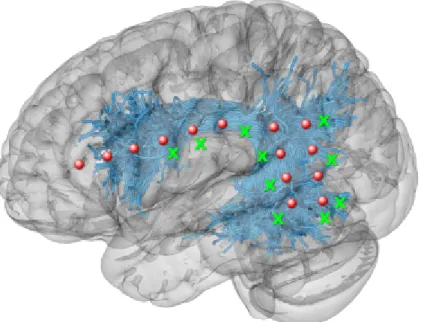
Fig. 1: Tractography-based Arcuate Fasciculus and Superior Longitudinal Fasci-culus III (marked as blue streamlines), ECoG electrode placements (red circles), and stimulation points (green crosses).
2
Methods
We acquired pre-surgical multishell dMRI (b ∈ {400, 800, 1550, 3100} [s/mm2]
with {6, 13, 29, 51} directions, respectively), from which we obtained probabilis-tic tractography. We dissected Arcuate Fasciculus (AF) and Superior Longitudi-nal Fasciculus III (SLF3) with MI-Brain [5] to plan the positioning of recording electrocorticographic (ECoG) electrodes. Next, following the awake craniotomy procedure, a neurosurgeon performed brain cartography with high-frequency 50 Hz DES to identify functional cortical sites related to AF and SLF3. Then, we placed the ECoG electrodes on the cortical terminations of those tracts de-termined with structural information from the dMRI-based tractography and functional information from the DES-based cartography, as illustrated in Fig-ure 1.
In this work, we considered two patients with written consent to participate in our study: 46-year old male (Patient 1) and 25-year old female (Patient 2). For both of them, we performed the ECoG recording under general anesthesia, right after the tumor resection. We used biphasic, bipolar 3.5 mA DES with the frequency 5 Hz for Patient 1 and 2.0 mA DES with the frequency 2 Hz for Patient 2. We recorded the signal, referenced to the average of all the electrodes, using the sampling frequency 2 kHz. The stimulation sites were located in the
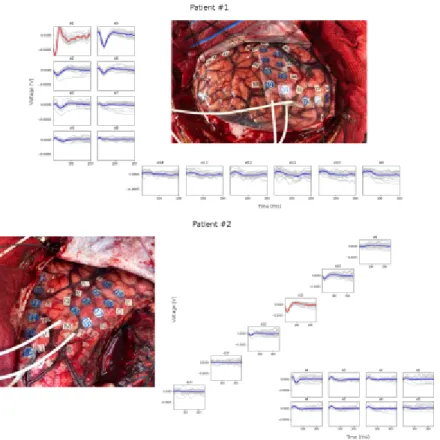
Fig. 2: Placement of ECoG electrodes and sample recordings of the CCEP prop-agation. The signals from the electrodes nearest the stimulation site are printed in red. The N1s are visible as downward peaks recorded by the electrodes located up to 4cm away from the stimulation site.
proximity of the reachable recording electrodes as illustrated in Figures 1 and 2. Each stimulation was repeated about 20 times.
In the post-processing, we averaged the ECoG signal of each DES trial in order to decrease the noise. Next, we computed the delays of the observed CCEPs and correlated them with the probability that a white matter bundle connects the stimulation and electrode sites. For that, we considered seeds located in the points of interest identified with the clinical neuronavigation system, surrounded by spheres of the 5 mm in diameter to account for a brain shift.
3
Results
Typically, an evoked potential consists of three consecutive voltage peaks named N1, P1, and N2 [6]. In most of our ECoG signals, we could identify the downward N1 peak propagating from the stimulation site, as illustrated in Figure 2.
Fig. 3: Means and standard deviations of (a) CCEP delays, (b) number of fibers originating from a stimulation site. The measurements are aggregated by the fiber lengths. Our delays are in accordance with the literature.
Figure 3a illustrates the means and standard deviations of delays of the N1 peaks aggregated by the lengths of the shortest fibers connecting a given stimulation-recording pair. The results for Patient 1 are less dispersed, reach-ing 23.6±13.0 ms delay on the fibers between 30- and 40-millimeter long, while for the Patient 2 we observed 43.7±23.2 ms delay for the same distance length. Figure 3b summarizes the number of fibers linking the examined pairs of points aggregated by the lengths. As expected, the majority of fibers connect neighbor-ing sites located 10-20 mm away from each other.
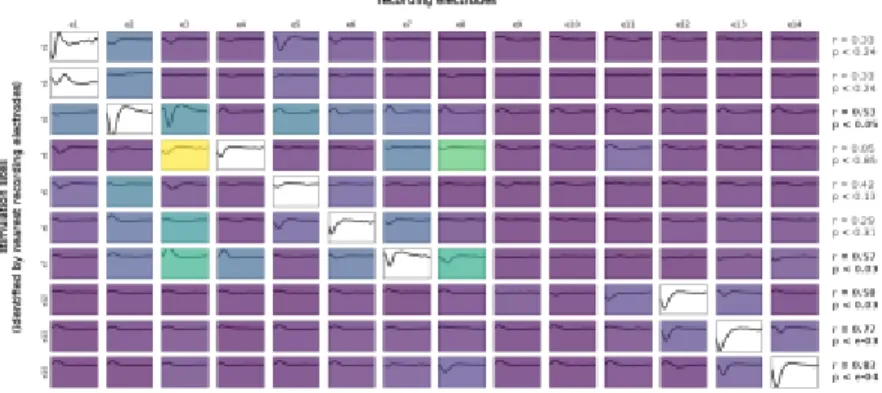
Figures 4 and 5 illustrate the correlation that we observed between delays of N1 and numbers of pathways connecting stimulation sites with recording electrodes. In most of the cases the Pearson’s correlation coefficient laid between 0.5 and 0.9.
4
Discussion
Elucidating the relationship between structure and function of the brain is one of the main challenges in neuroscience [7]. In this work, we addressed an open ques-tion, whether tractography provides an index of cortico-cortical communication.
Fig. 4: Correlation between the probability that there is an axonal connection linking stimulation sites and recording electrodes, and the latencies of sponding N1 peaks of the induced CCEPs for Patient 1. The Pearson’s corre-lation coefficients and p-values are given for each stimucorre-lation site. Statistically significant results are printed in bold. The squares on white are the reference stimulation points.
Fig. 5: Correlation between the probability that there is an axonal connection linking stimulation sites and recording electrodes, and the latencies of sponding N1 peaks of the induced CCEPs for Patient 2. The Pearson’s corre-lation coefficients and p-values are given for each stimucorre-lation site. Statistically significant results are printed in bold. The squares on white are the reference stimulation points.
We assesed the relationship between structural connectivity, measured through probabilistic tractography, and cortico-cortical communication as measured by injected DES. Despite being criticized, the correspondance between probabilistic tractography and the probability of an axonal connection has been accumulating positive evidence (e.g. in animal models [8]). In our case, the observed high corre-lation provides initial evidence that our tested hypothesis is correct. Our results outperform the previous streamline tractography study [2], where the Pearson’s correlation coefficient 0.4 was reported for the pathways obtained from Diffusion Tensor Imaging. This potentially indicates that probabilistic tractography is an effective tool to quantify cortico-cortical communication non-invasively.
5
Conclusion
Our study validates the structural connectivity measures based on white matter tractography with the propagation of CCEPs. We believe that combining those two modalities will help understand the organization of cognitive functions and support neurosurgical planning.
Acknowledgements
This work has received funding from the ANR/NSF award NeuroRef; the MAX-IMS grant funded by ICM’s The Big Brain Theory Program and ANR-10-IAIHU-06.
References
1. Matsumoto, R., Nair, D.R., LaPresto, E., Najm, I., Bingaman, W., Shibasaki, H., L¨uders, H.O.: Functional connectivity in the human language system: a cortico-cortical evoked potential study. Brain 127(10) (2004) 2316–2330
2. Conner, C.R., Ellmore, T.M., DiSano, M.A., Pieters, T.A., Potter, A.W., Tandon, N.: Anatomic and electro-physiologic connectivity of the language system: a com-bined dti-ccep study. Computers in biology and medicine 41(12) (2011) 1100–1109 3. Keller, C.J., Honey, C.J., M´egevand, P., Entz, L., Ulbert, I., Mehta, A.D.: Map-ping human brain networks with cortico-cortical evoked potentials. Philosophical Transactions of the Royal Society B: Biological Sciences 369(1653) (2014) 20130528 4. Yamao, Y., Matsumoto, R., Kunieda, T., Arakawa, Y., Kobayashi, K., Usami, K., Shibata, S., Kikuchi, T., Sawamoto, N., Mikuni, N., et al.: Intraoperative dorsal language network mapping by using single-pulse electrical stimulation. Human brain mapping 35(9) (2014) 4345–4361
5. Imeka: Mi-brain website (2018)
6. Vincent, M., Guiraud, D., Duffau, H., Mandonnet, E., Bonnetblanc, F.: Electrophys-iological brain mapping: Basics of recording evoked potentials induced by electrical stimulation and its physiological spreading in the human brain. (2017)
7. Jbabdi, S., Sotiropoulos, S.N., Haber, S.N., Van Essen, D.C., Behrens, T.E.: Mea-suring macroscopic brain connections in vivo. Nature neuroscience 18(11) (2015) 1546
8. Donahue, C.J., Sotiropoulos, S.N., Jbabdi, S., Hernandez-Fernandez, M., Behrens, T.E., Dyrby, T.B., Coalson, T., Kennedy, H., Knoblauch, K., Van Essen, D.C., et al.: Using diffusion tractography to predict cortical connection strength and distance: a quantitative comparison with tracers in the monkey. Journal of Neuroscience 36(25) (2016) 6758–6770