HAL Id: hal-00295632
https://hal.archives-ouvertes.fr/hal-00295632
Submitted on 3 Mar 2005
HAL is a multi-disciplinary open access
archive for the deposit and dissemination of
sci-entific research documents, whether they are
pub-lished or not. The documents may come from
teaching and research institutions in France or
abroad, or from public or private research centers.
L’archive ouverte pluridisciplinaire HAL, est
destinée au dépôt et à la diffusion de documents
scientifiques de niveau recherche, publiés ou non,
émanant des établissements d’enseignement et de
recherche français ou étrangers, des laboratoires
publics ou privés.
formation
B. Kärcher, T. Koop
To cite this version:
B. Kärcher, T. Koop. The role of organic aerosols in homogeneous ice formation. Atmospheric
Chemistry and Physics, European Geosciences Union, 2005, 5 (3), pp.703-714. �hal-00295632�
www.atmos-chem-phys.org/acp/5/703/ SRef-ID: 1680-7324/acp/2005-5-703 European Geosciences Union
Chemistry
and Physics
The role of organic aerosols in homogeneous ice formation
B. K¨archer1and T. Koop2
1DLR Oberpfaffenhofen, Institute for Atmospheric Physics, Wessling, Germany 2University of Bielefeld, Faculty of Chemistry, Bielefeld, Germany
Received: 10 September 2004 – Published in Atmos. Chem. Phys. Discuss.: 20 October 2004 Revised: 27 January 2005 – Accepted: 22 February 2005 – Published: 3 March 2005
Abstract. Recent field observations suggest that the
frac-tion of organic-containing aerosol particles in ice cloud parti-cles is diminished when compared to the background aerosol prior to freezing. In this work, we use model calculations to investigate possible causes for the observed behavior. In particular, homogeneous freezing processes in cooling air parcels containing aqueous inorganic particles and organic particles are studied with a detailed microphysical model. A disparate water uptake and resulting size differences that oc-cur between organic and inorganic particles prior to freezing are identified as the most likely reason for the poor partition-ing of organic aerosols into the ice phase. The differences in water uptake can be caused by changes in the relationship between solute mass fraction and water activity of the super-cooled liquid phase, by modifications of the accommodation coefficient for water molecules, or by a combination thereof. The behavior of peak ice saturation ratios and total ice crystal number concentrations is examined, and the dependence of the results on cooling rate is investigated. Finally, processes are discussed that could possibly modify the homogeneous freezing behavior of organic particles.
1 Introduction
Atmospheric aerosols often consist of varying mixtures of organic and inorganic compounds (Duce et al., 1983; Sax-ena and Hildemann, 1996; Murphy et al., 1998). The organic species are found at times to account for up to 50% of the total dry aerosol mass in the boundary layer as well as the free troposphere (Novakov et al., 1997; Middlebrook et al., 1998; Murphy et al., 1998; Lee et al., 2002). Furthermore, in upper tropospheric aerosols the organics are usually in-ternally mixed with sulfate, with organic constituents con-tributing 10–50% of the solute mole fraction (Murphy et al.,
Correspondence to: B. K¨archer
1998; Lee et al., 2002). The chemical nature of these or-ganics is quite diverse, but several field and modeling stud-ies have suggested that dicarboxylic acids are a significant component of the organic fraction (Gill et al., 1983; Saxena and Hildemann, 1996; Chebbi and Carlier, 1996; Yao et al., 2002).
The possible impact of organic constituents on the inter-play of atmospheric aerosol particles with water vapor and clouds has been investigated. For example, organics affect the hygroscopicity of aerosols (Cruz and Pandis, 2000; Dick et al., 2000; Ming and Russell, 2002) as well as the formation and properties of cloud droplets (Novakov and Penner, 1993; Facchini et al., 1999).
In contrast, the effects of organics on the ice nucleation behavior of upper tropospheric aerosols are less well stud-ied. Some laboratory studies have indicated that homoge-neous freezing of low molecular weight dicarboxylic acids is not as efficient as for sulfate aerosol, while others indicate identical ice nucleation efficiency (Prenni et al., 2001; Wise et al., 2004). Simultaneous measurements of ice cloud parti-cles and chemical identification of aerosols have been made in the field (Cziczo et al., 2004a,b; DeMott et al., 2003). These measurements have revealed that organic-containing aerosols are less abundant than sulfate aerosols in ice cloud particles when compared to the interstitial aerosols, suggest-ing that organics might hamper ice nucleation. At present, the reason for this behavior is not clear. This uncertainty stems in part from the lack of molecular information on the organics that are contained in the observed aerosols.
Here, we present the first attempt to provide a basic the-oretical understanding of the processes at work during the homogeneous formation of the ice phase in mixtures of inor-ganic and orinor-ganic aerosols. To this end, we use a microphys-ical parcel model to study the effects of organics on homoge-neous ice nucleation in liquid aerosols at upper tropospheric conditions as well as the resulting ice particle properties. We use a dicarboxylic acid, malonic acid (HOOC-CH2-COOH),
aerosol properties such as the mean particle size and water accommodation coefficient in order to make our results ap-plicable also to other organics of atmospheric relevance.
2 Model description
2.1 Microphysical model
We use the detailed microphysical model APSCm (K¨archer, 2003) to simulate aerosol particle growth and evaporation, homogeneous ice nucleation, ice particle growth and subli-mation. The model is used in a parcel mode with prescribed constant cooling rates dT /dt.
Aerosol and ice particle size distributions are discretized over 100 size bins with a constant bin-volume ratio of 1.35, starting at a minimum particle radius of 5 nm. Aerosol growth is treated in a Lagrangian manner while ice parti-cle growth is treated using a moving-center size structure that minimizes effects of numerical diffusion. Variable time steps inversely proportional to the cooling rate are suffi-ciently small (e.g., 0.1 s for dT /dt=10 K h−1) to yield accu-rate numerical solutions.
Inorganic and organic particles are prescribed as distinct types and are distributed lognormally, each with a total num-ber of 100 cm−3, a mode radius R of 0.1 µm, and a geo-metric width of 1.5. These parameters are chosen such that most of the freezing particles are in the accumulation mode size range. This choice takes into account that atmospheric particles which have been chemically analyzed are 0.1–1µm in size. Much larger liquid particles do hardly exist in no-table concentrations in the upper troposphere, while an aged accumulation mode is always present prior to cirrus cloud formation (Schr¨oder et al., 2002). Smaller Aitken mode par-ticles only have a chance to freeze homogeneously when this reservoir of larger particles is depleted. We are taking a lower limit concentration of free and upper tropospheric accumula-tion mode particles (typically several 100 cm−3), but observe
in our calculations that crystal number densities are typically only a fraction of the total aerosol, consistent with observa-tions.
For organic particles, the water accommodation coefficient
αis varied, and for inorganic particles (assumed to consist of aqueous sulfuric acid, H2SO4/H2O) we chose α=1, which
is consistent with recent laboratory measurements (Gershen-zon et al., 2004). The ice mass deposition coefficient is set equal to 0.5 (Haynes et al., 1992). Lowering this value would lead to increases in the total number of ice particles and the peak ice saturation ratios in the freezing events, but would not change our conclusions. However, exceptionally low values for the water vapor deposition coefficient on ice as proposed by Gierens et al. (2003) would contradict recent field (K¨archer and Str¨om, 2003) and freezing chamber (Haag et al., 2003) measurements.
While for some applications we study the behavior of each particle type in isolation, we focus on the fraction η of or-ganic particles that contribute to the total number density ni of ice crystals formed.
To describe homogeneous ice nucleation and freezing of aqueous aerosols in the APSCm, we use the water-activity-based model by Koop et al. (2000). This model is water-activity-based on an evaluation of ice nucleation measurements of 18 types of solutes including several organics. It has the advantage that it only requires knowledge of the water activity of a particu-lar aerosol solution particle at any given temperature in order to calculate the corresponding ice nucleation rate coefficient, without the need to know the ice–solution surface tension and other quantities. (However, gas–solution surface ten-sions might affect the water activity of small droplets via the Kelvin barrier, and thus, indirectly, affect the freezing rate, see Sect. 3.4.) In the APSCm, the water activity is calculated for each aerosol type as as function of particle size.
In our model, ice nucleation is described as a volume de-pendent nucleation process. Recently, pseudo-heterogeneous surface nucleation of ice has been proposed as an alternative mechanism (Djikaev et al., 2002; Tabazadeh et al., 2002). We note that organics might also influence this ice nucleation process through changes in particle surface tension (Djikaev et al., 2004). However, because of the remaining uncertain-ties associated with the surface nucleation mechanism, we restrict our model calculations to homogeneous volume de-pendent nucleation of ice. With this nucleation model, the APSCm has been shown to be suitable for the description of homogeneous freezing of sulfuric acid aerosol particles (Haag et al., 2003). In our present analysis, we make use of this model for all organic aerosols as well. Therefore, we can investigate what aerosol properties can lead to preferen-tial ice nucleation of sulfuric acid over organic aerosols, even if the nucleation model is identical for both particle types.
In most simulations we use dT /dt=10 K h−1, a value where non-equilibrium effects influence liquid aerosol wa-ter content and homogeneous freezing. Atmospheric ob-servations suggest that such rapid cooling rates are caused by mesoscale variability in vertical wind speeds and occur rather frequently at mid- and low latitudes in cirrus condi-tions (K¨archer and Str¨om, 2003; Jensen and Pfister, 2004; Haag and K¨archer, 2004; Hoyle et al., 2005). However, we will also address the impact of smaller and higher cooling rates on our results.
The temperatures T reported in this work are approximate freezing temperatures in the model, extending from warm (230 K) to cold (200 K) conditions. For simplicity, we let ice formation take place near an air pressure of 200 mb in all cases. The direct effect of upper tropospheric pressure changes on homogeneous freezing temperatures in liquid aerosols is negligible for our study. Only a slight dependence is introduced in the particle growth laws through the molec-ular diffusivity.
2.2 Representation of inorganic and organic aerosol prop-erties
2.2.1 General remarks
We have chosen sulfuric acid and malonic acid as the repre-sentatives for inorganic and organic constituents of upper tro-pospheric aerosols. While the occurrence of H2SO4is well
established through field data (e.g., Murphy et al., 1998, and references therein), the chemical nature of organics found in upper tropospheric aerosols is less clear and still an open is-sue. As mentioned in Sect. 1, the organics will most likely consist of a distribution of several organic species. On the other hand, organic acids seem to constitute a major frac-tion of the organics (Gill et al., 1983; Saxena and Hildemann, 1996; Chebbi and Carlier, 1996; Yao et al., 2002).
Because of the lack of quantitative in situ data, we have tried to establish a realistic representation of organic con-stituents by carefully considering those properties which most likely affect the homogeneous ice freezing of aerosols under conditions of the upper troposphere: first, the ther-modynamic properties of such aerosols and their equilibrium water uptake (hygroscopicity), and secondly, the kinetic wa-ter uptake through changes in the accommodation coefficient of water.
During the discussion phase of this paper the possible ef-fects of changes in the liquid/gas surface tension has been mentioned. Such changes are considered very important for the activation of aerosols into clouds droplets in warm clouds (Facchini et al., 1999). However, the effect on ice freezing is less clear. In contrast to classical nucleation theory, changes in surface tension (either liquid/gas or ice/liquid) do not af-fect calculations with the water-activity-based ice nucleation model used in this study, which is independent of surface ten-sion effects. In our calculations the solution surface tenten-sion only enters indirectly, through changes in the water uptake of small aerosols via the Kelvin effect (see discussion below). 2.2.2 Equilibrium water uptake by organic aerosols Field measurements have shown that the hygroscopicity of ambient aerosols is affected by the presence of organics. For example, hygroscopicity tandem differential mobility ana-lyzer data indicate that at low relative humidities the water content of aerosols containing organics is larger than that of sulfate aerosols. In contrast, at higher relative humidities the aerosols containing organics absorb considerably less water than sulfate aerosols (Dick et al., 2000). These observations can by generally understood by the thermodynamic proper-ties of water soluble organic acids and their mixtures with inorganic salts, as confirmed by a large number of laboratory and theoretical studies (e.g., Cruz and Pandis, 2000; Peng et al., 2001; Choi and Chan, 2002a,b; Prenni et al., 2003; Ming and Russell, 2002; Marcolli et al., 2004). For exam-ple, at room temperature and a relative humidity of 80%,
the solute mass fraction of the inorganic solutes H2SO4,
(NH4)2SO4, and NaCl are about 0.27, 0.43, and 0.23,
re-spectively (Wexler and Clegg, 2002). These values are con-siderably smaller than those of various organic acids such as oxalic acid (∼0.50), malonic acid (∼0.54), succinic acid (∼0.61), glutaric acid (∼0.69), malic acid (∼0.55), maleic acid (∼0.60), citric acid (∼0.62), and tartaric acid (∼0.54) (Peng et al., 2001; Choi and Chan, 2002a,b). Mixtures of organic acids or other organic substances such as glycerol behave similarly (Choi and Chan, 2002a,b; Marcolli et al., 2004). This comparison shows that pure inorganic aerosol particles will contain more water than pure organic particles at high relative humidity conditions relevant to this study of homogeneous ice freezing.
In addition, internal mixtures of inorganic solutes such as (NH4)2SO4or NaCl with organic acids always led to a
wa-ter uptake behavior (or particle growth factors) that was in between that of the pure components. Such experiments are consistent with calculations (Choi and Chan, 2002a; Ming and Russell, 2002; Prenni et al., 2003; Marcolli et al., 2004) which make use of the approach by Zdanovskii, Stokes, and Robinson (Seinfeld and Pandis, 1998).
Because of this more general pattern in the equilibrium water uptake behavior of the organic acids, we have de-cided to represent the organic hygroscopicity behavior of pure organic aerosols or mixed organic/inorganic aerosols by the thermodynamic properties of a single substance, malonic acid. We have chosen malonic acid for several reasons: first, it reveals a rather moderate hygroscopicity (∼0.54 at 80% RH) that represents an intermediate value for the various acids discussed above; secondly, the thermodynamic proper-ties of aqueous solutions of malonic acid at low temperature are better established than for most other organics of interest (Braban et al., 2003; Parsons et al., 2004); and thirdly, mal-onic acid is the smallest dicarboxylic acid with a large solu-bility in water, and it is miscible with inorganic solutes over a wide range of concentrations (Brooks et al., 2002; Ming and Russell, 2002; Wise et al., 2003; Marcolli et al., 2004).
In our simulations, we investigate three cases of aqueous solutions, pure aqueous sulfuric acid (SUL), pure aqueous malonic acid (ORG), and a 1:1 mole ratio mixture of sulfu-ric acid/malonic acid (SUL/ORG). We frequently refer to the first type as “inorganic” and to the two latter types as “or-ganic”.
To perform simulations with such aerosols in the APSCm, the water vapor pressure of aqueous solutions of these solutes are required over a wide concentration range to low temper-atures (∼200 K). The vapor pressure of H2SO4/H2O
solu-tions has been calculated using the parameterization by Luo et al. (1995). Since neither data nor parameterizations exist for aqueous malonic acid solutions at low temperatures, we have used experimental data to develop such a parameteriza-tion. We have used the data by Peng et al. (2001) at room temperature to establish a solute mass fraction versus water activity relationship, and the data by Braban et al. (2003) to
0
0.1
0.2
0.3
0.7
0.8
0.9
1
a
w0
SUL
0
0.15
0.30
0.45
W
200K
215K
230K
SUL/ORG 1:1
0
0.2
0.4
0.6
0.8
0.7
0.8
0.9
1
ORG
(a)
(b)
(c)
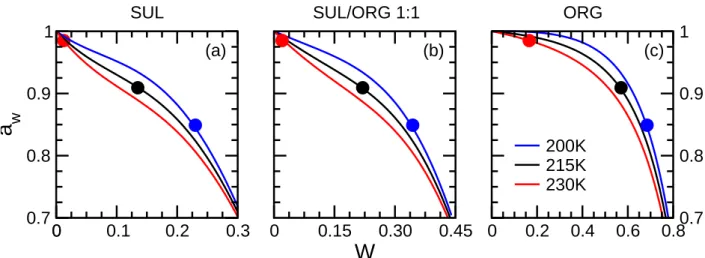
Fig. 1. Water activity as a function of solute mass fraction in aqueous solutions for three selected temperatures. Results are shown for pure
sulfuric acid (a), a 1:1 molar mixture of sulfuric acid and malonic acid (b), and pure malonic acid (c). Throughout this work we use malonic acid as a surrogate for the thermodynamic behavior of water soluble organics, as discussed in Sect. 2.2.2. The filled circles indicate the conditions where homogeneous ice nucleation commences according to the water-activity-based freezing model, assuming that the freezing particles are in thermodynamic equilibrium with water vapor, i.e., aw=RH /100%. For any given T , freezing occurs at the same awin each particle type, but the corresponding particle volumes (∝1/W ) may differ significantly.
parameterize its temperature dependence for the extrapola-tion to low temperatures. The latter data are in agreement with very recent measurements by Parsons et al. (2004). We have used both pure binary parameterizations to calculate the water vapor pressure of mixed ternary aqueous solutions of sulfuric acid/malonic acid with a 1:1 solute mole ratio. This has been done using the approach by Zdanovskii, Stokes, and Robinson (Seinfeld and Pandis, 1998), which has been shown to work successfully in ammonium sulfate/malonic acid mixtures at room temperature (Choi and Chan, 2002a; Prenni et al., 2003). Finally, we have used the above solution vapor pressures in the limit of vanishing solute mass frac-tions to compute the vapor pressure of pure water and hence water activity for reasons of internal consistency.
In Fig. 1 we show the awversus solute mass fraction W re-lationships resulting from our calculations for pure aqueous sulfuric acid (SUL), the 1:1 sulfuric acid/malonic acid mix-ture (SUL/ORG), and pure aqueous malonic acid (ORG) at three different temperatures T (color coded). The mixed par-ticle type SUL/ORG interpolates between the pure compo-nents SUL (hygroscopic) and ORG (less hygroscopic); note that W -axis scales change. The filled circles (same color coding) indicate at which combination of aw and W homo-geneous freezing commences under equilibrium conditions based on the water activity model.
Finally, we note that we have performed similar calcula-tions with polyols instead of malonic acid. The investigated polyols were oligomers of poly[ethylene glycol] with a mo-lar mass of 300 g mol−1, PEG300. Although the quantita-tive results for the PEG300 system are slightly different, the key processes and pathways of freezing modification are very similar to the malonic acid system. This increases confidence
in applying our findings to real atmospheric situations with variable types of organics, as described in Sect. 4.
2.2.3 Water accommodation coefficient in organic aerosols
The accommodation coefficient of water, α, for the different solutions is unclear. While α=1 is reasonable for aqueous sulfuric acid at low temperatures (Gershenzon et al., 2004; Clement et al., 1996), the presence of organic solutes might reduce α significantly (Gill et al., 1983; Wagner et al., 1996; Xiong et al., 1998).
The significant amounts of dissolved organics in our aerosol types ORG and SUL/ORG might also affect the value of α in such solutions. However, laboratory experiments in-dicate that already one or only a few monolayers of organics at the surface of an aerosol particle might affect α signifi-cantly (Xiong et al., 1998). Hence, only small amounts of a particular organic (or a mixture of organics) are sufficient to change α, and even organics with a relatively low solubility in water or surface active compounds might affect α. As a consequence, we believe that choosing only one representa-tive value for α of organics is not a suitable approach for our purpose. Therefore, we have decided to treat α as a param-eter in our simulations, and we vary α for the particle types ORG and SUL/ORG between 1 and 10−3for all model runs. Here, small α values are considered to be the result of the combined effects of organics dissolved in the bulk and other organics located at the droplet surface (possibly only in low concentrations).
10
-310
-210
-110
010
-410
-310
-210
-110
0η
10
-310
-210
-110
010
0SUL + SUL
10
-310
-210
-110
0α
230K 200K 215K 215K, 2R 215K, R/2SUL + SUL/ORG
10
-310
-210
-110
010
-410
-310
-210
-110
0SUL + ORG
(a)
(b)
(c)
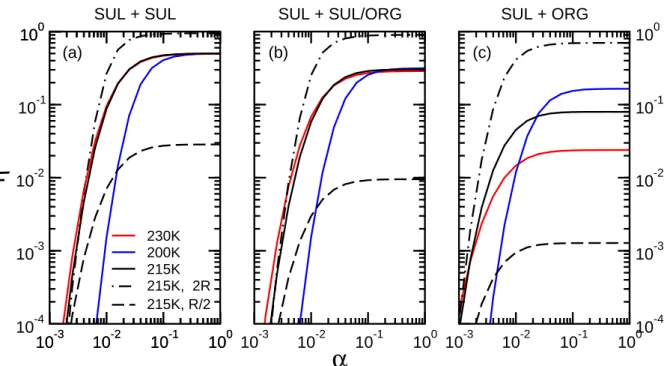
Fig. 2. Number of frozen aerosol particles with variable mass accommodation coefficient relative to the total number of ice particles formed
in air parcels cooling at 10 K h−1at different freezing temperatures. In all cases, the aerosol is composed of one pure inorganic particle mode (SUL) with α=1, to which another inorganic mode (a), the internally mixed inorganic/organic mode (b), and a mode composed of pure organic (c) is added, each with variable α. The solid curves represent cases where the initial dry size distribution of all modes were identical. The dashed (dash-dotted) curves represent cases where the initial dry sizes of the modes with variable α were half (twice) as large.
3 Results and discussion
3.1 Aerosol composition affects particle size
Let us first assume thermodynamic equilibrium between the ambient relative humidity (RH ) and the liquid aerosol par-ticles at all times, i.e., aw=RH /100%. Then Fig. 1 tells us that the particles are less water-rich when the amount of or-ganic solute is larger. Furthermore, the aerosol water content decreases with decreasing T . A direct implication of this be-havior is that the organic-containing particles remain smaller in a cooling air parcel than the more hygroscopic sulfuric acid particles. This is consistent with laboratory measure-ments and thermodynamic modeling studies of other inor-ganic/organic mixtures, as discussed above. In addition, very small particles will have lower aw than larger ones owing to the Kelvin barrier (Seinfeld and Pandis, 1998; Haag et al., 2003).
On the other hand, also kinetic effects have an impact on the water content and aw of aerosol particles. For example, at low cooling rates, all particles will actually stay close to water equilibrium. However, very large particles will have lower aw than smaller ones due to diffusion limitations of the water condensation rate. The latter non-equilibrium ef-fect becomes more important when the cooling rate is high and T is low. Both, thermodynamic and kinetic effects have been modeled for aqueous sulfuric acid particles (Haag et al.,
2003), in close agreement with measurements (M¨ohler et al., 2003).
In sum, we emphasize that both, different thermodynamic properties of aerosol particles and kinetic effects are ex-pected to result in a size separation between more and less hygroscopic particles that coexist in cooling air parcels. We demonstrate below that this size separation crucially impacts the contribution of each particle type to ice formation. 3.2 Aerosol composition affects freezing fractions Next, we describe the results from the parcel simulations. In most of these simulations the aerosol is composed of two externally mixed modes with identical dry size distributions but distinct number concentrations. Each mode is allowed to have different hygroscopic properties and water accommoda-tion coefficients. It is very instructive to study first two sep-arate modes that both consist of H2SO4/H2O aerosols, with
identical hygroscopic properties. However, we vary α from 0.0001 to 1 for one of the two modes for didactical purposes. Recall that η is the fraction of frozen aerosol particles with variable α relative to the total number of frozen particles.
Figure 2a depicts the results for η as a function of α for the two SUL modes (hereafter referred to as case SUL+SUL). As both aerosol modes have identical sizes (solid curves), η=0.5 when α approaches unity, because then both modes freeze in the same proportion. All solid curves in Fig. 2a would remain
10
-310
-210
-110
0α
1.4
1.5
1.6
1.7
1.8
S
i SUL+SUL/ORG SUL SUL/ORG ORG10
-310
-210
-110
0α
10
-110
010
110
2n
i, cm
-3200K
215K
230K
(a)
(b)
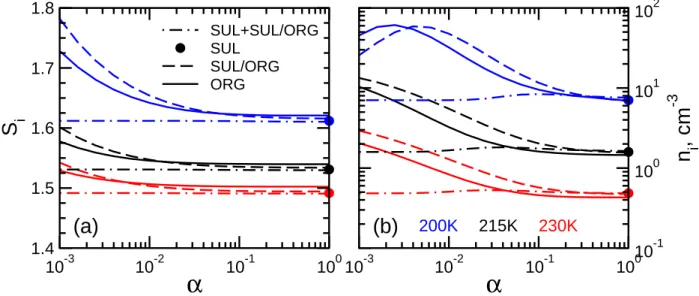
Fig. 3. Peak ice saturation ratio (a) and total number of ice crystals nucleated in the cooling air parcels as a function of the mass
accom-modation coefficient for pure inorganic particles (SUL, filled circles), pure organic particles (ORG, solid curves), internally mixed inor-ganic/organic particles (SUL/ORG, dashed curves), and the two particle system containing equal numbers of pure inorganic and internally mixed inorganic/organic particles (SUL+SUL/ORG, dash-dotted).
at η=0.5 for all values of α if the H2SO4/H2O particles were
in full thermodynamic equilibrium at all times, in which case
aw=RH /100%, regardless of size (apart from the Kelvin ef-fect, which is unimportant in most of our simulations, confer Sect. 3.4).
However, fewer droplets freeze from the mode with re-duced α because of rere-duced uptake of H2O molecules
dur-ing the cooldur-ing phase. These particles are less dilute (lower
aw, higher W ) and have smaller volumes than those with
α=1. This markedly reduces their probability to freeze ho-mogeneously for α . 0.05–0.1, depending on T . At low
T, equilibrium is approached later, as the H2O vapor
pres-sure decreases exponentially. (The characteristic timescale of equilibration of H2O by gas phase transport of H2O
molecules to the aerosol particles is inversely proportional to the H2O vapor pressure.) For our choice of dT /dt , this
ef-fect becomes important only at T <215 K, as the red (215 K) and black (230 K) curves are almost identical. In Sect. 3.5 we will examine the role of dT /dt in more detail.
We conclude from this exercise that non-equilibrium (ki-netic) and size effects are intimately coupled. A size separa-tion between particles with different water uptake properties must arise in a cooling air parcel. This size separation ul-timately influences the freezing process even if the particle size distributions are identical prior to cooling.
The impact of initial differences in particle size is analyzed by discussing the dashed and dash-dotted curves in Fig. 2a, where we have increased and decreased R from the particles with variable α by a factor of 2, respectively, at T =215 K. More (fewer) of these droplets freeze when they are initially larger (smaller). The effect of initial differences in particle
size is quite dramatic, and decides which of the two parti-cle modes wins the freezing competition, regardless of α. It is more pronounced at low T , where the kinetic effects are magnified. As shown at the end of this section, this effect occurs between chemically different aerosols as well.
Next, we investigate how differences in the hygroscopic properties of the two particle modes affect the water uptake, size, and freezing properties of the aerosol populations. In Figs. 2b and c, the second mode of particles with variable α are composed of the 1:1 mixture of sulfuric acid and organics (SUL/ORG) or pure organics (ORG), respectively, so that η denotes the fraction of ice particles that nucleated on organic-containing particles. The first mode continues to consist of aqueous sulfuric acid particles with α=1.
The principal behavior η(α) for the organic cases is sim-ilar to case SUL+SUL, but we observe differences in detail which are caused by differences in awbetween inorganic and organic species (recall Fig. 1). Typically, the organic aerosols do not freeze preferentially, as η<0.5 regardless of α or T (solid curves). The computed η-values are not sensitive to α unless α. 0.05–0.1, depending on T .
In contrast to case SUL+SUL, the solid curves differ in the limit α→1, especially in case SUL+ORG, caused by the dif-ferences in hygroscopic properties of the particles. The case SUL+SUL/ORG can be considered as an intermediate case, in which the freezing properties are still largely dominated by H2SO4in the mixed particles. The simulations start at
wa-ter equilibrium, where the organic mass fraction W adjusts such that aw(W, T )=RH /100% for all droplets. As W is inversely proportional to particle volume (apart from density effects), mean sizes of inorganic and organic droplets will be
different inasmuch as their aw(W, T )are different. The or-ganic particles are smaller than the H2SO4particles (Fig. 1).
This size effect becomes more pronounced as T decreases and yields different η in the limit α→1.
The effect of initial size differences between SUL, SUL/ORG, and ORG particles are similar to Fig. 2a. We point out that the organic particles might freeze preferentially over H2SO4 when they are sufficiently large (dash-dotted
curves in Figs. 2b and c).
3.3 Aerosol composition affects freezing relative humidity and ice crystal concentrations
Figure 3a shows the peak saturation ratios over ice, Si, for four cases (SUL, SUL/ORG, ORG, SUL+SUL/ORG) as a function of α and different freezing temperatures. Note that only the case SUL+SUL/ORG consists of two separate par-ticle modes.
Peak values of Si are generally higher than the freezing onset values (not shown), the difference increasing with de-creasing T , consistent with laboratory measurements and previous modeling studies (M¨ohler et al., 2003; Haag et al., 2003).
The SUL case with α=1 is displayed with single filled cir-cles. When organic solute is present (cases SUL/ORG and ORG), the peak (and onset) Si increases when α becomes smaller than ∼0.05–0.1. For small α, water uptake and, thus, freezing is retarded, allowing higher supersaturations to be reached. In such cases, the differences between onset and peak RHI can reach 8% (case ORG for α=0.001 at 200 K). An exception is the system SUL+SUL/ORG, where changes of α have no effect on Si which rather stays constant and close to the value obtained for case SUL. This is because ice formation occurs predominantly in the pure H2SO4
parti-cles, see Fig. 2b, rendering the presence of externally mixed SUL/ORG particles unimportant for the freezing process.
An important atmospheric implication of these calcula-tions is that the supersaturacalcula-tions required for homogeneous freezing of organic-rich particles can be substantially higher (by more than 0.1) than those for pure H2SO4/H2O, but
only in cases when no (or very few) separate H2SO4/H2O
particles are available for freezing. For example, we find that less than ∼ 0.05 cm−3 SUL particles must be present in a SUL+SUL/ORG particle population (with 100 cm−3 SUL/ORG particles) at a freezing temperature of 200 K in order to obtain a peak value Si=1.78 that coincides with the peak value obtained for pure SUL/ORG particles. The peak ice saturation is close to the pure SUL limit of Si=1.61 in the same particle population when the concentration of SUL particles increases above 10 cm−3. We reiterate this issue in Sect. 4.
Figure 3b shows the total number density of ice crystals,
ni, that nucleate from the aerosol types discussed in Fig. 3a. In general, ni increases with decreasing T as growth rates of pristine ice particles are smaller at low T , causing a slower
depletion of gaseous H2O and more available time for
addi-tional particles to freeze. Again, the filled circles denote the pure H2SO4/H2O case. For the organic particles SUL/ORG
and ORG, ni starts to increase substantially when α<0.1. At the coldest temperature, ni decreases again for α<0.006 (SUL/ORG) or α<0.0025 (ORG). Here, the water conden-sation rate onto aerosol particles becomes so small that only a limited number of particles can freeze, namely those large enough to take up water molecules despite the Kelvin barrier and small enough to take up water molecules despite diffu-sion limitations.
In contrast, the system SUL+SUL/ORG does not lead to significant changes of ni, and the crystal concentration stays close to case SUL, except for a slight enhancement at α∼0.1. 3.4 Aerosol composition affects freezing aerosol size
dis-tributions
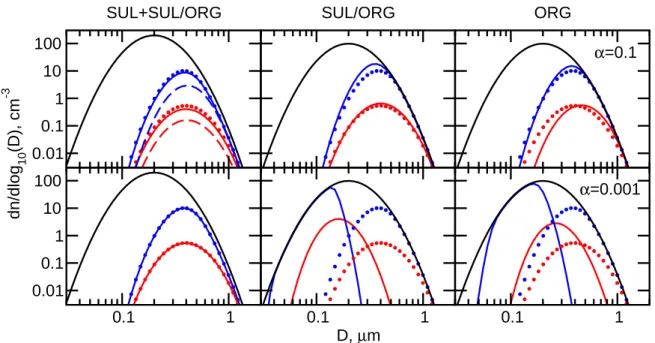
Interpretation of the results shown in Fig. 3 is supported by inspecting the freezing aerosol size distributions for selected cases, see Fig. 4. The freezing aerosol size distribution is defined as the difference between the aerosol number size distributions before and after freezing, displayed versus the dry particle diameter D.
The initial distributions are shown as black curves for the case SUL+SUL/ORG (left column), and for the cases SUL/ORG (middle column) and ORG (right column). The frozen particle distributions are plotted as solid curves (case SUL+SUL/ORG has two additive modes – solid curves: SUL, dashed curves: SUL/ORG). Also shown as filled circles are the freezing size distributions for case SUL (assuming α=1) to guide the eye. As before, red curves are for 230 K and blue curves for 200 K.
For the simulations with α=0.1 (top panel in Fig. 4), freez-ing aerosol spectra are similar to the pure H2SO4/H2O case
over a wide range of T . Only slight differences between SUL and SUL/ORG (middle column) and between SUL and ORG (right column) are notable. This is consistent with Fig. 3 when α>0.05 (230 K) α>0.1 (200 K), i.e., in regions where
Si and ni do not change significantly.
We now consider the case α=0.001 (bottom panel in Fig. 4), i.e., organic particles with a rather small water ac-commodation coefficient. If SUL and SUL/ORG are present as distinct particle types, then the organic particles do not contribute to freezing if α is small, and do not alter cirrus properties (left column).
However, the properties of cirrus clouds nucleating on or-ganic particles SUL/ORG or ORG in the absence of SUL may strongly differ from pure SUL in terms of Si and ni for sufficiently small α. Figure 4 demonstrates that the freez-ing aerosol distribution is shifted towards small particle sizes, where freezing at 200 K becomes eventually limited by the Kelvin effect, see left tails of the blue distributions in the cases SUL/ORG and ORG for α=0.001. These results for low α and low T are somewhat uncertain because, in the
0.01
0.1
1
10
100
SUL+SUL/ORG
SUL/ORG
ORG
0.1
1
0.01
0.1
1
10
100
dn/dlog
10(D), cm
-30.1
1
D,
µ
m
0.1
1
α
=0.1
α
=0.001
Fig. 4. Initial dry size distributions for the two particle system containing equal numbers of pure inorganic and internally mixed
inor-ganic/organic particles (SUL+SUL/ORG), internally mixed inorinor-ganic/organicd particles only (SUL/ORG), and pure organic particles only (ORG), all shown as black curves. Results are given assuming α=0.1 (α=0.001) for SUL/ORG and ORG in the top (bottom) panel. As before, red (blue) curves denote freezing temperatures of 230 (200) K. The colored solid curves (including the dashed SUL/ORG contri-bution in the left column that contributes for α=0.1 only) are the respective freezing aerosol districontri-butions, defined as the difference of the distributions before and after freezing plotted versus dry particle size. In all figures the freezing distribution for case SUL (with α=1) is shown (filled circles) for comparison.
0.1 1 10 100 dT/dt, K h-1 10-3 10-2 10-1 100 η α=0.1 α=0.01 α=0.001 SUL+SUL/ORG 200K 215K 230K
Fig. 5. Fraction of frozen aerosol particles in the two particle
sys-tem SUL+SUL/ORG versus air parcel cooling rate for selected sys- tem-peratures and mass accommodation coefficients of the SUL/ORG component.
absence of precise data, we have used the gas/liquid surface tension for H2SO4/H2O to calculate the Kelvin barrier for
SUL/ORG and ORG.
In cases SUL/ORG and ORG, the large particles that freeze when α=0.1 stay liquid when α=0.001 at both tem-peratures, because diffusion of H2O molecules to them is
hampered owing to strongly imperfect molecular
accommo-dation at the particle surface. Delayed freezing occurs be-cause smaller freezing particles result in smaller initial ice particles. Smaller ice particles, in turn, need longer to de-plete the H2O gas phase and thereby shut off further
nucle-ation. As a result, ni (and Si) increases significantly over the SUL or SUL+SUL/ORG cases, as can also be read off Fig. 3. 3.5 Effects of aerosol composition depend on cooling rates In Fig. 5 we show η as a function of the adiabatic cooling rate for the two particle system SUL+SUL/ORG at selected
αfor the SUL/ORG particles and T . For α=0.1, η is a weak function of dT /dt up to cooling rates of ∼20 K h−1. Under these conditions, all particles are close to water equilibrium, and η'0.3 is caused by differences in the equilibrium aerosol size distributions between SUL and SUL/ORG, see Fig. 2b. At higher cooling rates, non-equilibrium effects create larger differences in η, so that fewer organic-containing particles freeze for T =215 and 230 K.
When α is decreased, the range of cooling rates dT /dt within which all particles can be assumed to stay close to equilibrium conditions becomes successively narrower. Clearly, for less hygroscopic organic aerosols, the effect of disparate water uptake is the major factor for their poor ho-mogeneous freezing potential for all conceivable values of
Interestingly, the fraction of organic particles with α=0.1 that freeze at 200 K increases at high cooling rates and ap-proaches the limit η=0.5 (not shown). This is the case un-der conditions of vigorous cooling, where the freezing con-ditions are very rapidly surpassed and differences in freezing rates become irrelevant, thereby causing nearly all particles to freeze in the same proportion. This is not observed for smaller α-values.
4 Comparison with atmospheric observations
A large body of mass spectrometric data of the compo-sition of single particles obtained with the particle analy-sis by laser mass spectrometry (PALMS) instrument shows that organics are often internally mixed with sulfates (Mur-phy et al., 1998). The organic fraction varies significantly from almost pristine sulfate particles with only traces of organics to particles with comparable amounts of organic and inorganic species. In our theoretical two mode sys-tem SUL+SUL/ORG, SUL might represent particles with only a very small amount of water soluble organics, while SUL/ORG represents particles containing a significant wa-ter soluble organic mass fraction. The PALMS instrument does not distinguish between soluble and non-soluble or-ganic species. While our choice SUL/ORG is consistent with these data, we cannot exclude that other possibilities exist as well.
Then, our finding that organic-containing aerosols are in-efficient at homogeneous ice formation is consistent with more recent mass spectrometric measurements (Cziczo et al., 2004a,b; DeMott et al., 2003). In one study, particles from the clean lower troposphere over the continental United States of America were sampled and processed in the lab-oratory while in the second study particles were sampled and analyzed in situ in the subtropical upper troposphere.
On the basis of our model study, these new observations cannot be explained assuming only one internally mixed in-organic/organic particle mode with a fixed solute mole ratio. Instead, the recent observations can be explained in terms of size differences between two distinct modes of inorganic (∼SUL) and mixed inorganic/organic (∼SUL/ORG) aerosol particles. The size effects arise either from initial differences in size distribution or from effects caused by differences in the thermodynamic and hygroscopic particle properties. Re-ferring to Sect. 3.2, uncertainties in our simulations concern the size range over which most of the organic components are distributed and the chemical nature of the tropospheric organic aerosol population.
Atmospheric observations do not yet provide a detailed picture of the size-resolved chemical speciation of organic-containing particles, as well as their mixing state with other particle types. This is why a closer comparison of our re-sults with available observations is not possible at this point.
Our numerical simulations thus indicate the need for more specific data of such kind.
Ice saturation ratios up to 1.8 have been measured at cold temperatures (Gao et al., 2004) along with the pres-ence of organic-containing particles (Cziczo et al., 2004b). In view of the results shown in Fig.3, if two distinct modes of the type SUL and SUL/ORG were present during these measurements, then the high Si values could only be ex-plained if the number of SUL particles was exceptionally low (<0.05 cm−3at 200 K according to the estimate given in Sect. 3.3) and the SUL/ORG particles had very low water accommodation coefficients (of the order 0.001). Additional mechanisms that, possibly in combination with the effects of organics discussed above, might generate high Si values in-clude: small-scale temperature oscillations leading to larger peak values of Si (by 0.05–0.1 depending on the amount of ice present and on T ), which are not considered in our cal-culations but may effect the measured Si values in the at-mosphere (K¨archer and Haag, 2004); uncertainties at low T in the parameterizations for the vapor pressures of ice and supercooled liquid water and their effect on calculated satu-ration ratios by perhaps 0.1–0.2 in terms of Si (Murphy and Koop, 2005); effects of metastable cubic ice on the modeled gas phase relative humidities (Murphy, 2003).
5 Conclusions
The findings of our modeling study are summarized as fol-lows. As before, we refer with “inorganic” to pure inorganic particles and with “organic” to either pure organic or inter-nally mixed organic/inorganic particles.
1. Differences in the sizes of two externally mixed particle modes determine the homogeneous freezing fractions of each mode in a cooling air parcel. If the particles are chemically identical, the larger mode particles freeze first, preventing most of the smaller mode particles from ever nucleating ice. This effect is more pronounced the lower the freezing temperature.
2. If two particle modes have identical sizes, but differ chemically (inorganic versus organic particles), the par-ticles from the organic mode tend to stay less water-rich during cooling and thus stay smaller than inorganic par-ticles, even if the organic particles have high (>0.1) wa-ter accommodation coefficients.
In conditions close to local water equilibrium (slow syn-optic cooling), where the water activity in each particle is close to the ambient relative humidity, irrespective of its chemical nature, the organic aerosol is inefficient at homogeneous freezing owing to the induced size ef-fects.
At higher cooling rates (e.g., during mesoscale grav-ity wave activgrav-ity) particularly at low temperatures, non-equilibrium effects caused by (a) an increased time scale
of water condensation, (b) diffusion limitation of wa-ter molecules to large particles (>1 µm), and (c) the Kelvin effect for small particles (<0.1 µm) all influence the freezing fraction of organic particles.
3. If organic particles are sufficiently larger than inorganic particles prior to cooling, it might happen that the or-ganic mode particles nucleate ice preferentially over the inorganic mode, despite less efficient water uptake. 4. Besides size, the water accommodation coefficient for
organic particles is a crucial factor controlling their abil-ity to freeze homogeneously. Small values (<0.1) slow the rates of increase of water activity and volume of the particles, and thus delay freezing relative to inorganic particles, even if organic particles are initially larger and/or cooling rates are slow.
5. In case of vigorous cooling (e.g., in a convective cloud), differences between the freezing rates of organic and in-organic particles caused by size or kinetic effects dimin-ish, if water accommodation coefficients of organic par-ticles are not substantially smaller than ∼0.1. In such situations, nearly all particles freeze in the same pro-portion.
6. In the absence of inorganic particles, organic aerosol particles with low water accommodation coefficients will cause a substantial increase in the freezing satura-tion ratio at low temperatures (perhaps by up to ∼0.2), accompanied by an increase in the total number of ice crystals formed. If inorganic particles are present and compete in the freezing process, freezing commences at values characteristic for the inorganic particles unless their number concentrations fall below a (small) critical value.
Recent tropospheric observations indicate that organic par-ticles preferentially remain unfrozen. In view of the above findings, these observations would be consistent with freez-ing processes initiated in physically separate modes of in-organic and in-organic particles. Our study thus provides a consistent physical explanation within the framework of the water-activity-based nucleation model if such distinct parti-cle modes were indeed present during the measurements. We find it encouraging that some of our results have been con-firmed with the help of an independent microphysical model in the discussion stage of this paper (Murphy, 2004), increas-ing confidence in the robustness of our conclusions enumer-ated above.
Our study further indicates the strong need for more spe-cific data, because current atmospheric measurements do not provide all of the details about the organic aerosol number and size, size-resolved chemical composition and hygroscop-icity, and mixing state with inorganic species, required to bet-ter constrain the model simulations.
We have not considered possible mechanisms that could modify the freezing process in organic aerosol particles. Hydrophilic OH-groups of long chain alcohols could self-assemble into two dimensional crystal-like structures at the surface of aerosol droplets and perhaps lead to increased freezing temperatures, as observed for supercooled liquid water droplets of various size at rather warm temperatures (Gavish et al., 1990; Zobrist et al., 2004). On the other hand, as discussed in the present work, organic surfactants could hamper the uptake of water molecules in aerosol particles by reducing the water accommodation coefficient (e.g., Gill et al., 1983; Wagner et al., 1996; Xiong et al., 1998), thereby reducing their ability to freeze homogeneously.
Furthermore, partial crystallization in certain organic par-ticles and delayed deliquescence could change the freezing mode from homogeneous to heterogeneous. The precipi-tated crystal, possibly an organic solid, might induce het-erogeneous ice nucleation at the liquid/solid interface. Such effects have been observed in laboratory experiments with pure ammonium sulfate particles (Zuberi et al., 2001; Hung et al., 2002). Alternatively, ice nucleation might occur at the gas/solid interface in the deposition mode.
It is also possible that homogeneous freezing might be hampered in partially or fully crystallized particles. This would be the case, if the deliquescence relative humidity for the precipitate is larger than the relative humidity required for homogeneous ice nucleation of the fully liquid, but oth-erwise identical, particle. For partially crystallized particles, the reduced liquid volume would lead to a reduction in the actual nucleation rate, and for fully crystallized particles, ho-mogeneous freezing would be switched off entirely. How-ever, the latter case requires efflorescence of all individual solute species in a single aerosol particle. This appears to be somewhat unlikely when several solute species are in-volved, since the deliquescence relative humidity will also be reduced considerably (e.g., Marcolli et al., 2004).
Too little basic information is currently available to study all these issues theoretically. Despite these uncertainties, we believe that we have established the most important factors determining the role of organic tropospheric aerosols in ho-mogeneous ice formation in cirrus conditions. In particu-lar, we could show that preferential ice formation does occur even in the relatively simple homogeneous freezing frame-work using organic-containing, fully liquid particles. This may help refine parameterizations of cirrus cloud formation employed in climate models.
Our work provides a framework for future modeling stud-ies of the formation of cirrus clouds by homogeneous freez-ing. More laboratory and field observations are required in order to make further headway in quantifying the overall role of organic aerosols including heterogeneous ice nuclei in the freezing process and assessing their impact on the tro-pospheric ice phase.
Acknowledgements. This work was funded, in part, by the European Commission within the Integrated Project “Stratosphere-Climate Links With Emphasis on the UTLS” (SCOUT-O3). Edited by: R. MacKenzie
References
Braban, C. F., Carroll, M. F., Styler, S. A., and Abbatt J. P. D.: Phase transitions of malonic and oxalic acid aerosols, J. Phys. Chem. A, 107, 6594–6602, 2003.
Brooks, S. D., Wise, M. E., Cushing, M., and Tolbert, M. A.: Del-iquescence behavior of organic/ammonium sulfate aerosol, Geo-phys. Res. Lett., 29, 1917, doi:10.1029/2002GL014733, 2002. Chebbi, A. and Carlier, P.: Carboxylic acids in the troposphere,
occurrence, sources, and sinks: a review, Atmos. Environment, 30, 4233–4249, 1996.
Choi, M. Y. and Chan, C. K., The effects of organic species on the hygroscopic behaviors of inorganic aerosols, Environ. Sci. Technol., 36, 2422–2428, 2002a.
Choi, M. Y. and Chan, C. K., Continuous measurements of the wa-ter activities of aqueous droplets of wawa-ter-soluble organic com-pounds, J. Phys. Chem. A, 106, 4566–4572, 2002b.
Clement, C. F., Kulmala, M., and Vesala, T.: Theoretical consid-erations on sticking probabilities, J. Aerosol Sci., 27, 869–882, 1996.
Cruz, C. N. and Pandis, S. N.: Deliquescence and hygroscopic growth of mixed inorganic-organic atmospheric aerosol, Envi-ron. Sci. Technol., 34, 4313–4319, 2000.
Cziczo, D. J., DeMott, P. J., Brooks, S. D., Prenni, A. J., Thom-son, D. S., Baumgardner, D., WilThom-son, J. C., Kreidenweis, S. M., and Murphy, D. M.: Observations of organic species and atmospheric ice formation, Geophys. Res. Lett., 31, L12116, doi:10.1029/2004GL019822, 2004.
Cziczo, D. J., Murphy, D. M., Hudson, P. K., and Thomson, D. S.: Single particle measurements of the chemical composition of cirrus ice residue during CRYSTAL-FACE, J. Geophys. Res., 109, D04201, doi:10.1029/2003JD004032, 2004.
DeMott, P. J., Cziczo, D. J., Prenni, A. J., Murphy, D. M., Krei-denweis, S. M., Thomson, D. S., Borys, R., and Rogers, D. C.: Measurements of the concentration and composition of nuclei for cirrus formation, Proc. Natl. Acad. Sci., 100, 14 655–14 660, 2003.
Dick, W. D., Saxena, P., and McMurry, P. H.: Estimation of water uptake by organic compounds in submicron aerosols measured during the Southeastern Aerosol and Visibility Study, J. Geo-phys. Res., 105, 1471–1479, 2000.
Djikaev, Y. S., Tabazadeh, A., Hamill, P., and Reiss H.: Thermody-namic conditions for the surface-stimulated crystallization of at-mospheric droplets, J. Phys. Chem. A, 106, 10 247–10 253, 2002. Djikaev, Y. S. and Tabazadeh, A.: Effect of adsorption on crystal nucleation in binary droplets: implication for the formation of nitric acid hydrate particles, J. Phys. Chem. A, 108, 6513–6519, 2004.
Duce, R. A., Mohnen, V. A., Zimmermann, P. R., Grojean, D., Cautreels, W., Chatfield, R., Jaenicke, R., Ogren, J. A., Pelliz-zari, E. D., and Wallace, G. T.: Organic material in the global troposphere, Rev. Geophys. Space Phys., 21, 921–952, 1983.
Facchini, M. C., Mircea, M., Fuzzi, S., and Charlson, R. J.: Cloud albedo enhancement by surface-active organic solutes in growing droplets, Nature, 401, 257–259, 1999.
Gao, R. S., Popp, P. J., Fahey, D. W., Marcy, T. P., Herman, R. L., Weinstock, E. M., Baumgardner, D. G., Garrett, T. J., Rosenlof, K. H., Thompson, T. L., Bui, T. P., Ridley, B. A., Wofsy, S. C., Toon, O. B., Tolbert, M. A., K¨archer, B., Peter, Th., Hudson, P. K., Weinheimer, A. J., and Heymsfield, A. J.: Evidence that ambient nitric acid increases relative humidity in low-temperature cirrus clouds, Science, 303, 516–520, 2004. Gavish, M., Popovitz-Biro, R., Lahav, M., and Leiserowitz, L.: Ice
nucleation by alcohols arranged in monolayers at the surface of water drops, Science, 250, 973–975, 1990.
Gershenzon, M., Davidovits, P., Williams, L. R., Shi, Q., Jayne, J. T., Kolb, C. E., and Worsnop, D. R.: Uptake of H217O(g) and
D2O(g) by aqueous sulfuric acid droplets, J. Phys. Chem. A, 108,
1567–1573, 2004.
Gierens, K., Monier, M., and Gayet, J.-F.: The deposition coeffi-cient and its role for cirrus clouds, J. Geophys. Res., 108, 4069, doi:10.1029/2001JD001558, 2003.
Gill, P. S., Graedel, T. E., and Weschler, C. J.: Organic films on atmospheric aerosol particles, fog droplets, cloud droplets, rain-drops, and snowflakes, Rev. Geophys. Space Phys., 21, 903–920, 1983.
Haag, W., K¨archer, B., Schaefers, S., Stetzer, O., M¨ohler, O., Schu-rath, U., Kr¨amer, M., and Schiller, C.: Numerical simulations of homogeneous freezing processes in the aerosol chamber AIDA, Atmos. Chem. Phys., 3, 195–210, 2003,
SRef-ID: 1680-7324/acp/2003-3-195.
Haag, W. and K¨archer, B.: The impact of aerosols and gravity waves on cirrus clouds at midlatitudes, J. Geophys. Res., 109, D12202, doi:10.1029/2004JD004579, 2004.
Haynes, D. R., Tro, N. J., and George, S. M.: Condensation and eva-poration of H2O on ice surfaces, J. Phys. Chem., 96, 8502–8509,
1992.
Hoyle, C. R., Luo, B. P., and Peter, T.: The origin of high ice crystal number densities in cirrus clouds, J. Atmos. Sci., in press, 2005. Hung, H.-M., Malinowski, A., and Martin, S. T.: Ice nucleation ki-netics of aerosols containing aqueous and solid ammonium sul-fate particles, J. Phys. Chem. A, 106, 293–306, 2002.
Jensen, E. J. and Pfister, L.: Transport and freeze-drying in the tropical tropopause layer, J. Geophys. Res., 109, D02207, doi:10.1029/2003JD004022, 2004.
K¨archer, B.: Simulating gas-aerosol-cirrus interactions: Process-oriented microphysical model and applications, Atmos. Chem. Phys., 3, 1645–1664, 2003,
SRef-ID: 1680-7324/acp/2003-3-1645.
K¨archer, B. and Str¨om, J.: The roles of dynamical variability and aerosols in cirrus cloud formation, Atmos. Chem. Phys., 3, 823– 838, 2003,
SRef-ID: 1680-7324/acp/2003-3-823.
K¨archer, B. and Haag, W.: Factors controlling upper tropospheric relative humidity, Ann. Geophysicae, 22, 705–715, 2004,
SRef-ID: 1432-0576/ag/2004-22-705.
Koop, T., Luo, B. P., Tsias, A., and Peter, T.: Water activity as the determinant for homogeneous ice nucleation in aqueous so-lutions, Nature, 406, 611–614, 2000.
Lee, S. H., Murphy, D. M., Thomson, D. S., and Middlebrook, A. M.: Chemical components of single particles measured with
Particle Analysis by Laser Mass Spectrometry (PALMS) dur-ing the Atlanta SuperSite Project: focus on organic/sulfate, lead, soot, and mineral particles, J. Geophys. Res., 107, 4003, doi:10.1029/2000JD000011, 2002.
Luo, B. P., Carslaw, K. S., Peter, T., and Clegg, S. L.: Vapor-pressures of H2SO4/HNO3/HCl/HBR/H2O solutions to low
stratospheric temperature, Geophys. Res. Lett., 22, 247–250, 1995.
Marcolli, C., Luo, B. P., and Peter, T.: Mixing of the organic aerosol fractions: liquids as the thermodynamically stable phases, J. Phys. Chem. A, 108, 2216–2224, 2004.
Middlebrook, A. M., Murphy, D. M., and Thomson, D. S.: Ob-servations of organic material in individual marine particles at Cape Grim during the First Aerosol Characterization Experiment (ACE 1), J. Geophys. Res., 103, 16 475–16 483, 1998.
Ming, Y. and Russell, L. M.: Thermodynamic equilibrium of organic-electrolyte mixtures in aerosol particles, AIChE J., 48, 1331–1348, 2002.
M¨ohler, O., Stetzer, O., Schaefers, S., Linke, C., Schnaiter, M., Tiede, R., Saathoff, H., Kr¨amer, M., Mangold, A., Budz, P., Zink, P., Schreiner, J., Mauersberger, K., Haag, W., K¨archer, B., and Schurath, U.: Experimental investigations of homogeneous freezing of sulphuric acid particles in the aerosol chamber AIDA, Atmos. Chem. Phys., 3, 211–223, 2003,
SRef-ID: 1680-7324/acp/2003-3-211.
Murphy, D. M.: Dehydration in cold clouds is enhanced by a transi-tion from cubic to hexagonal ice, Geophys. Res. Lett., 30, 2230, doi:10.1029/2003GL018566, 2003.
Murphy, D. M.: Interactive comment on: The role of organic aerosols in homogeneous ice formation by B. K¨archer and T. Koop, Atmos. Chem. Phys. Discuss., 4, S2299–S2300, 2004. Murphy, D. M. and Koop, T.: Review of the vapour pressure of ice
and supercooled water for atmospheric applications, Q. J. Roy. Meteor. Soc., in press, 2005.
Murphy, D. M., Thomson, D. S., and Mahoney, M. J.: In situ mesurements of organics, meteoritic material, mercury, and other elements in aerosols at 5 to 19 kilometers, Science, 282, 1664– 1669, 1998.
Novakov, T. and Penner, J. E.: Large contribution of organic aerosols to cloud-condensation-nuclei concentrations, Nature, 365, 823–826, 1993.
Novakov, T., Hegg, D. A., and Hobbs, P. V.: Airborne measure-ments of carbonaceous aerosols on the east coast of the United States, J. Geophys. Res., 102, 30 023–30 030, 1997.
Parsons, M. T., Mak, J., Lipetz, S. R., and Bertram, A. K.: Deliques-cence of malonic, succinic, glutaric, and adipic acid particles, J. Geophys. Res., 109, D06212, doi:10.1029/2003JD004075, 2004. Peng, C., Chan, M. N., and Chan, C. K.: The hygroscopic proper-ties of dicarboxylic and multifunctional acids: measurements and UNIFAC predictions, Environ. Sci. Technol., 35, 4495–4501, 2001.
Prenni, A. J., DeMott, P. J., Kreidenweis, S. M., Sherman, D. E., Russell, L. M., and Ming, Y.: The effects of low molecular weight dicarboxylic acids on cloud formation, J. Phys. Chem. A, 105, 11 240–11 248, 2001.
Prenni, A. J., DeMott, P. J., and Kreidenweis, S. M.: Water uptake of internally mixed particles containing ammonium sulfate and dicarboxylic acids, Atmos. Environment, 37, 4243–4251, 2003. Saxena, P. and Hildemann, L. M.: Water-soluble organics in
at-mospheric particles: a critical review of the literature and appli-cation of thermodynamics to identify candidate compounds, J. Atmos. Chem., 24, 57–109, 1996.
Schr¨oder, F. P., K¨archer, B., Fiebig, M., and Petzold, A.: Aerosol states in the free troposphere at northern midlatitudes, J. Geo-phys. Res., 107, 8126, doi:10.1029/2000JD000194, 2002. Seinfeld, J. H. and Pandis, S. N.: Atmospheric Chemistry and
Physics, John Wiley, New York, 1998.
Tabazadeh, A., Djikaev, Y. S., and Reiss H.: Surface crystalliza-tion of supercooled water in clouds, Proc. Natl. Acad. Sci., 99, 15 873–15 878, 2002.
Wagner, J., Andrews, E., and Larson, S. M.: Sorption of vapor phase octanoic acid onto deliquescent salt particles, J. Geophys. Res., 101, 19 533–19 540, 1996.
Wexler, A. S. and Clegg, S. L.: Atmospheric aerosol models for sys-tems including the ions H+, NH+4, Na+, SO42−, NO−3, Cl−, Br−, and H2O, J. Geophys. Res., 107, doi:10.1029/2001JD000451,
2002.
Wise, M. E., Surratt, J. D., Curtis, D. B., Shilling, J. E., and Tolbert, M. A.: Hygroscopic growth of ammonium sulfate/dicarboxylic acids, J. Geophys. Res., 108, 4638, doi:10.1029/2003JD003775, 2003.
Wise, M. E., Garland, R. M., and Tolbert, M. A.: Ice nucleation in internally mixed ammonium sulfate/dicarboxylic acid particles, J. Geophys. Res., 109, D19203, doi:10.1029/2003JD004313, 2004.
Xiong, J. Q., Zhong, M. H., Fang, C. P., Chen, L. C., and Lipp-mann, M.: Influence of organic films on the hygroscopicity of ultrafine sulfuric acid aerosol, Environ. Sci. Technol., 32, 3536– 3541, 1998.
Yao, X. H., Fang, M., and Chan, C. K.: Size distributions and for-mation of dicarboxylic acids in atmospheric particles, Atmos. Environ., 36, 2099–2107, 2002.
Zobrist, B., Luo, B. P., Marcolli, C., Peter, T., and Koop, T.: A con-ceptual model for ice nucleation of water samples in the presence of organic surfactants, in: Nucleation and Atmospheric Aerosols 2004, edited by: M. Kasahara and M. Kulmala, pp. 119–122, Kyoto University Press, Kyoto, 2004.
Zuberi, B., Bertram, A. K., Koop, T., Molina, L. T., and Molina, M. J.: Heterogeneous freezing of aqueous particles induced by crystallized (NH4)2SO4, ice, and letovicite, J. Phys. Chem. A,