HAL Id: hal-01815619
https://hal.archives-ouvertes.fr/hal-01815619
Submitted on 14 Jun 2018
HAL is a multi-disciplinary open access
archive for the deposit and dissemination of
sci-entific research documents, whether they are
pub-lished or not. The documents may come from
teaching and research institutions in France or
abroad, or from public or private research centers.
L’archive ouverte pluridisciplinaire HAL, est
destinée au dépôt et à la diffusion de documents
scientifiques de niveau recherche, publiés ou non,
émanant des établissements d’enseignement et de
recherche français ou étrangers, des laboratoires
publics ou privés.
From SAM Instrument Background to Martian Signal:
Challenges of Solid Sample Analyses on Mars
Caroline Freissinet, Daniel P. Glavin, K. Miller, Arnaud Buch, A. Brunner,
Michel Cabane, Jennifer Eigenbrode, A. Fairen, S. Kashyap, M. Martin, et al.
To cite this version:
Caroline Freissinet, Daniel P. Glavin, K. Miller, Arnaud Buch, A. Brunner, et al.. From SAM
Instru-ment Background to Martian Signal: Challenges of Solid Sample Analyses on Mars. 45th Lunar and
Planetary Science Conference ( 2014 ), Mar 2014, Houston, United States. �hal-01815619�
FROM SAM INSTRUMENT BACKGROUND TO MARTIAN SIGNAL: CHALLENGES OF SOLID SAMPLE ANALYSES ON MARS. C. Freissinet1, D. P. Glavin1, K. Miller2, A. Buch3, A. E. Brunner1, M. Cabane4, J. L.
Eigenbrode1, A. G. Fairen, S. Kashyap1, M. Martin1, R. Navarro-Gonzalez5, A. Steele6, R. E. Summons2, C. Szopa4, P. R.
Mahaffy1 and the SAM and MSL science teams. 1NASA Goddard Space Flight Center, Greenbelt, MD,
[email protected], 2Massachusetts Institute of Technology, Cambridge, MA, 3Ecole Centrale Paris,
Chatenay-Malabry, France, 4LATMOS-UPMC, Paris, France, 6Carnegie Institution of Washington, Washington DC 20015.
Introduction: Amongst the Sample Analysis at
Mars (SAM) experiment capabilities, the GCMS mode (coupling of the Gas Chromatograph and the Quadrupole Mass Spectrometer instruments) was designed for the separation and identification of the chemical components of gases evolved from a solid sample, either processed using heat in pyrolysis or adding a chemical reactants in the wet chemistry experiments [1]. However, SAM empty cup blank runs revealed a suite of internally derived volatile compounds, which can interfere with a martian signal detection. Thus, understanding the SAM instrument background is an essential step before resolving the origin of the signal as a possible martian hydrocarbon signature. Here we report on various chlorohydrocarbons (chloromethanes, chlorobenzene and dichloroalkanes) detected above instrument background levels at the Cumberland (CB) drill site, and discuss how they might be or not be related to SAM internal sources.
SAM solid sample analyses: The analyses of
gases released from the Rocknest (RN), John Klein (JK), and CB solid samples were conducted by heating the sample portions in a pyrolysis oven to >800ºC, at a rate of 35ºC/min under 1 standard cubic centimeters per min He flow and 1) monitoring the evolved gases with a quadrupole mass spectrometer (Evolved Gas Analysis, EGA mode), and 2) trapping a specific temperature range of evolved gases using hydrocarbon traps containing Tenax TA and GR and then heating the traps to send the gases through one of the six gas chromatographic columns before analysis in GCMS. Prior to EGA and GCMS analyses of the first 3 solid samples (RN, JK and CB) collected by MSL and delivered to SAM, a procedural blank run was carried out with an empty quartz cup to characterize the volatile sources/background internal to the SAM instrument.
Discussion:
SAM internal sources: The hydrocarbon trap(s) Tenax
products are a major part of the SAM internal background measured by GCMS. Other major contributors to the background signal are the reaction products of one of the chemicals used for SAM wet chemistry experiment:
N-methyl-N-tert-butyldimethylsilyl-trifluoroacetamide (MTBSTFA)
[2]. This molecule was sealed inside each of the seven derivatization cups present in the SMS. Any MTBSTFA released from the cups will readily react with the residual water present inside the instrument to form byproducts, identified in the GCMS blanks by their mass spectra and used to estimate the initial amount of MTBSTFA present in the sample.!The presence of reactive species in the background can create newly formed products by interaction with inorganic species in the martian regolith, such as oxychlorine compounds. Before confirming detection of martian molecules, the possibility that these compounds could be derived from reactions between martian volatiles and terrestrial components internal to SAM has to be eliminated. For this reason, the empty cup blank runs on Mars are required, as are the laboratory experiments performed under SAM-like conditions to understand the reaction products of molecules in the background with known inorganic species in the martian regolith [3,4,5].
The case for chlorinated hydrocarbons: Numerous
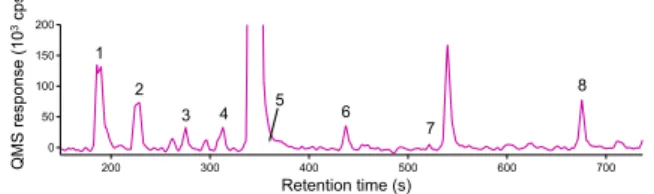
chlorohydrocarbons have been identified in some CB samples, including chloromethane, dichloromethane, trichloromethane, carbon tetrachloride [6,7,8], chlorobenzene, dichloropropane, 1,1- and 1,2-dichlorobutane and possibly 1,2-dichlorethane (Fig. 1). Although the chlorine in these compounds is believed to come from a martian oxychlorine phase [6,7], the origin of the primary carbon source requires additional investigation.
Fig. 1: Gas chromatogram of the CB-3 sample. 1: chloromethane, 2: dichloromethane, 3: trichloromethane, 4: carbon tetrachloride, 5: dichloroethane, 6: dichloropropane, 7: dichlorobutane, 8: chlorobenzene
It is known from laboratory experiments that the pyrolysis of MTBSTFA in the presence of Ca- and Mg-perchlorates generate all the four types of chloromethanes, and that at least part of these compounds detected in SAM derives from this reaction
200 150 100 50 0 x1 0 3 700 600 500 400 300 200 s Q MS re sp on se (1 0 3 cp s) Retention time (s) 1 2 3 4 5 6 7 8 2796.pdf 45th Lunar and Planetary Science Conference (2014)
[6]. It is notably the case for the RN samples, where the primary source of carbon for the chloromethanes has been argued to be terrestrial in origin [6,8]. Strategies have been successfully developed to reduce the MTBSTFA source in the CB-5, CB-6 triple portion and CB-6-residue runs (i.e. the CB-6 sample reheated under the same conditions as CB-6) and the MTBSTFA reduction offered additional insights to the origin of the chloromethane carbon. Indeed, the estimated initial amount of MTBSTFA carbon displayed a decreasing trend from CB-3 (0.032 ± 0.006 nmol of MTBSTFA C; no cup preheating) to CB-5 (0.018 ± 0.004 nmol of MTBSTFA C; cup preheated to ~335ºC) to CB-6 (0.009 ± 0.002 nmol of MTBSTFA C; cup preheated to ~390ºC). This decreasing trend is also observed for chloromethane and dichloromethane abundances measured by GCMS (Fig. 2), thus confirming MTBSTFA as a major carbon source for these compounds. However, distinctly larger amounts of chloromethane and dichloromethane were released from the Sheepbed mudstone (JK and CB) than from RN, suggesting a possible additional martian source of carbon [7]. It is interesting to recall here that chloro- and dichloromethane were the only two chlorinated compounds detected by Viking in 1976 after thermal volatilization of surface soils by the GCMS instruments at the Viking landing sites 1 and 2, respectively [9]. The authors concluded that the trace amounts detected were likely derived from terrestrial sources, although this hypothesis has been revisited [10] and challenged [11] and a martian carbon contribution to the chloromethanes measured by Viking still cannot be ruled out. Although the amount of carbon available from MTBSTFA alone is sufficient to form all of the chloromethanes detected in the SAM experiments at CB, trichloromethane and carbon tetrachloride do not decrease with MTBSTFA reduction (Fig. 2), and are not observed in the CB-6-residue. These combined observations may indicate a non-terrestrial source of CHCl3 and CCl4.
Fig. 2: Comparative abundances of chlorine-bearing hydrocarbons in RN, JK and CB. Abundance trend between the CB-3 sample (no MTBSTFA-reduction) and CB-5 sample (MTBSTFA-reduction).
1,2-Dichloropropane (1,2-DCP), as well as 1,1- and 1,2-dichlorobutane and possibly 1,2-dichloroethane have all been identified in the CB-3 and CB-5 runs.
Given the significant reduction of volatiles present in the instrument background in the CB-5 run compared to CB-3 and the lack of these chlorinated alkanes in any of the RN runs, in the blank run or in the reheated CB-6-residue, a martian carbon source for 1,2-DCP in CB is possible. The fact that no 1,2-DCP and none of the dichlorobutane isomers are detected in the laboratory pyrolysis GCMS experiments with MTBSTFA and perchlorates, and that no C3- or C4-alkanes have been detected in similar experiments, suggests that neither MTBSTFA nor the hydrocarbon trap components are a major carbon contributor to these chlorohydrocarbons detected in CB. The tentative identification of propane in the CB-5 GCMS analysis, made difficult by its low retention time and weak mass spectrum, indicates that aliphatic hydrocarbons may be available as precursors for the 1,2-DCP detected at CB. This propane could be a fragment of a larger hydrocarbon in the CB sample itself. Laboratory experiments using SAM-like conditions show that 1,2-DCP can be formed from C3-hydrocarbons or C3-alcohols when heated in the presence of perchlorates. In addition, 1,2-DCP is a product of the pyrolysis of the Murchison meteorite organic material in the presence of perchlorates [4].
Chlorobenzene: Another paper at this conference [3]
discusses the origin(s) of chlorobenzene detected by SAM and a possible martian origin for the elevated levels of chlorobenzene detected at CB.
Conclusion: Taken together, these results indicate
that the internal SAM sources create a background that challenges the analysis of solid samples in search for organics, creating interferences between terrestrial and possible indigenous carbon sources. We have been exploring the possibility of SAM-derived C contributions to chlorohydrocarbon generation. Current observations provide no direct link between SAM internal sources and the chlorohydrocarbons detected on Mars, thus a martian organic contribution to the chloromethanes, dichloroalkanes and chlorobenzene detected at CB is possible.
References: [1] Mahaffy, P. et al. (2012) Space Sci Rev, 170, 401-478. [2] Buch, A. et al. (2014) this meeting. [3] Glavin, D. et al. (2014), this meeting. [4] Miller, K. E. et al. (2014), this meeting. [5] Miller, K. et al. (2013) 46th AGU, #1785 [6] Glavin, D. P. et al. (2013) JGR, 118, 1955-1973. [7] Ming, D. W. et al. (2013) Science, DOI: 10.1126/science.1245267. [8] Leshin L. A. et al. (2013) Science 341. [9] Biemann K. et al. (1977) JGR, 82. [10] Navarro-Gonzalez R. et al. (2010) JGR-Planets, 115. [11] Biemann K. et al. (2010) JGR-Planets, 116.
Rocknest (RN) John Klein (JK) Cumberland (CB)
Sheepbed mudstone CH3Cl% +" +" +" CH2Cl2% +" +" +" CHCl3% +" +" +" CCl4% +" +" +" C3H6Cl2% #" #" +" C6H5Cl% +" +" ++" CB-3 CB-5 2796.pdf 45th Lunar and Planetary Science Conference (2014)