AN ANALOGUE
FOR MOTOR-VEHICLE VIBRATION
by
0. Mauri I. Kurki-Suonio
B.S. in M.E. Finland's Institute of Technology
'
''
~~~~~~~1948
Submitted to the Department of Mechanical gineering
on May 16, 1952 in partial fulfillment
of the requirements for the degree of
%.
MASTER OF SCIENCE
':~>~~~~
rfromthe
Massachusetts Institute of Technology
1952
'... ,.
Signature
of
Author
...
...
.
'*
S
.
.* *
!%i:
Department of Mechanical Eagineering, May 16, 1952
/9/
Professor in Charge of Research"
Chairman of Departmental
Committee on Graduate Students ..
C,
~:
A~~~~~~~~~~~~~~~~~~~~~~~~~~~~~~~~~~~~~~~~~~~~~~~~~I
II
I i
bit,~~~~~~~~~~~~~~~~~~~~~~~~~~~~~~~~~~~~~~~~~~~~~~~~~~~~~~~~~~~~~~~~~~~~~~~~~~~~~~~~~~~~~~
O%9
OCT 7 1q52by
O. Mauri I. Eurki-Suonio
Submitted to the Department of Mechanical
Eagineering on May 16, 1952 in partial
fulfillment of the requirements for the
A motor-vehicle with its springs and pneumatic
tires forms a very complicated vibrational
system. Although
the direct mathematical solution may be obtained for
systems of one or two degrees of freedom, the problem
of the complete vehicle is best solved experimentally.
The purpose of this thesis was to design and
build a mechanical analogue for motor-vehicle vibration.
It consists of a body and two unsprung masses. The body
is suspended by springs from the two masses which in
turn are suspended by stiff springs representing the
...tires.
-: -
~~In
designing a model it is necessary to retain
certain dimensionless uantities which are determined
through the methods of dimensional analysis. The
wheel-base of the model was chosen to be approximately one
fifth of that of the average American car. The spring
and tire stiffness
and the weight distribution
may be
electro-makes use of the fact that the force opposing the motion
of a conductor in a magnetic field is proportional to
the velocity of the conductor. By changing the exciting
current in the electromagnet which produces the magnetic
field, the amount of damping may be controlled.
With a
recording device the apparatus shows the motion of the
body directly and can be conveniently used for study on
problems of motor-vehicle vibration as well as
demons-tration pmrposes.
' Thesis supervisor:
C. ayette Taylor
Title: Professor of Automotive
The writer wishes to take this opportunity to express his sincere appreciation to Professor
G. F. aylor for his constant interest, kind
encour-agement, and helpful advice throughout his
super-vision of this thesis. Other aid I am happy to
acknowledge came fram Professor J. E. Forbes. His
suggestions were an invaluable aid in designing
the electromagnetic damper. The kind interest taken
by all members of the staff of Sloan Automotive
Laboratory has done much to make this thesis both
Page
I.
Introductin ... 1II. Mathematical Consideration
.
. . . 31. The Single Mass System
...
32. The Two Mass System . . . 6
3. The Body with Distributed Mass . . . 9
4. The Complete Vehicle . . . .12
III. Similitude of Vibration Systems . . . 17
1. Dimensional Analysis
...
172. Use of Differential Equations . . . . 20
IV.
Description
of the Analogue
. . . 23
1. General . . .
.
. 232. Weight Distribution . . . 24
3. Springs . . .
..
. . . 264.
The
Driving
Mechanism
. .
. . .
..30
5. The Recording Mechanism . . . 30
V. Electromagnetic Damper . . .. . . 31
1. General Theory . . ... . . . 31
2. Design
of the Magnet
. . . ..
.34
VI. Test Results . . .
..
. . . . 42VII. Conclusion . . . . . . . . . . . . . . . 53
The purpose of a motor-vehicle suspension is
to protect the vehicle and the passengers or load from
the road shocks. The suspension problem is very important
and
it has been the subject
of extensive
research
both
in this country and Earope (References 1...10).
Dr. Haleys
thesis on vibrational characteristics of automotive
suspensions which includes a large bibliography, may be
mentiozndhere as a study made previously at Massachusetts
Institute
of Technology
Unfortunately, the motor-vehicle with its
springs and pneumatic tires forms a very complicated
system. Even when only vertical
displacements are
considered and the effect of seat cushioning is neglected,
the system still
has seven degrees of freedom.
Mr. P.E. Mercier proposed a solution for the
vibration problem of the complete vehicle in his article
on vehicle suspensions 12 He considered a system
consisting a body and four wheel masses. He assumed also some kind of interaction between different wheels,
i.e. the load of the suspension member corresponding to
one wheel caused by the motion of another.
In order to simplify the mathematical procedure
Mercier assumed complete symmuetry
of the vehicle. Further
ing that when elastic characteristics are rationally determined the required degree of damping is low. It is
true that damping has very little effect on the frequency
of the vibration. However, it significantly affects the
amplitude, especially with steady-state disturbance at
resonance frequency when damping is essential.
In this thesis the problem of vehicle vibration
is
considered using a mechanical analogue.
The
problem
has been simplified by neglecting the rotations of the
body and the two axles about the longitudinal axis of the vehicle. These motions may be studied separately.
In other words, motions are considered only in the
vertical plane parallel to the direction of travel of
the vehicle. The number of degrees of freedom is thus
reduced to
four,
namely the '"bouncing" and "pitching"
of the body and the up-and-down motions of the two
axle s.
II: MATHVL TICAL CONSIDERPTIONi 1 11. 1 1 ' II Ill~~~~~~~~~~~~~~~~~~~~~.
The Single Mass Sstem
To start with the simpldi;t
kind of vibration problem let us
consider frst
the single mass system
[ T
as shown in Fig. 1. The motion is
determined by a second order linear
'
differential
equation. By simple
calculations the complete solution
for free vibrations can always be .. - : lg:. .
found 13 and is of the form:
K,
= A, es, t * e
where
4x,
(1)
-+
and
A
1and
A
2are arbitrary
constants which depend on
the initial conditions.
The values for s can be real or complex. In the former case the motion is not vibration but an exponential
curve to the equilibrium position. The smallest amount of damping for which this occurs is
(2)
This is called the critical damping. The damping coefficient is usually expressed in fractions of the critical value.
Usinig the fact that the natural undamped frequency is
the solution of the motion can be expressed in another,
more convenient form:
x=A
e
C,
s.
(4)
The coefficient A and the phase angle
depend again on the initial conditions. The value
.~V~JL
.,
is called the
damped
natural frequency. We see that a
reasonable amount of damping has very small effect on
the natural frequency. A damping coefficient which is
half of the critical value reduces the natural frequency
only by 13.4 per cent.
The solution for a forced vibration is also
found if the forcing function (the
form
of the road
surface) and the initial conditions are knlown.A
road
surface of sinusoidal form may be defined as a function
of time thus:
x%
- ao
((-
dt tJ
5)
The initial vertical displacement and velocity of the mass are assumed to be zero. The following
expression is then found for the motion of the mass as a function of time:
A7
olA,
4>A
e
4 O.' (6)where the coefficients
A
1and A
2and the phase angles
,and O
are functions of damping ratio and frequency
ratio:+~~~~
A,
_~
+
_
¢./Xtcj
r~,~'(Q,:"/:~' 2 %. ( L%~-.)."3'1,)=
2..-
-
2T>.t- L,,.
c/~3
1 . _..The motion is described by three terms, namely
a constant, a sinusoidal term varying at the forcing
frequency of the system. The third tenm decreases ver
rapidly and some time after the disturbance has begun the system is said to be in steady-state vibration, because the motion is purely periodic. Coefficient A1
is the ratio of the amplitude of the motion to the amplitude of the road surface. If it is plotted as function of frequency ratio for different damping ratios the well-known chart of Fig. 2 is obtained.
The Two Mass System
For the two mass system
with the notations of Fig. the differential equations are:
Fig. 5
rn,,,c(?,,-,.)
+ ,Cx,-:)-
mr,
c4-,) +
k x
-x.
x
0x-
(8)
The natural undamped frequencies of the system
are ound to be the roots of the equation 14
whioh
ar+
+~~~~
+
k
which are:
<
~ ~
~~.
.Hat
_
I r= .'+Cb
-
-tt
21 03.
3.0
}k
2.0
!s i I .t,0
, . ' I I - - ~ I . .. ..
2.o i tL
, .. .,n
For the motor-vehicle k>k and ml$ m2. Then
the natural frequencies are approximately:
;;L
ap
=
k' t
i
1(10)
Assuming again a road surface of the form:
and that the initial displacements and velocities are zero, the method of Laplace transform 15 can be applied for solving the problem. The Laplace transforms of x and x2 are found to be:
X -_""" -t. .C -. , k*
_
~~a.4
4
)t~
Kn(
f(PI'+P +
)P(3
+^J<
4- CkZ+AdL,
For the inverse transform it is necessary to find the roots of the fourth order polynomial in the denominator. If the system is oscillatory the roots are all complex and of the form:
p
_ r
!
+
i< 3It is possible to find these roots if the
numerical values of the coefficients are given. Dr. Haley
The general solution as algebraic function of the coefficients is not obtainable as in the case of one degree of freedom.
The steady-state
solution may be obtained
quite
easily
in terms of the parameters of the system
without evaluation
of the roots
of
the fourth
order
polynomial. This is accomplished by assuming that the
solutions are of the form:
XI
Ate
X=
'
l(12)
If these are substituted into (8) and the equations are solved for and x2, the amplitude
ratios are found to be:
1'1 = 0 iXt.. 0
{kik At
.Qt
Z~
a . - I $ . ^ - , 1. ?3
IL+I& k4
ao
It 1-4
+ ( kz Adk 1-
/. W 4- la.j 1cW_ (13) .i I (kxlteI ih .. . . _ . LJ
.kI
ka,
JLfThe first part of the denominator is the same
as
the equation for determining the natural frequencies.
This is clear because without dmping the amplitude goes to infinity if the forcing frequency is the same as the
natural frequency of the system.
I
z i
11 I
The Bdy with Distributed Mass
As next step let us consider a body with distributed mass ad two parallel springs. This is
also a system of two degrees of freedom.
Fig. 4.
With the notations of Fig. 4 the differential
equations of the system are:
t r
..
m
- 2.- A
X
,
~t*, XI
*em "~L
j, = c
(14)
.1h 4rL
..
" It
n
rx
ry,',
.t
=-The natural undamped frequencies are the roots of the equation:
L4 c,."+ r k, .rL)L + + L k tC.,
(15)
A particularly interesting case occurs when
the ratio I S., i2. a II a z6
which is called the mass coupling, is zero. Then the set of differential equations (14) reduces to two separate equations and the mnotions of and 2 are independent of each other. The natural frequencies are then simply:
(16)
Another exception is the case hen
i~~~~~~~
or spring constants are proportional to the wheel
loadings. This means that the taticdeflections in
front and rear are equal. Then the natural motions are
pure up and down motions parallel to itself
and rocking
about the center of gravity. The natural frequencies
of these motions are:
!~~~~~
tA
(17)
*~~~~~~~~~A
-i,
,+ ka.L,6
If mass coupling is also zero these frequencies
are equal.
Let us assume that the initial
displacements
and velocities are zero and the exciting motion under the
wheel 1 has the same form as previously:
The Laplace transformsi of the motions are:
X,(?) =
X"(,P) =
1
2.WL
L4Ia'
t(
-)(
4
jL
+7
where the constants a
1
. ... a
7
are:
Ikcg t*+ r c , k-
*
--CZ, -2c, 4,x 27 = Mr a = C' if?. jV# I i tL- *¢,
I+ r%
,,,&.
c, C. l, X. ~, t,2+r ~For the inverse transform the roots of the
fourth order polynomial in the denominator are required.
The amplitudes for steadystate
bration are found
without evaluation of the roots through a method
used previously for the two mass system and they are:
Xs
[-
0(alq)
(a\
*g)Aawhr
7)
t4lagt
L(Q+
*)
_ tf~~~~~~~~~~~~~~ae
jx
J
(18)
1L-%
( L
I WA S4 'S - % 4n,74j +
I .
B
Os j
r -&
14 11 1W, I-k
a7 IL 4-I
.0
-a EM I- 4,) a to' 2. -L 19)IThe omplete Vehicle
Fig. 5.
The vibrational system of the complete vehicle as chosen for this study is shown in Fig. 5. It is a
combination of the two previous cases and has four
degrees of freedom. The following coordinates are used: x = rise of the body at center of gravity
= rotation of the body about center of
gravity (positive counterclockwise)
x rise of the body at wheel 1
x = t "it t 2
terms of
U = " of the mass m
4=
" " m2X$ = " of the ground under wheel 1'
x
=
"
"
"
2
The coordinates x and '7 can be expressed in
x
1and x2:
L5t
4-~~~A
Let
1and F
2be the algebraic sum of the
spring and damping
forces at front and rear respectively.
From the balance of forces and moments acting on the
body
we get:
- M + +
2s
-Mrz8
+
-
(21)
Substituting the values for x and from (20)and the values for F1 and F2:
P =- c, (,
-Z)
-k,
,-
X)
(22)
F
2.
C =4
-)) 2 2 Xawe get the differential equations for the motion of the
body:
M
Z~
3
*
'
M
--
x,
c,
,-~), k,cx,x1
+
o
(23)
\
jxs ,-
+
C (%-
k,4)
+ kiL,^
The differential equations for the unsprung masses are found to be:
nM
, .-
(k,
)-x ,-i
x)
x2-
X
-(24)
Let
us consider a sinusoidal forcing function
which hits the rear wheel
/
v.
later than the front
wheel:
X -
I
(*j
& o,
Ij
(i-
(25)
If all the velocities and displacements are
zero for t=O, the Laplace transforms of the equations
(23) and (24) are:
M
t+ rX-t *
rZ
M
'- L LM L-' --y--F.A
L . - r .+
r
k3 x ak a +
(26)
Jp2g. .m (F Fx-.:/iAfter elimination of 23and
i4:
P 4 ,. X + I
L4~
i l' L~~~~~10_,@-+ rt
P3f(
f
k
!
,L
j
-'
*tm
1,, jLj P
'K
P~,
F411
~
A I
=- C2. + "7t ,/-kF
4-I!pE*.
J,1jpL
+ G -t wq LsV
t
-L+ rL ! La,o
FL+
TW40 f(27)
r4
4. ,.r ,> C * FF3
Lt
+xF
(. e 7, + rr~rr~-Up - IU j.l 'A j= a ( -E~
fC~pl~l-j4-) Uk - :Wa " C k i L i el F k fmf Q, jThese equations can be solved for
1by the use of determinants. The denoininator ill be:
4-.
1
+
c
,)
where the coefficients are:
I
4',
A,
k~L
7 =
( A It. '-
t 2-j
+'
A
,kt&
'O,~
t/ ,4 _-raX
._ a.i. 'y
g J-AL k + )
+
A.
I&4
.
f
ic
)"# 2k
4.L'i rbi *-C Cx I. en , ;6,i J
4- (A1; ;,Y
- w tV
K
+ -z ( . 'I ,+ L-Al = A. k MkA,
5 ,
%.,
I
.-
V'
1s,;+ .t)1~v '
2. MAC. ik AIA
}
A r, ¥"v111.~C =A t C., !^t- kA 1 t ) A M. . __ t~~~~rb a-s F-t 'It m -,M I' + C - .' W. *M . A - fa , I~ ` s . '--'k = -~it
j
A t = It
,., - -1.% anu x2(28;
_ -- (t , C, 'C A-2 X.. =~
~x
+ 51 Ssk.3,~.~A~4 i&
)
%.,
* k'
~~
1
-
t --
+ -k-%
i, f-4 Lzk S t 11 W.A W.% -* kA ' -1--l"S -- ") M .,, -4. (A\ +' -2.- (A -,..
R) K.
_4 .4- X 4 PR '. l.A~t
ILFQT
inverse transform it is necessary to find
the roots of the eighth order polynomial in p. If thenumerical values of the coefficients are known, the roots
can be found using-Graeffe 's method 16, but it is quite
too laborous for any practical purposes. Therefore the
mathematical solution of the vibration problem of
the
vehicle is not btainable. The only way to find the
III. SIMILITUDE OF VIBRATION SYSTEMS
Dimensional
Anysi
Dimensional analysis treats the general forms
of equations that describe natural phenomena. Applications
of dimensional analysis abound in nearly all fields of
engineering, particularly in fluid mechanics and
heat-transfer theory 17. If experimental methods are to be
applied the scope of the results can frequently be
increased through the use of dimensional analysis.
In designing a model of a vibrating system it is necessary
to retain certain dimensionless
quantities just as in any
other model making.
The procedure in the application of dimensional
analysis is first to list the various fundamental physical
factors or dimensions
which
enter into the problem. These
quantities
can be determined by examining the differential
equations of the simpler problems. These and their
fundamental units are:
1.
Mass
-
s-
W/g
FT2/L
2. Spring constant -k
F/L3. Damping constant
-
c
FT/L
4. Natural frequency -
1/T
5.
Forced frequency -
1/T
6. Displacement
-
x
L
7.
heelbase
-
i
L
8. Moment of inertia - I FT2LThe time might be considered but it does not seem necessary because it is the reciprocal of the frequency. The force does not enter in because except inertia, spring, and damping forces no external forces are acting in the system.
The terms involve three fundamental units,
F, T, and . The number of 7r functions that may be
determined is the number of factors (8) minus the number
of fudmental units (3), or five yt functions. Among tha variables listed three are selected which contain
all three of the fundamental dimensions among them.
These are the mass, the wheelbase, and the natural
frequency. These are set down vwith one of the other
variables written after them. If
,
/,
and
t
are arbitrary
powers to be
assigned
to the three
quantities selected, then the dimensional equations
can be written as:
r.
"
rr,
4'tm
(<~
±~1
QL
I":, ,FT.
L..r
J3t a)T"
r (29)T(29)
"r
i
>,*/
i")4~
_
,
...
i
J77 ; Ai 43lj_~ _ ok 1· a STTThe sum of the exponents for each of the
fundamental units must be zero. Therefore for
rT,:
C'(1- + I (Powers of force, F)
(Powers of time, T)
- <( +- ,(j = (Powers of Length, L)
When these equations are solved simultaneuusly the values of the exponents are:
Aq = -I
t =
so that the first imensionless fnction is
so that the first dimensionless function
YA
is
The remaining functions may be evaluated in
a like manner:
C I-3
e
(1'Al 4.. /( = .t i
aIf these five dimensionless quantities for one system are equal to the respective quantities of another
Use of Differential Equations
For the complete vehicle which has three
masses, four different spring constants,
and
two
damping constants, the dimensional analysis approach
is not sufficient. More definite method is changing
variables in the differential equations todimension-less form.
The differential
equations for the complete
vehicle are, combining (23), (24), and (25):
-. + X i, I - .
Zz.l
7 .X +a+M*TL A
-
+
..;^-+x)
4
k
,t
-X E
(30)
lh, <Xg - $ jY,- tj~ k, X -t Ck,+ z 3 '
,
+) C-If a change of variables is made using
(31)
When the dimensionless terms are differentiated, the results are:
L l = A__T
'~
,)
-z^_t
S ='g
£ : J._T'These derivatives are substituted in the
original equations:2""+ +, L
g W
tl
L&{c-xzK
+ M
I
"T Y4)Ar
z-4
-H. 1 Luf ~ u(32)
t",t:-
r r~~~~~~lrI
rrr~~~A;*(X-i)_
<sc<
(k
1
.k
4
OtL
k
.L-.(w&-i7
Uiw-
Since X and T are dimensionless, their
derivatives are dimensionless. If each equation is
divided
by
the
coefficient
of the second derivative,
it makes all terms dimensionless:
.... _ (.C
L
_ tz
j/.
,, &(3y) XEl ,+ ( r 1,
.kkt
<A ,
W3
1---
- ,
-I~r, A tn
)13
-- -
L
- , - - -/ A : . k* + WCIf these quantities are equal in two systems
also their ratios are equal. This way following quantities
may be determined:
, ',
L2 '
The
final conditions that two vibration systems
are- similar, are that following dimensionless constants
in one system are equal to corresponding constants in
another system:
- Weight
distribution
2.
r,%,
.3.
c, L5.
~ '2oi
6. o!,
L
7.
8.&, B
9. a.
10.
!&j
-
Mass coupling
-
Relative damping
- Static deflection
-
Spring coupling
- Damping coupling- Relative weight of unsprung mass
- Relative tire stiffness
- Amplitude/wheelbase ratio,
- Frequency ratio
- The ratio of driving speed to
the product of natural frequency
and the wheelbase
1*. l/?
IV. DESCRIPTION OF THE ANALOGUE
General
The main purpose of the analogue was the use
for demonstration of vibrational characteristics of the
motor-vehicle. It was therefore quite natural to think it first as a small-scale model of the actual vehicleas shown in Fig. 7,
using compressxon
springs in the place
of springs and tires. However, the guidance
needed in this type
of roalab wrOlA
involve too much friction and the application of road
disturbance would not be convenient.
For smaller friction and easier guidance the
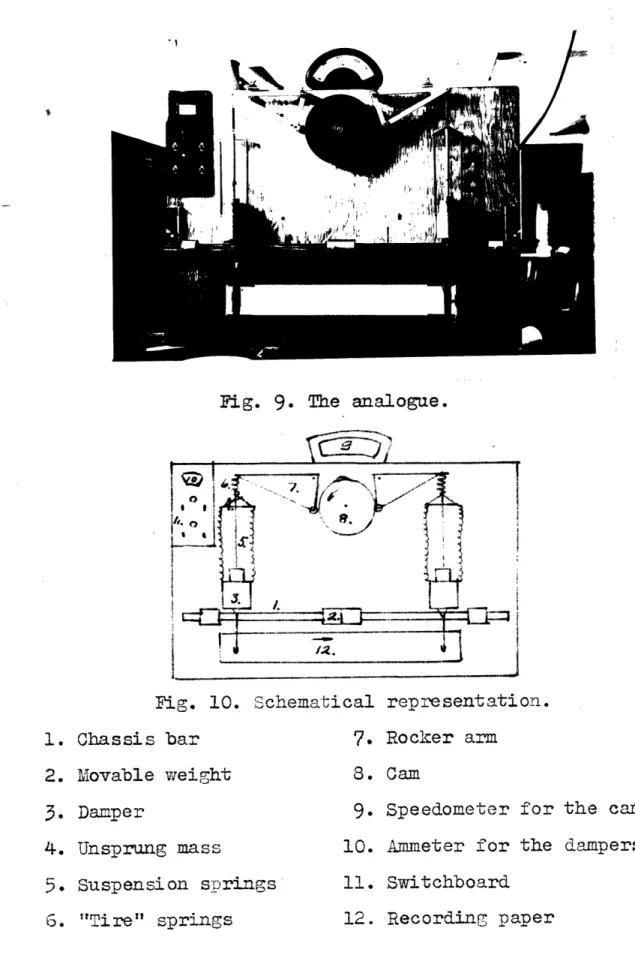
whole system was turned upside down as shown in Fig. 8.
Altnougn a alttle
more imagination isneeded in order to
understand that this
represent an
auto-mobile, it was found
very succesful. Fig. 8.
----No guides are needed to prevent other than vertical motions because the system is always stabile in the field of gravity. The friction is thus reduced to a
minimum. Further the road disturbance is easily
rep-resented by a single rotating
cam
which
affects
both
front and rear wheels through rocker arms.
Weight Distribution
The wheelbase of
the
analogue was chosen to
be
24 inches which is approximately one fifth of
the
wheelbase of the average American car. The weight ofthe analogue does not need to be proportional to the
third power of the linear ratio as for some other models,
because the laws of similitude do not include any
relation between the mass and the legth in this case.
It was desired to have a large range of weight
distribution.
Therefore the "chassis" was made of
l"
duralumium bar, 40" long, which weighed only 1.01 lb.
Four movable steel weights were made weighing 1.10 lb
each. The heaviest part of the analogue are the
electro-magnetic dampers which will be described later.
They
weigh
3.38
lb
each.
The weight of the whole body is
Chassis 1 x 1.01 lb = 1.01 lb
Weights
4 x
1.10
"
4.40
Dampers 2 x 3.38 t = 6.76" 12.17 lbi
----The moment of inertia of the chassis and the
dampers is:
vL" t.olh4oL _
= Ix
l I 'fL 7 lb,"I
0
Ibb-iJ1'The variation in the
moment
of the inertia is
due to the change of position
of the
weights.
The
minimum
is obtained when all four wights are in the center of the
bar, and the maximam when they are at both ends of the bar:
J.,J
=
4.
.
I.os
Ib...
The minimum
and the mmm
radii of gyration
of the body are:
r/
r,
'lo+ is-as
rV
=
.j
_.
p.
The minimum and the maximum mass coupling at
symmetrical weight distribution
are:
r',;t
I1.
'
'
_____
-
/- = AZ.to x J-ai '
The mass coupling can be varied in larger range
than in actual vehicle. In order to get zero mass coupling
(r2/1, - 1) at symmetrical weight distribution the
moment of inertia must be equal to the mass multiplied
by square of the half of the wheelbase:
_Ti ma be otn= h Ib .17 a
This may be obtained so that two weights are
left
in the center and two are put 17.075" from the center. This
distance is marked on the bar as well as the center for
easier weight installation.
Springs
Because of the large
size of the damper
it
was
found more convenient to use a set of two parallel springs
between the body and the unsprung masses instead of a
single spring.
n. ,l-
' P:'-nn, -'H_ . 4,'-'P'iI -enlrr.
w
t~'i'h+tdistributions a large number of springs of different rates was needed. The maxmum and minimum spring loads
which were half of corresponding
axle
loads,
were
estim-ated 4 lb and 2 lb. The static deflections between 4 in.
and 8 in. were desired corresponding the frequencies
94...66 cycles per minute. The maximum
and minimum spring
rates were then found:
- - -I
... . .. . . -. - . -.- .. . - --- - -L.-L~L YUL~-LI
k
- = I /.kis
; _
-
8
.
,5
Ib/n.
Etension type springs were ordered from
Hardware Products Company, Boston'. These are made of
high quality spring steel and have initial tension
which makes the actual static deflection smaller than
what is the effective deflection. A table of these
springs and their properties is given below.
Outside diameter in.
3/8
1/2
Wire diameter
in.
w 031 047 062 047 062 094
Max. load lb.
4-2
15.
35.
11.
25.
85.
Max.
extension
in.
3.4 1.2
.7
2.4 1.2
4
i
Initial tension lb.
.9
3.0 7.0j 2.2 5.0 17.
Spring rate lb/in.
1.0
9.6 43. 3.7 16. 153
_ _ _ _ _ ~ ~~~~~~~~~~~~~~~~ _ _
The figures for maximum
extension and spring
rate are for springs one inch long. The maximum
load
and initial tension remain constant for any length.
In order to keep the weight and the free length
of the springs as small as possible the suspension springs
were made 3/8" outside diameter .031" wire diameter.
The maximum
load for this spring is just above the
maximum required.
For "tire" spring the load varies between 4
and 8 lb. Statie
deflections
from .8" to
'.4"
were
wanted
because
the
natural frequency of tires is approximately
ten times that of the suspension springs. Spring rates are then:
=
8
=
o
Ib/,
kM;^
=
i -4
A
=
-
.-A set of springs of seven different lengths
were ordered for both purposes. All springs were
care-fully tested and the actual spring rates are listed below:
Suspension springs
3/8
x
.031
V Rate 5 Leength I 1" 3/2" Rate i 1.26.833
Tire springs
3/8
x .47
Length
4 tt Vt'1"
i-t '.
' J
/-/
5".410
.
,I
3 .410 1 lAtt Rate13.8
10.0
q_ LLR i . 9 1 6.90 .5345 i a 6.13 i 41" .298 2' 5.25 1, I 2" .605 424" -LL C _rr~-RD--a~lu~nu.·urw_.S vrrnr·~~rl r _ ._~~~~~~~~~I Pn-nD----,.-- imFig. 9. The analogue.
:z
I?
\
fz
Fig. 10. Schema-tical 1. Chassis bar 7. 2. Movable weight 8. 3. Damper 9. 4. Unsprung mass 10. 5 . Suspension springs 11. "T. "Tire" springs 12.repre sent ation. Rocker arm
Cam
Speedometer for the cam
Ammeter for the dampers Switchboard Recording paper L
- 1
I_ __I __I I I I I I I I i I I II I I I I IThe Driving Mechanism
For driving the cam which produces the road shocks a variable speed electric motor is used. Through a reduction gear the speed scale is O...400 rpm, but
30 rpm is practically the lowest speed possible. The relation between the cam rpm and the vehicle speed in mph whish has to be represented, may be found through following reasoning. During one half of cam revolution the analogue "travels" a distance equal to the wheelbase. At n rpm the distance traveled in one hour is
60 x
n 21
If the wheelbase is measured in feet, rpm
scale must be multiplied
by
120O
d=
.0227"1
in order to convert the speed into mph. For an average car of 10 feet wheelbase this coefficient is .227.
The Recording Mechanism
For measuring the amplitude of the motion a
recording mechanism is provided which uses regular 3"
iade adding machine tape. The tape is driven by an
electric
motor through a three-speed gearbox. The speeds
for the tape are .3",
1.0",
and 5.0" per second.
_~~~~~~~~~~~~~~~~~~~~~--v. ELECTROmGNETIC DAiPER
General Theory
If a conductor moves in a magnetic field an
electromotive force is induced in the conductor. The
electromotive force causes a current which in turn causes a force opposing the motion of the conductor.
The force is proportional to the magnetic flux density
and the relative
velocity
of
the
conductor
with
respect
to the field.
This phenominon occurs in so called
eddy-current brakes used in laboratories to measure the
mechanical output of a motor. It may be succesfully
applied to represent an automotive shock absorber. It is ideal for this purpose because the damping is linear,
i.e. proportional to the first power of the velocity.
In a fluid dashpot there is always in addition to the
linear viscous damping more or less hydrodynamic damping
which is proportional to the square of the velocity.
Tiner ,m1in"
__i
irtla.l not
---nnl
-dfn-r the simnlicity
-- _ - Jof
--mathematical treatment but also from comfort standpoint.
The control of an electromagnetic
damper is
also easier than in a fluid damper.
This
is accomplished
by changing the exciting current in the electromagnet.
The only drawback is considerably heavier eight.
It was figured,
however, that even when one half of the
weight
of the body would be concentrated at the places of
spring attachment in form of dampers, the desired range
of weight distribtuion
would still
be obtained by
using
light aluminium
bar for chassis and heavier movable weights.
This
gave
for
each damper an approximate weight of three
pounds.
In order to use the material most efficiently a round magnet as shown in Fig. 11, was suggested.
A cylinder of non-magnetic
material of high conductivity
moves up and down in the
circular
air gap. The magnet
i
o 4" o 4 9 M o -- - - -- I --na
s o
e aacnea
o
une
body and the moving cylinder
to the axle mass. Otherwise
tne unsprung mass would
become too large.
Fig. ll.
If the cylinder moves with a velocity v in
a magnetic field which has flux density B, the
electro-- . . .1
-QVlyO`ube
IO=f1TlaU71
n
1,11U
U
1US:(34)
it
E
=4~
2 2
t </ X
,
(34)
- = .5-~~~~~~~~~~~~~~~~_
u-i-;--- c--u-- -- r-- -Llrr
-The resistance of the piece of the cylinder
in
the air gap is in ohms:
- = (35)
where
~
is the resistivity
of the material (
for
copper
V =
6.79 x
10-7ohm
in.)
and b and
are the dimensions
of the cross section of the air gap. Electric current in
the cylinder is the electromotive force divided byy the resistance:
E -- = -
--I
=tIO
(36)
The force which opposes the motion of the cylinder is proportional to the current, flux density, and the legth of the conductor:
F =
f
I ld,,,
3
(37)
f is proportionality factor which das the value one when force is measured in newtons, flux density in webers/m2, current in amperes, and the length in meters. If the English system is used has to be calculated:
1 newton = .224 lb
i
weber/m
2= 64500 lines/sq.in.
1 meter = 39.37 in.
.22500 x
597
8.83 x 10- 8By substituting the expression for current (36)
into (37) and using the Eglish units we get:
F
-
8.83
o
-
Lb
(38)
The damping coefficient is equal to the force divided by the velocity:
F
-c8.t3A
b 4
Tdn
(39)
Where: c = damping coefficient (lb.sec/in. )
q
resistivity of the material (ohm in.)
B flux density (lines/sq.in.)
b
=
height of the air gap (in.)
=
length of the air gap (in.)
$d mean diameter of the air gap (in.)
Design of the Magnet
If certain damping coefficient is desired, the
flux density required in the air gap is found from (39):
73z
/
C-(40)
If leakage is neglected the total flux in the air gap is equal to the flux in the core
A4B,
=-Ac
(41)
from which:
(42)
35
In order to reduce the number of variables in
the expression for Ba (40) the following step is made:
M
=
_
4
X(43)
B)a 8.3$.Io'0 J d ; E
Magnetic field intensity in the air gap is
fK
, ,,
~
(44)
where io 0 is the permeability of free space. If Ba is
measured in liner/sq.in. and Ea in amp.turns/in. then
it has the value
)l
3.192
The magnetomotive force reqired is
F,.i -
, ,.
c
., -
14
(45)
where is the path of the lines in the core. In the
first approximation the path from the inner core to the
outer core may be neglected. If the height of the core
is h and the value for
K
ais substituted:
= _.,,.-"
(46)
o
aci
4
tI 2
(U)
The cross sectional area available for the coil:
A
5
Y
h
( -
-6
)(47)
The number of ampere turns which can be safely
used is:
N
I
=
C A
C
h (dm
-
di
-
)
(48)
-Cs is the safety carrying capasity of the wire
For small size ire in confined spaces it is approximate:
Cs = 2000 amp/sg.in.
The magnetomotive force is equal to the number of ampereturns:
A4C
, )LV L - L j . _,
ly:
j.AI, aI0 - '"*T. y r . ' M -- n -c-,
-
(49)8.1 1- 4)"O
Ir Al
L
t~,from which h may solved:
4 qc,
f
rewFor certain value of core diameter this
expression has a minimum. This is found by differentiating
(50) with respect to
di
and setting that equal to zero.
The optimum core diameter will be:
(51)
The magnetizing curve for cold rolled steel is shown in Fig. 1218In order to use the material efficiently
rather high flux density is desired. Corresponding
to the
assumed
maximum
flux density 120 kilolines/sq.in. the
maximum
field intensity is found by interpolation:
gK - 300 amp.tumns/in.
The length of the air gap was assumed 3/32"
and the mean diameter 2" because this size of copper tube
for the damper cylinder was available. The optimum core
diameter can then be calculated:
C 0c C ac, c c :3 0 E <c IC o C .C
-: o
C Nc Q
L left OQ c Cc
o
C 0a
c
Cs ct c 0 CI L - * -m300
3
-
0.875
in.
Corresponding value for h is found from eq.(51)
h
2.86 in.
Because in calculation of the lenugth of the path in the core the horizontal part was neglected the
total
height of the magnet was designed
2SL".
The
height
of the air gap was assumed /4".
The magnetizing curve for the magnet can be
plotted
be means of Fig. 12 and equation (45) which is
after necessary calculations:
Fm 11.25 Bc + 57 2
K
c(52)
The damping coefficient c may be determined
as
function
of magnetomotive
force
by using equation
(39)
which is after calculations:(B
c
in kilolines/sq.in.)
c = .187 (B /100)2
c(53)
The calculated values for Fm and c are in the
table below and the damping coefficient vs. magnetomotive
force is plotted in Fig. 13.
Fm
ki lolines/in amp. turns/in amp. turns
20 40
60
70
80
90
100
110120
4
69
12
16
23
40
100 300248
484
727
356
992
1145
1354
1810 3066 C lb. sec/in. .0075.0300
.0673 .0916.1196
.1514 .1870.2265
.2690 -l ;:,q)a CL 3 .) o
u
-r A v aA._
> Irj_ _ m Ed W :> -AL
E Ca
0 0 c C C C. 0 Cr
I-.0 I, 10.0
to 0~C I j i i I II I i i I I I 11"I iI I I I i I I i I I i i i i I I i i I I Ii . _ _ ~m C [SPThe critical damping coefficient for average
axle load (6 lb.) and spring rate (1 lb/in.) of the
analogue is
The number of ampere turns which gives this amount of damping is 2600 according to Fig. 13.
For coil it was suggested to use wire No 20, which specifications are 19:
Diameter 31.96 mils Area 1096 circ.mils
Resi stance 0.672 ohm/in3
The volume of the
coil is (Fig. 14):
v-J i = 5.1
in
.,
Resistance:
k
= 5
^.t
0. ,'7 =
S
.2z-3Z• ,
Fig. 14.
When the coil was made there were 14 layers,
55
turns
in
each, which means 770 turns total.
In order
to obtain critical damping coefficient the current must be:
I
2600
6= 3.
38A
N
77o
The voltage required is:
E = R I = 3.425 3.38 = 11.6 V
The maximum current is a little high for safety
carrying capasity of the rire. The cross section of the
I -. 11 71 l
-I
wire is only 292 circular mils per ampere when at least
500 is recommended in Radio Engineers Handbook. Because
the maximum
current is used only for short periods, this
considered satisfactory. It was found that it did not
cause any damage even when the maximum current was left
on for several minutes.
In order to keep friction as small as possible only one wire was connected to each damper. The other terminal is connected to "ground" where the current is
1
t 'n A +4iro Is -nr r r; ncl w"1 r. n n- ^ 1 rr ^ ^I' C D4S -nXc s C;CLVL W44L6w 5"UF++ LL":; U APEX LWU LUV'UO L-=
used for controlling the current, one for the total
current
and
another for the ratio between the dampers.
The wiring diagram of the damping system is shown in Fig.15.
I i kI
I~~~~~~~~
ie
I
VI. TEST RESULTS
For using the analogue it is necessary to find
the relation between exciting current and damping
coef-ficient. The direct measuring of the damping force is
difficult
but
it can be conveniently
determined by
examining free or steady-state vibrations.
Free Vibrations
The rate of diminishing of free vibrations depends on the damping. The relation is shown in Fig. 16 where the ratio of successive half-cycle amplitudes is plotted against relative damping coefficient 20
It was found that after turning off the exciting
current the remaining magnetism in the magnet caused a
small
amount
of damping. To eliminate this the first run
was made without copper cylinder in the air gap. There
was still
some dry friction
left due to the recorder pens
but it is so small it can be neglected. The first two
nns were made at low recorder speed (.3 in./sec.) but later only the intermediate speed (1.0 in./sec.) was used, because this made dry friction even for up anddow stroke.
The
vibration curves, test data are given
Fig.I. Roch'o of successive half-cycle
amplitudes
cI
free vibraionvs. darmpin J rafro o0. & A. A I V.V I .xn.l 9.0 S.0 7.0 b.0 I.
4.0
2.o AtI -MO3 u C U. o 0.4 d0.1! 1 i . a i I I
Run 4.
I
0.25 A
/xni+a
k
=
1.35
C/C = 0.095
Run 5 I = 0.5 Axn/xn+
=
1.8
C/C
=0.185
Run 6I = 0.75A
xn/xn+ = 2.5C/C = 0.28
C7 IX IC _ III Ran 12 i I = 3.4 A
C/Cc
=0.47
•-I
Forced Vibrations
The damping coefficient can be determined also by using forced vibrations. Some time after the forced
vibration has started the transient term dies out and
only the steady-state part is left. The test is best
done at resonance frequency because the amplitude
variation for different damping
coefficients is then
largest. The ratio of steady-state amplitude to the
forcing amplitude is plotted against the relative
damping coefficient for Co -W, in Fig. 26.
The forcing function was provided by a single
exentric cam which produced a bump 1/6" high. At the
end of the rocker arms the displacement will be twice
as much, i.e.
1/3".
A symmetric weight distribution
with zero mass coupling was used for these tests as
well as for free vibrations. The spring coefficients
for tires and suspension springs were 6.9 lb/in and
.82 lb/in respectively. The critical damping ratio
is then
9 2-% 4,9 12.17
C
N
2
.- 2
2
= .2/A
In Fig. 33 the relative damping ratio is
plotted against the exciting current. The test results
coinside reasonably well. The
absolute
damping
coefficient
is
shown in Fig. 34 as function of
Fig36. Amplifude ratio vs. darnpinj
ratio
or
forced vibration
el resonQnce freLencn.
1.00.
35
tc/ 0. (
g.c 8.0 7.0I.0
4.0 2.0 0.Z O.A/, I , r I i I i ! ?2 i I l i f ii IC I{ Ji o Run 13. I = 0.25 A, C/C = 0.08 C d ' id i r -1 .. i i' : / 18 I p w
Run 14. I = 0.5 A, C/% = 0.175
Run 15. I = 0.75 A, C/C = 0.28 B - i-i 7 k9 fI i i , I~S~ ii I a I i~~~~~~~i I I O.,...~~~~~~~~~~~~~~~~~~~~~~~~~~
1>
=
.
.
/0
A.
.
0 / Run. 16. I = 1.0 A, C/Co, =0035
/ I x / I II \ , , . . Run 17. I = 1.3 A, C/Ce = 0.40 I I / / · , a / i, I % I E , O I ' I Run 18. I 1.7 A, C/Co = 0.45 Run 19. I 2.4 A, C/C 0.50 Run 20. I i- 3.4 A, C/C 0.55 . e . ...o
l,, Cr, .C0
I
L c%dI .*0t·
I
u-vLLL1 1-t (\
N
N'
k
b o
C C, \
·I-. %._C
t.
. _ ":s V V. ar . E ;a
9
6i U-64 c~tJ C ajc*
Cc
ic
c
VII. CONCLUSION
If the experimental curve for damping
coefficient is compared to the theoretical one (Fig.13)
it pca be seen that the both curves have same shape.
Because of the remaining magnetism the actual curve
is
moved
a little to the left. Although the critical
damping was not obtained as calculated, the range of
damping is large enough for most purposes.
Vibrational systems may be represented also
by electrical analogies because the electrical and
the mechanical systems have same form in their
21.
differential equations . However, an electrical
analogue would not be so clear and descriptive as
the analogue designed. With the recording device it shows the motion of the body directly and can be
conveniently used for study on problems of
BIBLIOGRAPHY
1. McCain, G,L. - Dynamics of Modern Automobile
-SAE Journal 1934, pp. 248 - 56.
2. O'Connor, B.E. - Damping in Suspensions
-SAE Journal 1946, August.
3. Tea, C.A. - Secondary Vibrations in Front End Suspensions - SAE Journal 1950, pp. 55-60. 4. Polhemus, V.D. - Secondary Vibrations in Rear
Suspensions - SAE Journal, July 1950, pp.41-47
5. Cain, B.S. - Vibration of ail and Road Vehicles
-6. Rausch, E. - Schwingungen von Kraftfahrzeugen
-ATZ 1955, pp. 580 - 6.
7. Wedemeyer, E.A. - Fahrzeugfederung - ATZ 1935, pp 272.
8. Lehr,
E.
- Die Berechnung der Kraftwagenfederung auf
Scwwingungtechnischer Grundlage - ATZ
1937,
p. 401.
9. Marquard,
E.
- Zur Schwingungslehre der
Kraftfahrzeug-federung - ATZ 1936, pp. 352-61.
10. Marquard, E. - Untersuchung der Federungseigenschaften
von Kraftwagen an Modellen - ATZ 1937, p'. 435.
11. Haley, H.P. - Vibrational Characteristics ofAutomotive Suspensions - M.I.T. Thesis 1938. 12. Mercier, P.E. - Vehicle Suspensions - Automobile
Engineer
1942, pp 405-10.
13. DenHartog, J.P. - Mechanical Vibrations.
14. Freberg - emler - Elements of Mechanical Vibrations 15. Hildebrand, F.B. - Advanced Calculus for Engineers
16. Doherty - Keller - Mathematics of hModern Engineering
17. Langhaar, H.L. - Dimensional Analysis and Theory of
Models.
18. Magnetic Circuits and Transformers - 7I.I.T.Staff
Bibliography (cont 'd)
20. Lehr, E. - Schwingungtechnik
21. Alexander, S. N. - A Method of Solution for Vehicle Vibration by the Use of Electrical Analogues