2010/028
Complementary limb motion estimation for the control
of active knee prostheses
Heike Vallery1,*, Rainer Burgkart2, Cornelia
Hartmann3, Ju¨rgen Mitternacht2, Robert Riener1
and Martin Buss4
1Sensory-Motor Systems Lab, Institute of Robotics and
Intelligent Systems (IRIS), ETH Zurich, Switzerland and Spinal Cord Injury Center, Medical Faculty, Balgrist University Hospital, Zurich, Switzerland
2Klinik fu¨r Orthopa¨die und Unfallchirurgie, Klinikum r.d.
Isar, Technische Universita¨t Mu¨nchen, Mu¨nchen, Germany
3Otto Bock HealthCare GmbH, Duderstadt, Germany 4Institute of Automatic Control Engineering, Technische
Universita¨t Mu¨nchen, Mu¨nchen, Germany
Abstract
To restore walking after transfemoral amputation, various actuated exoprostheses have been developed, which control the knee torque actively or via variable damping. In both cases, an important issue is to find the appropriate control that enables user-dominated gait. Recently, we suggested a generic method to deduce intended motion of impaired or amputated limbs from residual human body motion. Based on interjoint coordination in physiological gait, statistical regression is used to estimate missing motion. In a pilot study, this complementary limb motion estimation (CLME) strategy is applied to control an active knee exoprosthesis. A motor-driven prosthetic knee with one degree of freedom has been realized, and one above-knee amputee has used it with CLME. Performed tasks are walking on a treadmill and alternating stair ascent and descent. The subject was able to walk on the treadmill at varying speeds, but needed assis-tance with the stairs, especially to descend. The promising results with CLME are compared with the subject’s perform-ance with her own prosthesis, the C-Leg from Otto Bock.
Keywords: active prostheses; intention estimation;
user-cooperative control.
Introduction
Physiological human gait is a continuous control process, which allows adaptation to almost arbitrary environments on
*Corresponding author: Heike Vallery, Sensory-Motor Systems Lab, Institute of Robotics and Intelligent Systems (IRIS), ETH Zurich, Switzerland and Spinal Cord Injury Center, Medical Faculty, Balgrist University Hospital, Zurich, Switzerland Phone: q41-44-632-4270
Fax: q41-44-632-1876 E-mail: [email protected]
the basis of a broad experience. Human capabilities in the coordination of movements still outperform biped robots by far. After the loss of a leg owing to amputation, the motor system is generally still capable of these complex control tasks, and the ideal of a prosthetic solution would be a seam-less integration into the sensorimotor control loop. In this regard, there are two challenges: one is to realize a portable hardware solution that is capable of generating the same forces and movements as a human leg. The second challenge is to interface the prosthesis with the human controller.
The first hardware solutions were passive mechanical joints. Using monocentric and later polycentric knee joints, stable stance and also knee flexion during swing were pos-sible. A major advance was marked by the development of adaptively damped devices, namely the C-Leg (Otto Bock HealthCare GmbH, Duderstadt, Germany) and the Rheo Knee (O¨ ssur Inc., Reykjavı´k, Iceland). These systems exploit the fact that knee joint power during physiological gait is mainly negative, meaning that the muscles are predominantly active to decelerate and to absorb energy. With very little power supply, microprocessor-controlled fluidic dampers can adapt the viscous torque according to the current gait phase, enabling a near-normal gait pattern. Microprocessor-con-trolled joints show biomechanical advantages compared with passive mechanical joints, such as smoother gait and less compensatory hip activity on the contralateral side w14x. Fur-thermore, they show an improved behavior when descending stairs and negotiating rough terrain, and they can reduce the risk of stumbling and falls w13x.
However, knee joint power is low during gait, but it is not zero. Thus, purely dissipative devices are still a compromise and cannot enable fully physiological gait. Furthermore, they do not allow movements that intrinsically depend on positive knee power, such as alternating stair ascent. Powered pros-theses are becoming more popular, but they pose consider-able engineering challenges, mainly owing to power and energy requirements. Early experimental platforms are there-fore tethered, such as the hydraulic knee prosthesis presented in w8x, or they have a limited range, such as the battery-powered prosthesis with electrical motors presented in w19x. Recent developments in actuator and energy storage tech-nology can alleviate the problem of weight and range w11x. The only commercial device is the PowerKnee from O¨ ssur and Victhom Human Bionics, Canada. However, there are various systems in a research stage, such as a pneumatic prosthesis w22x, a prosthetic knee with Series Elastic Actua-tion w17x, and a hybrid concept that combines dissipative and active elements using hydraulics and an electric pump w16x. Given controlled dissipative or active platforms, many options open up for control design. However, the integration
into the human control apparatus is challenging. Current exo-prosthetic controllers exhibit a high degree of intelligence: they work with sophisticated rules w20x, gait-phase dependent damping such as the C-Leg (Otto Bock) or the Rheo Knee (O¨ ssur), with variable stiffness w22x, or with artificial reflexes w6x. What is problematic in these intelligent devices is the accompanying autonomy: the user does not have direct con-trol over the leg. Clinical studies show that patients can feel forced to adapt to the system w28x.
There have been attempts to integrate prosthesis control more tightly with human sensorimotor control. One appli-cable strategy could be the use of electromyography (EMG), which measures motor commands sent to the muscles. This method has been applied to hand prostheses w4x and exo-skeletons w7, 15x, and it has been attempted also for knee prostheses w5x. For the upper extremities, the surgical pro-cedure of targeted muscle reinnervation already allows dex-terous control of multiple degrees of freedom w18x. However, a disadvantage of EMG is its high sensitivity to noise, espe-cially when non-invasive methods are used. For a leg pros-thesis, robustness is crucial. Furthermore, EMG cannot be used for all patients.
A key to estimating user intention could be to observe residual body motion. An early approach was made by sim-ply ‘‘echoing’’ the motion of the residual leg to the other side w12x. However, a major disadvantage is the time delay of one step that is introduced between human and prosthetic actions. A similar approach is taken by the control of the PowerKnee: its ‘‘sound-side sensory control’’ allows various movement primitives, with their number and type limited by an explicit state machine w2x. The prosthetic leg is synchro-nized with motion of the contralateral sound leg, which is possible owing to sensors in a shoe insole. However, such an approach limits the use to cyclic, symmetric patterns, and it requires initiating new motions with the sound side. Fur-thermore, it cannot be used for bilateral amputees.
Recently, we suggested an instantaneous, delay-free approach to motion intention estimation of missing or para-lyzed limbs w23, 26x. This approach, complementary limb motion estimation (CLME), observes residual body motion and it continuously complements this motion for missing limbs by simple regression. This is possible because physi-ological human motion exhibits strong interjoint coordination w21x, enabling statistical estimation of missing movements. CLME should not be confounded with the above-mentioned echo-control approaches, which replay the recorded motion of one leg with a time shift on the other side. By contrast, CLME offers a continuous and instantaneous complemen-tation of motion. Initially developed for robot-aided gait rehabilitation of hemiparetic patients, CLME has been suc-cessfully tested on a rehabilitation robot w25, 26x.
In this paper, we show how CLME can be transferred to active prostheses. To allow a first practical evaluation, a sim-ple actuated prosthesis has been realized. The device is used in combination with sensors to measure angles and velocities of the user’s residual body motion. We show data of an amputee subject walking on a treadmill, as well as ascending and descending stairs.
Materials and methods
Complementary limb motion estimation (CLME)
The goal of CLME is to find a mapping function that outputs the states of missing limbs (angles and velocities) in depend-ence of the states of residual human limbs. To obtain this function, interjoint coordination patterns are extracted from recorded physiological movement trajectories. Then, a ref-erence motion is generated online for exoprosthetic joints, using the current motion of the residual limbs.
To find a static mapping that gives prosthetic joint motion as a function of residual human joint motion, there are numerous approaches in statistical regression. A simple lin-ear mapping has shown acceptable results in past experi-ments in robot-aided gait rehabilitation w26x, thus a function of the type BwpE BwhE sK Hk (1)
C F
C F
˙ ˙ DwpG DwhGis used, with mapping matrix K and offset vector k. Here, the motion of the considered human body joints is described by the angle vector whand the vector of angular velocities
, and the motion of the prosthetic joints is described by
˙
wh
the vectors wpandw˙pfor angles and velocities, respectively.
To obtain K and k, conventional best linear unbiased esti-mation (BLUE) is used here as the baseline approach to regression w1x. First, a given movement pattern (e.g., level gait) is recorded from a non-impaired subject, and mean val-ues (w¯andw˙–) and standard deviations (subsumed in the diag-onal matrix S) are extracted for all joints. Using this information, the normalized state vector xhis defined,
con-taining only the data of human joints that will also be avail-able in the amputee subject:
The same is done for the states of the prosthetic joint(s):
The estimate of xp as a function of xh is then found by
minimizing the expected error
2
E(HHx -Cx HH )™p h min (4)
in terms of the constant matrix C. Using the covariance matrices Mhh and Mhp of the respective data vectors in
recorded physiological motion, the solution is given by:
-1 T ˆ
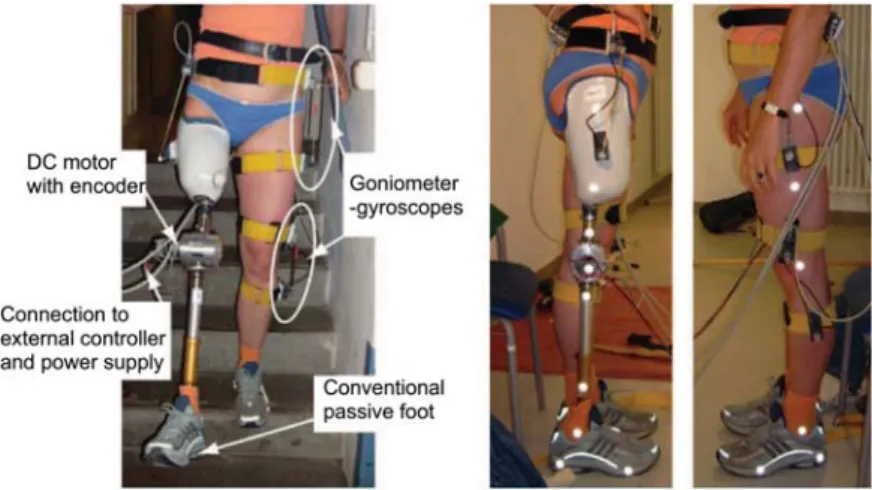
Figure 1 Experimental setup (left) and marker placement for gait analysis (right).
The outputs are augmented with mean and standard devi-ation of the physiological motion, which gives reference angle and velocity for the prosthetic joint(s). In summary, the coefficients in K and k in Eq. (1) are obtained by:
The estimates are subject to uncertainty, and there could be a discrepancy between estimated velocity and the deriv-ative of the estimated angle. To merge the two pieces of information for each joint, a Kalman filter is used. This filter is designed based on the model of a double integrator, and noise covariance matrices are obtained from the regression error of angle and angular velocity w23, 24x.
In this application of an actuated knee prosthesis for the right knee, the observed human joints are chosen as left hip angle whip,land left knee angle wkn,l. They are used to
esti-mate knee angle wkn,rfor the prosthesis on the right: T
w :s(wh hip,lwkn,l) , w :s(wp kn,r), (7)
with corresponding joint angular velocities. The Kalman fil-ter output provides the reference for a position controller for the joint.
This application shows that the state vectors of observed and prosthetic limbs do not have to be of equal size. There could be other limbs involved as part of xh. This would
require different or additional sensors, for example, to meas-ure trunk inclination. The ipsilateral hip had been included as an additional predictor in preliminary experiments, but this led to unstable oscillating behavior during stance. This effect could be as a result of mechanical coupling between hip and knee.
It is possible to include not only the states, i.e., angles and velocities, but also accelerations of residual human joints as inputs to the regression. Regardless of the input, it is also possible to estimate accelerations for the prosthetic joints, to obtain an additional piece of information for the Kalman filter. Simulations indicated that if angles and velocities are
available, additional measurement of accelerations hardly improves estimation performance w24x.
In summary, a recorded reference motion is reduced to the coefficients in K and k and the Kalman gains. Based on these parameters and driven by sound limb motion, online esti-mation provides a position reference for the prosthetic joint(s). Thus, CLME automatically exploits the observed kinematic correlations between joints, no explicit knowledge of the motion (e.g., the gait phase) is needed.
Experimental setup and data acquisition
The experimental setup consists of an actuated knee joint, as well as angle and angular velocity sensors attached to the contralateral hip and knee (Figure 1).
The knee joint is actuated by a Maxon RE 40 DC motor with a planetary gear with transmission ratiois91. To
meas-ure knee angle, the motor is equipped with an optical quad-rature encoder. The knee joint can be attached easily to the patient’s individual prosthetic shaft and foot using standard pyramid adapters. Flexion/extension angles and velocities of hip and knee joints are measured using goniometer-gyro-scope units, as described in w9, 10x. Their redundant design with two potentiometers per unit, connected by a telescopic shaft, allows to measure angles without requiring any joint alignment. They are attached to the body using velcro straps. As the focus of this project is not on hardware develop-ment, but on control, the device is tethered and depends on an external power supply. Control and data acquisition is realized via MATLAB/Simulink and RTAI Linux running on a desktop PC at a rate of 1 kHz. This PC, electronics, and the power supply are mounted on a cart that can be moved with the human subject. Safety mechanisms include mechan-ical and software range limitations, as well as manual emer-gency stop switches.
To obtain the mapping matrices for the CLME controller, a non-impaired 23-year-old female subject walked on a tread-mill at a speed of 3 km/h, as well as up and down stairs, equipped with the goniometer-gyroscope units to measure knee and hip flexion angles and velocities on both legs. Then, the interjoint coupling matrix C and statistical
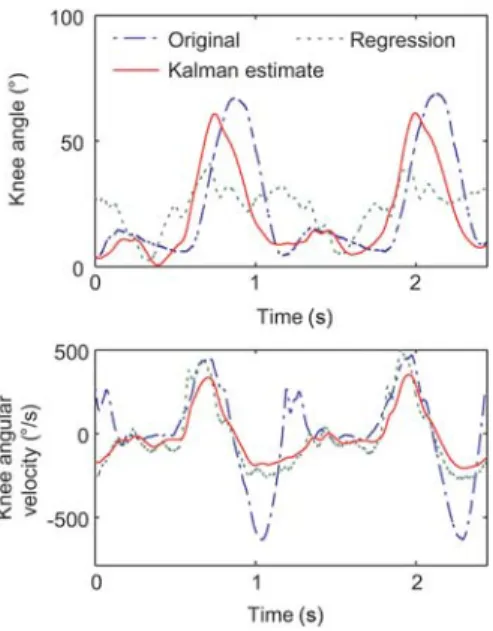
infor-Figure 2 Theoretical estimation accuracy when applying the regression and filtering to the offline stored gait data of the non-impaired reference subject.
Figure 3 Cartesian trajectory of the heel of the sound leg during treadmill walking with the C-Leg (left) and with a CLME-controlled active knee joint (right). Vaulting can be observed with the C-Leg.
mation for normalization were extracted from the recorded data, as described above. The mapping coefficients are given in Appendix 1.
A 42-year-old female subject with transfemoral amputa-tion took part in this case study and walked on a treadmill, as well as up and down stairs with the previously extracted couplings of the non-impaired subject. The subject was allowed to hold on to the bars during treadmill walking and to the handrail of the stairs, respectively. Furthermore, an assisting person secured her on the stairs.
Reflective markers were attached to the hip, knee, heel, forefoot, and ankle, to allow later motion analysis (Figure 1). One camera was used to subsequently record the marker positions of left and right side during treadmill walking. To compensate for changes in perspective in these two-dimen-sional recordings (e.g., owing to not perfectly symmetric camera positions on left and right side), a linear transfor-mation of the recorded data points was performed, using known side-symmetric landmarks on the treadmill and least-squares optimization. Stair trials were also captured, but only for video documentation, as markers were not visible.
Treadmill walking was compared between CLME-con-trolled walking and gait with the C-Leg, especially concern-ing the level of symmetry and the presence of compensatory motion. Symmetry was assessed by comparing the stance-to-swing ratio between legs, which denotes the time ratio spent for each leg with and without ground contact. ‘‘Toe off’’ and ‘‘heel strike’’ events were detected by offline analysis of the kinematic data. Stair descent was compared only qualitative-ly with the same motion with the C-Leg; alternating stair ascent is not possible with the C-Leg.
Results
The theoretically expected reconstruction accuracy can be illustrated using offline analysis of the non-impaired sub-ject’s recorded gait pattern. Figure 2 shows the result when the mapping is applied to estimate knee motion of one side from knee and hip motion of the contralateral side. The linear regression reconstructs knee angular velocity better than angle. However, it can be seen that the Kalman filter uses both pieces of information and improves angle estimation quality.
With this mapping, the amputee subject was able to walk smoothly after a few minutes of practice. She noticed how left and right legs were coupled, and she also managed to alter her gait voluntarily. She was able to walk at varying velocities (tested up to 5 km/h) with the same controller.
Compared with walking with the C-Leg, the subject made longer steps with her sound leg, such that asymmetry slightly increased. This is reflected in the average stance-to-swing ratio: for the C-Leg, this ratio was 1.09 and 1.38 for right and left legs, respectively, at 4 km/h. For the CLME-con-trolled prosthesis, the corresponding values were 0.99 and 1.40. The difference between C-Leg and CLME control is significant only for the right, prosthetic leg (ps0.00091), but not for the left leg (ps0.18).
A qualitative observation was that the subject vaulted slightly on her sound leg when walking with the C-Leg. This did not occur with the CLME-controlled prosthesis. In the trajectories of the heel marker during walking with the two devices (Figure 3), the vaulting can be seen, as well as the increased step size with CLME.
The shape of the knee joint angle trajectories of the sound and of the prosthetic knee joint is shown in Figure 4,
begin-Figure 4 Knee angle trajectories during treadmill walking with the C-Leg (left) and with a CLME-controlled active knee joint (right). Sound and prosthetic knee joint angles (dashed and solid lines, respectively) are normalized and plotted over multiple steps.
Figure 5 Stair ascent with a CLME-controlled prosthetic knee joint. An assisting person (right) helps with balance. Time between adjacent frames: 40 ms.
ning with heel strike. The prosthetic knee does not flex dur-ing stance phase, neither for the C-Leg nor for the CLME-controlled joint.
Similar to treadmill walking, the subject also quickly learned how to ascend the stairs smoothly (Figure 5), starting on either leg. However, she needed assistance with balance, and correct placement of the prosthetic foot on the next step required some compensatory motion with the hip.
In stair descent (Figure 6), the performance of the CLME-controlled prosthesis was less satisfactory, as it did not match the subject’s smooth stair descent with her C-Leg. The sub-ject reported that she felt insecure, and she hesitated to ini-tiate the next descend with the prosthesis, prolonging the time spent on the sound leg.
Discussion
The results show that it is generally feasible to control an actuated exoprosthesis by CLME. Using a simple mapping function from residual by body motion to the prosthesis, the volunteer amputee subject was able to achieve an almost physiological gait pattern.
In contrast to walking with the C-Leg, no contralateral vaulting occurred, which can be explained by the fact that the active prosthesis can generate positive power to flex the knee during swing. This eliminates the need for contralateral compensation to clear the foot. CLME also exploits another advantage of a system that can generate positive power, which is to enable alternating stair ascent.
Prolonged stance phases on the sound leg can to some extent be explained by a lack of training of the subject. For example, physiological stair descent is an almost ballistic motion consisting of successive phases of controlled falling. This requires a high level of confidence in the knee joint, which can probably not be achieved in the first minutes with a new device.
Figure 6 Stair descent with a CLME-controlled prosthetic knee joint. An assisting person (left) helps with balance. Time between adjacent frames: 40 ms.
The observation that the subject was able to walk at dif-ferent speeds without change of the mapping function indi-cates that the mapping is robust for a large range of speeds in level walking.
A major limitation for further evaluation is the current hardware. In addition to being tethered, the prosthetic knee is not a realistic platform, much better realizations are avail-able (such as the PowerKnee by O¨ ssur or the platforms described in w16, 17, 22x). For example, the motor protrudes from the joint, which leads to inertial torques about the ver-tical axis. Also in flexion/extension direction, motor and transmission weight and inertia could have introduced a disturbance.
Alternative or in addition to improving this hardware, it could be interesting to investigate a similar control scheme for controlled dissipative devices, which offer considerable advantages in terms of weight and range.
Conclusion and outlook
This first proof-of-concept shows that the minimization of ‘‘autonomous intelligence’’ in an actuated prosthesis com-bined with close observation of the user allow to incorporate the human’s superior motion control in a cooperative and intuitive way.
Future research will focus on generalizing CLME and adapting it to practical requirements of exoprostheses. The current position control scheme will be replaced by a more
compliant control approach. Other extensions will aim to enable seamless transitioning between different activities. This should be done without explicit switching, but by find-ing a more general mappfind-ing. A possible solution for this could be to observe more body parts, or to extend the map-ping to the nonlinear domain, possibly using techniques such as generalized principal component analysis w27x or corre-lation clustering w3x. Finally, the hardware platform needs to be improved in terms of weight and inertia, to allow more realistic testing.
Acknowledgements
The authors would like to thank the subject for her participation, Rolf Sitte and the orthopedic workshop of S. Merzendorfer oHG for technical and orthopedic support, as well as the ETH Research Grant ETHIIRA and the Gottfried und Julia Bangerter-Rhyner Stif-tung for financial support.
Appendix 1
The mapping matrix K and offset vector k in Eq. (1) for level gait are:
B-0.050 0.105 -0.125 s 0.012 sE B21.738 E
Ks
C
F
, ksC
F
-1 -1 -1
The values for stair ascent are:
B-1.242 -0.189 -0.048 s -0.046 sE B93.108 E
Ks
C
F
, ksC
F
-1 -1 -1
D-1.05 s 0.79 s -0.73 -0.25 G D17.088 s G and for stair descent:
B-1.372 -0.024 -0.147 s -0.022 sE B72.828 E
Ks
C
F
, ksC
F
.-1 -1 -1
D29.49 s -1.08 s -1.32 0.97 G D-705.698 s G
References
w1x Aitken A. On least squares and linear combinations of obser-vations. Proc Roy Soc Edinb 1935; 55: 42–48.
w2x Be´dard S. Control system and method for controlling an actu-ated prosthesis. US patent, Application number: 10600725, Issued 2006.
w3x Bo¨hm C, Kailing K, Kro¨ger P, Zimek A. Computing clusters of correlation connected objects. In: Weikum G, Ko¨nig AC, Deßoch S, editors. Proceedings of the ACM SIGMOD Inter-national Conference on Management of Data (COMAD), ACM, Paris, France, June 13–18, 2004: 1–12.
w4x Castellini C, van der Smagt P. Surface EMG in advanced hand prosthetics. Biol Cybern 2009; 100: 35–47.
w5x Donath M. Proportional EMG control for above-knee prosthe-sis. Master’s theprosthe-sis. Cambridge, MA: Department of Mechan-ical Engineering, MIT, 1974.
w6x Eilenberg MF, Geyer H, Herr H. Control of a powered ankle-foot prosthesis based on a neuromuscular model. IEEE Trans Neural Syst Rehabil Eng 2010; 18: 164–173.
w7x Fleischer C. Controlling exoskeletons with EMG signals and a biomechanical body model. PhD thesis. Berlin: Technische Universita¨t Berlin 2007.
w8x Flowers WC. A man-interactive simulator system for above-knee prosthetics studies. PhD thesis. Cambridge, MA: Depart-ment of Mechanical Engineering, MIT, 1973.
w9x Fuhr T. Ein kooperatives, patientengefu¨hrtes Regelungssystem zur Bewegungsrestitution mit einer Neuroprothese. PhD thesis. Mu¨nchen: Lehrstuhl fu¨r Steuerungs- und Regelungstechnik, Technische Universita¨t Mu¨nchen 2004.
w10x Fuhr T, Schmidt G. Design of a patient-mounted multi-sensor system for lower extremity neuroprostheses. In: Proceedings of the First Joint BME/EMBS Conference, Atlanta, GA, USA 1999: 662.
w11x Goldfarb M, Barth E, Gogola M, Wehrmeyer J. Design and energetic characterization of a liquid-propellant-powered actu-ator for self-powered robots. IEEE/ASME Trans Mechatron 2003; 8: 254–262.
w12x Grimes D, Flowers WC, Donath M. Feasibility of an active control scheme for A/K prostheses. J Biomed Eng 1977; 99: 215–221.
w13x Hafner BJ, Willingham LL, Buell NC, Allyn KJ, Smith DG. Evaluation of function, performance, and preference as trans-femoral amputees transition from mechanical to
microproces-sor control of the prosthetic knee. Arch Phys Med Rehabil 2007; 88: 207–217.
w14x Johansson JL, Sherrill DM, Riley PO, Bonato P, Herr H. A clinical comparison of variable-damping and mechanically pas-sive prosthetic knee devices. Am J Phys Med Rehabil 2005; 84: 563–575.
w15x Kawamoto H, Kanbe S. Power assist method for HAL3, esti-mating operator intention based on motion information. In: Proceedings of the IEEE International Workshop on Robot and Human Interactive Communication 2003: 67–72.
w16x Lambrecht B, Kazerooni H. Design of a semi-active knee pros-thesis. In: Proceedings of the IEEE International Conference on Robotics and Automation (ICRA), IEEE, Kobe, Japan, May 12–19, 2009: 639–645.
w17x Martinez-Villalpando E, Weber J, Elliott G, Herr H. Design of an agonist-antagonist active knee prosthesis. In: Proceedings of the IEEE RAS EMBS International Conference on Biomedical Robotics and Biomechatronics (BioRob), Scottsdale, Arizona, USA, 2008: 529–534.
w18x Miller LA, Lipschutz RD, Stubblefield KA, et al. Control of a six degree of freedom prosthetic arm after targeted muscle rein-nervation surgery. Arch Phys Med Rehabil 2008; 89: 2057– 2065.
w19x Popovic D, Schwirtlich L. Belgrade active A/K prosthesis. In: Wallinga W, Boom HBK, de Vries J, editors. Electrophysio-logical Kinesiology (International Congress Series 804). Amsterdam: Excerpta Medica 1988: 337–343.
w20x Popovic´ D, Tomovic´ R, Tepavac D. Control aspects of active above-knee prosthesis. Int J Man-Mach Stud 1991; 35: 751– 767.
w21x St-Onge N, Feldman AG. Interjoint coordination in lower limbs during different movements in humans. Exp Brain Res 2003; 148: 139–149.
w22x Sup F, Bohara A, Goldfarb M. Design and control of a powered transfemoral prosthesis. Int J Robot Res 2008; 27: 263–273. w23x Vallery H. Stable and user-controlled assistance of human
motor function. PhD thesis. Mu¨nchen: Institute of Automatic Control Engineering, Technische Universita¨t Mu¨nchen 2009. w24x Vallery H, Buss M. Bewegungsintentionsscha¨tzung auf Basis
von Gelenkkoordination. Automatisierungstechnik 2007; 55: 503–510.
w25x Vallery H, Ekkelenkamp R, van der Kooij H, Buss M. Com-plementary limb motion estimation based on interjoint coor-dination: experimental evaluation. In: Proceedings of the IEEE International Conference on Rehabilitation Robotics (ICORR), Noordwijk, The Netherlands 2007: 798–803.
w26x Vallery H, van Asseldonk E, Buss M, van der Kooij H. Ref-erence trajectory generation for rehabilitation robots: comple-mentary limb motion estimation. IEEE Trans Neural Syst Rehabil Eng 2009; 17: 23–30.
w27x Vidal R, Ma Y, Sastry S. Generalized principal component analysis (GPCA). IEEE Trans Pattern Anal Mach Intell 2005; 27: 1945–1959.
w28x Wetz HH, Hafkemeyer U, Drerup B. Einfluss des C-Leg-Knie-gelenk-Passteiles der Fa. Otto Bock auf die Ver-sorgungsqua-lita¨t Oberschenkelamputierter. Orthopa¨de 2005; 34: 298, 300–314, 316–319.