Publisher’s version / Version de l'éditeur:
Vous avez des questions? Nous pouvons vous aider. Pour communiquer directement avec un auteur, consultez la première page de la revue dans laquelle son article a été publié afin de trouver ses coordonnées. Si vous n’arrivez pas à les repérer, communiquez avec nous à [email protected].
Questions? Contact the NRC Publications Archive team at
[email protected]. If you wish to email the authors directly, please see the first page of the publication for their contact information.
https://publications-cnrc.canada.ca/fra/droits
L’accès à ce site Web et l’utilisation de son contenu sont assujettis aux conditions présentées dans le site LISEZ CES CONDITIONS ATTENTIVEMENT AVANT D’UTILISER CE SITE WEB.
Ceramic Engineering and Science Proceedings, 6, 11-12, pp. 1582-1586,
1985-11
READ THESE TERMS AND CONDITIONS CAREFULLY BEFORE USING THIS WEBSITE. https://nrc-publications.canada.ca/eng/copyright
NRC Publications Archive Record / Notice des Archives des publications du CNRC : https://nrc-publications.canada.ca/eng/view/object/?id=8ce9ca75-a00a-46ff-a8ae-40a383524ed1 https://publications-cnrc.canada.ca/fra/voir/objet/?id=8ce9ca75-a00a-46ff-a8ae-40a383524ed1
NRC Publications Archive
Archives des publications du CNRC
This publication could be one of several versions: author’s original, accepted manuscript or the publisher’s version. / La version de cette publication peut être l’une des suivantes : la version prépublication de l’auteur, la version acceptée du manuscrit ou la version de l’éditeur.
Access and use of this website and the material on it are subject to the Terms and Conditions set forth at
Firing optimization of clay bricks
Ser
ITH1 : National Research Conseil national I
N21d
Council Canada de recherche8 CanadaI
no
1368
Institute for lnstitut dec. 2 Research in recherche en
BLDG Construction construction
Firing Optimization of Clay
Bricks
by J.H. Kung
ANALYZED
Reprinted from
The American Ceramic Society
Ceramic Engineering and Science Proceedings. Vol. 6, No. 11-12, November-December 1985 p. 1582
-
1586(IRC Paper No. 1368)
Price $2.00 NRCC 25852 C ? NRC
-
CISTIBLDG.
RES.
L I B R A R Y
96-
OF
1 5
R.cch.BSi
En.Ce document montre comment on peut 6valuer Les conditions optimales de cuisson des briques d'argile soumises 3 divers degres de cuisson en traqant la courbe de l'aire de surface spgcifique en fonction du coefficient de saturation des briques.
Reprinled from Ceramic Engineering and Science Proceedings. Vol. 6, No. 11-12, November-December 1985 Copyright 1985 The American Ceramic Society
Firing
Optimization of Clay
Bricks
National Research Council of Canada
M-20 Montreal Rd., Ottawa KIA ORG, Canada
It is shown how the optimumjiring conditions of clay bricks subjected to &@rent degrees of fin'ng can be estimated by plotting the specific surface area against the saturation c&cient of hicks
Introduction
F
iring is the most important process that determines the physical properties of clay bricks. Phenomenologically, firing lowers the saturation coefficient and specific surface area. As the specific surface area of a clay brick decreases, strength increases. Low saturation coefficients and specific surface areas of bricks are also an indication of better frost resistance.' Thus, both strengths and frost resistance of clay bricks improve with increased degree of firing (soak- ing time and peak temperature). Since firing accounts for a major part of the cost of producing clay bricks, it is important for the clay brick industry to optimize the firing conditions.In practice, two methods that are indicative of the firing conditions are used. One method involves the determination of the time-temperature profile and the other,2 the shrinkage in arbitrary units (BRI) using firechek keys.* These methods, however, cannot be used directly to determine the optimum firing conditions.
Since the saturation coefficient and specific surface area of bricks are related to the degree of firing to which they are burned, it was of interest to explore the possibility of estimating the optimum firing conditions using these measurements.
Experimental Procedure
To establish the optimum firing conditions based on the saturation coef- ficient and specific surface area for a given brick made of a specific raw material, it was necessary to obtain a series of burned samples subjected to various degrees of firing. Samples fired in a laboratory furnace at various peak temperatures and soaking times, and bricks collected from different parts of a kiln during a shutdown were chosen for this study.
The saturation coefficient was determined according to the procedure specified by ASTM C67, and the specific surface area was measured by the BET gas adsorption method3 using either water or nitrogen as the adsorbate. The degree of firing was estimated from the shrinkage of firechek keys.
Results and Discussion
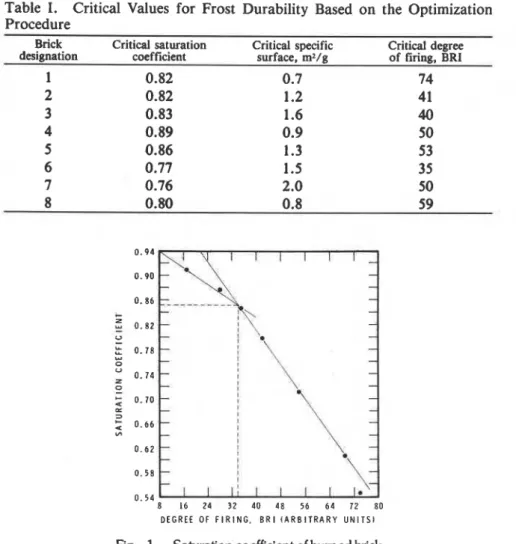
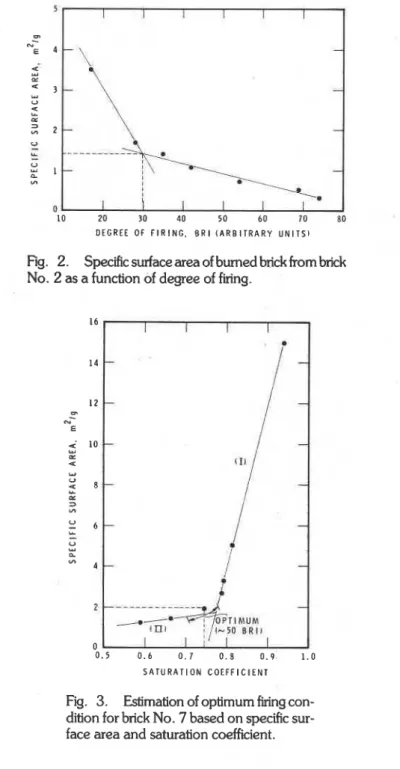
Plots of the saturation coefficient or the specific surface area of bricks vs degree of firing show an intersection (Figs. 1 and 2). Performance records in service indicate that some bricks with saturation coefficients and specific
surface areas corresponding to the intersections are not durable. Thus, the saturation coefficient or specific surface area alone is inadequate to assess the optimum firing conditions.
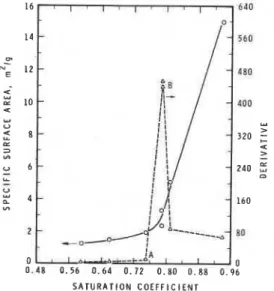
It was postulated that the optimum degree of firing should correspond to a particular value of saturation coefficient and surface area below which the brick will be durable. In order to determine this condition, the specific surface area of fired samples was plotted against the corresponding satura- tion coefficient. An example is shown in Fig. 3. This presentation also indicates a region of rapid change. In the high saturation coefficient region (region I), a large decrease in surface area is accompanied by only a small change in satura- tion coefficient. In region 11, a small change in surface area is accompanied by a large reduction in saturation coefficient. Mechanistically, region I cor- responds predominantly to the process of solid state sintering and region I1 to that of vitrification. The specific surface area and the saturation coefficient of most plant-fired bricks are scattered around the intersection of the two lines drawn through the experimental points in Fig. 3. In practice, the optimum firing condition (obtained through trial and error) is in the region correspond- ing to the intersection of the two lines. The intersection region for the brick studied in this example corresponds to a firechek key shrinkage of 50 BRI units. The optimum firing value is more clearly revealed by plotting the derivative of the curve showing the dependence of saturation coefficient on specific sur- face area (Fig. 4). The optimum values should correspond to those between A and B (A corresponding to the base of the beginning of the steep rise in the curve and B being the peak of the derivative curve) since durability of products between the two points has been proven in service. For the brick studied in this example, this corresponds to 0.76 to 0.78 for saturation coefficient and between 1.9 and 2.4 m2/g for specific surface area.
Using the above method, the critical saturation coefficient, critical specific surface area and critical degree of firing (BRI units) of the eight products were determined. The values are shown in Table I. Wide variations in the optimum conditions are evident. Durable bricks can be obtained from brick No. 6 with lower degree of firing than others, whereas higher heat energy has to be expended to obtain durable bricks from brick No. 1. Preliminary work sug- gests that bricks having a higher critical degree of firing have lower amounts of fluxes and clay mineral content.
Conclusions
The optimum firing condition of clay bricks determined from experience for a given product can be correlated with information obtained from a plot of specific surface area against saturation coefficient of samples subjected to different degrees of firing. This procedure shows promise as a method for deter- mining the conditions required to produce frost-resistant bricks from a given raw material. It is simple and requires only a small number of samples.
Acknowledgments
This work was carried out under the Industrial Research Fellowship Pro- gram sponsored jointly by the Clay Brick Association of Canada and the Division of Building Research, National Research Council Canada in the period
1978-1982. The author wishes to thank Dr. V.S. Ramachandran and Dr. L.W. Gold for their valuable discussions. This paper is a contribution from the Divi- sion of Building Research, National Research Council Canada, and is published with the approval of the Director of the Division.
References
'G.G. Litvan, "Testing the Frost Susceptibility of Bricks," ASTM STP 589, 123-32 (1975).
2H.B. Newman, "Direct and Indirect Methods of Measuring Body Maturity," Am. Ceram. SOC. Bull, 58 [6] 580-86 (1979).
IS. Brunauer, P.H. Emmett, and E. Teller, "Adsorption of Gases in Multimolecular Layers," J. Am. Chem. Soc.. 60 121 309-19 (1938).
*Bell Research. Inc., Chester, WV.
Table I. Critical Values for Frost Durability Based on the Optimization Procedure
Brick Critical saturation Critical specific Critical degree
designation coefficient surface, m2/g of firing, BRI
0 . 9 4 I I I 1 1 1
--
-
-
-
-
Z u 0 . 8 2-
-I-
U-
k 0 . 7 8-
-
w 0-
U 0 . 7 4-
Z 0-
; 0.70-
c= 3-
,
0 . 6 6-
VI 0 . 6 2-
0 . 5 8-
0 . 5 4 8 16 24 3 2 40 48 56 6 4 72 80 DEGREE OF F I R I N G . B R I ( A R B I T R A R Y U N I T S )Fig. 1. Saturation coefficient of burned brick
5 m -.. w ". a Ld w 3 u U LL e 2 2 U
-
-
U 2 1 I I I I I I"\
-- - -
-- - - m 0 10-
!\%\, 20 I 30 40 I 50 1 60 I \ 70!
80 D E G R E E O F F I R I N G . B R I ( A R B I T R A R Y U N I T S 1Fig. 2. Specific surface area of burned brick from brick No. 2 as a function of degree of firing.
16 1 4 I I I I
-
12 m-
N E 4- 10 u P: u ,d " u 8 u. LI: 3 m LL-
0-
a 6 --
1
/:
v,-
i
I
-
r
-
0 0 . 5 0 . 6 0 . 7 0 . 8 0 . 9 1 . 0 S A T U R A T I O N C O E F F I C I E N TFig. 3. Estimation of optimum firing con- dition for brick No. 7 based on specific sur- face area and saturation coefficient.
S A T U R A T I O N C O E F F l C l E N l
Fig.
4.
Optimizing the firing condition for brick No. 7 from the derivative of specific sur- face with respect to saturation coefficient.This paper is being distributed in reprint form by the Institute for Research in Construction. A list of building practice and research publications available from the Institute may be obtained by writing to the Publications Section, Institute for Research in Construction, National Research Council of Canada, Ottawa, Ontario, K1A 0R6.
Ce document est distribue sous forme de tire-3-part par 1'Institut de recherche en construction. On peut obtenir rlne liste des publications de llInstitut portant sur les techniques ou les recherches en matiere de batiment en 6crivant B La Section des publications, Institut de recherche en construction, Conseil national de recherches du Canada, Ottawa (Ontario), K1A OR6.