RECUMBENT-BICYCLE TECHNOLOGY
by
George Alexander Holt III
SUBMITTED TO THE DEPARTMENT OF MECHANICAL ENGINEERING IN PARTIAL FULFILLMENT OF THE REQUIREMENTS FOR THE
DEGREE OF
BACHELOR OF SCIENCE
at the
MASSACHUSETTS INSTITUTE OF TECHNOLOGY
May 1988
Copyright (c) 1988 Massachusetts Institute of Technology
7
Signature of Author ,Certified by
Accepted by
7
Department of Mechanical EngineeringMay 27, 1988
Professor David Gordon Wilson
-2f X~ Thesis Supervisor
'
f ' '' .~KI
..fUl&-/v' ~ ' ~/XI Professor Peter Griffith Chairk Undergraduate Thesis Committee MIS8ACHJSETS ISTITV? OF TECOLOBY JUN 1 3 1988 ARCHIVES · ii, & l^ 11
-RECUMBENT-BICYCLE TECHNOLOGY
byGeorge Alexander Holt III
Submitted to the Department of Mechanical Engineering on May 27, 1988 in
partial fulfillment of the requirements for the degree of Bachelor of Science.
Abstract
Experiments in human ergometry have established recumbent bicycles as one of the most efficient forms of power generation, while providing a higher degree of comfort than conventional bicycles. It was determined that power storage in a battery could be a lifesaver at sea. By applying recumbent-bicycle technology to a generator and power-storage apparatus, a new device would be created, the human-powered generator for lifeboats. The design of this human-powered generator, or HPG, is documented in this report. The design process progressed from a conceptual stage through the completion of a prototype. Using mostly 6061-T6 aluminum, a lightweight, foldable apparatus was built which resembled a recumbent bicycle, and would charge a 24-volt battery. The human power requirements were 120 watts at 70 rpm.
Thesis Supervisor: Title:
Professor David Gordon Wilson Professor of Mechanical Engineering
Acknowledgements
I would like to thank Professor David Gordon Wilson for proposing my undertaking of this
project and for consenting to be my thesis supervisor.
I would also like to thank Karl von Ellenrieder and Cindy Tsang, whose involvement as undergraduate researchers was necessary for completion of this project.
In addition I would like to thank Norm Doelling and Sea Grant, which provided the funding.
Table of Contents
Abstract 2 Acknowledgements 3 Table of Contents 4 List of Figures 5 1 Introduction 62 Design Requirements and Goals 7
3 Design Of The Human-Powered Generator 7
3.1 General Design Decisions 7
3.2 Frame Design 9
3.3 Quick-Release Seat Adjustment 14
3.4 Generator and Power Storage 14
3.5 Timing-Belt Step-Up Drive 17
3.6 Crankset and Bottom Bracket 20
List of Figures
Body Frame Of The HPG. Scale 1:8
Seat Frame Of The HPG. Isometric. Scale 1:8 Optimal Dimensions For Recumbent Bicycles
Quick-Release Seat-Adjustment Slider. Isometric. Scale 1:2 Efficiency-Testing Apparatus, diagram
Step-Up Drive of the Human Powered Generator. Scale 1:4
Figure 1: Figure 2: Figure 3: Figure 4: Figure 5: Figure 6: 11 1-2 13' 1'5 16 19
1 Introduction
This report documents the design and building of a prototype human-powered generator, referred to as an HPG. The intended working environment would be in lifeboats, where a drained battery could cost lives. It was determined that the recharging of batteries would be a significant asset, and could be accomplished by some form of human power generation. The technology of recumbent bicycles, which provided efficiency and a low
center of gravity, seemed perfect for the marine environment.
In 1980 Carl Nowiszewski, a mechanical-engineering student at M.I.T., worked out with Professor David Gordon Wilson a design for a pedal-powered generator, which when built would be used for auxiliary control functions in a sailboat in an Atlantic crossing. The energy storage was primarily for automatic steering while the pilot slept, and the pedalling
was a way to keep warm and avoid boredom. The overwhelming design problem was the
cramped quarters, which Nowiszewski eventually solved.
The advantage of storing power in a battery while at sea became apparent, and my involvement with a new human-powered generator began. The goal was to develop a pedal-powered device which could be used in lifeboats. The optimal design would take little space and be as light as possible. By pedalling for up to an hour, energy could be stored in a 24-volt battery; energy which could save lives. A secondary application was the possibility of using the device in pleasure sailboats for more recreational purposes. The remainder of this report describes the physical design and the design process.
2 Design Requirements and Goals
The requirements of the physical design were developed by analyzing the working environment(s) in which the device would be used. Design requirements can be considered those things which must be done to produce a reasonably fail-safe device. The working environment includes not only the physical surroundings, but also the types of stresses and abuse which could be encountered. Because the human-powered generator was being designed primarily for use at sea, salt water dictated that plastics and non-corrosive metals should be used. The right combination and dimensions of materials would produce a product which could withstand everyday stresses, as well as maximize the number of cycles until failure (failure due to fatigue from cyclical stresses).
Design goals are a list of objectives which the designer and/or client want the product to meet. These objectives can be anything from added safety or performance features, to aesthetics for marketing purposes. The overall objective in designing the HPG would result in a lightweight, safe, non-corrosive, foldable, adjustable, economical and easy-to-use product. It was in meeting these goals and requirements that the prototype human-powered generator evolved.
3 Design Of The Human-Powered Generator
3.1 General Design Decisions
The first step in meeting design requirements and objectives was to turn to bicycling technology, and in particular, recumbent bicycles. Studies in power generation show that bicycling is one of the most efficient forms of power generation known, in terms of energy expended per person.l This makes it an excellent technology to consider in designing any apparatus which is powered by humans.
1Intemrnational Human Powered Vehicle Association, The First Human Powered Vehicle Scientific
Designing with recumbent bicycles in mind met several objectives. The low center of gravity in recumbent bikes is perfect for marine applications, where a low center of gravity is vital for stability. Furthermore, the use of an aluminum frame designed after the Klein frame insured against corrosion, while producing a light weight. Lastly, a recumbent design maximizes comfort but also allows the user to produce more power than a conventional design because of the ability to press back against the seat and pump leg presses into the cranks. Presumably a trained athlete could push with more than his weight in force, something that requires stressing of the upper body while pulling on the handlebars on conventional bicycles. Conventional bicycles can leave one with a sore back and arms, and sometimes broken handlebars from these stresses. In very limited comparison testing at the University of California at San Diego, an athlete in a recumbent position produced 95% of the power produced in a conventional position.2This research,
headed by Professor Chester Kyle, proved that the recumbent position was a valid consideration. The validity of these tests is questionable, as a fully-recumbent position was tested as opposed to the semi-recumbent which the HPG employs.
One performance advantage of recumbent bicycles is their low drag coefficient when faired, which is generally less than on a conventional bicycle. However, on the stationary HPG the importance of the drag coefficient is negligible. It can still be concluded that the semi-recumbent position is the best option, since recumbency gives comfort, stability and near, equal to, or possibly even more than the power of an upright position.
In general, the frame size for a bicycle varies with the dimensions of the person using it. The objective in designing the HPG was to make one size fit all. This was accomplished with an adjustable seat, similar to that of the Avator 2000 recumbent bicycle. The Avator's
inability to fold could be a special problem in lifeboats, and so the HPG's seat was also
2Bruno Mombirinie, Recumbent Bicycle: Guidelines For Design and Construction, M.I.T. Bachelor's Thesis, p. 14
designed to fold, so that the entire device could be reduced to essentially one plane. The foldability was developed by introducing the use of tensioned cables and compressed aluminum tubes, which maintained the strength and rigidity of the apparatus while allowing
a compact storage size. The cables stabilized the seat frame in a manner similar to that of
sailboat stays stabilizing a mast. This feature also reduced the overall bulk, as the cables
take less space than the equivalent tubing.
One major disadvantage which needed to be addressed was the chain drive found on
bicycles. The use of a chain at sea would not only be messy due to grease and oil, but more
than likely the chain would rust while the HPG was in storage and break during use. This problem was eliminated by introducing toothed rubber timing belts and aluminum pulleys, an assembly commonly used in precision machinery, and beginning to be introduced in some bicycle designs. The geared pulleys produced a ratio of torques and speeds identical to a conventional chain and chainwheel apparatus, while providing a design optimal for the HPG's intended environment.
Thus the majority of the design objectives were met by applying recumbent-bicycle and timing-belt technologies. The following sections describe the specifics of the design in detail.
3.2 Frame Design
Bicycle frames encounter a complex set of stresses, which can not even be calculated and analyzed by computer, and are. certainly impossible to determine by hand. In designing a frame, engineers usually use an older design which has proven reliable as a starting point. The frame of the HPG was designed in a similar method, by using the highly successful Klein aluminum frame as a guide. Under testing the Klein frame was found to survive 100,000 cycles of simulated pedalling3. Two factors of the prototype HPG necessitated a
3
Raymond C. Izor, The Investigation of Fatigue Life in a 6061-T6 Aluminum Bicycle Frame, M.I.T. Bachelor's Thesis, p. 15
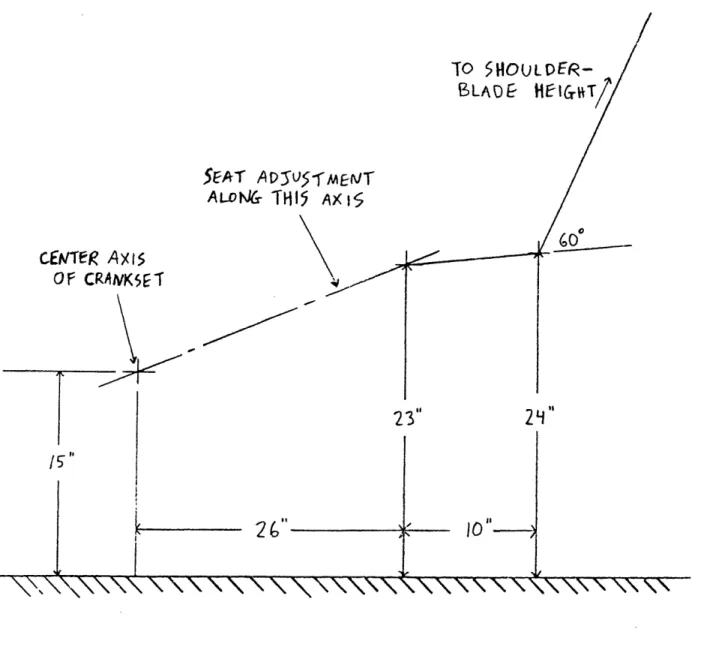
change from the Klein frame. The first was the completely different geometrical requirements of the frame. The second was the inability to heat treat the frame of the prototype. Because welding of aluminum is difficult and reduces strength, heat treatment is desirable to strengthen the welds. These two factors, plus availability of desired tubing, contributed to the use of 6061-T6 aluminum tubing which had 1 or 1.25 inch outer diameter similar to the Klein frame, and a 0.065 inch wall thickness, almost three times that of the Klein frame4. The front half of the frame, designated the body frame, is shown in Figure 1. The back half, designated the seat frame, is pictured in Figure 2. The geometry of the frame parts was developed using dimensions, shown in Figure 3, which proved to be the most comfortable and efficient for David Gordon Wilson on his recumbent bike5.
These dimensions were then expanded for variations in leg length, while the axis of seat adjustment was lowered to a horizontal to further reduce instability. Thus the geometry of the body frame needed a minimum height of 15 inches at the bottom bracket and leg variations from 24 to 31 inches. With this in mind the body frame was designed as a triangular truss system for strength and rigidity.
The two halves move relative to one another, and the device is adjustable for leg lengths of 24 to 31 inches as stated, which compares well with the 26 inch (27 inches along the axis) estimate found above. The seat frame also moves farther forward to 20 inches, where it rotates around the top tube in order to fold away. The adjustability is discussed
further in Section 3.3.
The seat frame is designed to further collapse so that when rotated and folded it is in the same plane as the body frame (which does not fold). This is accomplished by stainless-steel tensioned cables, with diameter 1/8 inch, and able to withstand 1100 pounds in
4
Ibid, p. 36
5
Z LJ 3::'0 a oo o I . 4:4 a u
o
lm ILF
4) o I.1 a lc3 .L Ll. 0w 1-\ 21i
s w _ I rm I IE: , D
i iI00 o "a CT ci t L
-`--To M;OULDER-BLAUg HTGiT,
,SEAT
A5-rf
ALOG TH15 CETER AS 5 OF CRAVK$eT 15 .jr
23"
.2"
2C
--
~6~'---~11
iOn, a\\\\\\ \ \\
\
\ \
\
\N\\
%\%"N\
N
'N'\
\ \ \ \\ \\
Figure 3: Optimal Dimensions For Recumbent Bicyclestension. The cables are attached to points on the seat frame, as shown in Figure 2 and tightened by steel turnbuckles. The cable ends are looped around galvanized-steel thimbles, which distribute the stress uniformly around the end loops. Stainless-galvanized-steel rings attach the thimbles to the frame, by simply looping over the tubes before the cable is tightened. The assemblage is similar to that of sailboat stays, and all parts are rustproof. The tightened bottom cables prevent the rear legs from collapsing, and disconnecting them
allows the seat frame to be folded as diagrammed. Thus the seat frame is designed to be
rigid when in use, yet collapsable for storage.
I-I
3.3 Quick-Release Seat Adjustment
The seat adjustability is achieved with two sliders which move along the top tube of
the frame, and are welded to the seat frame. These sliders act as the interface between the body and seat frames. The rear slider is set permanently loose so that its only degree of freedom is linear motion along the top-tube axis (i.e. it still supports vertical forces such as
weight).
The front slider (see Figure 4) is simnilar, except for two quick releases which when tight prevent the seat frame from moving relative to the body frame. Thus the seat can easily be adjusted for different leg lengths by using the quick releases, while both sliders provide vertical support. The parts are Suntour XC 9000 QR's, with steel shaft and alloy nut, designed for setting the seat height on bicycles. Ultimately the shaft should be replaced with an alloy or stainless-steel part, but these quick releases were adequate for a prototype.
In addition, the frame parts are prevented from rotating relative to one another by a slot-and-key assembly. The only time the sliders will rotate (and thus rotate the seat frame)
is at the break in the key where the apparatus is meant to fold. The key is merely a 3/16-inch-diameter 6061-T6 aluminum rod welded to the top of the top tube, and the slots are
1/4-inch-diameter holes in the sliders.
3.4 Generator and Power Storage
The generator used on the HPG is actually a 24- volt DC PM Field Motor
(government surplus) which doubles as a generator. The published specifications when
used as a generator are shown below.
Generator Specifications
-Reversible Heavy Duty Motortronics #31107-14-210-05 -14.3 to 14.6 Volts per 1000 rpm (average)
-maximum 2000 rpm
oN -4) c) o-4) CO () 1. 4GJ L .LT
-18.7 oz-in/amp torque constant -3.125 in. OD x 4.875 in. long
-shaft 0.375 in. diameter x 2 in. long -weight = 6 lbs.
Before this informnnation became known, efficiency research and testing was performed by Karl von Ellenrieder. An overview of his methods is described here. At the
time of this writing, an overall efficiency curve had not yet been developed, as the method
reveals. The highest efficiency obtained thus far was used for design purposes. However, there may be, and hopefully is, a more efficient point of operation.
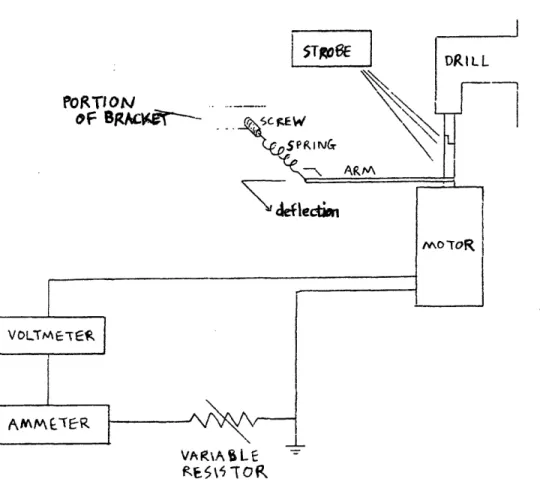
Figure 5 shows the apparatus used for testing the efficiency.
ITos
PoRP, TI ON
oF
BgcM--VA R\A L RE5\0 TOR
Figure 5: Efficiency-Testing Apparatus, diagram
strobe determined the rpm of the generator shaft. The generator was mounted in a bracket, with a small arm connected to the shaft. The arm was restrained from rotating by a spring with a known constant. For each run of the drill press, a deflection of the arm was measured, and this deflection along with the spring constant and arc radius allowed calculation of the torque. Thus a mechanical-power curve was obtained.
Similarly an electrical-power curve was obtained for each test run by reading the voltage and current off of a calibrated voltmeter and ammeter respectively. The electrical power out divided by the mechanical power in became an efficiency value for each torque/speed combination. The end product of these tests would be an efficiency curve for each resistance, which had not yet been completed at the time of this writing. However, the data points taken are still valid, and the most efficient point was used in the design. The highest efficiency of these points was about 50%, and occurred at 2600 rpm.
3.5 Timing-Belt Step-Up Drive
In Section 3.4 it was determined that most efficient production came at about 2600 rpm, while a human can pedal comfortably at between 60 and 75 rpm6. In addition, a
human is capable of producing 75 watts all day, and 150 watts and higher for increasingly shorter periods7. While humans could produce more watts for a shorter period of time, it was decided that the design should provide for the possible weakened state of the lifeboat user, and so the figure used was 120 watts, which would allow a healthy person up to 500 minutes before tiring8.
The parameters above determined an overall gearing ratio of between 34:1 and 43:1.
6Frank Rowland Whitt and David Gordon Wilson, Bicycling Science, Second Edition, M.I.T. Press, pp.
151-187
7Ibid, p. 45
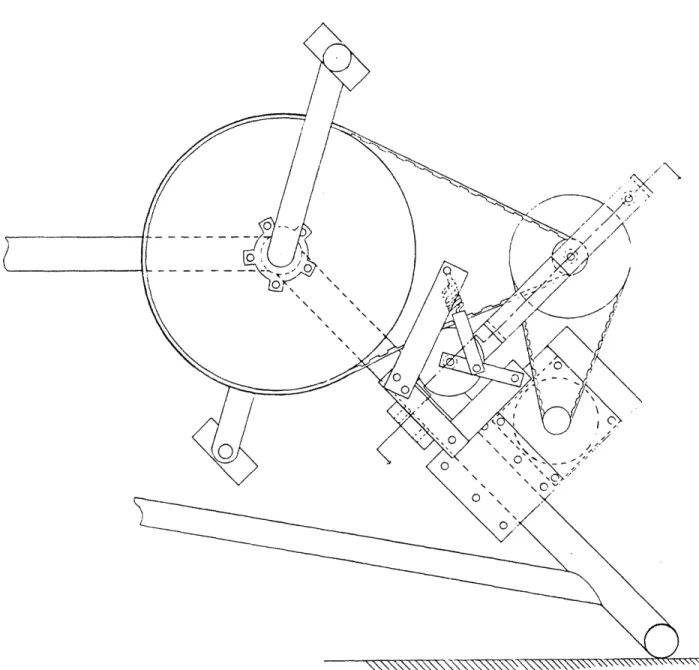
Normal gearing ratios on bicycles are on the order of one tenth this amount. Because the gearing ratio needed for the HPG was so high, a two-stage step-up was used, enabling the largest wheel, the driving wheel, to be only ten inches in diameter. The apparatus is shown in Figure 6.
The driver wheel is a ten-inch cast-aluminum plate curved slightly around the top to hold the belt in place. The wheel is not toothed, and belt drive A has a tensioning wheel, so that excessive force on the pedals will cause the tension wheel to relax the belt, resulting in slippage. When the belt is tensioned the large common surface area between the belt and driver wheel enables the belt to be turned with negligible slippage. The belts and other pulleys were selected according to a standard method outlined in [Gates 63]. The following selections were made:
Drive A: Driver Wheel to Step-Up Gear -10-inch driver wheel
-12L050 steel pulley. 1/2 inch width, 3/8 in. pitch, 12 teeth.
-450L050 belt. 45 inches long Drive B: Step-Up Gear to Generator
-72XL037 aluminum pulley. 3/8 inch width, 1/5 in. pitch, 72 teeth.
-15XL037 aluminum pulley. 15 teeth. -220XL037 belt. 22 inches long
Both belts are adjustable for tensioning and the 450L050 (belt A) also has the previously mentioned constant tensioning wheel, which is made from a plastic material and has a 2.5-inch diameter and 0.75-inch thickness. The spring used was strong enough to tension the belt without damage to the apparatus, and was selected according to guidelines in [Gates 63]. This tensioning apparatus is designed so that pedalling in the wrong direction collapses the tension wheel, loosens the belt, and does not damage the system.
3.6 Crankset and Bottom Bracket
The crankset and bottom bracket are alloy parts. The cranks are Stronglight, Modele Depose, and are the five-pin, three-piece cotterless variety. The bottom bracket is a Performance Comp Model 1, a bolt-type, sealed bearing bracket with the ability to adapt to variations in chain lines. The sealed bearing design is a benefit for the HPG, as it prevents infiltration of deteriorating agents and is extremely precise. This style has been the preferred design in recent years. The advantage of cotterless cranks is that the bolts are purely in tension; unlike cottered cranks the bolts have negligible shear stresses.
4 Design Improvements
Even before construction on the HPG concluded, possible design improvements became evident. In building the prototype, manufacturing methods were used which could be effective only for a small volume of parts. Any "mass" production would involve research in manufacturing.
In addition, the unknown stress distributions and lack of heat-treatment facilities necessitated a significantly oversafe design. The latter problem could easily be remedied, but the former could be resolved only through testing. The loss in weight of an improved design would be significant. The loss in weight from reducing part sizes of aluminum blocks could also be significant. Plastic materials might be a viable option in reducing weight, and unlike aluminum are completely immune to corrosion.
Besides weight optimization, other improvements could be made. An alteration in the geometrical configuration might make the design more efficient, and there is the possibility of using other body muscles to supplement the legs. Further ergonometer testing could be a help in this respect.
momentum would provide a smoother power output per revolution, and after start-up would allow lower pedalling forces.
Detailed prototype testing will cause any remaining flaws in design to become evident. However, the design prototype described herein meets the list of design objectives
References
International Human Powered Vehicle Association.
The First Human Powered Vehicle Scientific Symposium, Abbott, Allan, 1982. [Barber 48] [--- 861 [Drawing 85] [Gates 63] [Izor 75] [Miller 77]
Barber, Thomas Walter.
The Engineer's Sketch-Book Of Mechanical Movements.
E. & F. N. Spon, Ltd., 1948. Daedalus Project Working Group.
The Feasibility of a Human-powered Flight Between Crete and the Mainland of Greece.
Technical Report, Massachusetts Institute of Technology and Smithsonian Institution, April, 1986.
Jensen, Cecil and Helsel, Jay D.
Engineering Drawing and Design.
McGraw-Hill, Inc., 1985.
Timing Belt Drive Selection Catalog
The Gates Rubber Company, 1963. Izor, Raymond C.
The Investigation of Fatigue Life in a 6061-T6 Aluminum Bicycle Frame.
May, 1975.
Bachelor's Thesis. Miller, Jeffrey Clark.
A Recumbent Bicycle Design Using Linear Pedal Motion.
May, 1977.
Bachelor's Thesis.
[Mombrinie 82] Mombrinie, Bruno.
Recumbent Bicycle: Guidelines for Design
June, 1982.
Bachelor's Thesis.
and Construction.
Sharp, Archibald.
Bicycles And Tricycles.
MIT Press, 1977.
[Sutherland 85]
[Whitt 82]
Sutherland, Howard.
Handbookfor Bicycle Mechanics.
Sutherland Publications, 1985.
Whitt, Frank Rowland and Wilson, David Gordon.
Bicycling Science.
MIT Press, 1982.
[--- 82]