HAL Id: hal-02046330
https://hal.archives-ouvertes.fr/hal-02046330
Submitted on 22 Feb 2019HAL is a multi-disciplinary open access archive for the deposit and dissemination of sci-entific research documents, whether they are pub-lished or not. The documents may come from teaching and research institutions in France or abroad, or from public or private research centers.
L’archive ouverte pluridisciplinaire HAL, est destinée au dépôt et à la diffusion de documents scientifiques de niveau recherche, publiés ou non, émanant des établissements d’enseignement et de recherche français ou étrangers, des laboratoires publics ou privés.
CuO nanostructured sensors for enhanced CO detection
Justyna Jońca, R Lai-Cheong, Myrtil L. Kahn, Katia Fajerwerg, Céline
Combettes, Vincent Bley, Philippe Menini, Pierre Fau
To cite this version:
Justyna Jońca, R Lai-Cheong, Myrtil L. Kahn, Katia Fajerwerg, Céline Combettes, et al.. CuO nanostructured sensors for enhanced CO detection. EUROSENSORS 2017, Sep 2017, Paris, France. �hal-02046330�
Topic: Chemical Sensors
CuO nanostructured sensors for enhanced CO detection
J. Jońca1, R. Lai-Cheong, M. L. Kahn1, K. Fajerwerg1, 2, C. Combettes2,3, V. Bley2,3, P. Menini4,2, P. Fau1,2
1: Laboratoire de Chimie de Coordination (LCC), CNRS, Toulouse, France 2: Université Paul Sabatier, UT III, Toulouse, France
3 : Laboratoire Plasma et conversion d’énergie (LAPLACE) UT III, CNRS, INP, Toulouse, France 4: Laboratoire d’Analyse et d’Architecture des Systèmes (LAAS), CNRS, Toulouse, France
Summary
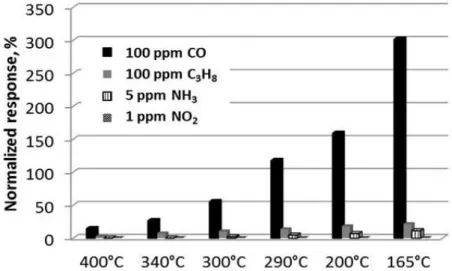
In order to increase the selectivity of semi-conducting gas sensors CuO, ZnO nanostructures have been integrated as sensitive layers on silicon substrates. A metalorganic approach has been employed for the preparation of CuO and ZnO anisotropic nanoparticles. Their gas sensing performance towards CO, C3H8 have been tested. The influence of the oxide nature is significant on the sensor response level and its selectivity to the reducing gases. Moreover, at an operating temperature T = 200°C, the sensors present an optimum performance towards CO with fast response and recovery time, unprecedented sensitivity (Rn= ca. 150%, 100 ppm CO, RH 50%) and selectivity as compared to NO2, C3H8 and NH3. Thus, these results highlight the remarkable role of CuO on the fabrication of very promising CO gas sensors.
Motivation and results
Semiconductor gas sensors have been widely studied due to their important applications in environmental monitoring and medical diagnosis [1]. They have attracted much attention in the field of gas sensing under atmospheric conditions due to their low cost and flexibility in production, simplicity of their use and large number of detectable gases/possible application fields. Semiconducting metal oxide sensors are one of the most widely used gas sensors. However, the main drawback of this type of devices is their lack of selectivity,
i.e. their capability to detect a specific gas in a mixture of several gaseous components. Many strategies have
been developed in order to achieve a better selectivity, i.e the use of mixed metal oxide layers and/or to dope the sensitive layer with noble metals such as Pt, Pd, …, well control the size and shape of the sensitive layer structures, catalytic filters, etc [2-4]. While a great attention has been focused on n-type semiconducting oxides, few studies have been devoted to the p-type gas sensors. Among p-type oxide semiconductors, single phase, or CuO as part of heterojunction sensors, have demonstrated considerable potential for detection of gases such C2H5OH, NO2, H2S, H2, CO, NH3. Some of these sensors exhibited interesting selectivity properties towards investigated gases. Up to now, various approaches have been reported to fabricate the CuO nanostructures in the literature. We have developed an organometallic approach for the preparation of crystalline copper oxide nanostructures. These CuO nanostructures have been deposited on miniaturized silicon gas sensor substrates by an ink-jet method or by using a screen-printing paste. More recently combining ZnO with a p-type semi-conductor has attracted great attention due to its enhanced sensing performance [5]. Such p-n heterojunction sensor will be tested with organometallic CuO/ZnO nanostructured mixed oxides and will be compared with the parent ZnO and CuO sensors under the same conditions.
References
[1] S. Deng , V. Tjoa, H.M. Fan, H.R. Tan, D.C Sayle., M. Olivo, S. Mhaisalkar, J.Wei C.H. Sow, Reduced graphene oxide conjugated Cu2O nanowire mesocrystals for high-performance NO2 gas sensor, JACS 134 (2012) 4905.
[2] Y. Shimizu, N. Matsunaga, T. Hyodo, M. Egashira, Improvement of SnO2 sensing properties of WO3 by noble metal
loading, Sens. Actuat. B 77 (2001) 35.
[3] A. Ryzhikov, J. Jońca, M. L. Kahn, K. Fajerwerg, B. Chaudret, A. Chapelle, Ph. Ménini, C. H. Shim, A. Gaudon, P. Fau, Organometallic Synthesis of ZnO Nanoparticles for Gas Sensing: Towards Selectivity Through Nanoparticles Morphology, J. Nanopart. Res. 17 (2015) 280.
[4] J. Jońca, A. Ryzhikov, M. L. Kahn, K. Fajerwerg, A. Chapelle, Ph. Menini, P. Fau, SnO2 “Russian Doll” octahedra prepared by the metalorganic approach: a new structure for sub-ppm CO gas detection, Chem. Eur.
J. 22 (2016) 10127.
[5] Y. Chen, Z. Shen, Q. Jia, J. Zhao, Z. Zhao and H. Ji, A CuO–ZnO nanostructured p–n junction sensor for enhanced N-butanol detection, RSC Adv., 6 (2016), 2504.
Word count: 430
Corresponding author: Pierre Fau, Laboratoire de Chimie de Coordination, 205 route de Narbonne, 31077 Toulouse
Topic: Chemical sensors
Figure 1: TEM (a) and HRTEM images and diffraction rings (b) of bare CuO synthesis
Figure 2: Semi-manual ink-jet method and silicon platform before sensitive layer deposition
Figure 3: Normalized responses of CuO sensitive layer to 100 ppm CO, C3H8, 5 ppm NH3 and 1 ppm NO2 at