HAL Id: hal-00296855
https://hal.archives-ouvertes.fr/hal-00296855
Submitted on 16 Feb 2006
HAL is a multi-disciplinary open access
archive for the deposit and dissemination of
sci-entific research documents, whether they are
pub-lished or not. The documents may come from
teaching and research institutions in France or
abroad, or from public or private research centers.
L’archive ouverte pluridisciplinaire HAL, est
destinée au dépôt et à la diffusion de documents
scientifiques de niveau recherche, publiés ou non,
émanant des établissements d’enseignement et de
recherche français ou étrangers, des laboratoires
publics ou privés.
Characterization of the precipitation in southwestern
part of Greece with X-band Doppler radar, 2-D video
disdrometer and rain gauges
E. Defer, M. Anagnostou
To cite this version:
E. Defer, M. Anagnostou. Characterization of the precipitation in southwestern part of Greece with
X-band Doppler radar, 2-D video disdrometer and rain gauges. Advances in Geosciences, European
Geosciences Union, 2006, 7, pp.121-125. �hal-00296855�
Advances in Geosciences, 7, 121–125, 2006 SRef-ID: 1680-7359/adgeo/2006-7-121 European Geosciences Union
© 2006 Author(s). This work is licensed under a Creative Commons License.
Advances in
Geosciences
Characterization of the precipitation in southwestern part of Greece
with X-band Doppler radar, 2-D video disdrometer and rain gauges
E. Defer1and M. Anagnostou2
1National Observatory of Athens, Institute for Environmental Research, Athens, Greece
2Department of Civil and Environmental Engineering, University of Connecticut, Storrs, Connecticut, USA
Received: 22 November 2005 – Revised: 6 January 2006 – Accepted: 10 January 2006 – Published: 16 February 2006
Abstract. We document precipitation in the southwestern
part of Greece with the National Observatory of Athens (NOA) X-band radar, NOA 2D video disdrometer and a net-work of rain gauges. The observations were collected be-tween February and April 2004. Time evolution of the drop size distribution (DSD) is presented for the 9 March 2004 case where rain rate (computed on 1-min period) was mea-sured up to 80 mm/h and reflectivity at the location of the disdrometer exceeded 40 dBZ. We then present the differ-ences of DSD as function of the rain rate for the studied case as well as for the entire observations of the field experiment. It shows that higher the rain rate is, larger the range of the DSD and higher the concentration of the raindrops are.
1 Introduction
Precipitation exhibits high variability in terms of intensity as well as spatial distribution. Weather radar remains the most suitable sensor to record and track the spatial distribution of the precipitating cells as well as to measure the intensity of the rain while rain accumulation and rain rate can be obtained locally, and easily, with rain gauges and disdrometers. In addition disdrometer provides details on the raindrops such their size or their orientation. Drop size distribution (DSD, concentration of rain drop per size bin) of the raindrops can then be investigated as well as properties and regimes of pre-cipitation during the entire life of rain events passing over the disdrometer. We present here some results of an on-going analysis of the data collected during the 2004 Ionian Sea Rainfall Experiment (ISREX-2004), which took place in Methoni on the coastline of the Ionian Sea (Peloponnese, southwestern part of Greece). Different types and regimes of rain were sampled and we present here an overview of their characteristics based on the measurements of the disdrome-ter.
Correspondence to: E. Defer
2 Instruments and method
The National Observatory of Athens (NOA) mobile Doppler X-band polarimetric XPOL radar was deployed to record precipitation in Southwestern part of Greece. The scan strat-egy applied in the present field experiment consisted in suc-cessive surveillance scans at a single elevation (2.1 deg). The radar was set up to record the precipitation at high temporal and spatial resolutions. The duration of each surveillance scan was on the average of 1 min. The range gates were set at 150 m and the radar range did not exceed 67 km. The scan strategy was imposed by the fact that a second instrument (not considered for the present study) was deployed over sea. Almost no RHI scans were performed over the disdrometer due to technical problems with the servo amplifier control-ling the motor moving the antenna along the elevation. More than half of the region scanned by the radar was over sea.
NOA also deployed a 2-D video disdrometer to document the characteristics of the raindrops. The disdrometer was located 9 km away from the radar. The disdrometer con-sists in two perpendicular 0.2 mm-resolution CCD scan lines recording the shade of the raindrops passing through two light beams illuminating the CCD lines (Sch¨onhuber, 1998). Algorithms are applied to combine the observations of each camera in order to identify the raindrops (seen by both cam-eras in their common field of view) and determine some physical characteristics of the raindrops such as their record-ing time, their equivalent diameter, their vertical velocity or their oblateness.
Additionally tipping-bucket rain gauges were deployed within a dense network over land to measure rain accumu-lation and rain rate at different locations. Three rain gauges were also deployed few meters away from the disdrometer.
Visible and Infrared METEOSAT images as well as light-ning observations from long-range UK MetOffice ATD sfer-ics sensors were used to bring additional information on the precipitating systems and clouds during both field experi-ment and analysis of the cases.
122 E. Defer and M. Anagnostou: Characterization of the precipitation in southwestern part of Greece
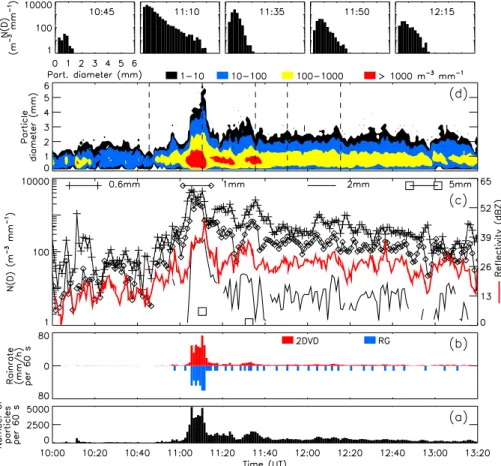
Fig. 1. (a) time series of the number of raindrops per min; (b) rain rate computed every minute from observations of the disdrometer and one
of the nearby rain gauges; (c) raindrop concentration for different 0.2 mm bins of equivalent diameters (0.6–0.8, 1–1.2, 2–2.2 and 5–5.2 mm) and uncorrected reflectivity measured at the location of the disdrometer; (d): iso-contours of drop size distribution as function of time (x-axis: time; y-axis: equivalent diameter; colours: raindrop concentration). Top panels: 1-min drop size distributions at different times (times are indicated in each panel).
Table 1. Rain rate classification.
Rain Rate (mm/h) Type min max Very light – <1 Light 1 2 Moderate 2 5 Heavy 5 10 Very heavy 10 20 Extreme >20 –
The method applied to analyse the data consists in retriev-ing the characteristics of the raindrops based on the 2DVD observations. Rain amount, rain rate and DSD are com-puted from the 2DVD data on a basis of 1-min time reso-lution. Rain rate was also determined from rain gauges lo-cated nearby the disdrometer. Surveillance reflectivity scans were plotted and animation of reflectivity images was used to investigate the motion of the precipitation as well as the intensity of the rain. Finally reflectivity above 2DVD was retrieved from the radar dataset.
3 Case of the 09 March 2004
The rain event studied here occurred during 9 March 2004 and lasted for more than 6 h. Figure 1 presents a synthesis of the typical parameters computed from the observations of different rain sensors for more than 3 h of rain. The analysis of the times series of the DSD showed that different regimes of precipitation occurred during the studied event (Figs. 1c and d). From 10:00 to 10:45 UT very light rain was measured at the location of the disdrometer and the equivalent diameter of the raindrops did not exceed 2 mm (Figs. 1c and d). Just after 10:45 UT a new regime of precipitation started with higher concentration of raindrops compared to the previous 45 min (Fig. 1d). Between 11:00 and 11:15 UT the disdrom-eter reported the highest concentration as well as the largest raindrops of the entire rain episode (Figs. 1c, d and DSD plot at 11:10 UT, top of Fig. 1). From 11:15 to 11:40 UT sig-nificant concentration of raindrops with small diameter was measured while the spectrum of DSD was less spread than during the previous regime of rain (Figs. 1c, d and DSD plot at 11:35 UT, top of Fig. 1). After 11:40 UT the range of DSD varied little (Fig. 1d) even if the concentrations of raindrops were varying as function of time with an overall decreasing trend (Fig. 1c).
E. Defer and M. Anagnostou: Characterization of the precipitation in southwestern part of Greece 123 During the period 11:00–11:15 UT, the rain rate exceeded
40 mm/h during more than 5 min (Fig. 1b). It is also during that period that the number of droplets reported by the dis-drometer was the highest for the entire rain event (Fig. 1a). This intense precipitating regime was characterized by high concentrations of raindrops as well as by a large spectrum of the DSD as shown in Figs. 1c and d.
Figure 2 shows different surveillance scans of (uncor-rected) reflectivity at three different times. At 11:10 UT reflectivity above 40 dBZ was measured over the location of the disdrometer (Fig. 2a) while at 11:35 and 11:50 UT XPOL reported reflectivity above 25 dBZ (Figs. 2a and c). As expected high reflectivity was recorded for periods dur-ing which both raindrops with large diameter and high rain-drop concentration were measured. It can also be seen in Fig. 1c by comparing the times series of the reflectivity mea-sured above the disdrometer (red solid line) and the different concentration of raindrops.
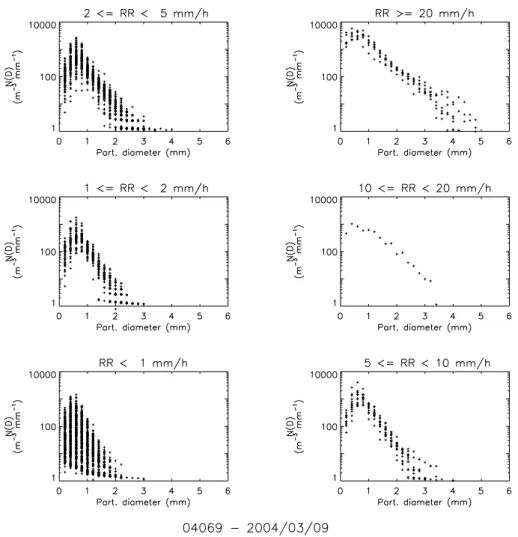
We extended the analysis by investigating the DSD changes as function of the rain rate (RR) for the studied day based on the measurements of the disdrometer (Fig. 3). Ta-ble 1 provides the definition of the types of rain and their RR ranges (Tokay et al., 1996).
For very light rain (RR<1 mm/h) and for a given size bin, rain drop concentration exhibits significant large variation in amplitude (up to three orders of magnitude, Fig. 3). Addi-tionnally the diameter of the raindrops hardly exceeds 2 mm. At larger RR, larger raindrops are observed and the concen-tration of raindrop for a given bin size increases. For in-stance, and for the present studied case, the concentration for raindrops with diameter up to 2 mm is about 10 times larger for extreme rain event (RR>20 mm/h) compared to moder-ate rain event (2<RR<5 mm/h) while larger raindrops are measured during extreme rain events.
4 Overview of the cases
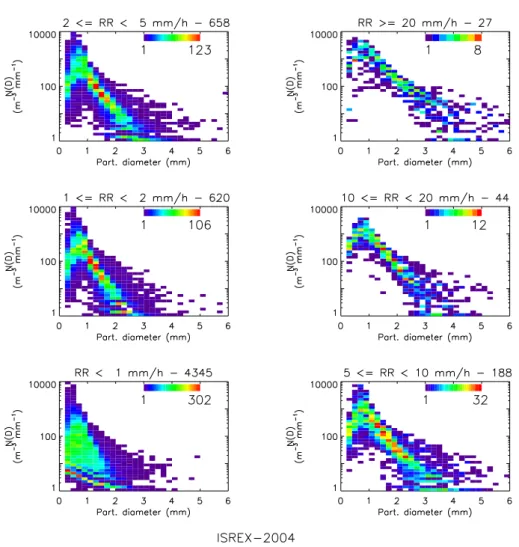
Figure 4 presents DSD as function of the rain rate based on the measurements of the disdrometer collected during 98 h of rain. Only 26% (16%) of the total period with rain ex-hibited RR>1 (2) mm/h (computed on 1-min time resolution as indicated in Sect. 2). The disdrometer collected very few samples during very heavy to extreme events. How-ever it should be noticed that significant reflectivity (above 40 dBZ) was measured during some of the precipitating events recorded during the field experiment but those high-reflectivity cells did not pass above the disdrometer.
For very light rain (RR<1 mm/h), we observed more often raindrops with diameter less than 1 mm with concentration ranging from 10 to 100 drops mm−3 mm−1. We observed
also some large raindrops but less frequently and also small raindrops (<1 mm) at high concentration. Investigations are underway to determine if those two categories of raindrops are real or due to instrumental errors.
For RR ranging from 1 to 10 mm/h, we can observe that the DSD seems to be distributed along a specific distribution
(a) 11:10 UTC
(b) 11:35 UTC
(c) 11:50 UTC
Fig. 2. Reflectivity at 2.1◦ elevation at different times within a 40×40 km box centred at the radar location. The white arrow points to the location of the disdrometer. The angular sectors cen-tred at 180 degrees azimuth (South) and between 320–360◦azimuth (North-North-West) were blocked by nearby hills.
but large variations of concentration are still existing for a given size bin. Current investigations are underway to com-pare our measurements and their validity to the different dis-tributions that have been published in the litterature.
124 E. Defer and M. Anagnostou: Characterization of the precipitation in southwestern part of Greece
Fig. 3. Drop size distributions at different rain rates recorded during the 9 March 2004 case.
Even if the number of 1-min periods with high rain rate (>10 mm/h) is small it is interesting to see that during that periods large raindrops were observed and the concentration of small raindrops was less than what was measured during very light to heavy rain.
5 Further investigations
The present work presents some results of an on-going inves-tigation. It presents the first measurements of DSD in Greece and on the coastline of the Ionian Sea. Unfortunately the samples associated with significant rain are relatively small in order to consider the results as being statistically represen-tative. It suggests that other observations are needed to doc-ument the high rain rates. However the present observations are still providing some insights for very light to moderate rains.
We will continue analyzing the disdrometric data and more specifically some other parameters such as oblateness or ver-tical velocity. We will also compare DSD that was deter-mined here with other DSD published in the litterature. We will also relate the disdrometric observations to determine
rainfall from NOA XPOL radar measurements based on the calibration of the radar with the disdrometric measurements.
Acknowledgements. This work is financed by the European
Union (75%) and the Greek Ministry of Development (25%) in the framework of the program “Competitiveness – Promotion of Excellence in Technological Development and Research – Excellence in Research Centers, Action 3.3.1”.
Edited by: L. Ferraris
Reviewed by: anonymous referee
References
Sch¨onhuber, M.: About interaction of precipitation and electromag-netic waves, PhD thesis, Institute of Communications and Wave Propagation, Technical University Graz, 1998.
Tokay, A. and Short, D.: Evidence from tropical raindrop spectra of the origin of rain from stratiform versus convective, J. Appl. Meteor., 35, 355–371, 1996.
E. Defer and M. Anagnostou: Characterization of the precipitation in southwestern part of Greece 125
Fig. 4. Probability of drop size distribution at different rain rates recorded during the entire field experiment. DSD bin set at 0.2 mm. The
number on the right of the title of each panel gives the total number of minutes with the given RR. The numbers just below each colour bar give the range of the number of DSD values for a given size bin and a given concentration bin.