AN ANALYSIS OF THE U.S. MILITARY ASSISTANCE PROGRAM - SOUTH KOREA
by RAYMOND H. GRENIER B.S. Boston University (1958) SUBMITTED IN PARTIAL FULFILLMENT OF THE REQUIREMENTS FOR THE DEGREE OF MASTER OF SCIENCE
at the
MASSACHUSETTS INSTITUTE OF TECHNOLOGY
August, 1971
Signature of Author:
Department Depatmen of f ,y0 tical Scione nP'gus gut 18, 1971
Certified by:
)
\3
Thesis Supervisor Accepted by:Chairman, Departmental Committee
Archives
eSS. IEn. FESEP 17 1971
Lia RA RIES
AN ANALYSIS OF THE U.S. MILITARY ASSISTANCE PROGRAM - SOUTH KOREA
by
Raymond H. Grenier
Submitted to the Department of Political Science on August 1971 in partial fulfillment of the requirements for the degree of Master of Science.
It is assumed that Military Assistance will continue to be a major foreign policy mechanism utilized by this country in promoting national interest. The large number and the dynamic nature of the programs now in being, and the high probability that new programs will be required in the near future, suggest that a detailed analysis
of a model program would aid in understanding the value, potential, and problems of this activity. South Korea was chosen as the case study because it has received military assistance for several years, there is a viable threat to its security which acts as a stimulant to the program, the effectiveness of the forces has been tested in actual military operations, and because of personal experience with this particular program.
Chapter I
In this chapter the United States/South Korean dialogue following the announcement of the Nixon Doctrine is reviewed. The reaction and mood of South Korea is revealed through selected quotes of various national leaders. The development and nature of the compromise U.S. force reduction program is included.
Chapter II
This chapter includes overviews of the three main force-elements which are integral to the development of the Military Assistance Plan
in this area. These include the South Korean military forces, the U.S./U.S. forces maintained in country, and the North Korean forces who represent a direct threat to the security of the country.
Chapter III
A historical development of the U.S. Foreign Aid and Military Assistance programs and, im particular, those which are operative in South Korea is presented. The current varieties of military assistance are also discussed including a detailed analysis of the methods and techniques of military assistance planning and programming.
Chapter IV
A detailed discussion of the South Korean assistance programs including the political, economic, and military aspects is presented.
An attempt is made to evaluate the effectiveness of the program by reviewing the performance record of the South Koreans in Vietnam and in reacting to the INZ violations and infiltrations of North Korea. Chapter V
Areas other than purely operational which affect the effectiveness of the South Korean military are discussed. The broad subject of
military support is reviewed in detail as it represents the most limiting facet of the South Korean forces, and. as such provides indicators of how future MAP planning should be directed. The role of the military
advisor is also discussed. Chapter VI
This chapter consist of conclusions and recommendations concerning the value of the South Korean MAP as a model for future Military
Assistance programs. Strengths and weaknesses discussed and the judgments offered are based on the data researched and on personal experiences
in the field.
Thesis Supervisor: William W. Kaufmann Title: Professor of Political Science
Table of Contents
ABSTRACT 2
INTRODUCTION 5
CHAPTER
I The Nixon Doctrine and South Korea 8
II Force Elements 15
III Foreign Aid and Military Assistance Overview 32 IV Analysis of the South Korean MAAG Effort 52 V Evaluation of the South Korean Military and MAAG 69
VI Conclusion and Observation 81
LIST OF TABLES
I Military Assistance Program
Executive Branch Organization 42
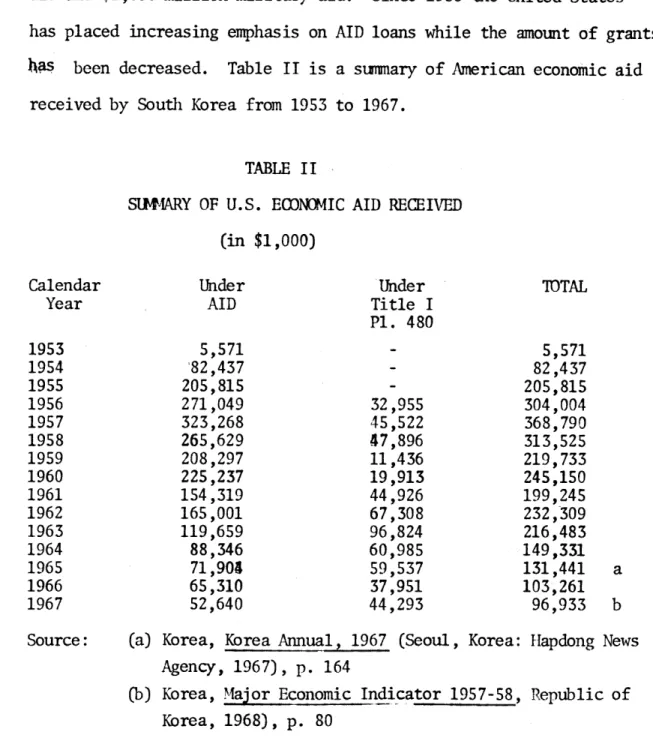
II Summary of U.S. Economic Aid Received 45 III Korean Map and Excess Defense Articles By
Fiscal Year 46
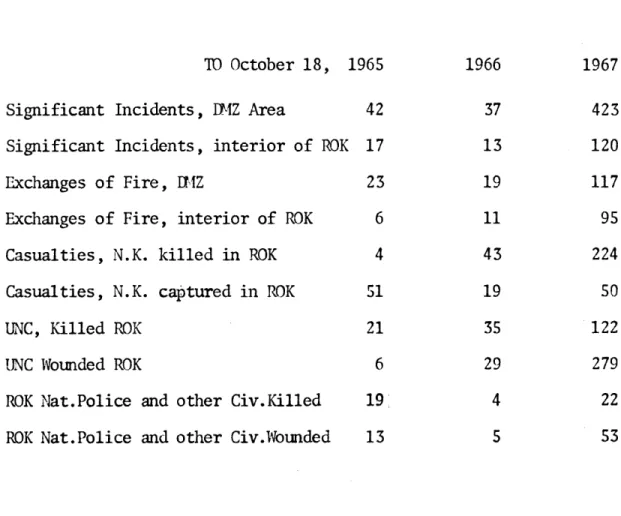
IIIA Incidents and Casualties Caused by North Korean
Infiltration 57
TV Inducements Offered South Korean Defectors 60
V Results of Battle in Vietnam 65
In 1969 President Nixon, in a major policy address delivered on the Island of Guam, outlined what has come to be known as the Nixon Doctrine. While the President carefully reassured his audience that this country would maintain its interest and commitments in Asia, he also expressed his belief that some Asian countries are now in a posi-tion to assume a larger share of the responsibility for the security of the area. Although the Nixon Doctrine deals with many facets of Asian policy nuch of its emphasis is directed to the status of mili-tary forces, both U.S. and indigenous. The doctrine calls for a re-trenchment of conventional United States forces, phased so that they will be replaced by properly trained and equipped local forces. The
President and other government officials have stated that the Military Assistance Program will be one of the vehicles used to bring about
this more cooperative security environment. In light of this new emphasis, the purpose of this study is to examine Military Assistance within the context of one of the countries most affected by the
Nixon Doctrine - South Korea.
South Korea was chosen for several reasons: It is one of the countries where the Nixon Doctrine has had imediate impact and where
there has been a variety of reaction; because South Korea has had a large and active Military Assistance Program for several years and there is unclassified documentation available; because South Korea has a real threat to its security represented by North Korea and this
threat is vividly dramatized on practically a daily basis; because several unique situations exist in South Korea which bear directly and indirectly on the Military Assistance Program; and finally because of
a personal interest in this particular area evolving from a recent assignment as a Military Advisor to the South Korean Air Force.
In organizing my research I attempted to isolate the following factors: 1) the direction that the Nixon Doctrine would drive the U.S./South Korea situation; 2) the extent that North Korea represents a viable threat to the security of South Korea, and the extent and direction that the threat is exercised; 3) documentation that would support arguments for or against the effectiveness of South Korean Armed Forces in various modes of military activity; 4) specifics about the evolution and character of the South Korean Military Assis-tance Program, and 5) commentary concerning the major component parts of the South Korean MAP.
Because of the constraints of Security Classifications, and limi-ted time and research material, it was not possible to support some of the assumptions and observations made, which are based primarily on personal experience. In fact, commentary in the area of support capability and analysis, with the exception of training, is conspicu-ous by its absence. To have questioned more deeply into the support area would require access to material not available outside of the
logistics channels of the U.S. Military Services.
The basic intent of this study can be summarized in the following manner. The Nixon Doctrine calls for Asian nations to carry a greater share of their defense while our share of the Asian Security responsi-bility calls for greater emphasis on Military Assistance Programs. If one assumes, as in the case of South Korea, that the American forces being withdrawn were originally sent to help counter the threat from North Korea, then it follows that the Administration feels that the South
Korean Armed Forces are capable of filling the void. Since the program most responsible for the condition of South Korean Armed Forces is the Military Assistance Program, it would be useful to identify those facets
of the program which have been successful and, if possible, those which have not, so that the future programming of Military Assistance Aid might profit from the Korean experience.
CIAPTER I
THE NIXON DOCTRINE AND SOUTH KOREA
Because the Nixon Doctrine represents a major shift in U.S. Foreign Policy it has been the focus of a great deal of concern in this country as well as in those Asian countries which are directly involved.
President Nixon summarized the essence of the Doctrine in his 1970 Report to Congress in the following way:
The United States will keep all its treaty commitments. We shall provide a shield if a nuclear power threatens
the freedom of a nation allied with us, or of a nation whose survival we consider vital to our security and
the security of the region as a whole.
In cases involving other types of aggression we shall furnish military and economic assistance when request-ed and as appropriate. But we shall look to the nation directly threatened to assume the primary rysponsibility of providing the manpower for its defense.
lie further amplified the above points by carefully emphasizing that this new policy
.... requires our commitment to helping our partners develop their own strength. In doing so we must strike a careful balance. If we do too little to help them - and erode their belief in our commitments -they may lose the necessary will to conduct their
own self-defense or become disheartened about
prospects of development. Yet if we do too much, and American forces do what local forces can and should be doing, we promote dependence rather than ins
dependence.
In providing for a more responsible role for
Asian nations in their own defense, the Nixon Doctrine means not only a more effective use of common resources,
but also an American policy 1hich can best be sustained over the long run.
The implementation of the Nixon Doctrine from its announcement to the point where there has been actual restructuring of Military forces in affected Asian countries has been relatively swift. In Korea, the implementation has not only been rapid, but it has also been attend-ed by a variety of reactions ranging from the threatenattend-ed resignation of high government officials to the final acceptance of a compromise American troop reduction plan, the first since the Korean War.
In July 1970 the Pentagon announced that 20,000 American ground troops would be withdrawn from South Korea by mid - 1971. However, this announcement had been preceded by a period of intense negotiation
because of the violent objection among Korean officials. President Chung Hee Park and Prime Minister Chung S1 Kwon berated the U.S. for the decision and the Prime Minister actually threatened to resign if the U.S. did not agree to delay the withdrawal until 1976 and pledge
$ 1 billion in military aid spread over the five year period.3 Following the initial announcement and its attendant turmoil in South Korea, President Nixon and several top administration spokesmen launched a campaign designed to explain the basic intent of the
Doctrine with particular emphasis on reasuring the South Koreans. For instance, in an interview on the American Broadcasting Company's
television and radio program "Issues and Answers" on January 18, 1970 Secretary of State Rogers,responding to a question about the country's position towards our existing defense commitment, stated:
Asians. I believe though, as a result of the trips by President Nixon, Vice President Agnew, and myself that we have tended to put their minds at ease. We can live up to our treaty responsibilities and still reduce our presence in Asia, and we are reducing our presence in Asia; and I think we have assured them to their satis-faction that we mean it4 We are going to live up to
our treaty obligations.
Responding to specific questions about the situation in South Korea, Secretary Rogers added:
.... we don't have any present plans to reduce our troops in South Korea, but undoubtedly the troops will be gradually reduced over a period of years. Now, that will be a decis on the President has to make down the road a bit. But of course it does; it means we will gradually reduce our troop
strength in some of these areas depending on the circumstances... We certainly have no intention of forever having troops in South Korea, but I wouldn't want to suggest we are going to take all of our troops out of South Korea in the foreseeable future as long as North Korea behaves the way they do.
At a press conference in July of 1970 Secretary Rogers again addressed himself to the South Korean situation, specifically to the threat of the Prime Minister that he and his staff would resign if the United States did not take measures to modernize the South Korean Army before any withdrawals were made. His reply indicated that several meetings had been held with the Foreign inister of South Korea and assurances had been repeated by this government that we would do what we could to modernize their forces to fill the
vacuum caused by U.S. troops withdrawals. He added that: I think that they regret the decision, but I think that they realize that we are going to cooperate with then. We have reiterated that this is not in any way a lack of resolve on our part to live up to our treaty commitments, and we will do what we can to reassure them and to make it clear to the other side that we are going to remain strong and that the forces ?f the
Vice President Agnew was also called upon to reassure the Koreans and he included a visit to Seoul in the itinerary of his Asian tour in mid 1970. The report of his Korean visit contains some indication of how the negotiations between the United States and South Korea were progressing. le repeatedly reaffirmed our government's intent to honor the 'utual Defense Treaty, but also made it quite clear that American ground forces would be reduced. However, he did announce that a squadron of F-4 tactical fighter aircraft would be permanently stationed in Korea and that, as a counter to increased North Korean attempts to infiltrate from the sea, special radar equipped patrol aircraft would be made available to the South Korean Navy. He further stated that
I am here to assure you that in connection with our commitment to Korea, the United States intends to provide your Government with additional military assistance to substantially modernize the defense ca-pability of your military. 8
Statements made by Prime Minister Il Kwon Chung indicate that
by this time the South Koreans were becoming resigned to the
situation, and were satisfied that they were not being abandoned by the United States.
Vice President Agnew in a press briefing after having left Seoul. admitted that a basic accord had been reached with the Koreans, but reaffirmed that the U.S. takes the position that the reduction is not contingent upon the modernization, nor is modernization contingent upon reduction.9
In a message to Congress delivered on November 18, 1970 President Nixon requested a supplemental appropriation of economic and military
assistance funds required because of the impact of the Nixon Doctrine, His comments concerning the Korean situation indicated in general
terms the nature of the agreements between the two countries. He said: I have announced our intentions to reduce by 20,000 the
authorized level of United States forces in the Republic of Korea. This has placed a greater defense burden on the Koreans.
Our present assistance to Korea is mostly of operations-and-maintenance items for their military forces. These items do not help to modernize the Korean force structure as we must do if we are to help Korea improve its own de-fense capability.
I therefore request authority to transfer to Korea
equipment currently being utilized by United States forces scheduled to be withdrawn.
Additional assistance is required this year as part of Korea's major five-year program to modernize its defense forces and to enable it to effectively meet
out-side threats as we reduce the level of direct U.S. involvement. These funds are needed now to insure that the needed equipment will be delivered in good time. I request that Congress provide 150 million dollars in suppofb of this modernization of South Korea's defense.
The impact of the Nixon Doctrine on South Korea now seems to have stabilized. The violent objections with which the Korean Government initially reacted have calmed and troop realignments have begun. The compromise which has mollified the Koreans includes: no with-drawals beyond the announced 20,000 men, the turnover of about $100 million worth of surplus United States military equipment which will
be left behind by the returning troops, an additional $150 million of Military Assistance for the modernization of the Korean Armed
Forces in addition to the regular military aid amounting to $140 million approved for this year, and the relocation of a tactical fighter wing from Japan to Korea.1 1
Examples of news releases from Korea are indicators of the rapid pace that the military force structure is changing:
After 18 years troops of the U.S. Second Infantry Division are being withdrawn from an 18 mile sector of the Korean Demilitarized
Zone.12
An Air Force Wing of 54 F-4D Phantom fighter bombers has been permanently transferred to Kunson Air Base, 120 miles south of Seoul, from Japan. 1 3
The South Korean Government is considering the possibility of withdrawing the 50,000 South Korean troops now stationed in South Vietnam, and also increasing the size of the defense forces in order to offset the U.S. troop withdrawals.1 4
Considering the intent of the Nixon Doctrine as described above, the context of the negotiated agreement between this government and South Korea, and actual conditions as they presently exist in South Korea today, it appears that the
security
of the area rests upon two pillars. The first consists of the South Korean military establish-ment bolstered by a large military assistance and advisory program.The second is implied in the pledge contained in the Mutual Defense Treaty, dynamically dramatized by the presence of a large U.S. force permanently stationed in South Korea. The Military Assistance Program affects and is affected by both of these major factors, and the whole
force structure package is carefully tailored to the most immediate threat, North Korea. In order to place the military assistance program as it operates in South Korea in the proper perspective it is necessary to briefly review these three major force elements.
CHAPTER I - FND NOTES
1. U.S. Government, Speech by Richard M. Nixon, Dept. of State Bulletin, Washington, D.C. 9 Nov. 1970, p. 294
2. ibid, p.294
3. "Yankees Going Home", Time Magazine, Aug. 3, 1970, p.24 4. U.S. Government, Speech by William P. Rogers, Dept. of State
Bulletin, Washington, D.C., 9 Sept. 1970, p. 152
5. The official announcement of the American Force Reduction of 20,000 men was made in July 1970
6. Rogers, William P., op. cit. in 4, p. 152
7. U.S. Government, Speech by William P. Rogers, Dept. of State Bulletin, Washington, D.C., 3 Aug. 1970, p. 125
8. U.S. Government, Speech by Spiro T. Agnew, Dept. of State Bulletin, Washington, D.C., Oct. 5, 1970, p.381
9. ibid, p. 382
10. "Why Nixon Wants Another $1 billion For Aid to Allies", U.S. News and World Report, Nov. 30, 1970, p.62
11. "U.S. - South Korea Agree on Cutback", New York Times, 27 Jan 1971 12. "U.S. Troops to Withdraw from Truce Line in Korea", Christian
Science Monitor, 10 Feb 1971
13. "U.S. Jet Squadrons Shifted From Japan to South Korea", New York Times, 16 Mar 1971
14. "South Korea Studying Viet Withdrawals", Brockton Daily Enterprise, lass., 9 March 1971
CHAPTER II
FORCE ELEMENTS
SOUTH KOREA
On the 5th of June 1950, when the Communist forces moved south across the 38th parallel with armor, heavy artillery and tactical air-craft, the ROK Army of 94,000 officers and men consisted of 8 under-strength and poorly trained divisions and two separate regiments. Training during the preceding year had progressed only to the point where each soldier had fired a qualification course with his individual weapon, and only two regiments had completed the battalion phase of unit training.
The ROK Air Force consisted of twelve L-4 and L-5 type airplanes which had been furnished by the United States for liaison and artillery
use, and ten AT-6 training ships purchased by the Korean Government. The Navy consted of a skeleton Coast Guard and one Marine regiment. There was no field army or corps organizations and comand and control could only be directed by ROK Headquarters.1
Today the military establishment of the Republic of Korea is the second largest military force in the Far East, exceeded only by Communist China. The armed forces have a total personnel strength of about
Navy of 50,000 and a Marine Corps of 33,000.2
The Army presently consists of 19 front line infantry divisions organized into the First Army deployed along the demilitarized zone dividing North and South Korea, and the Second Army made up of four military district commands and tasked primarily with the administration
and training of the reserve force and recruits.3 Most of the Army's equipment is of U.S. origin and consists of modern hardware such as M-48 tanks, M-79 grenade launches, and integrated military communications
networks. There is one battalion of "Honest John" rockets, two squadrons with "Hawk" surface-to-air missiles, and one battalion of "Nike-Hercules" surface-to-air missiles.4 The total number of South Korean
anti-air-craft missiles is reported to be 80.5
This equipment list is in the process of dynamic change as the U.S. forces, withdrawing from their positions on the IZ, turn over their equipment to their South Korean replacements.
The ROK Army has maintained a sizeable force in Vietman since 1964. Besides compiling an impressive combat record, the Korean army has profited from the Vietnam experience in that through the rotation of
troops in Vietnam they have exposed and trained their cadre in modern combat techniques against an enemy equipped and trained much the same
as the one they face in North Korea. The Vietnam situation will be more fully developed later.
The Chief of Staff of the Army commands all components of the Army, however, operational control of the field army, corps, division and
AAA Brigade is exercised by the Commanding General 8th U.S. Army.
Center, 19 Service Schools including a Command and General Staff College, and the Korean Military Academy.
There are Korean Military Assistance Group detachments at each of the major POKA commands and at other echelons down to and including the Corps and certain Military Districts.6
The ROK Navy is mainly limited, because of its small size, to coastal patrol, mine sweeping and limited amphibious operations.
Recently expanded to a total strength of 50,000 because of the increased threat of North Korean infiltration by sea approaches, the Navy command and control structure consist of a fleet command, two combat groups, two independent squadrons, and a training group. They operate 3 destroyers, 4 destroyer escorts, 4 frigates,15 coastal escorts,
3 fast transports, 11 coastal mine sweepers, 8 tank landing ships, 12 medium landing ships and 12 other ships. 7
Most of the officer personnel are procured from the Naval Academy, which conducts a four year course of instruction. In addition to these,
and a number of officers obtained from the Merchant Marine Academy, a few are obtained from civilian universities and given 12 to 16 weeks course prior to commissioning. There is also a Naval War College for senior Navy officers. 8
The ROK Marine Corps is subordinated to the Navy, and consists of five brigades, with one, the 2nd "Blue Dragon" brigade, serving in Vietnam. The remaining brigades are tasked with the defense of the capital and the security of the islands off the west coast of Korea.
Its equipment is modern and ROK marines are unusually well trained and motivated.
The ROK Air Force is the newest of the services, organized in May, 1948, as the Korean Air Base Group. It has a total strength of
23,000 and an equipment list consisting of 200 combat aircraft including
55 F-5 tactical fighters, 20 F-86D all weather interceptors armed with sidewinder missiles, 100 F-86F interceptors, 10 RF-86F reconnaissance aircraft, 29 C-46 and Aero Commander transports, 3 C-54 transports used in support of the Vietnam forces, T-33 and T-28 trainers and some Checkasaw and HU-1 helicopters used for liaison, counter-insurgency and priority material handling in support of remote operating locations. The Air Force also operates an aircraft control and warning network, and a modern microwave and tropo-scatter communications network.9 The U.S. Air Force Military Assistance and Advisory Group is completing the
F-4 tactical fighter modernization program. A squadron of 15 of these
aircraft was provided to the South Korean Air Force in order to bolster the defense against the MG-21's operated by North Korea. 10
The Chief of Staff of the ROK Air Force has full operational
control, his post corresponding closely to that of the Chief of Staff of the USAF. His relationship with the chiefs of the ROK Amy and the
CNO are comparable to those of the U.S. services. Officers are obtained from the Air Force Academy and through Officer Candidate Schools for qualified college graduates. The 6146th Air Force Advisory group USAF provides advisors at all echelons from headquarters ROKAF down to Squadron level.
In addition to their obvious utility as indicators of military potential, the above lists of military hardware and, even to a greater degree the highly specialized and modern equipment being transfered by
the departing U.S. troops to their Korean replacements draw attention to the sophistication of the force. Equipment of this type places a heavy premium on maintenance, supply and training facilities, and this
in direct proportion to the overall effectiveness of the Military. Since the South Korean military establishment is a technologically advanced military force it must provide the proper operations and training programs to its personnel. This is done both in country and outside as, either a feature of the military assistance program, or in a third country as a function of mutual defense agreements.
To use the Air Force as an example, the ROKAF training Command provides modem facilities for basic training and skill development. These facilities are modeled after USAF facilities and use much of the same training and course material. Instruction is provided in a variety of areas including air operations, basic flying instruction, aircraft maintenance, air traffic control, photographic interpretation, communications equipment operations and maintenance, and supply ad-ministration.12 Graduates of these centers are then exposed to
on-the-job training at operational units until testing and performance
indi-cates they are competent. In addition, instructors at these centers, and key supervisory NCO's receive training through the Military As-sistance Program. Thousands of Korean military personnel have re-ceived training since the program was established. Selection for this training is competitive and opportunities are provided for language training centers.
Third country training, utilized when it becomes economically expedient to provide special training for a large number of personnel without consuming funds for travel to the continental U.S., is
pos-sible because many Asian countires have received similar equipment through the Military Assistance Program.
Special courses on this equipment, or on procedures and tactics common to these countries can easily be organized using specially trained instructors or mobile training teams from the United States.
Another dimension of the training program will be treated in a later chapter.
NORTH KOREA
The modern Korean People's Army was formally established on February 8, 1948. At the ceremony marking the foundation of the Army, Kim II - Sung reminided the nation of "...the task of strengthening military discipline, educating the soldiers in bravery and heroism and mastering Soviet military science, and the valuable combat ex-perience of the Soviet Armed Forces."13 This task has been one of the central goals of the country since that time and at present the North Korean Military force is estimated to total approximately 400,000 in-cluding an Army of some 360,000, an Air Force of over 800 aircraft, and 30,000 men, a Navy with a defensive coastal fleet of about 160 small craft and 10,000 men. The regular forces are augmented by a civilian militia with a claimed strength of 1,200,000 making the size of the military establishment surpassed only by those of the Soviet Union and Comunist China among the Communist Nations. 14
In structure and equipment the North Korean military is patterned after the two major communist powers. The equipment used by all
services is mostly of Russian manufacture and obtained through various foreign aid programs.
The Army has an estimated total strength of 360,000 men organized into 1 amoured division and 18 infantry divisions. There are also 5 independent infantry brigades. The Army is equipped with 800 Soviet tanks including PT-76's, T-34's, T-54's, and T-55's, 200 Su-76's, Su-100 and Su-57 self-propelled guns, and 5000 other artillery pieces up to 152 mm guns. They also have 15 SA-20 "guideline" surface-to-air missile sites with about 300 missiles. There are about 15,000 men in "special commando teams" who specialize in clandestine and insurgency activities. Members of this group carried out the attempted assassination of South Korean President Park in 1968.15
The North Korean Navy with a total strength of 10,000 operates
4 Soviet W class submarines, 10 fleet mine sweepers, 14 coastal escorts, 4 missile patrol boats, 21 motor torpedo boats (less than 100 tons), 30 other small patrol boats and one slightly used U.S. intelligence boat.16
The Air Force derives its main strength from its more than 590 combat aircraft. These include 30 MiG-21 interceptors, 60 11-28 jet light-bombers, 50 MiG-19 interceptors, 450 MiG-17 and MiG-15 fighter bombers. They also operate 27 AN-2 and Li-2 transports, with 20 Mi-4 helicopters. Yak-9, Yak-11, Yak-18, MiG-15 and 11-28 are used for pilot and crew
. . 17 training.
Recently the South Korean Defense Minister announced in an interview that he had reason to believe that there were some MiG-23 aircraft in North Korea. 1 8
The para-military, territorial militia is now reported to be over the million personnel mark and appears to be a formidable factor for domestic discipline and for organized wartime support. The Militia is composed of men and women including factory workers, farmers, intellect-uals and others from all walks of life. Its members are organized into regiments composed of about 12 companies formed in factories, villages, cooperatives, and schools, and are sponsored and supervised by one of the Regular Army groups and by the Party as well.1 9
North Korea is also reported to have 19 factories capable of producing 73 million small-arms rounds, 6.5 million hand grenades,
650,000 artillery rounds, 14,000 tons of explosives, 150,000 rifles and
300 mortars a year.20
The bulk of enlisted personnel for the services are conscripted youth who are trained and administered by the relatively permanent cadre. Normal service is 3 years and six months for those in the Army and 4 years for the Navy and Air Force. Enlisted personnel may be discharged at any time for a variety of reasons including medical,
ideological, and political. A vocational placement and guidance program is provided following discharge.
Officers receive their commissions via their individual services Officer Candidate Schools, or as graduates of the cademies. Some officers have risen from the ranks. There does not appear to be any favored or elite class dominating the officer ranks.21
Training in the North Korean Military has been tempered by both Soviet and Chinese advisory teams. Several training sites have been established including a military school system for the basic and
advanced training of officers and enlisted men. Judging from the sophistication and advanced technology of the equipment operated and maintained, and by the appearance and performance of units in parades and demonstrations it appears that the training program is quite successful.
As in all communist military establishments political training plays a major role in the development of personnel. Recruits find that the Party's indoctrination program is vigorously enforced and future promotion depends on successfully meeting political training goals.
A unique feature of the training system is the military instruction conducted at all colleges and universities. It is compulsory for all male students to undergo 200 hours of training each year in addition to his regular academic work. The military subjects are taught by active duty officers and students must pass their military subjects before they are allowed to take examinations in their academic subjects and those who fail, leave school.22
Recently, because of reduced Soviet aid and Kim Il-Sung's added emphasis on military preparedness, the cost of maintaining the military absorbs a major portion of the national economy. Defense outlays for calendar year 1967 were raised sharply to 30.2 percent of the budget. In April 1968 a Cabinet minister announced an additional increase to 33 percent for military expenditures.23
The announced intention of Kim Il-Sung to re-unify the country before his 60th birthday with its attendant expanded program of INZ violations
additional demands on the Military which will result in higher cost. There is also reason to believe that new problems requiring expanded military involvement are developing on the Chinese border. It was recently reported in an Indian newspaper that because of clashes along the 600 mile border between Manchuria and North Korea the Chinese have sealed the border. China has claimed a large strip of North Korea which includes a heavily guarded military zone defended by
surface-to-air missiles, on the strength of its intervention in the Korea War. 24
Since 1966 when it was decided to change the character of the economy and give greater attention to military preparedness, the role of the military in politics, has greatly expanded. Many officers hold key positions in both the Korean Workers Party and in the government.
Most of the individuals who reach positions of power are those who have been closely associated with Premier Kim Il-Sung since WI IT and who survived the purges following the Korean War. Until 1959 there was a dual political - military structure, of the model common in most
communist countries. This system, because it caused conflicts between the professional military components, and the "political commissar" was reformed in order to tighten the party control over the military, A series of Party Committees and corresponding political offices have been established at all levels of command and is responsible for accommodating the political needs of the troops. The reorganization has also led to the expedient of combining the political and military functions in the same, properly conditioned officer.
U.S. FORCES
The third major element involved in the total military posture in the area are the U.S. military forces permanently stationed in South Korea. In spite of the announced withdrawal of 20,000 men, the U.S. contingent is still a large force capable of quick reaction. Current plans call for the retrenchment of U.S. troops from the forward positions they have manned on the western end of the DaZ, to reserve position in the interior of the country. This will result in the disbanding of the U.S. 7th Infantry Division. After this reorganization, U.S. Forces in Korea will stabilize at about 43,000 Army personnel, assigned to the 2nd Infantry Division, the Headquarter Staff of the 8th U.S. Army, and various air defense, maintenance, and medical support organizations.
The recently assigned F-4E fighter wing will bolster USAF forces under the command of the 314th Air Division. Other Air Force units in country are tasked with air control and warning missions, and other tactical control functions.
Not included above are the Military Assistance Groups which will be covered later.
Although the U.S. forces in Korea and those on call in the immediate area are a substantial element in the total security equation there are, however, other relationships in the interface of South Korean and U.S. forces more germane to the basic concern of this study in that they bear directly on the effectiveness of the Military Assistance Program.
Perhsps the most significant of these second order relationships is the Korean Augmentation to the United States Army Program (KATUSA).
This program involves the assignment and integration of the Republic of Korea Army (ROKA) enlisted personnel into units of the Eighth U.S. Army. It has two basic purposes:
(1) Increasing the operating capability of the U.S. Army units to which these ROKA personnel "KATUSAs" are assigned.
(2) Providing additional well-trained personnel and skilled technicians for ROKA.
The program of augmenting U.S. military units with Korean troops began in 1950 as a field expedient. Today, it is a program of inter-national cooperation through which extremely important contributions are made to the separate and collective needs of the U.S. and ROK Armies. The program permits the U.S. Army to maintain units of full strength and operating capability and, simultaneously, helps reduce the cost to the U.S. both in money and in manpower. It provides the U.S. units the tactical advantages that go along with assimilation of local troops into U.S. ranks. It has also helped to contribute to the building of an even more powerful allied army, for the Pepublic of Korea gains by means of this program, well trained personnel who will return to the ROKA and will be used as highly skilled trainers. At the same time, ROKA is spared some of the burdens of arming and
supporting these men while they are attached to the U.S. units. At present there are about 11,000 personnel in the KATUSA. To be selected an individual must have at least a 6th grade education and some English language training. Each man selected is provided a short familiarization program at the KATJSA training center prior to being assigned to an American unit. There are no commissioned or
warrant officers in this category and KATUSA personnel may not be assigned permanently as kitchen police, laborers, cargo carriers, houseboys, or other non-military tasks. This does not prohibit the rotation of KATUSA personnel, as individuals, to these housekeeping-or guard and security details, to which American personnel are
regu-larly detailed by unit duty rosters.26 Every effort is made to assim-ilate these augmentees into units as thoroughly as possible. There are cases where Korean NCO's are in supervisory positions over lower ranking U.S. troops; and further, because KATUSA have a permanency which the short tour length in Korea (13 months) denies Americans,
there are examples where KATUSA's provide high quality on-the-job
training for U.S. troops. This is particularly true in those operational centers where Korean and U.S. personnel work side by side and the
Koreans, because of their familiarity with the country, language, and the various contingency plans, dampen the effect of the rapid turnover of U.S. troops.
Although the training offered the KATUSA should not be equated
with the more formalized effort which is part of the Military Assistance Program, it does make a major contribution to general effectiveness of the South Korean forces and thus does parallel the basic intent of
the Assistance Program.
Another spin off from the U.S. military forces in South Korea
which affects the Assistance programs results because the U.S. presence provides a dynamic model against which the Korean Forces can compare their activities and even draw upon on occasion. There are many cases, especially during periods of increased alert such as following the
Pueblo seizure, when the rather slow mechanics of the Military As-sistance Program could not meet inmediate operational demands. During these times U.S. in-country maintenance, supply, and logistical re-sources can be used to supplement the Korean capability. This by-passes the long procurement lead times required for standard MAP
pro-gramming by drawing on U.S. material and expertise because of over-riding operational needs.
During joint exercises, ROK units operating side by side with
U.S. units can compare their performance, witness advanced tactics
be-ing demonstrated, and observe how modem military equipment is used
--all in the physical environment that the Korean forces must operate. This unique characteristic of the Korean situation does have dis-advantages. Very often inefficiencies in either the Military Assis-tance Program or in the ROK forces themselves are overlooked or tole-rated because of the expedient of simply having the "Americans do it". This is particularly true in the area of supply and logistical support. Often high value items essential to the proper functioning of
sophis-ticated equipment are not stocked in sufficient numbers because to do so would deplete funds from the limited resources available. The ra-tionale justifying this practice being that if conditions deteriorate to the point where joint operations are affected the U.S. forces will intercede and by-pass the Assistance channel in order to expedite the fix.
Another possible negative effect develops whenever Koreans com-pare their forces with the obviously better equipped U.S. troops and assume from this a lack of confidence in their own military, and an overreliance on U.S. forces. This partially explains the violent re-action described earlier which followed the announcement of U.S. troop withdrawals from Korea.
The basic reason for presenting this brief overview of the major forces operating within the area is to dramatize the highly sophisticated environment within which the Military Assistance Program must operate. The size of these force elements, the types of equipments they utilize, and the integrated nature of many of the operations the South Korean and United States forces participate in to counter the North Korean threat) provide insights into the magnitude of the M.A.P. The following discussion will add another dimension to the development of the program.
CHAPTER II - FND NOTS
1. U.S. Government "U.S. Army Area Handbook for Korea", Foreign Areas Studies Division, Special Operations Research Office, The American University, Washington, D.C., Nov. 1964, p.435
2. Choenski, Walter, "Country Study, Republic of Korea", American Institute for Research, Washington, D.C., May 1963, p.65
3. U.S. Government, op.cit. in 1, p. 442
4. "The Military Balance" 1970-1971- Institute of Strategic Studies, London, p.65
5. Korea Week, Washington, D.C., 15 Dec. 1970, p.2
6. Choenski, Walter, op.cit., p.67 7. "The Military Balance, op.cit., p.65 8. Choenski, Walter, op.cit. p.72
9. "The Military Balance" op. cit., p.65
10. Ashworth, George W. "U.S. 'Five-Year Plan' of Korean Withdrawal", Christian Science Monitor, 30 July 1970, p. 1
11. Choenski, Walter, op. cit., p. 72
12. "U.S. Government", op.cit., in 1, p. 447
13. Shim, Rinn-Sup (et. al.), U.S. Government, "Area Handbook for North Korea", Foreign Area Studies Division, Special Operations Research Office, The American University, Washington, D.C., Oct. 1969
14. "The Military Balance", op.cit., p. 64 15. ibid p. 64
17. ibid p. 65
18. Korea Week, Washington, D.C., Aug. 31, 1970, p.4 19. Shinn, Rinn-Sup., op. cit., p.407
20. Korea Week, Washington, D.C., Dec. 15, 1970, p. 3
21. Shim, Rinn-Sup. op. cit., p.408 22. ibid p. 409
23. ibid p. 409
24. Department of Army, "North Korea China Rift", Military Review, Dec. 1969, p. 1 04
25. McCray, John, "Commanders KATUSA Program Checklist", U.S. Government, Washington, D.C., pp.1-5
CHAPTER III
,FOREIGN AID AND MILITARY ASSISTANCE OVERVIEW
In order to better appreciate and understand the impact of
Military Assistance in South Korea, one must, as a minimum, consider the general background of the United States Foreign Assistance Program.
Technically, foreign aid can be defined as any contribution made by one economy on the behalf of another. In this broad sense, all
forms of private investments and commerical trade may be labelled as foreign aid. Usually, however, the term refers to that aid which is generated at the governmental level and generally includes economic as well as military assistance. Therefore, it is adequate to limit this review to those programs beginning with the Lend Lease of World War II to appreciate the evolution of the program which now operates
in South Korea, although as an interesting aside, the Korean government was one of the first governments to request military assistance from
the United States. In correspondence from the then ambassador to Korea, Lucuis H1. Foote to the Secretary of State dated October 19, 1883 is quoted an interview with the King of Korea where he requested the services of an American Military Officer to instruct and drill his troops. As a reward, he was willing to confer upon the officer the second highest military rank in the kingdom.1
In a follow-up dispatch dated Sept. 3, 1884 the ambassador again referred to the request of the King describing the actions taken by the Korean government in anticipation of the arrival of the U.S. advisor in the following way:
Fourteen young Koreans educated in the Military School at Tokio are waiting to assist him and four thousand stand at arms, - breechloading rifles -purchased in the U.S., remain by order of his majesty undistributed until he shall arrive. Men of other nationalities, through the Officials of their respective governments are seeking these positions, and I would earnestl ask you to take immediate action in the matter.
LEGISLATIVE HIS'ORY
United States post war relief from 1946 to 1948 was given through the United Nations Relief and Rehabilitation Program (UNRRP) which supplied emergency food, supplies, shelters, and clothing to Europe.
In 1948 the Economic Cooperation Act (ECA), commonly called the Marshall Plan, was launched for the reconstruction of western Europe.
The ECA administered aid to Europe on a regional basis, aiming to increase agricultural and industrial production, eliminate intra-European trade barriers, reduce the "dollar gap", and achieve
financial stability. The ECA program was later extended to include economic stabilization and development in non-European areas such as China, Korea, Indonesia, Thailand, Burma and the Philippines.
The ECA goals were being accomplished, but, with the threat of Cornunist aggression in Greece and Turkey, Europe turned from reconstruction to rearmament.. In 1948 aid was given Greece and Turkey which in-augurated the postwar U.S. foreign aid program as a vehicle to counter Soviet aggression using American money and material. The
Defense Assistance Program was initiated in 1949 to aid Europe in rearming without sacrificing its reconstruction program.
The Mutual Defense Assistance Program CDAP) and the North Atlantic Treaty Organization (NATO) were established in 1949 as a joint U.S.
-European response to the mounting possibility of Soviet aggression in Europe. The MDAP helped Europe in rearmament while NATO was a program of mutual defense with America agreeing to support Europe militarily if aggression occurred. Military Assistance was extended to some 40 countries in the Far East, Near East, South Asia, Africa and Latin America, mostly outside of NATO and Europe.
In 1950 the first Act of Internal Development under the Point IV Program was passed offering technical skills and knowledge to under-developed nations. With the outbreak of the Korean War that same year, the U.S. aid program was restructured into the military oriented
supporting assistance concept. The ECA was terminated and replaced by the Mutual Security Administration (MSA) in 1951. The MSA also
provided material help and technical advice to hasten the economic developent of underdeveloped nations with a substantial part of the economic aid used for defense support.
The Foreign Operations Administration (FOA) was established in 1953 to succeed the MSA and administer all non-military assistance, along with relieving the State Department of technical assistance while military assistance remained under the Secretary of Defense.
In 1954 the United States began programs in which surplus agricultural products were exported by sale or grants to less
and Freedom Program. The Commodity Credit Corporation made available surplus agricultural products under Title I, for sale for overseas currency at current world market prices; Title II, as grants to meet famine or other relief; and Title III, as donations for volunteer non-profit agencies and inter-governmental agencies.
It was planned in the Mutual Security Act of 1953 that economic aid be terminated in two years and military aid in three, however, the Mutual Security Act of 1954 recognized that some aid might have to be extended and the International Cooperation Administration (ICA) was created in 1955. The ICA centralized operations as under the
FOA and was the successor of MSA.
With the formation of the Development Loan Fund in 1957, an
increasing emphasis on long-tenn, low-interest loans replacing grants took place. This fund made loans for economically sound development projects in the less-developed countries available when the projects did not qualify for loans from private sources.
A critical review of our foreign aid program took place in 1961. Europe had economically recovered from the war, the need for large scale military assistance was greatly decreased and a new approach to the problem of conmmunism became necessary along with a new approach to economic development.
To meet these needed revisions, Congress enacted the Foreign Assistance Act which enabled the U.S. to improve and adapt new methods in administering aid. The Agency for International Development (AID) was established as the central administrator for coordinating economic
in the new foreign aid policy were: (1) long-range development
assistance, based on well-conceived plans prepared by the developing country in cooperation with the U.S., aimed at self-sustaining growth of that country; (2) ability and willingness on the part of the developing country to help itself; (3) Aid programs are tailored to the developing country's capacity to use them effectively and the existing threat of communism, depending on the situation of the particular country; (4) long-term, low-interest loans replacing grants to encourage self-help, with repayment in dollars rather than local currency; (5) increase the share of other developed countries in aiding the less-developed countries.
An extensive reorganization of the administrative machinery took place establishing an administrator who was in charge of four regional bureaus representing Latin America, Europe and Africa, the Near East and South Asia and Far East. Supporting offices were created to handle the different phases of assistance along with a Program Review
and coordination Staff for agency-wide program and policy planning, economic analysis, and to review and coordinate all AID programs as well as military assistance activities.
There are two other operations, the Peace Corps and the Export-Import Bank, which are not a part of the AID organization but are closely related to it. The Peace Corps, an agency of the Department of State, supplies volunteer manpower for a "people-to-people" program to fill the existing gap between technical experts and unskilled
populations of many countries. Loans repayable in dollars for procur-ement of U.S. goods are made by the Export-Import Bank for projects
that directly earn or create income in the country of the borrower. 3 Other legislative milestones are the Foreign Assistance Act (FAA) 1969 which provides the authority for the U.S. to implement its foreign, economic, and military assistance program in fiscal year 1970. In his comments during the signing of the Act, President Nixon referred to upcoming changes in the foreign assistance program through the efforts of a Task Force which he had recently appointed.
He stated that the Task Force had been instructed to intensively examine U.S. assistance programs both past and present. The recommend-ations of the Task Force were submitted to the President on March 8, 1970 by the Chairman Rudolph A. Peterson, President of the Bank of America. The report concluded, among other things, that changes in the organization and management of U.S. security programs would
contribute to their effectiveness, clarify their relationship to U.S. foreign policy, and make our objectives and rationale more understand-able to the Congress and the American public. Accordingly, the Task Force recommended: That security assistance programs be combined in one piece of legislation - an International Security Cooperation Act - separate from international development assistance. This Act should cover foreign military sales and grants, surplus military stocks, supporting assistance, public safety programs, and the Contingency Fund; that responsibility be assigned to the Department of State for setting policy and for directing and coordinating security
assistance programs. In carrying out this policy, the State Department should relate security programs to U.S. foreign policy, to global strategies, to changing military technologies, and to the financial
capabilities of receiving countries. Administration of military grant and credit sales programs should remain with the Department of Defense, supporting assistance, public safety programs and the contingency fund should be administered by the Department of State.4
The President emphasized that it was essential to maintain an adequate level of foreign assistance while a new program was being formulated. This caution because Congress had substantially reduced his request, which was already the lowest in history, in the Foreign Assistance Act of 1969.
Another major Act was enacted on 22 October 1968 by Congress. This was the Foreign Military Sales Act which consolidated and revised into a single act legislation to authorize sales of defense articles and services by the U.S. Government to friendly foreign countries and international organizations. The act itself, and subsequent instructions issued by the Secretary of Defense, includes clear and precise instructions as to how this activity will be conducted. It prohibits sales to countries where funds for development assistance
are directed to military expenditures, encourages unclassified defense equipment sales by private industry whenever possible,provided the arrangements are approved and consistent with the foreign policy interest of the U.S., and through controls and reviews attempt to control the impact of these sales on social and economic development and on arms races.5
The Ship Loan Legislation enacted on 10 March 1951 provides Congress with another control device. This act provides that no transfer of major combatant naval vessel, i.e., battleships, carriers,
cruisers, destroyers, and submarines, can be made without the specific approval of Congress. In effect this provides a dual check in that
equipment of this type authorized under the Military Assistance Program (MAP) cannot be transferred until it is also authorized under the
Ship Loan Act.6
Aside from the legislation detailed above there are other forms of guidance directly bearing on Military Assistance. These are prim-arily in the form of international agreements and necessprim-arily cover a broad range of subjects, and vary from country to country. One such class of agreements of particular interest because it is the form which operates between the U.S. and South Korea is the type known as Grant Aid Bilateral Agreements. These agreements are the vehicle which provides the U.S. with the assurances which we feel protect our interest. For instance, these agreements usually contain clauses which obligate the recipient countries to obtain the consent of the President of the United States before they: (1) permit any use of
MAP equipment by anyone other than an officer, employee, or agent of that country; (2) transfer such articles by gift, sale, or other-wise; (3) use such equipment for purposes other than those for which furnished.
The agreements also demand that the recipient countries provide security for the equipment, permit inspection of the equipment by
agents of the U.S., and return the equipment to the U.S. for disposition unless a waiver is considered in the best interest of the United
States.7
Special Grant Aid Agreements, when it is felt that aid is in the best interest of the U.S., but the recipient does not wish to enter into a bilateral agreement with the U.S.; Mutual Security Agreements; Foreign Military Sales Bilateral Agreements; Cost-Sharing Agreements, pertaining to those cases where material could be procured either
indigenously or in the U.S., with cost involved being charged by pre-arranged formula to MAP funds and to the country in question such as the case of shipbuilding in Norway and aircraft production in Japan; Facilities Assistance Agreements, covering the situation where
facilities were provided at MAP expense, but the recipient agreed to furnish the product, usually propellants and explosives, upon request to other NATO members and other free world nations at a fair and
reasonable prices and not to discriminate in terms of price and quality, time of delivery or performance; Mutual Defense Treaties; Atomic
Energy Treaties; Patent Agreements; and Tax Relief Agreements. 8
PLANNING AND PROGPM IING.
Within the legislative constraints outlined above, the planning of the military assistance program is based on comprehensive guidance
from the Department of Defense, the Department of State and AID - the administrator of AID is responsible for coordinating MAP with economic aid; and DOD provides guidance setting forth U.S. policy objectives and dollar guidelines for future planning for each country, as well as specifying the military tasks which require emphasis in AID
programming. Within this framework, the planning of five year military assistance programs on a regional and country-by-country basis also
depends on military requirements planning as visualized by the Joint Chiefs of Staff (JCS). 9
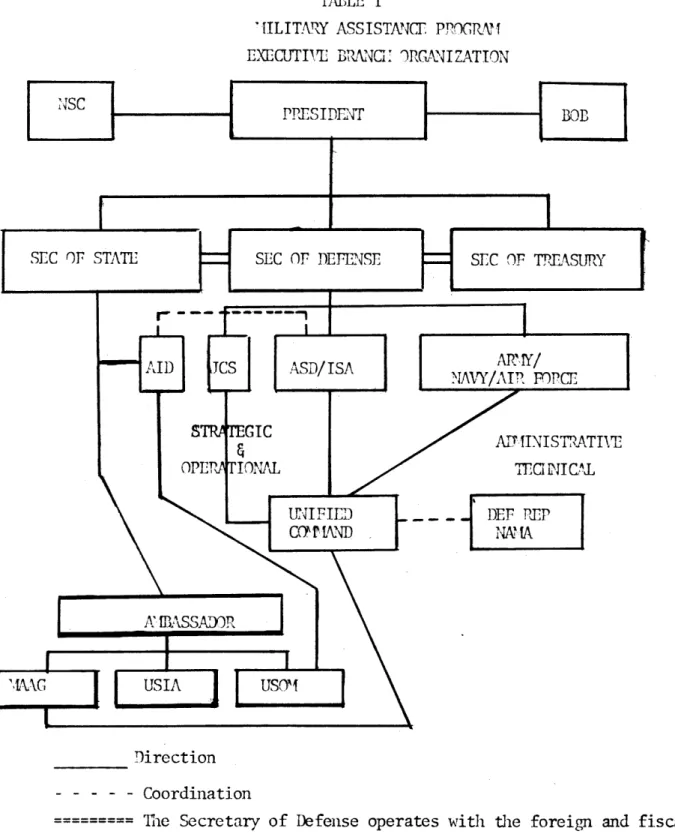
On the basis of the JCS force goals and base requirements, and the country dollar guidelines, the in-country Military Assistance and Advisory Groups (MAAG) prepare and submit their proposed five year equipment and training plan for the forces of recipient countries. These plans are first submitted to the Unified Commander and include both the dollar costs of equipment programmed under MAP, and the total estimated local defense budget cost with which the dollar programs are associated. Todal defense costs are subdivided into those to be financed by the country itself, and those for which foreign assistance is required. 1 0
The MAAG submission also includes a notation concerning expected short falls between the JCS goals and the programmed funds, if any, and an evaluation of the effect of these shortfalls to U.S. objectives and the anticipated threat. The MAAG proposal is reviewed or modified by the Unified Commander and submitted to the Department of Defense.
The DOD review procedure includes a variety of steps designed to accomodate the MAAG submission to the various executive, legislative, and political guidelines available. Following this review the programs are submitted to the administrator of AID in his role as foreign aid coordinator, and then to the Bureau of the Budget who in turn request an allotment to implement the operating program for the current fiscal year, and approves the basic estimates of the full term five year plan.12
After action by the Budget Bureau and further DOD coordination with the Unified Commander and the local MAAGs, any necessary program
revisions are made so that the current program can be implemented. Table I shows a schematic representation of this protess.
TABLE I
'IILITARY ASSISTANC PPrOGRNI EXECUTIVE BIMNC: RCANIZATION
. DEF REP
NNIAJ
Direction
- - - - - Coordination
-====Ie Secretary of Defense operates with the foreign and fiscal policy guidelines laid down by the Secretaries of State and Treasury, respectively
U.S. FOREIGN AID FOR 1OREA
Having reviewed the legislative and procedural facets of foreign aid it is now possible to examine the details of how this program has been applied in the case of South Korea.
Following the Japanese surrender offer of August 10, 1945, prompt arrangements were necessary for the surrender of Japanese forces in the Pacific and Asiatic theaters, including Korea. The decisions were incorporated in General Order No.1, which defined areas of responsibility for accepting surrender of all Japanese military forces. As regards Korea, the order provided that Japanese forces north of the 38th
parallel were to surrender to the Soviet commanders, while those south of that line surrender to the United States commanders. This was culmi.-nated September 9, 1945.13
The main objective of the United States was to help make Korea a free and independent nation. As commissioned by the United Nations, the United States first facilitated the surrender of the Japanese forces, then attempted to "reestablish Korea as an independent state' through the Moscow Agreement of 1945. This agreement called for a
joint Soviet-U.S. Commission which was to assist in forming a provisional Korean democratic government, but, after two meetings, failed to agree on any major issues. On September 17, 1947, the United States submitted the Korean problem to the United Nations .14
From the beginning of the occupation through 1948 the United States Government spent $300 million for relief and rehabilitation of South Korea. Only about 10 percent of this amount was used for development )rojects while the rest was used for supplies needed for relief.