HAL Id: hal-01808764
https://hal.inria.fr/hal-01808764
Submitted on 28 Jun 2018
HAL is a multi-disciplinary open access
archive for the deposit and dissemination of
sci-entific research documents, whether they are
pub-lished or not. The documents may come from
teaching and research institutions in France or
abroad, or from public or private research centers.
L’archive ouverte pluridisciplinaire HAL, est
destinée au dépôt et à la diffusion de documents
scientifiques de niveau recherche, publiés ou non,
émanant des établissements d’enseignement et de
recherche français ou étrangers, des laboratoires
publics ou privés.
A Cloud-aware autonomous workflow engine and its
application to Gene Regulatory Networks inference
Arnaud Bonnaffoux, Eddy Caron, Hadrien Croubois, Olivier Gandrillon
To cite this version:
Arnaud Bonnaffoux, Eddy Caron, Hadrien Croubois, Olivier Gandrillon. A Cloud-aware autonomous
workflow engine and its application to Gene Regulatory Networks inference. CLOSER 2018 - 8th
International conference on Cloud computing and Service Science., Mar 2018, Funchal, Madeira,
Portugal. pp.1-8. �hal-01808764�
A Cloud-aware autonomous workflow engine
and its application to Gene Regulatory Networks inference
Arnaud Bonnaffoux
12, Eddy Caron
3, Hadrien Croubois
3and Olivier Gandrillon
11Univ Lyon, ENS de Lyon, Univ Claude Bernard, CNRS UMR 5239, INSERM U1210, Lyon, France 2Cosmo Tech
3Univ. Lyon, ENS de Lyon, Inria, CNRS, Universit´e Claude-Bernard Lyon 1, Lyon, France
{Firstname.Lastname}@ens-lyon.fr
Keywords: Auto-Scaling, Resource Management, Workflow, Cloud, Scientific applications, HPC
Abstract: With the recent development of commercial Cloud offers, Cloud solutions are today the obvious solution for many computing use-cases. However, high performance scientific computing is still among the few domains where Cloud still raises more issues than it solves. Notably, combining the workflow representation of com-plex scientific applications with the dynamic allocation of resources in a Cloud environment is still a major challenge. In the meantime, users with monolithic applications are facing challenges when trying to move from classical HPC hardware to elastic platforms. In this paper, we present the structure of an autonomous workflow manager dedicated to IaaS-based Clouds (Infrastructure as a Service) with DaaS storage services (Data as a Service). The solution proposed in this paper fully handles the execution of multiple workflows on a dynamically allocated shared platform. As a proof of concept we validate our solution through a biologic application with the WASABI workflow.
1
Introduction
Scientists in fields like biology and physics tend to rely more and more on High Performance Com-puting (HPC) resources both to perform large scale simulations and to analysis the huge amount of data produced by said simulations as well as other ex-periments. For example, new generation DNA se-quencers can now produce a large amount of data, in the terabyte range, at a very low cost. Analyzing these required the development of computing tools for large scale sequence alignment, which relies upon HPC resources (Das et al., 2017; Yu et al., 2017). Similarly, the reconstruction of Gene Regulatory Net-works (GRNs) from high-throughput experimental data comes with a high computational cost, leading to the development of parallel algorithms (Xiao et al., 2015; Zheng et al., 2016; Lee et al., 2014).
However, accessibility to these HPC resources is limited and Cloud-based platforms have emerged as good solution for people with these use-cases that might not have access to large computing infrastruc-tures. Using the virtual resources offered by Cloud providers, anyone can build its own computing plat-form without having to bear the initial investment cost and the necessary maintenance that comes with
own-ing the hardware. However, while HPC applications are moving toward the Cloud, the deployment mecha-nisms used are generally trying to replicate the exist-ing paradigm rather than usexist-ing the full elasticity the Cloud has to offer.
The approach most commonly used is to de-ploy Cloud instances such to have a platform simi-lar to what users are familiar with, and use the batch scheduling mechanisms they are familiar with. While this approach requires minimal changes, the tools used were designed for a fixed platform, and do not benefit from the dynamicity of Cloud solutions. We, on the other hand, believe that using the dynamicity of Cloud infrastructures to modify the platform deploy-ment in real time can help users achieve better perfor-mances at a lower cost. Managing such deployment is a complex task, which requires constant awareness of the platform and of the workload. In order to achieve that, we need the (re)deployment mechanisms to work autonomously. Rather than asking the user to dive into the details of the platform deployment, we have to build a solution that releases them from all interac-tions with this deployment process.
Unlike task placement, which is a well-studied is-sue, little work deals with the automation of Cloud platform deployment.
Our goal in this paper is to evaluate the efficiency of our framework, which contains mechanisms that automate the deployment of Cloud ressources into a self adapting, shared, computing platform, as well as scheduling scientific applications on top of it. As a proof of concept we validate our solution through a biologic application with the WASABI workflow. We provide a tool that contribute to the convergence of HPC applications and Cloud resources, thus provid-ing easy access to HPC resources to all users.
2
Related work
Many scientific and industrial applications from various disciplines are structured as work-flows (Bharathi et al., 2008). A workflow can be seen as a structured set of operations which, given an input data set, produce the expected result. For a long time, the development of complex middleware with workflow engine (Couvares et al., 2007; Deelman et al., 2005; Caron et al., 2010) automated workflow management. Infrastructure as a Service (IaaS) Clouds raised a lot of interest recently thanks to an elastic resource allocation and pay-as-you-go billing model. A Cloud user can adapt the execution environment to the needs of their application on a virtually infinite supply of resources. While the elasticity provided by IaaS Clouds gives way to more dynamic application models, it also raises new issues from a scheduling point of view. An execution now corresponds to a certain budget, which imposes certain constraints on the scheduling process.
Solutions to dynamically-scaled Cloud computing instances exist. For example in (Mao et al., 2010) the solution is based on deadline and budget informa-tion. In (Kailasam et al., 2010) the solution deals with Cloud bursting. Another autonomous auto-scaling controller, which maintains the optimal number of re-sources and responds efficiently to workload varia-tions based on the stream of measurements from the system, is introduced in (Londo˜no-Pel´aez and Florez-Samur, 2013). This paper shows the benefits of an auto-scaling solution for Cloud deployments. How-ever, these solutions do not handle workflow appli-cations. Likewise in (Nikravesh et al., 2015), au-thors gave a suitable prediction technique based on the performance pattern, which led to more accurate prediction results. Unfortunately, all these papers fail to consider the delays resulting from communications between the different tasks of a workflow.
In (Mao and Humphrey, 2013), authors show the benefit of auto-scaling to deal with unpredicted workflow jobs. They also show that scheduling-first
and scaling-first algorithms have different advantages over each other within different budget ranges. The auto-scaling mechanism is introduced as a promising research direction for future work.
Nevertheless, some solutions provide an au-tonomous workflow engine. In (Heinis et al., 2005), altering the cluster configuration helps the authors build an autonomous controller that responds to work-load variations. Authors introduce a mechanism of self-healing that reacts to changes in the cluster con-figuration. This solution shows some benefits for cluster architecture but does not work well for Cloud architecture. Workflow engines for Cloud environ-ments dealing with dynamic scalable runtimes are given in (Pandey et al., 2012).
A comparative evaluation of several auto-scaling algorithms is given in (Ilyushkin et al., 2017). How-ever, the policies discussed in the review solely focus on auto-scaling, thus missing on issues like data local-ity and tasks clustering. Our approach is different in that it considers a more complex issue where work-flow optimizations can induce cycles in their clus-tered representation. This representation ask for more complex task placement and demand analysis mecha-nisms. Last but not least, our approach differs in that parts of the resource manager and of the scheduler are decentralized and rely on the nodes to take decisions by themselves in order to improve scalability.
3
Infrastructure
Our objective in this paper is to describe and eval-uate the architecture of a middleware that uses re-sources from Cloud providers to build a computing in-frastructure for the execution of scientific workflows.
3.1
IaaS Cloud platforms
Among the many offers Cloud providers propose, IaaS (Infrastructure as a Service) is arguably one of the most versatile. Through the use of virtualization technologies, it allows anyone to get access to remote resources and use them just as if they owned their own server. These resources are seen as virtual machines and they can run any system the user needs. This en-ables anyone to build their own computing infrastruc-ture without the initial investment cost or the burden of maintenance that comes with owning hardware.
The main advantage of Cloud solutions, which ex-plains their development over the past few years, is the versatility and dynamicity of these solutions. Not only can a user deploy a custom platform in just min-utes, but the deployment can be modified to match any
change in the workload. As such, users only have to pay for what is really needed, and not bear the cost of platform when not in use.
3.2
The allocation problem
It is easy to deploy a large platform using current Cloud technologies. However, knowing how many resources are really needed is a completely different problem. There might be many options, each one re-sulting in different performances and costs. While cost per unit of time is easy to compute, estimating performances and tasks completion time is extremely difficult. Consequently, the total deployment cost can also be hard to predict as it depends on completion time.
A common practice is to distribute the budget along a specific duration and get as many resources as one can afford during this period. This simple ap-proach, which tries to maximize performances within a given cost constraint, has major drawbacks. Not only is the user committing all his budget, but there are no warranties to have enough resources during peak hours, and resources are very likely to be wasted during off-peak hours.
A more elegant and efficient solution would be to modify the deployment in real time so that it matches the needs. Estimating the needs is a very complex task, and adjustment should be performed 24/7, which would require too many actions to be realistically per-formed by a human. For it to be efficient, we need this process to be fully autonomous and not require any human input.
3.3
An autonomic solution
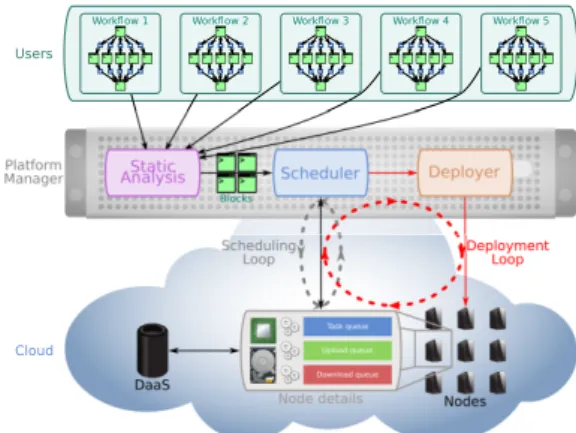
In order to automate the deployment of the platform, we have to design a control loop that could drive the allocation mechanisms. According to the MAPE-K (MAPE-Kephart and Chess, 2003) model, such a loop re-quires 4 features: (1) Monitoring the platform, both in terms of platform status and workload; (2) Analyzing the needs in term of platform allocation; (3) Planning actions to modify platform allocation towards what is required; (4) Executing the plan.
Such design is already part of common schedulers and is used to control the placement of the interde-pendent tasks in a workflow. However, unlike depen-dency control, the issue of platform deployment con-trol is complex and still unsolved. This is this issue that our approach (Figure 1) tries to solve in the con-text of homogeneous IaaS Clouds.
In addition to the traditional mechanisms used to control the task flow (scheduling loop), we added
fea-> > > > >> > > > > > >> > > > > > >> > > > > > >> > > > > > >> > Cloud Users
Work ow 1 Work ow 2 Work ow 3 Work ow 4 Work ow 5
Figure 1: Outlines of our middleware with autonomous platform deployment capabilities.
tures to the existing agents, as well as new agents, to implement a deployment control loop. More pre-cisely, we built these such that two distinct mecha-nisms work in coordination to achieve the automation of both up-scaling and down-scaling.
Data locality Data locality is a major concern in the scheduling of workflows. While parallelization is ex-pected to reduce the completion time of workflows, data transfer can produce undesirable side effect that reduces the overall performances.
In our previous work (Caron and Croubois, 2017) we discussed the possibility to solve this issue using an off-line scheduling mechanism. The static anal-ysis step described in this paper left us with blocks of tasks that already handle the issue of data locality and can therefore be scheduled without requiring the scheduler to solve this optimization issues at runtime.
Down-scaling control The down-scaling is decen-tralized and controlled by the nodes themselves. Each node has its own work queue, and requests work from the scheduler when it has free resources in term of CPU (ability to start new work) or Down-link (abil-ity to prefetch data). When a node requests work, the scheduler is to provide it with a block that can be executed on this node without breaking the dead-line constraints. However, if the platform is oversized, the nodes will end up executing all the tasks up to the point where the scheduler cannot provide work to the requesting node. In addition to requesting work, when a node work queue is empty, the node starts a suicide timer. Once this timer is initiated, and if no work has been received by then, the node will auto-matically deallocate itself before the beginning of the next billing hour.
This mechanism helps reduce the dimension of oversized platforms during off-peak hours thus en-abling a more efficient platform deployment that de-creases infrastructure cost.
Up-scaling control Unlike the down-scaling, the up-scaling mechanism is not decentralized, and re-quires a global knowledge of the platform. It relies on a new agent, the deployer. When the workload changes, for example with the addition of new jobs by the users, the scheduler will inform the deployer of these changes, and provide it with a description of the work queues and nodes status. This monitoring of the platform means that the deployer is able to use simple list scheduling algorithms to simulate jobs placement, analyze it, and plan for the deployment of new nodes if required.
If new nodes have to be deployed, the deployer will do so according to the last computed deployment schedule. This schedule can be overridden by new, updated, runs of the analysis and planning steps. This control mechanism ensures new nodes are deployed when required, such that QoS is achieved (deadlines are meet).
4
Gene Regulatory Networks
Inference
4.1
WASABI
Gene Regulatory Networks (GRN) play an important role in many biological processes, such as cell dif-ferentiation, and their identification has raised great expectations for understanding cell behaviors. Many computational GRN inference approaches are based on bulk expression data, and they face common issues such as data scarcity, high dimensionality or popu-lation blurring (Chai et al., 2014). We believe that recent high-throughput single cell expression data (see (Pina et al., 2012)) acquired in time-series will allow to overcome these issues and give access to causality, instead of “simple” correlations, to dissect gene interactions. Causality is very important for mechanistic model inference and biological relevance because it enables the emergence of cellular decision-making. Emergent properties of a mechanistic model of a GRN should then match with multi-scale (molec-ular/cellular) and multi-level (single cell/population) observations.
The WASABI (WAves Analysis Based Inference) framework is based upon the idea of an iterative infer-ence method. This will allow to adopt a
divide-and-conquer type of approach, where the complexity of the problem is broken down to a “one gene at a time” much simpler problem, which can be parallelized.
The whole process can be decomposed along the following steps:
1. Gene Ordering. We order all the 94 genes from time-series single cell gene expression data from chicken erythrocyte progenitors acquired during their differentiation process (Richard et al., 2016). These data have been analyzed using a stochastic mechanistic model of gene expression, the Ran-dom Telegraph model (Peccoud and Ycart, 1995). 2. Iterative inference. For each step of the inference process a new gene is added to a set of GRN can-didates inferred in the previous iterations. It cre-ates new extended GRN candidcre-ates to be assessed, though all possible combinations with the previ-ously conserved networks. For each new network, its behavior will be simulated using a recently de-scribed mathematical formalism (Herbach et al., 2017) and the resulting gene expression values will be compared to the experimental one. Should the fit between the two genes expression be ac-ceptable, the networks will be kept and carried to the next step. If, on the contrary, the network should be too different, then it will be pruned and will not participate in future attempts.
At the beginning of the process, one would expect (and an initial assessment confirmed) that the num-ber of suitable networks will sharply increase. In this growth phase, an efficient parallelization will be of essence. In a second phase, one expects that most of the ”bad” networks will have accumulated so many errors that they will diverge from the experimental re-ality, and it will in the end result in the generation of a manageable amount of networks.
The use of Design of Experiment ap-proaches (Kreutz and Timmer, 2009) should finally help us to get to the most probable network.
4.2
WASABI workflow description
WASABI, as an application, is composed of many steps, each one divided into many instances of the same elements. The control flow, which links these many elements into the complete application, can ex-press this iterative structure through a DAG of suc-cessive fork-join patterns. The WASABI workflow contains 9 fork-join steps of width 5, 6, 36, 252, 1000, 1000, 1000, 1000, 1000. This adds up to a to-tal 5309 tasks (including synchronization tasks) and 10598 control flow dependencies. Total runtime for all these tasks is 4250.1 hours.
All these informations, as well as details about in-dividual tasks, such as runtime) were extracted from traces of the previous runs. This allowed us to build a descriptions of WASABI as a workflow. While our middleware is not based on the Pegasus engine, for the sake of clarity, our inputs file are compliant with the well-known Pegasus workflow syntax. It is this workflow that we will be using to compare our de-ployment solution to existing approaches.
5
Evaluation
5.1
Comparison to fixed deployment for
a single workflow execution
In order to estimate the efficiency of our deployment, we will compare it to a more traditional “fixed deploy-ment” method. In a fixed deployment, the user books a given amount of resources which are then used by a batch scheduler. Whenever a task is ready to run and a node is available, the task will be placed on the node to be computed. It is clear that, with this approach, the more resources there are, the faster the workflows will be executed, up to the point where the sequen-tial dimension of the workflow prevents the user from achieving any more parallelism. Still, having more re-sources also means that more cpu time is wasted dur-ing the synchronization parts of the workload. Once all computation is done, the user has to release the resources.
Assessing total cost and runtime of a workflow for a specific deployment is a hazardous operation which requires trial and error. Simulation can help with this process, but it requires knowledge of the plat-form specifications and time, which users non famil-iar with computer science might not have. What our framework offers is a platform where users can spec-ify their workflows and the required wall time for each of them. The platform is then automatically deployed in order to meet the expected QoS while achieving the lowest cost possible.
The results in this section have be achieved through simulation. Details about the WASABI work-flow were extracted from traces of runs on existing HPC structures (IN2P3). Estimation of the deploy-ment cost for those simulations were obtained assum-ing their deployment on Amazon EC2 instances of similar performance. The down-scaling mechanism was tunned to match Amazon EC2 billing policy.
Our first results show platforms performance and cost for deploying a single WASABI workflow. This workflow contains 5309 tasks for a total of 4250
core-hours. Ideally, we would like to pay only for these 4250 hours of computation, but the billing policy of Cloud providers is such that we will also be charged for some unused time when we cannot perfectly use the hours allocated to each node. For example, a node used to compute a task that lasts 1 hour and 48 min-utes will be billed for 2 hours, and we are thus wast-ing 12 minutes of CPU time. The critical path in this workflow is about 17 hours, meaning that no matter how many resources we have, we will not be able to get results faster than that using the type of node con-sidered here.
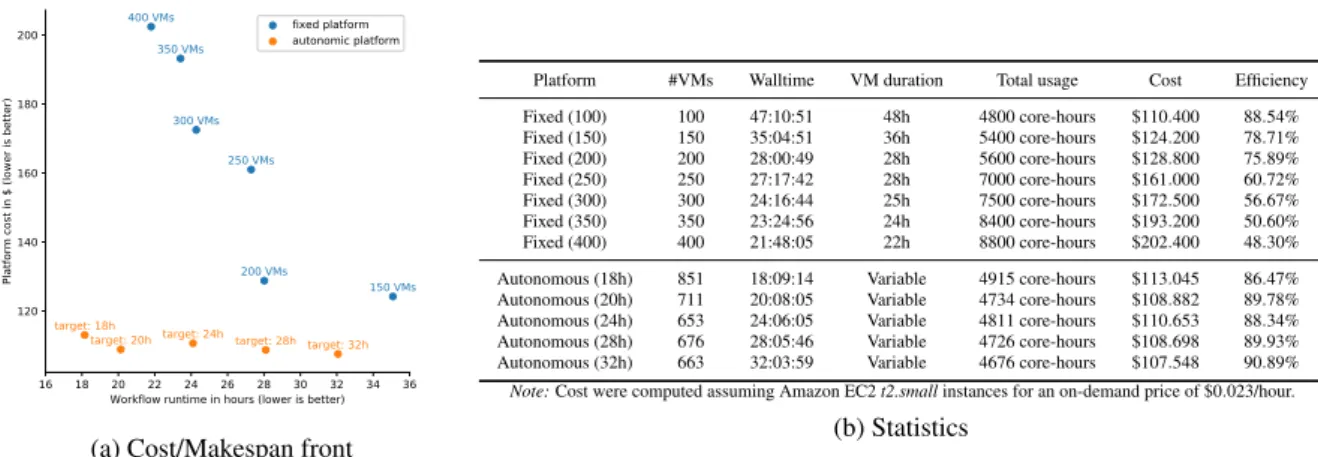
For this experiment, we run simulations with fixed platforms of sizes varying from 100 to 400 nodes. This gives us a base line of what current approaches achieve. The results in Table. 1b and Figure 1a show a Pareto front which comes from the conflict between two contradictory objectives: maximizing platform performance and minimizing deployment cost. This confirms the idea that there is not ideal value for the size of a fixed platform. Selecting the size of a fixed platform results in a choice between performance and cost on this non-optimal front.
However, the dynamicity offered by the deploy-ment control loop impledeploy-mented in our framework leads to better results. By efficiently allocating and deallocating nodes we manage to free ourselves from this Pareto efficiency and we achieve good results in term of deployment cost even when facing tight QoS constraints.
5.2
Multi-tenant/multi-workflows
deployment: Example of a small lab
using WASABI
In the previous section, we saw how our approach can efficiently deploy a computing platform to execute a single instance of the WASABI workflow. However, this context still requires quite many human interven-tions as the platform was dedicated to this workflow. This means that in order to execute their workflow, the user first has to deploy the platform manager. Even worse, in the case of a fixed allocation, the user has to deploy the fixed platform, selecting the number of nodes they want and to be there at the end of the run to shut down the platform.
We believe that the platform should be maintenance-free, and users should be able to submit workflows to an already existing platform manager. This perpetually running tool would be the entry where any user can submit their workflows. The platform would be handled automatically, allocating new nodes when needed, sharing nodes between workflows of different users and shutting nodes down
16 18 20 22 24 26 28 30 32 34 36 Workflow runtime in hours (lower is better)
120 140 160 180 200 Pla tfo rm co st in $ ( low er is be tte r) 150 VMs 200 VMs 250 VMs 300 VMs 350 VMs 400 VMs target: 18h
target: 20h target: 24h target: 28h target: 32h
fixed platform autonomic platform
(a) Cost/Makespan front
Platform #VMs Walltime VM duration Total usage Cost Efficiency
Fixed (100) 100 47:10:51 48h 4800 core-hours $110.400 88.54% Fixed (150) 150 35:04:51 36h 5400 core-hours $124.200 78.71% Fixed (200) 200 28:00:49 28h 5600 core-hours $128.800 75.89% Fixed (250) 250 27:17:42 28h 7000 core-hours $161.000 60.72% Fixed (300) 300 24:16:44 25h 7500 core-hours $172.500 56.67% Fixed (350) 350 23:24:56 24h 8400 core-hours $193.200 50.60% Fixed (400) 400 21:48:05 22h 8800 core-hours $202.400 48.30%
Autonomous (18h) 851 18:09:14 Variable 4915 core-hours $113.045 86.47%
Autonomous (20h) 711 20:08:05 Variable 4734 core-hours $108.882 89.78%
Autonomous (24h) 653 24:06:05 Variable 4811 core-hours $110.653 88.34%
Autonomous (28h) 676 28:05:46 Variable 4726 core-hours $108.698 89.93%
Autonomous (32h) 663 32:03:59 Variable 4676 core-hours $107.548 90.89%
Note:Cost were computed assuming Amazon EC2 t2.small instances for an on-demand price of $0.023/hour.
(b) Statistics
Table 1: Details for different runs of the WASABI workflow on various platforms. The workflow contains 5309 tasks for a total of 4250.1 core-hours
when they are no longer necessary.
Sharing a computing platform today, using the fixed deployment approach and a batch scheduler, is simple but very inefficient. In addition to the waste we could already witness when running a single work-flow, we also have to consider all the wasted resources which are allocated during off-peak hours.
We simulated such a context at the scale of a small laboratory. In this example, we consider a research team who uses the WASABI application to analyze their results. Over a one week period, our imagi-nary lab produces data requiring 10 runs of WASABI. Researchers in this team submit the data for analy-sis when available. As such, the submissions are not distributed evenly throughout the week. In particular, we assume that all submissions will be performed ing work days. While no new jobs are submitted dur-ing the week-end, computation can still be performed during the week-end. When using the autonomous approach, they ask the results to be available 24 hours after submission.
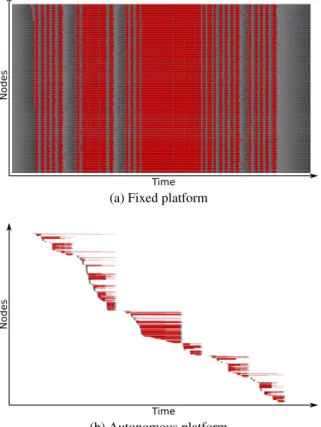
Statistics for this simulated workload is reported in Table. 2. Gantt diagrams for both deployment methods are shown in Figure 2. Once again, we see that the dynamic allocation of node has major advan-tages over the previous approach.
The most obvious advantage to our method is cost. Having a platform with 500 t2.small instances run-ning for a whole week would cost $1932.00, with an efficiency of 50.60% with this particular workload. For the same work, our approach would reduce de-ployment cost by 44.57%.
The second advantage to our method is the ease of maintenance and the efficiency of the elastic deploy-ment.
Some might argue that the fixed platform does not have the right size, and using 500 nodes is an em-pirical choice, and they would be right. However, as discussed previously, choosing which platform size to use is not an obvious choice. While having a 500 nodes platform leads to wasted resources, it is also not enough to ensure that sufficient resources are avail-able to all users. During rush periods, workflows are fighting for resources. This is visible around the mid-dle of Figure 2a when all nodes are busy. During this period, no resources are wasted but work does not progress as users would expect, causing some work-flows to finish with delays. While users would require the workflows to be computed within 24 hours, some took over 33 hours due to the limited number of re-sources available.
Unlike the fixed platform approach, the au-tonomous deployment allocates resources when needed which limits waste during off-peak hours and guarantees that the user will have the results they ex-pect with minimal delays. This is visible in Figure 2b. The burst in the workload causes the nodes to be allocated and deallocated in blocks. When many resources are required, the platform manager deploys many nodes. Once the work has been done, nodes start to suffer work shortage and start deallocating. We can see that the burst that caused the fixed plat-form to saturate is here triggering the allocation of many nodes. These nodes execute tasks from all ac-tive workflows and contribute to meeting the QoS users expect. In our example, this elastic allocation process helped limiting delays to at most 7 minutes 12 second.
We also notice that the efficiency achieved by our method in the multi-tenants context is slightly
bet-Platform #VMs Fastest run Slowest run Total VM usage Cost Efficiency Fixed 500 20:12:36 33:58:52 84000 core-hours $1932.00 50.60% Autonomous 4698 23:50:03 24:07:12 46563 core-hours $1070.95 91.28%
Note:Cost were computed assuming Amazon EC2 t2.small instances for an on-demand price of $0.023/hour.
Table 2: Platforms statistics for the multi-tenants execution of WASABI workflows. 10 workflows are executed over a 1 week period, for a total of 42501.0 core-hours of computation.
Time
Nodes
(a) Fixed platform
Time
Nodes
(b) Autonomous platform
Figure 2: Gantt diagram of VMs during the multi-tenants execution of WASABI workflows. 10 workflows are exe-cuted over a one week period, for a total of 42501.0 core-hours of computation. For each VM (line) computation time is shown in red and idle time in grey. Figure 2a shows re-sults for fixed deployment of 500 VMs running for the fun weeks while Figure 2b shows result for an autonomous de-ployment that spawned 4698 VMs over the week, some of which only ran for a single hour.
ter than in a single workflow context. On a fixed platform, having multiple workflows causes conflicts and decreases the QoS. However, with our elastic de-ployment manager, having multiple workflows on the same platform is a good thing as the workflows can share nodes to maximize their use and reduce waste. QoS is maintained by the allocation of new resources when required.
Last but not least, the autonomous deployment makes the results availability more predictable. This is more comfortable for users who might require these results for specific deadlines or just to be part of a broader pipeline. With a fixed platform, users are af-fected by each other’s submissions which might lead to frustration and conflicts.
6
Conclusion
In this paper, we presented the outlines of a fully autonomous platform manager. We also described the WASABI application, and how it can benefit from this platform management. Comparing this approach to more traditional ones, we showed that not only do we achieve the QoS required by the users through dead-lines, but we also achieve substantial savings in de-ployment cost.
So far this approach is restricted to homogeneous infrastructures, and further work is required to make this solution more versatile. Other optimization ob-jectives, such as minimizing a workflow execution time with a constrained budget, also require some work. Still, our multi-tenants example showed that using our platform to deploy existing scientific work-loads can result in cost savings of 40% while avoiding the need for human intervention in the management of the platform.
In conjunction with previous work on the static clustering of workflows for DaaS-based Cloud execu-tion, we now have a comprehensive solution. While the modular nature of this framework means the com-ponents could be improved, the current state of this solution is already effective and we hope to apply it soon in the context of an easy-to-use, all-in-one solu-tion for scientific and industrial users.
REFERENCES
Bharathi, S., Chervenak, A., Deelman, E., Mehta, G., Su, M.-H., and Vahi, K. (2008). Characterization of sci-entific workflows. In SC’08 Workshop: The 3rd
Work-shop on Workflows in Support of Large-scale Science (WORKS08) web site, Austin, TX. ACM/IEEE. Caron, E. and Croubois, H. (2017). Communication aware
task placement for workflow scheduling on daas-based cloud. In Workshop PDCO 2017. Parallel / Dis-tributed Computing and Optimization, Orlando, FL. USA. In conjunction with IPDPS 2017, The 31st IEEE International Parallel & Distributed Processing Sym-posium.
Caron, E., Desprez, F., Glatard, T., Ketan, M., Montag-nat, J., and Reimert, D. (2010). Workflow-based comparison of two distributed computing infrastruc-tures. In Workflows in Support of Large-Scale Science (WORKS10), New Orleans. In Conjunction with Su-percomputing 10 (SC’10), IEEE. hal-00677820. Chai, L. E., Loh, S. K., Low, S. T., Mohamad, M. S., Deris,
S., and Zakaria, Z. (2014). A review on the compu-tational approaches for gene regulatory network con-struction. Comput Biol Med, 48:55–65.
Couvares, P., Kosar, T., Roy, A., Weber, J., and Wenger, K. (2007). Workflow Management in Condor. In Taylor, I., Deelman, E., Gannon, D., and Shields, M., editors, Workflows for e-Science, pages 357–375. Springer. Das, A. K., Koppa, P. K., Goswami, S., Platania, R., and
Park, S. J. (2017). Large-scale parallel genome assem-bler over cloud computing environment. J Bioinform Comput Biol, 15(3):1740003.
Deelman, E., Singh, G., Su, M.-H., Blythe, J., Gil, Y., Kesselman, C., Mehta, G., Vahi, K., Berriman, G. B., Good, J., Laity, A., Jacob, J., and Katz, D. (2005). Pe-gasus: a Framework for Mapping Complex Scientific Workflows onto Distributed Systems. Scientific Pro-gramming Journal, 13(3):219–237.
Heinis, T., Pautasso, C., and Alonso, G. (2005). Design and evaluation of an autonomic workflow engine. In Autonomic Computing, 2005. ICAC 2005. Proceed-ings. Second International Conference on, pages 27– 38. IEEE.
Herbach, U., Bonnaffoux, A., Espinasse, T., and Gan-drillon, O. (2017). Inferring gene regulatory net-works from single-cell data: a mechanistic approach. https://arxiv.org/abs/1705.03407.
Ilyushkin, A., Ali-Eldin, A., Herbst, N., Papadopoulos, A. V., Ghit, B., Epema, D., and Iosup, A. (2017). An experimental performance evaluation of autoscal-ing policies for complex workflows. In Binder, W., Cortellessa, V., Koziolek, A., Smirni, E., and Poess, M., editors, ICPE, pages 75–86. ACM.
Kailasam, S., Gnanasambandam, N., Dharanipragada, J., and Sharma, N. (2010). Optimizing service level agreements for autonomic cloud bursting schedulers. In Parallel Processing Workshops (ICPPW), 2010 39th International Conference on, pages 285–294. IEEE.
Kephart, J. O. and Chess, D. M. (2003). The vision of auto-nomic computing. Computer, 36(1):41–50.
Kreutz, C. and Timmer, J. (2009). Systems biology: exper-imental design. FEBS J, 276(4):923–42.
Lee, W. P., Hsiao, Y. T., and Hwang, W. C. (2014). De-signing a parallel evolutionary algorithm for inferring gene networks on the cloud computing environment. BMC Syst Biol, 8:5.
Londo˜no-Pel´aez, J. M. and Florez-Samur, C. A. (2013). An autonomic auto-scaling controller for cloud based ap-plications. International Journal of Advanced Com-puter Science and Applications(IJACSA), 4(9). Mao, M. and Humphrey, M. (2013). Scaling and
schedul-ing to maximize application performance within bud-get constraints in cloud workflows. In Parallel & Dis-tributed Processing (IPDPS), 2013 IEEE 27th Inter-national Symposium on, pages 67–78. IEEE. Mao, M., Li, J., and Humphrey, M. (2010). Cloud
auto-scaling with deadline and budget constraints. In Grid Computing (GRID), 2010 11th IEEE/ACM Interna-tional Conference on, pages 41–48. IEEE.
Nikravesh, A. Y., Ajila, S. A., and Lung, C.-H. (2015). Towards an autonomic auto-scaling prediction system for cloud resource provisioning. In Inverardi, P. and Schmerl, B. R., editors, 10th IEEE/ACM International Symposium on Software Engineering for Adaptive and Self-Managing Systems, SEAMS 2015, Florence, Italy, May 18-19, 2015, pages 35–45. IEEE Computer Soci-ety.
Pandey, S., Voorsluys, W., Niu, S., Khandoker, A., and Buyya, R. (2012). An autonomic cloud environment for hosting ecg data analysis services. Future Gener-ation Computer Systems, 28(1):147–154.
Peccoud, J. and Ycart, B. (1995). Markovian modelling of gene product synthesis. Theoretical population biol-ogy, 48:222–234.
Pina, C., Fugazza, C., Tipping, A. J., Brown, J., Soneji, S., Teles, J., Peterson, C., and Enver, T. (2012). Inferring rules of lineage commitment in haematopoiesis. Nat Cell Biol, 14(3):287–94.
Richard, A., Boullu, L., Herbach, U., Bonnafoux, A., Morin, V., Vallin, E., Guillemin, A., Papili Gao, N., Gunawan, R., Cosette, J., Arnaud, O., Kupiec, J. J., Espinasse, T., Gonin-Giraud, S., and Gandrillon, O. (2016). Single-cell-based analysis highlights a surge in cell-to-cell molecular variability preceding irreversible commitment in a differentiation process. PLoS Biol, 14(12):e1002585.
Xiao, X., Zhang, W., and Zou, X. (2015). A new asynchronous parallel algorithm for inferring large-scale gene regulatory networks. PLoS One, 10(3):e0119294.
Yu, J., Blom, J., Sczyrba, A., and Goesmann, A. (2017). Rapid protein alignment in the cloud: Hamond com-bines fast diamond alignments with hadoop paral-lelism. J Biotechnol.
Zheng, G., Xu, Y., Zhang, X., Liu, Z. P., Wang, Z., Chen, L., and Zhu, X. G. (2016). Cmip: a software pack-age capable of reconstructing genome-wide regulatory networks using gene expression data. BMC Bioinfor-matics, 17(Suppl 17):535.