HAL Id: hal-02441975
https://hal-cea.archives-ouvertes.fr/hal-02441975
Submitted on 16 Jan 2020HAL is a multi-disciplinary open access archive for the deposit and dissemination of sci-entific research documents, whether they are pub-lished or not. The documents may come from teaching and research institutions in France or abroad, or from public or private research centers.
L’archive ouverte pluridisciplinaire HAL, est destinée au dépôt et à la diffusion de documents scientifiques de niveau recherche, publiés ou non, émanant des établissements d’enseignement et de recherche français ou étrangers, des laboratoires publics ou privés.
Eddy current flowmeters at core outlet in french sodium
fast reactors
K. Paumel, M. Girard, J. Bonnin
To cite this version:
K. Paumel, M. Girard, J. Bonnin. Eddy current flowmeters at core outlet in french sodium fast reactors. 10th PAMIR International Conference Fundamental and Applied MHD, Jun 2016, Cagliari, Italy. �hal-02441975�
10th PAMIR International Conference - Fundamental and Applied MHD June 20 – 24, 2016, Cagliari, Italy
_________________________________________________________________________________________________________________
EDDY CURRENT FLOWMETERS AT CORE OUTLET IN FRENCH
SODIUM FAST REACTORS
Kevin PAUMEL1*, Marianne GIRARD1, Jessie BONNIN1
1 CEA, DEN, Nuclear Technology Department, F-13108 Saint-Paul-lez-Durance, France
*Corresponding author: [email protected]
Abstract: Eddy current flowmeter (ECFM) is envisaged to measure sodium velocity at core
outlet in sodium fast reactors. Firstly, sodium tests in a pipe were carried out to ensure the feasibility of this detecting principle. The sensor exhibited a good behaviour: the flow rate dependence of its response is linear and a particular frequency exists for which the ECFM’s normalized response is temperature independent. Moreover, a numerical modelling was developed with COMSOL® to assess the efficiency of the measurement in an opened flow, i.e. without a pipe confining the flow. Despite the decrease of sensitivity, the signal keeps linearity. However, the frequency for which the signal is temperature independent has vanished.
Key words: Eddy Current Flowmeter, Finite Element Modelling, Sodium Fast Reactors,
Sodium Tests.
1. Introduction
CEA is one of the main contributors to the design of the French sodium fast reactor prototype called ASTRID. Studies were conducted during the pre-conceptual design and are continuing through the basic design phase to assess the capacity of an eddy current flowmeter (ECFM) to detect partial or full plugging of a fuel sub-assembly of the core [1]. It is foreseen to integrate one ECFM into each thermal flowmeter rod (336) of the above-core structure. This paper details the results of tests on an ECFM that were performed in a sodium loop. These tests are part of the feasibility study on potential use of ECFM at core subassemblies outlet. The main objective of this test campaign was to demonstrate the feasibility of measuring the sodium flow using a CEA-manufactured ECFM. This paper presents also briefly the results of a finite element modelling of the sensor in an opened flow, i.e. without the presence of the pipe confining the flow.
2. Principle of the Eddy Current Flowmeter
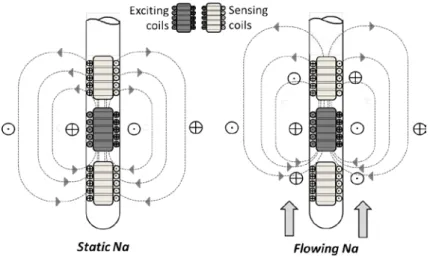
The ECFM was patented in the United States in 1948 [2]. It works on the principle of the deflection of a magnetic field due to eddy currents induced by the sodium flow (Fig. 1). It consists of three coaxial windings or coils, arranged in series (some designs have 5 coils). The central primary winding, the magnetic field generator, is flanked on either side by two identical secondary windings. The sodium flow distorts the magnetic field so that electromotive forces generated in the two secondary coils differ in proportion to the sodium speed. The advantages of ECFM are its small size and its ability to withstand temperatures up to 600ºC (value to check) and radiation above the core.
10th PAMIR International Conference - Fundamental and Applied MHD June 20 – 24, 2016, Cagliari, Italy
Figure 1: Diagram of an external flow ECF (the three coils are in a thimble). Left: sodium is stagnant and the magnetic field emitted by the central coil is not deflected. Right: the sodium flows upwardly
and the magnetic field is deflected upward.
3. Sodium tests
3.1 Experimental conditions Sodium was heated by heater around the main tank in the loop up to 450°C. The sodium flow rate in the circuit, up to 3,000 litres per hour, was adjusted using the supply voltage of the electromagnetic pump of the loop. The ECFM was placed in a test sleeve (Fig. 2). More specifically, it was placed in a thimble in the top part of the sleeve. The thimble was made of stainless steel with a diameter of 12-14 mm and was leak tight. The ECFM was never in direct contact with sodium. The sodium was circulated from the bottom to the top and from right to left in the ECFM section.
Sodium direction
Three 420 W heater bands Flange
3 thermocouples on the wall Coils
ECFM Thimble
*Position of the coils in relation to the end of the thimble: 50 cm for the top coil, 52 cm for the central coil, and 54.5 cm for the bottom coil. The coils are located in the middle of the test section, whether a direct or inverse flow is used
Figure 2: Diagram of the ECFM test sleeve
The ECFM used was designed and manufactured by the CEA. It was made in the 90’s. It underwent a number of thermal cycling tests at 500°C. Its windings are made from copper wire coated with a layer of zirconium oxide, insulated with magnesium oxide (mineral insulation), and protected by a stainless steel sheath, resulting in a total outer diameter of the wire of 0.5 mm. Its main dimensions are: a total length and diameter of respectively 60 mm and 11.4 mm, a length of each coil of 13 mm.
The current intensity (RMS) in the primary coil is 150 mA. For each temperature and flow rate, the primary coil was fed by various frequencies: from 100 Hz to 3100 Hz by increments of 300 Hz. The frequency impacted the penetration depth of the magnetic field, i.e. more or less the volume of sodium probed by the sensor.
3.1 Results The ECFM response curves – difference in voltage between the two coils: S2 – S1 expressed in mV – were obtained as a function of the flow rate for each
sodium temperature. Generally speaking, the result curves reveal the good linearity of the ECFM in the low frequency range and particularly at 500 Hz in the sleeve configuration (see for example Fig. 3).
Figure 3: ECFM output signal S2 – S1 as a function of the sodium flow rate around the ECFM at a frequency f = 500 Hz and temperature of 400°C.
S2 – S1 is proportional to the flow rate, but the coefficient of proportionality depends on
the temperature. COMSOL® simulations and sodium tests carried out by IGCAR [3] showed that this temperature dependency can be overcome by using the normalized ECFM response (S2 – S1)*100 / (S2 + S1) whose coefficient of proportionality to the flow rate is temperature
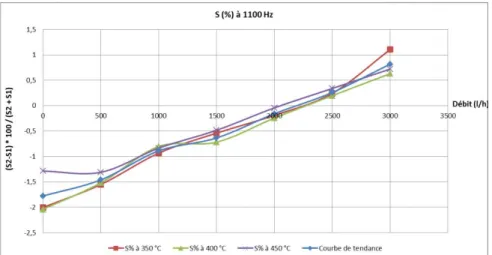
independent at a specific frequency of the primary coil supply current. Figure 4 is obtained by tracing S% = (S2 – S1)*100 / (S2 + S1) as a function of the flow rate (l/h), at a frequency of
1,100 Hz, and with temperatures of 300°C, 350°C and 450°C. The differences in S% between 300°C and 450°C are relatively small in the 500 l/h to 2,700 l/h range, which means that this ECFM in its test configuration (sleeve, thimble and hydraulic channel dimensions) is almost independent of the temperature at 1,100 Hz.
Figure 4: ECFM normalized responses at a frequency f = 500 Hz and temperatures of 300°C, 350°C and 450°C.
10th PAMIR International Conference - Fundamental and Applied MHD June 20 – 24, 2016, Cagliari, Italy
4. Finite Element Modelling
This FEM study relies on 2D axisymmetric modelling developed with COMSOL® for an ECFM design similar to the IGCAR’s ECFM [3]. For that, two “physics” were coupled: magnetic fields and turbulent flows. This coupling is weak because the turbulent flow is computed independently before. The velocity field is then used by the second physics: “magnetic fields” via a coupling term called “velocity Lorentz term” which takes into account the velocity field of a conducting fluid (sodium). This weak coupling is justified by the low Hartmann number.
The approach to this study was firstly to validate the ECFM model with pipe configuration measurements (not presented here) and secondly to simulate its behaviour in conditions similar to those of the thermal flowmeter rod i.e. opened flow.
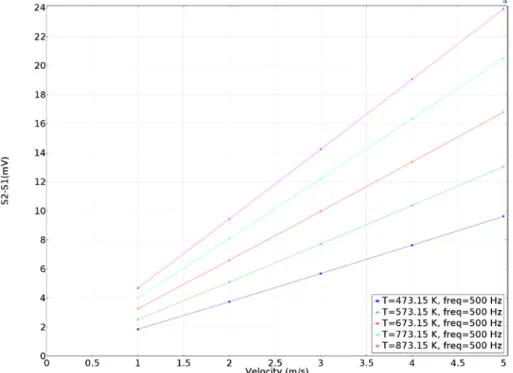
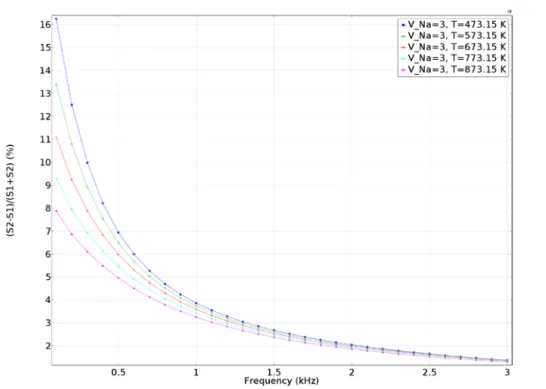
The Figure 6 shows that the linear flow rate dependence of the output signal is kept even if there is not a pipe confining the flow anymore. However, the curves of the normalized responses as a function of frequency for various temperatures never intersect (Fig. 7). In that case of an opened flow it seems that it is impossible to find a frequency for which the normalized response is temperature independent.
Figure 6: ECFM output signal S2 – S1 as a function of the sodium velocity around the ECFM at a frequency f = 500 Hz and temperatures of 200, 300, 400, 500 and 600°C.
Figure 7: ECFM normalized responses at 300°C, 350°C and 450°C.
3. Conclusions
Preliminary sodium tests and FEM simulations were conducted to study the feasibility of using ECFM at core outlet in sodium fast reactors to measure sodium velocity. Firstly, sodium tests in a pipe were carried out to ensure the feasibility of this detecting principle. The sensor exhibited a good behaviour: the flow rate dependence of its response is linear and a particular frequency exists for which the ECFM’s normalized response is temperature independent. Secondly, a numerical modelling was developed with COMSOL® to assess the efficiency of the measurement in an opened flow, i.e. without a pipe confining the flow. Despite the decrease of sensitivity, the signal keeps linearity. However, it seems there is not any frequency for which the signal is temperature independent. Currently, this FEM is used to design the prototypes for ASTRID and a new test campaign is planned to qualify them. Furthermore, more fundamental studies are underway to evaluate the ability of this sensor to detect bubbles in sodium.
Acknowledgments The authors wish to express their gratitude to J.-S. Bailly, Pascal
Taraud, Gwendal Blevin and Pascal Defrasne involved in preparing and carrying out the tests.
REFERENCES
[1] K. PAUMEL ET AL. R&D on early detection of the Total Instantaneous Blockage for 4th Generation Reactors - inventory of non-nuclear methods investigated by the CEA, IEEE 3rd Int.
Conf. on Advancements in Nuclear Instrumentation Measurement Methods & their Applications (ANIMMA), 2013, 1-12.
[2] H.LEHDE AND W.T.LANG. Device for measuring rate of fluid flow, US Patent 2,435,043, Jan. 27 1948.
[3] P.SHARMA ET AL.Development, computer simulation and performance testing in sodium of an eddy current flowmeter,Annals of Nuclear Energy, 37, 332–338, 2010.