HAL Id: hal-02053647
https://hal.archives-ouvertes.fr/hal-02053647
Submitted on 1 Mar 2019
HAL is a multi-disciplinary open access
archive for the deposit and dissemination of
sci-entific research documents, whether they are
pub-lished or not. The documents may come from
teaching and research institutions in France or
abroad, or from public or private research centers.
L’archive ouverte pluridisciplinaire HAL, est
destinée au dépôt et à la diffusion de documents
scientifiques de niveau recherche, publiés ou non,
émanant des établissements d’enseignement et de
recherche français ou étrangers, des laboratoires
publics ou privés.
Copyright
Plant Pangenome: Impacts On Phenotypes And
Evolution
Christine Tranchant-Dubreuil, Mathieu Rouard, Francois Sabot
To cite this version:
Christine Tranchant-Dubreuil, Mathieu Rouard, Francois Sabot.
Plant Pangenome:
Im-pacts On Phenotypes And Evolution.
Annual Plant Reviews, Wiley Online Library 2019,
�10.1002/9781119312994.apr0664�. �hal-02053647�
Plant Pangenome: Impacts On Phenotypes And
Evolution
Christine Tranchant-Dubreuil
1,3
, Mathieu Rouard
2,3
, and Francois Sabot
1,3
1DIADE University of Montpellier, IRD, 911 Avenue Agropolis, 34934 Montpellier Cedex 5, France2Bioversity International, Parc Scientifique Agropolis II, 34397 Montpellier Cedex 5, France 3South Green Bioinformatics Platform, Bioversity, CIRAD, INRA, IRD, Montpellier, France
With the emergence of low-cost high-throughput sequencing
technologies, numerous studies have shown that a single genome
is not enough to identify all the genes present in a species.
Re-cently, the pangenome concept has become widely used to
in-vestigate genome composition of a collection of individuals. The
pangenome consists in the core genome, which encompasses all
the sequences shared by all the individuals, and the dispensable
genome, composed of sequences present in only some
individu-als. Pangenomic analyses open new ways to investigate and
com-pare multiple genomes of closely related individuals at once, and
more broadly new opportunities for optimizing breeding and
studying evolution. This emerging concept combined with the
power of the third-generation sequencing technologies gives
un-precedented opportunities to uncover new genes, to fully explore
genetic diversity and to advance knowledge about the
evolution-ary forces that shape genome organization and dynamics.
Pangenome, Gene Diversity, Adaptation, Evolution, Population Genomics, Structural VariationCorrespondence: [email protected], [email protected], [email protected]
Introduction
Revolutionary advances in high-throughput sequencing
tech-nology during the last two decades have offered new ways
to study genome diversity and evolution. Limited initially
to a few reference genomes, current capabilities allow
se-quencing and analysis of multiple genomes of closely
re-lated species. Indeed, for years genomic studies typically
used a reference-centric approach, which relied mainly on
the expensive and low-throughput Sanger sequencing,
limit-ing large-scale population studies to a few loci, or to
mark-ers such as simple sequence repeats (SSRs) (
1
,
2
). Since
the advent of Next-Generation Sequencing (NGS), a
transi-tion has occurred from a single-genome/species to
multiple-genomes/species analysis. The data deluge produced by these
NGS data revealed that individuals from the same species do
not systematically share the same genetic content (
3
).
Genetic Diversity and Structural Variations. Many
genetic diversity studies have focused on single-nucleotide
polymorphisms (SNPs) as the main source of genetic
variation (
4
–
7
).
However, larger structural variations
(SVs), including copy number variation (CNV) and
pres-ence/absence variation (PAV), have been shown to play
a major role on genetic variability, and are thought to
contribute to phenotypic variations (
3
,
8
,
9
). Moreover, even
if there are variations within genes, such as SNPs or small
insertions or deletions (InDels), several studies showed that
all the genes from a given species are not obtained using a
single genome (
10
–
12
). In plants, evidence first from maize
(
13
,
14
) showed that only half of the genomic structure is
conserved between two individuals. Similarly, a study of 18
wheat cultivars revealed the absence of 12,150 genes from
the reference genome (
15
). Previous studies performed on
rice showed that genes absent from the Asian rice Oryza
sativa japonica
subspecies are present in other rice varieties
(
16
) and confer tolerance to submergence (Submergence 1,
Sub1) (
17
), deep water (SNORKEL1, SNORKEL2) (
18
) or
low-phosphorus soils (Phosphorus-Starvation Tolerance,
Pstol1) (
19
). In the same species, Yao et al. (
20
) highlighted
that 41.6 % of trait-associated SNPs (from GBS markers)
were not present in the reference genome sequence. In the
wild Brachypodium distachyon, the flowering time
diver-gence is directly linked to SV and pangenomic variations
(
21
).
Origin of the Pangenome Concept. Studies on bacteria
benefited earlier by the NGS potential due to their small
genome size and large populations, and gave rise to the
Pangenome concept, first introduced by Tettelin et al in 2005
(
22
,
23
), to refer to the full genomic content of a species. The
pangenome was first defined to consist of the core genome
shared among all individuals and the dispensable genome,
shared only between some individuals. In plants as in
bac-teria, the dispensable genome turns out not to be so
"dis-pensable" (
24
), and encompasses a large portion of structural
variants that affect a large number of genes. The
dispens-able genome may contribute to phenotypic trait diversity (
9
)
such as biotic resistance, organ size or flowering time (
21
)
and may play a role in adaptation to various environments.
The pangenome view of the genome opens new ways to
in-vestigate diversity, adaptation and evolution with strong
im-pacts on the species concept itself.
What is a Pangenome ?
Since the pangenome concept was first proposed (
22
,
23
),
definitions and objectives fluctuated between various
inter-pretations including (i) the total number of non-redundant
genes that are present in a given dataset (
25
), (ii) the full gene
repertoire of a species (
26
), (iii) the result of genomic
com-parison of different organisms of the same species or genus
(
27
,
28
), (iv) the similarity-based representation of the total
set of genes, which are present in a group of closely related
species or strains of a single species (
29
) or (v) the sum of
the genes of all living organisms, viruses, and different
mo-bile genetic elements (
30
).
Different Ways to Define a Pangenome. These multiple
definitions highlight the flexibility of the pangenome concept
and the levels of granularity possible in relation to
taxon-omy (genus, species, subspecies) or composition of the core
genome (e.g. single copy genes versus CNV, gene and
non-genic).
Here, we propose to define the pangenome in two different
ways: a function-based and a structure-based. Whatever
def-inition is used, the considered group can be a species, a
sub-species, a genera or even a family. Thus, the limits of a
spe-cific pangenome will change if the referential group changes.
Function-Based Definition.
The function-based definition
states that the pangenome is the sum of all genes within a
given set of individuals; it can be extended at the gene
fam-ily level, as in (
31
). This is similar to the definition used
in bacteria, and relies on the identification of gene clusters
(genes with close phylogenetic relationships, that may be
scattered all along the genome). Highly similar sequences
(e.g. recent paralogs) may be considered as the same
se-quence. Once all gene clusters per individual are identified,
the presence/absence for each gene is scored, wherever the
location. In this context, if at least one member of a gene
family is present in each individual (whatever is the sequence
itself), the function belongs to the core genome. Such a
defi-nition is gene-centric and does not take into account
transpos-able elements or non-canonical genes (e.g. tRNA, miRNA).
Most of the current pangenome analyses use this definition.
Structure-Based Definition.
The structure-based definition
states that the pangenome is defined as the complete set of
non-redundant sequences approximately 100 base pairs (bp)
in length or more (except for few SNP and InDels, see
be-low) within a given group of individuals. The advantage of
this definition is that it allows both genes and non-genic
se-quences to be taken into account. However, this definition
may be difficult to apply when dealing with copies of
trans-posable elements (TE; see below). Sequences of 100 bp can
be identified and annotated with few ambiguities (e.g. the
size of a small TE, miRNA locus or tRNA gene). The
pres-ence or abspres-ence of a sequpres-ence here is purely position-based.
Thus, in the case of a recent duplication followed by an
al-ternative deletion (i.e. individual A conserves A copy and
individual B the B copy; see Figure
1
), none of the copies
are in the core genome. In the same way, genomic
recombi-nation in a portion of the population can change the location
of a given region, and thus will not be included in the core
genome. Transposition of a Class I (Copy-and-Paste) or of
a Class II TE (Cut-and-Paste) (
32
) will also change the core
genome content. Indeed, more and more studies show that
the position of these events (recombination and transposition)
will impact the expression of adjacent genes (
33
). Thus, the
location of a given sequence may modify its impact on the
phenotype, in addition to selection and evolution.
The Different Compartments of the Pangenome.
The Core Genome.
The core genome is the common set of
sequences shared by all individuals of the group, and is
gen-erally described as the minimal genome sequence required
for a cell to live. Indeed, the core genome has been shown to
include the main essential gene functions: (i) Maintenance of
the basic functions of the organism which include DNA
repli-cation, translation and maintenance of cellular homeostasis
(
22
), and (ii) Essential cellular processes (e.g. glycolysis)
(
21
).
However, some authors (e.g. (
34
)) proposed that the core
genome consists of two sub-compartments, one essential
and the other ’persistent’. The persistent core genome
sub-compartment includes genes or sequences that were perhaps
necessary at one time in the life history of an organism, but
have lost their necessity and have not yet been removed by
the genetic drift.
The Dispensable Genome.
An unexpectedly large number of
sequences, including a surprising number of genes, belong
to the dispensable genome (
11
). Thus, PAVs were
identi-fied within 38% of genes in the Brassica napus pangenome
(
35
). Similarly, Zhao et al. identified 10,872 novel genes
(absent from the reference genome) using 66 rice
acces-sions (
36
).
Among those, several genes detected in
pvious studies as absent in the reference genome were
re-ported, such as SUBMERGENCE1A (Sub1A), SNORKEL1
and SNORKEL2 (
17
,
18
), controlling submergence tolerance,
and PHOSPHORUS-STARVATION TOLERANCE 1 (Pstol1),
implied in the tolerance to phosphorus-deficient soil (
19
),
re-spectively.
Dispensable genes in bacteria are thought to contribute to
diversity and adaptation (
22
).
In plants, the dispensable
genome seems to be enriched in abiotic and biotic stress
related genes, including defense and response, and
devel-opmental genes such as those that control flowering time
(
16
,
21
,
36
–
39
). Disease resistance-related genes are some of
the most prevalent types in the dispensable genome (
40
,
41
).
In rice, Schatz et al. showed that 5 to 12% of the
dispens-able genes within 3 divergent genomes contain the NB-ARC
domain (nucleotide-binding domain of plant R-genes),
ver-sus
only 0.35% within the core genome. In Arabidopsis, the
largest part of the dispensable genome assembly (absent from
the Columbia reference) belongs to to nucleotide-binding site
leucine-rich repeat (NBS-LRR) genes (
42
). Other gene
fam-ilies that are also enriched in the dispensable genome include
auxin- or flowering-related genes, or genes that encode
en-zymes involved in secondary metabolism (e.g.
glucosino-lates) (
39
). Finally, more "accessory" functions are linked
to the dispensable genome sequences such as telomere
main-tenance or negative regulation (
21
). However, those
"ac-cessory" functions can drive major differentiation within a
species, as in the wild Brachypodium distachyon with which
flowering time is the main population splitter (
21
). In this
last study, almost 77.6% of the protein coding genes from the
core genome has similarities with known InterPro domains, a
much higher proportion than that in the dispensable genome
Fig. 1. After a recent duplication, through generation or speciation, one individual will conserve the dark blue paralog while the second individual will conserve the light blue
paralog
set (35.8%). This observation led some authors to suspect
that a portion of the PAV genes in the dispensable genome
set may be just annotation artifacts or pseudogenes (
43
).
Individual Specific Genome. The individual-specific
com-partment contains sequences uniquely detected for one
indi-vidual and therefore potentially responsible for specific
fea-tures of the individual. Although this compartment may
con-tain sequences with real biological functions (for highly
di-vergent sequences or neogenes) (
44
), many of them are
prob-ably artifacts, misannotations or contaminations. It may also
be the result of sampling bias; additional individual data may
transfer those sequences to the dispensable genome.
Conse-quently, this compartment might either be merged with the
dispensable genome (
5
), or discarded for subsequent
analy-ses as in Brachypodium analyanaly-ses (
21
).
To Be or not to Be Core. The core genome is generally
considered as the set of sequences common to all individuals
of the considered group. However, even if in theory this is a
valid definition, due to various limitations (e.g. sampling,
se-quencing and technical issues linked to GC-content), some
sequences may not be detected in some individuals even
though they are present. Thus, we propose that a sequence
belongs to the core genome when 90 to 95% of the
individu-als harbor it, as published previously (
21
,
36
). All sequences
not included in the core genome are by default placed in the
dispensable genome (Figure
2
). Other authors proposed a
less strict definition than core and dispensable genomes,
us-ing more sophisticated statistical approaches to define
per-sistent, shell and cloud levels in the pangenome (
34
). Some
sequences may be unique to a single individual, while some
may be shared only by less than 90-95% of the group. While
individual-specific sequences are most of the time artifacts or
contamination, they could indeed be new genes (see below).
From a functional point of view of the pangenome, a gene
family will remain in the core if any member of this family
is able to perform the function and is present in each
individ-ual. As the classification in a given family will depend on the
threshold used in its computation, using a functional
defini-tion may be complex and may also depend on the clustering
method used (e.g. OrthoMCL(
45
), MCL(
46
), Mutual Best
Hit(
47
), GET_HOMOLOGUES-EST(
43
)).
Fig. 2. The pangenome is seen as a sphere that contains all the genome of a
col-lection of individuals. The core genome gathers all the common sequences shared by all individuals while the dispensable genome consists of sequences shared by only some individuals.
How Many Genomes to Capture the Whole Genome
Content of a Given Group ?. For each pangenome
analy-sis, recurrent questions arise: 1) How many genomes should
be sequenced to maximize the diversity within a group? 2)
Will there always be the same set of sequences shared by all
members of a group even when newly sequenced individuals
are added? 3) Will new specific sequences still be discovered
with additional individual sequencing?
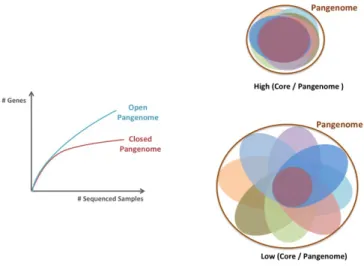
In order to validate whether the definitive pangenome size
has been reached, Tettelin et al. (
22
,
48
) proposed to
rep-resent the evolution of the total number of sequences found
after the addition of each individual sequenced. If the
num-ber of sequences levels off to a plateau with each newly
added genome, the pangenome is closed. Otherwise, the
pangenome is still unlimited and defined as open (Figure
3
A).
Tettelin et al showed that the pangenome of the bacteria
S. agalactidae
is very large and open with numerous new
Fig. 3. A. Open and closed pangenomes (adapted from (49)). B. C/P ratio illustra-tion.
unique genes identified even after hundreds of genomes were
sequenced (
48
). Within plants, the pangenome was shown
closed for several models such as soybean, Brassica
oler-acea, maize or Medicago with a small number of samples
(
39
,
50
–
52
). Indeed, the size of the pangenome will depend
on the genome dynamics of the considered group; thus, in
this regard, bacteria have a relatively larger pangenome than
plants because of their higher level of gene flow.
Such observations are generally performed based on gene
se-quences only (i.e. standard protein coding genes a fortiori),
and not on non-protein genes, neogenes and TEs. In
ad-dition, the sample choice is critically important: an
under-representation of the diversity within a given group may
in-dicate that the pangenome is closed, while if the population
of individuals sampled is increased, the pangenome may be
found to be open. In this case, the largest possible population
of individuals should be targeted for sampling (
15
).
The Core/Pangenome ratio seems to be related to an
organ-ism’s capacity of adaptation (
53
), with values under 85%
showing a huge adaptability(Figure
3
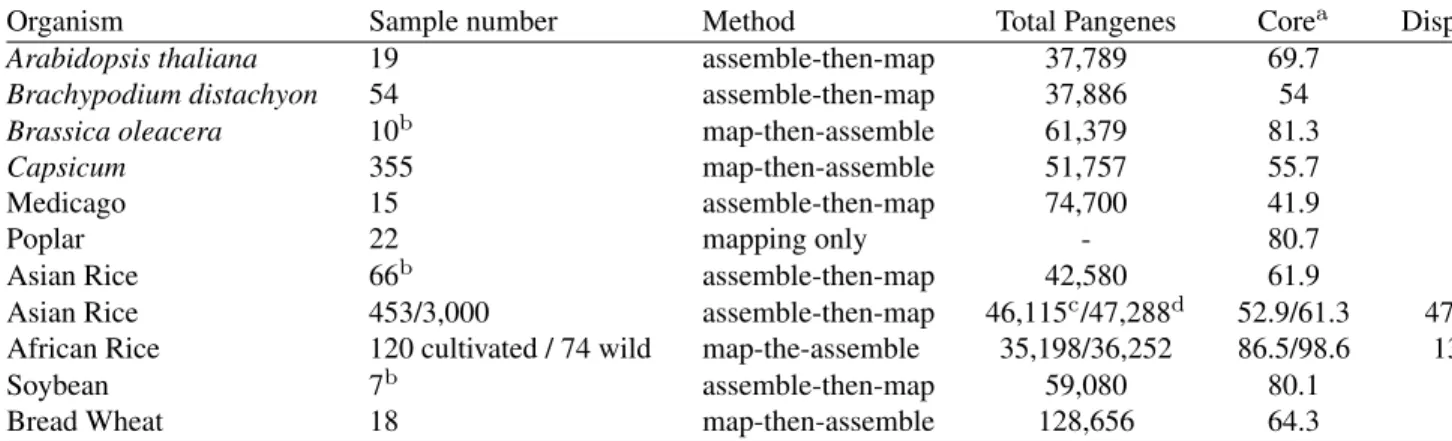
B). In plants, the core
genome represents from 40 to 80% of the total pangenome,
depending on the organism and group’s structure (Table
1
),
indicating a large potential for plants.
Methods for Pangenome Assembly
Whichever pangenome definition is used, the first step is to
obtain sequences per individual. Up to now, three main
ap-proaches have been used in plants to assemble pangenomes.
Assemble-Then-Map:
Complete de novo Assembly
Approach. With bacteria, pangenome studies used
com-plete de novo assemblies of small genomes (and their
sub-sequent annotations) (
22
,
48
).
With plants, most studies
(
16
,
21
,
36
,
50
,
54
,
55
) also used a similar approach (Figure
4
A). With this method, sequences from each individual are
assembled separately, then mapped all-versus-all sequences
and also to a reference in order to reduce redundancy and to
identify shared and non-shared sequences. This approach is
time-consuming, requires costly computing and sometimes
leads to errors when short read sequencing (e.g. Illumina)
is used for large genomes. Indeed, repeated sequences are
difficult to resolve using short reads sequences and such
as-semblies generally result in fragmentation of contigs,
lead-ing to a loss of collinearity of fragments. However, the
re-cent and rapid development of long-read sequencing
tech-nologies such as Oxford Nanopore Techtech-nologies and Pacific
Biosciences will allow better assemblies and longer contigs,
which should resolve the main problem with this approach.
Metagenomic-Like Approach. Yao et al. (
20
) combined
low-coverage data of around 1,500 rice genomes to
per-form a pangenome assembly using a metagenomic-like
ap-proach (Figure
4
B). They assembled the whole sequence
data together then re-assigned the different contigs to
indi-viduals through mapping of the single individual data on their
metagenomic assembly. While this allows working with low
coverage data from a large number of samples, such an
ap-proach may result in chimerical assembly of artifactual
se-quences.
Map-Then-Assemble: Reference-Based Approach. The
map-then-assemble approach allows to perform individual
assemblies after shared sequences are identified (Figure
4
C).
The idea here is to map all the sequences upon a reference
se-quence, then to re-assemble per individual the unmapped data
(
12
,
42
,
56
). An alternative way is to re-assemble through an
iterative mode (
39
), where samples are mapped successively
on a panreference, which is updated each turn by the newly
assembled sequences. In such a way, shared repeated and
complex regions are resolved immediately. Assemblies per
individuals are then grouped and de-duplicated to avoid
re-dundancy. This approach is less time-consuming than the de
novo
assembly previously described; however it may impair
the detection of recent duplicated sequences. Reads from the
two copies that are the result of a recent duplication may map
on the single target. In addition, this approach is generally
performed using short reads and which may lead to short
con-tigs as described in the sections above for the
metagenomic-like or de novo assembly approaches.
Creating a Panreference. Whatever approach is selected to
identify the core and dispensable sequences, the dispensable
genome is generally anchored into a reference sequence in
order to create a panreference needed for subsequent
analy-ses. Anchoring to a reference sequence may be performed by
gene synteny (
21
) using the collinearity of nearby core genes
to identify the position of the dispensable sequences. This
method allows to anchor the data precisely, but only if the
dis-pensable sequence is located close to core genes
(annotation-based). Another approach is the use of linkage disequilibrium
(LD) between genetic markers (e.g. SNPs) on dispensable
se-quences and on core markers (
20
). It can be faster than gene
synteny methods and allows working with non-genic data,
but the anchoring is not precise and generally depends on the
local LD value. Similarity-based approaches can also be used
Fig. 4. The three approaches for pangenome sequence data assembly: left, map; center, metagenomic-like; right, map-then-assemble. For
assemble-then-map and assemble-then-map-the-assemble methods, reduction of redundancy is performed (deduplication step) to identify the common sequences of different individuals.
to identify where the border of dispensable sequences are
lo-cated within the reference sequence. While this approach can
be precise at the single-base scale, in the case of repeated
se-quences, the similarity can occur with multiple regions and
the exact location between all these similar regions may be
difficult to distinguished.
Annotation of the Core and Dispensable Genome. As
for any classical single-sequence genome annotation,
se-quences can be annotated to provide functions. Dispensable
and core gene sequences are generally clustered using
meth-ods coming from comparative genomics: pair-wise BLASTP
or MCL tools (e.g.
OrthoMCL (
57
), OrthoFinder (
58
))
and clustering with GET_HOMOLOGUES-EST approaches
(
43
). The stringency of the clustering level used here will
heavily influence the results. Different studies used
differ-ent thresholds, and these thresholds for clustering will mainly
depend on the genetic diversity of the considered group. For
instance, a highly recently diverged group will be analyzed
using a high threshold (up to 95% of similarity), while an
older diverged group will use a more relaxed threshold (80%
e.g.). For non-genic elements, such as TEs or miRNAs, the
annotation will also be performed as with classical genomic
annotation, using state-of-the-art tools (
59
,
60
).
With bacteria, the pangenomic analyses generally rely on
gene annotation and gene family clustering. With plants, no
specific trend (gene family or structure or synteny) has been
clearly adopted by the community, and authors tend to
com-bine several approaches within the same study (
21
).
Dynamics of Pangenome Compartments
The ability of the pangenome size to increase or to be stable,
as well as switching from core to dispensable and reversely,
is strongly connected to the balance between gain and loss
events and the ability to adapt to diverse environments (
25
).
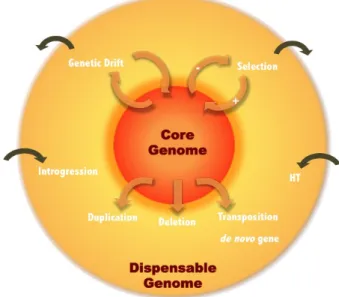
Different factors and forces can impact on the pangenome
structure, including gene birth and death, horizontal transfers
and TE activity (Figure
5
).
Fig. 5. Dynamic overview of the pangenome structure shaped by different events
and forces. New sequences are added to the dispensable genome through mu-tations, duplications, deletions and transpositions, while the core genome content may decrease by deletion and transposition. Horizontal transfer and introgression also impact on the dispensable genome compartment (sequence gain). Moreover, positive and purifying selection as well as genetic drift impact on the core and dis-pensable genomes (sequence gain and loss) as well as on the pangenome (se-quence loss).
Gene Birth-and-Death Processes. Gene creation and
elimination can occur as a result of different processes,
in-cluding errors during recombination that eliminate genes,
TEs that mediate gene duplication, duplication events that
result in gene gains, followed by diversification and
neofunc-tionalization (
21
). There is evidence that most of the
dispens-able genes may arise from these gene birth-and-death
mech-anisms. Unique protein-coding genes may emerged from (i)
non-coding DNA (de novo genes), (ii) an older coding
se-quence by a combination of mechanisms such as duplication
followed by rapid divergence, horizontal gene transfer, or
an-cient gene lost with important sequence variation followed
by neofunction, or exapted transposon (domesticated by the
host genome to provide a new biological function) (
61
,
62
).
Dispensable genes identified in several studies tend to
dis-play common features similar to young genes: short gene,
weak Interpro homology, low expression, rapid evolution and
turnover (
16
,
39
,
63
,
64
). Several studies showed a regulatory
role of these genes in response to numerous varying
environ-mental conditions, biotic (
65
) or abiotic stresses (
44
), and
potentially also in death gene processes (
52
).
Transposable Elements, Umpires and Players.
Ubiqui-tous in all eukaryotic genomes, TEs represent a major part
of many plant genomes. TEs are endogenous genomic
ele-ments able to duplicate themselves and to insert elsewhere
in a host genome. They use different strategies to move,
in-cluding RNA (retrotransposons, Class I) or DNA
intermedi-ates (DNA transposons, Class II) (
32
). The Copy-and-Paste
amplification strategy used by retrotransposons allows them
to accumulate in the genome at a high-copy numbers, with
the result that some TE families can represent a predominant
part of a genome. For instance, 85% of the maize (Zea mays)
genome consists of TEs, mainly LTR Retrotransposons (
66
).
TE movements are at the origin of numerous genomic
varia-tions within species (
14
,
67
). For instance, in maize, the
ac-tivity of TEs, especially Helitron-like elements, was able to
modify up to 50% of the genome structure in a vast majority
of the collinear BACs analyzed (
13
,
14
). Due to their ability
to change location within the host genome (
32
), they are the
first candidates for dispensable genome creation (
14
,
16
), as
every new insertion will belong to this compartment. Finally,
their ability to spread through a population at a high rate
al-lows them to invade even the core genome of species, such as
the P element in different Drosophila species (
68
).
Beyond their own intrinsic activity, the presence of TEs at a
given position may alter the pangenomic structure. Golicz et
al. observed a higher TE density surrounding variable genes
in Brassica oleacerea (
39
). In the same way, Gordon et al.
(
21
) showed that non-core genes are more linked to TE
activ-ity than core genes. TEs can alter the expression of
surround-ing genes (
69
,
70
), but also the global genome structure by
serving as anchor for illegitimate recombination (
71
).
Horizontal Transfers. It has been shown within bacteria the
importance of Horizontal Gene Transfer (HGT)(
72
) and its
impact on the pangenome (
73
). HGT has been shown in
eu-karyotes (
74
,
75
), sometimes with a high success and
essen-tial functions, and can be selected to become a core gene.
Horizontal Transfers (HT) from non-genic elements such as
TEs (
76
,
77
) may also impact the dispensable genome and
could invade the host genome in a very short period of time
(
68
), and on a large array of species (
78
,
79
).
Challenges, Perspectives and the Way
For-ward
Links and Impacts on Phenotype. Dispensable genes are
thought to be responsible for considerable phenotypic
varia-tion that could be suitable for breeding improved crop
vari-eties and evolutionary studies of adaptive traits (
21
).
Struc-tural variations (including CNV and PAV) can significantly
have an impact on phenotypic variation in plants. For
in-stance, Lu et al, (
80
) investigated the contribution of PAVs
to phenotypic variance using GWAS on 4 traits in maize
and SNPs located in non-reference sequences were found
en-riched in the significant GWAS hits compared to
reference-based SNPs, indicating their possible role in such variation.
In the same way, in a study with rice, more than 40% of the
agronomical traits were linked to non-reference sequences,
thus dispensable (
20
). In addition, in wild African rice O.
barthii, the PAV of the PROSTATE GROWTH 1 (PROG1)
gene directly impacts global plant phenotype: when absent,
plants are erect, while when present plants are not erect (
7
).
The absent state seems to have been selected in the cultivated
relative O. glaberrima. Many other examples exist in rice
and other crops that show numerous phenotypes of interest
are not linked to SNPs but to PAVs.
Adaptation, Selection and Speciation. The pangenome
concept offers new perspectives to increase our knowledge
about evolutionary mechanisms that allow organisms to adapt
quickly to new environments. Indeed, more and more
stud-ies show adaptive phenotypic changes in plants for various
traits due to CNVs (e.g. flowering time (
81
,
82
), pest and
diseases resistance (
83
,
84
), herbicide resistance (
85
), plant
height (
86
)). The ability to acquire new genes and to
gener-ate gene allelic diversity has various potential effects
includ-ing neutral, adaptive or not on fitness (
49
,
87
). Pangenome
analysis offers new ways to investigate the adaptation
pro-cesses and to understand their impacts on the core and
dis-pensable genomes. It would be particularly interesting to
fo-cus on different periods of divergence within a given group,
such as speciation, when effective population size is small,
genetic drift effect is important, and events such as the
repro-ductive isolation is occurring. It was shown for some species
that speciation will impact drastically the pangenomic
struc-ture (
12
,
39
,
64
). This will lead to additional questions and
possibilities, such as what is a species in perspective of the
pangenome? Is having the same core genome enough to be
from the same species, or is it too restrictive or relaxed?
Graphical Visualization. Graphical tools have been
devel-oped to handle and display bacterial pangenome datasets
such as PanX (
88
), pan-Tetris (
89
), PanViz (
90
), seq-seq-pan
(
91
) and PanACEAE (
92
). However, fewer have been
pro-posed for plant genomes including Rpan (
93
) and Brachypan
(
21
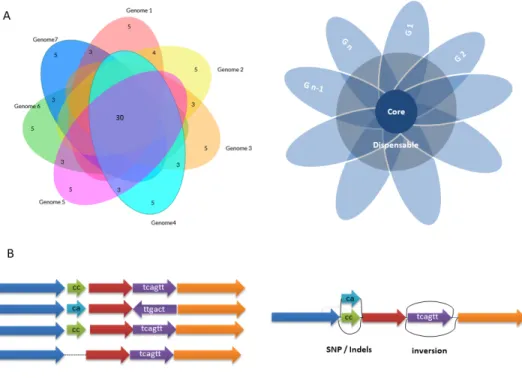
). Generally, publications on the topic have revisited Venn
diagram or flower plot like representations (
94
–
97
) (Figure
6
A) to illustrate PAV, but this representation has limitations
with increased sample size, leading to the possibility of
al-ternate visualization tools, such as Upset (
98
). Various
ap-proaches are emerging using graph-based structures (
99
,
100
)
(genome and variation graphes; Figure
6
B), for example
us-ing the de Bruijn Graph Algorithm.
The main challenge remains to design scalable solutions for
large panels of samples able to support PAV-based functional
analyses that allow to zoom into chromosome segments to
visualize individual SVs and SNPs for structural-based
anal-yses. However, such comprehensive systems are still in their
Fig. 6. A. Frequent static representations of Pangenomes. B. Cartoon of a Graph-based structure, adapted from (99)
infancy and are not yet operational. Whatever solutions will
be developed as reference tools, it would be recommended to
build them upon existing systems with powerful capacity to
explore genomes and variants, or at least to enable
interoper-ability between them.
Expected Contribution of recent sequencing
ap-proaches. Conformation capture methods such as Hi-C,
mate-pairs libraries or 10x synthetic long-reads are second
generation technology based approaches that can be used in
the near future to resolve panreference assemblies. Besides,
third-generation sequencing technologies such as Pacific
Bio-Sciences SMRT or Oxford Nanopore Technologies (ONT)
offer single-strand long-reads sequences (up to 2 Mb, the
current ONT record so far). These methods, and especially
the low-cost Minion from ONT, will change the paradigm
of one high-quality reference sequence and many draft
se-quence samples. Indeed, a golden-standard quality sese-quence
can be performed for less than 1,000 USD for genomes of
around 150Mb (
101
), and 1,300 USD for a rice-sized genome
(400Mb; F. Sabot, unpublished data). Thus, the
Assemble-then-map approach (see Figure
4
) may become the standard
for future pangenomic approaches. Indeed, the capacity of
long-read assemblies to overcome the repeat sequence
para-dox and to solve the scaffolding difficulties will make this
technology the best tool for pangenome analysis.
Advan-tages of a portable solution such as Minion will allow rapid
sequence capacities in any lab with any sample of interest to
identify PAVs or CNVs of interest.
Conclusions and Future Perspectives. The pangenome
concept combined with high-throughput third-generation
se-quencing will probably allow access to large gene repertoires
of the wild relatives of cultivated plants, particularly
interest-ing for crucial agronomic traits such as drought and salinity
tolerance. Genome portals will have to evolve from a
ref-erence genome centric view to adopt a pangenome refref-erence
view, or to manage multiple reference assemblies with a
gran-ular level of display with standardized genome assembly and
gene models nomenclature. Using dispensable genome data
will allow identifying the genetic basis of phenotypes of
in-terest in dedicated lines.
Summary points
1. Pangenome view of a genome opens new challenging
ways to explore genetic diversity, adaptation and
evo-lutionary mechanisms within a group.
2. Pangenome analyses give access to a surprisingly large
reservoir of genes/sequences never identified when
working on a single reference genome.
3. Increased knowledge of dispensable genes may be of
high importance for breeding applications.
Disclosure Statement
None
ACKNOWLEDGEMENTS
Authors want to thank their respective host institutions for funding as well as the CGIAR Research Programs (CRP) on Roots, Tubers and Bananas (RTB) and RICE.
Table 1. Current overview of current plant pangenome studies.
Organism
Sample number
Method
Total Pangenes
Core
a
Dispensable
a
References
Arabidopsis thaliana
19
assemble-then-map
37,789
69.7
30.3
(
43
)
Brachypodium distachyon
54
assemble-then-map
37,886
54
46
(
21
)
Brassica oleacera
10
b
map-then-assemble
61,379
81.3
18.7
(
39
)
Capsicum
355
map-then-assemble
51,757
55.7
44.3
(
102
)
Medicago
15
assemble-then-map
74,700
41.9
58.1
(
103
)
Poplar
22
mapping only
-
80.7
19.3
(
104
)
Asian Rice
66
b
assemble-then-map
42,580
61.9
38.1
(
36
)
Asian Rice
453/3,000
assemble-then-map
46,115
c
/47,288
d
52.9/61.3
47.1/28.7
(
105
)
African Rice
120 cultivated / 74 wild
map-the-assemble
35,198/36,252
86.5/98.6
13.5/1.4
(
12
)
Soybean
7
b
assemble-then-map
59,080
80.1
19.9
(
5
)
Bread Wheat
18
map-then-assemble
128,656
64.3
33.7
(
15
)
1
a
Percentage of total pangenes;
b
Wild and cultivated ;
c
indica
subspecies ;
d
japonica
subspecies.
8 | bio R
χ
iv T ranchant-Dubreuil et al. | Plant P angenomeBibliography
1. Karl J Schmid, Sebastian Ramos-Onsins, Henriette Ringys-Beckstein, Bernd Weisshaar, and Thomas Mitchell-Olds. A multilocus sequence survey in arabidopsis thaliana reveals a genome-wide departure from a neutral model of dna sequence polymorphism. Genetics, 169(3):1601—1615, March 2005. ISSN 0016-6731. doi:10.1534/genetics.104.033795. 2. Zhang De-Xing and Godfrey M. Hewitt. Nuclear dna analyses in genetic studies of
popu-lations: practice, problems and prospects. Molecular Ecology, 12(3):563–584, 2003. doi: 10.1046/j.1365-294X.2003.01773.x.
3. Richard Redon, Shumpei Ishikawa, Karen R Fitch, Lars Feuk, George H Perry, T Daniel Andrews, Heike Fiegler, Michael H Shapero, Andrew R Carson, Wenwei Chen, Eun Kyung Cho, Stephanie Dallaire, Jennifer L Freeman, Juan R González, Mònica Gratacòs, Jing Huang, Dimitrios Kalaitzopoulos, Daisuke Komura, Jeffrey R MacDonald, Christian R Marshall, Rui Mei, Lyndal Montgomery, Kunihiro Nishimura, Kohji Okamura, Fan Shen, Martin J Somerville, Joelle Tchinda, Armand Valsesia, Cara Woodwark, Fengtang Yang, Junjun Zhang, Tatiana Zerjal, Jane Zhang, Lluis Armengol, Donald F Conrad, Xavier Estivill, Chris Tyler-Smith, Nigel P Carter, Hiroyuki Aburatani, Charles Lee, Keith W Jones, Stephen W Scherer, and Matthew E Hurles. Global variation in copy number in the human genome. Nature, 444(7118):444–54, nov 2006. ISSN 1476-4687. doi: 10.1038/nature05329.
4. Jianjian Qi, Xin Liu, Di Shen, Han Miao, Bingyan Xie, Xixiang Li, Peng Zeng, Shenhao Wang, Yi Shang, Xingfang Gu, Yongchen Du, Ying Li, Tao Lin, Jinhong Yuan, Xueyong Yang, Jinfeng Chen, Huiming Chen, Xingyao Xiong, Ke Huang, Zhangjun Fei, Linyong Mao, Li Tian, Thomas Städler, Susanne S Renner, Sophien Kamoun, William J Lucas, Zhonghua Zhang, and Sanwen Huang. A genomic variation map provides insights into the genetic basis of cucumber domestication and diversity. Nature Genetics, 45:1510, oct 2013.
5. Jia-Yang Li, Jun Wang, and Robert S Zeigler. The 3,000 rice genomes project: new opportunities and challenges for future rice research. GigaScience, 3(1):8, dec 2014. ISSN 2047-217X. doi:10.1186/2047-217X-3-8.
6. Tao Lin, Guangtao Zhu, Junhong Zhang, Xiangyang Xu, Qinghui Yu, Zheng Zheng, Zhonghua Zhang, Yaoyao Lun, Shuai Li, Xiaoxuan Wang, Zejun Huang, Junming Li, Chun-zhi Zhang, Taotao Wang, Yuyang Zhang, Aoxue Wang, Yancong Zhang, Kui Lin, Chuanyou Li, Guosheng Xiong, Yongbiao Xue, Andrea Mazzucato, Mathilde Causse, Zhangjun Fei, James J Giovannoni, Roger T Chetelat, Dani Zamir, Thomas Städler, Jingfu Li, Zhibiao Ye, Yongchen Du, and Sanwen Huang. Genomic analyses provide insights into the history of tomato breeding. Nature Genetics, 46:1220, oct 2014.
7. P. Cubry, C. Tranchant-Dubreuil, A.-C. Thuillet, C. Monat, M.-N. Ndjiondjop, K. Labadie, C. Cruaud, S. Engelen, N. Scarcelli, B. Rhoné, C. Burgarella, C. Dupuy, P. Larmande, P. Wincker, O. François, F. Sabot, and Y. Vigouroux. The Rise and Fall of African Rice Cultivation Revealed by Analysis of 246 New Genomes. Current Biology, 2018. ISSN 09609822. doi:10.1016/j.cub.2018.05.066.
8. Nathan M Springer, Kai Ying, Yan Fu, Tieming Ji, Cheng-Ting Yeh, Yi Jia, Wei Wu, Todd Richmond, Jacob Kitzman, Heidi Rosenbaum, A Leonardo Iniguez, W Brad Barbazuk, Jef-frey A Jeddeloh, Dan Nettleton, and Patrick S Schnable. Maize Inbreds Exhibit High Levels of Copy Number Variation (CNV) and Presence/Absence Variation (PAV) in Genome Con-tent. PLOS Genetics, 5(11):e1000734, nov 2009.
9. Rachit K Saxena, David Edwards, and Rajeev K Varshney. Structural variations in plant genomes. Briefings in functional genomics, 13(4):296–307, jul 2014. ISSN 2041-2657. doi:10.1093/bfgp/elu016.
10. Bhavna Hurgobin and David Edwards. SNP Discovery Using a Pangenome: Has the Single Reference Approach Become Obsolete? Biology, 6(1), mar 2017. ISSN 2079-7737. doi:10.3390/biology6010021.
11. Cécile Monat, Bérengère Pera, Marie-Noelle Ndjiondjop, Mounirou Sow, Christine Tranchant-Dubreuil, Leila Bastianelli, Alain Ghesquière, and Francois Sabot. De novo assemblies of three oryza glaberrima accessions provide first insights about pan-genome of african rices. Genome Biology and Evolution, 9(1):1–6, 2017. doi:10.1093/gbe/evw253. 12. Cecile Monat, Christine Tranchant-Dubreuil, Stefan Engelen, Karine Labadie, Emmanuel Paradis, Ndomassi Tando, and Francois Sabot. Comparison of two african rice species through a new pan-genomic approach on massive data. bioRxiv, 2018. doi:10.1101/ 245431.
13. Michele Morgante, Stephan Brunner, Giorgio Pea, Kevin Fengler, Andrea Zuccolo, and Antoni Rafalski. Gene duplication and exon shuffling by helitron-like transposons generate intraspecies diversity in maize. Nature genetics, 37(9):997—1002, September 2005. ISSN 1061-4036. doi:10.1038/ng1615.
14. Michele Morgante, Emanuele De Paoli, and Slobodanka Radovic. Transposable elements and the plant pan-genomes. Current Opinion in Plant Biology, 10(2):149 – 155, 2007. ISSN 1369-5266. doi:https://doi.org/10.1016/j.pbi.2007.02.001. Genome Studies and Molecular Genetics / Edited by Stefan Jansson and Edward S Buckler.
15. Juan D. Montenegro, Agnieszka A. Golicz, Philipp E. Bayer, Bhavna Hurgobin, HueyTyng Lee, Chon-Kit Kenneth Chan, Paul Visendi, Kaitao Lai, Jaroslav Doležel, Jacqueline Bat-ley, and David Edwards. The pangenome of hexaploid bread wheat. The Plant Journal, 90(5):1007–1013, jun 2017. ISSN 09607412. doi:10.1111/tpj.13515.
16. Michael C Schatz, Lyza G Maron, Joshua C Stein, Alejandro Hernandez Wences, James Gurtowski, Eric Biggers, Hayan Lee, Melissa Kramer, Eric Antoniou, Elena Ghiban, Mark H Wright, Jer-ming Chia, Doreen Ware, Susan R McCouch, and W Richard McCombie. Whole genome de novo assemblies of three divergent strains of rice, Oryza sativa, doc-ument novel gene space of aus and indica. Genome biology, 15(11):506, 2014. ISSN 1474-760X. doi:10.1186/PREACCEPT-2784872521277375.
17. Kenong Xu, Xia Xu, Takeshi Fukao, Patrick Canlas, Reycel Maghirang-Rodriguez, Sigrid Heuer, Abdelbagi M. Ismail, Julia Bailey-Serres, Pamela C. Ronald, and David J. Mackill. Sub1A is an ethylene-response-factor-like gene that confers submergence tolerance to rice. Nature, 442(7103):705–708, aug 2006. ISSN 0028-0836. doi:10.1038/nature04920. 18. Yoko Hattori, Keisuke Nagai, Shizuka Furukawa, Xian-Jun Song, Ritsuko Kawano, Hi-toshi Sakakibara, Jianzhong Wu, Takashi Matsumoto, Atsushi Yoshimura, Hidemi Kitano, Makoto Matsuoka, Hitoshi Mori, and Motoyuki Ashikari. The ethylene response factors
SNORKEL1 and SNORKEL2 allow rice to adapt to deep water. Nature, 460(7258):1026– 1030, aug 2009. ISSN 0028-0836. doi:10.1038/nature08258.
19. Rico Gamuyao, Joong Hyoun Chin, Juan Pariasca-Tanaka, Paolo Pesaresi, Sheryl Catau-san, Cheryl Dalid, Inez Slamet-Loedin, Evelyn Mae Tecson-Mendoza, Matthias Wissuwa, and Sigrid Heuer. The protein kinase Pstol1 from traditional rice confers tolerance of phosphorus deficiency. Nature, 488(7412):535–539, aug 2012. ISSN 0028-0836. doi: 10.1038/nature11346.
20. Wen Yao, Guangwei Li, Hu Zhao, Gongwei Wang, Xingming Lian, and Weibo Xie. Explor-ing the rice dispensable genome usExplor-ing a metagenome-like assembly strategy. Genome biology, 16:187, sep 2015. ISSN 1474-760X. doi:10.1186/s13059-015-0757-3. 21. Sean P. Gordon, Bruno Contreras-Moreira, Daniel P. Woods, David L. Des Marais, Diane
Burgess, Shengqiang Shu, Christoph Stritt, Anne C. Roulin, Wendy Schackwitz, Ludmila Tyler, Joel Martin, Anna Lipzen, Niklas Dochy, Jeremy Phillips, Kerrie Barry, Koen Geuten, Hikmet Budak, Thomas E. Juenger, Richard Amasino, Ana L. Caicedo, David Goodstein, Patrick Davidson, Luis A. J. Mur, Melania Figueroa, Michael Freeling, Pilar Catalan, and John P. Vogel. Extensive gene content variation in the Brachypodium distachyon pan-genome correlates with population structure. Nature Communications, 8(1):2184, dec 2017. ISSN 2041-1723. doi:10.1038/s41467-017-02292-8.
22. Hervé Tettelin, Vega Masignani, Michael J. Cieslewicz, Claudio Donati, Duccio Medini, Naomi L. Ward, Samuel V. Angiuoli, Jonathan Crabtree, Amanda L. Jones, A. Scott Durkin, Robert T. DeBoy, Tanja M. Davidsen, Marirosa Mora, Maria Scarselli, Immacu-lada Margarit y Ros, Jeremy D. Peterson, Christopher R. Hauser, Jaideep P. Sundaram, William C. Nelson, Ramana Madupu, Lauren M. Brinkac, Robert J. Dodson, Mary J. Roso-vitz, Steven A. Sullivan, Sean C. Daugherty, Daniel H. Haft, Jeremy Selengut, Michelle L. Gwinn, Liwei Zhou, Nikhat Zafar, Hoda Khouri, Diana Radune, George Dimitrov, Kisha Watkins, Kevin J. B. O’Connor, Shannon Smith, Teresa R. Utterback, Owen White, Craig E. Rubens, Guido Grandi, Lawrence C. Madoff, Dennis L. Kasper, John L. Telford, Michael R. Wessels, Rino Rappuoli, and Claire M. Fraser. Genome analysis of multiple pathogenic isolates of streptococcus agalactiae: Implications for the microbial “pan-genome”. Pro-ceedings of the National Academy of Sciences, 102(39):13950–13955, 2005. ISSN 0027-8424. doi:10.1073/pnas.0506758102.
23. Duccio Medini, Claudio Donati, Herve Tettelin, Vega Masignani, and Rino Rappuoli. The microbial pan-genome. Current Opinion in Genetics & Development, 15(6):589 – 594, 2005. ISSN 0959-437X. doi: https://doi.org/10.1016/j.gde.2005.09.006. Genomes and evolution.
24. Fabio Marroni, Sara Pinosio, and Michele Morgante. Structural variation and genome complexity: is dispensable really dispensable? Current Opinion in Plant Biology, 18:31– 36, apr 2014. ISSN 1369-5266. doi:10.1016/J.PBI.2014.01.003.
25. Luis Carlos Guimarães, Jolanta Florczak-Wyspianska, Leandro Benevides de Jesus, Mar-cus Vinícius Canário Viana, Artur Silva, Rommel Thiago Jucá Ramos, Siomar de Cas-tro Soares, and Siomar de CasCas-tro Soares. Inside the pan-genome - methods and soft-ware overview. Current genomics, 16(4):245—252, August 2015. ISSN 1389-2029. doi: 10.2174/1389202916666150423002311.
26. Clémence Plissonneau, Fanny E Hartmann, and Daniel Croll. Pangenome analyses of the wheat pathogen zymoseptoria tritici reveal the structural basis of a highly plas-tic eukaryoplas-tic genome. BMC biology, 16(1):5, January 2018. ISSN 1741-7007. doi: 10.1186/s12915-017-0457-4.
27. Lars Snipen, Trygve Almøy, and David W Ussery. Microbial comparative pan-genomics using binomial mixture models. BMC genomics, 10:385, 2009. ISSN 1471-2164. doi: 10.1186/1471-2164-10-385.
28. Luis David Alcaraz, Gabriel Moreno-Hagelsieb, Luis E Eguiarte, Valeria Souza, Luis Herrera-Estrella, and Gabriela Olmedo. Understanding the evolutionary relationships and major traits of bacillus through comparative genomics. BMC genomics, 11:332, May 2010. ISSN 1471-2164. doi:10.1186/1471-2164-11-332.
29. David A Rasko, MJ Rosovitz, Garry S A Myers, Emmanuel F Mongodin, W Florian Fricke, Pawel Gajer, Jonathan Crabtree, Mohammed Sebaihia, Nicholas R Thomson, Roy Chaud-huri, Ian R Henderson, Vanessa Sperandio, and Jacques Ravel. The pangenome structure of escherichia coli: comparative genomic analysis of e. coli commensal and pathogenic isolates. Journal of bacteriology, 190(20):6881—6893, October 2008. ISSN 0021-9193. doi:10.1128/jb.00619-08.
30. Victor V Tetz. The pangenome concept: a unifying view of genetic information. Medical science monitor, 11(7):HY24–HY29, 2005.
31. Chen Sun, Zhiqiang Hu, Tianqing Zheng, Kuangchen Lu, Yue Zhao, Wensheng Wang, Jianxin Shi, Chunchao Wang, Jinyuan Lu, Dabing Zhang, Zhikang Li, and Chaochun Wei. Rpan: rice pan-genome browser for 3000 rice genomes. Nucleic Acids Research, 45(2): 597–605, 2017. doi:10.1093/nar/gkw958.
32. Thomas Wicker, François Sabot, Aurélie Hua-Van, Jeffrey L Bennetzen, Pierre Capy, Bou-los Chalhoub, Andrew Flavell, Philippe Leroy, Michele Morgante, Olivier Panaud, Etienne Paux, Phillip SanMiguel, and Alan H Schulman. A unified classification system for eukary-otic transposable elements. Nature Reviews Genetics, 8:973, dec 2007.
33. Sarah C.R. Elgin and Gunter Reuter. Position-effect variegation, heterochromatin forma-tion, and gene silencing in drosophila. Cold Spring Harbor Perspectives in Biology, 5(8), 2013. doi:10.1101/cshperspect.a017780.
34. R. Eric Collins and Paul G. Higgs. Testing the infinitely many genes model for the evolution of the bacterial core genome and pangenome. Molecular Biology and Evolution, 29(11): 3413–3425, 2012. doi:10.1093/molbev/mss163.
35. Hurgobin Bhavna, Golicz Agnieszka A., Bayer Philipp E., Chan Chon-Kit Kenneth, Tir-naz Soodeh, Dolatabadian Aria, Schiessl Sarah V., Samans Birgit, Montenegro Juan D., Parkin Isobel A. P., Pires J. Chris, Chalhoub Boulos, King Graham J., Snowdon Rod, Batley Jacqueline, and Edwards David. Homoeologous exchange is a major cause of gene pres-ence/absence variation in the amphidiploid brassica napus. Plant Biotechnology Journal, 16(7):1265–1274, 2017. doi:10.1111/pbi.12867.
36. Qiang Zhao, Qi Feng, Hengyun Lu, Yan Li, Ahong Wang, Qilin Tian, Qilin Zhan, Yiqi Lu, Lei Zhang, Tao Huang, Yongchun Wang, Danlin Fan, Yan Zhao, Ziqun Wang, Congcong Zhou, Jiaying Chen, Chuanrang Zhu, Wenjun Li, Qijun Weng, Qun Xu, Zi-Xuan Wang, Xinghua Wei, Bin Han, and Xuehui Huang. Pan-genome analysis highlights the extent of genomic
variation in cultivated and wild rice. Nature Genetics, page 1, jan 2018. ISSN 1061-4036. doi:10.1038/s41588-018-0041-z.
37. Weiya Xue, Yongzhong Xing, Xiaoyu Weng, Yu Zhao, Weijiang Tang, Lei Wang, Hongju Zhou, Sibin Yu, Caiguo Xu, Xianghua Li, and Qifa Zhang. Natural variation in Ghd7 is an important regulator of heading date and yield potential in rice. Nature Genetics, 40:761, may 2008.
38. Cui Jiajun, Fan Shengci, Shao Tian, Huang Zejun, Zheng Dali, Tang Ding, Li Ming, Qian Qian, and Cheng Zhukuan. Characterization and fine mapping of the ibf mutant in rice. Journal of Integrative Plant Biology, 49(5):678–685, 2007. doi:10.1111/j.1744-7909.2007. 00467.x.
39. Agnieszka A. Golicz, Philipp E. Bayer, Guy C. Barker, Patrick P. Edger, HyeRan Kim, Paula A. Martinez, Chon Kit Kenneth Chan, Anita Severn-Ellis, W. Richard McCombie, Isobel A. P. Parkin, Andrew H. Paterson, J. Chris Pires, Andrew G. Sharpe, Haibao Tang, Graham R. Teakle, Christopher D. Town, Jacqueline Batley, and David Edwards. The pangenome of an agronomically important crop plant Brassica oleracea. Nature Commu-nications, 7:13390, nov 2016. ISSN 2041-1723. doi:10.1038/ncomms13390. 40. Xun Xu, Xin Liu, Song Ge, Jeffrey D Jensen, Fengyi Hu, Xin Li, Yang Dong, Ryan N
Gutenkunst, Lin Fang, Lei Huang, Jingxiang Li, Weiming He, Guojie Zhang, Xiaoming Zheng, Fumin Zhang, Yingrui Li, Chang Yu, Karsten Kristiansen, Xiuqing Zhang, Jian Wang, Mark Wright, Susan McCouch, Rasmus Nielsen, Jun Wang, and Wen Wang. Re-sequencing 50 accessions of cultivated and wild rice yields markers for identifying agro-nomically important genes. Nature Biotechnology, 30:105, dec 2011.
41. Leah K. McHale, William J. Haun, Wayne W. Xu, Pudota B. Bhaskar, Justin E. Anderson, David L. Hyten, Daniel J. Gerhardt, Jeffrey A. Jeddeloh, and Robert M. Stupar. Structural variants in the soybean genome localize to clusters of biotic stress-response genes. Plant Physiology, 159(4):1295–1308, 2012. ISSN 0032-0889. doi:10.1104/pp.112.194605. 42. Jun Cao, Korbinian Schneeberger, Stephan Ossowski, Torsten Günther, Sebastian
Ben-der, Joffrey Fitz, Daniel Koenig, Christa Lanz, Oliver Stegle, Christoph Lippert, Xi Wang, Felix Ott, Jonas Müller, Carlos Alonso-Blanco, Karsten Borgwardt, Karl J Schmid, and Detlef Weigel. Whole-genome sequencing of multiple Arabidopsis thaliana populations. Nature Genetics, 43:956, aug 2011.
43. Bruno Contreras-Moreira, Carlos P. Cantalapiedra, María J. García-Pereira, Sean P. Gor-don, John P. Vogel, Ernesto Igartua, Ana M. Casas, and Pablo Vinuesa. Analysis of Plant Pan-Genomes and Transcriptomes with GET_homologues-EST, a Clustering Solution for Sequences of the Same Species. Frontiers in Plant Science, 8:184, 2017. ISSN 1664-462X. doi:10.3389/fpls.2017.00184.
44. Li Ling, Foster Carol M., Gan Qinglei, Nettleton Dan, James Martha G., Myers Alan M., and Wurtele Eve Syrkin. Identification of the novel protein qqs as a component of the starch metabolic network in arabidopsis leaves. The Plant Journal, 58(3):485–498, 2009. doi:10.1111/j.1365-313X.2009.03793.x.
45. Li Li, Christian J Stoeckert, and David S Roos. OrthoMCL: identification of ortholog groups for eukaryotic genomes. Genome Research, 13(9):2178–2189, September 2003. ISSN 1088-9051. doi:10.1101/gr.1224503.
46. A. J. Enright, S. Van Dongen, and C. A. Ouzounis. An efficient algorithm for large-scale detection of protein families. Nucl. Acids Res., 30(7):1575–1584, 2002. doi:10.1093/nar/ 30.7.1575.
47. Roman L. Tatusov, Eugene V. Koonin, and David J. Lipman. A Genomic Perspective on Protein Families. Science, 278(5338):631 –637, October 1997. doi:10.1126/science.278. 5338.631.
48. Hervé Tettelin, David Riley, Ciro Cattuto, and Duccio Medini. Comparative genomics: the bacterial pan-genome. Current Opinion in Microbiology, 11(5):472 – 477, 2008. ISSN 1369-5274. doi:https://doi.org/10.1016/j.mib.2008.09.006. Antimicrobials/Genomics. 49. James O McInerney, Alan McNally, and Mary J O’Connell. Why prokaryotes have
pangenomes. Nature Microbiology, 2:17040, mar 2017.
50. Ying-hui Li, Guangyu Zhou, Jianxin Ma, Wenkai Jiang, Long-guo Jin, Zhouhao Zhang, Yong Guo, Jinbo Zhang, Yi Sui, Liangtao Zheng, Shan-shan Zhang, Qiyang Zuo, Xue-hui Shi, Yan-fei Li, Wan-ke Zhang, Yiyao Hu, Guanyi Kong, Hui-long Hong, Bing Tan, Jian Song, Zhang-xiong Liu, Yaoshen Wang, Hang Ruan, Carol K L Yeung, Jian Liu, Hailong Wang, Li-juan Zhang, Rong-xia Guan, Ke-jing Wang, Wen-bin Li, Shou-yi Chen, Ru-zhen Chang, Zhi Jiang, Scott A Jackson, Ruiqiang Li, and Li-juan Qiu. De novo assembly of soybean wild relatives for pan-genome analysis of diversity and agronomic traits. Nature Biotechnology, 32(10):1045–1052, 2014. ISSN 1087-0156. doi:10.1038/nbt.2979. 51. Candice N. Hirsch, Jillian M. Foerster, James M. Johnson, Rajandeep S. Sekhon,
Ger-man Muttoni, Brieanne Vaillancourt, Francisco Peñagaricano, Erika Lindquist, Mary Ann Pedraza, Kerrie Barry, Natalia de Leon, Shawn M. Kaeppler, and C. Robin Buell. Insights into the maize pan-genome and pan-transcriptome. The Plant Cell, 26(1):121–135, 2014. ISSN 1040-4651. doi:10.1105/tpc.113.119982.
52. Peng Zhou, Kevin A. T. Silverstein, Thiruvarangan Ramaraj, Joseph Guhlin, Roxanne Denny, Junqi Liu, Andrew D. Farmer, Kelly P. Steele, Robert M. Stupar, Jason R. Miller, Peter Tiffin, Joann Mudge, and Nevin D. Young. Exploring structural variation and gene family architecture with De Novo assemblies of 15 Medicago genomes. BMC Genomics, 18(1):261, dec 2017. ISSN 1471-2164. doi:10.1186/s12864-017-3654-1.
53. Aurélia Caputo, Vicky Merhej, Kalliopi Georgiades, Pierre-Edouard Fournier, Olivier Croce, Catherine Robert, and Didier Raoult. Pan-genomic analysis to redefine species and sub-species based on quantum discontinuous variation: the Klebsiella paradigm. Biology Di-rect, 10(1):55, 2015. ISSN 1745-6150. doi:10.1186/s13062-015-0085-2.
54. Xiangchao Gan, Oliver Stegle, Jonas Behr, Joshua G Steffen, Philipp Drewe, Katie L Hilde-brand, Rune Lyngsoe, Sebastian J Schultheiss, Edward J Osborne, Vipin T Sreedharan, André Kahles, Regina Bohnert, Géraldine Jean, Paul Derwent, Paul Kersey, Eric J Belfield, Nicholas P Harberd, Eric Kemen, Christopher Toomajian, Paula X Kover, Richard M Clark, Gunnar Rätsch, and Richard Mott. Multiple reference genomes and transcriptomes for Arabidopsis thaliana. Nature, 477:419, aug 2011.
55. Hiroaki Sakai, Hiroyuki Kanamori, Yuko Arai-Kichise, Mari Shibata-Hatta, Kaworu Ebana, Youko Oono, Kanako Kurita, Hiroko Fujisawa, Satoshi Katagiri, Yoshiyuki Mukai, Masao Hamada, Takeshi Itoh, Takashi Matsumoto, Yuichi Katayose, Kyo Wakasa, Masahiro Yano, and Jianzhong Wu. Construction of pseudomolecule sequences of the aus rice cultivar
Kasalath for comparative genomics of Asian cultivated rice. DNA research : an interna-tional journal for rapid publication of reports on genes and genomes, 21(4):397–405, aug 2014. ISSN 1756-1663. doi:10.1093/dnares/dsu006.
56. Veronika Laine, Toni I Gossmann, Kees van Oers, Marcel E Visser, and Martien A.M. Groenen. Exploring the unmapped dna and rna reads in a songbird genome. bioRxiv, 2018. doi:10.1101/371963.
57. Li Li, Christian J. Stoeckert, and David S. Roos. Orthomcl: Identification of ortholog groups for eukaryotic genomes. Genome Research, 13(9):2178–2189, 2003. doi:10.1101/gr. 1224503.
58. David M. Emms and Steven Kelly. Orthofinder: solving fundamental biases in whole genome comparisons dramatically improves orthogroup inference accuracy. Genome Bi-ology, 16(1):157, Aug 2015. ISSN 1474-760X. doi:10.1186/s13059-015-0721-2. 59. Adam D. Ewing. Transposable element detection from whole genome sequence data.
Mobile DNA, 6(1):24, dec 2015. ISSN 1759-8753. doi:10.1186/s13100-015-0055-3. 60. Lavanya Rishishwar, Leonardo Mariño-Ramírez, and I. King Jordan. Benchmarking
com-putational tools for polymorphic transposable element detection. Briefings in Bioinformat-ics, 18(6):bbw072, aug 2016. ISSN 1467-5463. doi:10.1093/bib/bbw072.
61. Zebulun W. Arendsee, Ling Li, and Eve Syrkin Wurtele. Coming of age: orphan genes in plants. Trends in Plant Science, 19(11):698–708, nov 2014. ISSN 1360-1385. doi: 10.1016/J.TPLANTS.2014.07.003.
62. Christian Schlötterer. Genes from scratch–the evolutionary fate of de novo genes. Trends in genetics : TIG, 31(4):215–9, apr 2015. ISSN 0168-9525. doi:10.1016/j.tig.2015.02.007. 63. Joshua C. Stein, Yeisoo Yu, Dario Copetti, Derrick J. Zwickl, Li Zhang, Chengjun Zhang, Kapeel Chougule, Dongying Gao, Aiko Iwata, Jose Luis Goicoechea, Sharon Wei, Jun Wang, Yi Liao, Muhua Wang, Julie Jacquemin, Claude Becker, Dave Kudrna, Jian-wei Zhang, Carlos E. M. Londono, Xiang Song, Seunghee Lee, Paul Sanchez, drea Zuccolo, Jetty S. S. Ammiraju, Jayson Talag, Ann Danowitz, Luis F. Rivera, An-drea R. Gschwend, Christos Noutsos, Cheng-chieh Wu, Shu-min Kao, Jhih-wun Zeng, Fu-jin Wei, Qiang Zhao, Qi Feng, Moaine El Baidouri, Marie-Christine Carpentier, Eric Lasserre, Richard Cooke, Daniel da Rosa Farias, Luciano Carlos da Maia, Railson S. dos Santos, Kevin G. Nyberg, Kenneth L. McNally, Ramil Mauleon, Nickolai Alexandrov, Jeremy Schmutz, Dave Flowers, Chuanzhu Fan, Detlef Weigel, Kshirod K. Jena, Thomas Wicker, Mingsheng Chen, Bin Han, Robert Henry, Yue-ie C. Hsing, Nori Kurata, Anto-nio Costa de Oliveira, Olivier Panaud, Scott A. Jackson, Carlos A. Machado, Michael J. Sanderson, Manyuan Long, Doreen Ware, and Rod A. Wing. Genomes of 13 domes-ticated and wild rice relatives highlight genetic conservation, turnover and innovation across the genus Oryza. Nature Genetics, page 1, jan 2018. ISSN 1061-4036. doi: 10.1038/s41588-018-0040-0.
64. Agnieszka A. Golicz, Jacqueline Batley, and David Edwards. Towards plant pangenomics. Plant Biotechnology Journal, 14(4):1099–1105, apr 2016. ISSN 14677644. doi:10.1111/ pbi.12499.
65. Wenfei Xiao, Hongbo Liu, Yu Li, Xianghua Li, Caiguo Xu, Manyuan Long, and Shiping Wang. A rice gene of de novo origin negatively regulates pathogen-induced defense re-sponse. PLOS ONE, 4(2):1–12, 02 2009. doi:10.1371/journal.pone.0004603. 66. Patrick S. Schnable, Doreen Ware, Robert S. Fulton, Joshua C. Stein, Fusheng Wei,
Shi-ran Pasternak, Chengzhi Liang, Jianwei Zhang, Lucinda Fulton, Tina A. Graves, Patrick Minx, Amy Denise Reily, Laura Courtney, Scott S. Kruchowski, Chad Tomlinson, Cindy Strong, Kim Delehaunty, Catrina Fronick, Bill Courtney, Susan M. Rock, Eddie Belter, Feiyu Du, Kyung Kim, Rachel M. Abbott, Marc Cotton, Andy Levy, Pamela Marchetto, Kerri Ochoa, Stephanie M. Jackson, Barbara Gillam, Weizu Chen, Le Yan, Jamey Higgin-botham, Marco Cardenas, Jason Waligorski, Elizabeth Applebaum, Lindsey Phelps, Jason Falcone, Krishna Kanchi, Thynn Thane, Adam Scimone, Nay Thane, Jessica Henke, Tom Wang, Jessica Ruppert, Neha Shah, Kelsi Rotter, Jennifer Hodges, Elizabeth Ingenthron, Matt Cordes, Sara Kohlberg, Jennifer Sgro, Brandon Delgado, Kelly Mead, Asif Chinwalla, Shawn Leonard, Kevin Crouse, Kristi Collura, Dave Kudrna, Jennifer Currie, Ruifeng He, Angelina Angelova, Shanmugam Rajasekar, Teri Mueller, Rene Lomeli, Gabriel Scara, Ara Ko, Krista Delaney, Marina Wissotski, Georgina Lopez, David Campos, Michele Braidotti, Elizabeth Ashley, Wolfgang Golser, HyeRan Kim, Seunghee Lee, Jinke Lin, Zeljko Dujmic, Woojin Kim, Jayson Talag, Andrea Zuccolo, Chuanzhu Fan, Aswathy Sebastian, Melissa Kramer, Lori Spiegel, Lidia Nascimento, Theresa Zutavern, Beth Miller, Claude Ambroise, Stephanie Muller, Will Spooner, Apurva Narechania, Liya Ren, Sharon Wei, Sunita Ku-mari, Ben Faga, Michael J. Levy, Linda McMahan, Peter Van Buren, Matthew W. Vaughn, Kai Ying, Cheng-Ting Yeh, Scott J. Emrich, Yi Jia, Ananth Kalyanaraman, An-Ping Hsia, W. Brad Barbazuk, Regina S. Baucom, Thomas P. Brutnell, Nicholas C. Carpita, Cris-tian Chaparro, Jer-Ming Chia, Jean-Marc Deragon, James C. Estill, Yan Fu, Jeffrey A. Jeddeloh, Yujun Han, Hyeran Lee, Pinghua Li, Damon R. Lisch, Sanzhen Liu, Zhijie Liu, Dawn Holligan Nagel, Maureen C. McCann, Phillip SanMiguel, Alan M. Myers, Dan Nettleton, John Nguyen, Bryan W. Penning, Lalit Ponnala, Kevin L. Schneider, David C. Schwartz, Anupma Sharma, Carol Soderlund, Nathan M. Springer, Qi Sun, Hao Wang, Michael Waterman, Richard Westerman, Thomas K. Wolfgruber, Lixing Yang, Yeisoo Yu, Lifang Zhang, Shiguo Zhou, Qihui Zhu, Jeffrey L. Bennetzen, R. Kelly Dawe, Jiming Jiang, Ning Jiang, Gernot G. Presting, Susan R. Wessler, Srinivas Aluru, Robert A. Martienssen, Sandra W. Clifton, W. Richard McCombie, Rod A. Wing, and Richard K. Wilson. The b73 maize genome: Complexity, diversity, and dynamics. Science, 326(5956):1112–1115, 2009. ISSN 0036-8075. doi:10.1126/science.1178534.
67. Benoit Piegu, Romain Guyot, Nathalie Picault, Anne Roulin, Abhijit Sanyal, Hyeran Kim, Kristi Collura, Darshan S Brar, Scott Jackson, Rod A Wing, and Olivier Panaud. Dou-bling genome size without polyploidization: dynamics of retrotransposition-driven genomic expansions in oryza australiensis, a wild relative of rice. Genome research, 16(10): 1262—1269, October 2006. ISSN 1088-9051. doi:10.1101/gr.5290206.
68. Robert Kofler, Tom Hill, Viola Nolte, Andrea J Betancourt, and Christian Schlötterer. The recent invasion of natural drosophila simulans populations by the p-element. Proceed-ings of the National Academy of Sciences of the United States of America, 112(21): 6659—6663, May 2015. ISSN 0027-8424. doi:10.1073/pnas.1500758112.
69. Cory D. Hirsch and Nathan M. Springer. Transposable element influences on gene expres-sion in plants. Biochimica et Biophysica Acta (BBA) - Gene Regulatory Mechanisms, 1860