HAL Id: hal-02417345
https://hal.archives-ouvertes.fr/hal-02417345
Submitted on 18 Dec 2019
HAL is a multi-disciplinary open access
archive for the deposit and dissemination of
sci-entific research documents, whether they are
pub-lished or not. The documents may come from
teaching and research institutions in France or
abroad, or from public or private research centers.
L’archive ouverte pluridisciplinaire HAL, est
destinée au dépôt et à la diffusion de documents
scientifiques de niveau recherche, publiés ou non,
émanant des établissements d’enseignement et de
recherche français ou étrangers, des laboratoires
publics ou privés.
Benchmark study of TRIPOLI-4 for decommissioning
purposes
C. Le Loirec
To cite this version:
C. Le Loirec. Benchmark study of TRIPOLI-4 for decommissioning purposes. DEM 2018 -
Disman-tling Challenges: Industrial Reality, Prospects and Feedback Experience, Oct 2018, Avignon, France.
�hal-02417345�
DEM 2018 - Dismantling Challenges: Industrial Reality, Prospects and Feedback Experience
France, Avignon – 2018, October 22 │24
Benchmark study of TRIPOLI-4® for decommissioning purposes
Cindy Le Loirec 1*
1
CEA/DEN/DER/SPRC/LECy 13108 Saint-Paul-lez-Durance
This paper presents a verification benchmark of the TRIPOLI-4®/DARWIN-PEPIN2 se-quence for performing radiological characterization of reactors in decommissioning phase. Computed activities were compared with measured activities included in the JPDR experi-mental program. A good agreement was found with a variability of about 30%. The current benchmark exercise successfully validates the general computational procedure.
KEYWORDS: activation analysis, TRIPOLI-4®, DARWIN
Introduction
Decommissioning of nuclear facilities is nowadays one of the most important issues in the field of nu-clear technology. Radiological characterization is essential in planning of a decommissiong project. It ensures the decommissiong activities to be conducted in safe and rational manners. However, before using software for specific applications, one should try to repeat some benchmarks and analyze their results. The JPDR (Japan Power Demonstration Reactor) benchmark [1,2] was used to validate the TRIPOLI-4®/DARWIN-PEPIN2 [3, 4] sequence for performing neutron activation calculations. Calcu-lated fluxes and activities were compared properly with experimental data and uncertainties associat-ed with these parameters were obtainassociat-ed.
Materials and Methods
The JPDR configuration and the irradiation history were modeled according to data reported in [1, 2]. Monte Carlo based neutron transport calculations were performed with TRIPOLI-4® (v4.10) [3] and EPDL-97 data library in order to determine the neutron fluence rates in different material regions. The neutron fluence rates were calculated at the nomical power rating conditions and each flux was ho-mogenized in 315 energy groups. To speed-up the simulation in the radial direction a variance reduc-tion adjustment was applied [5]. The neutron fluence rates obtained in the structures of interest were then used to model the decay chains of different nuclides with DARWIN-PEPIN2 package (v2.4) [4]. The nuclear data library used for activation was JEFF-3.1/A.
Results
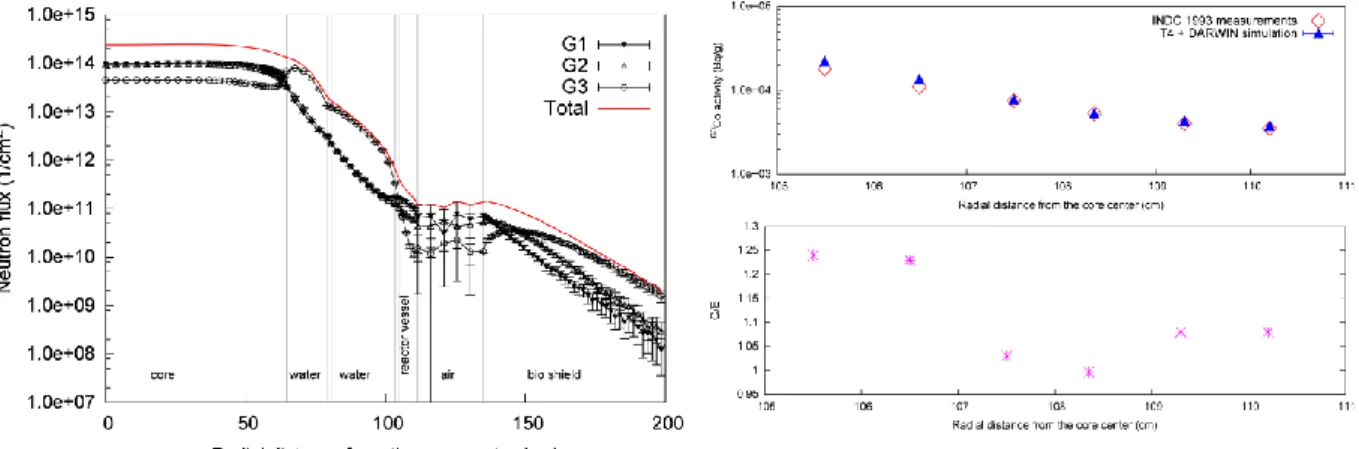
Figure 1 shows the radial broad group profiles obtained from the unbiaised simulation. Group 1 (G1) represents fast neutrons above 0.1 MeV, Group 3 (G3) is the thermal group with energies below 0.4 eV and Group 2 (G2) covers all energies between these limits. This profile behaves qualitatively as expected and illustrates the quite rapid change in neutron spectrum that occurs at various locations through the excore regions.
In table 1 are reported neutron flux obtained in the bioshield with the reference and the biased simula-tions. Results show that the biaised simulation induced no error in the flux determination and improve the simulation efficiency defined as with the Monte Carlo uncertainty and the com-putation time.
The biaised simulation was then used to estimate the flux in various structures of interest. The results were then injected as input data in the DARWIN package to estimate the activity levels. The evolution of 60Co activity with the radial distance in the reactor vessel is reported in figure 2. The ratio of the calculated to experimental (C/E) value is also reported and varies between 0.88 and 1.27. C/E values obtained axially in the shroud and the cladding are reported in table 2 and vary between 0.777 and 1.32.
DEM 2018 - Dismantling Challenges: Industrial Reality, Prospects and Feedback Experience
France, Avignon – 2018, October 22 │24
Figure 1: TRIPOLI-4® three group radial flux profiles at mid core plane
Figure 2: In up panel, measured (red open squares) and simulated (blue triangles) activity values obtained at h=360 cm are compared. The
behavior of the C/E value is reported in down panel.
Batches nb.
(5000 n/batch) t (s)
Flux
(n/s/cm2) σ (%) ε REF 100 000 1 058 058 6.99E+10 20.42 2.27E-05
IC 19 500 929 453 6.97E+10 2.17 2.07E-03
Table 1: Validation and figure of merit of the biased scheme.
C/E values in the shroud C/E values in the cladding
Axial distance from core center 0 cm 241
55Fe 0.978 0.811
60Co 1.20 1.11
63Ni 1.32 0.777
Table 2: C/E values for activity determined in the shroud.
Conclusion
C/E values show good agreement with experiment to within 30%.The current benchmark exercise successfully validates the general computational procedure, as well as the use of TRIPOLI-4® vari-ance reduction techniques for decommissioning purposes.
References
1) N. S. T. Sukegawa and K. Fujiki, “Accuracy verification for calculation of inventory in JPDR due to neutron activation,” INDC(JPN), vol. 164, March 1993.
2) N. P. Kocherov, “International benchmark calculations of radioactive inventory for fission reactor decommis-sioning,” INDC(NDS), vol. 355, April 1996.
3) Brun E. et al. TRIPOLI-4® CEA, EDF and AREVA reference Monte Carlo code, Annals of Nuclear Energy 82, 151-160 (2015)
4) B. N. A. Tsilanizara, C.M. Diopp et al., “DARWIN: an evolution code system for a large range of applications,” Journal of Nuclear Science and Technology, vol. 37, pp. 845–849, 2000.
5) O. Petit and C. Diop, “Variance reduction adjustment in Monte Carlo TRIPOLI-4® neutron gamma coupled calculations,” Progress in Nuclear Science and Technology, vol. 4, pp. 408–412, 2014.