Publisher’s version / Version de l'éditeur:
Technical Translation (National Research Council of Canada), 1960
READ THESE TERMS AND CONDITIONS CAREFULLY BEFORE USING THIS WEBSITE.
https://nrc-publications.canada.ca/eng/copyright
Vous avez des questions? Nous pouvons vous aider. Pour communiquer directement avec un auteur, consultez la
première page de la revue dans laquelle son article a été publié afin de trouver ses coordonnées. Si vous n’arrivez pas à les repérer, communiquez avec nous à [email protected].
Questions? Contact the NRC Publications Archive team at
[email protected]. If you wish to email the authors directly, please see the first page of the publication for their contact information.
Archives des publications du CNRC
For the publisher’s version, please access the DOI link below./ Pour consulter la version de l’éditeur, utilisez le lien DOI ci-dessous.
https://doi.org/10.4224/20386773
Access and use of this website and the material on it are subject to the Terms and Conditions set forth at
Compacted Snow as a Transport Substratum
Ager, B. H:Son
https://publications-cnrc.canada.ca/fra/droits
L’accès à ce site Web et l’utilisation de son contenu sont assujettis aux conditions présentées dans le site LISEZ CES CONDITIONS ATTENTIVEMENT AVANT D’UTILISER CE SITE WEB.
NRC Publications Record / Notice d'Archives des publications de CNRC:
https://nrc-publications.canada.ca/eng/view/object/?id=bf2845ea-de0e-4478-8463-2f4157889815 https://publications-cnrc.canada.ca/fra/voir/objet/?id=bf2845ea-de0e-4478-8463-2f4157889815
COMPACTED SNOW AS A TRANSPORT SUBSTRATUM
o FROM
NORRLANDS SKOGVARDSFORBUNDS TIDSKRIFT. (3): 293 - 388. 1956 NATIONAL RESEARCH COUNCIL OF CANADA
TECHNICAL TRANSLATION 865
BY
B. H: SON A':ER
TRANSLATED BY E. PEREM
THIS IS THE FIFTY - SEVENTH OF THE SERIES OF TRANSLATIONS PREPARED FOR THE DIVISION OF BUILDING RESEARCH
OTTAWA
1960
Technical Translation 865
Title: Compacted snow as a transport substratum
(Packad sno som transportunderlag)
Author: B. H:son Ager
Reference: Norrlands Skogvgrdsforbunds Ti1skrift, (3): 293-388,
1956 (SDA* Meddelande no. 57)
Translator: E. Perem
•
•
SOA セ Forestry Society and Royal Domain Administration, Research•
Although snow roads are of economic interest in
Canada, particularly to its pulp and paper industry, there is as yet very little published information on their construction and performance which is generally available in English to engineers.
As one contribution toward solving this problem the National Research Council, through its Associate Committee on Soil and Snow Mechanics, is cooperating with Professor Seheult of the University of New
Brunswick, on a project to evaluate current practice in the construction and use of snow roads in Canada
and other countries of the world. One of the first
steps has been to translate into English the more pertinent publications available on the subject.
Sweden, through experiment and field practice has gained much valuable experience on the
construc-tion of SnOT/l roads. This translation is the first of
a series of reports to be translated which describe this Swedish experience.
•
Ottawa,
February 1960
R.F. Legget, Director
•
Foreword
For a number of years SDA has been engaged 1n intensive experi-ments aimed at the establishment of rational methods of
construc-tion and maintenance of compacted snow roads. A summary of
previous experiments and experience in this field has been publish-(12)
ed by Crown Forester A.C:son Leijonhufvud, Chief of the SDA •
For the Winter 1955-1956 both SDA and the Army Field Engineer-ing School (under Major Tore Rahmqvist) had planned studies on
compacted snow roads. These studies were coordinated and were
carried out at Lycksele and in Alsbacken, approximately five
Swedish miles (50 km) northwest of Lycksele. The Department of
Theory of Work of the State Institute of Forestry Research
(Profes-sor Ulf sオョセ「・イァL Director) also cooperated in the studies of
certain fundamental problems associated with the methods of measurement.
Since one part of the test results seemed to セ・ of certain
value for future research in this field, the test procedures and the probable errors in the test results have been reported in
detail, a fact which makes reading of the article wearisome. The
writer has attempted to compensate for this by making the chapter "Views on the opening and maintenance of compacted snow roads", which is based on the test results and on the practical experience of the recent winters, somewhat fuller.
The present report is a complement to and an extension of the previous publications and therefore does not clqim to be a summary
of present knowledge in this sUbject. For the fundamental
proper-ties of snow, general rules for the use of compacted snow rOads etc., the reader is referred to other SDA publications.
On behalf of the initiators of this study the author wishes
to acknowledge the support given to these experiments. Great
interest in this study has been shown by Stora Kopparbergs 8ergslags AB and Mo och Domsjo AB •. The officials of these companies have
Statens Vaginstitutet (State Institute of Highways), Mellan och
Sydsvenska Skogbrukets Arbeitstudier (MSA) (the Institution of
Work Studies of the Forestry Association for Central and South Sweden) and with Sveriges Meteorologiska och Hydrologiska Institut
(the Swedish Institute for Meteorology and Hydrology) have also been valuable.
I wish to acknowledge personally the good advice and valuable co;nments given to me by my chief and my co-workers at the SDA, by Crown Forester Nils Natterqvist, Inspector Rune Ostberg and by licentiate in technology Rune Eriksson.
The Object of the StudX
The aim of the research activities of the SDA in the field of compacted snow roads is to establish effective methods for the use of a snow substratum as an alternative to the conventional methods of construction and maintenance of roads for different types of
エゥセ「・イ transport. Two phases can be clearly distinguished in this
field of research. The first phase includes fundamental studies
of the demands made by different types of transport on the bearing properties of a snow substratum, the securing of information on the variations of the bearing properties under different conditions and the establishment of methods of construction and maintenance to
meet the requirements of the various forms of transport. The
second phase falls entirely within the category of applied research. Its aim is to modify in practice the principles of construction and maintenance to suit the requirements of the different types of traffic and to compare the new techniques with the prevalent ones
from the economic point of view. This second phase of the research
is naturally a long-term project. The conditions vary tremendously
from year to year for the different methods, and experiences of several years are required before a given method can be recommended or before the approximate limits can be determined for the
applica-tion of the different methods. Good progress has been made in this
..
..
•
horse for example, methods of opening and maintaining compacted snow roads have been developed which compare favourably from the
economic point of view with the method of deep ploughing. For
other forms of transport, for example hauling by trucks, we still are in the first phase of research, although some methods of pro-cessing snow have been developed which suggest possibilities of improving the bearing strength of a substratum of snow •
I. Measuring Instruments Used in Exueriments
The hardness of snow was determined by a proctor needle
(see Fig. 3). During the winter another apparatus for measuring
the hardness of snow was also developed. This instrument is
described in a separate chapter.
The density of compacted snow was determined by weighing
samples of snow taken with the aid of a cylinder 10 em long with an
inside cross-section of 30.9 cm2
• For loose snow a graduated (in
em) tUbe, 150 em long with an inside cross-section of 16.6 cm2
,
was used.
The drawbar pull of a vehicle was registered with the aid of a dynamometer, PM-dynamometer (see Fig. 1).
The traction イ・ウゥウエ。セ of the loaded timber sledge was
determined with a "work recorder" (Fig. 2). This instrument is
coupled between the vehicle and sledge. Traction resistance 1s
recorded on a strong steel ring and the distance travelled on a
measuring wheel which runs on the surface of the road. These two
factors, traction resistance and the distance travelled, are re-corded with the aid of two planimeter mechanisms, each of which is
connected to its own counting mechanism. On these counting
mecha-nisms the product of the traction resistance and the distance
travelled are recorded, -indicating the total work done. The
dis-tance travelled is also recorded separately on a counting mechanism
connected to the measuring wheel. From these values the average
drawbar pull of the vehicle
=
traction resistance of the sledge,The Rarticle size of the ウセッキ was determined with a magnifying glass and a millimetre scale.
The temperature and the relative humidity of the 。ゥセ were
measured constantly during the whole period of experiments with a thermo-hygrometer, enclosed in a ventilated case which protected
it from radiation. The case was placed 1.2 metres above the
compacted snow surface.
The temperature of the snow was recorded with thermistors. n1e type of thermistor used in the tests consisted of two small
metal plates separated by a semiconducting material. A thermistor
changes its electrical resistance with temperature in accordance with definite laws.
II. Determination of Snow Hardness
1. Proctor needle
When a few years ago SDA started its field experiments with compacted snow roads, one of the first tasks was to find an instru-ment which would measure the bearing strength or the "hardness" of
snow under various conditions. The proctor needle was selected
for this purpose (see Fig. 3). A proctor needle is a spring
balance which records the force exerted on a disc when pressed
against a substratum. In measuring the hardness of a snow road
the stress is recorded at the moment the plate penetrates the
sub-stratum. The load is measured in kilograms and the area of the
plate in cm2• The bearing-strength values are thus expressed in
kg/cm2 •
(a) Relationship between hardness and the size of the plate
The different sipes of plate gave different values for the maximum load or "breaking" load per unit area on the same
substra-tum, greater values always being obtained with smaller plates. The
relationship between the area under load and the breaking load has been discussed and explained by R. Eriksson(9) and A.C:son
LeijOnhufvud(12). Before bearing-strength values obtained with
•
adjustment of the values to a uniform size of plate must be carried
out. In a previously PUblished'SDA investigation, Eriksson(9)
recorded unadjusted breaking loads in kg/cm2 and the sizes of
plates used, but LeijOnhUfvud(12) and the author of this article(l) reported values which were adjusted to a uniform plate size of
32 cm2
• The adjustments were made according to the results of a
specific relationship study.
Through a contact with the State Institute of Highways it was learned that in recent years the proctor needle has been used for
determining the bearing strength of clays. The findings of this
work have been published by F. Rengmark(16) and A. 01hagen(6).
Olhagen has demonstrated the existence of a rectilinear relation-s}lip between the mean breaking load and the reciprocal of the
plate diameter. This relationship can be expressed as follows:
w
=
tan a(a + セIL where (see Fig. 4)w
=
mean breaking loadD = diameter of the plate
a and a are constants which vary with the characteristics of the clay.
The angle a increases with increasing hardness of the
sub-stratum. From measurements in which different plate sizes were
used on a large number of clay surfaces Olhagen found that the curves tended towards a more or less constant value of a between 0
and l(JL). The best value キ。ウセN In computing the value of a the
cm
scatter of this value for the different plate sizes was taken into
account. On a given substratum the scatter of the values from
individual observations increases as the size of the plate is
decreased. The values obtained with the smaller plates were
there-fore given less weight in the calculations than those from the
larger plates. Olhagen demonstrated that the empirically determined
relationship was also theoretically sound.
A re-examination of the relationship found for clay between the breaking load and the size of plate was required for snow. During the late winter of' 1956 a series of measurements was
there-fore carried out with different plate sizes on compacted snow roads
of different bearing properties. In each substratum 25 observations
were recorded for each plate and a mean value was calculated for
each plate. A graphic representation of the data showing breaking
loads (= 00 kg/cm2) on the ordinate and the reciprocal values of the plate diameter on the abscissa showed that the relationship between these two variables could be expressed in comparatively rough
approximation as a straight line. When the reciprocal value of the
plate diameter was replaced by the reciprocal of the plate area HセIL
the straight line seemed to fit the test data better. In order to
find out if the relationship could be expressed in the form of a pencil of rays, the following calculations were made:
Different paired values of 00 and S were assumed to be the
points of origin of the different pencils of rays. For each such
pencil of rays the sum of the squares of the deviation of the
cal-culated 00 value from the experimental value was found. The sum of
the squares (Q) was thus employed as a criterion for the
correct-ness of the adjustments. The minimum sum of the squares Hセ i ) was
m n
obtained by graphical interpolation, for the point 00 = 1.1 and
6-1.75. The corresponding Q value was approximately 12.4. In order
to find a simple expression for 00, the ーッセウゥ「ゥャゥエケ of placing the
point of origin of the pencil of rays on a point on the abscissa
was studied. Qmi n for 00
=
0 was 12.6 whenセ
=
-2.06, or in otherwords the pencil of rays originating from this point showed almost as good agreement as that from the "best" point with an arbitrary
00 value. For comparison it may be mentioned, that the セ value for
a parallel pencil Df rays was as high as 35.2.
The best expression for the relationship between the maximum load per unit area and the size of plate for the observations made thus seems to be:
1
00
=
tan a(2.06 + S).In order to demonstrate graphically the agreement between the derived relationship and the observed values a few curves drawn
..
from the point 00
=
0, セ=
-2.06 are compared in Fig. 5 with theresults from the test data. The agreement seems satisfactory for
the higher values of 00, which represent a range of breaking
strengths for which only plate sizes of 4 cm2 or less can be used.
The agreement for the larger plates seems to be less satisfactory. It has to be mentioned, that all plates were given the same weight
in the calculations. Had the larger plates been given a greater
weight on the grounds that their mean values have smaller coeffi-cient of variation, the agreement would have been better for the
low bearing-strength values and poorer for the high values. Since
the most common sizes of plate used in such studies are 0.5 - 4 cm2,
and since the agreement within this range was satisfactory when unweighted mean values were employed, an adjustment was not
con-sidered necessary.
In order to eliminate the influence of plate size on the measured bearing strength values, Olhagen introduced a term
"proctor bearing strengthll
=
mean bearing load in kg/cm2 obtainedwith a plate size of 6.45 cm2 or 1 square inch. This unit was
selected for certain practical reasons.
As mentioned above, the bearing-strength values in the more recent experiments carried out by SDA have been converted to the plate 32(cm2 ) .
As will be shown later, the possibility of subjective errors by the person carrying out the proctor needle measurements on a substratum of snow are too great to allow comparison of the results of different experiments where the measurements have been made by 、セヲヲ・イ・ョエ persons._ The values of ュ・。ウオイ・セ・ョエウ made by proctor needle ought to be taken only as relative values applying to a given study in which the bearing strength of snow is involved.
The author therefore considered it unnecessary to use the same'unit for the computation of the snow hardness as was used in the
previous studies(1,12).
In the experiments reported in this article, plate sizes 1
For reasons associated with the calculations, the 1 cm2 plate was
chosen as the standard. For breaking loads obtained with this size
of plate the term "proctor value" is applied. What will be the
conversion factor by which the values obtained with other plate
sizes have to be adjusted? In discussing this problem the results
of the calibration tests reported by Leijonhufvud (1951 and 1955
sertes) are compared with Olhagen's data on clay and with the
results 、・ウ」イゥセ・、 above by the author (1956 series). In all four
series the plate size 1 was given the value 1.00 and the values
for the other plate sizes セ・イ・ indicated in relation to this
figure. The comparison for plates 0.5 to 4 cm2 is shown in
Table L,
The variations in the values from the different serles are
probably due to many causes. The series of the years 1951 and 1955
were obtained from mid-winter snow, while those of the year 1956
were from the coarse-grained snow of late winter. These two types
of substratum probably affect the values of the series. The
eiperlmental results reported here were obtained almost entirely
under mid-winter conditions. Since Olhagen's series have an
intermediate position between the two mid-winter series, the author has chosen these data as a basis for rendering the values for the different plate sizes comparable.
(b) pッウウゥ「ゥャゥエセ・ウ of ・セイ
A compacted snow road in 1111hich the snow has been well mixed before compacting shOWS increasing hardness with increasinG depth
below the snow surface. When the hardness of the upper layer of
the snow is measured with a proctor needle, no definite break-through point is obtained, since at constant load the plate first
penetrates a relatively thin layer andLs then stoppea by the
harder layer of snow beneath. If the load 1s increased, the prate
breaks through this latter layer, but is stopped by the next
layer, etc. The same phenomenon is probably encountered if the
hardness of snow is uniform in the vertical direction throughout
a much greater load is in all probability required in order to reach the breaking 11:nit and to achieve a step-by-step break-through with increased loading as the plate is forced break-through the
snow cover(23). In most cases, however, such a definite failure
is produced in the layer for which the hardness value is to be determined that the reading can be taken without hesitation.
Occasionally, however, the question of which break-through to read may arise and, of course, the greater the increase of the hardness from the surface to the bottom layers the more difficult the choice
will be. At the same time it can be assumed that different
observers may obtain different values for the same substratum. Another source of error is associated with the rate of loading up
to the breaking limit. In order to clarify these sources of error
two persons were asked to carry out measurements on the same
sub-stratum. The measurements were performed at noon when the
tempera-ture of the air was OoC. The previous nieht had been extremely
cold and thus the warmed up surface layer was relatively loose and the hardness of the road bed increased toward the bottom, which was
still cold due to the night time cooling. The conditions were
thus most unfavourable for proctor needle tests. Both observers
had had previous experience with the proctor needle, had received the same instructions, but they did not have the same training.
The measu.rements were carried out on two different roads. The
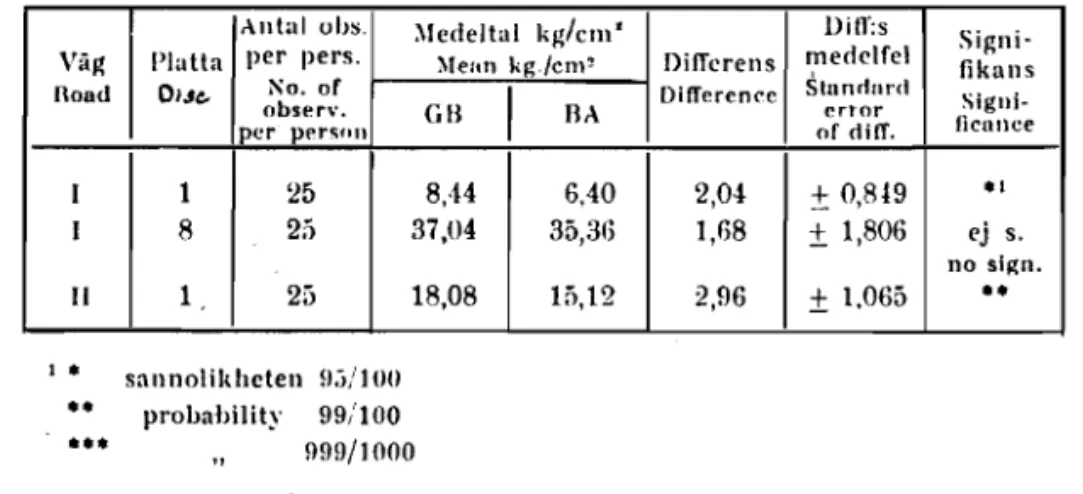
results are shown in Table II.
As indicated in the table, observer G.B. generally obtained higher values than B.A. and in two out of three cases the
differ-ences were considerable. Although the test conditions were the
worst ゥュ。ァゥョ。セャ・ and while it might be possible to obtain greater
agreement from observers who had had the same training, these
experiments showed clearly that セ the snow hardness is 、・エ・セ
mined with a proctor needleL measurement q for the same comRarative
stqdl shoul2-n ot 「セ made bl different e・ッーセN On the basis of the
results of these experiments one would tend to disapprove entirely the use of the proctor needle for comparative measurements of the
•
hardness of a substratum of snow. hoセャ・カ・イL in the hands of a
person who carries out measurements consistently, the proctor
needle 1s a sufficiently reliable instrument. In the SDA
experi-ments on compacted snow roads all measureexperi-ments during the recent years have been carried out by one and the same person.
2. Other methods of measuring snow hardness
The obvious disadvantages of the proctor needle have resulted in a search for other methods of determining snow hardness aimed
at the development of a more objective method. In determining the
strength properties of the different types of soil several methods
have been employed. Most of these are complicated and designed
for laboratory use. A study of the literature in this field has
directed the attention to the simple drop device shown in Fig. 6.
Description: A stand which is supported by an iron ring is
provided With a vertical aperture through which passes a metal rod. An impact body is screwed onto the threaded lower end of this rod. In order to provide the freely movable part of the apparatus with the desired weight for experimentation, an additional weight is fastened to the lower part of the rod and is locked in position
against the impact body. On the upper end of the bar is a
milli-metre scale, 0 - 150 mm, mounted in such a way that the zero mark
on the scale is in line with the upper edge of the aperture
(reading index) when the tip of impact body is touching the surface
of the substratum. The vertical aperture has a latch mechanism
which engages in notches on the rod thus locking the rod at a
certain height. The notches determine the height of fall in 5 em
intervals from 0 to 40 em. Gセィ・ョ the latch mechanism is released,
the impact body drops vertically toward the substratum.
First a wedge with an edge angle of 30° and an edge length of
40 mm was tried as an impact body. Then two cones with generating
angles of 30° and 60°, respectively, were tested. The method is
based on the same principle as the cone method of the Geotechno-logical Commission(IO) and F. Rengmark's drop wedge method(16) ,
•
of the tested cones and the wedge were in part selected on the
basis of those of the above-mentioned instruments. The weights of
the three impact bodies were chosen .so that the movable part (impact
body, additional weight and rod) would weigh approximately 5 kg. As in the case of proctor needle and most other instruments for measuring the bearing properties of a substratum, a great
number of onysi cal ')roperties of the substratum determine the value of the snow's "hardness" as measured by this method.
The proctor needle and the drop device with the two cones and the wedge were compared under different conditions, always using
two or more methods for the same substratum. For example, the
following experiment was carried out. At the beginning of April
the differences between the temperature during day time and that
during the night were extremely high. A snow road (A) was compacted
early in the morning when the temperature of the air was -21°C.
\
The snow was first gone over キゥエセ a track-type tractor and then
compacted with a rail-roller and a sliding pontoon (see Fig. 8). By using the same method another road (B) was compacted in the
afternoon when the temperature was _4°C. The next day the hardness
of the surface layer of the two roads was measured by all four
methods. Twenty-five observations were recorded for each road and
each method. Plate 1 was used with the proctor needle, the height
of fall was 10 em for all the three impact bodies. The results
are summarized in Table III. The average values are given in
kg/cm2 for the proctor needle and in millimetres of penetration
for the impact bodies.
In general, all four methods led to much the same conclusion in this teat, namely, that the differences in the bearing proper-ties of the two roads were not significant.
Additional measurements were carried out on different snow
roads by using two or more methods simultaneously. For each series
of tests on the same substratum the standard error was calculated as a percentage of the mean from 20 observations for each method
•
Table IV indicates that, as a rule, the impact bodies give a smaller standard error than the proctor needle for the same number of observations. However, the "sensitivity" of the
dif-ferent methods must also be taken into consideration. In Fig. 7
the relationship is shown between the proctor value and the
pene-tration in millimetres of the wedge for a drop of 10 em. From
this relationship certain conclusions as regards the "sensitivity" of the two methods can be drawn.
If the "sensitivity" of the different methods is taken into consideration, the proctor needle was found to give more reliable
bearing-strength values below the range of 15 to 20 kg/cm2 , while
the impact bodies seemed to give more reliable mean values for
substratums of higher bearing strength. When the different impact
bodies are compared with each other, the 30° cone seems to be more suitable than others for the substratums to which these
measure-ments were applied. The wedge showed a greater standard error and
showed a less uniform performance than the cones. For the range
of hardness which is commonly found in the compacted snow roads, the 30° cone seems to be more suitable than the 60° cone.
What scale should be used for measuring the strength of a
substratum? The Geotechnological Commission(10) has set up a scale
of relative strength values in which a relative number of 10 is assigned to a substratum into which a 60° cone, weighing 60 grams,
penetrates 10 mm. The weight of a 60° cone which is required to
produce a 10 mm penetration in another substratum is then expressed
in relation to 60 gm. In his tests with a wedge Rengmark(16) has
オウセ、 the term "wedge-strength value", which indicates "the total w9rk calculated in mechanical work units (kilogram-metres, etc.), which is required to produce a penetration of 10 mm into a soil
sample by a freely falling wedge with a 30° edge angle and a 40 mm edge length". The work (A) is expressed as the product of the
weight of the wedge (G) and the drop distance. The drop distance
is the sum of the height of the fall (F) and the depth of
a rectilinear relationship between セg . (F + N) and N and that this
relationship held for a wide range of N, G and F values. When this
relationship was calculated for the different degrees of hardness and transferred to a system of coordinates, a pencil of rays with a common point of intersection at the origin was obtained for various types of cohesive soils.
In this way the "wedge-strength value" for any drop distance,
any wedge weight and any penetration can be 」。ャ」オャセエ・、 from a
simple expression. The rectilinear r8lationship between the total
work and the penetration, however, presupposes a homogeneity of the substratum Which is seldom found in a compacted snow road where
the hardness ッヲエ・セ varies with the layer depth in the road. If
one Wishes to use a scale such as the above "wedge-strength value", which is tied to a certain N value, the actual measurements have
to be in the vicinity of that N value. The proper way is to take
one A value on each side of that N value and then interpolate
be-tweoo thpse two, assuming that エィ・セLnM」オイカ・ is a straight line
wi,thin this l"ange of N values. This can be done, of course,
provided that the welghtof the wedge and the drop distance can be
varied within a wide ・ョ。オセィ range so that for every actual
sub-str2.tum a penetration is obtained which is セャッr・ to the N value to
which the strength value is tied. For the SPセ cone, 40 mm seems
to be a suitable penetration to be used with the drop apparatus employed in this study.
The simplest way to obtain a snow hardness measurement with a drop apparatus is, of course, to employ a constant height of fall
and to measure only the penetration into the substratum. In
choosing the weight of the cone and the distance of the fall it is
necessary to reconcile two opposed aims. If a small weight and a
small height of fall are chosen a wider イ。ョセ・ is achieved for エセ・
apparatus, but the method becomes relatively insensitive at higher
degrees of hardness. セN}ゥ th a greater ....leight and height of fall the
apparatus becomes more sensitive but the range is reduced.
•
•
cone weight of 3 kg combined with the height of fall of 10 em
seemed to セ・ the most suitable.
3. Surnm9.ry of v 1e1,-7S ッョ⦅NZセjRQ_GZャZイNZ。 t.uses for イョ・cAMNウオイゥョァMィXZイ、ョセᄃNNᄃ
The results of measurements of a snow substratum with a proctor
needle are often greatly influenced by the person performing the
tests. Therefore, all the hardness measurements taken with that
instrument in the course of a given experiment must be carried out by the same person if the different phases of the experiment are
to be comparable. A certain degree of experience also seems to be
desirable in order to secure consistent readings of the instrument
under different conditions. Where different sizes of plate are
used in the different phases of an ・クセ・イゥュ・ョエ to be compared with
each other, a source of error has to be taken into account when the
measured values are adjusted to a single plate size. This source
of error is eliminated if only one plate size is used during all
phases of the experiment. A limiting factor here is, however, the
load range for a given plate size. The readings are difficult on
the parts of the scale indicating the highest and lowest values. IT
the scale range is from 0 to 50 kg, the plate size must be chosen so that the readings will fall within the limits of 5 and 40 kg.
In addition, the instrument must be calibrated from time to time since its spring may be subject to fatigue.
If the above-mentioned requirements are taken into considera-tion a proctor needle is sufficiently reliable for comparative
measurements of hardness. The instrument is easy to handle and is
relatively sensitive. The source of error due to the person who
uses it is, however, a great disadvantage for the method and may render any objective and detailed comparison between the test results of different workers impossible.
The simple drOD aRRaratus which was constructed during the winter makes possible an objective recording of the snow hardness. Of the different impact bodies tested, a cone with a 30° acute
angle seemed to be the most suitable. The type of scale needed
•
•
•
the data collected for this purpose were too limited. Two
possi-bilities are discussed. One is to record the resistance,
calculat-ed in kilogram-metres between the snow and the cone for a given
penetration after free fall. As a standard, a depth of 40 mm is
recommended. For the second method, a constant wedge weight and
a fixed fall distance (3 kg and 10 em, respectively, have been recommended) are used and the penetration in millimetres is re-corded as the hardness.
The present design of the drop apparatus limits its use to
flat or only slightly sloping ground. The possible errors arising
from a cone falling against a steep slope are not known.
The drop apparatus is not as convenient as the proctor needle and the working speed is slower.
The drop apparatus was not completed before the end of the
test period. The hardness measurements reported below were
there-fore made entirely with the proctor needle. Every reported
hard-ness value in this naper is a mean value from 25 observations and is' expressed in kg/cm2 , adjusted to the plate size of 1 cm2
,
un-less otherwise indicated. All the measurements were carried out
by the same Rerson.
The term "bearing strength" below refers to surface hardness
expressed as the ーイッ」セッイ value.
III. Different Methods of Processing Snow
One of the aims of the experiments on compacting snow carried out by the SDA has been to find simple and inexpensive methods and
equipment for the construction of snow roads. iセ the traditional
method the snow is first processed throughout the road bed with a
deeply penetrating track-type tractor and then dragged. With this
method a certain time must generally be allowed for the snow to harden between compacting and dragging, otherwise the drag pene-trates too deeply into the snow, producing an inferior road surface and at the same time requiring more pulling power.
..
experiments employing different methods of ーイッ」セウウエョァ of snow and
has demonstrated empirically the great importance
of
セー・セォャョセ upand mixing the s now before compacti.ng it vmere the read is
established directly in deep snow. The research activities are
directed t.oviar-ds the development of a tractor-driven combine in
which the mixing is performed by one part of the equipment and the
compacting by another. The aim has been to make a road in one
pass. The work has been continued and the results of the tests
carried out during the last winter are reported below.
1. Comparative ・セー・イゥュ・ョセキゥセィ certain equipment alld methods
During the winter of 1955-56 the following equipment was tested.
RO.lle.r__of fゥョケA|ᄃNィNNNQセ (See Fig. 8): The roller consists of
three circular wooden discs セッオョエ・、 on a 」ッュセッョ axle and joined
together on their circumferences by rails alon
s
the generatingsurface of the drum. The roller is attached to a frame made of
U-beams which serves as a tOVJ gear. It is provided at the rear
with hooks for the suspension of weiGhts. The effective width of
the roller is 。ーーイックゥセ。エ・ャケ 2.0 m. This type of roller is used in
Finland and has also been tested in Sweden by the Stora Kopparbergs
3ergslaGs AS for construction of compacted snow roads. It ュゥクセセ
and 」セュRイ・ウウ・ウ snow. In this paper it is イ・ヲ・イセ・、 to as the
イ。ャQMイッャャセイᄋ
POlfler-tal{e-.Q.ff qriven .rotar,:::'l tiuセ (Settergren tiller)
attached to § FergusQn tractor (see Fig. 9): The tiller has a
prong mechanism mounted on a rotating axis placed at right angles
to the direction of セッエゥッョ of the tractor and connected to a
hydraulic hoisting mechanism. The wo rki ng depth is controlled by
an adjustable runner. The tiller has an effective Width of 75 cm
and is operated at a speed of 500 rpm. Its function is to セ
and mix エィ・セセN
SDA ウャゥ、ゥュセ 12ol1tQQll (Fig. 8): The sliding pontoon (earlier known as " p a ckoped") consists of an iron plate with a parabolic
..
the position of the iron plate was adjustable so as to produce
various specific pressures against the substratum. The pontoon
can be loaded with additional weights. The model used during the
experiments had an effective width of approximately 2.0 m and
weighed 180 kg. It levels and compacts the snow.
Closed イッャャ・セN By covering the above-described rail-roller
with corrugated sheet-metal which could easily be removed and replaced during the experiment, a roller, which had a compacting
effect only, was produced. In this report it is referred to as
a closed roller Hーャセエカ。ャエI •
Conventional wooden drag (see Fig. 10): The test drag had
three blades. The total contact-area of the blades was
approxi-mately 4000 cm2
• The total weight, including the additional
weights, was 142 kg, the pressure of the drag against the substra-tum being thus approximately 0.035 kg/cm2 •
The above-described equipment was combined in the various ways described below and roads 10 to 15 m long were compacted.
m・エィッ、セ
1. An Oliver OC3 tractor was driven three times "track to track" over the section of road to be compacted, thus working the
snow down to the bottom. After a certain time the drag was
towed once over the road by the same tractor. The time
be-tween processing and dragging was three hours if the temperature was below -10°C, and approximately 24 hours if the temperature was higher.
2. The snow-was worked over with the Oliver OC3, "track to track", after which the tractor towed a closed roller and sliding
pontoon once over the section of road.
3. The Oliver OC3 first made a track and then towed a rail-roller
with sliding pontoon once over the section road.
4. The Oliver OC3 made a track and then towed first a rail-roller
and afterwards a closed roller once over the road.
5. The Oliver OC3 made a track and then towed a rail-roller once
and afterwards a rail-roller with sliding pontoon once over. the section of road.
6. The Oliver OC3 made a track and then towed a rail-roller once and closed roller with slidinG pontoon once over the road segment.
7. The Oliver OC3 towed a half-tracked Ferguson tractor with
rotary tiller attached once back and forth over the section
of road. It then pulled a sliding pontoon once over the road.
It should be mentioned that not all the above-tlescrlbed
equip-ment and methods are considered ready for practical use. The
pur-pose of these experiments was to compare different processing
principles. The comparative tests were carried out in a swamp at
the SDA Experiment Station in Lycksele from January 9th to January 21st 1956.
The experiments were arranged in such a way that two or more
comjinations were tested more or less simultaneously. This was
repeated several times. Every repetition was designated as a
series. In every series method 1 was included as a control method,
as it had hitherto been the most 'common method of constructing compacted snow roads.
The depth of snow increased during the experiments from 70 to
90 em. The Oliver OC3 was equipped with standard tracks and could
not pull the equipment immediately in the loose snow. It was first
necessary to open a track.
In the experimental road, sections constructed by the above-described methods the snow hardness was determined with a proctor needle both at the surface of the road (bearing strength) and at
a depth of 20 em. In each serles the hardness values at the
sur-face and at 20 em セ・ーエィ for method 1 were given a relative value
of 100. The respective hardness values obtained with the other
methods for each series were expressed in relation to the method 1
value. In cases where the deep snow was considered to have been
processed by the special equipment used and by the tractor, the hardness at the 20 em depth was determined between the ruts of the
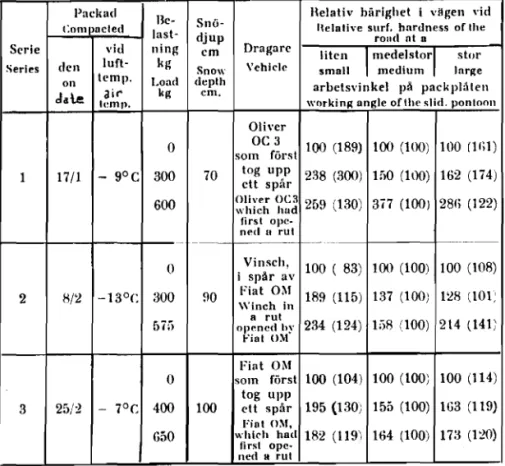
vehicle. The results are summarized in Table V. It should be
emphasized that in the comparisons the bearing-strength values and the snow-hardness values at a depth of 20 em are dealt with
•
separately. Data on the significance of the difference between
the values of different methods have been recorded in the same table.
It can be seen from Table V that in some respects the results are relatively uncertain, resulting from too few comparisons in
some cases, but are decisive in many other instances. The
following .9...Q.Q9lusions have been dral'Tn, エ。jセゥョァ into consideration
only the ウエイ・ョセエィ values which were determinpd.
Methods 3 and 4 gave approximately the same bearing-strength values as method 1, whereas methods 2, 5 and 6 gave values
approximately 40 percent above those of the basic method (method 1). The rotary tiller and sliding pontoon combination gave consider-ably higher bearing-strength values.
At 20 em depth the same hardness was obtained by processing snow with the tractor in both method 1 and method 2, although a closed roller and a sliding pontqon were used as compacting
equipment in method 2. If a snow cover is exposed to a certain
load, the stress decreases in the substratum with increasing depth
of the snow(22). Figure 11, reproduced from SIPRE Report 13,
illustrates this phenomenon. At a depth of 20 em only a fraction
of the initial surface stress is present. As compared with
pro-cessing by the tractor, the rail-roller produced a definitely lower
hardness in the snow at a depth of 20 em. When the rail-roller is
pulled twice over the road instead of only once, the hardness of snow at this depth seems to increase but little (compare 3 and 5). The rotary tiller produced a considerably greater hardness of snow even at the depth of 20 em.
What conclusions of nractical lmRortance can be drawn from
the results of these ex»eriments? It is known that basic methqd 1
generally produces roads of adequate bearing properties for horses
and track-type tractors. Of the two methods which produced almost
the same bearing-strength values (methods 3 and 4) method 3 seems
to be preferable because of its simplicity. Is the hardness at
strength comparable to that of method 11 Here Fig. 11 can be consulted again - it shows that the primary and deciding factor,
up to a certain limit, is the surface hardness of the road. This
limi t is, howeve r , somet imes exceeded by the traffic on roads which have been compacted by the "Weasel" tractor. Such roads develop, as a rule, a hard surface layer, but the unprocessed
bottom layer consists of loose- and coarse-grained snow(12). When
the surface layer becomes loose, during mild weather, the vehicle
may break through this layer. On the basis of data pUblished by
LeijOnhufvud(12) and the results of the experiments of 1954/55, a road compacted by the "'NeaselII in January or later Hセセャィ・ョ the coarse-grained layer of the loose snow in the bottom layer has become
relatively thick) may be expected to have a hardness of 20 to
40 percent of that of a road produced by method 1. Since the
cor-responding figures obtained with a rail-roller and a sliding
pontoon are 60 to 70 percent, the. depth processing by this method
can be considered satisfactory. The traditional method produces a
hardness in the deeper layers which is unnecessarily high for horses and track-type tractors.
Of methods 2, 5 and 6, all of which are superior to methods 1 and 3, method 2 seemed to be the most practical as far as the
compacting effect is concerned. The possibilities of using this
method will be discussed later.
The method employing a rotary tiller and a sliding pontoon
was superior to all other methods. It produced a road which had
a great hardness throughout. It is obvious, that this method
produces roads wit6 adequate bearing strength for horses and
track-type tractors. This bearing-strength requirement however,
can be satisfied with considerably simpler and less expensive
methods. In order to find out if the method produces roads with
adequate bearing strength for wheeled vehicles also, including cases where the road is established directly in snow of consider-able depth, specific tests were carried out, the results of which are to be reported in a later chapter.
It should be pointed out that the rail-roller and rotary tiller both reduced considerably the depth of the undisturbed snow, 40 to 50 percent in the first case and 50 to 60 percent in the latter. The bearing strength of the snow is increased substantially if these implements are followed by compacting equipment.
The rail-roller and sliding pontoon combination was considered almost ready for practical use, and the properties and working
principles of these were studied in detail.
2. t・ウエjーセ the rail-roller and sllding Rontoon combination In order to study the operation of the roller in snow the
following experiment was carried out. A winch was used to pull a
rail-roller and sliding pontoon over an undisturbed snow cover. Next to this area a Weasel tractor towed the same equipment over
the snow cover after first producing the tracks. This experiment
was repeated using a deep-penetrating track-type tractor, a
Fiat OM* equipped with Alfta tracks. The depth of the snow was
then measured in the prepared test areas. The results are shown in
Figure 12.
The graph shows clearly that the compacting capacity of a rail-roller with a sliding pontoon in deep snow depends strongly
on the vehicle used for towing the equipment. The compacting
capacity of the equipment alone in unmixed snow Is rather limited. When it is pulled by a vehicle which does not penetrate deeply
into the snow, the ruts probably give some support to the processing equipment, making the performance of the equipment unsatisfactory. When pulled by a deep-penetrating vehicle, however, a substantial
compacting effect is obtained. Nevertheless, it seems that the
working depth of the rail-roller was not sufficient for mixing
the coarse-grained snow in the bottom layer. The bearing strength
of the experimental road area was relatively low.
A few tests were carried out with different working angles ar-d with different loads on the sliding pontoon in order to find out to
*
A track-type tractor with Diesel motor which when equipped withwhat extent these factors affect the bearing strength of the road.
Three series of tests were performed. The results are summarized
in Table VI where the bearing-·ztrength values are expressed as
relative figures. For each setting of the sliding pontoon the
bearing strength obtained with an unballasteq pontoon 24 hours after compacting has been given the numerical value of 100, and the bearing-strength values recorded for pontoons with a given
bal-last are expressed in イ・セ。エゥッョ thereto. Secondly, the
bearing-strength value obtained with the sliding pontoon set at an inter-mediate working angle for each test load is taken as 100 and the strength values obtained with large and small working angles for
this test load are recorded in .the table as relative values. The
bearing-strength values referring to working angles are given in the table in parentheses.
Although the variations were relatively great, mainly due to the difficulties of creating similar conditions for each test, the results have generally provided answers to the questions formulated. The compacting effect of a sliding pontoon was improved
consider-ably when the weight of the pontoon was increased. AlSO, in
almost every case a lower surface hardness was obtained with a medium working angle than with either the largest or smaller
possible working angle of the experimental sliding pontoon. For
practical reasons the use of the smallest working angle is not
feasible. In that position the front edge of the pontoon is forced
downwards and pushes some snow ahead of it. This is probably why
a high bearing strength is obtained after compacting with a pontoon set at a small working angle.
3. Traction resistance
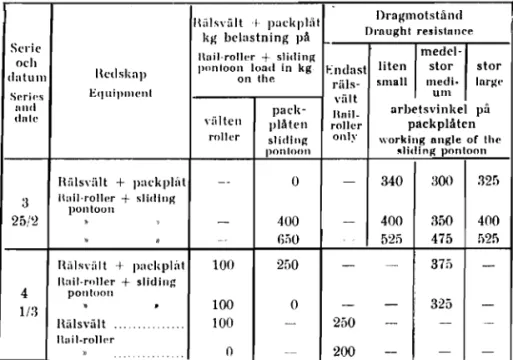
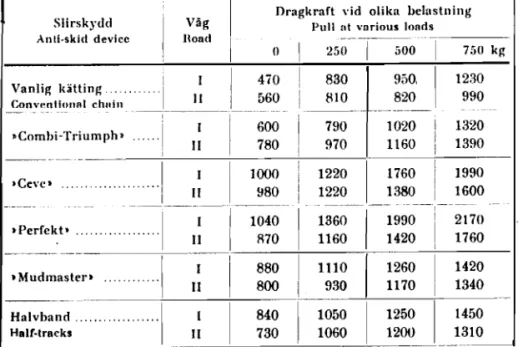
Traction resistance studies were carried out in connection With test series 3 using the above-described compacting equipment. A dynamometer was coupled between the tractor and the compacting equipment, consisting of a sliding pontoon set at different
working angles and provided With different test loads. The PM
25 kiloponds*, but values could be estimated to within 10 kp. The traction resistance estimates were naturally very approximate, but the only purpose of the study was to obtain general information
on the problem involved. Series 3 was later supplemented with
traction resistance measurements carried out under similar
condi-tions (ser1es 4). The results are recorded in Table VII.
The results show エィセエ the traction resistance is at a minimum
at the intermediate working angle of the sliding pontoon. The
high traction resistance at the smallest working angle is due to
the penetration of the edge of the pontoon into the snow. It is
obvious that the traction resistance also increases when the working angle of the pontoon is. increased.
Side by side with the compacting tests, experiments were carried ont with different types of vAhlcles for the purpose of comparing the behaviour of t ••e vehicles in loose ano compacted snow
under different conditions. This ゥョ」ャセ、・、 a test of the pulling
power of the vehicles in deep loose snow. The test was conducted
by mounting a dynamometer on the braking vehicle and making a reading at the moment the tracks of the pulling vehicle began to
slip. The drawbar pull up to this limit had increased continuously
from 0 kilopond to the reading at which the tracks lost their grip
on the substratum. The pulling vehicle was braked the whole time,
keeping it stationary. Three tests were made for each gear position
which brought about slipping of the tracks. These experiments
were carried out on a flat substratum of loose snow, 90 - 95 em
deep on February 8. The following approximate maximum values (With
"best gearsll
) of drawbar pUll were recorded for some of the most
common tractors:
Tractor
Drawbar pull at the moment of slipping
Fiat CF and Cletrac HG 42, both
equip-ped with Alfta winter-tracKs... 400 - 500 kp
Fiat OM with Alfta winter-tracks and
'Fordson Major with SDA wheel-tracks.. 800 - 1000 kp
Vessla ("Weasel"), original... 600 - 700 kp
Nordwerk snow tractor... approx. 800 kp
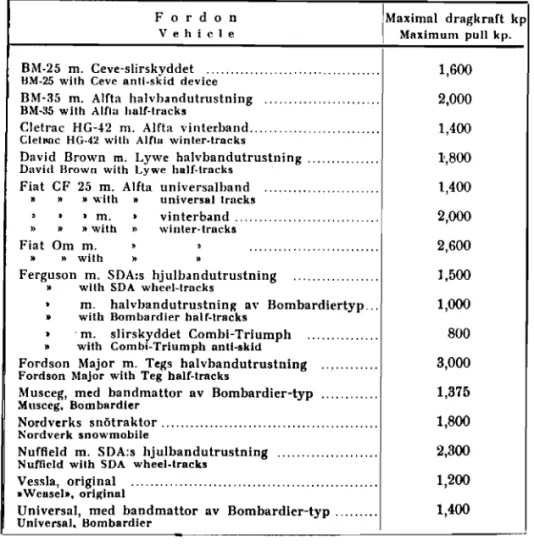
It must be emDhasized that these results reRresent only a single eXDeriment and as such have to be regarded as examples of the ーuャャゥョセ power of the vehicles in deep, loose snow. They cannot, therefore, be compared directly with the traction resistance values
of the compacting equipment recorded in Table VII. However, since
the depth of snow was approximately the same, and the properties of the snow did not differ too greatly in the two experiments, cer-tain conclusions can be drawn from the approximate orders of
magni-tude for the respective experiments. Only a certain proportion of
the 、イ。ャセ「。イ pull recorded during the above-mentioned tests is
avail-able for pulling the snow-processing equipment in the snow. A great
deal of this force is required for moving the pulling vehicle itself,
because of the resistance of the snow to the vehicle. The
propor-tion of the total pull lost by a Given vehicle in this way depends on the bearing properties of the snow.
The drawbar pull of the small tractors (Fiat CF 25 and Cletrac) eqUipped with commercially available tracks seems to be adequate for pulling a rail-roller and an unloaded sliding pontoon on level ground at the depths of snow mentioned above.
For the largef tractors there seems to be a certain margin
for loading the pontoon on level ground. However, it must be
pointed out that the drawbar Rull of the vehicle decreases rapidly
in loose snow with increasing uohill grade. For example, a Fiat OM
was able to move only v1ith great difficulty in a depth of snow of
approximately 100 cm with unballasted equipment up an estimated
2 - 3 percent grade. Although this difficulty may be eliminated
is evident, エセ。エ .tDe 、イ。キ「。tセセャャMRゥMQィセセュュッョ vehicles which are used .in snow1 .is セウエゥャャエゥョセ ヲセ」セッイ -in .us\nfs the tested compacting. ・アオャーュ・セエN In a depth of snow of less than 50 - 60 em this dif-ficulty usually vanishes because most of the above-mentioned vehicles make contact with the ground when they lose traction on the grade and are thus able to continue on their way.
adーイ。ゥウセ| qf methqds ッセセィ・ ba§is of エィ・セクr・イゥidセョエ。ャ results. Since the various combinations constitute heavy loads in rotation to the drawbar pull of most of our tractors in loose snow, the desired production of a road in a single pass can be realized only
if the snow is less than 50 - 60 cm deep. Up to this depth light
tractors, even the lightweight .II snow-weasel", can be used to tow
the compacting equipment. Beyond this depth, heavier
deep-pene-trating tractors must generally be used to pull the present-day
rollers. A larger tractor is required for greater drawbar pUll,
and a deep-penetrating vehicle is needed for the efficient use of
the processing equipment. Shallow ruts prevent the roller from
penetrating deeply into the snow and mixing it properly. If the
depth of the snow is more than 90 - 100 em, the compacting
equip-ment produces roads of low bearing strength no matter What type of vehicle has been employed.
The sliding pontoon should be loaded to the limit of the
vehicle's drawbar pull. The bearing properties of the road will
be greatly improved. The working angle of the pontoon With respect
to the snow should be quite large.
4. The ーッセ・イMエ。ォ・Mッヲヲ driven roller
The limiting factor for the use of the relatively simple and practical combination of rail-roller and sliding pontoon has been
the drawbar pull of the tractor. In preparing the SDA Winter
experiments in Vinliden, Crown Forester C.E. Malmberg (SDA)
pro-posed the idea of making the roller p01A 1 e r - t a k e - o f f driven. The
relatively poor grip that the tracks of a tractor have on loose snow セ・。ョウ that only part.of the total engine output is utilized
•
the roller does not have to be pUlled and the "surplus-power" of the engine, because of the good ground traction of the equipment,
can be utilized for the progress of the tractor. The Sandbergs
Mekaniska Verkstad in Stensele took up this idea and in the late
winter produced a prototype of such a roller (see Fig. 13). This
working model was similar in principle to the rail-roller described
above. The snow processing part, however, was made of plate iron
and the effective width of the roller was only QセV cm. The drum
axle was driven from the drive shaft of the tractor. The tractor
was fitted with a specially constructed power-take-off behind the gear box and the roller was operated synchronously with the tractor
in all gears. The coupling was made in such a way that the
peri-phery of the roller had apprOXimately 10 percent higher velocity
than the tracks of the tractor. This was done in order to bring
about a more intensive processing of snow by the roller(5).
The roller was tested during the late winter only. It seemed
to fUlfill expectations with regard to assisting the forward motion of the tractor even in great depths of snow, while at the same time the processing of the snow was more intense than with a rail-roller pulled by a tractor.
It would seem appropriate to give the roller a greater effec-tive width (the working model tested was intended for roads for horse-drawn traffic) and to add a sliding pontoon or some simpler
compacting tool to the equipment, because the bearing strength of the road thus can be improved considerably as compared with treat-ment by roller alone.
5. Other methods of ーイッ」・セウゥョセセ
Most of the known methods of snow processing have been des-cribed by LeijOnhUfvud(lZ) who has also reported on those methods
which were tested by the SDA during the winter of 1954-55. No
detailed descri?tions of these セ・エィッ、ウ will therefore be given
here.
Interest in compacted snow roads has been very high in the
U.S.A., Canada and Russia for various reasons. The conditions for
those here. Relatively large and complicated machines have been
used there which process the snow intensively and セイ・ followed up
by large closed rollers weighing several tons. Such equipment is
in general use for the construction of airfields in arctic regions. The author recently found in the literature a short description of an 。ーー。イセエオウ for building airfields of snow.· This machine is
called "Pulvimixer" and is described in an American journal* as follows: "The Pulvimixer, With its tilter-like prongs, tears up several inches of the surface snow and throws it into the flames
of eight huge blow torches. The snow is partially melted and
returned to the ground to be smoothed by a rear drag blade of the
Pulvimixer. Immediately behind come wobbly-wheel pneumatic rollers
and corrugated-iron rollers which compress the snow as it refreezes." It is mentioned in the article that an aircraft equipped with
wheels landed on the airfield 72 hours after the compacting.
Although these methods seem too complicated and expensive for our conditions, the proceGsing principles ought to be taken into
consideration 1n future research.
IV. Hardness of Compacted Snow under Various Conditions
The basic physical processes in a snow cover, both in the natural condition and in the compacted condition, have been des-cribed by Eriksson in the forestry publications(9).
l・ゥェoョィオセ、HQRI
and the author(l) have also reviewed these briefly so that it is
unnecessary to do so again. In the course of reporting on
obser-vations made during recent winters the author hopes to explain some of the important processes which take place in a road bed.
The experiments described below were, unless otherwise stated, carried out in Alsbacken, approximately five Swedish miles
north-west of Lycksele. Almost all the experiments were performed in a
small, relatively Wind-protected area during the month of February
*
Snow airfield construction.No. 317
and the beginning of March, 1956. The snow conditions were almost
uniform over the whole area owing to its protected location. This
fact, and the relatively stable prevailing climatic conditions, facilitated comparison of the various experimental methods.
1. Density of snow. temperature and period of time after
compacting
On the experimental area in Alsbacken four roads were compact-ed on the 14th of February at a temperature of -lgOC and a relative humidity of 87 percent, as follows:
Road
Np.
I 2 3 4 Method of compactingThe snow was first mixed. A Fiat OM (with Alfta
winter-tracks) pulled a Ferguson (half-tracl{ed) to
which a tiller was subsequently attached. The Fiat OM
then pulled a rail-roller and a sliding pontoon loaded with a 300 kg ballast once over the road section.
The Fiat OM processed the snow by repeated "track-to-track" treatment and then pulled a rail-roller and a sliding pontoon with a 300 kg ballast once over the processed snow.
The Fiat OM pulled a rail-roller and a pontoon with a 300 kg ballast directly over the untreated snow.
A rail-roller with unballasted sliding pontoon was pulled directly over the untreated snow by means of a
winch. The depth of the snow was 100 cm.
The temperature, hardness and density at the surfaces of these
roads were then determined. The temperature was measured with a
thermistor which was inserted in the road so that the upper edge
of the thermistor was level with the surface. The hardness キ。セ
measured with a proctor needle and the density in the upper 10 cm
was determined with the sampler described on page 5. These
mea-surements were carried out as the opportunity arose during the "waiting periods" between.the tests, generally in order to "see what was hanpening". Whenever fresh snow fell on the road it was
•
•
immediately swept off.
The analysis of the test data showed that the density of snow had increased during the period of measurement in all test roads
(see Fig. 14). The density of the snow is recorded as the mean
value of four measurements for each test, with the exception of the first series of determinations where only three measurements tATere taken for each road. The high variability cf' the results for road No. 1 is due to the extreme hardness of this road which made the sampling very difficult.
The causes of the increase in the density of the snow are, of
course, open to discussion. Consolidation of the upper layer of
tile snow due to melting must be ruled out, since the temperature during the period of measurement was never above the freezing
point. Nor could condensation of water vapour from the atmosphere
in th8 upper layer of the road be claimed, since during the winter the sublimation of snow generally exceeds the condensation of
moisture. The author believes the increase in density in the upper
layers to be due mainly to the transport of material from the
lower layers upward. This transport takes place in form of water
vapour originating in the relatively warm bottom layers of snow and the substratum, and freezing again in the colder upper layers
of the road. The prerequisite for such a condition is a decrease
in temperature from the bottom towards the surface - a temperature gradient - which is practically always present during the winter. The water vapour thus ascends, so to speak, step by step through
the road bed as a result of this gradient. In principle, water
vapour moves away from high vapour pressure conditions to lower vapour pressure conJitions, and the vapour pressure of ice dccreasoo With decreasing temperature (snow consists of ice particles mixed
with air). w。エセイ Gvaporates most easily from the highly convex
surfaces of the s now particles, such as HGセI・ョ corners and edges, and refreezes on cd19h tly co,I'-'X, pLanr- ind concave ice surfaces, or in other words, on the in': tvidual IF11' セ・ crystals and at their common bonda" During the pr vLous wint(cl' the author proved
•
•
experimentally that the above-mentioned movement of moisture is one of the reasons for the hardening of a road after compacting_ These measurements were carried out during the time when the road was "freezing-solid", i.e., as a rule during the 24 hours following compacting(l).
In order to determine whether the increase of density during the 20-day period of measurements was accompaniec by an increase
, .
of hardness during the same period, the following experiment was
carried out. Two road sections were compacted on the 4th of March
in the experimental area at a temperature of -13°C and a relative humidity of 85 percent using approximately the same methods of
compacting described above for test roads No. 1 and 2. The depth
of snow was 90 to 95 em. During the 24 hours following the
com-pacting treatment the weather was clear to partially clear and
showed fluctuations in the temperature. During this 24-hour
period the temperature and the surface hardness were repeatedly measured in both roads as the temperature increased from the
minimum to the maximum and again as it decreased from the maximum
to the minimum. This was done in order to avoid any systematic
error due to the hardening lagging behind the temperature change
or to some similar phenomenon. The results are shown in Fig. 15.
The roads are designated as I-a and 2-a. The temperature ranged
during the measurements from -9.7 to 29.5°C. The relationship
between temperature and bearing strength for both roads during this period of time could be expressed as a straight line •
Road I-a: P
=
6.84 - 0.63 tRoad 2-a: P
=
4.04 - 0.33 t, where p is the proctor value andt is temperature in degrees centigrade.
In order to test the セエゥャゥエケ of this approximation the ヲッャャッキセ
ing procedure was applied: During the second half of February
several test roads were prepared in the experimental area in the
same way as roads 1 and I-a. The surface hardness and the
tempera-ture of these roads were determined by the routine methods used for roads 1 and I-a as a rule 24 hours, but sometimes 48 hours,
..
•
•
data of the first measurements for road 1 (48 hours after 」ッュー。」エゥョセ
were also included in the graph on Fig. 15. With few exceptions,
the values are concentrated satisfactorily along the straight line and its extension on the graph.
Applying the relationship between surface temperature and surface hardness found to exist for roads I-a and 2-a, a test was made to determine if an increase in hardness had taken place in
roads 1 and 2 during the period of measurement. This was carried
out by expressing each proctor value obtained for roads 1 and 2 as a relative value of the corresponding proctor values for roads I-a
and 2-a. For example, eleven days after compacting a hardness
value of 33.5 kg/cm2 was measured for road 1 at a temperature of
-20°C. According to the equation P
=
6.84 - 0.63 t a hardness of19.4 kg/cm2 will be obtained for road I-a at this temperature.
The relative value is thus:
33.5. 100 - 173
19.4 _ .
The results are shown in Fig. 16, where the relative hardness values are indicated on the ordinate and the number of days counted
from the time of compacting on the abscissa. There is a clear
increase in hardness. An attempt was made to smooth the curve
graphically. The temperature for each measurement is also indicated
on the graph. Deviations from the curve seem to bear no relation
to the temperature values. The level indicated on the graph by
100 represents the hardness of the roads I-a and 2-a approximately 24 hours after compacting and holds only approximately for the
roads 1 and 2. No additional examination of possible errors is
required. The only purpose was to determine whether an increase
of hardness had taken place during the period of measurement and this question was considered satisfactorily answered.
This form of hardness and density increase answers a question which was raised several times during the experiments, i.e.,
•
between -5 and -10°C for a relatively long time after compacting. During the two recent cold winters such temperatures have been rare during the time that most of the roads were constructed. On this question the answer is in the affirmative, assuming that the right construction technique has been used for the type of
traffic to be carried. It is believed that if the methods of
com-pacting recommended for the given type of traffic are applied the road will be ready for use a few days (e.g. 3 to 5 days) after compacting under the above-mentioned temperature conditions.
The test results obtained for the above-described roads have also been used in an attempt to illustrate the interrelation
be-tween density, temperature and hardness. First, relationships with
respect to surface hardness between simultaneously compacted test
roads 1 - 4 were studied. This is shown in Fig. 17. The hardness
value of road 1 has been given the relative value of 100 for each time of measurement and the corresponding hardness values for
roads 2 - 4 are shown in relation to the value for road 1. The
hardness of road 2 tends to decrease compared with road 1, but in
the rOads 3 and 4 the hardness tends to increase. No definite
tendency is, however, present. The distributions of experimental
values were ァイ。セィゥ」。ャャケ represented by straight lines. For the
sake of breVity the dependence of the relative hardness values on the temperature was examined by determining " a verage temperature values" for the points above the straight line and for the polnts
below the line. No tendency of t.he relative hardness value to
change with temperature could be traced in the material, and for that reason it was not considered necessary to carry out a more detailed examlnation of the data.
The author then wished to analyze the relationship between
density, t empe ra tu r-e and hardness in r oa ds 1 - 4, 24 hours after
construction. A period of time of 24 hours was chosen for the
follOwing reason. In a road Which has been compacted during a
moderately severe cold period, the warm snow of the bottom layers is mixed with the cold snow of the upper layers prOducing a tem-perature of the snow which is higher than that of the air above