
Clonidine decreases propofol requirements during anaesthesia: effect on bispectral index
6
0
0
Texte intégral
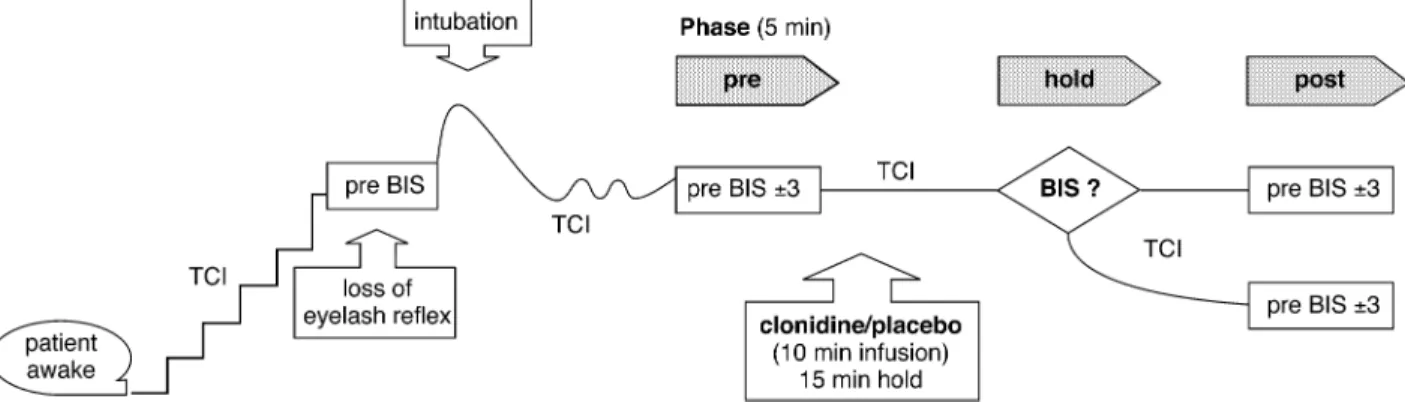
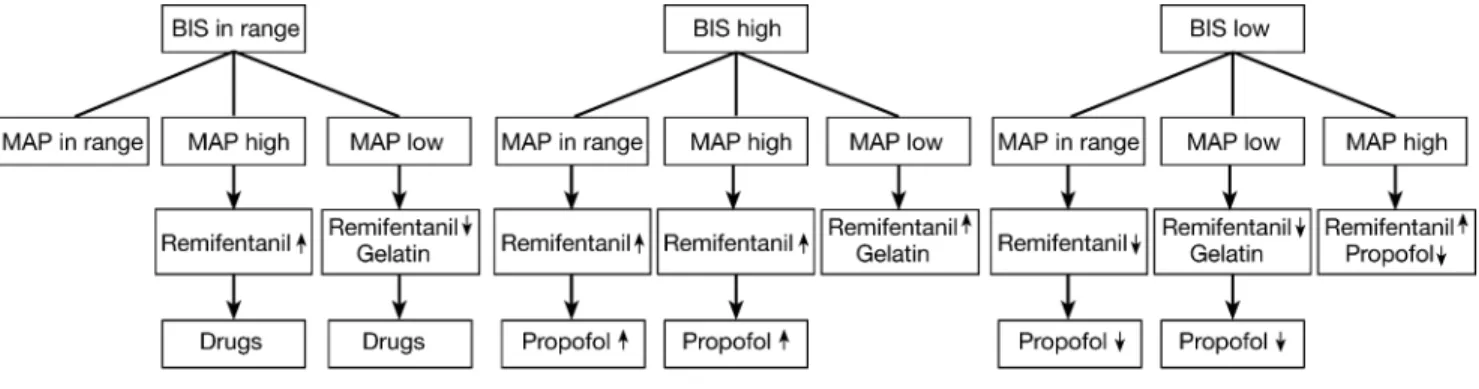
(2) Fehr et al.. Fig 1 Study design: preoperative examination. BIS?: after clonidine/placebo infusion, the BIS response was evaluated. With an unchanged BIS the target plasma concentration of propofol (TCI) was maintained; when a decrease in the BIS was observed, the target plasma concentration of propofol was reduced until the BIS was again at the pre-BIS level.. Materials and methods This randomized, double-blind, placebo-controlled study was designed to test the hypothesis that clonidine deepens anaesthesia as measured by the BIS and allows the dose of propofol to be reduced. After obtaining institutional review board approval and written informed consent, we studied 50 German-speaking patients, aged 18±70 yr, American Society of Anesthesiologists physical status I or II, scheduled for super®cial surgical procedures expected to last at least 45 min. Patients with cardiopulmonary, neuropsychiatric or hearing disorders and patients taking any medication affecting cardiovascular or neurological function were excluded. Patients received no premedication. After admission of the patients to the operating room, an i.v. cannula was placed and standard monitoring was established. In addition, the level of consciousness was surveyed by bispectral EEG analysis (Aspect A-1000 EEG monitor, software module 3.12; Aspect Medical Systems, Natick, MA, USA) and expressed as the BIS. After preparation of the skin, four disposable, self-prepping, low-impedance electrodes (Zipprep; Aspect Medical Systems) were positioned over the left and right prefrontal cortex (Fp1, Fp2) and referenced to a central vertex electrode (Cz) according to a standard montage. Impedances were kept at less than 5000 W. Anaesthesia was induced by propofol infusion using a target-controlled infusion (TCI) pump (Graseby 3500; Graseby Medical, Watford, UK). The target plasma concentration of propofol (mg ml±1) was raised in incremental steps until the patient became unconscious, as de®ned by the loss of the eyelash re¯ex. The corresponding BIS was recorded. To intubate the trachea, anaesthesia was deepened by increasing the target plasma concentration of propofol and muscle paralysis was achieved with rocuronium 0.6 mg kg±1. During the whole procedure, the patients' lungs were ventilated with 40% oxygen in air. The target plasma concentration of propofol was adjusted to achieve a. constant level of anaesthesia, indicated by a BIS corresponding to the BIS at loss of eyelash re¯ex (pre-BIS). The target concentration of propofol was adjusted in steps of 0.1±0.5 mg ml±1. A steady state was assumed only when the calculated effect site concentration equalled the target plasma concentration. Keeping the propofol target concentration constant, we allocated the patients randomly to receive either an infusion of clonidine 4 mg kg±1 or placebo in 0.9% NaCl 100 ml during the following 10 min. If the BIS was altered 15 min after the end of infusion, the target plasma concentration of propofol was reduced until the pre-BIS value was reached (Fig. 1). Heart rate, arterial blood pressure, the BIS and target plasma concentration of propofol were recorded every 2 min. Blood samples for measuring the blood concentration of propofol were taken via an additionally established 14 G cannula in a large vein on the contralateral arm before (`pre' phase) and 15 min after clonidine or placebo infusion (`hold' phase) and after adjusting the propofol target concentration (`post' phase), to achieve a steady state, de®ned as a constant BIS (= pre-BIS 63) over a period of at least 5 min. The blood samples (4 ml heparinized tubes) were stored immediately at ±20°C and analysed by high-performance liquid chromatography with ¯uorescence detection.9 During the surgery, supplementary analgesia was provided by remifentanil infusion at a rate between 0.01 and 1 mg kg±1 min±1 to maintain an unchanged BIS and haemodynamic stability (Fig. 2). The target concentration of propofol was maintained unchanged unless the target BIS (pre-BIS 65) could not be maintained by varying the remifentanil infusion rate, and at the end of the operation to allow a fast wake-up. Heart rate, arterial blood pressure, BIS, propofol target concentration and remifentanil infusion rate were recorded every 5 min during the intra-operative course. Hypertension or hypotension (620% of the arterial blood pressure in the `pre' phase) occurring with the BIS in the target range or sudden and marked blood pressure changes were scheduled to be treated with esmolol (20 mg). 628.
(3) Clonidine decreases BIS in propofol anaesthesia. Fig 2 Anaesthetic decision tree during the operation.. or phentolamine (1 mg) respectively, ephedrine (5 mg) and gelatin (500 ml). Simultaneously, remifentanil and propofol dosing was adjusted in accordance with the study protocol (Fig. 2). Atropine (0.5 mg) was administered if the heart rate fell below 40 beats min±1. Plasma concentrations of clonidine were analysed from blood samples 15 min (`hold' phase) and 180 min after clonidine infusion and at the end of surgery. Heparinized blood (6 ml) was placed on ice immediately after sampling, centrifuged promptly at +4°C to separate the plasma, and stored at ±20°C until analysis by high-performance liquid chromatography. To avoid clonidine redosing, the propofol-sparing ef®cacy was assessed during the ®rst 180 min after clonidine administration. To assess implicit memory during anaesthesia, four test items of different categories were presented to the patients through headphones at the following time points: immediately before (`pre' phase), 15 min after (`hold' phase), after possible reduction of propofol (`post' phase) and 180 min after infusion of clonidine (or the end of the operation, whichever came ®rst). The test items were selected in a pilot study in which 48 patients were asked to name 10 items from four categories (animals, fruits, colours, countries). The sequence in which these items were named was recorded and we evaluated which item was named on average in 10th position. These four items, named last in each category, were selected to be presented to the patients in the present study. On the post-operative day, patients in the current study were asked to name 10 items in each category. The sequence in which these items were named was again recorded. Scores of test items (10 points for ®rst position, 9 points for second position,. .. and 0 points for not mentioning the item at all) were computed for each study time point (pre, hold,. post and intra-operative) to compare the clonidine and placebo groups.10 Explicit memory was assessed by asking for any free recall.. Statistical analysis The duration of the different phases of the intra-operative course and memory test items were analysed using the Mann±Whitney U-test and Fisher's exact test. Repeated measures analysis of variance with two within-group factors [phase (pre, hold, post) and repetition (steady state values in each phase)] and one between-group factor (clonidine/ placebo) and post hoc t-test with Bonferroni correction were performed to evaluate differences in the progression of the preoperative phases pre, hold and post. To analyse differences between phases (pre, hold post) within groups (clonidine, placebo), paired t-tests with Bonferroni correction were used. Continuous data are presented as mean (SD). P values less than 0.05 were considered signi®cant.. Results The two groups were similar with regard to the physical characteristics of the patients (Table 1) and the type of operation. Times from the end of the preoperative examination to the start of the operation and the duration of operation did not differ between the groups (Table 1).. Pre-operative measurements before and after administration of clonidine TCI values, BIS, measured propofol blood concentrations, heart rate and mean arterial blood pressure were similar in the two groups before starting the clonidine or placebo infusion in the `pre' phase (Fig. 3). Fifteen minutes after the infusion (hold phase), haemodynamic variables were still. 629.
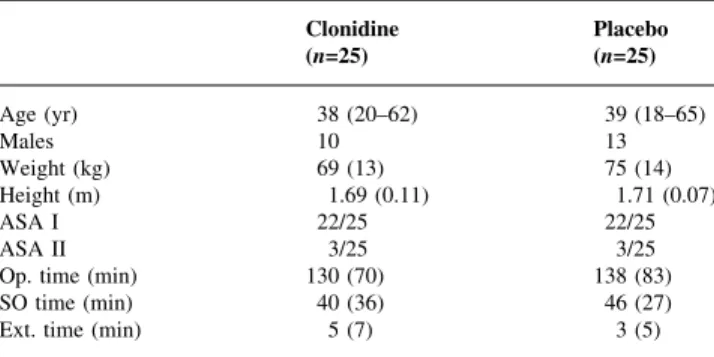
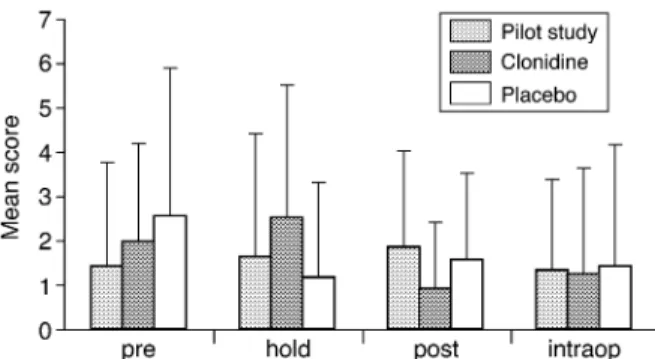
(4) Fehr et al. Table 1 Patient characteristics and operative times. Values are mean (SD) or absolute count. Op. time=duration of operation; SO time=time from end of pre-operative study phase to start of operation; Ext. time=time from end of operation to extubation. Age (yr) Males Weight (kg) Height (m) ASA I ASA II Op. time (min) SO time (min) Ext. time (min). Clonidine (n=25). Placebo (n=25). 38 (20±62) 10 69 (13) 1.69 (0.11) 22/25 3/25 130 (70) 40 (36) 5 (7). 39 (18±65) 13 75 (14) 1.71 (0.07) 22/25 3/25 138 (83) 46 (27) 3 (5). similar between the groups but there was a signi®cant decrease in heart rate in both groups (P<0.001). In the `hold' phase, the BIS showed a signi®cant decrease in the clonidine group (P<0.001) and was signi®cantly lower than in the placebo group (P=0.002). After achieving preBIS in the `post' phase, the clonidine group showed a signi®cant decrease in the target propofol concentration (P<0.001) and measured blood concentrations of propofol (P=0.009), and a signi®cant decrease in heart rate and mean arterial pressure (MAP) (P=0.002). In the `post' phase, the target propofol concentration (P=0.002) and the measured propofol blood concentrations (P=0.006) were signi®cantly lower in the clonidine group than in the placebo group, but similar BIS values (P=0.403) (Fig. 3) resulted. The measured plasma concentrations of clonidine were in the therapeutic range [`hold' phase, 2.7 (0.8) ng ml±1; 180 min after clonidine administration or the end of operation, 1.7 (0.5) ng ml±1].. Intra-operative measurements Throughout the intra-operative course, similar values for the BIS were observed in the two groups. In the clonidine group, this was achieved despite lower propofol target concentrations and a reduced total propofol dosage (Table 2). Interestingly, patients in both groups received similar amounts of remifentanil (Table 2). Despite a signi®cant decrease in mean intra-operative MAP, the patients in the clonidine group needed similar amounts of gelatin, atropine and ephedrine (Table 2). No patient was treated with phentolamine or esmolol. The time to extubation did not differ between the groups (Table 1).. Implicit and explicit memory analysis There were no differences in age or gender between patients in the pilot study and those in the current study [mean age: pilot group 38 (18±75) yr; current group 38 (18±65) yr; male/female 20/28 vs 23/27]. The scores for the presented items were similar between the pilot study and the current study and between the clonidine and the placebo groups at. all time points (P>0.05) (Fig. 4). No patient had any free recall either of the presented items or of any other pre- or intra-operative events.. Discussion Intravenous clonidine results in a decrease in the BIS during propofol anaesthesia and allows reduction of the target concentration of propofol in order to maintain a certain BIS level. The pharmacodynamic effect of clonidine during anaesthesia can thus be monitored with the BIS. Clonidine affects the EEG in a variety of ways: it increases slow-wave activity (delta) and attenuates the physiological alpha ¯uctuations.7 11 Although no data exist regarding the speci®c effect of clonidine on the BIS, clonidine causes sedation12 and therefore may also affect the BIS,13 which indeed was demonstrated in the present study. The propofol saving in the current study of nearly 20% is comparable with earlier studies in which an iso¯urane saving of approximately 40% was reported.14 15 The somewhat greater iso¯urane saving in that study may be explained by a different EEG analysis, a larger dose of clonidine (5 vs 4 mg kg±1) and perhaps especially because iso¯urane dosing was guided mainly by haemodynamic responses. Another trial investigated the effect of clonidine on i.v. anaesthesia with propofol and fentanyl and found a reduction of approximately 40% in the propofol requirement with similar doses of fentanyl after clonidine.5 Despite similar anaesthetics and a relatively small dose of oral clonidine (150 mg), this study revealed a greater reduction of propofol in comparison with our study. This may be explained by dosing propofol according to arterial blood pressure and heart rate but without any monitoring of brain function, such as the BIS. Larger doses of clonidine may allow greater reductions in anaesthetic drug use, but may lengthen the time required for recovery from anaesthesia.6 This was not observed in the present study and the time to extubation was similarly short in the two groups. The restrictive propofol dosing in our control group may be another reason for the relatively small propofol saving compared with previous studies. This might be linked to continuous monitoring of the BIS, which has been reported to facilitate immediate recovery and to decrease the consumption of anaesthetics.16 Clonidine administration resulted in a lower propofol requirement for a certain level of anaesthesia to be achieved, as de®ned by similar BIS values. The fact that no explicit intra-operative awareness occurred and no signs of implicit memory were observed indicates that the anaesthetic state induced by clonidine and low-dose propofol may be similar to the anaesthetic state induced by a larger dose of propofol alone. It is evident that larger trials will be necessary to show conclusively that a lower dose of propofol combined with clonidine is as safe as a larger dose propofol in preventing intra-operative awareness.. 630.
(5) Clonidine decreases BIS in propofol anaesthesia. Fig 3 Propofol target plasma concentration (TCI), bispectral index, blood concentration of propofol, heart rate (HR) and mean arterial pressure (MAP) before (pre) and after (hold) clonidine administration and after achieving the pre-BIS-value (post) with possible reduction of propofol in patients treated with i.v. clonidine or placebo (mean6SD). ²Signi®cant difference from `pre' condition (within-group comparison, after Bonferroni correction, P<0.017). ³Signi®cant difference from `hold' condition (within-group comparison, after Bonferroni correction, P<0.017). *Signi®cant difference between groups (after Bonferroni correction, P<0.017).. Table 2 Intra-operative BIS, haemodynamic variables, anaesthetic requirements and the use and dose of gelatin, atropine and ephedrine for haemodynamic events. Values are mean (SD), absolute counts or median and range. BIS=bispectral index; HR=heart rate; MAP=mean arterial pressure; Prop=intra-operative propofol infusion rate; Remi=intra-operative remifentanil infusion rate. P<0.05 is signi®cant. BIS HR (beats min±1) MAP (mm Hg) Target concentration of propofol (mg ml±1) Prop (mg kg±1 min±1) Remi (mg kg±1 min±1) Use of gelatin Gelatin (ml) Use of atropine Atropine (mg) Use of ephedrine Ephedrine (mg). Clonidine. Placebo. P (clonidine vs placebo). 48 (4) 53 (5) 71 (7) 2.3 (0.4) 0.11 (0.02) 0.14 (0.08) 10/25 0 (0±1500) 5/25 0 (0±1.5) 4/25 0 (0±10). 48 (4) 54 (7) 78 (9) 2.8 (0.5) 0.13 (0.02) 0.11 (0.08) 10/25 0 (0±1000) 4/25 0 (0±1.0) 1/25 0 (0/5). 0.73 0.46 0.01 <0.01 <0.01 0.13 1 0.48 0.73 0.67 0.35 0.16. We analysed the propofol concentration of venous blood to avoid the insertion of an arterial catheter or repeated arterial puncture. In addition, we ensured that the time to steady state was always more than 10 min,. and thus arterial and venous propofol concentrations should have been stable and in a ®xed ratio to each other.17 Therefore, venous propofol concentrations may be considered representative of the blood concentration. 631.
(6) Fehr et al.. Fig 4 Scores of test items (10 = ®rst position, 1 = 10th position, 0 = not listed) at different time points in the current study (clonidine vs placebo) and in the pilot study. There are no signi®cant differences between the groups. Values are mean+SD.. of propofol when comparing different phases and the two groups. Clonidine did not have any additional effect in reducing the intra-operative requirement for remifentanil. This is in agreement with a study by Engelman and colleagues, describing similar intra-operative opioid requirements with and without clonidine.18 However, clonidine has been reported to reduce post-operative opioid requirements.19 Because the primary site of analgesic action of clonidine has been proposed to be the spinal dorsal horn, it is conceivable that systemically administered clonidine has a relatively limited analgesic ef®cacy, enabling modulation of postoperative pain but being less effective against the more intense intra-operative pain.20 In summary, the pharmacodynamic effect of i.v. clonidine can be monitored with the BIS. Intravenous clonidine causes a signi®cant decrease in the BIS and allows a lower propofol dose to be used at a similar level of anaesthesia without intra-operative awareness or prolonged recovery times.. Acknowledgements Financial support was provided by the Institute of Anaesthesiology, University Hospital Zurich, Switzerland, a grant from Zeneca, Switzerland and a research grant from the Swiss Society of Anaesthesiologists, Berne, Switzerland. References 1 Maze M, Tranquilli W. Alpha-2 adrenoceptor agonists: de®ning the role in clinical anesthesia. Anesthesiology 1991; 74: 581±605 2 Stuhmeier KD, Mainzer B, Cierpka J, Sandmann W, Tarnow J. Small, oral dose of clonidine reduces the incidence of intraoperative myocardial ischemia in patients having vascular surgery. Anesthesiology 1996; 85: 706±12 3 Thomson IR, Peterson MD, Hudson RJ. A comparison of clonidine with conventional preanesthetic medication in patients undergoing coronary artery bypass grafting. Anesth Analg 1998; 87: 292±9. 632. 4 Howie MB, Hiestand DC, Jopling MW, Romanelli VA, Kelly WB, McSweeney TD. Effect of oral clonidine premedication on anesthetic requirement, hormonal response, hemodynamics, and recovery in coronary artery bypass graft surgery patients. J Clin Anesth 1996; 8: 263±72 5 Imai Y, Mammoto T, Murakami K, et al. The effects of preanesthetic oral clonidine on total requirement of propofol for general anesthesia. J Clin Anesth 1998; 10: 660±5 6 Goyagi T, Tanaka M, Nishikawa T. Oral clonidine premedication reduces induction dose and prolongs awakening time from propofol±nitrous oxide anesthesia. Can J Anaesth 1999; 46: 894±6 7 Bischoff P, Mahlstedt D, Blanc I, Schulte am Esch J. Quantitative topographical electroencephalographic analysis after intravenous clonidine in healthy male volunteers. Anesth Analg 1998; 86: 202±7 8 Hall JE, Uhrich TD, Barney JA, Arain SR, Ebert TJ. Sedative, amnestic, and analgesic properties of small-dose dexmedetomidine infusions. Anesth Analg 2000; 90: 699±705 9 Knibbe CA, Koster VS, Deneer VH, Stuurman RM, Kuks PF, Lange R. Determination of propofol in low-volume samples by high-performance liquid chromatography with ¯uorescence detection. J Chromatogr B Biomed Sci Appl 1998; 706: 305±10 10 Graf P, Masson MEJ. Implicit Memory: New Directions in Cognition, Development, and Neuropsychology. Hillsdale (NJ): Lawrence Erlbaum, 1993 11 Bischoff P, Scharein E, Schmidt GN, von Knobelsdorff G, Bromm B, Esch JS. Topography of clonidine-induced electroencephalographic changes evaluated by principal component analysis. Anesthesiology 2000; 92: 1545±52 12 Kamibayashi T, Maze M. Clinical uses of alpha2-adrenergic agonists. Anesthesiology 2000; 93: 1345±9 13 Johansen JW, Sebel PS. Development and clinical application of electroencephalographic bispectrum monitoring. Anesthesiology 2000; 93: 1336±44 14 Gabriel AH, Faryniak B, Sojka G, Czech T, Freye E, Spiss CK. Clonidine: an adjunct in iso¯urane N2O/O2 relaxant anaesthesia. Effects on EEG power spectra, somatosensory and auditory evoked potentials. Anaesthesia 1995; 50: 290±6 15 Ghignone M, Calvillo O, Quintin L. Anesthesia and hypertension: the effect of clonidine on perioperative hemodynamics and iso¯urane requirements. Anesthesiology 1987; 67: 3±10 16 Song D, Joshi GP, White PF. Titration of volatile anesthetics using bispectral index facilitates recovery after ambulatory anesthesia. Anesthesiology 1997; 87: 842±8 17 Wang YP, Cheng YJ, Fan SZ, Liu CC. Arteriovenous concentration differences of propofol during and after a stepdown infusion [published erratum appears in Anesth Analg 1995; 80: 434]. Anesth Analg 1994; 79: 1148±50 18 Engelman E, Lipszyc M, Gilbart E, et al. Effects of clonidine on anesthetic drug requirements and hemodynamic response during aortic surgery. Anesthesiology 1989; 71: 178±87 19 Bernard JM, Hommeril JL, Passuti N, Pinaud M. Postoperative analgesia by intravenous clonidine. Anesthesiology 1991; 75: 577±82 20 Hirata K, Koyama N, Minami T. The effects of clonidine and tizanidine on responses of nociceptive neurons in nucleus ventralis posterolateralis of the cat thalamus. Anesth Analg 1995; 81: 259±64.
(7)
Figure

+2
Documents relatifs
Pour tenter de pallier ces limitations, on peut s’orienter vers une approche indirecte qui consiste à ne plus décrire la surface par sa géométrie point par point, mais à extraire
To study in more details the dynamic of the identification performance across the diversity of species, Figure 2 presents the scores achieved by the best system of each team on
*Préparer 30 étiquettes sur lesquelles sont notés des indicateurs de temps (avant, jadis, autrefois, il y a longtemps, hier, il y a cinq ans, l'année dernière,
The present results with a mean threshold of 14.2±12.1 µm (Weibull function) indicate an interocclusal perception of high tactile sensibility5. The 50% thresholds estimated by
Début 2016, le taux de sortie pour reprise d’emploi reste stable et la part des sorties pour formation accélère En mars 2016, 512 000 demandeurs d’emploi tenus de re- chercher
Certains désignent le rapporteur du groupe avant la recherche, d’autres juste avant la mise en commun ; d’autres encore préfèrent faire venir tout le groupe pour
Alors que l’intervenante soutient l’enfant dans ses forces pour l’encourager à réussir, l’enseignante doit aussi évaluer ses apprentissages en plus de soutenir l’élève voir
The shift from the previous regime to the two-thirds rule was made possible by a combination of factors: the increasing pressure on improving the conditions of technology
