ANALYSIS OF DATA
FROM THE VOYAGER PLASMA SCIENCE EXPERIMENT
USING THE FULL CUP RESPONSE
by
ALAN SETH B)RNETT
S.B. Massachusetts Institute of Technology 1977
Submitted to the Department of Physics
in Partial Fulfillment of the Requirements for the Degree of
DOCTOR OF PHILOSOPHY at the
MASSACHUSETTS INSTITUTE OF TECHNOLOGY. May 1983
,/#~)
A
6
r
Signature of Author
Certified by
Department of Physics, 29 April 1983
Thesis Supervisor
Accepted by_
Chairman, Department Committee on Graduate Students
This work was funded in part by JPL contract 95733 and NASA contract NAGW-165
Arc h
ivp
MASSACHUSETTS INSTTUT5 OF TECHNOLOGY
JUL 2 7 1983
DISCLAIMER OF QUALITY
Due to the condition of the original material, there are unavoidable
flaws in this reproduction. We have made every effort possible to
provide you with the best copy available. If you are dissatisfied with
this product and find it unusable, please contact Document Services as
soon as possible.
Thank you.
Pages are missing from the original document.
ANALYSIS OF DATA
FROM THE VOYAGER PLASMA SCIENCE EXPERIMENT
USING THE FULL CUP RESPONSE
by
ALAN SETH BARNETT
Submitted to the Department of Physics on 29 May 1983 in partial fulfillment of the
requirements for the degree of
Doctor of Philosophy in Physics ABSTRACT
The Voyager Plasma Science experiment consists of four modulated grid
Faraday cups which measure positive ions and electrons in the
energy-per-charge range of 10-5950 volts. A formula for the full response function of each of the cups is derived from the solution to the equations of motion for a charged particle inside the cup. The current in each of the energy-per-charge channels of the detector can be expressed as the difference between two integrals over velocity space of the product of the response function and the distribution function which describes the plasma. The integrals are performed for two special cases when the distribution function is a convected Maxwellian.
For the case when the sonic Mach number of the flow is large ("cold plasma" approximation), we approximated the dependence of the distribution function on the components of the flow perpendicular to the cup normal by a Dirac delta function, permitting the integrals over those components to be performed trivially. The remaining integral must be performed numerically.
For the more general case when the sonic Mach number is not large, we
approximated the analytic expressions for the response function by a functional form which permits the integration over the components of velocity transverse to the cup normal to be performed analytically. Once again, the integral over the normal component of the velocity must be performed numerically. We developed a special integration scheme which greatly reduces the computer time required for the numerical computation of the remaining integral.
The formula for the response function was tested by using the solar
wind as a test beam when the spacecraft was rotating during a cruise
maneuver. Analysis of the data taken during the maneuver using the "cold plasma" approximation confirmed the accuracy of our response function for angles of incidence of up to 7 0 for the main sensor cups and up to at least
55
for the side sensor cup. By using data from all four cups simulatneously, we are able to determine the solar wind direction with aprecision of better than 0.50.
We then present analysis of data taken in the vicinity of the Jovian satellite Io. The interaction between Io and the Jovian
magnetosphere is a topic of considerable interest due to the fact that the decametric radio emmision from Jupiter appears to be modulated by the satellite. Unfortunately, the problem of determining the plasma parameters near Io is extremely difficult due to the low Mach number of the flow, the
large angle of the flow with respect to the cup look directions, and the
presence of several differeU ioPc specie . Under the assumption that the only ions present are 0 , 0 , S , and SO and that all of the ionic
species have the same thermal speed, we otain estimates of the plasma parameters by fitting seven spectra taken in the vicinity of Io. We
interpret our results in terms of a model of the interaction between Io and
the Jovian ionosphere due to Neubauer (1980). The results indicate qualitative agreement with the model that the flow is analogous to the potential flow of an incompressible fluid around an infinitely long cylinder.
Thesis Supervisor: Dr. Stanislaw Olbert
Acknowledgements
For helpful discussions and encouragement, I wish to thank Professors John Belcher and Ralph McNutt, and Drs. Alan Lazarus and Fran Bagenal.
For his assistance in the seemingly futile endeavor to tame the recalcitrant computer, I wish to thank Dr. George Gordon.
For their patience with my plottapes, I wish to thank Pamela Milligan and Mary Terkoski.
For her general helpfulness and cheerfulness, I wish to thank Anne
Bowes.
For his amazing ability to find money to support me term after term, I wish to thank Professor Herb Bridge.
There is more to life than physics, and I would not have been able to finish this thesis and retain Mr sanity without the help of many other people. In particular;
For his companionship as partner in frequent attempts to boldly sail where no windsurfer has sailed before, I wish to thank Dr. Paul Gazis.
For providing (too?) many hours of extremely enjoyable distractions, I wish to thank the staff of the Sailing Pavilion and the members of the MIT
Nautical Association.
For greatly enriching my life through the joy of music, I wish to
thank all of the people with whom I have played chamber music over the past
six years, in addition to the conductor, accompanist, and members of the MIT Choral Society.
For their frequent company and deep friendship, I wish to thank Peter
Shaw, Leslie Silverfine, Penelope Metzidakis, Roland Vanderspek, Donna
Hewitt, and Norman (Gil) Bristol, Jr..
For their love and moral support throughout my entire life, I wish to thank my parents.
And most important, for his many stimulating discussions of physics
and other topics, his infinite patience, his encouragement to help me through the all too frequent discouraging moments, his great generosity with his time, and numerous other things great and small, I wish to thank Professor Stanislaw Olbert.
Table of Contents Title Page p 1 Abstract p 2 Acknowledgements p 4 Table of Contents p
6
Chapter 1 Introduction p 8Chapter 2 Derivation of the Response Function of the
Voyager Plasma Science Experiment p 13
Section 2.1 Location and Orientation of the Instrument p 14 Section 2.2 Structure and Operation of the Main Sensor Cups p 15
Section 2.3 Response Function of the Main Sensor p 17
Section 2.3a The Grid Transparency p 18
Section 2.3b The Sensitive Area p 20
Section 2.4 Structure and Operation of the Side Sensor p 24
Section 2.ha The Grid Transparency p 25
Section 2.4b The Sensitive Area p 26
Section 2.5 The "Cold Plasma" Approximation p 29
Section 2.6 The "Hot Plasma" Approximation for the Main Sensor p 32
Section 2.7 The "Hot Plasma" Approximation for the D-Cup p 37
Chapter 3 Experimental Test of the Response Function p 38
Section 3.1 The Cruise Maneuver p 39
Section 3.2 Analysis of Data Taken During the Cruise Maneuver p 41
Chapter 4 The Theory of the Interaction Between Io and the
Jovian Magnetosphere p 49
Section 4.1 Introduction p 50
Section 4.2 The Equations Which Describe the Plasma at Io p 52 Section 4.3 The Io-Magnetosphere Interaction p 59 Chapter 5 Analysis of Plasma Data Taken in the Vicinity of
Io by Voyager I p 73
Section 5.1 The Io Flyby p 74
Section 5.2 Analysis of the Data p 75
Section 5.3 The Flow Around the Alfven Wing p 82
Section 5.4 Summary p 89 References p 92 Tables p 94 Figure Captions p 100 Figures p 113 Appendix A p 166 Appendix B p 178 Appendix C p 182 Appendix D p 186
Chapter I
On 20 August
1977,
a spacecraft named Voyager II was launched from the
Kennedy Space Center in Florida, bound for the outer solar system. Voyager I,
its sister ship, was launched two weeks later on September 5. Both spacecraft
were targeted for close encounters with Jupiter and Saturn. Voyager II will
also fly close to Uranus and Neptune.
One of the experiments carried by both of these spacecraft was a set of
four modulated grid Faraday cups called the Plasma Science Experiment (PLS).
The PLS experiment measures positive ions and electrons in the energy range of
10-5950 eV. It was designed and constructed at MIT, and includes several
novel features (Bridge et al). Three of its four cups are very shallow,
resulting in an extremely wide field of view. These same three cups are
arrayed about an axis of symmetry such that their fields of view overlap.
This region of overlap includes the direction of the solar wind flow
throughout most of the mission. By analyzing positive ion data taken by all
three of these cups simultaneously, it is possible to determine the direction
of the solar wind flow to better than one-half degree and its magnitude to
within a few km/sec.
The fourth cup is more conventional in design, and it looks in a
direction perpendicular to the symmetry axis of the main cluster.
During the
interplanetary, or cruise, phase of the
mission, this cup is used to measure
electrons.
In addition, during the inbound pass .of planetary encounters, this
cup looks in the direction of the corotating plasma, measuring both electrons
and positive ions.
The main sensor cups were designed in such a way that for a wide range of
sonic Mach numbers and flow directions, including all of the situations which
one expects to encounter during the cruise phases of the mission, almost all
of the particles which enter the aperture and are not stopped by the modulator voltage do reach the collector. During planetary encounters, however, the facts that the Mach number is frequently low and that the flow is highly oblique to the cups makes the "unity response" approximation not valid. In order to analyze data taken at these times, a knowledge of the full response function of the cups is required.
This thesis presents a derivation of the full response function based on a calculation of the trajectories of charged particles inside the cups. The
current measured by the sensors is given by the integral over velocity space of the product of the plasma distribution function and the cup response
function. A computer program which performs this integration numerically has already been written by V. Vasyliunas, one of the designers of the instrument. Unfortunately, his algorithm is very slow. Not only is it impossible to use
it to perform any iterative fitting procedure to determine the macroscopic plasma parameters, but it is even too slow to use at all for simulating the
high resolution (M-mode) energy-per-charge spectra. We have overcome this difficulty by approximating the analytic expression for the response function
by a functional form which permits the integrations over the components of
velocity perpendicular to the cup normal to be performed analytically for the case where the distribution function is a convected Maxwellian. This
derivation is the topic of Chapter 2.
In order to test the response function derived in Chapter 2, it is neccessary to have an extremely narrow test beam. Since such a beam is very
difficult to make in the laboratory and the quiet solar wind has just these properties, we have tested the response function by analyzing data taken by Voyager I during a cruise maneuver. During the cruise maneuver, the
cup response functions is the topic of Chapter 3.
On the outbound pass of its Jupiter encounter, Voyager I flew about 20,000 km above the south pole of the satellite Io. As the decametric radio burst from Jupiter are known to be correlated with the phase angle of Io, the interaction between Io and the magnetospheric plasma is a topic of
considerable interest. During the Io flyby, the sonic Mach number of the plasma was low (about 2) and the flow direction was perpendicular to the main sensor symmetry axis. This situation makes knowledge of the full response function neccessary for the analysis of the data taken during this period. This stretch of data was chosen for the first use of the full response function in analyzing data.
The satellite Io appears to have a high electrical conductivity. Drell, Foley and Ruderman (1965) have shown that any conductor which moves through a magnetized plasma will be a source of Alfven waves. If the velocity of the conductor with respect to the ambient medium does not change with time, there will be a standing wave pattern in the rest frame of the conductor consisting
of a pair of Alfven "wings" which extend away from the conductor in the direction of the Alfven characteristics. Neubauer (1980) has shown that the plasma flow around each of these wing is analogous to the potential flow of an incompressible fluid around an infinite cylinder.
The final two chapters of the thesis are concerned with Io's interaction with the Jovian magnetospheric plasma. Chapter 4 contains a discussion and critique of Neubauer's theory, while Chapter 5 consists of analysis of the
data taken by Voyager I during the Io flyby. We conclude that the data is consistent with the overall picture that the plasma flows around the Alfven wing as if the wing were a long, cylindrical obstacle.
Chapter 2
Derivation of the Response Function
of the
2.1 Location and Orientation of the Instrument
The Voyager Plasma Science Experiment consists of four modulated grid
Faraday cups. A sketch of the instrument is shown in Figure 2.1. Three of the cups, called the A-cup, B-cup, and C-cup, comprise the main sensor.
These three cups have the same pentagonal shape and are arrayed with their
cup normals 200 from an axis of symmetry. The fourth cup, called the side
sensor or D-cup, has a circular aperture. The normal to the D-cup aperture points in a direction 880 from the main sensor symmetry axis.
Figure 2.2 shows the location and orientation of the plasma instrument on the spacecraft. The instrument is mounted on the science boom, a metal support structure which extends away from the main body of the spacecraft. Also on the science boom are the cosmic ray, imaging, UV spectrometry, IR
spectrometry, photopolarimetry, and low energy charged particle experiments.
The system of coordinates called spacecraft coordinates is defined as follows: The spacecraft center of mass is taken as the origin. The
unit vector zsc points along the axis of the main antenna, with +sc
pointing into the antenna. The unit vector ysc lies in the plane
containing the zsc and the axis of symmetry of the science boom. It is
perpendicular to the 2sc and makes an acute angle with the science boom.
The unit vector
isc
is defined so as to make a right-handed system (see Fig. 2.2).The outward pointing symmetry axis of the PLS main sensor is parallel to -Z sc As this axis is also parallel to the axis of the main antenna, it is pointed at the earth during most of the mission. Since the angular separation between the earth and the sun as seen from the outer solar
system is small, the solar wind flow direction is substantially into the main sensor. The D-cup is oriented such that it looks into corotating flow during the inbound pass of a planetary flyby. The relative orientations of the cup apertures as viewed from along the main sensor symmetry axis is shown in Fig. 2.3.
During the interplanetary, or cruise, phase of the mission, the main sensor measures positive ions and the side sensor measures electrons. During planetary encounters, the D-cup is also used to measure positive
ions.
2.2 Structure and Operation of the Main Sensor Cups
A vertical cross section of a main sensor cup is shown in Figure 2.4,
and a top view is shown in Figure 2.5. The collector of the cup has the shape of home plate on a baseball field with the corners smoothed out. The aperture is similar in shape, differing in that it is smaller and its
parallel sides are shorter with respect to its other sides. The aperture
2
area (A ) is 102 cm . Around the edge of the collector is a rim of metal.
ap
The collector plane is considered to be the plane defined by the top of this rim. The distance (h) from the aperture to this plane is 4.1 cm.
The cup has nine parallel grids. Each grid consists of a woven mesh of two perpendicular sets of parallel wires. When measuring ions, the suppressor grid is held at -95V relative to the collector, and the same positive voltage square wave is impressed on all three modulator grids. The rest of the grids and the collector are grounded to the spacecraft. When a square wave voltage is impressed on the modulator grids, the
collector current is a square wave differing in phase by 1800, as shown in
Figure 2.6. The amplitude of this square wave is the information which is telemetered back to Earth. During operation, a sequence of such square
waves is used. The frequency of the wave is 400hz, and the limiting
voltages are changed every 0.240 secs. The voltages are changed such that
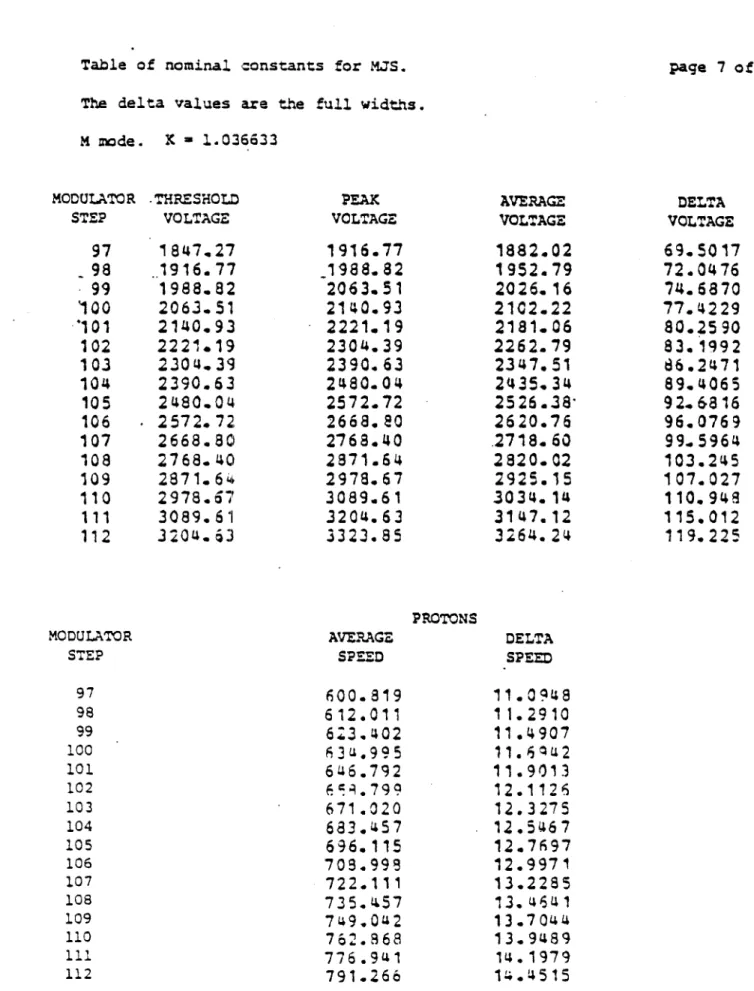
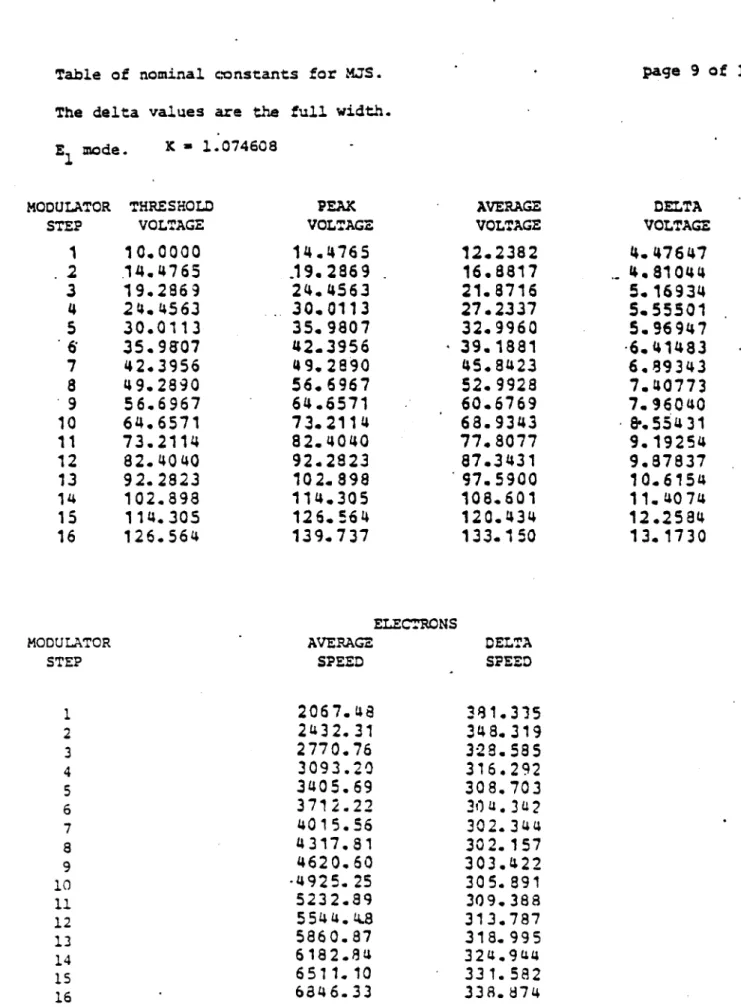
the higher voltage of any one square wave is the lower voltage of the next. In this way the voltage range of 10-5950 volts is divided into contiguous channels. In the low resolution (L-)mode there are 16 channels; in the high resolution (M-)mode there are 128 channels. Hereafter, we will label the channels with a subscript k. Appendix A includes a table which lists the threshold voltage #k, the voltage width Ak *k+1~ *k), and the average voltage 'k ((*k+l+
*
k)/2) for each channel in each of the positive ion modes (L and M). A more thorough description of the instrument and its operation is given in Bridge et al (1977).In order to define the threshold speeds vk we will use a coordinate
system called cup coordinates. We take as the origin the center of the long side of the aperture (point 0 in Figure 2.5). The unit vector 2 is
cup
perpendicular to the aperture plane and points into the cup, the unit vector xCUp is defined by the vector cross product of z s with Z cup and the unit vector gcup is defined to make a right-handed coordinate system.
Consider a parallel beam of positive monoenergetic ions incident on the cup. The only particles to reach the collector will be those with a z-component of velocity greater than vk given by
vk=(Zek/M)
1/2 2.la*
where Z is the charge state of the ion, e is the elementary charge,
*
m is the modulator voltage, A is the atomic weight and M is the proton mass. It isconvient to define the average proton speed k and the channel width Avk as
rkk
Vk (vk+1+vk)/2 2.lb
Avk ~k+l~ k 2.1c
The values of 7k and Avk for each channel are included in Appendix A. In terms of the distribution function f(v) which describes the plasma environment of the spacecraft, the current in the k-th channel is given by Equations 2.2a and 2.2b.
* *
Ik k k+l 2.2a
I*=A Z e I ldv dv fdv v f(v)R(v,vk) 2.2b
kC 0W
y
ZZwhere A0 is the aperture area times the transparency at normal incidence and R(V,vk) is the cup response function, to be derived hereinafter. The quantity
f(v) in the above equation is the distribution function of a single species;
if the plasma contains more than one species the current will be given by a sum of terms like Equation 2.2b, one for each type of ion.
The quantity Ik can be thought of as a function of vk. For the remainder of this thesis, the quantity I k(vk)/Ak will be referred to as the reduced
distribution function. This is because when the unity response approximation is valid, Ik/"k is in fact proportional to the object which generally goes by that name (see McNutt et al (1981)).
2.3 Response Function of the Main Sensor
Our problem is to determine the function R. A particle incident'on the
voltage, it collides with a grid, or its trajectory is such that it misses the collector and collides with the side of the cup. The first effect is taken
care of by the lower limit of the integration over vz; the latter two effects are included in R. R can therefore by written as a product of two terms and a normalization constant,
R=TA/A0 2.3
where T is the transparency of the grids and A is the "sensitive" area of the collector. Note that R is normalized to unity at normal incidence. T and A are functions of velocity and channel number, while A0 is a constant. We will first consider the effect of collisions with the grids (transparency).
2.3a The Grid Transparency
The transparency of a single grid is defined as the probability of an incident particle traversing the plane of the grid without colliding with the wires. We model a grid as a planar structure consisting of two perpendicular sets of parallel cylindrical wires. In the main sensor, the sets of wires of all of the grids are parallel to the x- and y- axes in cup coordinates. The transparency of the grid will be the product of the transparencies of each set of wires considered separately.
Consider the wires which run in the x-direction. Since the transparency of these wires does not depend upon v , we only need to consider the
projection of the motion into the y-z plane. The probability of a particle
colliding with one of the wires is simply the ratio of the area of the wires to the area of the gaps between the wires projected into a plane perpendicular to the particle velocity vector (see Figure 2.T). Per unit length along the
wire, this ratio is
Probability of collision = d = c sec a 2.4
L cos a
where d is the wire diameter, L is the grid spacing, c(=1/42) is their ratio, and a is the angle between the particle velocity and the grid normal. The probability of a particle not colliding with the grid, is
Probability of no collision = 1- (c sec a) 2.5 If v* is the velocity of the particle as it crosses the grid plane, we see that the transparency of one grid is
v* 21 2V21/
T=[l-,(1+ V*V2/l[-+( 27/) 2.6
z z
Under the assumption that the potential inside the cup depends only on z,, v* depends solely upon the velocity of the particle before it enters the cup and the voltage on the grid. The validity of this approximation will be discussed in the next section. An expression relating v* with v is now found from
energy conservation to be V* x = VY 2. Ta v* = v 2.Tb y y V* = (v2 - 2e /Am )1/2 2.Tc z z p
The transparency of all of the grids is the product of the transparencies of the individual grids. It is given by
2 2 Vi v l' T=H1-c(l+ )1/2I (1-c(l+
)1/2
2.8 i 2 2ei 2 2e*. vz Am z Am p pwhere is the voltage on the i-th grid
Each cup has three modulator grids, one suppressor grid, and five
by v2,2 2 T=[1-c(l+ -) 1/2]5[1-ce(,+ vx 2 1/213[1-c(,+ 2 y1/2 x
2
vs2
(1- ) (J+ ). V Vz
z
2.9 2 2 2v )125lv
y
[(-c(l+)_/25
c( + 7 2_1/233[-C(l+ v 1/2 z 2 (-k2
(1+ 5)vz('
2
Tz (:.i
V z zThe subscript s refers to the suppressor grid; vs is defined in a manner analogous to the definition of vk in Equation 2.1
v =(2Z*e#8/Amp )1/2 2.10
where
*s
is the voltage on the suppressor grid.Note that for normal incidence T=T 0=(-c)18=0.65 and AO=66 cm2.
2.3b The Sensitive Area
The second factor in Equation 2.3 is the "sensitive area". This is defined to be the overlap of the area of the collector with the area of the image of the aperture in the plane of the collector.
Consider a beam of particles incident at an angle a to the cup normal. In the collector plane, the beam will have the shape of the aperture, but its position will be displaced because of the components of the particle velocity transverse to the cup normal direction, as shown in Figure 2.8. First we will
compute the amount of the shift., and then we will discuss the functional dependence of the sensitive area on the shift vector.
We define a two dimensional vector , also shown in Figure 2.8, to be the
aperture into the plane of the collector. Figure 2.9 shows the projection into the x-z plane of a possible trajectory of a positive ion as it moves from the aperture to the collector of one of the main sensor cups. If the
particles were not deflected by the electrostatic fields inside the cup, the shift would be given by
xv
S = -- h 2.11a
Z
S = - h 2.llb
y vz
The effect of the fields is to bend the beam, thereby changing the amount of the shift. To compute the amount of the shift, we will solve the equations of motion for a charged particle moving in the electric field of one of the cups.
We will assume that the potential between the grids depends only upon z. This neglects the fine structure of the fields close to grids as well as the
fringing fields near the edges of the grids.
The fine structure of the fields in the vicinity of the wires decays in a
distance comparable to the mesh size of the grid. Since this distance is much
less than the spacing between grids, the ripple in the fields near the wires can safely be ignored.
The fringing fields are important only in a region around the edge of the grids which has a width comparable to the grid spacing. Because of the cup goemetry, any particle whose trajectory includes the region where the fringing
fields are important will miss the collector. As.this will occur whether or not the fringing fields are used in computing the trajectory, these fields can be ignored.
The potential is therefore well approximated by a linear function of distance between any two neighboring grids. Figure 2.10a shows the potential
as a function of z for a typical channel. Using energy conservation and the
fact that the fields are entirely in the z-direction the equation of motion is
easily solved. The equations of motion of the particle are
V* dx = v 2.12a
x
dt
x
V*= y = v 2.12b y dt y v* =dz
= (v2_ 2z*e(z))1/2 2.12c z dt z Am p with *(z) given by *(z)= *k O<z<.762 2.13a *(z)= *k .762<z<1.143 2.13b (Z)= 1.905-z 1.143<z<1.905 2.13c.762
k
*(z)= 0 1.905<z<2.286 2.13d *(z)= z-2.28 6 2.286<z<2.700 2.13e(z)= 3.089-z
#
2.700<z<3.089
2.13f
*(z)= 0 3.089<z<4.100 2.13gEquations 2.12a and 2.12b can be solved by inspection. For a particle which crosses the aperture plane at the origin of the cup coordinate system, the
result is
x=v t 2.14a
Y-v t 2.14b
y
The components of the shift vector are simply the values of x and y
evaluated for t equal to the transit time of the particle from the aperture to
the collector plane. This can be evaluated with the aid of Equation 2.12c, which can be rewritten as
t h
dz
fdt = I _(
2
2.15z Am
Inserting the expressions for $(z) from Equations 2.13a-2.13g and performing the integrations we find
t=t +tb +t +t +t +t f+t 2.16 2 IV -)1/2 1-2 V t (.762 z 2.17a a v z (v 2 2 z k tb=(. v X )2.1Tb z v
(1-
-)
z tc a 2.lTctd
381 2.lTd 2[(1+
)1/2
t =(2 )(.414)
z 2.Te e (z s 2 [(1+ s 1/2 2 tf (2 )(389) 2z 2.17f z (v 2/v2 z t =.1 2.17gUsing Equations 2.14a, 2.14b, 2.16, and 2.17a-2.17g the shift vector can be written as
S = S(
)h
2.18a
z
S
y=
S(
I
)h
2.18b
with S, the shift function, defined by :2 2 (1-( k)1/2] [
)(+
)1/2_12
1(+2
S=.743( 22 )+.093(_ _ 1 1/2+.392(
2Z )+.340 2.19(v /v
)
1-(vv
/V)
(v /v )
kz k z S zWe shall now very briefly consider the sensitive area as a function of the shift vector, which we will denote by A(S). Because of the shapes of the aperture and the collector, this functional dependence is complicated. As there are 16 separate regions where the dependence is different (see Figure 2.11), an analytic representation is cumbersome. A(S S y) is given in tabular
form in Table 1. A plot of the sensitive area as a function of S y with S as
y x a parameter, is shown in Figure 2.15.
2.4 Structure and Operation of the Side Sensor
The geometry of the D-cup is quite different from that of the main sensor cups. Figure 2.12 shows its cross section. Its aperture and collector are circular, and it has a metal annulus called the guard ring which is located 1.4 cm above the collector. The outer edge of the guard ring is connected to the side of the cup, while its inner diameter is smaller than the diameter of the aperture. The radii of the aperture, guard ring, and collector are 5.64
cm, 5.13 cm, and 6.35 cm, respectively. The distance from the collector to
the guard ring is 1.413 cm, and from the collector to the aperture is 6.000 cm. It has eight grids, two of which are suppressor grids and only one of which is the modulator grid for the positive ion mode. The potential as a function of position for a typical channel is shown in Figure 2.10b.
In addition to measuring positive ions, the D-cup-is also used to measure
electrons. A different modulator grid is used for the electron mode. The
potential as a function of position for a typical channel in the electron mode
is shown in Figure 2.10c. The voltage thresholds for the two electron modes
are included in appendix A.
2.4a The Grid Transparency
We will first consider the transparency function for the D-cup. The only
complication not found in the main sensor cups is caused by the fact that the
wires meshes in the different grids are not parallel to each other, but are
rotated relative to each other by a specific angle. Also, the Voyager I and
Voyager II instruments are different from each other. The mesh orientations
for both spacecraft are given in Table 2.2.
We define cup coordinates for the D-cup a fashion analagous to that used
for main sensor cups; the z
cup-axis is parallel to the cup normal and points
into the cupq CUp =sc X
,cup
and cup cupxcup.
The origin of thecoordinate system is defined to be the center of the aperture. The
transparency of any grid is still given by Equation 2.6 provided vx and vy are
interpreted as the components of velocity along the directions of the grid
wires. The grid orientation as given in Table 2.2 can then be used to rotate
from cup coordinates to "grid" coordinates. The resulting expression for the
transparency of the D-cup is
6 2 V2
T= _1-c(l+ - cos2( -a )) 1 [1-c(l+ sin (t-a))1 j x
z z
-2 2 2 2
v cos (t-a
)
1/2 tsin (t-aM 1/2Ii-c
(i+
2
)1/2Il-c
(1+
2
)J
x 20202 2 v2
v (1- ) v (1- M)
2 2 2. 2
z
z
2 Cos 2 (-a / sin (-as
1l- tl F S )1/2J Il-( 2t 2__V / 2 V ( - )2 [ -c(s v (1- 8) v (1- S) z v2 v2 z z
where the a's are the angles from Table 2.2 which describe the grid orientation, and t and Vt are defined by
V =(V2+v2) 1/2 2.21a
t x y
t=arctan(vy/v x) 2.21b
At normal incidence, T=TO=(1-c) 16=0.68 and AO=56.2 cm2.
2.4b The Sensitive Area
We now proceed to the sensitive area calculation. Because of the guard ring, the sensitive area is the mutual overlap of three circles of different sizes, the centers of which lie on the same line. There are now two
independent shift vectors, one for the collector-guard ring shift and one for the collector-aperture shift. Because of the circular symmetry, the sensitive area does not depend upon the direction of the shift vector, only its
magnitude. We therefore assume, without loss of generality, that the velocity vector of the incident beam lies in the x-z plane. By assumption, the
magnitude of the (x-directed) shifts between the aperture and collector and between the guard and collector, respectively. It is also convenient to
define Sag as the relative shift between the aperture and the guard ring,
S
=s -s.
ag ac ge
We will now derive an expression for the overlap area of two circles with radii Rs and RL (RL>Rs) whose centers are separated by a distance S, as shown in Figures 2.13a, 2.13b and 2.13c. Let the coordinates of the centers of the circles be (0,0) and (s,0). The equations of the two circles are
X2+y2=2 2.22a
(x-s)2 +y 2=R2 2.22b
s
An important parameter, which we shall call X, is the x-coordinate of the points where the two circles intersect (see Figure 2.13b). X can be
determined as a function of s, RL, and Rs by subtracting Equation 2.22b from 2.22a and solving for x. The result is
2 -2+2
X= 2s 2.23
Note that X as defined by Equation 2.23 is real and well defined even when the circles do not intersect. In this case X>RL and the corresponding value of y which simultaneously satisfies Equations 2.22a and 2.22b is imaginary. We shall find it convienient to define X by Equation 2.23 even when the
geometrical interpretation of it no longer holds.
Now consider the following three cases, as shown in Figures 2.13a, 2.13b,
and 2.13c.
Case I szRL-Rs
In this case the overlap area is obviously just the area of the smaller circle.
A=wR 2.24a
Case II R1-Rs<s<RL+Rs
The overlap area is given by the following sum of two integrals.
XR
A= X [(x-s)2-R2 1/2dx + jL I2-R I/dx
2.25
s-R5 X
This integral is elementary, yielding
A=R2 [2 + arcsin Q (1-Q1)1 /21+R2
[1 -
arcsin Q2~.2Q5Q
2)
1/21 2.24b 2 2 2 RL=R2 s 2.26a1 2sR
s RQ2 2s 2.26b 2 2 sR L Case III sRL+RsIn this case the overlap area is zero.
A=0 2.24c
We shall denote by X and X the x-coordinates of the points of
ac g
intersection of the image of the aperture in the plane of the collector and
the collector and of the image of the guard in the plane of the collector and
the collector, respectively (see Figure 2.14). These can be evaluated with
Equation 2.23 by substituting the radius of the collector for RL, the radius
of the aperture(guard ring) for Rs, and S ac(S g) for s.
To determine the overlap area of the three circles, one must consider the
following two cases; Case A: X >X
gc ac
This is the most frequently encoutered case, and it covers several apparently different situations. These are all shown in Figures 2.14a-2.14c. For all of these cases the sensitive area is given by
A=A +A g-A 2.2Ta
of the guard ring and the collector, respectively, as given by Equations 2.24a-2.24c, and A is the area of the guard ring.
Case B: X =X gc ac
For this case, shown in Figure 2.14d, the sensitive area is the overlap area of the aperture and the collector.
A = Aac 2.2Tb
This completes the derivation of the cup response function.
2.5 The "Cold Plasma" Approximation
The problem of data reduction now formally reduces to inverting a set of integral equations like Equations 2.2 to solve for the distribution function. Unfortunately, this task is very difficult, and a unique solution may not exist. The approach which we have adopted involves paramaterizing the
distribution function and then searching parameter space for the "best fit" to the data.
From statistical mechanics we know that the distribution function which describes a gas in thermodynamic equilibrium is the Maxwell-Boltzmann
distribution
-- N 0 2 2
f(v) 3/ 3 exp-(v-V)
w
1 2.28ir w
where N is the particle number density, V is the bulk flow velocity, and w is the thermal speed. Although neither the solar wind nor the Jovian
magnetospheric plasma is in local thermodynamic equilibrium, there is some empirical justification for using this form for the distribution function. It can be shown that distributions with more than one peak are unstable, and in
the vicinity of the peak one expects the distribution function to be bell
shaped. We shall therefore assume that the distribution functions can be approximated by expressions like Equation 2.28.
We now must evaluate the integrals in Equation 2.2b. This cannot be done analytically without further approximations. For the case of a "cold" plasma, i.e. when IVI/w>>l, we can approximate the dependence of f('V) on the
components of velocity transverse to the cup normal by a product of two delta functions
N
2
f(V)= 6(v -V ) 6(vy-v ) exp{-(vz-z) 2v 2} 2.29
This permits the integrations over v and vy to be performed trivially. The
result is
N
0I = exp(-(v z 2/ 2) R(V XV ,
9 vz) dvz 2.30
vk
For the D-cup, Equation 2.2b can be evaluated numerically using Equations 2.20, 2.21 and 2.23-2.27. For the main sensor Table 2.1 must be-used in
addition to Equation 2.9. The use of the lookup table can be eliminated by fitting the area overlap with an easily evaluated function. This approach will be particularly important for the "hot plasma" approximation described
hereinafter.
The family of curves representing the sensitive area is shown in Figure
These functions will be fit by the "trapezoidal approximation"
A=A (S /h)A (S /h,S /h)=A, (S /h)C(S /h)A (S /hSy//h)
A= x r (s /h) -X'<S /h<X x X'-X x r x r
r r
1
(S /h)-X' xr
(S/)
r r 0-X
r< x/h<Xr Xr<S /h<X' rx rOtherwise
2.312.32a
2.32b
2.32c
2.33d
1(S /h)-Y (S )
0u Sx0
YA<Sy/h<Yd -Yd<S y/h<Yd Otexrws /h<Y'(S) OtherwiseX
r=1.10X'
=4. 94
r
y
d=-2.02Y'=-3.62
d
.762 cos{1.018(S /h)+.247}
2.3
4e
u" 1+0.25(Sx /h)* .4Y'=2.50-0.125 [(S/h)-1.2
2.34f
t(s /h)= 1.257-O.o63(S /h)-.126,{(s /h)2 -5.1(S /h)+6.612) 2.34gx
x
x
All of the quantities defined by Equations 2.34a-2.34f are dimensionless.
Yu
and Yu' are plotted in Figure 2.16. Fiqure 2.17 shows the
trapezoidal
approximation for A plotted versus S
y/h with
S
/h as a parameter, while Figure
2.18 shows A plotted versus
S
/h for S equal to
0.
Figure 2.19 shows a 3D
plot of A(S). The values of X
,
X1'
9d'
r
VYA
r
A'
YUu,
and Y' were chosen so as to
A
x
A
A = Ay
A =y
A = y with2.33e
2.33f2.33g
2.33h
2.34a
2.34b
2.34c
2.34d
(S y/h)+'Yd d dmatch the volume of the solid of Fig. 2.19 as closely as possible with the
volume of the solid representing the true area overlap. Figure 2.20 shows a
3D plot of R(S /h,S /h)
for which the "trapezoidal" approximation was used to
eveluate the sensitive area and Eq. 2.9 was used to compute the transparency.
Appendices B and C contains listings of Fortran programs which compute the
integrals in Equation 2.2b for the main sensor cups using the "trapezoidal"
approximation and for the D-cup, respectively.
The "cold plasma" approximation was used to test our theoretical response
function
by analyzing data taken during a cruise maneuver, as described in the
next chapter.
2.6 The "Hot Plasma" Approximation for the Main Sensor
When the thermal speed of the plasma is comparable to the magnitude of
the bulk
streaming velocity Equation
2.30 is no
longer valid. This is the
case during Voyager I's
pass near the Io flux tube.
To perform the integral
of Equation 2.2b in this case we have fit the previously derived expression
for the transparency, Equation 2.9, by an expression with a functional form
which permits the integrals over v and v to be performed analytically. The
x
y
expression we have used is a sum of two Gaussians
2
2
v
2T=-TO
0.i~
.E
ZC
cjicex
excp(-a.(
i
-)-a(
Y))2.35
3
2
J
v2
i=1 j=
vz
2 2
2 2
where c , cj, ai, and aj are functions of vZ /k and of v
2/v, and T
0is the
transparency at normal incidence. The values of the c's and a's were
determined from Equation 2.9 by the following procedure: We reduced the
integral over v and y of Eq. 2.2b give the correct answer for an infinitely
hot plasma, and then did a nonlinear least-squares fit to determine the best
values for the a's and c's.
Using a Maxwell-Boltzmann distribution (Equation 2.28) for f( o), the "trapezoidal approximation" (Equations 2.31-2.34) for A, and Equation 2.35 for T, Equation 2.2b becomes T z*eN * (v
-V
)2 I=o 3 dvvexp(- 2 -k 2 2 2.36 - -v2
(v -V )
(v-V )
;IA Z c c exp{-a-2i -a-- - 2 }dv dvy
-- -- ij v v w
z
z
It wiU be convient to perform the following change of variables
X = Svx/vz = Sx/h 2.3Ta
Y = Svy/v =S Sy/h 2.3Tb
After some algebra Equation 2.36 becomes
N ez*T R a
v
3 (v-V
) 23
0 k- 1323v fjdXdY z2
2 exp(-
Z Z Vw2)0
A(X,Y)ij jix jy
z C G G 2.383
2 2
2aiw
a w
C.
=c c exp{-Ij( 2 2)-i-+ 1 2 a 2) 2.39av2+a w yv+a w G =exp{-a (X-a )2} 2.39b G3y=exp{-a (Y-a )2 2.39c a.w2 +v2 2 z 2.39d Sv x w X= 2.39e V2+a w2 Sz I Z = -- 2.39f V +a w2
zJ
2.39g
with A(X,Y) defined by Equations 2.31-2.34We are now ready to carry out the necessary integrations. We will
perform the integral over Y first. Regrouping terms in Equation 2.36 we find N 0z*eT0 A0
I*= /
.E
{dvzs
2 i dX(A (X)Gi(X) dY AY(X,Y)Gj,(Y))]} 2.40a2
2
v z 2 2( a w 2 w2
D ij=c C expf-[(- - z +11 2 2 )+1y2 2)]}
2.40b
w v +a w v +a w
The Y-integration can be expressed in terms of elementary functions and the Gaussian error function. The result is
- /, T(Z
*(Z')-
(Z/) )-9(ZD)H
f(X)=
fdY Ay(X,Y)G 4=
- { -}
2.41a
-a 2/a Z'-Z
Z
-ZJ
u
d
*(Z)=Z erf(Z) +(l//w)exp(-Z
2)
2.41b
Zd=/ ( d MX) aj) 2.41c
ZA=7/0
(Yu(X)--)
2.41d
Zu=a (u(X)--V ) 2.41e
Z'=/Q (Y'(X)-a )2.41f
u
u
J
Equation 2.36 now becomes
Noz*eTOA
02
2
w.
2
Ox
2z
X Z{fdv[-
zD LdX AX(X)G.X(X)H
(X)JI)24
k W3/2 3 i~
jz _aZS
2ii
Ai
Since the integral over X is now very complicated, it cannot be done without
further approximations. If H
(X)
is a slowly varying function of its
argument, we can use the saddle point method to write the integral over X as
fdX AX(X)GiX(X)Hj (X) H (R )E((X) dX AX(X)GiX(X) 2.43a
I XI AX(X)GiX(X)dX
2.43b
1 a
JAX(X)GiX (X)dX
-M
Again, all the integrals can be expressed in terms of elementary functions and the Gaussian error function. The results are
CO /
(Z
)+(z' )-,(Zri )-(z ) F = IAX(X)G (X)dX= - } 2.44a S-- 2/a Z'-Z 1 r r Zri V41 (r-ai) 2.44b Z =/ (X'-a ) 2.44c Z li =S t X -a )2.44d ZI =/a (Xa2.44e X =-X =-l.10 2.44fX
=-X'=-4.94
2.44g
1r
a 1 y(Z1)+(Z')-
)-)+
Z'-Z aaG) ;IXIA (X)G i(X)dX= - /T_ r r 2.44h -2a
Z'-ZrT(Z)=(a /a Z-(1/2))/lw erf(Z)+a / a exp(- 2) 2.44 We now sumarize the results of this section by rewriting Eq. 2.2 in terms
of the functions defined by Eqs. 2.19 and 2.39-2.44 as
z*eTOAONO 2 2 a v D
I*= 4/ww3 I X
ffdv
z 2 H (X )F 1 2.45The integral over vz in Eq. 2.45 must be performed numerically. To devise an efficient scheme for calculating Ik for many adjacent channels, we
shall rewrite Eqs. 2.2a and 2.2b as
vk+l O
Ik = I dvz Q z' k) + I dvz (Q(vz vk)-Q(vz'vk+l) 2.46
vk+l
where Q denotes the integrand of Eq. 2.45. The contribution from the second integral on the right side of Eq. 2.46 is called the feedthrough current. The dependence of Q upon vk is implicit in its dependence on the a's and c's. Since the a's and c's are slowly varying functions of vk for vz<v k, we can expand the second integrand in Eq. 2.46 in a Taylor series in the a's and c's.
Q(V
k z' k+l ) z9 ' c2,al,a2)+(Q/acl)(c(vvz'k)-clvz'v+l+(aQ/ac2)(c2(V zvk)-c2(vz vk+)+(aQ/aal)(al(vzgvk)-al(vzvk+l)+ 2.47
(BQ/3a2)(a 2(vz' k-a2(vz' k+1)
This enables us to use compute one value of Q(vz) and use it in the numerical integration of several channels, greatly reducing the amount of computer time required to simulate an M-mode. Appendix D contains the listing of a Fortran program which utilizes this technique to simulate an M-mode spectrum. We
expect that this program can simulate the response of the main sensor cups to
2.7 The "Hot Plasma" Approximation for the D-Cup
Except for a small effect due to the alignment of the grids, the D-cup response is azimuthally symmetric about its z-axis. Therefore, the response can only depend upon v +v2 and cannot depend upon v and vy individually. We have fit the the full response function by a function of the form
3 v2 2
R(v,vk'v s . c exp{-ai 2 1} 2.48
i=l
v
z
where once again the a 's and c 's are functions of v2 /0 and *s. Using a
Maxwellian for the distribution function and Equation 2.48 for R in Equation
2.2b we obtain
3 AoToNoz*e (v z
-V
Z) 2Ik 1 1i 3/2
W3
vz
z
w2
}2
2
2
22.9
Ce (v -V) ajv x o (vy-Vy) a v
lexp{- x 2 - v1 x exp{- w 2 - ydv
- w 2v
z
_mW2 vZz
The integration over the transverse components of the velocity are easily done, yielding
3 AoToNoz*e vzdvz v -V a (V2+V2)
=Z C. 0 vv exp-( (e ) - } 2.50
k
i /wk
(l+aw2/v
) V aw+vAs in the case of the main sensor cups, the integration over vz must be done numerically.
This completes the discussion of the response function of the Voyager PLS
Chapter 3
3.1 The Cruise Maneuver
Before the formulas derived in the preceding chapter can be used with
confidence to analyze data, they should be tested. Attempts to measure the
response of the cups as a function of angle were made prior to launch.
This was done by placing the instrument in an evacuated chamber in the path
of a beam of charged particles. Data were then taken with the instrument
in different orintations.
Unfortunately, it was not possible to test the cup response function
to the desired accuracy. Tests were performed with both a proton beam and
an electron beam. Since the quantity which is measured is an integral over
velocity space of the product of the response function and the distribution
function (Eqs. 2.2a,b), it is desirable to have a beam with a small thermal
velocity dispersion. The proton beam had too great a velocity dispersion
for the desired measurement. The electron beam, although sufficiently
narrow, caused the emission of a large number of secondary electrons which
contaminated the data. In particular, the response at large angles of
incidence was different from what was expected.
The quiet solar wind, on the other hand, has ideal properties for use
as a test beam. At 1 AU, the magnitude of its bulk streaming velocity is
typically eight times its thermal speed, and this ratio increases with
distance from the sun. In order to test the response function, however,
the direction of the test beam must be varied. Since the direction of the
solar wind is steady to within a few degrees, this requirement can only be met by rotating the spacecraft.
On 14
September 1978, Voyager I, then 4.1 AU from the sun, executed a
series of rotations called a cruise maneuver. Data from this particular
maneuver were selected for analysis because during it the solar wind was
quiet and the Mach number of the flow was high (-.20). The maneuver consisted of ten rotations about the spacecraft z-axis(rolls), ten rotations about the spacecraft y-axis(yaws), and ten more rolls. Each rotation took about 33 minutes. Since the symmetry axis of the main sensor
is aligned with the spacecraft z-axis, only the yaws are useful for the purpose of determining the cup response because the angle of the solar wind to the cup normals does not change appreciably during the rolls.
During the cruise maneuver the PLS experiment was taking one M-mode measurement every 96 seconds. Due to telemetry rate constraints, the data from all 128 channels of each spectrum was not sent back to Earth. On alternate spectra, the data from channels 1-72 and 57-128 were transmitted. During the maneuver the solar wind speed was about 380 km/sec, so the peaks in the spectra were never in a channel higher than about 68. Thus, only the spectra containing channels 1-72 could be used for analysis when the
beam was oblique to one or more of the cups.
Due to a coincidence, the period between PLS M-mode spectra and the rotation period of the spacecraft during the maneuver were almost
commensurate, resulting in the spacecraft having almost the same orientation at the times of corresponding spectra taken in different rotations. Since an odd number (21) of M-mode spectra were taken during
each rotation, an upper-half spectrum was taken with the spacecraft in the
same orientation as a lower-half spectrum from the previous rotation. Weo
therefore did not lose any angular coverage due to the fact that only 72 of the 128 channels were available from each spectum.
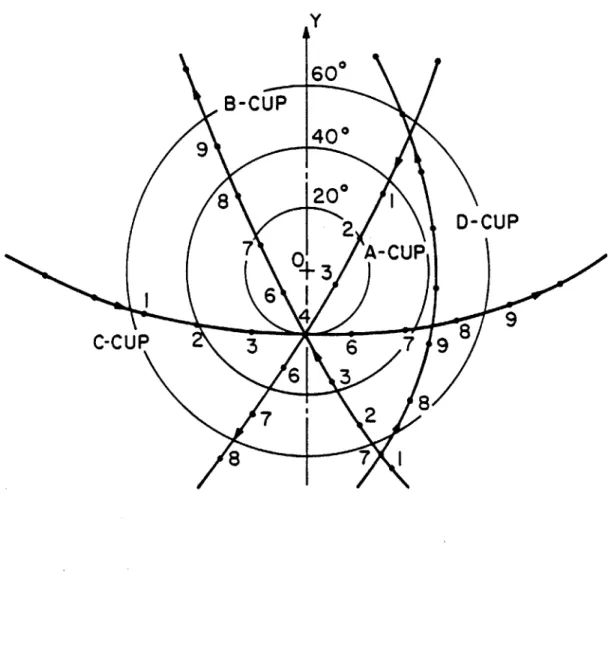
The angular coverage of the cruise maneuver is shown in Figure 3.0, which is a polar plot of a unit vector which points radially away from the
sun. This vector, the nominal solar wind direction, is plotted in cup
coordinates at the times of the start of the M-modes for each of the four
-.
cups. The polar angle 0 and the azimuth angle $ of a vector V are defined
by Equations 3.la and 3.lb
O=cos- (v //e(V2+V2+V2)) 3.1a
z x y z
*=tan (V /V ) 3.lb
y x
where V,, Vy, and Vz are the cartesian components of V. The numbered points in Fig. 3.1 correspond to the spectra which were analyzed as described hereinafter.
3.2 Analysis of Data Taken During the Cruise Maneuver
To test the response function we adopted the following strategy. We analyzed data from all of the orientations for which there were signals in
at least three of the four cups. We then did a simultaneous fit to these data using the "cold" plasma approximation described in Section 2.5. The derived macroscopic plasma parameters were then compared with each other. We also fit an additional spectrum taken when the plasma flow direction was
almost aligned with the main sensor symmetry axis. In this case we expect the "unity" response approximation to be valid. Since we have confidence
in the parameters we derive at these times we can estimate how much the solar wind is changing between the times of the other measurements and see
if the parameters derived from the other measurements stay reasonably
steady. If they are, this fact and the goodness of the fits indicates how well we understand the response function. In addition, comparison of the parameters derived from the fits of the solar wind using the "unity"
fits to these same spectra using the "cold beam" approximation indicate the
systematic error, if any, which the former approximation introduces. Nine spectra taken during the cruise maneuver were analyzed. The numerical integrations in Equation 2.30 were done using Simpson's rule. For a term with velocity threshold vk, we chose a step size of
Avk/10. Since the integrand is formally undefined at vz k, the proper
limiting value of zero was used.
The spectra consist of a background and one or two peaks. The main
peak, due to protons, was fitted. In each cup, about twelve channels around the peak were included. The fits have five parameters; the three
components of bulk velocity in spacecraft coordinates, the density, and the thermal speed. The velocity was then rotated into cup coordinates and the
currents were computed.
The criterion used to define the "best" fit was the minimization of X , defined by
X 2=Z(D.-A) 2/(.o4D )2 3.2
where each of the D i's is the measured current divided by the channel
voltage width and the A. 's are the simulated reduced distribution
functions. The solution to the extremum problem was found using a gradient
search algorithm similar to that described in Bevington (1969). The
derivatives with respect to the velocity components and thermal speed were computed numerically, while the derivative with respect to the density was computed analytically.
The results of the analysis of the cruise maneuver are shown in Table 3.1 and Figures 3.2-3.10. Figure 3.2 corresponds to point 1 in Fig. 3.1,
distribution function versus velocity for the nine spectra used. The data
are represented by the "staircase" while the fit is represented by the smooth curve. Table 3.1 lists the time, the wind velocity in RTN
coordinates, the density, and the thermal speed derived from the fits for each of the spectra. (RTN coordinates are a sun centered orthogonal
system. r points radially away from the sun;
£
lies in a plane parallel to the ecliptic and points in a positive sense when viewed from the North, and n completes a right-handed system.)The variation in these parameters is about what one expects to find in
a quiet solar wind, and the fits are quite good. The fits correctly
reproduce the relative heights, positions, and shapes of the spectra in the oblique cups.
The question of choosing the proper criterion for determining the
"best fit" deserves more discussion. If one chooses to minimize the square
of the difference between the data and the fitting function, there remains the problem of choosing the proper statistical weights. This choice must be made by analyzing the sources of error in the measurement. In our case, there are two main sources of error; electrical noise and digitization
error. Since the logarithm of the currents is digitized, this error is a
fixed percentage of the signal. This accounts for the weight factor of 1/Q.04D2 in Eq. 3.2. The electrical noise is a more difficult problem. We
expect thermal fluctuations in the amplifiers to be seen as fluctuations in
the current. The rms power in these current fluctuations should be about
the same in all of the channels. Since the reduced distribution function is the current divided by the channel width and the channel width increases with increasing channel number, this component of the noise should be most
An example of spectra which we expect to be entirely noise are the
D-cup spectrum in Fig. 3.4 and the lower channels in the main sensor cups in the same figure. The predominately smooth trace is due to the signal
being less than the minimum that can be digitized with our coding scheme; the fluctuations are noise. The predominant smoothness of the curve, especially the lower channels in the B-cup, indicate that the true thermal noise is below the threshold of the detector. We conclude that the noise which we see has another origin. Other sources of noise, such as cosmic
rays or interference with other instruments on the spacecraft, are more difficult to estimate. I have accounted for them in nqr selection of which channels to include in the fits. Unless specifically mentioned, all of the graphs of the results of fits to spectra include all of the data in a
particular spectrum and the simulations for all of the channels used in determining the best fit, and no others.
The question of estimating the uncertainty in the macroscopic plasma parameters derived from the previously described fitting procedure deserves
discussion. The formal uncertainty in the fit parameters is contained in the so-called error matrix. The properties of this matrix are described in Bevington (1969). The uncertainties which I quote throughout the remainder
of this chapter are defined by 2 2
"i =ii X /nf 3.3
where a. is the formal uncertainty in the determination of the i-th parameter, c is the error matrix, and nf is the number of degrees of
freedom (number of data points/number of parameters). In the case of linear parameters and Gaussian statistics, a is simply the standard
deviation one would expect to find in the value of the i-th parameter if the same experiment were done many times.
If the uncertainty in the individual data points can be accurately
2
2
estimated, a2 is simply equal to e. Unfortunately, the values of x we obtained in the fits of the cruise maneuver were sufficiently large to convince us that we had underestimated the uncertainty in the measurement.
The factors which multiply c in Eq. 3.3 are an attempt to compensate for
this underestimate.
In addition to random errors estimated by a, there is always the possibility of some systematic error. There are many possible causes for systematic errors. They can be related to the detector, such as
uncertainty in the values of the threshold voltages, or they can be
related to the plasma itself, such as the presence of suprathermal tails to
the distribution functions or thermal anisotropy. In general, systematic
errors are more difficult to estimate than random errors.
3.3 Discussion and Conclusions
An examination of Table 3.1 shows that the formal errors in the
density and thermal speed are about 3%. In addition, the magnitude of the bulk flow velocity is determined with a precision of less than one percent, and the direction is determined to within 10 arcseconds. We expect that the systematic errors in the determination of these quantities is
considerably larger.
The quality of the fits, even at large angles of incidence, gives us
great confidence in the accuracy of the response function. For example, compare Figures 3.1, 3.la, 3.lb, and 3.5. (The following numbering scheme is used; the spectrum in Figure 3.n was taken when the orientation of the spacecraft was such that the nominal solar wind direction corresponded to