Publisher’s version / Version de l'éditeur:
Vous avez des questions? Nous pouvons vous aider. Pour communiquer directement avec un auteur, consultez la première page de la revue dans laquelle son article a été publié afin de trouver ses coordonnées. Si vous n’arrivez pas à les repérer, communiquez avec nous à [email protected].
Questions? Contact the NRC Publications Archive team at
[email protected]. If you wish to email the authors directly, please see the first page of the publication for their contact information.
https://publications-cnrc.canada.ca/fra/droits
L’accès à ce site Web et l’utilisation de son contenu sont assujettis aux conditions présentées dans le site LISEZ CES CONDITIONS ATTENTIVEMENT AVANT D’UTILISER CE SITE WEB.
BSI 2003 Proceedings, pp. 1-6, 2003-10-01
READ THESE TERMS AND CONDITIONS CAREFULLY BEFORE USING THIS WEBSITE.
https://nrc-publications.canada.ca/eng/copyright
NRC Publications Archive Record / Notice des Archives des publications du CNRC :
https://nrc-publications.canada.ca/eng/view/object/?id=163e3de7-e153-469d-ac8e-5a505b0204b8
https://publications-cnrc.canada.ca/fra/voir/objet/?id=163e3de7-e153-469d-ac8e-5a505b0204b8
NRC Publications Archive
Archives des publications du CNRC
This publication could be one of several versions: author’s original, accepted manuscript or the publisher’s version. / La version de cette publication peut être l’une des suivantes : la version prépublication de l’auteur, la version acceptée du manuscrit ou la version de l’éditeur.
Access and use of this website and the material on it are subject to the Terms and Conditions set forth at
Durability and performance of building envelopes
Durability and performance of building envelopes
Lacasse, M.A.
NRCC-46888
A version of this document is published in / Une version de ce document se trouve dans :
BSI 2003 Proceedings, Oct. 2003, 15 Cities across Canada, pp. 1-6
Introduction
This article reviews important issues for assessing the long-term performance of wall assemblies, focusing on the interrelation between experience, testing and modeling. It presents some basic information related to the function of walls and their performance requirements. It also offers insights into the meaning of durability and establishes links between the effects of environmental loads on walls, the response of the different components and highlights the importance of moisture as the primary agent of deterioration in buildings.
Durability implies satisfactory performance of the basic functions of a wall and its components when subjected to environmental loads and other factors that may have a deteriorating or degrading effect.1
Durability of a material is at times described as if it were a basic property, measured as the length of time it will function adequately.2However, the useful life of a
material or component is always related to the particular combination of environmental factors to which it is subjected, so that durability, or service life, must always be related to the particular conditions involved.2
Different methods can be used to assess the long-term performance of assemblies or components. When an estimate of performance is based on an interpretation of test results, it is always necessary to take into account the differences between the test conditions and those that pertain to the particular applications on the job.3
Understanding the basic principles governing durability, the methods for characterizing the environment and the effects these impose on walls is useful for examining the long-term performance of walls.
The new and innovative products regularly introduced need to be assessed quickly and thoroughly to ensure their long-term performance. Performance assessments follow carefully designated test methods having a specified set of conditions so that meaningful and comparable results can be obtained.3,4
Performance and
Durability Defined
The essential function of exterior walls is to provide a continuous barrier to the exterior environmental conditions and maintain interior conditions consistent with the intended use of the space. By intended use it is recognized that in defining the use of a space, desired indoor conditions may vary. For example, an indoor swimming pool requires different indoor conditions compared to a warehouse.
Whatever the intended use of a space, the basic performance requirements of a wall, as provided in CBD 485(Canadian Building Digest 48), include:
• Structural strength and rigidity, and fire control • Control of noise
• Control of light, solar and other radiation • Control of rain penetration, heat, air and water
vapour flow • Durability
In addition to these requirements, aesthetics and economy are important.
Durability and Performance
of Building Envelopes
by Michael A. Lacasse
Institute for Research in Construction, National Research Council Canada
[email protected]
The performance of the assembly is dependent on the performance of individual wall components. Does this mean the failure of a particular component means failure of the wall system as a whole? A wall has been considered to fail when either the health or safety of occupants is affected. Indeed, the failure of any component that subsequently leads to compromising the health or safety requirements would be significant. It is necessary to understand how both wall components and assemblies respond to the range of climatic conditions to which they will be exposed.
Finally, given that a wall may perform adequately if the individual components perform to an acceptable level, it is essential to ensure continuity of building envelope. Where junctions and penetrations such as windows, ventilation ducts, electrical outlets, and pipes occur, continuity of the envelope must be maintained. The long-term performance of the assembly depends on providing functional details at these vulnerable points of the assembly.
Durability – “Long-Term Performance”
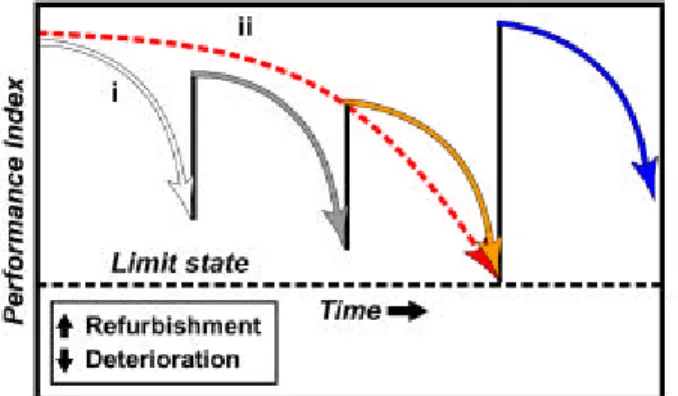
The long-term performance of a material or component is a fundamental performance requirement for walls. But what is meant by long-term performance? Figure 1 shows a performance indicator (index) that diminishes over time for two types of components. The first (i) – for example, sealant deterioration in a joint serving to seal the interface between a window frame and the cladding – is characterised by a rapid rate of deterioration followed by maintenance to restore it to a higher level of expected ‘performance.’ The second (ii) might be the window itself, for which the rate of loss in performance (e.g., watertightness) is
comparatively less pronounced.
Figure 1. Loss of performance over time – effects of deterioration.
There is a limit below which the performance of a component is no longer acceptable, in effect a “limit state.” At this stage (state), the component should be replaced, or refurbished. An increased level of
performance, close to but not that of the initial state, indicates replacement (or refurbishment ã). As shown, the on-going cycle of deterioration and refurbishment continues until the limit state is reached.
This simplistic model illustrates that materials, components and assemblies deteriorate at different rates when subjected to degradative effects (agents of change 6,7). Their
performance level deteriorates to a limit state at which maintenance is no longer practical or possible and replacement is required.
The time frame over which materials and components deteriorate is usually expressed in decades and there are examples of buildings that have met performance requirements for several hundred years. However, some products have a more restricted service life. For example, joint sealants typically require replacement every five to seven years, although certain products have been known to perform adequately for over three decades.
Degradative effects are brought about by different agents including mechanical, thermal, chemical and biological agents. For example, biological agents in the atmosphere can result in the formation of fungi or moulds on the surfaces of certain components. Chemical agents in the form of moisture (liquid water and water vapour) are responsible for corrosion in metals, the efflorescence of salt compounds from porous materials, and the deterioration of concrete by the action of aqueous solutions of sulphate salts. Thermal agents cause dimensional change in all materials, promoting fissuring and cracking. Thermal agents cause heat aging of polymer-based materials (e.g., vinyl cladding and window frames, sealants and gaskets) or subject porous materials to the effects of freeze-thaw action (e.g., stone and brick masonry, mortar).
Mechanical agents such as gravity result in structural loads but also cause rain loads, and kinetic energy contributes to both wind loads as well as rain loads. The degree of deterioration of any given material or component is dependent on the mechanism of deterioration (e.g., corrosion, wood decay, heat aging, freeze-thaw action), the expected response of materials or components to specific in-service loads (dose-response relationship) and the magnitude and duration of the load effect. For example, the degree of heat aging in polymers is dependent on the amount of time a material is above a threshold temperature.
Of all the degradative agents, moisture (atmospheric and rainfall) is particularly important to assessing the long-term performance of wall assemblies.
Characterization of
environmental loads
As stated in the article on “Climate Loads,”8some of the
basic elements of climate (Figure 2) are temperature (T), atmospheric moisture (RH), wind (winds speed - υ) and precipitation (rainfall intensity, RI). These factors have an effect on either the wetting or the drying of building elements, or both. Rainfall and wind characteristics provide a good indication of the wetting potential for a given location, whereas levels of atmospheric moisture affect the drying potential. Outdoor temperature, wind and atmospheric moisture are factors that can contribute to condensation on inside wall surfaces and inside walls.
Figure 2. Effects of climate loads – wind brings about pressure differences across the wall directly related to wind speed (υ). The rate of rain deposition on walls is related to the combined action of rainfall (RI) and the effects of wind.
The characterization of temperatures ranges and extremes, wind and wind pressures, moisture loads (atmospheric and rainfall) is obtained from weather data. A great deal of information can be obtained from the Environment Canada website, which provides a large range of weather records for hundreds of Canadian locations. As well, Appendix C of the National Building Code of Canada provides ready access to certain climatological data referred in the Code.9
The two key climatic factors for assessing a wall assembly’s ability to manage rainwater and control rain penetration are the wetting potential due to rain and drying potential due to atmospheric moisture.
The wetting potential for a location can be estimated from the annual average rainfall. Knowing the intensity,
duration and frequency of rainfall provides a more select measure of rainwater load. Rainfall typically does not occur or very seldom occurs without the action of wind, so the effect of wind-driven rain on the building cladding must be considered.
As might be expected, coastal and maritime climates have noticeably higher wetting potential compared to other regions in Canada.
The evaporative drying potential for Canadian climates is based on values of the vapour pressure deficit.8 That is,
for a given air temperature, the difference between what the atmosphere can potentially retain as compared to that actually retained is the vapour pressure deficit.
Clearly, the ability of walls to dry in coastal and northern regions is low compared to warmer and drier regions of Canada.
Assessing performance
and long-term performance
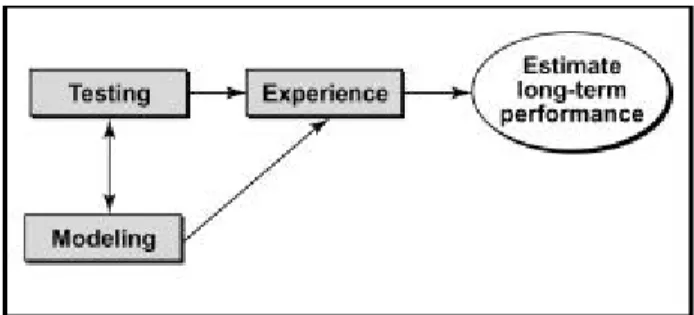
Different means may be used to assess the long-term performance of building components and assemblies. As provided in the CSA Guideline on Durability in Buildings9an estimate of long-term performance (service life) can be based on demonstrated performance (experience), performance testing, or the analysis of results from modeling. The interrelation between long-term performance assessment, testing and modeling and field experience is illustrated in Figure 3.
Results from tests and modeling should be interpreted in light of information gained from in-service performance. Such information might be acquired, for example, through performance audits, maintenance inspections or case studies of failure. This type of information can provide estimates of the long-term performance of components based on predicted in-service conditions.
Figure 3. Interrelation between long-term performance assessment, testing, modeling and field experience.
3
Numerous case studies have been reported over the years related to the performance of external wall cladding (additional information in this area can be obtained from the article on “Rain penetration”10).
Performance assessment
through testing
Performance assessment testing of wall cladding and assemblies include conformance evaluations, as are prescribed by the Canadian Construction Materials Centre (CCMC) for new or innovative products being introduced to the Canadian market. The testing helps to ensure that products or components of the wall assembly conform to technical requirements.
For example, windows must meet the performance requirements for heat loss, air leakage, water penetration and structural strength according to CSA 440, the Canadian standard for window energy performance and installation. The watertightness of wall assemblies and cladding systems is assessed using ASTM E331 Water Penetration of Exterior
Windows, Skylights, Doors, and Curtain Walls. Similarly, there
are standard tests to determine the level of performance of most elements of the building envelope.
Performance testing establishes the degree to which a component or assembly conforms to a level of acceptable performance. It also helps to determine the location of vulnerable points in a wall assembly, the test loads at which anomalies occur, and possibly, to relate the response of the test specimen to specific details or simulated climate effects. Test results may provide useful insights for estimating the long-term performance of products (in combination with in-service conditions and the performance of similar products in the field). Estimating the long-term performance for new or innovative products is challenging given the need to obtain results in a time frame considerably smaller than the expected life of the product. As well, there is a need for test results to provide some measure of adequate performance or risk of premature failure. Understanding the behaviour of component parts of an assembly in relation to the performance of the system is a primary concern when developing performance assessments. This is achieved by assessing products on the basis of their proposed implementation in practice. In this manner, interfaces of adjacent products are delineated, details defined, and in-service conditions estimated. On the basis of results, key elements ensuring long-term performance are recognized.
Performance testing incorporating accelerated techniques can be used when the in-use conditions are known, mechanisms of deterioration are understood, key effects causing deterioration have been identified, and the range of effects (application time and severity) can be adequately simulated in the laboratory. As well, effects applied to a test product should not bring about changes in the product that are unlikely to occur in service. Hence, for accelerated tests to have validity, there must be a reasonable relation between it and the service environment.
Performance assessment
through modeling
Modeling can also be used to simulate the performance response of wall assemblies. The introduction of advanced hygrothermal (hrgro – Gr. water; thermos - Gr.
heat) simulation software with high-speed computers
provides means to determine the hygrothermal response (i.e. changes in moisture content, relative humidity, temperature) in any wall component when subjected to simulated climate loads.
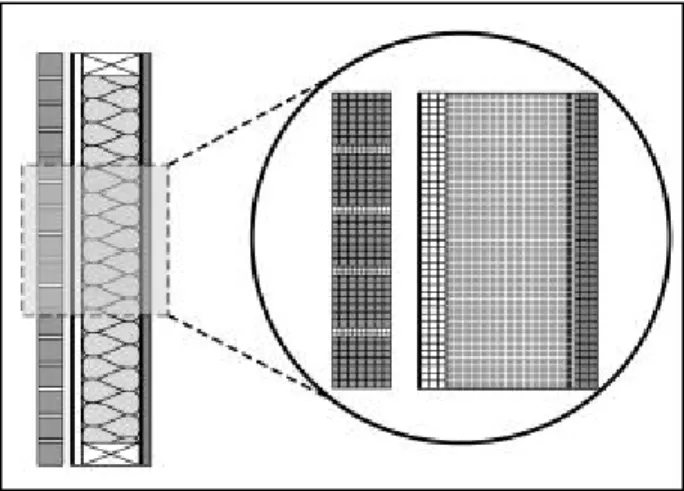
For example, Figure 4 shows a two-dimensional representation of a brick masonry veneer wood-frame wall consisting of the different assembly components arranged in the typical manner. Individual wall components (i.e. products such as brick, mortar, sheathing membrane, sheathing board, insulation, vapour barrier, gypsum board) are represented in the simulation model using discrete elements arranged in an array as shown in the inset. The complete set of physical characteristics for each element is incorporated in the respective layers of the wall.
Figure 4. Two-dimensional schematic representation (not to scale) of a masonry brick veneer wall section prepared for modeling showing the different assembly components. The inset shows a notional representation of the discrete elements that together form the various individual components.
Over the course of a simulation, the hygrothermal response to simulated environmental loads on either side of the wall is known; models can trace the moisture content, relative humidity, temperature in each of the elements within each layer for every hour being simulated. Materials that reach high moisture content, high temperature or both conditions simultaneously can readily be identified. Modeling the response of the wall to the action of climatic loads provides a means for recognizing elements that remain ‘too wet’ for ‘too long.’ The overall significance of this can be determined from an analysis of the complete set of simulation results.
Modeling can extend the results obtained from full-scale laboratory performance tests. The performance response of many different variations in wall assembly can be simulated. Modeling also permits identifying vulnerable materials and key components, and isolating the basic variables affecting the performance of components. The response of various wall assemblies to different climate loads or to inadvertent moisture entry can be assessed. Many different situations that lead to failure can be simulated and the relative performance of different wall components appraised.
In essence, modeling provides another “performance assessment” tool. Ideally, the results of modeling should be interpreted together with knowledge of in-service performance. This typically requires some expertise in designing modeling techniques to evaluate the performance of assemblies. Before applying modeling software, knowledge of modeling precepts, implementation of and limitations to modeling, establishing boundary conditions, simulating load effects and their duration, and interpretation of results, is needed.
Useful insights into the response and performance of wall assembles can readily be derived from the analysis of modeling results provided consideration is given to some basic requirements:
• Knowledge of component functions and interrelation among components. Those components that are key to the long-term performance and most vulnerable to the action of moisture should be identified.
• Characterization of environmental loads.
• Use and implementation of physical models that relate loads, component and system response (and possibly deterioration).
• Establishment of performance limits that relate to response.
The methodology used to assess the response and moisture management performance of wood-frame wall assemblies for North American climate variables using an advanced hygrothermal simulation model developed at the IRC is provided in the article on “Integrated methodology.”11
Summary
Basic information about the function of walls and their performance requirements is presented. The durability of wall components and assemblies is not an inherent property but rather an indication of expected long-term performance when subjected to environmental conditions in service. The effect of environmental loads on wall assemblies is characterized by the action of chemical, mechanical, and other agents of deterioration. These degradation agents bring about a response in the wall assembly materials. For a given mechanism, the degree to which degradation occurs is directly related to the intensity of the agent and the time over which it is applied. Moisture is identified as the primary agent of deterioration in buildings. Therefore it is essential to characterize moisture loads in the form of water vapour or rainwater, its relation to different climates, and the likelihood of occurrence and duration.
Performance assessment, through either testing or modeling, helps to establish the degree to which a component or assembly conforms to a level of acceptable performance. It may provide an estimate of the long-term performance of the assembly. As well, performance assessment may help to determine the location of vulnerable points in a wall assembly, the loads at which anomalies occur, and possibly, to relate the response of the wall to specific details or simulated climate effects. However, results from tests and modeling should be interpreted in combination with information gained from in-service performance.
5
References
1. Legget, R.F. and Hutcheon, N.B., “The Durability of Buildings,” ASTM STP 236, Symposium on Some Approaches to Durability in Structures, ASTM 1958, pp. 35-44, April 1959 (NRCC 4915).
2. Sereda, P.J., Performance of building materials, Canadian Building Digest 115, July 1969, 4 p. 3. Legget, R.F. and Hutcheon, N.B., “Performance
concept in building,” Symposium on Relation of Testing and Service Performance (Atlantic City, NJ, USA, 6/26/66), pp. 84-95, May 01, 1967 (NRCC-9593).
4. Legget, R.F., and Hutcheon, N.B., Performance Testing Standards for Building, Canadian Building Digest 210, pp. 4, December 1979.
5. Hutcheon, N.B., Requirements for Exterior Walls, Canadian Building Digest 48, pp. 5, December 1963. 6. ISO Performance standards in building – contents
and presentation, ISO 6240-1980 (E), ISO Geneva, Switzerland.
7. ISO Performance standards in building – principles for their preparation and factors to be considered, ISO 6241-1984 (E), ISO Geneva, Switzerland. 8. Cornick, S.M. and Rousseau, M.Z., Understanding
the Severity of Climate Loads for Moisture-related Design of Walls, BSI 2003, Building Science Insight Seminar Series, October 2003, 6 p.
9. CSA Guideline on Durability in Buildings, S478-95 (R2001), Canadian Standards Association,
Mississauga, ON, 93 p.
10. Lacasse, M.A., Recent studies on the control of rain penetration in exterior wood-frame walls, BSI 2003, Building Science Insight Seminar Series, October 2003, 6 p.
11. Kumaran, M.K., Mukhopadhyaya, P., Cornick, S.M., Lacasse, M.A., Rousseau, M.Z, Maref, W., Nofal, M., Quirt, J.D. and Dalgliesh, W.A., An Integrated Methodology to Develop Moisture Management Strategies for Exterior Wall Systems, BSI 2003, Building Science Insight Seminar Series, October 2003, 16 p.