HAL Id: hal-00462488
https://hal.univ-cotedazur.fr/hal-00462488
Preprint submitted on 9 Mar 2010HAL is a multi-disciplinary open access archive for the deposit and dissemination of sci-entific research documents, whether they are pub-lished or not. The documents may come from teaching and research institutions in France or abroad, or from public or private research centers.
L’archive ouverte pluridisciplinaire HAL, est destinée au dépôt et à la diffusion de documents scientifiques de niveau recherche, publiés ou non, émanant des établissements d’enseignement et de recherche français ou étrangers, des laboratoires publics ou privés.
Inter-Organizational Controls in Public Land Concession
Contracts
Damien Bo
To cite this version:
Inter-Organizational Controls in Public Land Concession Contracts
Damien BO1
Abstract: Research into the inter-organizational relationship (IOR) is proliferating. In several
social science disciplines, such as economy, strategy, organizational and management research the IOR has become a topic of substantial importance. Accounting researchers have been slow to explore the control mechanisms within IOR but, for some years now, have started to give some attention to it. After introducing the recent works on the subject, this study applies a framework of concrete control modes to the French public-private partnership model: the concession contract. Drawing from a case-study, it highlights the complementarities between formal and informal controls. It also clearly shows the non-linearity of the link between trust and controls.
Keywords : Inter-Organizational Relationships, Control Modes, Trust, Concession Contract
INTRODUCTION
When inter-organizational relationships developed in the business world, research on this subject have been proliferating. Disciplines such as strategy, management, economy and sociology decided IORs was a topic of substantial importance. Due to the different forms of inter-organizational relationships, and therefore all the different contributions linked to it, it has become difficult to make an exhaustive study of the pluridisciplinary literature.
On the other hand accounting researchers have been slow to explore the control mechanism within the IORs. Dumoulin, who was interested in strategic networks in the mid-1990s, notices first of all that the papers dealing with “control” is as a whole disorganized and confused (1996). Then, he tries to explain his point of view showing that the assimilation of control strategy to the governement structures as defined by Williamson (1985), hierarchy, market and hybrid forms overshadowed an in-depth study on the mechanisms of control
1
within these structures (Dumoulin, 1997). The stream of publications on the governance system did not improve the situation.
Since Otley (1994) observed that the scope of management control could no longer be restricted to the boundaries of the organization and Hopwood (1996) called for more explicit contributions to the management of inter-organizational control, studies have been proliferating in Anglo-saxon accounting journals (Frances and Garnsey, 1996; Gietzmann, 1996; Seal and al., 1999; Van der Meer-Kooistra and Vosselman, 2000; Tomkins, 2001; Speckle, 2001; Dekker, 2004; Cooper and Slagmulder, 2004; Anderson and Decker, 2008; special issue of the Management Accounting Research, 2006). These different studies are enriching an approach which was confined to the typology developed by Ouchi (1979, 1980) and are offering a corpus of problems from which it becomes possible to work in a more structured way than before.
The french experience of public-private cooperative interaction is “old, well-known and
diversified” (Martinand, 1993, p.1). Within this diversity, the concession contract is the
reference. The definition of concession was given by the government auditor of the Chardenet government:
“It is the contract by which an individual or a company has to perform a public work or a public utility, at its own expenses, with or without subsidies, with or without interest guarantees and which is paid by being given the use of the public work or utility, they have the right to collect money from the users or those who take advantage of the public utilities.”
West (2005) points out that the informal and non-contractual control, which is characteristic of the public-private cooperative interaction in France is progressively replaced by a formal and contractual control, in keeping, without quoting it, with the analyses of the English case suggested by Broadbent and Laughlin (2003).
Using the recent theoretical corpus of inter-organizational management control system and more precisely the analysis framework provided by Dekker (2004), this study is exploring the relationships between the different control modes through the case of a concession of public land and particularly, if formal mechanisms really dismiss informal mechanisms or if they can be combined as explained by the “theory of complementarity” suggested by Guibert and Dupuy (1997).
1. The control of inter-organizational relationships
When neo-classical market exchange, or spot exchange, is abandoned, some forms of organizational relationships are created, either in the form of hierarchical governance referring to a company, or in the form of hybrid governance. The controls of inter-organizational relationships have for a long time been assimilated to these forms of governance, but lately, concrete control pratices are more precisely analysed.
1.1 Assimilation of control modes to governance structures: the legacy of the transaction cost theory.
Ronald Coase’s observation (1937) has given rise to a research on organizational relationships. His question is the following: why do firms exist if market mechanisms are so perfect? Coase’s hypothesis is that it is costly to resort to the market. The cost is principally set up by the research of a co-contracting and by the negotiation process for the terms of the contract. After him, Williamson (1979) classifies transaction costs in two categories, ex-ante costs and ex-post costs: adverse selection and moral hazard.
These costs stem from several hypothesis concening the economic agents’ characteristics. Bounded rationality is central to the transaction cost study (Williamson, 1983, p.352). This concept, which was developed first by Simon in 1957, is opposed to the rationality developed in traditional economic models. If we take into consideration that individuals do not have the cognitive capacity to deal with all the factual information in the entire world, they will necessarily make sub-optimal choices. Indeed, rather than optimizing, the economic agent is looking for a satisfactory situation. The adverse selection springs from this hypothesis. Acording to Williamson: “[bounded rationality] is useful till where it leads us to, but it’s not
leading us far enough” (1983, p.354). On top of bounded rationality, he gives the economic
agent opportunism which is the research of personal interest but which also allows a very subtle and even deviant form of behaviour: the reseach of personal interest using trickery
(ibid.).
These discrete alternative governance structures allow to frame a transaction: hierarchy, market and hybrid form (Williamson, 1991). It is the governance structure which minimizes the transaction costs that is going to be chosen. These costs depend on the characteristics of
the transaction: assets specificity, uncertainty and frequency. Many authors notice that it is difficult to apply contractual theories, such as the economy of transaction costs or the agency theory, studying concrete process of control (Bouquin, 2005; Tiéry-Dubuisson, 2005). The observation sometimes comes from theorists being part of this movement. (Baiman, 1982; 1990). “Both theories, agency and transaction, seem to suffer from the same limit. It is due to
the fact that it is using an economics paradigm, the cost, which is at the same time simple and woolly (...) to give an account of a phenomenon which is undeniably complex.” (Bouquin,
2005, p. 181). Nevertheless, in a recent study, Speklé (2001) provided a complete analysis of control modes based on the contribution of the Transaction Costs Theory (TCT).
1.2 An exploration of contol modes on the TCT bases.
The most important attempt of the exploration of the explanatory potential of transaction costs to understand the control modes comes from Speklé (2001). The latter is using it to explain the variety of control modes within governance structures. Drawing his ideas from Ouchi, Speklé uses the notion of “archetypal” control: “a detailed and discrete shape of the control
system which represents in a descriptive and theoretical way a significant group of practices and observable control structures.” (2001, p. 427). Theses archetypes are considered to be
optimal solutions to different problems of control associated to specific activities categories. The categories are defined from Williamson’s concepts: programmability/predictability, asset specificity and ex-post information asymmetry.
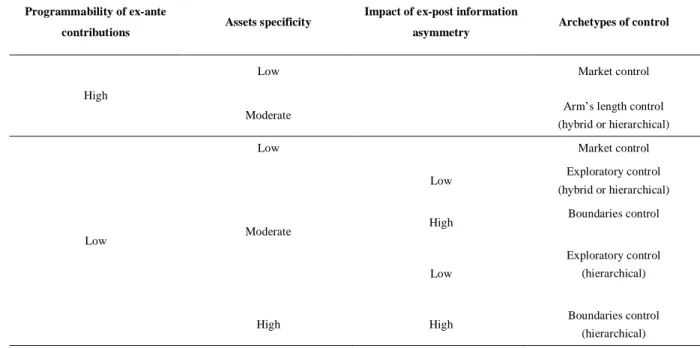
Speklé ends up by identifying 5 control archetypes: market control, machine control, arm’s length control, boundary control and exploratory control (e.g. Table 1).
Market control actually corresponds to market governance and therefore, according to him, this category is beyond management accounting control. (2001, p.429). It allows controlling activities in which assets are generic and therefore in which the behaviour of the contracting is regulated by competition.
Table 1. Archetypes of control management and their habitat in a transaction cost approach (Speklé, 2001, p.436)
Programmability of ex-ante
contributions Assets specificity
Impact of ex-post information
asymmetry Archetypes of control
High
Low Market control
Moderate Arm’s length control
(hybrid or hierarchical)
Low
Low Market control
Moderate
Low Exploratory control
(hybrid or hierarchical)
High Boundaries control
Low
Exploratory control (hierarchical)
High High Boundaries control
(hierarchical)
Machine control is efficient to control activities endowed with very specific assets but which are evolving in a certain environment, thus programmable. It is the specificity of assets which prevents the need of the market. This archetype actually refers to hierarchical governance structure. It is expressed by the implementation of rules and norms, the control of the respect of rules, and a system of negative and positive outcome regarding the importance of obedience.
In between the two extreme assets specificity, the three others control archetypes can be found whose pratices and modes are using market and hierachical mechanisms together. These archetypes can be indifferently attached to governance structures of firm or hybrid form.
Arm’s length control can therefore take the form of “anti-hostage taking” arrangements in hybrid forms with contractual implementation, thus ex-ante, for instance, in the payment by a partner, counterbalancing the investment of resources in non recoverable investments by the other. If these types of arrangements cannot be found, therefore arm’s length control of a hierachical nature is implemented. The latter imports market mechanisms within the
boundaries of an organization. This can, for example, be the result of an almost autonomous service manager whose performances are compared to those of his competitors (Market-based
benchmarking.)
In the case of non-programmable activities, Speklé introduces a new dimension to characterize the activities and therefore deciding the optimal control mode: the asymmetrical information impact level (2001, p.430). If this level is moderate thus an exploratory control is implemented. To find a solution for initial limited information, co-contracting is encouraged to share information and use it as soon as it comes out during the process. Exploratory control arrangements are very informal, there are few explicit rules and individual responsibilities are hardly defined. Speklé does not give precise examples to illustrate this archetype, but the implementation of knowledge management structures seem to fit.
Boundaries control is chosen in case of “very high levels impacts of ex-post information.” (p. 435). As it is very difficult to define the awaited performance before as well as after the contract, codes of conduct or ethics are implemented, defining undesirable behaviour and activities. Machine control defines “what should be done” and boundary control “what should not be done”. Examples of control management are given by Speklé (2001) but also Simons (1995). They notably quote the implementation of a budget with maximum line of expenses, or a code of conduct of a bank which forbids his employees to develop relationships with “forbidden” industries like gambling.
Speklé’s study enables to have a more precise approach of concrete mechanisms of control. It is nevertheless dependent on the limits characteristic of transaction costs approach. In a perspective of control, these limits are essentially on the one hand, the fact of not taking into account the dynamic value creation and on the other hand, the refusal of the trust concept outside the analysis.
Even if Williamson (1999) admits that inter-organizational relationships’ main goal is not to minimize transaction costs, he insists on the fact that it is their main function. However, “being interested in transaction costs only(...) is likely to hide rather than to reveal” (Osborn and Hagedoorn, 1997, p.274). Indeed, as Burlaud and al. emphasized: “From the moment
when value creation finality tends to become shared by all companies, accounting management has no other choice but to integrate this constraint for fear of disappearing”
of transaction costs economy, the structure control which is minimizing the cost is not exactly the one which maximizes the total value created. Beyond a certain level of control, the contract is destoying value. Pendergast (1999) takes the example of a sportsman to illustrate this hypothesis: Ken O’Brien contract, a football player in the mid 1980’s. As O’ Brien was used to make a lot of intercepted passes, the contract stipulated that undergone interceptions would be controlled and punished. Unsurprisingly, O’Brien attempted few passes during the season, even in situations when he should have done it, causing the decline of his reputation and above all, the performance of his team.
Another theoretical absence in Williamson’s study is trust. It certainly is the most disputable concept between pros and cons of the transaction costs theory (Granovetter, 1985; Powell, 1990; Ghoshal and Moran, 1996). As far as Williamson is concerned (1993), governance structures are decided by rational actors in order to minimize behavioral risks. Therefore, if they accept those risks without implementing control structures it is not a question of trust but the acceptance of a calculated risk (Van der Meer-Kooistra and Vosselman, 2006).
The next part of the present study introduces the latest advances made in inter-organizational relationships. On the one hand these works aim at combining an explanation of control modes from a TCT perspective but also from a value creation one. On the other hand, it allows a non-lineary approach of trust even if on this concept authors did not achieve a concensus yet.
1.3 Beyond transaction costs theory
Dekker (2004) notices that if control modes typologies coming from the theoretical register of transaction costs are incomplete, it is because it settles appropriation concerns of value but not the coordination requirements which are necessary to the creation of it. Thus he suggests the double reading of formal and informal control mechanisms.
1.3.1 A typology of control modes
The formal control is gathering contractual obligations and organizational control mechanisms. The latter can be divided into two categories: outcome control and behaviour control (Ouchi, 1979). Informal control, sometimes called social control or rational governance, refers to a system of tacit rules such as culture, influencing individuals through selfregulation mechanisms. (ibid.)
Outcome control mechanisms specify ex-ante the goals to achieve and the system of positive or negative punishments according to the achievement point of the latter. They are based on a monitoring system of performance indicators or balanced scorecard type. Formal behaviour control mechanisms consist in implementing explicit behaviour rules. Within this framework,
ex-ante mechanisms are: planning, rules and standard operation procedures or else procedures
of solving conflicts (Gulati and Singh, 1998). Ex-post control elements can be cost, quality, audit or else credit for legal hazards (Das and Teng, 1998).
Informal control mechanisms are associated to “the existence and game of transversal
relationships which can evolve and are very often implicit between the actors and the parts of the organization, face to the emergence of new or ill-structured problems.” (Guibert and
Dupuy, 1997, p.40). The result is frequent interactions between the actors and the creation of social networks, the joint solving of problems and the unsupervised risks taking within the contract by each partner of the exchange.
On the theoretical plan, as Guibert and Dupuy (1997) remind us, two cantradictory hypothesis can be envisaged on the relationships between formal and informal control. The first states a subsitution logic between the two, the formal control tending to dismiss the informal one and inversely. The second lays on the complementarity principle. According to the latter, “the
development of formal control cannot act along the cohesion sense only if a perspective with informal control can complete it and vice versa.” (Guibert and Dupuy, 1997, p.40). This
relation will be the first exploration line of the following case study. The second concept which is going to be studied will be trust and more particularly its link with control mechanisms in inter-organizational relationships.
1.3.2 A non-linear relationships between trust and controls
Trust and informal control concepts are too often mistaken (Broadbent and Laughlin, 2003; Dekker, 2004; West, 2005). In accordance with Guibert and Dupuy (1997), it seems important to make a clear distinction between the two concepts. Indeed, the implementation of informal control mechanisms is increasing the cohesion between the actors and therefore an aspect of trust. But judging in advance that trust disappears with formal control mechanisms corresponds to make a shortcut which is not generally based on empirical proof and sometimes to the limits of ideology. Seal thus shows how the opponents of the neo-classical movement eventually associate contract and liberalism forgetting entire parts of the legal analysis of the contract, notably its “empowering and liberating” role (2004, p.331).
In a general way, the relationship between trust and control turns out to be complex (Van der Meer –Kooistra and Vosselmen, 2006). Four attitudes are to be distinguished in what we called the new theoretical corpus of inter-organizational control.
The first consists in considering the structures and control practices themselves holding trust. When implemented, if they are trustworthy, actors only have to tackle the shares of the profits or the interests adjustments. (Mouritsen and Thrane, 2006).
The second position is that controls help to build up trust. Tomkins (2001) agrees with an argument displayed by Guibert and Dupuy (1997). The share of information is made easier by control mechanisms and would create positive anticipations on future contributions to the relationships and thus would increase trust between the partners.
The most ancient and shared position, that we have already presented, is to consider that trust is an alternative to control structures. This position leads to confuse trust and informal controls. It is totally in keeping with a critic of the transaction costs model.
Finally, the fourth position, which is in particular stood up for by Cooper and Slagmulder (2004) is that trust is a sine qua none condition in order to socially build up practices and control structures. These authors notably show how it is necessary when you use control techniques of transversal costs in a partnership with a supplier.
Some authors have already pointed out, and even proven, the complementary aspect of informal and formal mechanisms (Ouchi, 1979 and 1980; Guibert and Dupuy, 1997). But these authors confessed they didn’t have as an analysis framework a precise typology of control mechanisms. Using the two proposed theories, we are going to explore the links between the three general concepts: formal and informal control and trust. We are going to make the distinction between the different modes of the first two and study the links drawn with trust.
2. Study of a public land concession contract
2.1 Research method
The exploration of theoretical concepts was made through a study of an exploratory study case (Yin, 1994). During a so called qualitative research, the researcher will have an approach of “methodological fiddling” (Giordano, 2003), mixing the sources and the methods of empirical data gathering. The researcher will generally have an inductive approach even if deductive is not excluded. The present case study is based on two years of observation in the tradition of English anthropological works of the fieldwork type. It means an unconditional and often long presence on the places of the enquiry.
This enabled first to have an illimited access to all the documents related to the marina management, the legal obligation to keep all the documents until the concession is over being a valuable help, then the long immersion allows to apprehend informal relationships. This observation was completed by semi-structured interviews with key actors.
2.2 The case of a marina
Marinas in France
Before the mid 1960s there were no structures specifically dedicated to yachting. Boats were generally on individual anchorages implemented by sailors themselves or in fishing or commercial harbours where their presence was hardly approved of. This absence of structure can be explained by the confidentiality of yachting since it appeared in England; as a luxury sports, it only concerned a small part of the aristocratic society. With the booming of leisure-oriented activities and the evolution of techniques of production in the 1960s, yachting activities exploded.
Seaside resorts quickly realised the benefits they could draw from this booming activity. The first harbour entirely dedicated to yachting was born in 1964 thanks to private funds: the
Pierre Canto marina, in Cannes, from the name of its developer. This first initiative
announced fifteen years of intense collaboration between the state services and private developers to increase the offers of marinas. Today, there are about 250 marinas. If we add anchorages which benefit from a temporary occupation authorization and wild anchorage, we reach a total offer of 223,000 sites on the coast in France.
The French Yachting Federation has a 150 million euros turnover, whereas the French Water sports industry Federation, which represents 1,200 companies declares providing 8,500 jobs and a 1.5 billion Euros turnover. The last criterion places France in the first position in Europe and second in the world.
The public land concession contract
The public seashore is inalienable, imprescriptibly and non-transferable. All occupation of the first band of land on the seaside is regulated by administrative authorization. The regulation bases of this occupation dates back from the 30th of June 1539 edict of François the First. This public land is composed of two sub-sets. The first, which is natural, consists of shores, land and subsoil of the territorial sea, natural harbour, haven and salted pond in communication with the sea. The second, which is artificial, is composed of shipping harbour as well as protection against the sea works.
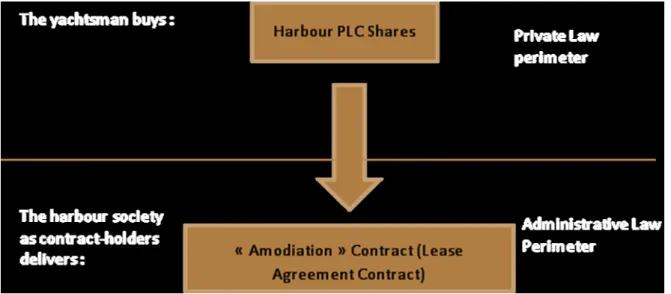
In this framework, many different occupation titles exist from the simple temporary occupation decree to the concession. Marinas concessions were established for long period, often for 50 years. Concerning the funding of yachting harbours by PLCs, the building of harbours through the subscription of shares allowed shareholders to obtain a possession right to occupy a plot of the public field harbour. To confirm this right of use of the public field an lease agreement contract has to be given by the contract-holder, subject to the approval of the mayor (figure 1).
The strict definition of the concession calls for fundamental precisions that we have to expose, in order to distinguish it from derivated processes. Three points have to be gathered for a concession to be created stricto sensu:
- the contract-holder has to advance the fees for the first installation of the service ( installation, goods). The concession is doubled by a civil engineering one if there is a building of works necessary to the exploitation;
- the contracty-holder has to exploit the service for the whole duration of the concession “at his own risks”, managing it, funding and monitoring at his own expenses the works and tools which have to go back to the contractor authority at the expiration of the concession;
- the contract-holder has to be paid by direct perception of fees on users, those fees have to enable him to make profits for himself.
The system of concession is dominated by the necessity to combine two principles which can at first sight seem contradictory: on the one hand, a public administration submitted to the general interest imperatives and on the other hand, a private contract-holder which is managing it, motivated by his own interest. The concession contract is thus composed of a set of regulation clauses which determines rules of organisation and operation of the service and financial contractual measures which guarantee the contract-holder his remuneration according to the principle of financial balance peculiar to all administrative contracts.
The contract-holder has therefore to ensure the running of the public service and in the case of a concession of civil engineering, the building of works, in the conditions predicted in the schedule of conditions. The licensor authority is diposing of a technical and financial control power and can modify the organisation of the service to adapt it to the general interest. The exploitation of the granted service allows the collection of fees on the users, and the rates have to be approved of by the licensor. The concessionary can also take advantage of the financial balance principle of the contract to be compensated for extra costs imposed by the licensor (theory of the Fait du Prince) or to face an exceptional cost (unpredictable theory). The contentious of the concession act is a matter for administrative law. The disputes which can oppose the contract-holder or the users to the licensor authority is within the competence of an administrative magistrate because one of the contracting part is an individual. The concession should end up when the contract expires but it can be renewed. The concession
can also end up before if there is a deprivation, or a contractual clause of takeover or a loss against the occupier, who is not respecting his commitments and who deprives him definitely and with no compensation of the rights he had from the contract.
The marina concessions are governed by two decrees: Decree n°69 of 29 December 1965 and Decree n° 81-22/2/5 of 19 March 1981. Both texts establish a standard schedule of conditions that collectivities applied even after the decentalization laws. In the latter, control is provided for in article 31: “The exploitation of works and tools conceded and carried out under the
aegis of the authority in charge of the control; the latter can prescribe when it seems to be useful, administrative, technical or financial controls.” Whereas, as far as accounting is
concerned, article 43 makes provision for: “ the contract-holder gives to the conceding
authority, in the prescribed forms by the latter, the balance sheet, the exploitation account, the profit and loss account, the capital operation financing account, established for the previous fiscal year.” It is during harbours councils that the essential of the formal control of
a marina takes place. This was the chosen object of the observations for this study.
The marina board
The marina board is an advisory institution governed in its functions, its composition and its functioning regulations by articles R.621-1 to R. 623-4 of the maritime harbours code.
“The harbour board is able to express opinions, in the conditions provided for
by the present Code, on the habour business which concerns individuals implied in its administration.”
It has in particular to be referred to the administrative delimitation of the harbour, the projected budget of the harbour and the propositions of aid funds, the rates and the harbour rights, the concession amendments, the new concessions and the exploitation sub-treatise, the new works projects, and finally, the particular police regulation. The members of the board are elected for five years by the Mayor’s order who is heading it.
The studied case
The marina which is studied is located in a city of around 3,000 inhabitants in the French Riviera. The population of the sea resort doubles during the summer period. The capacity is around 800 boats but like all marinas, the frequenting is more due to strollers rather than
yachtsmen. That’s why the marina promotion is more and more based on entertainment. The marina is managed by a PLC. The president of the marina society is a yachtsman and represents the society at the harbour board. The mayor elected one year ago is at the head of the harbour board. The entertainment on the marina is the mayor’s main objective. He often repeats during the harbour board:
“It is not a city and a marina; it is a city which has a marina.”
He would like the harbour society to consider the infrastructure as a district. Entertainment is also the only activity in which an efficient cooperation between the city and the society is necessary. The effect of this cooperation in fact is joint investments in communication, coordination meetings dedicated to the lending of equipment and personel for the entertainment days. The basic harbour service does not need such coordination.
2.3 Results
2.3.1. Formal control mechanisms
Market control
Speklé (2001) excludes that control emanating from a competition or market mechanism, can be considered in the management control panorama.
Nevertheless, the more or less convincing threat of this mechanism implementation constitues a certain form of control. If marinas were for a long time spared by concession contract challenge, a great number of takeovers or losses have occurred for the last 10 years (Saint-Laurent-du-Var, Port Canto, Théoule-sur-mer). During a lively negotiation on an infrastructure investment, the legal offices of the Ministry of the Environment, reminds:
“It is true that in case of a takeover, the calculation scale is interesting for the
city which can have the marina for next to nothing.”
Shareholders are therefore trapped in a Williamsonian hold-up case in which a unconvertible investment is asked to them to continue the relationship but in which the investment can be lost during the year in case of a loss with no guarantees. Indeed the Ministry of the Environment assumes that only a gentleman agreement is possible:
“The commitments can only bind the elected Mayor.”
Facing this threat of resorting to market mechanisms, shareholders tend to take refuge behind the specifications which have not evolved since 1965 and which does not anticipate the necessary investments to the maintenance of a modern maritime harbour service (for example, the electricity needed for an anchorage was multiplied by ten in intensity with the development of inboard electronics: heating, air conditioning, television, etc.)
Contract control
Confronted to this absence of modernization of the contractual backup, the Mayor reminds:
“The Harbour Society benefits from user rights and not ownership.”
The evolution of a type of schedule conditions is generally reduced. A statistics survey carried out in the course of our PhD work, showed that 29 marinas concession out of 41 added no amendments to the initial contract. As far as the Beaulieu-sur-mer marina is concerned, 7 amendments were added and one during our observations. The latter concerned a means of access to a towing dock saturated by the users of new yachting practising. Thus the contract is not seen as a means to impose extra controls but as the achievement of a partnership in order to solve new problems that ocured in the environment. This mechanism therefore asked for a minimal trust initial level so that all partners collborate. Furthermore, it has been a trust production source since here the amendment to the contract seems to be a shared solving problem of which Dekker already showed the positive effect on relationaships trust. The role of the contract therefore is double: destroying the relationship between partners when shareholders rely on it in order not to carry out modernization expenses, it conveys trust when partners alter it to face new situations. But the matter which was the most dealt with between the actors during the two years of observation is the implementation of individual occupation authorizations of the public land: “amodiation”contracts.
Control through legal regulation
The term contract is misleading because it only refers to an administrative procedure aiming at supervizing the occupation of the public land. “Amodiation” contracts were implemented only 30 years after the building of the first marina. The evolution of marinas from “harbour
park to touristic products” (Bernard, 1998) caused the multiplication of side activities on the
maritime public land. This intensification of the business interest for the domain caused a recall of the regulation by the tribunal dealing with internal disputes in the French civil service to the State services. The latter recommended standardization in all harbours, as they themselves pointed out:
“Concerning legal problems, until 31 December 1983, the legal offices of the Ministry of the Environment, we were happy to build harbours; we did not deal with law problems. Today, there’s a reminder from the part of the two departments, Infrastructure and Treasury, to update things within the law. Today society is developing, litigations indeed occur, these disputes show that we have to be immune on the legal level.”
This reminder of the legal law where there only was a more informal regulation is destroying trust between the partners. When the effective implementation of contracts, a shareholder accuses:
“The Sate was not equal to the task when not demanding the respect of the law concerning Amodiation contracts.”
In this case, the contract recalls, or makes shareholders aware of their precarious status and therefore shakes the threat of market control. Yet, it is not an administrative act which ratifies an already existing legal situation.
Other formal control mechanisms
At the beginning of our observations, very few information were produced at the Harbour Board. The expected controls in the schedule conditions were as a consequence not carried out. Only the elements which should be voted by this advisory body were published: rates, building plans. Progressively, controls were implemented. It started with behaviour control: projected budget and training schedule. Then a new step took the project to a new level when the managing team of the marina get committed in a dual certification procedure in accordance with ISO 9 001 and ISO 14 001 norms. This dual certification not only strenghten the behaviour control, by implementing standardized procedures but also enables a control of the results since from then on the indicators of the follow-up improvement were published,
notably the result of client satisfaction surveys. This implementation of extra controls was made with no offence of the link between partners. The commitment in the certification, decided by the contract-holder, was exclusively motivated by the harbour manager as a means to prove the delegated authority the good management of the harbour. We need to recall here that the French Riviera marinas are saturated and therefore have no problems to find personal customers. Formal control mechanisms which are implemented seem to be a means to strenghten trust and thus be protected against market threat. But trust also builds itself through more informal mechanisms.
2.3.2 Trust and informal control mechanisms.
We have already seen that trust is necessary to the implementation of formal controls and this implementation strenghten it. As the Mayor commented:
“It is established on duties respect of everyone, respect of the
specifications on the part of the contract-holder and respect of management of the contract-holder, the fact of not interferring in the marina business on the part of the conceding authority each time there is a problem that occurred.”
But trust is above all a relationship between two persons rather than between two organizations:
“It is first between the one that presides over the marina business, the president, and the one that presides over the city district, notably the Mayor. So trust is to be built on a human relationship.”
And the latter cannot be decided, it is built little by little through informal mechanisms:
“Trust emanates from an open debate, good relationships, communication between them and us, or to be more precise him and me. Does it work correctly? It is working better today because we know each other better, because we dealt with a great number of things together.”
The bond between formal and informal controls and trust is not linear and reduced to great concepts. In the studied case, only the menace of the market damaged the bond between partners. It was not possible to check if too many controls, formal or informal, came up with
damaging the partners relationships since I was able to examine only one context in which mechanisms are implemented where nothing existed before.
CONCLUSION
Contrary to West argument (2005) on the evolution of public-private partnerships in France, informal mechanisms are not, in the studied case, replaced by contractual mechanisms but the increased reminder to the supervision of the law regulation. The control by legal regulation seems to hush up the other modes of control including contractual ones. Not escaping from bureaucratic excesses, control by public actors aims at freeing them from their responsibilitiy. This phenomenon intensified because of the increasing legal procedures of our society.The dynamic of the contract as well as formal behaviour or results control mechanisms generally are the expression of collaboration between public and private partners and therefore the expression of reciprocal trust and trust mechanism. Mechanisms which destroy trust seem to be those concerning strictly speaking market mechanism (that is to say the threat of a competition thus of a destruction of the contract). Nevertheless, in some cases, the contract can also play a negative role for the relationships. By its temporal rooting it is the base for the legitimization to the necessary resistance to the evolution. In short, the role of the contract depends on what the actors do of it, and it is neither an omnipotent solution, nor a destructive tool of human relationships.
Finally, trust, based on informal interaction mechanisms between actors, is beneficial to the relationship but appears to be unstable since it is bounded to persons and not organizations. The present case study enables to clarify concepts and shed light on the bonds between formal control and trust in particular, that literature does not tackle or in a general way where different modalities and practices have to be distinguished. Yet, this exploratory procedures call for several extensions. First, it would mean to convey quantitatively the different concepts in a sample of varied public-private partnerships, integrating important delegated industries in particular such as water, electricity or waste industries. This range would allow to compare industries in which balance of power between contract-holder and conceding authority would
be various. It would also be necessary to be able to measure the impact of interorganizational control on performance. Studies could with this in mind rely on works in which models of performance were detailed. For example, we could apply the theoretical framework suggested by Ménard and Saussier works (2003) on water supply delegation. Finally, it would mean to go outside the analysis of the public-private context in order to measure which resorts to a public specificity and which resorts to a more general bond between interorganizational control mechanisms, trust and performance.
REFERENCES
ANDERSON,S.W. and DEKKER, H.C. (2005), “Management control for market transactions: the relation between transaction characteristics, incomplete contract design and subsequent performance”, Management Science, vol. 51, pp. 1734-1753.
BAIMAN, S. (1982), “Agency research in managerial accounting: a survey”, Journal of
Accounting Literature, vol. 1, pp. 154-213.
BAIMAN,S. (1990), “Agency research in managerial accounting: a second look”, Accounting,
Organizations and Society, vol. 15, n°4, pp. 341-371.
BERNARD, N. (1999), “From parking lot to touristic product: evolution of French yachting harbours”, Norois, tome 46, n°182, pp. 275-285.
BOUQUIN,H. (2005), “William G. Ouchi : from control to Z theory, a conceptual framework”,
in BOUQUIN,H. (Dir.), Les Grands Auteurs en Contrôle de Gestion, EMS, pp. 173-186.
BRADACH, J.L. and ECCLES, R.G. (1989), “Markets versus hierarchies: from ideal types to
plural forms” in SCOTT, R.W. (dir.), Annual Review of Sociology, Palo Alto, CA: Annual Reviews, pp. 97-118.
BROADBENT, J. and LAUGHLIN, R. (2003), “Control and legitimation in government accountability processes: the private finance initiative in the UK”, Critical Perspective on
Accounting, vol. 14, pp. 23-48.
BURLAUD, A., TELLER, R., CHATELAIN-PONROY, S., MIGNON, S. and WALLISER, E. (2004),
Contrôle de Gestion, Vuibert.
COOPER, R. And SLAGMULDER, R. (2004), “Interorganizational cost management and relational context”, Accounting, Organizations and Society, vol. 29, pp. 1-26.
DAS, T.K. and TENG, B.S. (1998), “Between trust and control : developing confidence in partner cooperation alliances”, Academy of Management Review, vol. 23, pp. 491-512.
DEKKER, H.C. (2004), “Control of inter-organizational relationships : evidence on
appropriation concerns and coordination requirements”, Accounting, Organizations and
Society, vol. 29, pp. 27-49.
DUMOULIN, R. (1996), Control system design in interorganizational networks, Thèse de doctorat, IAE de Lille.
DUMOULIN,R. (1997), “Market, Bureaucracy and clans in strategic networks”, Comptabilité-
Contrôle- Audit, tome 3, vol. 2, September, pp. 45-58.
FRANCES, J.and GARNSEY,E. (1996), “Supermarkets and suppliers in the United Kingdom:
system integration, information and control”, Accounting, Organizations and Society, vol. 21, pp. 591-610.
GHOSHAL,S.andMORAN,P. (1996), “Bad for practice: a critique of transaction cost theory”,
Academy of Management Review, vol. 21, pp. 13-47.
GIETZMANN,M.B. (1996), “Incomplete contracts and the make or buy decision: governance design and attainable flexibility”, Accounting, Organizations and Society, vol. 21, pp. 611-626.
GIORDANO, Y. (2003), “Qualitative research specificities”, in GIORDANO, Y. (dir.), Conduire
un projet de recherche, EMS, pp. 12-39.
GRANOVETTER, M. (1985), “Economic action and social structure: the problem of
embeddedness”, American Journal of Sociology, n° 91, novembre, pp. 481-501.
GUIBERT, N. and DUPUY, Y. (1997), “Complementarities between formal and informal controls: case of client-supplier relationship”, Comptabilité- Contrôle- Audit, tome 3, vol. 1, mars, pp. 39-52.
GULATI,R. andSINGH,H. (1998), “The architecture of cooperation : managing coordination costs and appropriation concerns in strategic alliances”, Administrative Science Quarterly, vol. 43, pp. 781-814.
HOPWOOD,H.G.(1996), “Looking across rather than up and down : on the need to explore the
lateral processing of information”, Accounting, Organizations and Society, vol. 21, pp. 589-590.
MARTINAND, C. (1993), « Préface » in MARTINAND, C., (dir.), L’Expérience Française du Financement Privé des Equipements Publics, Economica, pp. 13-43.
MÉNARD,C. etSAUSSIER,S. (2003) “Public Service delegation as an efficient organizational
mode for water supply in France : Theories and empirical evidences” Economie Publique, vol. 12, pp. 99-129.
MOURITSEN, J. and THRANE, S. (2006), “Accounting, network complementarities and the development of inter-organizational relations”, Accounting, Organizations and Society, vol. 31, pp. 241-275.
OSBORN, R.N. and HAGEDOORN, J. (1997), “The institutionalization and evolutionary dynamics of interorganizational alliance and networks”, Academy of Management Journal, vol. 40, pp. 261-278.
OTLEY,D.T. (1994), “Management control in contemporary organizations : towards a wider
framework”, Management Accounting Research, vol. 5, pp.289-299.
OUCHI, W.G. (1979), “A conceptual framework for the design of organizational control mechanisms”, Management Science, vol. 25, n°9, pp. 833-848.
OUCHI, W.G. (1980), “Markets, bureaucracies and clans”, Administrative Science Quaterly, vol. 25, n°1, pp.129-141.
POWELL, W.W. (1990), “Neither market nor hierarchy : networks forms of organization”,
Research in Organizational Behavior, vol. 12, pp. 295-336.
PRENDERGAST, C. (1999), “The provision of incentives in firms”, Journal of Economic
Literature, vol. 37, pp. 7-63.
SEAL,W.,CULLEN,J., DUNLOP,A., BERRY,T.et AHMED,M. (1999), “Enacting a European
supply chain : a case study on the role of management accounting”, Management Accounting
Research, vol. 10, pp. 303-322.
SEAL, W. (2004), “Towards an enabling research agenda for the accounting/contracting nexus”, Accounting Forum, vol. 28, pp. 329-348.
SIMONS, R., (1995), Levers of Control : How Managers Use Innovative Control Systems to
Drive Strategic Renewal , Boston, Harvard Business School Press.
SPEKLÉ, R. (2001), “Explaining management control structure variety : a transaction cost
economics perspective”, Accounting, Organizations and Society, vol. 26, pp. 161-191.
THIÉRY-DUBUISSON, S. (2005), “Stanley Baiman: the contractual view on control”, in
BOUQUIN,H. (Dir.), Les Grands Auteurs en Contrôle de Gestion, EMS, pp. 391-412.
TOMKINS,C. (2001), “Interdependencies, trust and information in relationships, alliances and networks”, Accounting, Organizations and Society, vol. 26, pp. 161-191.
VAN DER MEER-KOOISTRA, J. and VOSSELMAN, E.G.J. (2000), “Management control of
interfirm transactional relationships : the case of industrial renovation and maintenance”,
VAN DER MEER-KOOISTRA, J. et VOSSELMAN, E.G.J. (2006), “Research on management
control of interfirm transactional relationships : whence and whiter”, Management Accounting
Research, vol. 17, pp. 227-237.
WEST,K. (2005), “From bilateral to trilateral governance in local government contracting in France”, Public Administration, vol. 83, n°2, pp. 473-492.
WILLIAMSON, O.E. (1979), “Transaction cost economics : the governance of contractual
relations”, Journal of Law and Economics,22,pp.233-261.
WILLIAMSON, O.E. (1985), The Economic Institutions of Capitalism, Firms, Markets, Relational Contracting, New York, The Free Press.
WILLIAMSON, O.E. (1993), “Calculativeness, trust and economic organization”, Journal of Law and Economics, vol. 36, pp. 453-486.
WILLIAMSON, O.E. (1999), “Strategic research: governance and competence perspectives”, Strategic Management Journal, vol. 20, pp. 1087-1108.
ZAJAC, E.J. et OLSEN, C.P. (1993), “From transaction cost to transactional value analysis : implications for the study of interorganizational strategies”, Journal of Management Studies, vol. 30, pp. 131-145.