Publisher’s version / Version de l'éditeur:
ASTM Special Technical Publication, 444, pp. 223-226, 1969-08-01
READ THESE TERMS AND CONDITIONS CAREFULLY BEFORE USING THIS WEBSITE.
https://nrc-publications.canada.ca/eng/copyright
Vous avez des questions? Nous pouvons vous aider. Pour communiquer directement avec un auteur, consultez la
première page de la revue dans laquelle son article a été publié afin de trouver ses coordonnées. Si vous n’arrivez pas à les repérer, communiquez avec nous à [email protected].
Questions? Contact the NRC Publications Archive team at
[email protected]. If you wish to email the authors directly, please see the first page of the publication for their contact information.
NRC Publications Archive
Archives des publications du CNRC
This publication could be one of several versions: author’s original, accepted manuscript or the publisher’s version. / La version de cette publication peut être l’une des suivantes : la version prépublication de l’auteur, la version acceptée du manuscrit ou la version de l’éditeur.
Access and use of this website and the material on it are subject to the Terms and Conditions set forth at
Instrumentation and downdrag
Crawford, C. B.
https://publications-cnrc.canada.ca/fra/droits
L’accès à ce site Web et l’utilisation de son contenu sont assujettis aux conditions présentées dans le site LISEZ CES CONDITIONS ATTENTIVEMENT AVANT D’UTILISER CE SITE WEB.
NRC Publications Record / Notice d'Archives des publications de CNRC:
https://nrc-publications.canada.ca/eng/view/object/?id=22062a5d-9f52-4f18-ae57-069b5964d159 https://publications-cnrc.canada.ca/fra/voir/objet/?id=22062a5d-9f52-4f18-ae57-069b5964d159
Authorized Reprint from Special Technical Publication 444
Copyright
American Society for Testing and Materials 1916 Race Street, Philadelphia, Pa. 19103
1969
Instrumentation and Downdrag
REFERENCE: Crawford, C. B., "Instrumentation and Downdrag,"
Performcr~~ce of Deep F o r r t ~ h r i o n s . A S T M S T P 444, American Society for
Testing and Materials, 1969, pp. 223-226.
ABSTRACT: The distribution of downdrag on end bearing and friction piles
is explained and illustrated. From the meager published information and ex- perience some of the important factors affecting field measurements and their interpretation are given.
KEY WORDS: piles, static loads, downdrag, bearing piles, friction piles,
field tests, instrumentation, skin friction, evaluation, tests
In normal use, a pile transfers load through soft or compressible layers of soil to deeper, more competent strata. Downward movement of the pile is resisted by the bearing capacity of the pile point and by shearing resistance or skin friction between the vertical surface of the pile and the surrounding ground. Under certain conditions, however, the ground surrounding a pile may move downward with respect to the pile, and the transfer of stress between pile and soil is reversed. This is called negative skin friction or downdrag. Downdrag may be caused by settlement of the ground due to surface loading or ground water lowering.
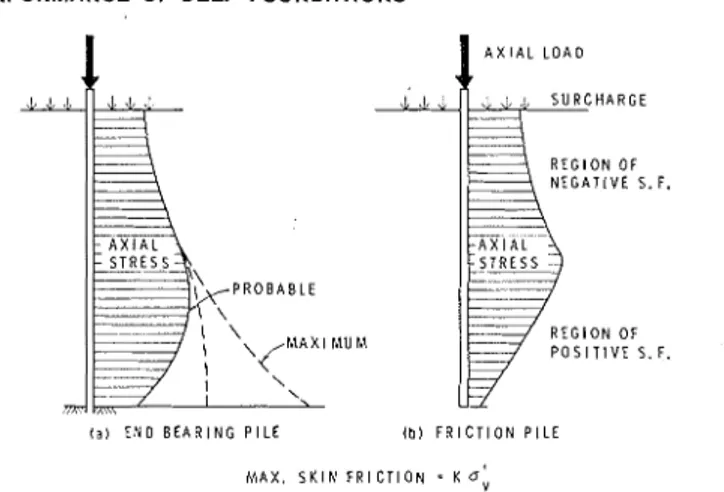
Although the nature of negative skin friction has been known f o ~ many years, there are few measurements available on full-scale piles. Such measurements are complicated by the long-term changes in effective stresses which always accompany the consolidation of large masses of soil. In addition, the relative movement between the pile and the soil will reverse, usually at an unknown location, and this location will probably change with time or when surface loads are added to the pile. These are complications in addition to the ordinary uncertainties of maximum adhesion forces and degree of mobilization of theseforces. Figure 1 is a schematic representation of the stresses induced in piles due to a combination of applied loads, end bearing, and skin friction. F o r a pile ending in bedrock or other hard strata, the negative skin
'
Head, Soil Mechanics Section, Division of ~uilding Research, National Research Council of Canada, Ottawa, Ont., Canada. Personal member ASTM.224 PERFORMANCE OF DEEP FOUNDATIONS M U M A X I A L L O A D N E G A T I V E 8 . F.
lB
0 F R E G I O N O F P O S I T I V E S.F. l a 1 E N 0 B E A R I N G P I L E I b l F R I C T I O N P I L E M A X . S K I N F R I C T I O N.
K b yFIG. 1 -Stress distribrrtio~z irz piles due ro nxirrl loarl rrttd skill fiictiotz.
friction or downdrag could be enormous if the entire overburden com- pressed and moved down relative to the pile. This is illustrated by the "maximum" curve in Fig. In. For very long piles soil compression throughout the entire depth of soil is improbable, and in the lower regions, therefore, the pile will move down relative to the soil due to its own compression and tip penetration. This results in some positive friction at the lower end and a reduction in the axial stress in the pile. In the case of a friction pile (Fig. Ib) the pile will move downward under the combined influence of applied axial load and downdrag until sufficient end bearing and positive skin friction are developed to
resist the movement. If the applied axial load is repetitive the relative
movement between soil and pile may reverse over certain regions, with each load change, resulting in reversals of friction loads.
Only one paper to this symposium, that by Bozozuk and Labrecque,? deals with measurements of negative skin friction. Although the in- terpretation of loads from strain measurements is complicated be- cause of the changing modulus in the composite steel and concrete section of the piles, it is reasonably certain from these measurements that negative skin friction can develop quickly after small relative movements and that it will continue to develop with time. This agrees with experience at the Norwegian Geotechnical Institute where ex- perimental piles driven in 1962 are still accumulating downdrag forces in 1968 (Bjerrum and Johannessen, 1968)."
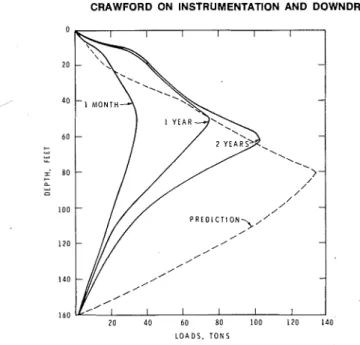
Figure 2 shows load accumulation in an experimental steel friction pile in which the downdrag is caused by a 30-ft-high fill through which the pile was driven. This preliminary sketch, showing load distribution
2See p. 15.
CRAWFORD ON INSTRUMENTATION AND DOWNDRAG 225
L O A D S . T O N S
FIG. 2- Load distribrrtiorz in 12-in.-dian1eterJontir1g steel pile.
in the pile after one month, one year, and two years, is a valuable illustration of the great influence of time on the development of nega- tive and positive skin friction. Details of this field experiment will be published when the observations are completed.
There is a great need for field measurements of downdrag loads o n piles. Although little direct experience is available for guidance, a few factors can be enumerated for attention in planning field research.
1. A simple steel pile section will permit the most reliable interpre-
tation of load distribution in the pile.
2. If a cast-in-place composite pile must be used, it should be noted that the concrete may expand in the early stages of hardening, and this complicates the interpretation of results. This was the experience of Bozozuk and Labrecque and has been reported informally by several other investigators. In addition, the modulus of a composite section changes as the concrete ages.
3. Skin friction may develop quickly and continue to develop for a
considerable time. Long-term observations therefore are required on pile compression and vertical soil movement.
4. Significant residual stresses may remain after driving, loading,
o r unloading. This has been demonstrated in a paper to the symposium by Hunter and Davisson4 and by Hanna5 (1966). Simple mechanical
'See p. 106.
Hanna, T. H., "Distribution of Load in Long Piles," Orztnrio Hydro Research
226 PERFORMANCE OF DEEP FOUNDATIONS
deformation gages should therefore be augmented by electrical gages to measure strains developed at every stage.
5. Downdrag may be greatly reduced by the application of a thin
layer of asphalt to the pile surface. This technique has been described
by Golder and Willeumier (1964)"nd has recently been used success-
fully in experiments at the Norwegian Geotechnical Institute (Bjerrum and Johannessen, 1968).
Wolder, H. Q. and Willeumiel., G. C., "Design of the Main Foundations of the Port Mann Bridge," Journal, Engineering Institute of Canada, Vol. 47, Aug. 1964, pp. 22-29.