Publisher’s version / Version de l'éditeur: Technical Report, 2004-03
READ THESE TERMS AND CONDITIONS CAREFULLY BEFORE USING THIS WEBSITE.
https://nrc-publications.canada.ca/eng/copyright
Vous avez des questions? Nous pouvons vous aider. Pour communiquer directement avec un auteur, consultez la
première page de la revue dans laquelle son article a été publié afin de trouver ses coordonnées. Si vous n’arrivez pas à les repérer, communiquez avec nous à [email protected].
Questions? Contact the NRC Publications Archive team at
[email protected]. If you wish to email the authors directly, please see the first page of the publication for their contact information.
For the publisher’s version, please access the DOI link below./ Pour consulter la version de l’éditeur, utilisez le lien DOI ci-dessous.
https://doi.org/10.4224/12327143
Access and use of this website and the material on it are subject to the Terms and Conditions set forth at Scientific Basis for Ice Regime System: Final Report
Timco, G.W.; Kubat, I.; Johnston, M.
https://publications-cnrc.canada.ca/fra/droits
L’accès à ce site Web et l’utilisation de son contenu sont assujettis aux conditions présentées dans le site LISEZ CES CONDITIONS ATTENTIVEMENT AVANT D’UTILISER CE SITE WEB.
NRC Publications Record / Notice d'Archives des publications de CNRC: https://nrc-publications.canada.ca/eng/view/object/?id=dbaeb0e7-0b4c-421d-865e-3c891080f1ec https://publications-cnrc.canada.ca/fra/voir/objet/?id=dbaeb0e7-0b4c-421d-865e-3c891080f1ec
TP 14274 E
Scientific Basis for the Ice Regime System:
Final Report
G.W. Timco, I. Kubat and M. Johnston Canadian Hydraulics Centre
National Research Council of Canada Ottawa, Ont. K1A 0R6
Canada Prepared for Transport Canada
330 Sparks St
Ottawa, Ont. K1A 0N8 Canada
Technical Report CHC-TR-020
ABSTRACT
This report gives a summary of the work that was performed on behalf of Transport Canada to put the Arctic Ice Regime Shipping System on a more scientific basis. There are several aspects to the work. The report describes the seven Tasks for the scientific approach that were defined by the CHC. A summary of the results of the research into each Task is presented. In the final Task, the CHC made recommendations for a more scientifically-based system. These recommendations were discussed at a 1-day Workshop of all relevant AIRSS Stakeholders and were applied to a number of vessels to investigate the potential improvements. The recommendations have, as an underlying principle, that Operators with well-equipped ice-strengthened vessels with experienced Masters and accurate and timely ice information should be encouraged and rewarded. The data supports this view.
RÉSUMÉ
Ce rapport résume le travail qui a été effectué au nom de Transports Canada afin de baser le Système des régimes de glaces pour la navigation dans l’Arctique sur un fondement plus scientifique. Il y a plusieurs aspects à ce travail. Le rapport décrit les sept tâches pour l’approche scientifique qui ont été définies par le CHC. Un résumé des résultats de la recherche pour chaque tâche est présenté. Dans la tâche finale, le CHC a fait des recommandations afin que le système soit plus axé sur la science. Ces recommandations ont été discutées lors d’un atelier d’une journée pour tous les intervenants pertinents du SRGNA et ont été appliquées à un certain nombre de bâtiments afin d’étudier les améliorations potentielles. Les recommandations ont, en tant que principe fondamental, mentionnées que les exploitants ayant des bâtiments biens équipés renforcés pour la navigation dans les glaces avec des capitaines expérimentés et des renseignements sur les glaces exacts et d’actualité devraient être encouragés et récompensés. Les données appuient ce point de vue.
TABLE OF CONTENTS ABSTRACT... 1 RÉSUMÉ ... 1 TABLE OF CONTENTS... 3 LIST OF FIGURES ... 4 LIST OF TABLES... 4 1.0 INTRODUCTION ... 5 2.0 BACKGROUND INFORMATION ... 6
2.1 The Zone-Date System ... 6
2.2 The Ice Regime System ... 6
2.3 The Seven Tasks ... 10
2.3.1 Task 1 - Safety-Related Issues... 12
2.3.2 Task 2 - Specific Problems with Corresponding Ice Conditions... 13
2.3.3 Task 3 – Adequacy of the AIRSS Definition of the Ice Numeral ... 15
2.3.4 Task 4 - Definition of Problem Ice and Operating Conditions... 16
2.3.5 Task 5 - Identification of Problem Ice ... 18
2.3.6 Task 6 - Detection of Problem Ice ... 20
2.3.7 Task 7 – An Approach for the Implementation of the AIRSS... 21
3.0 AIRSS WORKSHOP... 25
4.0 APPLICATION OF THE MODIFIED APPROACH... 28
5.0 SUMMARY AND CONCLUSIONS ... 31
6.0 ACKNOWLEDGEMENTS... 32
7.0 REFERENCES ... 32
LIST OF FIGURES
Figure 1: Map showing the regions of the Zones in the Zone-Date System... 8
Figure 2: Context diagram for the scienitfic basis for the Ice Regime System ... 12
Figure 3: Histogram showing the number of damage events and the damage severity for the vessel damage in the Arctic (after Kubat and Timco, 2003). ... 13
Figure 4: Illustration of the information in the CHC Ice Regimes Database... 14
Figure 5: Location of the damage events in the CHC database... 14
Figure 6: Pie chart showing the breakdown of the events in the CHC database according to vessel class and damage (D) and non-damage (ND) events. ... 15
Figure 7: Pie chart showing the number of damage events according to the Damage Severity (DS) number as defined in Table 4. ... 16
Figure 8: Illustration of the pie chart analysis of the data using the existing AIRSS definition for the Ice Numeral. An ideal Ice Numeral would maximize the positive Ice Numerals for DS=0, and maximize the negative Ice Numerals for DS≥ 3... 17
Figure 9: Relation between the ice strength and air temperature as a function of Julian Day for first-year ice in the Resolute region. ... 19
Figure 10: Comparison of first-year, second-year and multi-year borehole strength during the decay season. ... 19
Figure 11: Pie chart comparison of the data from Fednav vessels from 1997 to 2002. The data represents 435 events with no damage. Note the clear improvement using the CHC-modified approach... 29
Figure 12: Graphs of the Ice Numeral (IN) versus vessel speed for (a) IN calculated using the AIRSS approach, and (b) IN calculated using the CHC-modified approach. Data from Fednav vessels from 1997-2002 in which there was no damage to the vessels... 30
LIST OF TABLES Table 1: Zone-Date Table ... 7
Table 2: Table of the Ice Multipliers (IM) for the Ice Regime System ... 10
Table 3: Vessel Class for the Ice Regime System ... 10
Table 4: Definition of Damage Severity Numbers ... 15
Scientific Basis for the Ice Regime System:
Final Report
1.0 INTRODUCTION
Transport Canada has asked the Canadian Hydraulics Centre (CHC) of the National Research Council of Canada to investigate a methodology to put the Arctic Ice Regime Shipping System (AIRSS) on a scientific basis. The NRC developed a 7-Task approach to do this (Timco et al. 1997). The work on the Tasks is now complete.
The overall objective of this report is to provide a summary of the research that was performed to put AIRSS on a more scientific basis. This is done through a discussion of each of the seven tasks. The overall results of the work led to recommendations made by the CHC to put the system on a more scientific basis. The recommendations were discussed at a 1-day workshop that was held in Montreal with the relevant stakeholders. A summary of the workshop is presented in the report. For illustrative purposes, these recommendations were applied to a number of vessels to illustrate the improvements that could be made to the system if the recommendations were implemented.
2.0 BACKGROUND INFORMATION
2.1 The Zone-Date SystemIn 1972, the Canadian Government drafted the Arctic Shipping Pollution Prevention Regulations (ASPPR) to regulate navigation in Canadian waters north of 60°N latitude. These regulations include the Shipping Safety Control Zones (Figure 1), and the Date Table (Table 1), made under the Arctic Waters Pollution Prevention Act. Both of these are combined to form the “Zone/Date System” matrix that gives entry and exit dates for various ship types and classes. In this system, the ship types and classes, in descending order of ice capability are:
Arctic Class: 10, 8, 7, 6, 4, 3, 2, 1A, 1 Type Ships: A, B, C, D, E
The Arctic Class was normally but not accurately described as the thickness in feet of level ice that the vessel would have the power and strength to break. The Type ships represent the Classifications Societies’ designation of ice-capable ships that are in turn equivalent to the Baltic Rules. The “Zone-Date System” is based on the premise that nature consistently follows a regular pattern year after year. It is a rigid system with little room for exceptions.
Although the Zone-Date System has been used for many years, it does have a number of shortcomings:
1. The permission to proceed into a region and the regulatory control for not allowing entry into a region is based solely on historical ice data for any given vessel. It does not take into account the ice conditions at the time that the vessel wants to enter the region;
2. There has not been a recent update on the ice information in the Zone-Date System so the defined zones are not based on the more recent and complete ice information;
3. Even if the ice conditions are light outside the zone-date for a particular vessel, it is not straightforward for the vessel to get permission to enter the zone;
4. The Arctic Class classification of vessels currently in regulations is out of date with several existing vessels still in operation. The Equivalent Standards for the Construction of Arctic Class Ships (1995) has the more up-to-date classification (CAC) for structural integrity. An essential pollution prevention measure for safe ship operation in ice-covered waters requires knowledge of the structural capability of the vessel in different ice conditions.
2.2 The Ice Regime System
Transport Canada, in consultation with Stakeholders, has made extensive revisions to the Regulations through the introduction of the Ice Regime System (ASPPR 1989; Canadian Gazette 1996; Equivalent Standards 1995; AIRSS 1996). The changes are designed to reduce the risk of structural damage in ships which could lead to the release of pollution
into the environment, yet provide the necessary flexibility to Shipowners by making use of actual ice conditions, as seen by the Master to determine transit.
Figure 1: Map showing the regions of the Zones in the Zone-Date System.
In this new system, an "Ice Regime", which is a region of generally consistent ice conditions, is defined at the time the vessel enters that specific geographic region, or it is defined in advance for planning and design purposes. The Arctic Ice Regime Shipping System (AIRSS) is based on a simple arithmetic calculation that produces an “Ice Numeral” that combines the ice regime and the vessel’s ability to navigate safely in that region. The Ice Numeral (IN) is based on the quantity of hazardous ice with respect to the ASPPR classification of the vessel (see Table 2). The Ice Numeral is calculated from
.... ] [ ] [ + + = CaxIMa CbxIMb IN [1] where IN = Ice Numeral
Ca= Concentration in tenths of ice type “a”
IMa= Ice Multiplier for ice type “a” and Ship Category (from Table 2)
The term on the right hand side of the equation (a, b, c, etc.) is repeated for as many ice types as may be present, including open water. The values of the Ice Multipliers are adjusted to take into account the decay or ridging of the ice by adding or subtracting a
correction of 1 to the multiplier, respectively (see Table 2). The Ice Numeral is therefore unique to the particular ice regime and ship operating within its boundaries.
The vessel class is defined in terms of vessels that are designed to operate in severe ice conditions for both transit and icebreaking (Canadian Arctic Class - CAC) as well as vessels designed to operate in more moderate first-year ice conditions (Type ships). The classes were developed based on a “nominal” ice type, which were correlated to the World Meteorological Organization (WMO) classification for sea ice as given in Table 3 (ASPPR 1989).
The Ice Regime System determines whether or not a given vessel should proceed through that particular ice regime. If the Ice Numeral is negative, the ship is not allowed to proceed. However, if the Ice Numeral is zero or positive, the ship is allowed to proceed into the ice regime. Responsibility to plan the route, identify the ice, and carry out this numeric calculation rests with the Ice Navigator who could be the Master or Officer of the Watch. Due care and attention of the mariner, including avoidance of hazards, is vital to the successful application of the Ice Regime System. Authority by the Regulator (Pollution Prevention Officer) to direct ships in danger, or during an emergency, remains unchanged.
At the present time, there is only partial application of the Ice Regime System, exclusively outside of the “Zone-Date” System. That is, vessel traffic is regulated by the Zone-Date System, but is allowed to proceed into a (normally) restricted zone if the ice conditions are such that the Ice Regime System gives a positive Ice Numeral. For this, the vessel must have an Ice Navigator onboard and initially send an Ice Regime Routing Message to the CCG-NORDREG office in Iqaluit indicating a positive ice regime. Following the voyage, an After Action Report must be submitted to Transport Canada. Full details are found in the applicable regulatory standards guidelines.
Over the years, Transport Canada has sponsored a considerable amount of research on the Ice Regime System through a series of dedicated shipboard observations. The department has also sponsored several projects and Workshops related to the understanding of local hull loads on vessels in different ice conditions. Further, they have worked with the Canadian Ice Service to ensure that there is co-ordination between the two Organizations with respect to the Ice Regime System.
Transport Canada also produced a Users Assistance Package (1998), which provides information and a video on the Ice Regime System. More recently, Transport Canada sponsored the Canadian Hydraulics Centre to develop a Pictorial Guide to the Artic Ice Regime Shipping System (Timco and Johnston, 2003a).
Table 2: Table of the Ice Multipliers (IM) for the Ice Regime System
Type E Type D Type C Type B Type A CAC 4 CAC 3
Old / Multi-Year Ice……….. (MY) -4 -4 -4 -4 -4 -3 -1
Second Year Ice……….. (SY) -4 -4 -4 -4 -3 -2 1
Thick First Year Ice………. (TFY) > 120 cm -3 -3 -3 -2 -1 1 2 Medium First Year Ice…………. (MFY) 70-120 cm -2 -2 -2 -1 1 2 2 Thin First Year Ice……….
Thin First Year Ice - 2nd Stage (FY)
30-70 cm
50-70 cm -1 -1 -1 1 2 2 2 Thin First Year Ice - 1st Stage 30-50 cm -1 -1 1 1 2 2 2 Grey-White Ice………. (GW) 15-30 cm -1 1 1 1 2 2 2
Grey Ice………. (G) 10-15 cm 1 2 2 2 2 2 2
Nilas, Ice Rind < 10 cm 2 2 2 2 2 2 2
New Ice……….. (N) < 10 cm " " " " " " " Brash (ice fragments < 2 m across) " " " " " " "
Bergy Water " " " " " " "
Open Water " " " " " " " Ice Decay : If MY, SY, TFY or MFY ice has Thaw Holes or is Rotten, add 1 to the IM for that ice type.
Ice Types Ice Multipliers
Ice Roughness : If the total ice concentration is 6/10s or greater and more than one-third of an ice type is deformed, subtract 1 from the IM for the deformed ice type.
Table 3: Vessel Class for the Ice Regime System
CATEGORY OPERATING
ROLE ICE TYPE
CAC 1 Unrestricted Multiyear Ice
CAC 2 Transit or controlled icebreaking Multiyear Ice CAC 3 Transit or controlled icebreaking Second Year Ice CAC 4 Transit or controlled icebreaking Thick First Year Ice
Type A Transit Medium First Year Ice
Type B Transit Thin First Year Ice - 2nd Stage
Type C Transit Thin First Year Ice - 1st Stage
Type D Transit Grey-White Ice
Type E Transit Grey Ice
2.3 The Seven Tasks
Credibility of the Ice Regime System has wide implications, not only for ship safety and pollution prevention, but also in lowering ship insurance rates and predicting ship performance. Therefore, there is a definite need to establish a scientific basis for the system. To this end, Transport Canada approached the Canadian Hydraulics Centre of the National Research Council of Canada in Ottawa to assist them in developing a methodology for establishing a scientific basis for AIRSS. This led to a "road map" approach that is based on 7 Tasks (Timco and Frederking 1996; Timco et al. 1997).
Different approaches were looked at to put the system on a scientific basis. For a variety of reasons, it was decided that an empirical approach would provide the most confidence in establishing a scientific basis. That is, the approach is not based on first-principle calculations of potential ice damage. Instead, the approach makes use of the large number of different vessels that have traveled through a wide range of ice and environmental conditions. It investigates the actual conditions that have caused vessel damage in ice. There are many aspects to consider with the ice regime system. It is based on pollution prevention measures and is, therefore, safety (not performance) oriented. Any suitable system must meet the needs of Transport Canada as the Regulator, but must not unduly penalize ships from operating in ice-covered waters. The ice regime system does not deal with the efficiency or effectiveness of the ship operation. In developing a scientific basis, there are a number of key components that can be used as input into the scientific approach. Based on this analysis, Timco and Frederking (1996) prepared the Context Diagram for the scientific basis as shown in Figure 2. This Diagram presents a summary overview of the main factors driving this work. It is important to understand this diagram. It is the main driving force for the scientific basis.
In developing the methodology, a very straightforward approach was employed. The approach centred on asking and answering seven basic questions. Each question is a logical extension to the answer of the previous question. The basic questions are:
1. What problems can happen to a ship in ice?
2. What are specific examples of problems that have occurred that could be used for a deterministic development? i.e. specific case-histories that can be used to identify and understand the problems.
3. Would the current ice regime system have predicted these problems? 4. If not, how can the problem conditions be better defined?
5. Can the current ice detection methods identify the problem ice conditions?
6. If not, how can the ice detection systems be improved in a pragmatic manner to be able to detect the problem ice?
7. How can this information be communicated to the ship to implement the Ice Regime System?
These questions led to the following 7 Tasks: 1. Define Safety-Related Issues
2. Definition of Specific Problems with the Corresponding Ice Conditions 3. Assess the Adequacy of the AIRSS
4. Definition of Problem Ice and Operating Conditions 5. Identification of Problem Ice
6. Detection of Problem Ice
Figure 2: Context diagram for the scienitfic basis for the Ice Regime System
The authors have published a number of reports and papers describing the approach and the work that was done in each of the 7 Tasks. The results are too lengthy to report here and only a brief sketch of the results of each Task will be presented here. Interested parties should consult the original cited reports for complete details.
2.3.1 Task 1 - Safety-Related Issues
This task reviewed historical data on the safety-related problems that a ship could encounter in ice. The review showed that a large number of vessels have been damaged by ice. The damage primarily relates to hull deformation or fractures due to impacts with ice, damage to propellers or steering gears, vessel immobilization due to pressured-ice conditions, and ice overtopping the deck and damaging critical elements. A complete listing of the damage descriptions can be found in Timco and Kubat (2000). A detailed analysis of the damage events was carried out by Kubat and Timco (2003) relating the type of damage and the ice conditions that caused damage for different Vessel Classes. A separate analysis was made based on the presence or absence of multi-year ice. Figure 3 shows a histogram of the number of damage events and the damage severity for the vessel damage in the Arctic (Kubat and Timco, 2003). The data clearly shows that the majority of damage events occur with multi-year ice in the ice regime. The data and analysis show that in 73% of the damage events, there was multi-year ice present in the ice regime. Further, the data show that more severe damage events occur with multi-year ice in the ice regime. Overall, the analysis clearly illustrates that the major factor causing vessel damage is contact with multi-year ice.
21 10 3 0 40 29 19 3 0 10 20 30 40 50
denting small hole large hole ship sank Damage Severity Nu mb er of E v en ts
First Year Ice only Multi Year Ice present
Figure 3: Histogram showing the number of damage events and the damage severity for the vessel damage in the Arctic (after Kubat and Timco, 2003).
2.3.2 Task 2 - Specific Problems with Corresponding Ice Conditions
In this task, it was necessary to collect, in a very systematic manner, information on both damage Events and non-damage Events. In this case, an Event is described as ship transit through a known ice regime. The Event should include all relevant information about the transit including the vessel characteristics, route, climate, ice conditions and resulting damage (or no damage). It was important to include both damage and non-damage events to ensure that the analysis had a fair balance between the restrictions to limit damage (i.e. Regulators viewpoint) and the ability to travel through ice (Operators viewpoint).
The CHC developed a very comprehensive database that combines all of the key elements in a systematic manner (Timco and Morin 1997, 1998a, 1998b; Timco et al. 1999; Timco and Kubat 2000, 2001a). Since the details of the database have been discussed extensively in these references, they will not be described here. For the present purposes it is important to understand that the database can be used to evaluate the influence of a number of different parameters in the Ice Regime System. At the present time, the database contains 1768 events, with a break-down of damage and non-damage Events as shown in Figure 4. The location of the damage Events are shown in Figure 5. Data have been collected for all vessels classes in the AIRSS System. The individual breakdown of damage/non-damage Events for all vessel classes is shown in Figure 7. Figure 7 shows the number of damage Events according to the Damage Severity number as defined in Table 4.
No Damage (1531)
89%
Damage (31)
Not complete information
2%
Damage (206)
12%
Figure 4: Illustration of the information in the CHC Ice Regimes Database.
Type
D
(35) TypeC
(8) Type E (37) TypeB
(629) TypeA
(360) CAC4
(322) CAC3
(335)D=6, ND=2
D=19, ND=16
D=6, ND=2
D=25, ND=335
D=29, ND=306
D=69, ND=560
D=19, ND=303
Figure 6: Pie chart showing the breakdown of the events in the CHC database according to vessel class and damage (D) and non-damage (ND) events.
2.3.3 Task 3 – Adequacy of the AIRSS Definition of the Ice Numeral
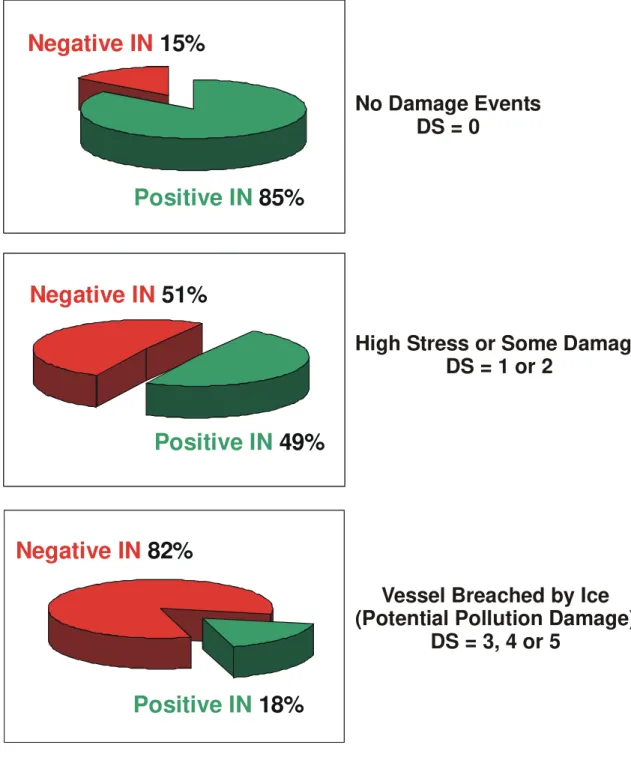
It was possible to use the CHC database to determine if the definition for the Ice Numeral (IN) proposed in the AIRSS agrees with documented empirical data. An analysis was performed and it was found that the AIRSS definition provided a reasonable definition of the Ice Numeral (see Figure 8). However, the definition was not ideal. There were several Events of ship damage that had a positive Ice Numeral, and a considerable number of Events with a negative Ice Numeral in which there was no damage. According to this analysis, the current definition of the Ice Numeral captures the general desired trend. However, the current definition misses several damage Events, and significantly restricts access in situations in which there was no resulting damage.
Table 4: Definition of Damage Severity Numbers
Damage Severity (DS)
Number Description
0 No damage
1 High measured stress
2 Slight deformation of hull, denting, propeller 3 Small puncture or fracture, extensive denting
4 Large hole
DS1 (29) 12% DS5 (3) 1% DS4 (28) 12% DS3 (50) 21% DS2 (96) 41% NDamage = 237 unknown (31) 13%
Figure 7: Pie chart showing the number of damage events according to the Damage Severity (DS) number as defined in Table 4.
2.3.4 Task 4 - Definition of Problem Ice and Operating Conditions
In this task, the CHC database was used to investigate the relative influence of a number of factors not considered in the current definition of the Ice Numeral. This was done by using an “Interaction Approach” which takes into account factors such as vessel speed, experience of the Master, ice strength, visibility, etc. (see Timco and Kubat 2000, 2001b). This approach showed a significant improvement in the definition of the Ice Numeral. The methodology had 2 basic underlying principles driving it:
1. Ship Operators are rewarded when they use a high ice-strengthened vessel (CAC or Type A, B) operating with experienced Masters who proceed carefully through difficult ice and navigation conditions.
2. Ship Operators are severely penalized when they use lower class vessels (Type C and lower) and less experienced personnel.
Although this approach provided a significant improvement in the definition of the Ice Numeral, its application would be difficult since several factors must be taken into account. Nevertheless, it clearly showed that a significant improvement could be made if the appropriate factors were taken into account in the Ice Regime System.
Positive IN
18%
Negative IN
82%
Positive IN
85%
Negative IN
15%
Positive IN
49%
Negative IN
51%
No Damage Events
DS = 0
High Stress or Some Damage
DS = 1 or 2
Vessel Breached by Ice
(Potential Pollution Damage)
DS = 3, 4 or 5
Figure 8: Illustration of the pie chart analysis of the data using the existing AIRSS definition for the Ice Numeral. An ideal Ice Numeral would maximize the positive Ice Numerals for DS=0, and maximize the negative Ice Numerals for DS≥ 3.
2.3.5 Task 5 - Identification of Problem Ice
This task examined several aspects related to Arctic ice; in particular, looking at methods of identifying problem ice. Both the properties of multi-year ice and the requirements for defining decayed ice were investigated. This was done in several ways.
Data were examined to provide information on the ability of the Canadian Ice Service (CIS) of Environment Canada and current ice detection systems to accurately predict the ice conditions. A comparison was made of CIS-predicted ice conditions with ground-truthed information (Timco and Kubat 2000; Kubat and Timco 2001; Timco et al. 2003a, 2003b). Based on the data analysed in this Task, it appears that the CIS ice predictions usually present a reliable description of the actual ice conditions. An analysis was also performed of the variability of ice regimes within a single egg code “region” of an ice chart. This analysis showed that, although the average conditions are correct, there could be considerable variability in the ice conditions within the region. Thus, the ice charts should not be solely used for calculating the Ice Numeral for tactical navigation. Continual on-board ice observations are an essential component for correct determination of the Ice Numeral.
Field programs were performed to measure the properties of multi-year and second-year ice (Johnston et al. 2002, 2003) and first-year ice during the spring decay process (Johnston et. al. 2001, 2002, 2003; Johnston and Frederking 2000, 2001a, 20001b; Johnston and Timco 2002; Timco and Johnston 2002).
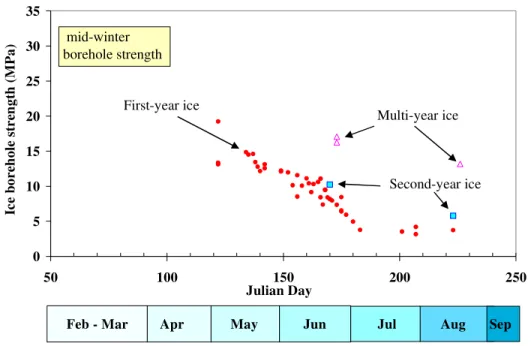
Figure 9 shows the correlation between the strength of first-year sea ice and air temperature in the Resolute region (Timco and Johnston 2002). The graph clearly shows an inverse relationship between the air temperature and the strength of the ice. By early July, the strength of the first-year ice is only about 10-15% of the mid-winter strength of the ice. Clearly there is a significant decay process for first-year ice. On the other hand, Figure 10 shows a comparison of the strength of first-year, second-year and multi-year ice (Timco and Johnston 2003b). The plot clearly shows that the strength of multi-year ice does not decay in the same manner as either first-year or second-year ice. Based on this information and an analysis of the Ice Regime Database, recommendations were made with regard to multi-year ice, second-year ice and decaying first-year ice in AIRSS (Timco et al. 2001; Timco and Johnston 2003b).
0.0 0.2 0.4 0.6 0.8 1.0 1.2 0 20 40 60 80 100 120 140 160 180 200 220 Julian Day No rma lized ice st re ng th -50 -40 -30 -20 -10 0 10 R es o lu te m e a n d ai ly ai r t e m p er at u re ( o C )
April May June July Au
Jan - Feb - Mar
air temperature (10 pt average)
early June, 50%
late June, 15 to 20% early July, 10%
mid May, 70% mid-winter strength
Figure 9: Relation between the ice strength and air temperature as a function of Julian Day for first-year ice in the Resolute region.
0 5 10 15 20 25 30 35 50 100 150 200 250 Ic e b o re h o le stre n g th (M Pa ) Apri l
May Jun Jul Aug Sep Apr May Feb - Mar Julian Day First-year ice Second-year ice Multi-year ice mid-winter borehole strength
Figure 10: Comparison of first-year, second-year and multi-year borehole strength during the decay season.
The following recommendations are made for multi-year sea ice decay:
1. The increase of +1 to the Ice Multiplier should not be given for decay of multi-year ice. It is recommended that the approach proposed in the ASPPR (1989) be re-adopted.
2. Field measurements of multi-year ice throughout the summer season should be undertaken to provide more insight into the decay and strength of multi-year ice. This work would provide the necessary information for making the final decision on the issue of decayed multi-year ice and the Ice Regime System.
The following recommendations are made with regard to second-year sea ice decay: 1. It is recommended that the bonus for second-year ice remain as currently defined
in the AIRSS Regulations.
2. It is further recommended that active research being undertaken on second-year ice to allow a scientific basis for evaluating the validity of this bonus for this ice type.
The following recommendations are made with regard to first-year sea ice decay:
1. The concept of decay of sea ice should be re-cast in terms of the strength of the ice in the Ice Regime System.
2. There should be a bonus given for low strength during the summer months, since the ice is considerably weaker and thinner than in mid-winter.
3. The springtime (i.e. melt) limit for the summer bonus could be based on the present analysis. The summer decay bonus can be applied if the CIS Ice Strength Charts indicate that the strength is 10% or less of the mid-winter strength. If this information is not available, the decay bonus can be applied if observations show that the ice has decayed to the rotten stage (thaw holes throughout the full-thickness of ice).
4. The summer decay bonus should be removed if there is Thin First-year ice (or thicker ice) in the ice regime in the autumn during ice growth.
5. In applying the summer bonus, the Ice Multipliers for all first-year ice types (including Open Water) should be increased by +1.
2.3.6 Task 6 - Detection of Problem Ice
The intent of this Task was to examine, in a pragmatic way, improvements in ice identification methods that could be implemented if the results of Task 5 were poor. However, as noted above, the CIS predictions are quite reasonable and can be used in the IRS for strategic planning. Thus, there was no effort spent in this Task. However, two points should be mentioned. The CIS charts were often found to underestimate the amount of multi-year ice in the ice regime (Timco et al. 2003a). Since this ice type has been associated with a large number of vessel damage events, efforts for improving the detection of multi-year ice would be very beneficial. Second, the CIS is developing an Ice Strength Chart that will provide information on the strength of level, first-year sea ice throughout the shipping season (Gauthier et al., 2002; Langlois et al, 2003). The CHC is working with the CIS on this project by providing input on the strength of the sea ice
(Johnston and Timco, 2004). Further, a ground-truthing program has been performed with the cooperation of the Canadian Coast Guard and the Canadian Ice Service (Timco et al. 2003a, 2003b).
2.3.7 Task 7 – An Approach for the Implementation of the AIRSS
Timco and Kubat (2002) wrote a Discussion Report that summarized the work that had been performed on the scientific basis for AIRSS. It included a detailed description of the comments on AIRSS from the Stakeholders (Ship Owners and Operators, Transport Canada, Canadian Coast Guard, Environment Canada). Further, it examined the factors that could (and/or should) affect the Ice Numeral including vessel class, ice concentration, ice thickness, summer conditions, decay, ridging, presence of multi-year ice, ships under escort, visibility, vessel speed, experience of Master or Ice Navigator, maneuverability of vessel, navigational (ice information) equipment, floe size, and bergy bits.
Timco and Kubat (2002) discussed four different approaches that could be used with regard to the advancement and improvement to AIRSS:
1. Existing Definition of Ice Numeral (AIRSS Approach) – In this approach, the existing definition of the Ice Numeral using the existing AIRSS Table of Multipliers with the existing modifications for decay and ridging would be used. 2. Adding Modifiers to Ice Numeral (Interaction Approach) – In this approach, a
revised Table of Multipliers would be used and values would be added or subtracted to the calculated Ice Numeral to modify for speed, visibility, experience, etc.
3. Integer Bonus to Ice Multiplier (Modified Approach) – In this approach, the existing Table of Multipliers would be used and a bonus of +1 is given to the Ice Multipliers of first-year ice for vessels of Type B class and higher if the vessel has three specific features; viz, Master with a certain number of years of experience, very good ice detection equipment, and summer (low strength) ice conditions. 4. Non-Integer Multipliers (Non-Integer Approach) – In this approach, each vessel
would be given a unique set of Multipliers based on the vessel class, experience, ice navigation equipment, time of year (i.e. ice strength, decay, etc.), vessel speed, etc. This would be done when the vessel crosses north of 60º N latitude, and would be a (non-integer) bonus on the Ice Multipliers for each identified factor. Timco and Kubat (2002) discussed the advantages and disadvantages of each approach and made a recommendation that the third approach, Integer Bonus to Ice Multipliers, be adopted. This should give more flexibility to operators that have good experience in ice and good ice information onboard the vessel. In their analysis, they developed two basic underlying principles that gave the optimum fit to the empirical data:
1. Ship Operators are rewarded when they use a high ice-strengthened vessel (CAC or Type A, B) operating with experienced Masters who proceed carefully through difficult ice and navigation conditions.
2. Ship Operators are severely penalized when they use low ice class vessels and less experienced personnel.
Timco and Kubat (2002) proposed the following modified1 approach to AIRSS:
The Ice Numeral (IN) is based on the quantity of hazardous ice with respect to the classification of the vessel, and calculated using the same approach as the existing system (Equation 1). In this case, however, the Table of Multipliers is revised from the existing table. Table 5 lists the revised Table of Multipliers. In this table, the changes from the current Ice Multiplier table are indicated with yellow shading. There would be three significant changes from the existing system:
1. The Ice Multipliers for multi-year and second-year ice are increased by 1 for all of the lower class vessels (Type E, D and C)2.
2. The Ice Multipliers for Type B vessels in Thin First-Year Ice (First-stage) and Grey-White Ice are increased from 1 to 2.
3. A Summer Bonus replaces the decayed ice modification. This Bonus would add +1 to the Ice Multipliers for first-year ice for vessels Type B and higher (indicated in the Red box). It would be given if:
1) There are low strength ice conditions (as discussed in Section 2.3.5);
2) The Master or Ice Navigator has a minimum four seasons and number of voyages of experience in the Arctic; and
3) The vessel has suitable instrumentation and equipment for identifying the ice conditions. This could be marine radar (crosspolar) and downlink capability for receiving the CIS information directly.
With this modified approach, several of the key factors such as speed, vessel manoeuvrability, floe size, etc. would not be taken into account explicitly. Instead, it would be implicitly taken into account in the experience of the Master or Ice Navigator. This would provide more flexibility for the Operators while maintaining the basic structure of the Ice Regime System. It should also provide the necessary framework for minimizing damage Events that could lead to pollution. Further, this approach would maintain the general simplicity of the current approach to the Ice Regime System. This approach combines the simplicity of the existing system with the improvements driven by the scientific analysis. The difficult aspect of this approach relates to the definition of the experience level of the Master, and defining the acceptable level of ice detection/navigation equipment for the bonus integer. These aspects should not be insurmountable.
1 In this report, this is called the CHC-modified approach.
2 This was done in response to the significant damage events that occur with the lower class vessels and
Table 5: Table of Multipliers for the Modified Ice Regime System (Proposal)
Type E Type D Type C Type B Type A CAC 4 CAC 3
Old / Multi-Year Ice……….. (MY) -5 -5 -5 -4 -4 -3 -1
Second Year Ice……….. (SY) -5 -5 -5 -4 -3 -2 1
Thick First Year Ice………. (TFY) > 120 cm -3 -3 -3 -2 -1 1 2 Medium First Year Ice…………. (MFY) 70-120 cm -2 -2 -2 -1 1 2 2 Thin First Year Ice……….
Thin First Year Ice - 2nd Stage
(FY) 30-70 cm
50-70 cm -1 -1 -1 1 2 2 2 Thin First Year Ice - 1st Stage 30-50 cm -1 -1 1 2 2 2 2 Grey-White Ice………. (GW) 15-30 cm -1 1 1 2 2 2 2
Grey Ice………. (G) 10-15 cm 1 2 2 2 2 2 2
Nilas, Ice Rind < 10 cm 2 2 2 2 2 2 2
New Ice……….. (N) < 10 cm " " " " " " " Brash (ice fragments < 2 m across) " " " " " " "
Bergy Water " " " " " " "
Open Water " " " " " " "
Ice Roughness : For floes that are more than 3/10s ridged, subtract 1 from the Ice Multiplier
Ice Types Ice Multipliers
Summer Conditions: For vessels that meet the Summer Conditions requirements, add +1 to the Ice Multiplier for first-year ice (indicated in the Red box).
The Timco and Kubat (2002) report also provided a number of recommendations for furthering the advancement of AIRSS:
1. All Stakeholders – Transport Canada, Ship Owners/Operators and other interested agencies and organizations must initially reach an agreement in principle that the Ice Regime System should be applied in whole or as part of the Regulations; 2. All Stakeholders must have input into the decision of the best approach to define
the Ice Numeral and implement the System. This approach must give the Regulators sufficient confidence that safety aspects are considered a priority, whilst giving the Operators the necessary flexibility to manage their business. Once all Stakeholders have put forward their input, Transport Canada as the Regulator should decide and implement the best approach;
3. All Stakeholders must actively play a role in improving the Ice Regime System. This includes providing continual quantitative feedback on the use of the IRS, and advising on the relative importance of the key parameters affecting the Ice Numeral;
4. Transport Canada should develop an improved approach for educating people on the Ice Regime System. This approach should be directed towards helping people (1) understand the basic concept of the Ice Regime System, (2) identifying ice regimes, (3) calculating Ice Numerals for a variety of situations, and (4) using the various ice navigation information systems for supporting the Ice Regime System.
With this information, the Canadian Hydraulics Centre organized a Workshop for all AIRSS stakeholder. This is discussed in the next section.
3.0 AIRSS WORKSHOP
A Workshop for the key Stakeholders of AIRSS was organized by the Canadian Hydraulics Centre. The Workshop was initially advertised at the CMAC-Northern meeting and the participants were invited to attend. It was held on Wednesday, May 14, 2003 in the Boardroom of the Fednav Offices, Suite 3500, 1000 de La Gauchetiere West, in Montreal. The following people attended:
Victor Santos-Pedro Transport Canada
Peter Timonin Transport Canada
Tim Keane Fednav - Canarctic
Capt. John Cowan Fednav - Canarctic Glenda Cameron Fednav - Canarctic
Capt. Robert Bélanger Nunavut Eastern Arctic Shipping
Capt. David Day NTCL
Capt Steve McKnight NTCL
Christopher King Groupe Desgagnes inc. Andrew Kendrick BMT Fleet Technology
Tom Zagon Enfotec
Capt. Germain Tremblay CCG - Des Groseilliers
Fiona Robertson CCG - Ottawa
Capt. Jean Ouellet CCG - Sarnia
Robert Gray CCG - Sarnia
Darlene Langlois Canadian Ice Service
Gilles Desgagnes Gouvernement du Quebec - Transports Paul-Denis Vallee Transport Canada
Bernard Breton Transportation Safety Board Ivana Kubat Canadian Hydraulics Centre - NRC Dr. Michelle Johnston Canadian Hydraulics Centre - NRC Dr. Garry Timco Canadian Hydraulics Centre - NRC The Agenda for the Workshop was
1. Welcome to the AIRSS Workshop – V. Santos-Pedro 2. Welcome to Fednav Offices – T. Keane
3. Introduction to the Scientific Approach to AIRSS – G. Timco 4. The AIRSS Ice Regime Database – I. Kubat
5. AIRSS and Ice Decay – M. Johnston 6. The 4 Approaches for AIRSS – G. Timco
7. Industry Experience with AIRSS – all Industry Members 8. CCG Experience with AIRSS – CCG Members
9. General Discussion – Which way to go? – led by V. Santos-Pedro 10. Concluding Remarks – V. Santos-Pedro
The Workshop was chaired by Mr. Victor Santos-Pedro of Transport Canada. He opened the Workshop by thanking all of the Participants for attending, and thanking Fednav for hosting the Workshop. Tim Keane from Fednav welcomed everyone to the Fednav
offices. Mr. Santos-Pedro encouraged everyone to openly participate in the meeting and hoped that there could be a general consensus on the future directions of AIRSS.
The Canadian Hydraulics Centre (Timco, Kubat, and Johnston) made a number of presentations related to their work on the scientific basis for AIRSS. Garry Timco presented an introduction to the scientific work and emphasized that the Context Diagram (Figure 2) was used throughout to ensure that all aspects were addressed based on the original plan. Ivana Kubat presented a detailed discussion of the CHC database that was developed for the scientific basis. She discussed the general philosophy of the database, the number and types of events in the database, and the current status. She presented an overview of the damage events and the causes for the vessel damage. Michelle Johnston provided a graphic presentation of the research that the CHC has preformed for Transport Canada to investigate the decay of sea ice. She presented the results of several years of field measurements on both first-year ice and old ice. Examples were given to illustrate the rapid decay of first-year sea ice during the spring, and the general inconsistencies in the decay of second-year and multi-year ice. Garry Timco concluded the presentation by giving a detailed description of the discussions that had been held with the various AIRSS Stakeholders. He emphasized the key strong points and apparent weaknesses which people had identified for AIRSS. He discussed the four approaches that the CHC had proposed as part of Task 7 (see Section 2.3.7).
A copy of the full CHC presentation can be found in Appendix A of this report.
Victor Santos-Pedro led a general discussion on AIRSS. Many of the points that had been raised in Timco’s presentation on the strengths and weaknesses were re-enforced. There was a discussion on the four possible AIRSS approaches with a general consensus that the “modified” approach might be the most favourable one. There was concern that the other approaches (Interaction Approach or Non-Integer Approach) would take too much control out of the hands of the Master. Questions were raised regarding the new IMO Arctic Shipping Guidelines that were soon to be adopted (IMO, 2002), and the IACS Unified Requirements for Polar Ships. Considerable discussion ensued on how AIRSS would fit with these new guidelines. Transport Canada replied that only preliminary work has begun on the best approach for doing this. Darlene Langlois from the Canadian Ice Service described a new product under development called “Ice Strength Charts” which would provide information on the strength of the first-year sea ice. Industry asked if this new information could be incorporated into AIRSS. G. Timco replied that it could be used in the modified approach to AIRSS. There was a general discussion on future directions with unanimous agreement that continuing training and education on operating vessels in ice-covered waters is essential.
With regard to the recommendations made by the CHC on advancing the scientific basis for AIRSS, the following summary conclusions were made:
1. All Stakeholders – Transport Canada, Ship Owners/Operators and other interested agencies and organizations must initially reach an agreement in principle that the Ice Regime System should be applied in whole or as part of the Regulations;
There was a general consensus that the Ice Regime System could play an important role in the Regulations. Industry had a guarded acceptance of it. There was no desire at present from Industry to replace the Zone-Date System with AIRSS.
2. All Stakeholders must have input into the decision of the best approach to define the Ice Numeral and implement the System. This approach must give the Regulators sufficient confidence that safety aspects are considered a priority, whilst giving the Operators the necessary flexibility to manage their business. Once all Stakeholders have put forward their input, Transport Canada as the Regulator should decide and implement the best approach;
The modified approach suggested by the CHC had the widest acceptance by both Industry and Transport Canada. Industry emphasized that the control of the vessel had to remain with the Master and not be directly dictated by a calculated number. The issue of defining the amount of experience and the amount of ice detection equipment and information must still be addressed.
3. All Stakeholders must actively play a role in improving the Ice Regime System. This includes providing continual quantitative feedback on the use of the IRS, and advising on the relative importance of the key parameters affecting the Ice Numeral;
Industry agreed to continue to work with the CHC to improve the confidence in the AIRSS System. The CHC will continue to seek advice and information from Industry regarding the scientific basis for AIRSS, and the integration of the IMO Arctic Shipping Guidelines and the IACS Unified Requirements for Polar Ships.
4. Transport Canada should develop an improved approach for educating people on the Ice Regime System. This approach should be directed towards helping people (1) understand the basic concept of the Ice Regime System, (2) identifying ice regimes, (3) calculating Ice Numerals for a variety of situations, and (4) using the various ice navigation information systems for supporting the Ice Regime System. Transport Canada has released the Pictorial Guide to Ice Regime System (Timco and Johnston, 2003a) and have distributed it to Industry, the Canadian Coast Guard and the Canadian Ice Service. Further work should be directed towards increased training for operating in ice-covered waters.
4.0 APPLICATION OF THE MODIFIED APPROACH
As an example of improvements that could be achieved using the CHC-modified approach to AIRSS, data from Fednav vessels that are contained in the CHC database were examined. Data 1997 to 2002 were analyzed using both the existing AIRSS approach (Table 2) and the CHC-modified approach (Table 5) for calculating the Ice Numeral. A total of 435 events were identified for the Arctic Kalvik, Federal Baffin, Federal Elbe, Federal Franklin, Federal Fuji, Federal Rhine and the MV Arctic. Three hundred and eighty-six out of the 435 events met the criteria proposed for the Summer Bonus – viz. there are low strength ice conditions (as discussed in Section 2.3.5), the Master or Ice Navigator has a minimum 4 years of experience in the Arctic; and the vessel has suitable instrumentation and equipment for identifying the ice conditions. All of the events were non-damage events.
Figure 11 shows a pie chart comparison of the data analyzed using the present AIRSS definition for the Ice Numeral and that calculated using the CHC-modified approach. Since these were all non-damage events, the Ice Numerals should be positive and the pie chart should only show positive Ice Numerals (i.e. all green). For the AIRSS approach, 13% of the events had a negative numeral even though there was no damage to the vessels. On the other hand, only 5% of the events had a negative numeral using the CHC-modified approach. There is a clear improvement.
Figure 12 shows the Ice Numeral as a function of speed for both the AIRSS approach (Figure 12a) and the CHC-modified approach (Figure 12b). The figures clearly show the shift in the Ice Numeral values to more positive values. There are a significant number of events that had a negative IN as calculated using the AIRSS approach. A large number of these negative IN values shift to positive Ice Numerals with the CHC-modified approach. Since there was no reported damage to these vessels, the observed shift exhibits the correct trend.
Positive IN 87% Negative IN 13%
AIRSS IN
Positive IN 95% Negative IN 5%(a)
(b)
Figure 11: Pie chart comparison of the data from Fednav vessels from 1997 to 2002. The data represents 435 events with no damage. Note the clear improvement using the CHC-modified approach.
0 5 10 15 20 -40 -30 -20 -10 0 10 20 30 40 AIRSS IN S pe ed (k not s ) 0 5 10 15 20 -40 -30 -20 -10 0 10 20 30 40 Modified IN S p eed (k n o ts)
AIRSS Approach
CHC-Modified Approach
(a)
(b)
Figure 12: Graphs of the Ice Numeral (IN) versus vessel speed for (a) IN
calculated using the AIRSS approach, and (b) IN calculated using the CHC-modified approach. Data from Fednav vessels from 1997-2002 in which there was no damage to the vessels.
5.0 SUMMARY AND CONCLUSIONS
The research performed to put the Ice Regime System on a scientific basis has been very successful. It has opened a good dialogue amongst the Stakeholders of the AIRSS System. Through these discussions, there has been a better appreciation of the intent and scope of the System. The dialogue has identified the strengths and weaknesses, and brought forward the concerns of the various Stakeholders. Quantitative data have been obtained where it is possible to evaluate the existing system and investigate new alternatives and improvements to the system. Field work on the strength of ice has led to a significant improvement of the understanding of decay of sea ice. It has proved a new way to quantify the role of ice decay in AIRSS. The Modified Approach suggested by the CHC to improve AIRSS has as an underlying principle that Operators with well-equipped ice-strengthened vessels with experienced Masters and accurate and timely ice information should be encouraged and rewarded. Analysis of the data supports this view.
6.0 ACKNOWLEDGEMENTS
The financial support of Transport Canada in the development of a scientific basis for the Ice Regime System is gratefully acknowledged. The authors would like to thank a number of individuals for helpful comments and discussions throughout the course of this work. These include Glenda Cameron, Capt. Doug Camsel, Capt. John Cowan, Roger DeAbreu, Capt. Peter Dunderdale, John Falkingham, Bob Frederking, Marie-France Gauthier, Bob Gorman, David Jackson, Tim Keane, Andrew Kendrick, Darlene Langlois, Tom Paterson, Fiona Robertson, Victor Santos-Pedro, Peter Timonin, Georges Tousignant, Dugald Wells, Robert Wolfe, Brian Wright, Bob Zacharuk, Tom Zagon, and the Commanding Officers of the Canadian Coast Guard.
7.0 REFERENCES
AIRSS 1996. Arctic Ice Regime Shipping System (AIRSS) Standards, Transport Canada, June 1996, TP 12259E, Ottawa. Ont., Canada.
ASPPR, 1989. Proposals for the Revision of the Arctic Shipping Pollution Prevention Regulations. Transport Canada Report TP 9981, Ottawa. Ont., Canada.
Canadian Gazette, 1996. Regulations Amending the Arctic Shipping Pollution Prevention Regulations. p 1729, Ottawa, Ont., Canada.
Equivalent Standards for the Construction of the Arctic Class Ships, 1995. Transport Canada Report TP-12260, Ottawa, Ont., Canada.
Gauthier, M-F., De Abreu, R., Timco, G.W. and Johnston, M.E. 2002. Ice Strength Information in the Canadian Arctic: From Science to Operations. Proceedings of the 16th IAHR International Symposium on Ice, pp 203-210, Dunedin, New Zealand.
IMO MSC/MEPC Circular on Guidelines for Ships Operating in Arctic Ice Covered Waters. 2002. in Annex 10 of the forty-fifth session of the Sub-Committee (DE 45/27) - reference Chapter 11 of the Circular. Draft Guidelines submitted to MSC76 , December 2002.
Johnston, M. and Timco, G.W. 2004. Developing an Ice Strength Algorithm for Sub-Arctic Regions. NRC Report CHC-TR-023, Ottawa, Ont., Canada.
Johnston, M., Frederking, R. and Timco, G.W. 2003. Properties of Decaying First-year Sea Ice at Five Sites in Parry Channel. Proceedings 17th International Conference on Port and Ocean Engineering under Arctic Conditions, POAC’03, Vol. 1, pp 131-140, Trondheim, Norway.
Johnston, M. Frederking, R. and Timco, G. 2003. Property Changes of First-year Ice and Old Ice during Summer Melt. NRC Report CHC-TR-010, TP 14098E Ottawa, Ont., Canada.
Johnston, M., Frederking, R. and Timco, G. 2002 Testing the Compressive Strength of Sea Ice with a Borehole Jack: Third Season. NRC Report HYD-TR-05, April 2002, Ottawa, Ont., Canada, 18 pp.
Johnston, M., Frederking, R. and Timco, G. 2002. Properties of Decaying First Year Sea Ice: Two Seasons of Field of Field Measurements. Proceedings 17th International on Okhotsk Sea and Sea Ice, pp 303-311, Mombetsu, Hokkaido, Japan.
Johnston, M. and Timco, G.W. 2002. Temperature Changes in First Year Arctic Sea Ice During the Decay Process. Proceedings of the 16th IAHR International Symposium on Ice, Vol., 2, pp 194-202, Dunedin, New Zealand
Johnston, M. and Frederking, R. 2001a. Decay of First Year Sea Ice: A Second Season of Field Measurements: Interim Report. NRC Report HYD-TR-66, August 2001, Ottawa, Ont., Canada.
Johnston, M. and Frederking, R. 2001b. Decay of First Year Sea Ice: A Second Season of Field Measurements. NRC Report HYD-TR-69, December 2001, Ottawa, Ont., Canada. Johnston, M., Frederking, R. and Timco, G. 2001. Seasonal Decay of First-Year Sea Ice. NRC Report HYD-TR-058, April 2001,Ottawa, Ont., Canada.
Johnston, M.E. and Frederking, R. 2000. Seasonal Decay of First-year Sea Ice: Field Measurements. NRC Report HYD-TR-057, September, 2000, Ottawa, Ont., Canada. Kubat, I. and Timco, G.W. 2003. Vessel Damage in the Canadian Arctic. Proceedings 17th International Conference on Port and Ocean Engineering under Arctic Conditions, POAC’03, Vol. 1, pp 203-212, Trondheim, Norway.
Kubat, I. and Timco, G.W. 2001. Ground-Truthing of Ice Conditions Predicted by the Canadian Ice Service. Proceedings 16th International Conference on Port and Ocean Engineering under Arctic Conditions, POAC’01, pp 1071-1080, Ottawa, Ont., Canada. Langlois, D.J., De Abreu, R., Gauthier, M-F., Timco, G.W. and Johnston, M. 2003. Early Results of the Canadian Ice Service Ice Strength Chart. Proceedings 17th International Conference on Port and Ocean Engineering under Arctic Conditions, POAC’03, Vol. 1, pp 165-174, Trondheim, Norway.
Timco, G.W., Johnston, M., Sudom, D., Kubat, I. and Collins, A. 2003a. Data Collection Program on Ice Regimes Onboard the CCG Icebreakers – 2002. NRC Report CHC-TR-012, Ottawa, Ont., Canada.
Timco, G.W., Johnston, M., Sudom, D., Gauthier, M-F. and Zacharuk, R. 2003b. Data Collection Program on Ice Regimes. Proceedings 17th International Conference on Port and Ocean Engineering under Arctic Conditions, POAC’03, Vol. 1, pp 141-150, Trondheim, Norway.
Timco, G.W. and Johnston, M. 2003a. Arctic Ice Regime Shipping System Pictorial Guide. Canadian Hydraulics Centre Report, TP 14044, Ottawa, Ont., Canada.
Timco, G.W. and Johnston, M., 2003b. Ice Decay Boundaries for the Ice Regime System: Recommendations from a Scientific Analysis. NRC Report CHC-TR-009, TP 14096E, Ottawa, Ont., Canada.
Timco, G.W. and Johnston, M.E. 2002. Sea Ice Strength during the Melt Season. Proceedings of the 16th IAHR International Symposium on Ice, Vol. 2, pp 187-193, Dunedin, New Zealand
Timco, G.W. and Kubat, I. 2002. Scientific Basis for Ice Regime System: Discussion Paper. NRC Report CHC-TR-002, TP 13916E, Ottawa, Ont., Canada.
Timco, G.W., Johnston, M. and Kubat, I. 2001. Ice Decay and the Ice Regime System. NRC Report HYD-TR-70, TP 13871 E, Ottawa, Ont., Canada.
Timco, G.W. and Kubat, I. 2001a. Scientific Basis for the Ice Regime System: March 2001 Update. CHC/NRC Report HYD-TR-061, TP-13405, Ottawa, Ont., Canada.
Timco, G.W. and Kubat, I. 2001b. Canadian Ice Regime System: Improvements Using an Interaction Approach. Proceedings 16th International Conference on Port and Ocean Engineering under Arctic Conditions, POAC’01, pp 769-778, Ottawa, Ont., Canada. Timco, G.W. and Kubat, I. 2000. Scientific Basis for the Ice Regime System: March 2000 Update. CHC/NRC Report HYD-TR-048, TP 13574E, Ottawa, Ont., Canada.
Timco, G.W., Skabova, I. and Morin, I. 1999. Scientific Basis for Ice Regime System: March 1999 Update. National Research Council of Canada Report HYD-CTR-072, Ottawa, Ont., Canada.
Timco, G.W. and Morin, I. 1998a. Scientific Basis for Ice Regime System: March 1998 Update. National Research Council of Canada Report HYD-CTR-047, Ottawa, Ont., Canada.
Timco, G.W. and Morin, I. 1998b. Canadian Ice Regime System Database. Proceedings ISOPE’98, Vol. II, pp 586-591, Montreal, PQ, Canada.
Timco, G.W., Frederking, R.M.W. and Santos-Pedro, V.M. 1997, A Methodology for Developing a Scientific Basis for the Ice Regime System. Proceedings ISOPE’97, Vol II, pp 498-503, Honolulu, USA.
Timco, G.W. and Morin, I. 1997. Canadian Ice Regime System Database. National Research Council of Canada Report HYD-TR-024, TP 13003E, Ottawa, Ont., Canada.
Timco, G.W. and Frederking, R.M.W. 1996. A Methodology for Developing a Scientific Basis for the Ice Regime System. National Research Council of Canada Report HYD-TR-009, TP-12789E, Ottawa, Ont., Canada.
Transport Canada UAP. 1998. User Assistance Package for the implementation of the Canada’s Arctic Ice regime Shipping System (AIRSS). Transport Canada Report and Video, TP12819, Ottawa, Ont., Canada.