HAL Id: hal-01151451
https://hal.archives-ouvertes.fr/hal-01151451
Submitted on 22 May 2015HAL is a multi-disciplinary open access archive for the deposit and dissemination of sci-entific research documents, whether they are pub-lished or not. The documents may come from
L’archive ouverte pluridisciplinaire HAL, est destinée au dépôt et à la diffusion de documents scientifiques de niveau recherche, publiés ou non, émanant des établissements d’enseignement et de
Laurent Dumergues, Benoît de Guillebon
To cite this version:
Miriame Cherbib, Minh Ha-Duong, Marie Gastine, Quang Chan Vong, Laurent Dumergues, et al.. French R&Dialogue Council Discussion paper. [Research Report] CIRED/SMASH. 2015. �hal-01151451�
French R&Dialogue council
Discussion Paper
11/05/2015
Miriame Cherbib, Minh Ha-Duong (CIRED)
Marie Gastine, Vong Chan Quang (BRGM)
Table of contents
1.Summary...4 2.Energy transition and territorial governance...6 3.Oil and dependence...10 4.Wind power: social acceptability and obstacles to development...14 5.Energy transition and European construction...18 R&Dialogue related documents...24 R&Dialogue French team and partners...25
Abstract
This document is the R&Dialogue French national dialogue council discussion paper. The French national dialogue started in July 2014 and will end in February 2015. The discussion paper is the result of the discussions between the council members organized by thematic groups: i. wind power: social acceptance and difficulties; ii. oil and dependence; iii. energy transition and European
construction; iv. territorial organization of the energy transition. The final and plenary meeting of the French national council will be the opportunity to present the thematic common visions to all its members. This manuscript is a first version of these common visions of the energy transition.
About R&Dialogue Project
R&Dialogue is a consortium of 15 partners in the field of energy (scientists, NGOs, industry, consultants and policy advisors) in 10 European countries. The R&Dialogue project initiates a dialogue between research and civil society, including industry, NGOs and public authorities to build a low-carbon society. < http://www.rndialogue.eu >
This project has received funding from the European Union’s Seventh Framework Programme for research, technological development and demonstration under grant agreement no 288980. The views and opinions expressed in this publication reflect the authors' view and the European Union is not liable for any use that may be made of the information contained therein.
1. Summary
This is the discussion paper for the final and plenary meeting of the R&Dialogue
French national dialogue council, on February 12th, 2015 in Nogent-sur-Marne. This event will be the opportunity for a larger group of actors to comment and discuss these visions. This group is larger since some participants participated to the dialogue during the interview phase only, some participated to the CNRS workshops only, and a few are new to the project. After these face to face discussions and follow-up interactions by email and online, this manuscript will become the French national dialogue council Common Vision on the Energy Transition report.
Between July 2014 and February 2015 the French R&Dialogue team has been organizing groups of dialogue on different subjects linked to the energy transition: i. wind power: social acceptance and difficulties; ii. oil and dependence; iii. energy transition and European construction; iv. territorial organization of the energy transition. Each group has produced at least one common vision of the energy transition. The method used for these groups is based on the training provided by U. Roma during the R&Dialogue meetings, and was first tested in a pilot sharing group on “Energy transition and eco-citizenship” held internally with CIRED colleagues. Results of that pilot group are not reported here.
i. The European construction group was the first French dialogue and took place at CIRED. Two half day meetings and one phone call (+ several individual calls to the different stakeholders) were organized between July and December 2014. Nine stakeholders (including two non-French citizen) coming from different sectors (research, industry, government, trade-union) were part of this group. The preparation of the discussions and the writing of the visions were made in collaboration with « the co-president of the group » (a member of the French team had one phone call with the co-president once week during the whole process). In preparation of the first meeting the stakeholders were asked to share by email theirs thoughts about the subject. We produced a mind map summarizing and organizing their thoughts. A report of the discussions was sent after each meeting. During the two first meetings the discussions were structured by the mind map (which does not impose a set order, but allows to check which themes have been discussed) and the actors were asked to follow the rules of the non-violent communication (non judgement, listening, no debate). The last
meeting on the phone was more pragmatic in a sense that the actors were asked to imagine ideas and concrete ways of doing of the things they shared previously.
ii. The wind power group convened at three 1h30 meetings in an private office in the center of Paris. Eight stakeholders were part of this group. The co-president of the group was also very active in the preparation of the meeting and in the writing of the visions. Following the previous method we asked the actors their thoughts about the subjects, what was the most important for them, and produced a mind map beforehand. The discussions were structured with the mind map but also with participation of the co-president. The actors were asked to imagine ideas and concrete ways to realize their ideal wind power development. The rules of non-violent communication were also followed.
iii. For the oil and dependence group, three 2h30 meetings were organized in a Parisian café. Nine stakeholders were part of this group and the co-president of the group was also very active before, during and after the meetings. Before the first meeting, the stakeholders received a document with some information and data on the subject. Reports were produced between each meeting. The stakeholders were invited to first talk about what they wanted. Then we organized the ideas with post it and a board (two first meetings). The third meeting was focused on the actions to realize the vision.
iv. The Territorial organization of the energy transition was organized in Bordeaux and Bidart, as part of a larger weekly seminar on sustainable development. Sixteen stakeholders participated to the two half day meetings sessions. Since that group was already functioning and very well aware of the topic to be discussed, we proceeded rapidly to the vision-building exercise, The first meeting was the opportunity for the actors to reflect individually on the subject and share their ideas for the vision using post it notes. This first step was followed by a non-violent communication dialogue session were the actors exchanged on each other's ideas. The second day started with an example of local energy project (the representative of the municipality involved in the project presented it), to further anchor the vision into the reality of local development.
2. Energy transition and territorial governance
1. Territories, birthplace of energy transition
A "territory" is not an enclosed, administrative or geographic land area. It is an area unified by usage, life-style, resources and specialisation that has a distinctive culture and history and can be defined at several scales. One of these levels can be characterised by the minimum expressed need for energy, current or future, depending on the available resources and their externalities.
A territory evolves in symbiosis with neighbouring territories. Inter-territorial solidarity is essential in order to share value and not deplete one area to profit another. A territory that has plentiful resources (wood, geothermal, biogas, etc.) and produces renewable energy can pair up with a neighbouring territory that has fewer resources but invests in energy storage solutions.
Since future needs will not be the same as current needs, a territory must be able to evolve, adapt, and not be restricted by rules and regulations that exclude tomorrow's actors.
Furthermore, each territory is different (habits, consumption, resources, needs, energy models, etc.). There is not one, unique energy transition model, but rather several models that must be adapted specifically to each territory.
2. Energy transition models initiated by citizens with government backing
Behavioural changes are related primarily to sociology rather than to technology. The tenure of territorial politicians is short compared to the time-frame of energy transition. For these reasons, elected officials give citizens the means to be true participants so that they can initiate energy transition projects that will outlive political tenures.
Approaches have therefore been modified.
Communication campaigns incite citizens to question their own behaviour, which results in a voluntary change in behaviour. Instead of moralising, the message is engaging and empathetic: "Energy transition is easy to do, saves money, has an impact on employment, is profitable over the long term, etc.". The notion of "efficiency", which calls for responsible consumption, possibly aided by technology, is used rather than "sufficiency", which is more moralising.
Activities involving panels of citizens are developed. The information provided is simpler, more accessible, and more suitable for the general public. It focuses on
saving energy, "winning" initiatives, personal experiences, comparisons, positive initiatives, etc. It enables everyone to feel concerned by clarifying the positions of all of the stakeholders, clearly explaining energy transition, and discussing the basic notions related to energy, consumption, energy bills, etc. in laymen's terms. Local and participatory democracy has enabled citizens to familiarise themselves with the issues: "social" or "complementary" money, compulsory voting, citizens' involvement in tax revenue allocation, etc.
"Simplification shock" is effective. It makes it possible to reduce not only the number of stumbling blocks that daily impede innovation and the circular economy, but also the administrative delays that slow down global dynamism (e.g. it is no longer necessary to wait 12 to 18 months for authorisation for a biogas project).
The technical and financial means proposed are consistent with the stated commitment to energy transition. ANAH (French national housing improvement agency) grants, for example, used to be too small to enable property owners to renovate their homes. Moreover due to the complexity of the system, these grants had no takers. Everything has now been simplified.
National and European bodies encourage energy innovation in industrial production and coherently structure their strategic industrial energy policy. This involves de-industrialisation accompanied by successful job transition. Technological advances like 3D printers have made it possible to produce locally while increasing the number of jobs in the tertiary sector.
In education, the focus continues to be on training in the new professions in continuing education programmes, and energy awareness-raising in primary and secondary schools.
Territories have benefited from decentralisation and become more autonomous, similar to the German Länder.
3. Experimenting with energy transition at the territory scale
Between 2034 and 2050, the territory has evolved: +10% of inhabitants (European demographic projection). There is 40% less CO2 emitted, 40% more renewable
energy used, and 40% less energy consumed. The territory is where energy transition is being applied and experimenting is being done in several fields:
- Financial mechanisms and models: the following have become commonplace – third-party financing for energy renovation, which allows a third-party company to make the initial investment and draw revenue from the energy savings without
any disadvantage for the property user., crowd-funding, cooperatives, etc. Democracy is more participatory: The use of 20% of tax revenues and the city budget are decided by inhabitants organised in citizens' collective groups and neighbourhood committees. Fifty percent of buying and selling is done with complementary money, which supports shortened supply chains.
- Production cooperatives: A mega water-energy-treatment utility (citizen investment) manages energy production and use as a function of production costs (biogas, wood, photovoltaic panels, geothermal energy, etc.). This enables economies of scale and the implementation of circular economy projects (water treatment sludge is used to produce energy).
Other types of citizen-based functions are set up, from neighbourhood collective groups to associations responsible for maintaining a long-term outlook and advising political bodies.
- The decentralisation of energy production is effective and comes mainly from renewable sources. Agricultural biogas has developed thanks to efforts to make it socially acceptable, to "Carbon Accounting" studies that make it possible to select, based on "life-cycle" analysis, site locations that reduce energy consumption generated by waste transport.
Farmers have become energy producers and farm land is monetised as a function of its agronomical, energy, and ecosystem "potential" and "value".
- Technology: Energy innovations become common, e.g. smart grids, biogas storage, home automation, etc. We consume energy more efficiently.
- Buildings: 40% of buildings have been renovated (funded by investment companies paid by energy savings capital, etc.). Each household produces and supplies energy. Energy autonomy is real in neighbourhoods: dense habitat, insulation, smart buildings, etc.
- Transportation: This is a strategic and high-priority area for improvement. By materialising (visible increase in fuel prices) the notion of energy transition, transportation made it possible to raise the awareness of and involve citizens. Commutes have been re-imagined depending on the territory characteristics. Shortened supply chains, increased population density in urban areas , pedestrian zones, car-pool lots, company mobility plans, low-impact transport (bikes, biogas/electric hybrid buses with space for bikes) are preferred.
Overall, people move around less as teleworking and co-working has increased, neighbourhoods are renovated to promote habitat/commerce/workplace mixing, collective housing units, etc.
Aided by technology, new fuels are used: biogas, hydrogen, algae-based fuel, etc. - Waste: Managed within the framework of a circular economy, waste contributes to the energy transition. With less waste produced (due to eco-design, prevention, producer tax, recycling that prevents the extraction of raw materials, etc.), it is recovered more efficiently (micro-biogas units, new recovery processes, etc.).
3. Oil and dependence
1. Oil: reserves and consumption
How much oil do we have left? Predictions, over the last 30 years, are that it will soon run out. Technological advances enable us to explore and develop more deposits that were once considered to be impossible or too difficult to develop. However, we are now consuming more oil than we are discovering. Maintaining world production is strongly bolstered by shale oil and gas. Production has sharply decreased in Europe's oil producing countries (Norway, the UK). The resource will steadily diminish as production costs and environmental risks continue to rise. Do we really want to get to the point where we are burning the last drop of oil and continuing to emit ever-increasing amounts of CO2 while using ever more polluting processes? Wouldn't it be better to decrease our dependence and eventually become independent?
In France, according to the French Ministry of the Environment, Sustainable Development and Energy, 30% of the energy consumed in 2012 came from oil and 21% from natural gas. Transportation is responsible for 70% of the French consumption of hydrocarbons to produce energy, followed by domestic (17%), industrial (8%), and agricultural (5%) uses. Road transport represents 90% of the consumption of the transportation sector. The cost of importing gas and oil accounted for 3% of France's GDP in 2012. The drop in the price of the barrel in recent months will have a strong impact, as yet difficult to measure, on the world economy.
2. A societal issue
The development of our present-day society is based on the abundance of cheap energy, oil in particular. The steady depletion of oil reserves jeopardises many aspects of our society/life, which is characterised by individualism as regards needs, consumer practices, and the search for solutions, centralised mass production and large-scale transport of merchandise, the automobile at the centre of both the economy and our life style. It is therefore very difficult to discuss oil independently of other energies and societal issues. Various aspects such as ethical values, the influence of the media, individual behaviour, and relationships between citizens, politicians and industrial players all play a large role.
Challenging the massive use of oil therefore challenges the organisation of our society, in particular its values such as the consumer culture, the importance of immediate gain, and growth as an engine in our economy. However, if the current
model is not challenged, we will eventually use up all of the available cheap energy with no regard for any possible negative consequences.
3. In 2050
The vision of 2050 is therefore that of a society that has been able to escape from the model of infinite growth and individual profit in order to build on other values that will take into account immaterial goods and future generations. Our consumer society will be replaced by a sustainable and united society. In particular:
- The organisation of our life and territory will no longer be centred on the automobile (which will no longer be a status symbol). In cities, there will be an overall decrease in the number of cars, a truly multi-modal offer of public transport, and restricted automobile access to urban centres. The organisation of work will make it possible to minimise commuter traffic (teleworking, office sharing).
- Industrial production will be maintained in the territories but will focus on recycling, reuse, and the production of durable products (as opposed to "consumer" products meant to be rapidly discarded or those designed with planned obsolescence). People will prefer consuming local and seasonal farm products via short supply chains.
- Indicators of CO2 emissions/energy for the production and transport of consumer products, along with better traceability, will be indicated on products when they are sold so that the consumer can make informed decisions. Bulk sales (with a minimum of packaging) will be standard practice.
- Individuals will be conscious of their energy consumption and will have a certain understanding of its consequences. Certain problems/challenges will be resolved by citizens' groups: local energy production consortiums, sharing of automobiles, electrical appliances or tools, and housing. Most homes will be insulated and energy efficient.
- The consumption of hydrocarbons for transportation and housing will have decreased sharply and will be nil for electricity production. They will have been replaced by new and renewable energy (NRE) and energy storage.
This vision assumes that individuals will have truly assimilated the problems related to sustainable development and climate change. The benchmarks of our value system must also change. If we keep those of the current consumer society, the individual will see nothing in the change but renouncement: being forced to renounce freedom of movement, access to cheap products, having a car as a status symbol, etc. This shift will be followed only if it is perceived as being positive,
and therefore only if other values besides instant gratification and individualism become more important.
This will involve educating younger generations and coherent and appropriate communication campaigns. The success of communication campaigns like those that have encouraged people to stop smoking or drive safely show that we can change the habits and behaviours of individuals if messages are coherent and if the government helps those who "lose out" due to the changes. Today, the individual is torn between repeated messages to preserve the environment and reduce consumption on the one hand and, on the other hand, to continue to enjoy consuming and buy still more.
4. What should be done today?
1. Develop consciousness in citizens
Every day, week or month we get weather reports or hear new unemployment figures. Why don't we periodically receive information concerning oil imports, our consumption, etc.? These have an impact on all of our lives but we aren't consciously aware of them. These figures and trends should be highlighted.
2. Hydrocarbon traceability
As we move towards greater transparency and responsible consumption, it is still impossible to do this for oil. Where does the fuel oil that we use to heat our homes come from? And the petrol from this or that pump? The origin is important for questions of general environmental ethics and also for CO2 emissions, and would
help citizens who wish to "buy responsibly" identify the products that are the most respectful of the environment and humans. Gas and petrol production can be highly polluting and the working conditions of employees can vary enormously from one country to another. Moreover, depending on the origin (and the deposit, in particular), the production of hydrocarbons specifically for consumption requires more or less heavy processes, and also CO2 emissions that vary
depending on production.
3. Consumption visibility
The installation of tools that make it possible to visualise day-to-day consumption (like, for example, meters on radiators in Germany or smart electricity meters) should be generalised and be usable/understandable by all. We might, eventually, imagine the creation of a personal emission (/pollution) meter that would tally up each product bought, each trip taken, etc.
- This would enable people to make informed choices between similar products. - It would enable a tax on emissions or the definition of personal quotas.
This however raises complex ethical issues (surveillance of the individual, the real efficiency of the government's fiscal policies).
4. Transportation in large cities
Measures like odd-even road-space rationing must be implemented, progressively and appropriately but firmly, and ultimately must not be used only during crisis situations (e.g. when air pollution is greatest). To diminish the number of cars on the road, more car-sharing schemes must be developed (joint ownership of automobiles, carpooling, etc.) and alternative means of transportation must be used (bicycles). Automobiles consuming little or no petrol must become ubiquitous in places where they cannot be replaced by public transport.
5. Questions raised
A certain number of questions or problems that have arisen in group discussions remain unresolved. These include:
- How can we advocate a decrease in the number of cars in France when part of the economy depends on the car industry? How can we escape from the need to consume in order to fuel growth?
- How can we avoid slipping into "green fascism" and, for the sake of the common good and sustainable development, monitoring people right in their homes, which might drift towards "Big Brother" activity?
- How do we ensure freedom of movement while limiting petrol consumption for transportation?
- How do we ensure that those who suffer most from the changes are not always the same people – the poor? How do we ensure that the transition is a "win-win" operation?
- How do we guarantee that the State, assuming that it plays a major role in the transition, will act credibly over the long term, with sufficient means and shielded from any sort of pressure, notably political or industrial?
- How much confidence can we have in scientific climate predictions that are hard to interpret for those not familiar with scientific tools?
Moreover, some day, we will have to tackle the taboo associated with controlling population growth: Can we hope to live sustainably, on a global scale, if the world's population continues to increase at the current rate?
4. Wind power: social acceptability and
obstacles to development
1. Acceptability of wind power projects
1. Territorial planning of wind power projects
Territorial land-use planning has been extended to French communautés de
communes (communities grouping several towns) and discussion of projects can
now begin further upstream in the planning process. These communities define the best sites for developing wind power projects, jointly with the French Agency for the Environment and Energy Management (ADEME), for example. A system to select project promoters and to accompany the development of onshore wind power projects by calls for tenders piloted by these communities (after sending out the selection procedures) with the help of public organisms and overseen by the government, gets local stakeholders, and citizens in particular, involved. This procedure makes it possible to identify possible opposition early on and to choose the best sites for projects. Involving citizens in planning when their stated opinions are motivated mainly by personal interest is, however, a major drawback that can be overcome in time by the measures listed below.
2. Global energy plans initiated by local governments
The communities develop energy plans that target various concrete projects in order to reach the greenhouse gas emission reduction objectives (energy saving projects) and to develop renewable energies consistent with those initiated by Europe and France. An example of this is the Mené communauté de communes whose objective was to reach ~70% of energy self-sufficiency by means of a project, launched in the 1980s, initiated by local elected officials and farmers. This involved carrying out five renewable energy projects (urban heating using wood from pruning, small furnaces), including citizen initiatives (solar water heater on the retirement home). The development of the projects was suited to the territory – a windy and wooded territory being better suited to the development of wind power and biomass, whereas a sunny and densely populated territory would focus on photovoltaic solar panels).
3. Integration of the wind power project in a broader local project with one component focused on tourism and the promotion of the wind farm and another focused on local fishermen
The idea is to show the general public marine life around offshore wind farms or the flora and fauna around onshore wind farms. Return on experience from many offshore wind farms has emphasised the reef-effect that develops in these farms. Videos show marine life around offshore wind farms. For example, a hollow underwater pylon with portholes or shipwrecks.
4. An involvement of citizens by means of precise information concerning territorial energy projects that are coherent and positive
A survey conducted by EDF concerning the St Nazaire project found that 62% of the people questioned were interested in receiving more information, in particular concerning environmental issues and the financial cost. The fact that jobs created by wind power projects cannot be relocated is largely unknown.
Information campaigns initiated by local governments and not by companies (a question of users' perception) are carried out on successive public targets (visits to secondary schools to present the project, distribution of teaching aids in local schools so that people can visualise the project, public meetings). Users, when better-informed, recognise that the territorial development is consistent with the territory's values and its cultural and natural heritage.
5. Citizens profit from the tax revenues
Creation of a citizens' council to involve citizens in the allocation of revenue from the professional taxes that the towns collect. Part of the revenue from this tax is used to combat energy poverty at the local level (insulation, for example). Citizens feel they are benefiting from the tax and are better able to feel the
positive effects of wind power projects.
6. Perception of energy as p ublic property
Wind power projects are above all and constantly perceived to be nuisances (for those living nearby and fishermen) and the fact that they are in the public interest is not enough to make them socially acceptable. A campaign is implemented to make people aware of the value of energy and its status as public property, focusing on consumers (different energy prices depending on hours, progressive rates, “the more you consume, the more you pay for”,accompanied by programmes for the renovation of housing for the most vulnerable families, smart
meters, information sessions in schools). An example of this is Quimper. That city's energy manager changed the city's electricity supplier and switched to Enercoop – a green energy supplier. This was accompanied by actions to get city employees to save energy. This serves as a model at the scale of a city that faces up to the true cost of NRE and develops an energy saving policy. Energy becomes public property and we have a sharing community?/collaborative consumption?.
2. Development of wind power in France
1. The government has reviewed and simplified administrative procedures
Administrative procedures for wind power projects have been simplified and application processing times shortened. The project initiator submits a single document to a regional administration instead of filing numerous applications. At the same time, the regions and prefects have an obligation to achieve a result in compliance with the European Directive on NRE (+23% by 2020).
Regulatory permanence is ensured in order to decrease the risks associated with wind power projects, which are currently high. Risk premiums and interest rates drop.
The government re-examines and clarifies all of the laws associated with NRE projects, the accumulation and ambiguity of which also weighs in the cost.
2. Sharing of environmental assessments by all of the parties involved in the project
In France, the contracting authority is responsible for all environmental assessments and the choice of techniques must be defined very early in the procedure, limiting their ability to technically and financially optimise projects. This is not the case in many other countries including Great Britain.
The preliminary studies are therefore done jointly by the contracting authority and the other parties involved and the contracting authority can propose different technologies, depending on scenarios, and can modify the project after it has been authorised in order to adapt to possible changes in the situation.
3. NRE and competitiveness
NRE still have a reputation for being subsidised and costly, in spite of decreasing costs compared to fossil fuels, because price comparisons are biased (include externalities, carbon footprint). To put an end to a system of constantly changing subsidies, set up a compensation fund, which entails guaranteeing a purchase price only when the cost of electricity is lower than the predetermined purchase price. This will incite NRE producers to position themselves on a competitive market.
Then, if they lose money, the government, as guarantor, compensates them at the end of the month.
5. Energy transition and European construction
1. Energy transition is an opportunity for a more efficient and democratic European Union
In this vision, energy transition (ET) is an opportunity for large scale institutional reform, for reconsidering the values of the European society. Energy transition(s) is/are coordinated at the supra-national level and carried out at the local level. The means allocated to the European Union are more consistent with its objectives and mandates. Local and regional authorities have more responsibilities and means of action for managing energy and fighting climate change. The EU is responsible for economic, commercial and industrial policies and benefits from a real fiscal striking force that enables greater efficiency at the European level. European industry produces (thanks to more unified research and adequate funding) and exports green technologies that comply with environmental and social standards and maintains the fairness and coherence of its environmental and social policies by taxing imported products. The problems associated with employment in fossil fuel sectors are also managed at the European Community level. ET is accompanied by a societal transition that begins with education, the involvement of European citizens in decision making, and on-going social dialogue.
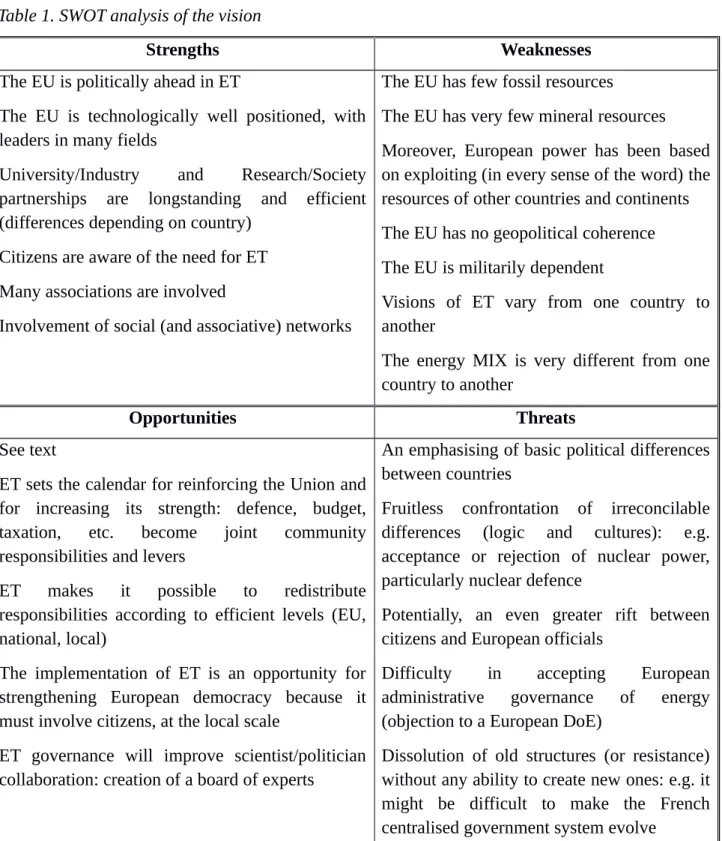
The three following pages illustrate the three basic proposals of this scenario. A SWOT table on the last page summarises the strengths/weaknesses/opportunities/threats of this vision.
2. Energy transition is an opportunity for institutional reform and the setting up of a democratic process in the European Union
The aim is to make EU objectives more consistent with allotted means. An institutional review is done in order to re-examine the powers/functions and means of the EU and examine or review the final results of concrete projects set up by the EU. The most important mandates or subjects that need to be re-examined at the European level are the budget, taxation, defence, energy, and its mineral/fossil resource development policy. There is a redistribution of responsibilities between national, European and local levels with an increased ability for local authorities to act locally. If the EU is in charge of coordinating ET, it should have the resources to do it. Therefore, to manage ET sectoral reconversions and "winners and losers" over the short- and medium-term, the EU must have a taxing right.
This is done through negotiations, debates, and discussions within the EU and with all of the stakeholders in a new European social contract, a fiscal pact, because ET is synonymous with transfers, winners and losers. Since ET implicates European values and involves a large scale institutional reform, a European social debate will eventually be necessary in spite of linguistic and cultural difficulties, and a new branch will need to be created, drawing lessons from the past (better communication, transparency, involvement of European citizens upstream). The EU must coordinate the setting up and carrying out of ET for more power and less redundancy at the European level. Creation of strategic frameworks by zone or region and more efficient arbitration tools, improved coordination in order to avoid location effects and provide more coherence.
A supranational institution is created and put in charge of energy, ET and the management of the externalities associated with the energy policy, since all energies have externalities. However, we must remain vigilant as regards the mandates of this institution and consider the democratic process when appointing managers because European citizens feel disconnected from European institutions, which they consider to be too technocratic. How can we/Can we imagine, at the same time, investing more power in the European Parliament?
To bring Europe, ET and citizens closer together: develop partnerships between towns on energy issues/projects. Joint decision making bodies, joint public policies, or simply exchanges are created. An example of a public policy would be to decrease the number of diesel powered cars in French and German cities. There might be joint assemblies of citizens and elected officials. This type of initiative already exists (http://www.energy-cities.eu), but it must be further developed and broadened. In general, these initiatives involve only elected officials who meet in Brussels. Citizens of towns in different European countries must be given the opportunity to become directly involved in the decision making process, make laws together, and create joint and participatory governance.
The triple "sovereignty/defence/nuclear" issue is discussed in the European Union and is resolved thanks to energy independence and by setting up a joint defence policy, which resolves, in particular, problems related to the opposition to nuclear power.
3. The European Union governs industrial, commercial and energy policies
1. Energy transition that applies to Europe and to imported products and services
Setting up an arsenal of protection, not by isolating Europe from the market but by imposing an environmental tax on imports, granting subsidies, and including life-cycle analysis, in order to guarantee fairness and compliance with European environmental and social regulations (in particular, in the job market). With the revenue from import taxes, the VAT on certain products and the tax burden on labour can be lowered.
2. The energy market
Government authorities provide means and re-examine market regulations so that small operators have a fair chance up against large, historical energy companies that benefit from assets and market distortions. By attacking the factors that prevent change rather than attacking the major energy companies head-on, a new economic model will emerge.
3. Supporting NRE, energy efficiency and sufficiency
Member States continue to support renewable energies as public property. An assessment policy that includes life cycle analysis and takes into account externalities results in the suppression or modification of current subsidies (that are meant only to aid in the development of NRE and are therefore not permanent) for more transparency and coherence.
4. The signal price
Inclusion of externalities in the price. Setting up of a signal price that is stable enough so that companies will modify their long term investment decisions.
For petrol and fossil fuels, the EU sets a price that does not depend on the market price (floating tax). Predictable oil prices that will encourage investments and behaviours that are conductive to ET (system associated with trade protection in order to reintroduce equity between imported products and those produced within the EU).
Use of a carbon tax system but with no emissions trading and with a fixed carbon price in order to prevent past errors.
5. Funding energy transition 6. European research
European research helps improve energy efficiency and sufficiency, create NRE that are consistent with European social and environmental conditions, and stimulate the third industrial revolution (see Jeremy Rifkin) / a new type of economic dynamism with modified economic performance indicators. Increase in the budget allotted to European research, in particular for ET projects.
4. The European Union, Member States and civil society stakeholders work to create a new European society
1. A board of innovation scientists that can act on its own initiative guides the decisions of politicians who are not experts
The objective is to include scientists in political decision making.
A board of scientists at the European level in charge of innovation in the broad sense. This is important because it challenges current modes of operation and decision making.
The board of experts is associated with the reform of the political circle. Encourage the circulation of talent between the political and private sector. Politicians are usually civil servants or are self-employed (i.e. liberal professions) because it is difficult for people in the private sector to enter politics and then return to the private sector. This could attract more people with different backgrounds and motivations, though safeguards are needed to prevent any conflict of interest.
2. Social dialogue
There is constant dialogue between stakeholders at the European level.
3. Education and teaching
Ensure that future generations are not consumers but "consum'actors" (or "prosumers").
In schools, study consumer behaviour in the economic machine and discuss the values conveyed by economic growth (consumption = happiness). As long as people continue to desire to consume more products for less money, it will be hard to have a long-term vision and include externalities.
Re-examine the economic performance indicators (see final report of the Pour
une économie positive think-tank headed by Jacques Attali).
Use marketing strategies to change how people usually think of sufficiency and make the message more attractive: "Consume better rather than consuming less", "Live better rather than consuming more".
The text above describes, for the most part, opportunities for placing ET at the centre of European construction. These thoughts should be put in perspective by listing the EU's strengths in this area (ET), its weaknesses, the foreseeable risks or threats associated with a proactive policy (like the one described here), and a summary of the opportunities described in detail above.
Table 1. SWOT analysis of the vision
Strengths Weaknesses
The EU is politically ahead in ET
The EU is technologically well positioned, with leaders in many fields
University/Industry and Research/Society partnerships are longstanding and efficient (differences depending on country)
Citizens are aware of the need for ET Many associations are involved
Involvement of social (and associative) networks
The EU has few fossil resources
The EU has very few mineral resources Moreover, European power has been based on exploiting (in every sense of the word) the resources of other countries and continents The EU has no geopolitical coherence The EU is militarily dependent
Visions of ET vary from one country to another
The energy MIX is very different from one country to another
Opportunities Threats
See text
ET sets the calendar for reinforcing the Union and for increasing its strength: defence, budget, taxation, etc. become joint community responsibilities and levers
ET makes it possible to redistribute responsibilities according to efficient levels (EU, national, local)
The implementation of ET is an opportunity for strengthening European democracy because it must involve citizens, at the local scale
ET governance will improve scientist/politician collaboration: creation of a board of experts
An emphasising of basic political differences between countries
Fruitless confrontation of irreconcilable differences (logic and cultures): e.g. acceptance or rejection of nuclear power, particularly nuclear defence
Potentially, an even greater rift between citizens and European officials
Difficulty in accepting European administrative governance of energy (objection to a European DoE)
Dissolution of old structures (or resistance) without any ability to create new ones: e.g. it might be difficult to make the French centralised government system evolve
R&Dialogue related documents
• R&Dialogue position paper, R&Dialogue project, 2012
• Ciesielska, J., 2014, Energy Dialogue : the story so far, R&Dialogue report, February
• Ha-Duong, M., Cherbib, M., 2014, Panorama des positions et visions des acteurs sur le dialogue social sur la transition énergétique,
CIRED/SMASH report, April
• Ha-Duong, M. & al, 2015, French national council vision paper, R&Dialogue project, May
• Ha-Duong, M., Finon, 2013, Transition énergétique, projets de société et tensions du présent: actes électroniques de la première journée de dialogue CNRS sur la transition énergétique en France.
• Ha-Duong, M., Finon, D., 2014, La recherche controversée d'énergies "propres" : actes électroniques de la deuxième journée de dialogue CNRS sur la transition énergétique en France.
• Ha-Duong, M., Finon, D., 2014, Maîtriser la demande d'énergie, une option consensuelle face à ses obstacles : actes électroniques de la troisième journée de dialogue CNRS sur la transition énergétique en France.
R&Dialogue French team and partners
B
RGM: Bureau de Recherches Géologiques et Minières, France’s leading public institution in the earth science field has three main activities: scientific research, support for government policy, and international cooperation and development assistance.
SMASH: Société de Mathématiques et de Sciences Humaines, a research organisation founded for the development of mathematical methods
applied to the social sciences. SMASH extended its R&Dialogue position paper expertise to energy planning, energy economics, the rational use of energy, the development of renewable energy vectors and carbon capture and storage. CIRED : Research programs conducted at Cired (international research center on environment and development) focus on the relationships between environment, natural resources and development, with focus on three key domains: energy, urban infrastructure, and agriculture and forestry---which imposes a constant dialogue between social sciences, natural sciences and engineering knowledge. APESA : APESA is a technological center on enviromnent and risk management. Its objectives are to develop technological solutions, innovative methodologies, trainings to allow stakeholders to integrate the sustainable development challenges in their strategy.