Publisher’s version / Version de l'éditeur:
Cement, Concrete and Aggregates, 25, Dec. 2, pp. 29-34, 2003-12-01
READ THESE TERMS AND CONDITIONS CAREFULLY BEFORE USING THIS WEBSITE.
https://nrc-publications.canada.ca/eng/copyright
Vous avez des questions? Nous pouvons vous aider. Pour communiquer directement avec un auteur, consultez la
première page de la revue dans laquelle son article a été publié afin de trouver ses coordonnées. Si vous n’arrivez pas à les repérer, communiquez avec nous à [email protected].
Questions? Contact the NRC Publications Archive team at
[email protected]. If you wish to email the authors directly, please see the first page of the publication for their contact information.
Archives des publications du CNRC
This publication could be one of several versions: author’s original, accepted manuscript or the publisher’s version. / La version de cette publication peut être l’une des suivantes : la version prépublication de l’auteur, la version acceptée du manuscrit ou la version de l’éditeur.
Access and use of this website and the material on it are subject to the Terms and Conditions set forth at
Proposed universal accelerated test for alkali-aggregate reaction the concrete microbar test
Grattan-Bellew, P. E.; Cybanski, G.; Fournier, B.; Mitchell, L. D.
https://publications-cnrc.canada.ca/fra/droits
L’accès à ce site Web et l’utilisation de son contenu sont assujettis aux conditions présentées dans le site LISEZ CES CONDITIONS ATTENTIVEMENT AVANT D’UTILISER CE SITE WEB.
NRC Publications Record / Notice d'Archives des publications de CNRC:
https://nrc-publications.canada.ca/eng/view/object/?id=59eb907b-48cf-4f12-be8e-c27ac5b26e7d https://publications-cnrc.canada.ca/fra/voir/objet/?id=59eb907b-48cf-4f12-be8e-c27ac5b26e7d
Proposed universal accelerated test for alkali-aggregate reaction the concrete microbar test
Grattan-Bellew, P.E.; Cybanski, G.; Fournier, B.; Mitchell, L.
NRCC-46876
A version of this document is published in / Une version de ce document se trouve dans : Cement Concrete and Aggregates, v. 25, no. 2, Dec. 2003, pp. 29-34
Proposed Universal Accelerated Test for Alkali-Aggregate Reaction The Concrete Microbar Test
P.E. Grattan-Bellew1, George Cybanski2, B. Fournier3 & L. Mitchell1 1
Institute for Research in Construction, National Research Council of Canada, Building M-20, Ottawa, ON Canada, K1A 0R6. 2Karson Group, P.O. Box 264, Carp-Ottawa, ON, Canada K0A 1L0. 3 Canadian Centre for Mineral and Energy Technology, Materials Technology Laboratory, 405 Rochester Street, Ottawa, ON, Canada, K1A 0G1.
ABSTRACT
The Concrete Microbar Test is modified after a Chinese test, for alkali-carbonate reactive aggregates, described in 2000. The protocol for the test is essentially the same as for ASTM C 1260, the accelerated mortar bar method except for the size of the bars, the grading of the
aggregate, the water to cement ratio and the length of the test. The concrete microbars are 40 by 40 by 160 mm. The aggregate is graded to pass a 12.5 mm sieve and be retained on a 4.75 mm sieve. The water to cement ratio is 0.33. The length of the test is 30 days in 1 M NaOH at 80°C. The test results show that the method is applicable to both alkali-carbonate and alkali-silica reactive aggregates. Moderate correlation was found between the expansions measured in this test at 30 days, and in the concrete prism test (CSA A23.2-14A) at 1 year. When expansions in the concrete prism test and in the concrete microbar test are plotted on a graph the siliceous limestones fall on a separate line from all the other aggregates tested so far including the alkali-carbonate reactive aggregate from Kingston. Some tests were also carried out with some bars measuring 40 by 40 by 300 mm. The longer bars gave, on average, 22% more expansion.
Alkali-carbonate reactive aggregates may be distinguished from alkali-silica reactive aggregates in this test by replacing a portion of the portland cement by a supplementary cementing material. The expansions of alkali-silica reactive aggregates are significantly reduced by the presence of the supplementary cementing material but expansion of alkali-carbonate reactive aggregates is largely unaffected. Opal does not appear to exhibit the pessimum effect in this test. It would be premature to establish expansion limits based on the limited number of aggregates tested to date. However, it is tentatively suggested that the expansion limit for siliceous limestones is ~0.13% at 30 days; the limit for all other aggregates is ~0.06%.
KEYWORDS: accelerated test method, alkali-silica, alkali-carbonate, aggregate, sodium hydroxide, 80°C.
Introduction
The most commonly used accelerated test for alkali-silica reaction (ASR) is the Accelerated Mortar Bar Method ASTM C 1260-94 that was originally proposed by Oberholster and Davies in 1986. This method has also been adopted by the Canadian Standards Association as Test
Method A23.2-25A, 2000 and is being developed as an ultra accelerated mortar bar test by RILEM. The use of this method permits the determination of the potential alkali-silica reactivity of aggregates in 16 days. However, this method is not effective with alkali-carbonate reactive (ACR) aggregates. Although the accelerated mortar bar method is widely used it is not without it’s problems. For example, Fournier and Bérubé2000 found poor correlation between
expansions in the accelerated mortar bar test and in the concrete prism test CSA A23.2-14A, 2000. In a recent series of tests, of assorted aggregates, the present authors also found no
correlation between the expansions obtained in the accelerated mortar bar test and those in the concrete prism test CSA A23.2-14A.
Xu et al., 2000 proposed a new accelerated test for alkali-carbonate reactive aggregates using concrete microbars containing aggregates varying in size from 10 to 5 mm stored in 1M NaOH @ 80 °C. Storage times were up to 25 weeks. A modification of their test procedure is the basis for the method proposed here. The test method is applicable to both ACR and ASR aggregates. The proposed test protocol is similar to ASTM C 1260 except for the use of bars with a larger cross section, different aggregate grading and mixture proportions and a longer test period.
Test Procedure
Apparatus
The apparatus conformed to ASTM C 490 except that the molds have a gauge length of 160 ± 2.5 mm and a cross-section of 40 x 40 mm. These are the RILEM mortar bar molds that were used by Xu et al., ibid.
Aggregate Preparation
The aggregates are crushed, if necessary, and sieved and graded to pass a 12.5 mm sieve and be retained on a 4.75 mm sieve. This grading gave satisfactory results. However, for a standard test it may be desirable to specify the amounts retained on the intermediate 9.5 mm sieve in addition to that on a 4.75 mm sieve. Using only one size of aggregate might result in differences in the grading in laboratories using different crushers and this might increase the coefficient of
variation between laboratories. Additional testing will be necessary to determine if this is the case.
Mixture Proportions
The dry materials for the concrete microbars were proportioned using 1 part graded aggregate to 1 part Type 10 portland cement. The quantities required to make three concrete microbars are 900 g of cement and 900 g of dry aggregate. The water to cement ratio is ~0.33. It is adjusted for workability. The cement used has an alkali content of 0.9% Na2O equivalent. The alkali content of the cement is probably not very significant due to the excess alkali supplied by the sodium hydroxide solution in the containers. However this needs further investigation.
Mixing & Molding Procedure
The cement and most of the water (290 ml) are put in the Hobart bowl and mixed at slow speed for 60 seconds The sides of the bowl are then scraped down and the paste is allowed to stand for 90 seconds. It is then remixed for another 60 seconds. The standard paddle specified in ASTM C 305 is then changed for a spiral shaped hook type and the aggregate is added and the batch is remixed at slow speed for one minute. If required, small quantities of water may be added to obtain the desired consistency. The mixture is compacted into the molds with a tamper, in the usual way. After the molds have been filled they are vibrated for a few seconds to remove air from the mixtures. The molds, covered with plastic, are stored in a fog room, or moisture cabinet, at 23°C for 24 ± 2 hours. The bars are then de-molded and immersed in water in
suitable plastic containers. The lids are sealed shut with duct tape and the containers are placed in an oven at 80°C for 24 hours. The containers are then removed from the oven and the lengths and masses of the bars are measured. These measurements are the zero length and mass for subsequent measurements. The bars are then transferred to 1 M NaOH at 80°C and returned to the oven at 80°C. Length and mass change are monitored periodically for 30 days.
Test Results
Alkali-Silica and Alkali-Carbonate Reactive Aggregates
The expansions of concrete microbars made with three highly-reactive Canadian aggregates, i.e., an alkali-carbonate reactive limestone from Kingston (Ontario), the alkali-silica reactive Spratt limestone from Ottawa (Ontario), an alkali-silica reactive meta-greywacke from Halifax (Nova Scotia), and a non-reactive limestone are shown in Figure 1. The expansions shown in Figure 1 are the means of the three bar sets. It is evident, from these limited test results that the test is capable of differentiating between expansive and non-expansive aggregates. The test method is also effective with both ACR and ASR limestones and with greywacke. Expansion limits will have to be established for the different categories of aggregates.
An advantage of the concrete microbar method is that, for most aggregates tested so far, expansion is linear over, at least, a 30-day period. In principle, the linearity of the expansion would permit estimation of the 30-day expansion by extrapolation from, for example, expansion at 15 days.
0 0.05 0.1 0.15 0.2 0.25 0.3 0.35 0.4 0.45 0 10 20 30 40 50
Days in 1M NaOH @ 80 Deg. C.
Expansi on % Kingston Spratt Greywacke Non-Reactive lst
Fig.1-Expansion of concrete microbars made the ACR aggregate from Kingston, Spratt siliceous limestone from Ottawa, a reactive greywacke from Nova Scotia and a non-reactive limestone.
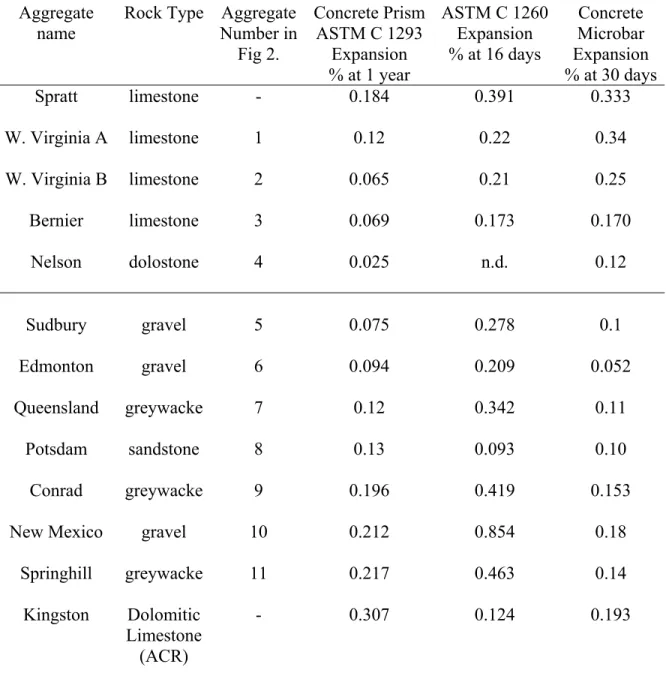
A number of different types of aggregates, from Canada, USA and Australia were evaluated in the concrete microbar test. The expansions, at 30 days, obtained are compared with the one-year expansions of concrete prisms made with the same aggregates in Table I and Figure 2. The results shown in Figure 2 indicate that the siliceous limestones plot along a separate line from that of the other assorted aggregates. The surprising result is that the point representing the Kingston ACR aggregate plots on the line of the assorted aggregates rather than on that of the limestones. The correlation coefficient (R2) for the line fitted to the points representing assorted aggregates and the Kingston sample is 0.79 that for the line fitted to the limestones is 0.70. There is thus a reasonable correlation between expansions in the concrete prism test and in the concrete microbar test, at least for the assorted aggregates.
Table I Expansions of aggregates in ASTM C 1293, C 1260 and in the Concrete Microbar test Aggregate
name
Rock Type Aggregate Number in Fig 2. Concrete Prism ASTM C 1293 Expansion % at 1 year ASTM C 1260 Expansion % at 16 days Concrete Microbar Expansion % at 30 days Spratt limestone - 0.184 0.391 0.333 W. Virginia A limestone 1 0.12 0.22 0.34 W. Virginia B limestone 2 0.065 0.21 0.25 Bernier limestone 3 0.069 0.173 0.170 Nelson dolostone 4 0.025 n.d. 0.12 Sudbury gravel 5 0.075 0.278 0.1 Edmonton gravel 6 0.094 0.209 0.052 Queensland greywacke 7 0.12 0.342 0.11 Potsdam sandstone 8 0.13 0.093 0.10 Conrad greywacke 9 0.196 0.419 0.153
New Mexico gravel 10 0.212 0.854 0.18
Springhill greywacke 11 0.217 0.463 0.14
Kingston Dolomitic Limestone
(ACR)
0 0.1 0.2 0.3 0.4 0.5 0.6 0 0.1 0.2 0.3 0.4 0.5 0.6
Concrete Prism Expansion % @ 1 year
C on c ret e M ic rob ar E x pans ion % @ 30 da y s Assorted Siliceous Limestone Greywacke Gravels 1 2 3 4 Spratt 5 Kingston (ACR) 6 7 8 11 9 15 10 14 13 12
Fig.2. Comparisons of 1-year expansions of concrete prisms stored at 38°C and 100% humidity with the 30-day expansions of concrete microbars, made with assorted aggregates and stored in 1 M NaOH @ 80 Deg. C. #1 West Virginia limestone A; West Virginia limestone B; #3 Bernier limestone; #4 non-reactive Nelson dolostone; #5 Sudbury gravel; #6 Edmonton gravel; #7 Queensland greywacke; #8 Potsdam sandstone; #9 Conrad greywacke; #10 New Mexico gravel, 11 Springhill greywacke.
Effect of Aggregate Grading on Reproducibility of the Test
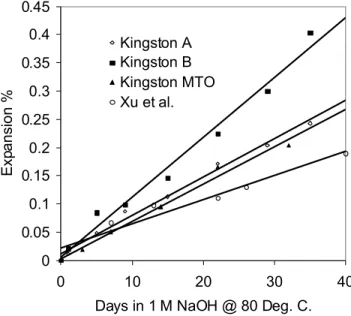
A number of tests were run on the Kingston aggregate both in the laboratory of the authors and in that of Xu et al., ibid., in China. The grading of the aggregates was varied to find that which resulted in the maximum expansion with the Kingston ACR aggregate in the proposed test method. The results are shown in Figure 3. The results of all the tests are similar for the first 15
Grattan-Bellew et al., March 2003
0 25 0.3 0.35 0.4 0.45 o n % Kingston A Kingston B Kingston MTO Xu et al.
0 0.05 0.1 0.15 0.2 0.25 0.3 0.35 0.4 0.45 0 10 20 30 40
Days in 1 M NaOH @ 80 Deg. C.
Ex p a ns io n % Kingston A Kingston B Kingston MTO Xu et al.
Fig 3.-Effect of grading and location in the quarry on the expansion of concrete microbars made with Kingston ACR aggregate. Kingston A -9.5 +4.75 mm; Kingston B - 12.5 +4.75 mm; Kingston MTO S -9.5 + 4.75 mm; Xu et al. -10 + 5 mm.
days, but thereafter the expansions of bars with different gradings diverged. It should be noted that the aggregate used in tests A and B was taken from a different part of the Kingston quarry than the MTO reference aggregate. However, the test bars with the same gradings gave
essentially the same results. The expansions of all the bars tested in Canada are essentially linear up to 40 days, but those tested in China diverged from linearity after about 15 days. The concrete made with the Kingston aggregate with the coarser grading gave the most expansion. This result is in agreement with that of Xu et al., ibid. The workability of the concrete with an aggregate grading of –12.5 +9.5 mm was poor so it was decided to standardize on a grading obtained by passing the aggregate through a 12.5 mm screen and being retained on a 4.75 mm screen. This grading that gave greater workability.
Reproducibility of Expansions within Bars of an Individual Test
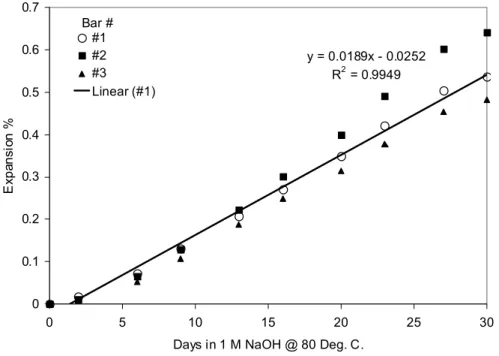
After some practice with making and measuring the concrete microbars good reproducibility was found between the three bars of a set. Figure 4. The increased spread at later ages is likely due to the effect of the development of significant cracking in the microbars. Cracks were first
observed in Bar #2 that shows the most expansion.
y = 0.0189x - 0.0252 R2 = 0.9949 0 0.1 0.2 0.3 0.4 0.5 0.6 0.7 0 5 10 15 20 25 30
Days in 1 M NaOH @ 80 Deg. C.
E x pa ns io n % #1 #2 #3 Linear (#1) Bar #
Fig. 4-Expansions of individual concrete microbars in a three-bar test set made with a siliceous limestone.
Effect of Length of Concrete Microbars on Expansion
The same set of assorted aggregates for which the expansions are shown in Figure 2 were evaluated in the laboratory of one of the co-authors (G.C) using bars 40 x 40 x 286 mm. The grading of the aggregates used was also coarser –13.2 + 4.75 mm. The mixture proportions were the same as for the short bars but the quantity of aggregate required for a 3-bar mixture is 1650 g. The longer bars gave, on average, 22% more expansion compared to the 160 mm bars, Figure 5. Additional testing of 160 and 300 mm long bars made from one batch of concrete will be done to determine if the greater expansion of the longer bars is due to the use of coarser aggregate.
Comparison of Expansions in Concrete Microbars and in Mortar Bars Stored in 1 M NaOH at 80°C.
The results of the measured expansions of concrete microbars and of mortar bars, made with Kingston ACR and Spratt ASR reference aggregates, stored in 1 M NaOH @ 80 °C. are shown in Figure 6. The mortar bars made with the ASR siliceous limestone (Spratt) expanded significantly more than the concrete microbars. This is as expected as expansion of test bars made with ASR aggregates increases with decreasing particle size. On the contrary, with the ACR aggregates, expansion increases with increasing particle size. Mortar bars were found to expand less than concrete prisms Swenson & Gillott 1964.
0 0.1 0.2 0.3 0.4 0.5 0.6 0 10 20 30 40 5
Days in 1 M NaOH @ 80 Deg. C.
Exp ansi on % Spratt 0 ASR Kingston ACR mortar concrete concrete mortar
Fig.5-Comparison of 30-day expansions of 160 mm and 286 mm concrete microbars.
Queensland greywacke #1, Conrad greywacke #2, New Mexico gravel #3, Edmonton Gravel #4, Sudbury gravel #5, Potsdam sandstone #6.
Differentiation Between Expansions of Concrete Microbars Due to ASR and ACR
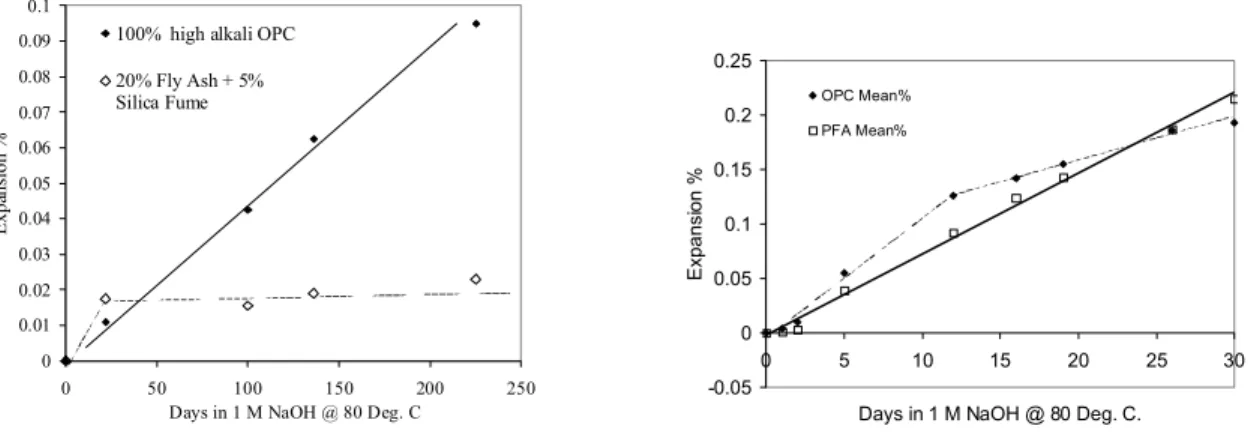
In the case of limestone aggregates it is possible to differentiate between expansion due to ASR and ACR by running a second test in which a portion of the portland cement is replaced by a supplementary cementing material, (SCM) or a suitable amount of a lithium salt. Swenson & Gillott1960 showed that fly ash was not effective in preventing expansion due to ACR. Slag is also not effective Grattan-Bellew & Rogers2000. A combination of 20% low alkali, ASTM Class F fly ash and 5% silica fume was found to be very effective in preventing expansion of concrete microbars containing an alkali-silica reactive siliceous limestone, Figure 7a., while
replacement of 30% of the portland cement by a low alkali ASTM Class F fly ash had little effect on the expansion of concrete microbars containing Kingston ACR aggregate, Figure 7b.
0 0.01 0.02 0.03 0.04 0.05 0.06 0.07 0.08 0.09 0.1 0 50 100 150 200 250
Days in 1 M NaOH @ 80 Deg. C
Ex
pa
n
sio
n %
100% high alkali OPC 20% Fly Ash + 5% Silica Fume -0.05 0 0.05 0.1 0.15 0.2 0.25 0 5 10 15 20 25 30
Days in 1 M NaOH @ 80 Deg. C.
E x pa ns ion % OPC Mean% PFA Mean%
Fig. 6- Effect of supplementary cementing materials on expansion of concrete microbars: a. Bars made with siliceous limestone in which a portion of the portland cement was
replaced by 20% of a low calcium fly ash and 5% silica fume.
b. Effect of the replacing 30% of portland cement with a low calcium fly ash on expansion of bars made with Kingston ACR aggregate.
Discussion
Length of Microbars
The advantage of the 160 mm bars is that this is the size that has been adopted by RILEM in Europe, and by the Chinese and Japanese research laboratories. Adoption of the 160 mm bars would lead to uniformity in the test method throughout the world. The main disadvantage is that the North American laboratories, that normally measure 286 mm bars, would have to obtain, or modify the measuring apparatus for measuring the 160 mm bars. Adoption of 286 mm bars would mean that North American laboratories could use their existing measuring apparatus and would only have to acquire new molds.. We have found that plastic molds, that can be made
cheaply, are quite satisfactory. If subsequent evaluation confirms that greater expansions are obtained with the longer bars this would be an added advantage to the adoption of the 286 mm bars. There would presumably also be an improvement in the precision of the measurements with the longer bars. This could mean, however, that different expansion limits would have to be adopted compared to those of RILEM.
Comparisons of Expansions of Concrete Prisms stored at 38°C and 100% humidity and of concrete microbars stored at 80°C in 1 M NaOH
The reason why the siliceous limestones plot along a different line, in Figure 2, from the other assorted alkali-silica reactive aggregates is unknown; similarly, the reason why the Kingston ACR sample plotted on the line with assorted alkali-silica reactive aggregates is unknown. This will be the subject of a future investigation.
Effect of SCM’s on Expansion of Concrete Microbars Made with ASR Aggregates
Tests have shown that replacement of a suitable proportion of portland cement with an SCM to be effective in minimizing expansion in the concrete microbar test due to ASR. Accordingly, this test could, in principle, be developed to evaluate the effectiveness of SCM’s in preventing deleterious expansion of concrete made with ASR aggregates.
The Pessimum Effect
The pessimum effect that results in maximum expansion of concrete or mortar bars occurring when some small proportion of a non-reactive aggregate is replaced by a highly reactive aggregate such as chert or opalHobbs 1988. With some cherts and opals the pessimum
proportion may be about 5% or less. Preliminary results of tests using a non-reactive dolomitic limestone aggregate mixed with 5, 25 and 50% opal indicates that opal does not appear to exhibit the pessimum effect over the range of replacement levels used in this test, Figure 8. The
concrete containing 50% opal shows marginally more expansion than the other samples. Expansion Limits
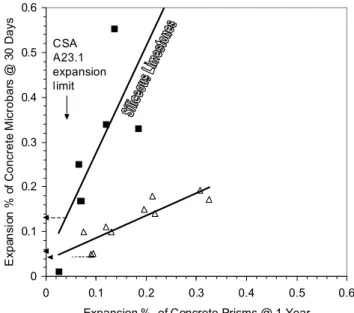
The expansion limit for concrete prisms at one year in CSA A23.2-14A is 0.04%. If the 0.04% limit is transferred from the concrete prism test results to the concrete microbar test results shown in Figure 2 provisional expansion limits for the concrete microbar test may be obtained, Figure 7. The expansion provisional limits, at 30 days, are 0.05% for the assorted alkali-silica reactive aggregates and 0.14% for the siliceous limestones. These proposed limits would have to be confirmed by a more extensive testing program. The expansion limit at 30 days for ACR aggregates is uncertain, as at present a suite of alkali-carbonate reactive aggregates with known expansions in the concrete prism test is not available.
Mass Change of Concrete Microbars During Test
Measuring the change in mass of the bars over the course of the test is helpful in interpreting the results and in monitoring the condition of the bars. If, for example, one of the three bars of a set shows anomalous expansion a check of the mass change may help understanding the cause of the
0 0.1 0.2 0.3 0.4 0.5 0.6 0 0.1 0.2 0.3 0.4 0.5 0.6 Expansion % of Concrete Prisms @ 1 Year
E x pa ns io n % o f C o nc re te Mi c roba rs @ 3 0 D a y s CSA A23.1 expansion limit
Fig. 7-Extrapolation of the 0.04% expansion limit for concrete prisms in the CSA test A23.2-14A to concrete microbars indicates a limit of ~0.14% for siliceous limestones and ~0.04% for all other aggregates.
anomaly. A detailed discussion of the change in mass of the concrete microbars during the test is outside the scope of this document and will be the subject of a future publication.
Change in Temperature of Bars During Measurement
It is very important to always measure the bars in a container in the same sequence every time because the temperature of the bars will probably change while the measurements are being made. The expansions reported here were measured while the plastic container was kept on a hot plate to try and maintain 80° C. Despite being on a hot plate the temperature of the sodium hydroxide solution fell at a rate of 1.4°/minute. This is presumed to be due to the poor thermal conductivity of the plastic container. If the temperature of the hot plate is raised too high the plastic starts to melt. It is probable that the drop in temperature of the bars may be somewhat less than that of the solution, but it may not be insignificant particularly if the container holds many bars. For this reason, it is probably preferable to limit the number of bars in a container to three, or at most, six.
Conclusions
The following conclusions may be drawn from the test data obtained in this investigation: The concrete microbar test has been shown to be effective in evaluating the potential
reactivity of both ASR and ACR aggregates.
Moderate correlation was found between expansion in the concrete microbar test and in the concrete prism test.
Test results show that the optimum aggregate grading, for evaluating ACR aggregates, is passing a 12.7 mm screen and retained on a 4.75 mm screen. The recommended mixture proportions for 160 mm bars of a three-bar mix are: 900 g of portland cement and 900 g of dry graded aggregate with a water : cement ratio of ~0.33.
The size of the concrete microbars used may be either 40 x 40 x 160 mm, or 40 x 40 x 286 mm.
Siliceous ASR limestones may be differentiated from ACR dolomitic limestones by running two tests, one in which the bars contain 100% portland cement, the other in which a suitable proportion of the portland cement is replaced by a supplementary cementing material (SCM), e.g., 30% low alkali, ASTM Class F fly ash. Expansion of bars containing ASR aggregate and an SCM is significantly reduced, while the addition of the SCM had little effect on the expansion of ACR aggregate.
The concrete microbar test also has a potential for evaluating the effectiveness of supplementary materials in minimizing expansion due to ASR.
Tentative expansion limits at 30 days for siliceous limestones and assorted other aggregates are 0.14% and 0.04% respectively. However, these limits will have to be confirmed by additional work.
References
ASTM C 1260-94, Standard Test Method for Determining the Potential Alkali Reactivity of Combinations of Cementious Materials and Aggregate (Accelerated Mortar-Bar Method). Annual Book of ASTM Standards 2002, Vol 04.02, American Society for Testing and Materials, 1916 Race Street, Philadelphia, PA 19103.
CSA International, 2000, “A23.1-00/A23.2-00 Concrete Materials and Methods of Concrete Construction/Methods of Test for Concrete,” CSA International, 178 Rexdale Boulevard, Toronto, Ontario M9W 1R3.
A23.2-14A Potential Expansivity of Aggregates (Procedure for Length Change Due to Alkali-Aggregate Reaction in Concrete Prisms), pp. 207-216.
A23.2-25A Test Method for Detection of Alkali-Silica Reactive Aggregate by Accelerated Expansion of Mortar Bars, pp. 240-245.
Fournier, B., Bérubé, M-A., & Frenette, J., 200, “Laboratory Investigations for Evaluating Potential Alkali-Reactivity of Aggregates and Selecting Preventive Measures Against Alkali-Aggregate Reaction (AAR) What does it Mean?” Proc. 11th International Conference on Alkali-Aggregate Reaction, Quebec, 2000, pp. 287-296. Grattan-Bellew, P.E., & Rogers, C.A., “Expansion Due to alkali-Carbonate Reaction: Laboratory Prognosis Versus Field Experience,” Proc. 11th International Conference on Alkali-Aggregate Reaction, Quebec, 2000, pp. 41-50.
Hobbs, D.W., 1988 “Alkali Silica Reaction in Concrete,” Thomas Telford Ltd., London, pp. 183.
Oberholster, R.E. and Davies, G., 1986, “An Accelerated Method for Testing the Potential Alkali Reactivity of Siliceous Aggregates” Cement & Concrete Research, Vol.16, pp. 181-189.
Swenson, E.G., and Gillott, J.E., “Characteristics of Kingston Carbonate Rock Reaction,” Highway Research Board Bulletin No. 275, 1960, pp. 18-31.
Xu, Z., Lan, X., Deng, M., and Tang, M. “A New Accelerated Method for Determining the Potential Alkali-Carbonate Reactivity,” Proc. 11th International Conference on Alkali-Aggregate Reaction, Quebec, 2000, pp. 129-138.