Publisher’s version / Version de l'éditeur:
Vous avez des questions? Nous pouvons vous aider. Pour communiquer directement avec un auteur, consultez la première page de la revue dans laquelle son article a été publié afin de trouver ses coordonnées. Si vous n’arrivez pas à les repérer, communiquez avec nous à [email protected].
Questions? Contact the NRC Publications Archive team at
[email protected]. If you wish to email the authors directly, please see the first page of the publication for their contact information.
https://publications-cnrc.canada.ca/fra/droits
L’accès à ce site Web et l’utilisation de son contenu sont assujettis aux conditions présentées dans le site LISEZ CES CONDITIONS ATTENTIVEMENT AVANT D’UTILISER CE SITE WEB.
Proceedings of the 2nd CIE Expert Symposium on Lighting and Health: 07
September 2006, Ottawa, Ontario, pp. 56-61, 2006-09-07
READ THESE TERMS AND CONDITIONS CAREFULLY BEFORE USING THIS WEBSITE. https://nrc-publications.canada.ca/eng/copyright
NRC Publications Archive Record / Notice des Archives des publications du CNRC :
https://nrc-publications.canada.ca/eng/view/object/?id=344b162d-aca0-4cbe-a629-1a04161c10ab https://publications-cnrc.canada.ca/fra/voir/objet/?id=344b162d-aca0-4cbe-a629-1a04161c10ab
NRC Publications Archive
Archives des publications du CNRC
This publication could be one of several versions: author’s original, accepted manuscript or the publisher’s version. / La version de cette publication peut être l’une des suivantes : la version prépublication de l’auteur, la version acceptée du manuscrit ou la version de l’éditeur.
Access and use of this website and the material on it are subject to the Terms and Conditions set forth at
Lighting for well-being: a revolution in lighting?
http://irc.nrc-cnrc.gc.ca
L i g h t i n g f o r w e l l - b e i n g : a r e v o l u t i o n i n
l i g h t i n g ?
N R C C - 4 9 2 0 5
V e i t c h , J . A .
A version of this document is published in / Une version de ce document se trouve dans: Proceedings of the 2nd CIE Expert Symposium on Lighting and Health, Ottawa, Ontario, Sept. 7-8, 2006, pp. 56-61
Originally published in the Proceedings of the 2nd CIE Expert Symposium on Lighting and Health
(CIE x031:2006, pp. 56-61). Vienna, Austria: CIE.
LIGHTING FOR WELL-BEING: A REVOLUTION IN LIGHTING?
Jennifer A. Veitch, Ph.D.National Research Council of Canada, Institute for Research in Construction Ottawa, Ontario, Canada
ABSTRACT
A model of lighting quality proposed in the 1990s defined good lighting as that which balances the needs of humans, economic and environmental issues, and architectural design. The model made explicit what had long been implicit: Lighting is not just about seeing details. Good lighting provides for the needed level of visual performance, but also determines spatial appearance, provides for safety, and contributes to human health and well-being. Far from being a revolutionary proposal, lighting for everyday well-being has long been a goal of lighting recommendations. The question for today is how quickly we should incorporate new research findings in revisions of recommendations. This paper will address the knowledge base and the state of lighting recommendations for three aspects of interior lighting that contribute to health and well-being: areas of high luminance (about which much is known, but more to be learned); luminous modulation (flicker) (about which we have some knowledge); and, total daily light exposure (about which knowledge is weak, but
suggestive). Appropriately, recommendations are most specific for
those areas about which knowledge is strongest. Revisions should keep pace with evolving knowledge, but not run ahead.
1. INTRODUCTION
The World Health Organization has defined health as follows: “…a state of complete physical, mental, and social well-being and not merely the absence of disease or infirmity” [1]. Although some have argued that this definition is too broad, it has the merit of being both negative (not a disease state) and positive (a state of complete fitness and contentment). My contention here is that lighting installations can, and do, contribute to both states. The question we face today is to what extent, and how quickly, we will modify our
recommendations to take into account new science concerning light effects on human physiology and psychology.
Figure 1 shows a model of lighting quality that appeared in the 2000 edition of the IESNA lighting handbook [2], and which is consistent with discussions at the First CIE Symposium on Lighting Quality here in Ottawa in 1998 [3]. It represents a major change in thinking about lighting design, a shift away from the dominance of visual performance as the chief goal for a lighting installation. Individual well-being for the people in the space – all the many and various needs of all the different people who encounter the lighting installation – is among three dimensions of good-quality lighting. Visibility (seeing fine details) remains an essential part of any lighting installation, but is not the only purpose of the installation.
Figure 1. Lighting quality model. From
Veitch (1998), courtesy of the National Research Council of Canada.
One example of how this new model might be applied is evident in the report of CIE's technical committee TC 6-11 [4]. The
page 2 of 6
report was the first review of the literature on light, lighting and health, and made the first attempt at formulating principles of healthy lighting together with preliminary suggestions for achieving healthy lighting within the framework of good-quality lighting. Two of the five principles are particularly relevant to this paper:
• The daily light dose received by
people in Western countries might be too low.
• The important consideration in
determining light dose is the light received at the eye, both directly from the light source and reflected off surrounding surfaces.
The science of light effects on human physiology and psychology is moving rapidly; for example, the TC 6-11 report included an appendix with citations to 58 original research papers published between the close of the literature review phase and the final editing of the report (January 2002 – November 2003) [4]. Further advances were reported in Vienna in September 2004 at the 1st CIE Symposium on Light and Health, which was attended largely by the scientific community [5]. Now, at the 2nd CIE Symposium on Lighting and Health, the challenge for lighting applications people is to consider how this work might change lighting recommendations.
Some have considered this to be a revolution in lighting [6]; others are more cautious in their excitement [7,8]. In this paper I review three ways in which lighting can influence well-being, with the aim of demonstrating that lighting practice has long addressed well-being in at least a limited way. The question before us now is not whether to use lighting to influence health and well-being, but which specific effects have sufficient scientific support to change recommendations now. These three aspects of well-being are not the whole picture, but they illustrate the progression of knowledge that one hopes will arise from prolonged investigation.
2. LIGHTING AFFECTS WELL-BEING 2.1 Direct Glare
Direct glare has a long history in the lighting research literature [9,10,11]. By
“direct glare” I mean unwanted light shining directly into the eye (or glancing off the cornea, in the case of what's been called "overhead glare"). This is an instance in which lighting recommendations already aim to provide well-being; in this case, prevention is the goal. The phenomena are somewhat well-understood, have been studied for decades, and have resulted in the adoption of predictive models in recommendations [12,13].
There are two dominant predictive models: Visual Comfort Probability (VCP) [12] and Unified Glare Rating (UGR) [13]. Although the models differ in their details, both predict the discomfort experienced by viewers as a function of luminaire luminance, adaptation luminance, luminaire position and luminaire size. VCP is less commonly used today, but UGR limit values are a feature of CIE’s standard for lighting of interior workplaces [14].
Nonetheless, there remain unanswered questions, and reasons to think that the models might not be the best predictors of discomfort in real settings. Glare from daylight induces less discomfort than would be predicted from the electric lighting models [15]. Little attention has been paid to evidence that psychological variables (for example, task involvement [16]) influence discomfort, or to evidence that view content influences discomfort [17,18]. Wide individual differences in discomfort also have received little research attention [16].
Lighting recommendations that aim to reduce direct glare do so in order to preserve well-being, despite these gaps in knowledge. There is room for improvement, but no one would recommend that we ignore direct glare in lighting recommendations because of the need for improved models.
2.2 Flicker
Luminous modulation of light source output, or flicker, is an example of a lighting dimension for which the evidence of effects on well-being is reasonably strong but which receives little emphasis in lighting recommendations.
Several studies have found that low-frequency luminous modulation, as from the operation of fluorescent lamps on magnetic ballasts (~100 – 120 Hz operation), can
page 3 of 6
interrupt saccadic eye movements [19,20], reduce visual performance [21,22], and increase the incidence of headache and eyestrain [23]. High-frequency operation, as when electronic ballasts with an operating frequency on the order of 40 kHz are used, improved well-being in these studies. It is thought that the effect is caused by meaningless neural signals in phase with the lamp operation that impede cortical functioning [24]. That is to say, there can be a sensory response to low-frequency flicker even when the luminous modulation is not perceived.
Although several studies have found deleterious effects of flicker, not all have been successful. Küller and Laike [25] found only that individuals with a low critical flicker fusion frequency showed the effect, raising the possibility that individual differences moderate the effect. The effect may diminish with age [26].
The principal lighting recommendations documents do discuss flicker and recommend the use of high-frequency control gear for discharge lamps in order to promote well-being [2,14,27]. However, it may be said that there is little emphasis given to this aspect of well-being. For example, flicker is rated as not important to reading in the Lighting Design Guide of the IESNA Lighting Handbook [2], and the topic rates a scant paragraph in the equivalent CIE document [14]. Reading the technical magazines one obtains the impression that energy savings, not improvements to well-being, are more likely reasons for the adoption of electronic over magnetic ballasts.
2.3 Daily Light Dose
This topic is more controversial: The suggestion that people in industrialized countries receive too little total light exposure each day. Although this was expressed as a principle in the CIE report [4], it is a novel suggestion based on a comparatively small research foundation and one which raises many questions.
One key study surveyed 106 middle-aged adults in San Diego, California [28], measuring daily patterns of light exposure and combined with self-reported mood. The median person spent 4% of each 24 hr in illumination greater than 1000 lx, and more
than 50% of the time in illuminance levels from 0.1 to 100 lx. The questionnaire results showed a moderate correlation between atypical seasonal affective disorder symptoms and time in bright light (r=-.27). This suggests that inadequate light exposure is associated with depressed mood, but does not establish a causal link.
Older adults in New York City participated in a similar study, to which detailed ophthalmologic measurements were added [29]. The total daily light exposure was low, although it is difficult to compare the two studies because the NYC study reported only that the median daily illuminance was 518 lx. Those with higher daily light exposure had less depressed mood; however, the correlation was reduced when ophthalmologic problems were added to the equation. The authors suggested that people with ophthalmologic problems experience lower retinal illuminance than healthy people, and therefore derive less benefit from light exposure.
Studies in Finland have found that modest increases in light exposure can improve feelings of vitality in healthy adults [30,31,32,33]. In several studies they delivered the light exposure (2400-4000 lx vs 400-600 lx) in a gymnasium while participants exercised for one hour two to three times a week. In general, all the participants became more fit than a relaxation-training control group, but the bright-light group showed a bigger improvement in mood and mental health scores over the 8-week study period. However, the beneficial effect seems to rely on continued exposure: 4 months later, the people who had received the bright light (which had stopped after the 8-week study period) showed the biggest declines [30]. Overall, these studies are interesting because they suggest that a relatively modest increase in light exposure (both in terms of intensity and duration), delivered during other activities, might improve well-being.
At the First CIE Symposium on Light and Health, Noguchi reported on two small experiments into increasing light exposures in an office [34]. In these two experiments, the authors boosted light exposure for part of the morning and afternoon, from 750 lx to 2500 lx, and observed trends in
page 4 of 6
physiological and self-report measures suggesting that the higher light exposure increased alertness and modified physiological indices of circadian rhythms. Although inconclusive, the findings are suggestive enough to warrant further research. They also highlight a reason for there being little work of this type: The physiological measurements are both intrusive and expensive, making it very challenging to track changes over a day, and then cumulatively over time.
The evidence that increasing light dose can improve mood and feelings of well-being in healthy adults is fairly strong; the Finnish studies were randomized, controlled trials that set a high standard for causal inference. However, none of the studies has provided enough information to form the basis for lighting recommendations. In particular, there is no systematic work that has established the light dose (its intensity, spectrum, duration, and timing) required for good health. None of the studies cited here specified the light exposure in terms of light received at the eye, and all reported photopic illuminance, which is an inappropriate weighting of radiant energy for non-visual processes [4]. As a result, it is impossible to precisely calculate how much light triggered the beneficial responses. Without this information we cannot establish even the most simple design goals.
We also know too little about the physiological mechanisms behind the observed effects. It is unlikely to be melatonin suppression, because there is very little circulating melatonin during the daytime periods when the experimental exposures were received. Thus, lighting interventions to modify circadian rhythms are probably not appropriate to influence general feelings of well-being.
Furthermore, we do not know whether light exposure follows the principle of reciprocity: Is a longer exposure at a lower intensity equivalent to a shorter exposure at a higher intensity? What is the appropriate time-of-day for the light exposure? What is the spectral sensitivity curve for this response? All of these questions require at least a preliminary answer before considering the creation of lighting installations to deliver an increased light dose.
3. CONCLUSIONS
Great excitement has arisen in the lighting community because advances in photobiological science have provided unexpected insights into fundamental processes, insights that will probably change interior lighting recommendations. However, this is not a revolution: Lighting recommendations already aim at providing for health and well-being of occupants, where the evidence base warrants. Future revisions of lighting recommendations documents will continue the evolution towards high-quality lighting that integrates individuals’ well-being, architectural goals, and economic and environmental constraints.
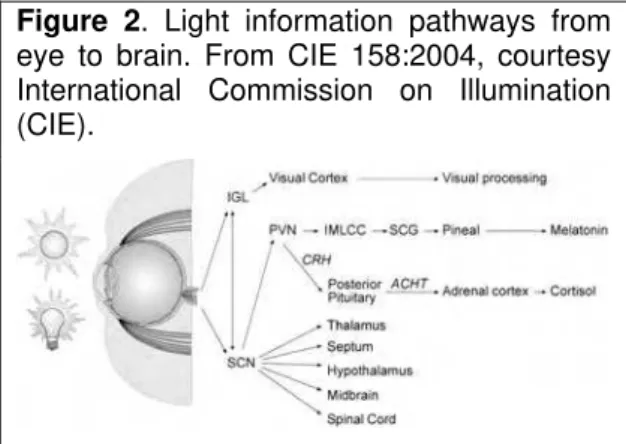
In considering how to apply the latest scientific insights to lighting practice, we must remember that much of the recent work into light and lighting effects on health stems from research into the effects of light on melatonin suppression and release, and the associated consequences for circadian rhythms. Figure 2 shows that the neural path from the retina to the pineal gland is not the only route for retinal information about light and dark [4]. These several other pathways await more thorough investigation. Despite all the important advances thus far, we are a long way from having all the answers about how light affects physiology and psychology.
Figure 2. Light information pathways from
eye to brain. From CIE 158:2004, courtesy International Commission on Illumination (CIE).
Lighting practitioners and applied lighting researchers (the “lighting community” – designers, industry, researchers, educators) together have a role to play in developing the necessary knowledge base. We need substantial evidence to warrant changes to recommendations; but we cannot expect
page 5 of 6
basic science to provide the necessary evidence without our input and participation. Many scientists who study fundamental processes lack the understanding of the information needs of the lighting community and the motivation to work on applied questions. Advances of the required type will occur only through interdisciplinary research, and only if promoted by the lighting community [35].
4. REFERENCES
1 World Health Organization. (1948). Preamble . In Constitution of the World
Health Organization As Adopted by the International Health Conference, New York, 19-22 June, 1946; Signed on 22 July 1946 by the Representatives of 61 States (Official Records of the World Health Organization, No. 2, P. 100) and Entered into Force on 7 April 1948.
Geneva, Switzerland: World Health Organization.
2 Illuminating Engineering Society of North America (IESNA). (2000). Lighting
handbook: Reference & application (9th
ed.). New York: Illuminating Engineering Society of North America .
3 Veitch, J. A. (Ed.). (1998). Proceedings
of the First CIE Symposium on Lighting Quality (Vol. CIE-x015-1998). Vienna,
Austria: CIE.
4 Commission Internationale de
l'Eclairage (CIE). (2004). Ocular lighting
effects on human physiology and behaviour (CIE 158:2004). Vienna,
Austria: CIE.
5 Commission Internationale de
l'Eclairage [CIE]. (2004). Proceedings of
the CIE Expert Symposium on Light and Health (Vol. CIE x27:2004). Vienna,
Austria: CIE.
6 Bommel, W. J. M. v., & Beld, J. G. v. d. (2004). Lighting for work: a review of visual and biological effects. Lighting
Research and Technology, 36, 255-269.
7 Boyce, P. R. (2006). Lemmings, light, and health. Leukos, 2(3), 175-184. 8 DiLaura, D. L. (2005). Editorial: The next
big thing. Maybe. Leukos, 2(1), 4-6. 9 Luckiesh, M., & Guth, S. K. (1949).
Brightnesses in visual field at borderline
between comfort and discomfort (BCD).
Illuminating Engineering, 44(11),
650-670.
10 Einhorn, H. D. (1991). Discomfort glare from small and large sources. In
Proceedings of the First International Symposium on Glare. New York:
Lighting Research Institute.
11 Ngai, P., & Boyce, P. R. (2000). The effect of overhead glare on visual discomfort. Journal of the Illuminating
Engineering Society, 29(2), 29-38.
12 Committee on Recommendations for Quality and Quantity of Illumination [RQQ]. (1966). Outline of a standard procedure for computing visual comfort ratings for interior lighting - Report No. 2. Illuminating Engineering, 61, 643-666.
13 Commission Internationale de
l’Eclairage [CIE]. (1995). Discomfort
glare in interior lighting (Publication No.
117-1995). Vienna, Austria: CIE.
14 Commission Internationale de
l'Eclairage [CIE]. (2001). Lighting of
indoor work places (ISO 8995:2002 CIE
S 008 / E:2001). Vienna, Austria: CIE. 15 Hopkinson, R. G. (1970). Glare from
windows. Construction Research and
Development Journal, 2(3), 98-105.
16 Osterhaus, W. K. E., & Bailey, I. L. (1992). Large area glare sources and their effect on visual discomfort and visual performance at computer workstations. In Proceedings of the
1992 IEEE Industrial Applications Society Meeting, Houston, TX, October 4-9, 1992 (Vol. 2, pp. 1825-1829).
Piscataway, NJ: Institute of Electrical and Electronics Engineers.
17 Hopkinson, R. G. (1972). Glare from daylighting in buildings. Applied
Ergonomics, 3(4), 206-215.
18 Tuaycharoen, N., & Tregenza, P. R. (2005). Discomfort glare from interesting images. Lighting Research and Technology, 37(4), 329-341.
19 Wilkins, A. (1986). Intermittent illumination from visual display units and fluorescent lighting affects movement of the eyes across text. Human Factors,
page 6 of 6
20 West, D. C., & Boyce, P. R. (1968). The effect of flicker on eye movement. Vision
Research, 8(2), 171-192.
21 Veitch, J. A., & Newsham, G. R. (1998). Lighting quality and energy-efficiency effects on task performance, mood, health, satisfaction and comfort. Journal
of the Illuminating Engineering Society, 27(1), 107-129.
22 Veitch, J. A., & McColl, S. L. (1995). Modulation of fluorescent light: Flicker rate and light source effects on visual performance and visual comfort.
Lighting Research and Technology, 27(4), 243-256.
23 Wilkins, A. J., Nimmo-Smith, I., Slater, A. I., & Bedocs, L. (1989). Fluorescent lighting, headaches and eyestrain.
Lighting Research and Technology, 21(1), 11-18.
24 Eysel, U. T., & Burandt, U. (1984). Fluorescent tube light evokes flicker responses in visual neurons. Vision
Research, 24(9), 943-948.
25 Küller, R., & Laike, T. (1998). The impact of flicker from fluorescent lighting on well-being, performance, and physiological arousal. Ergonomics,
41(4), 433-447.
26 Brundrett, G. W. (1974). Human sensitivity to flicker. Lighting Research
and Technology, 6, 127-143.
27 Chartered Institution of Building Services Engineers/Society of Light and Lighting [CIBSE/SLL]. (2002). Code for
lighting. Oxford, UK:
Butterworth-Heinemann.
28 Espiritu, R. C. et al. (1994). Low illumination experienced by San Diego adults: Association with atypical depressive symptoms. Biological
Psychiatry, 35(6), 403-407.
29 Jean-Louis, G., Kripke, D., Cohen, C., Zizi, F., & Wolintz, A. (2005). Associations of ambient illumination with mood: contribution of ophthalmic dysfunctions. Physiology & Behavior,
84(3), 479-487.
30 Partonen, T., Leppämäki, S., Hurme, J., & Lönnqvist, J. (1998). Randomized trial of physical exercise alone or combined with bright light on mood and
health-related quality of life. Psychological
Medicine, 28(6 ), 1359-1364.
31 Leppämäki, S. , Partonen, T., & Lönnqvist, J. (2002). Bright-light exposure combined with physical exercise elevates mood. Journal of
Affective Disorders, 72(2), 139-144.
32 Leppämäki, S. J., Partonen, T. T., Hurme, J., Haukka, J. K., & Lönnqvist, J. K. (2002). Randomized trial of the efficacy of bright-light exposure and aerobic exercise on depressive symptoms and serum lipids. Journal of
Clinical Psychiatry, 63(4), 316-321.
33 Partonen, T., & Lönnqvist, J. (2000). Bright light improves vitality and alleviates distress in healthy people.
Journal of Affective Disorders, 57(1-3),
55-61.
34 Noguchi, H., Ito, T., Katayama, S., Koyama, E., Morita, T., & Sato, M. (2004). Effects of bright light exposure in the office. In Proceedings of the CIE
Expert Symposium on Light and Health
(CIE x27:2004, pp. 153-156). Vienna, Austria: Commission Internationale de l'Eclairage.
35 Veitch, J. A. (2005). Light, lighting, and health: Issues for consideration. Leukos,
2(2), 85-96. CONTACT
Jennifer A. Veitch, Ph.D.
National Research Council of Canada Institute for Research in Construction Building M-24, 1200 Montreal Road Ottawa, ON K1A 0R6 Canada tel. +1-613-993-9671
fax +1-613-954-3733
![Figure 1 shows a model of lighting quality that appeared in the 2000 edition of the IESNA lighting handbook [2], and which is consistent with discussions at the First CIE Symposium on Lighting Quality here in Ottawa in 1998 [3]](https://thumb-eu.123doks.com/thumbv2/123doknet/14176911.475499/3.892.453.766.645.1009/lighting-appeared-lighting-handbook-consistent-discussions-symposium-lighting.webp)