Dealing with Danger: Threat Perception and
Policy Preferences
by
Marika Landau-Wells
A.B. Government, Harvard University
M.Sc. Global Politics, London School of Economics and Political Science
Submitted to the Department of Political Science
in partial fulfillment of the requirements for the degree of
Doctor of Philosophy in Political Science
at the
MASSACHUSETTS INSTITUTE OF TECHNOLOGY
JUNE 2018
( Marika Landau-Wells, MMXVIII. All rights reserved.
The author hereby grants to MIT permission to reproduce
and to distribute publicly paper and electronic
copies of this thesis document in whole or in part
in any medium now known or hereafter created.
Signature redacted
Author:
Marika Landau-Wells
Department of Political Science
9 April 2018
Signature redacted
Certified by:
Roger Petersen
Arthur and Ruth Sloan Professor of Political Science
Thesis Supervisor
Signature redacted
Accepted by:
Ben Ross Schneider
MASS
CH NSNSITUTE
Ford International Professor of Political Science
Chair, Graduate Program Committee
JUN 2 52018
LIBRARIES
ARCHIVES
M ITibraries
77 Massachusetts Avenue
Cambridge, MA 02139 http://Iibraries.mit.edu/ask
DISCLAIMER NOTICE
Due to the condition of the original material, there are unavoidable
flaws in this reproduction. We have made every effort possible to
provide you with the best copy available.
Thank you.
The images contained in this document are of the
best quality available.
Dealing with Danger:
Threat Perception and Policy Preferences
by
Marika Landau-Wells
Submitted to the Department of Political Science
on April 9, 2018 in partial fulfillment of the requirements for the degree of Doctor of Philosophy in Political Science
Abstract
This dissertation develops and tests a new individual-level theory specifying the rela-tionship between threat perception and policy preferences. The project takes a unified approach to studying the space of danger-mitigating political behaviors. It is designed to demonstrate that a single psychological model can apply to both citizens and elites and in both domestic and foreign policy issue areas. The first paper develops Threat-Heuristic Theory, a new individual-level model of the psychological processes linking the detection of danger to specific policy preferences for mitigating it. The paper presents a review of the literature in biology and cognitive science regarding evolved systems of threat perception and response, on which the theory draws. The paper demonstrates that the theory's core explanatory variable, threat classification, is not a proxy for other constructs already incorporated into political science. The paper also illustrates that the domain of complex dangers, characterized by low levels of agreement in threat classification, contains issues of interest to political science. The second paper applies the theory to explain variation in preferences for specific forms of immigration restriction in the U.S. The paper highlights the importance of understanding threat classification in order to move beyond explanations of pro/anti-immigrant sentiment towards a model that captures preferences for real-world policy options. The third paper applies the theory to a small number of elite policy-makers in order to explain their support for particular measures included in
U.S. national security strategies of the early Cold War and of the first George W. Bush
Administration. The paper demonstrates how "bad strategy' and problematic policy preferences can arise systematically through the operation of Threat-Heuristic Theory's psychological model and need not be solely explained by bureaucratic politics or error. Thesis supervisor: Roger Petersen
Acknowledgments
Dissertations are strange things. This work represents years of personal effort (intellectual, emotional, and physical). It also represents the tremendous efforts of others (certainly intellectual, possibly emotional, and occasionally physical). Yet the corporeal incarnation is rather flimsy: two hundred pages, more or less. The digital incarnation, even flimsier. So where did all the effort go?
The challenge was not in filling up pages with words, though there are approximately fifty thousand of them here. It was in the choices of the words. Their ultimate configuration represents millions of choices, some of which were quite difficult. It is in these choices that the efforts of so many are embedded.
Roger Petersen ensured I made choices that kept politics squarely in mind, but never at the expense of being ambitious. Fotini Christia made sure that I chose not to take the easy way out of any argument. Rose McDermott opened up a universe of possible choices
by showing me how to be a constructive skeptic. Rich Nielsen taught me that I would
have as many choices as I was willing to learn how to make. Together, this committee of advisers influenced not only the choices made in producing this particular work, but also the decision to make something of a vocation out of social science.
Ken Oye made sure that I chose complex problems over simple ones every time. Adam Berinsky taught me how to turn the choices of others into data. And Rebecca Saxe made it possible for me to choose to bring the brain in.
Other enablers of ambitious choices were: Melissa Nobles, Chappell Lawson, Paula Kreutzer, the MIT Department of Political Science, the Political Experiments Research Lab, the MIT Security Studies Program, and Beyond Conflict.
Many others improved the quality of my various choices, academic and otherwise, over the years. Fiona Cunningham demonstrated how one chooses to be bold and stay bold. And also when it's time to choose a sushi dinner over work. For their many forms of support, my thanks go to: Lena Andrews, Elissa Berwick, James Dunham, Cullen Nutt, Tesalia Rizzo, Leah Rosenzweig, Kai Thaler, Andreas Wiedemann, Stephen Wittels, and Ketian Zhang. I would also like to thank Terry and Robert Corbin and Susana Cordeiro Guerra and Bridge Colby for making my study of Cold War minutia possible.
Without the encouragement to choose to pursue a doctorate, none of the rest would have followed. For that, I thank Tanya and Ulrich Suter and Joshua Weinstein.
For everything, I thank my mother, Terry Landau.
Contents
Introduction
1 Old Solutions to New Problems: An Introduction to Threat-Heuristic Theory
Threat Perception in Political Science . . . . Threat-Heuristic Theory . . . . Relation to Existing Constructs . . . . Conclusion . . . . Appendix . . . . 2 Disaggregating Danger: Preferences for Immigration
U.S.
2.1 Anti-Immigration Sentiment and Threat Perception . . . 2.2 Threat-Heuristic Theory . . . . 2.3 Study 1 (April/May 2015) . . . . 2.4 Study 2 (May 2016) . . . . 2.5 General Discussion . . . . 2.6 Conclusion . . . . 2.7 A ppendix . . . . Reform in the 77 . . . . 81 . . . . 84 . . . . 90 . . . . 99 . . . . 113 . . . . 115 . . . . 117
3 Danger is What We Make of It: The Role of Threat Perception in 1.1 1.2 1.3 1.4 1.5 13 23 26 29 47 60 62
Shaping U.S. National Security Strategy
3.1 Making National Security Strategy ... ...
3.2 Threat-Heuristic Theory . . . .
3.3 D ata . . . .
3.4 Combatting Communism, 1946-1953 . . . . 3.5 Defeating International Terrorism, 2001-2003 . . . .
3.6 Conclusion . . . . 3.7 A ppendix . . . . 4 Conclusion 4.1 Shortcomings . . . . 4.2 Extensions . . . .. . . . . 4.3 Contributions . . . . References 8 129 134 137 144 157 170 177 180 185 188 189 190 193
List of Tables
1.1 Affective and Behavioral Responses . . . . 36
1.2 Potential Dangers . . . . 64
1.3 Rating Task Items . . . . 65
1.4 Nonwords and Prompts . . . . 68
1.5 Classification and Preference Options . . . . 69
1.6 Personality Measures . . . . 70
1.7 Descriptive Statistics . . . . 71
1.8 Threat Detection (Logistic Regression) . . . . 72
1.9 Threat Classification of Nonwords (Logistic Regression) . . . . 73
1.10 Policy Preference for Novel Danger (Logistic Regression) . . . . 74
1.11 Policy Preferences (Terrorism and Climate Change) . . . . 75
1.12 Policy Preferences (Immigration) . . . . 76
2.1 Study 1 Independent Variable Measures . . . . 92
2.2 Study 1 Dependent Variable Measures . . . . 93
2.3 Study 2 Independent Variable Measures . . . . 102
2.4 Study 2 Dependent Variable Measure . . . . 103
2.5 Sources for Threat-Heuristic Theory Framework . . . . 117
2.6 Study 1 Respondents . . . . 118
2.8 2.9 2.10 2.11 2.12 2.13 2.14 2.15 3.1 3.2 3.3 3.4 3.5 3.6 3.7 3.8 10
All Study 2 Respondents . . . . 119
Study 2 Respondents: CA-RO Condition . . . . 120
Study 2 Respondents: ME-RO Condition . . . . 120
Study 2 Respondents: General Condition . . . . 121
Study 1: Disgust Questions . . . . 122
Study 2: Disgust Questions . . . . 123
Study 2: Trait Fear Questions . . . . 124
Control Variables in Regression Analyses . . . . 126
Policy-Makers and Documents . . . . 147
Example of Threat Classification Coding . . . . 150
Examples of Harm-coded Text . . . . 164
Frequencies for Each Family per 1,000 Words . . . . 173
Examples of Contaminant Context . . . . 173
Policy-Makers and Policy Preferences . . . . 181
Policy Endorsement Rates . . . . 183
List of Figures
Threat-Heuristic Theory's Framework . . . . 38
Hierarchical Clustering of Threat Types . . . . 42
Threat Classification Self-Rating Examples . . . . 43
Bivariate Correlations in the Detection of Familiar Issues . . . . 50
Predicted Probability of Detecting Familiar Issues as Dangerous . . . . . 52
Effects on Threat Classification of Climate Change . . . . 53
Relative Odds of Threat Classification (Novel Dangers) . . . . 55
Word Use in Free Responses . . . . 57
Threat-Heuristic Theory's Framework . . . . 86
Threat Assessments: ME-RO and CA-RO Immigrants . . . . 95
Policy Preferences and Threat Classification . . . . 97
Average Marginal Effects on Policy Endorsement . . . . 98
Threat Classification: Study 1 vs. Study 2 . . . . 105
Threat Classification by Condition . . . . 106
Distribution of Policy Preferences by Condition . . . . 108
Predictors of Policy Choice: Region x Safety Threat . . . . 110
Predictors of Policy Choice: Region x Jobs Threat . . . . 110
Predictors of Policy Choice . . . . 111
Threat Detection Count by Subject . . . . 125 1.1 1.2 1.3 1.4 1.5 1.6 1.7 1.8 2.1 2.2 2.3 2.4 2.5 2.6 2.7 2.8 2.9 2.10 2.11
2.12 Predictors of Policy Choice . . . . 2.13 Threat Assessment Contrasts: Study 1 vs. Study 2 . . . .
. 127 . 128 3.1 3.2 3.3 3.4 3.5 3.6 3.7 3.8 3.9 3.10 3.11 3.12 3.13 3.14 3.15 3.16 3.17 12
Threat-Heuristic Theory's Framework . . . . 139
Endorsement of Policy Measures . . . . 149
Relative Word Frequencies . . . . 153
Threat Classification Over Time . . . . 158
Threat Classification Distribution . . . . 159
Congruence between Policy Endorsement and Threat Salience . . . . 161
Endorsement Rates by Type of Threat Perceived . . . . 162
Relative Word Frequencies . . . . 163
First Atomic Detonation: Threat Words as % of Total . . . . 165
First Atomic Detonation: Existential Harm Classification % . . . . 166
Korean War Onset: Threat Words as % of Total . . . . 166
Korean War Onset: Existential Harm Classification % . . . . 167
Affiliation Change: Threat Words as % of Total . . . . 168
Affiliation Change: Existential Harm Classification % . . . . 168
Word Family Correlations (Sept. 11, 2001-Sept. 16, 2002 (n=191) . . . . 175
Word Family Correlations (Sept. 11, 2001-March 5, 2002 (n=72) . . . . 176
Word Family Correlations (Sept. 17, 2002-Feb. 28, 2003 (n=85) . . . . . 177
-Introduction
The world is a dangerous place. This adage underlies many of the justifications for government, including Hobbes's famous argument in favor of an absolute ruler (Hobbes
1651). At a more granular level, potential dangers like nuclear proliferation also serve as a
justification for the measures governments undertake in the domains of both foreign and domestic policy.' What is a national security strategy if not the government's attempt to deal with dangers that affect its citizens and/or its ruling elites? Domestic policies also address the concerns citizens have about dangers closer to home, such as public safety and
job security. From containing nuclear proliferation to imposing immigration restrictions,
citizens have preferences for both whether and how governmental policies can be used to make their world a less inherently dangerous place.
Despite the relevance of danger writ large as a motivating force for outcomes of interest, political science has not yet interrogated the domain of dangers as a coherent space within which to study political preferences, attitudes and behaviors.2
The space of dangers is not an "issue area" in the traditional sense. Rather, it has been largely divided by subfield.
1I
use the term "danger" to refer to the large, indefinite category of potential harms that may or may not rise to the level of concern for a given individual. Individuals vary in their thresholds for identifying something as dangerous. I use the term "threat" to refer to dangers that an individual has evaluated as relevant and worth mitigating, though that evaluation process may be largely subconscious.2
This is equivalent to saying that these issues are not treated as a natural or investigative kind. "Natural kinds" are defined by Griffiths (2004) as "categories which admit of reliable extrapolation from samples of the category to the whole category. In other words, natural kinds are categories about which we can make inductive scientific discoveries" (903). "Investigative kinds" are natural-kind concepts whose boundaries are under investigation (907). The argument made in this dissertation is that "danger" should be considered an investigative kind.
International Relations has claimed some topics (military, financial, and increasingly cyber security at the national level). But local security concerns, as well as dangers to economic well-being, culture, and identity, are left to other subfields. The result insofar as theory is concerned has been a fragmentation of explanations for how danger, and the perception of it, motivates political outcomes of interest. These theories have also varied in their reliance on objective versus subjective perception, the relevant scale of vulnerability (individual versus collective), and the sources of vulnerability (what are people really worried about?).
Can we instead consider how people deal with dangers as a unified line of inquiry? Unified across domains of danger, but also in terms of the populations of interest?
I argue in this dissertation that treating danger-oriented issues, and the policy
prefer-ences concerning them, as a coherent space is a theoretically and practically productive endeavor. It is theoretically productive because pooling the topics that scholars have been investigating in isolation can reveal shared assumptions and common mechanisms. It is practically productive because it provides purchase on a set of problematic outcomes in the world. Many of the policies individuals endorse to mitigate perceived danger are costly in financial and human terms while their benefits are dubious. From genocide, to preventive war, to discriminatory social policies, the solutions adopted to make some individuals feel safer can make many others dramatically less safe.
In this dissertation, I develop and test Threat-Heuristic Theory, a new theory linking the evaluation of dangers, both abstract and concrete, to specific policy preferences. Threat-Heuristic Theory (THT) is a model of the psychological processes associated with threat perception that draws primarily on research in biology and cognitive science for its foundations.3 The resulting framework offers a more nuanced way of
understand-3In this dissertation, I use the words "mental" and "psychological" to describe processes occurring in the mind and "neurological" to describe processes occurring in the brain. With the exception of the phrase "cognitive science", I avoid the use of the words "cognitive" and "cognition" wherever possible.
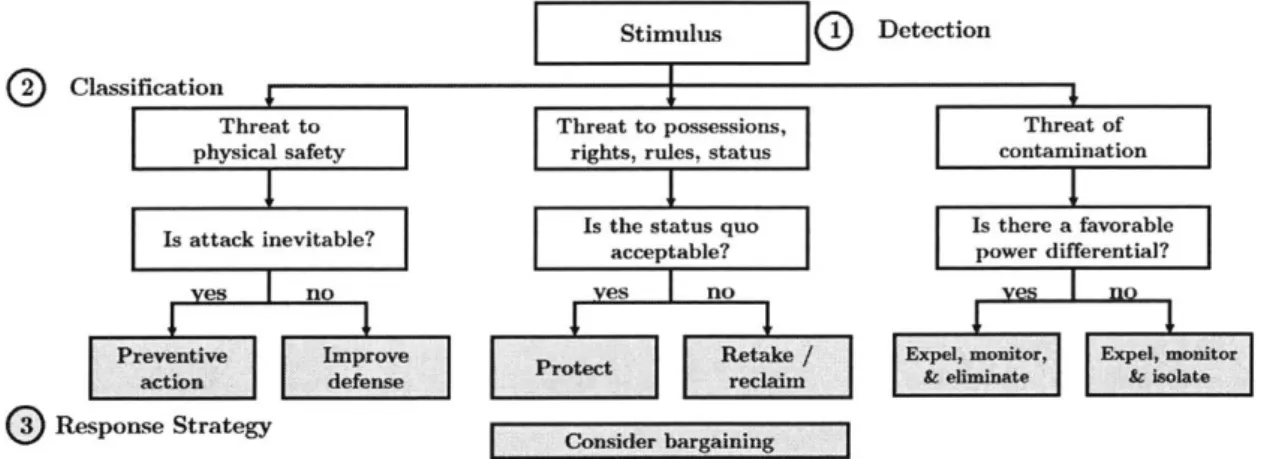
ing how threat perception affects political attitudes, behaviors, and policy preferences. Within Threat-Heuristic Theory I introduce the concept of threat classification, a rapid, unconscious mental process by which dangers are parsed into categories - as threats of physical harm, threats of loss, and threats of contamination - each with its own evolved response strategy. While some dangers of interest to political science, like nuclear war, fall relatively neatly into a single category (i.e., the threat of physical harm), others like immigration are complex in that they do not have a single, agreed-upon categorization. For these sorts of issues, the theory predicts that consensus around threat-mitigating policies will be difficult to achieve because of fundamental differences in how the problem is conceived.
Threat-Heuristic Theory fits within the branch of political psychology focused on the contemporary consequences of mental systems that have evolved to be species-typical in humans (e.g., Johnson 2004; Johnson and Toft 2014; Lopez and McDermott 2012; McDermott 2013).' Broadly speaking, such research is adaptationist in its approach, which results in some limitations. The adaptationist approach "constrains the hypothesis space to explore: the only design features the mind is likely to have are those that would have served functions associated with the lifestyle of our hunter-gatherer ancestors" (Sidanius and Kurzban 2013, 5). Threat perception systems qualify as adaptive by this measure because the need to detect and respond to danger in the environment was a persistent challenge in our evolutionary past, prior even to our hunter-gatherer ancestors.5
This is because the use of "cognitive" in psychology and neuroscience refers to a broad set of mental processes, including perception, attention, learning and memory, which can be largely unconscious. In political science, however, the use of "cognitive" often serves as a stand-in for "thinking" or the deliberate engagement of higher-level mental functions. This difference in definitions is consequential when considering a theory of heuristic (non-reflective) information processing, so I use other terms to avoid confusion.
4
Species-typical features are shared by all humans, with limited variation. Adaptationist research agendas focus on this commonality. This can be distinguished from research agendas focusing on high degrees of individual-level variation in heritable traits, where not all individuals in a population possess the trait of interest (e.g., Alford, Funk, and Hibbing 2005; Fowler and Dawes 2013; Fowler and Schreiber 2008; Hatemi et al. 2013; Loewen and Dawes 2012).
5I do not go into much of the animal-model literature that supports the evolutionary interpretation of human threat detection mechanisms, but for such evidence see Eilam, Izhar, and Mort (2011) and
Both biology and cognitive science treat threat perception as an adaptive human capacity (Ohman and Mineka 2001, 483; Tooby and Cosmides 1990, 27), but the consequences of that treatment have yet to be fully appreciated within political science. On the one hand, building and testing theories reliant on adaptive features of the human mind (or body) are relatively straightforward. Species-typicality means that any adaptive system should be testable in convenience samples under the right conditions. This is good news for experimental approaches confronting issues of external validity, for example, and generates a rich set of testable hypotheses. However, it also precludes the cherry-picking of adaptive systems because by definition all adaptive systems co-exist in all humans all of the time. Defining which adaptive system is in operation, and how it relates to others that might
also be engaged, becomes an obligation rather than an option.
Current models of threat perception and political attitudes or behaviors frequently elide this difficulty by asserting that a particular system dominates or is a dominating driver
of the outcome of interest. This kind of argument is at play in the foundations of Realism (but also in classical Realism, see Rose 1998; e.g., Waltz 2010). It also undergirds the theoretical value of horse-racing adaptive mechanisms as competing explanations, an approach common in the study of anti-immigration and anti-trade attitudes (e.g., Hainmueller and Hopkins 2014; Mayda and Rodrik 2005). This insistence on uncovering a singular mechanism is fundamentally at odds with how adaptive systems manifest themselves, however. The harder point, theoretically, is to address the co-existence of multiple adaptive systems simultaneously engaged by a given contemporary context. Adaptive systems as explanatory variables, specifically those affecting subjective perception (e.g., psychological processes, sex differences) introduce a second challenge for traditional theorizing in political science. These systems are not amenable to the "scope conditions" approach of theory-bounding. This makes building and testing theories of political
Ohman (1986).
behavior relying on such mechanisms both easier and harder. Easier because there is no theoretical limit to the circumstances under which an aspect of subjective perception can be engaged. In the context of threat perception, there is no real limit to what an individual might consider to be a threat. Thus, there are no issue areas one can exclude a priori from being subject to Threat-Heuristic Theory's model. This is precisely what makes theory testing hard. The challenge is not to find instances where the theory holds; it is to find instances where the theory matters, by offering new insights or improving upon existing explanations, for consequential outcomes in the world.
Given these considerations, my objective with this dissertation is to change the way in which threat perception is integrated into theories of political attitudes and behaviors. I build up an individual-level theory from recent research in biology and cognitive science on how humans deal with danger. I test this theory in two critical populations, ordinary citizens and political elites, and in the fields of domestic and international politics. Within these tests, I also illustrate that multiple methods can be brought to bear on the problem of measuring the theory's psychological processes.
The dissertation encompasses three papers united by a single question: what explains the preferences people have for dealing with a given danger?
In the first paper, I provide the first comprehensive survey of the recent experimental and observational research in cognitive science and biology regarding human threat detection and response. I synthesize this research into an original framework - an individual-level model of the psychological processes connecting the detection of danger to preferences for reducing that danger through political action. I term this framework, and the approach it embodies, Threat-Heuristic Theory. I present observational and experimental data from two original surveys to support (1) THT's 3-threat model; (2) the distinctiveness of threat classification from other relevant constructs, including disposition and political ideology; and (3) the existence of complex dangers - issues where individuals disagree on
the kind of problem posed and/or for which more than one dimension of the danger is salient. Complex dangers are broadly the space in which Threat-Heuristic Theory might outperform other theories (and so might matter) because it measures rather than assumes how individuals conceptualize danger. I show that this space of complex dangers contains issue areas of interest to political science, including immigration, fundamentalism, and climate change.
The second paper focuses on the connection between threat perception and policy pref-erences among ordinary citizens for a topic of interest to scholars of domestic politics and international political economy: immigration policy. In the U.S. case, despite sev-eral periods of single-party control of the Legislative and Executive branches, winning coalitions on immigration reform have not materialized and the landscape of policies up for consideration is vast and growing. Paper 1 identifies immigration as a complex danger, which suggests that the lack of consensus about not only whether, but also how, immigration should be restricted is due to fundamental differences in how the danger is classified. Using observational and experimental data collected from two samples of U.S. adults in 2015 and 2016, I test THT's predictions for the relationship between the classifi-cation of immigrants as particular kinds of threat and the preference for specific forms of immigration restriction. I argue that the existing literature focuses on a distinction that is important but insufficient: the drivers of pro- versus anti-immigrant sentiment. This is the equivalent of focusing only on whether or not individuals differ in their detection of immigrants as threats. This uni-dimensional outcome measure does not reflect the reality of a fragmented policy landscape, where particular means of restricting immigration
-including travel bans, visa reductions, and construction of a wall along the U.S./Mexican border - all vie for support. I show that THT accurately predicts the relationships between threat classification and support for a particularly costly form of immigration restriction - mass deportation and construction of a border wall with Mexico - under several different conditions. The theory thus provides insight beyond existing explanations
of the broad pro-/anti- split. By providing leverage on a finer-grained outcome, this paper adds to the immigration literature, and to the political psychology literature on which it often draws.
The third paper applies Threat-Heuristic Theory to political elites and their preferences for how to combat ideological threats to American national security. Specifically, I focus on individuals linked to the development of America's formal national security strategies in (1) the early years of the Cold War (1947-1953); and (2) the year after the terrorist attacks on September 11, 2001. In both cases, these strategies were designed to wage "wars of ideas". And, in both cases, the somewhat unexpected onset of these "wars"
provided observable moments where individuals were forced to articulate preferences for national security strategy without clear blueprints. To probe the connection between an individual's classification of these ideological threats and their policy preferences, I collected two corpora of threat classifications in text: Cold War policy-makers' discussions of communism over time; and President George W. Bush's speeches mentioning national security concerns between his inauguration and the start of the war in Iraq. I show that prior classifications of these ideological threats are good predictors of the specific preferences expressed later for countering them. This includes preferences for preventive war and for the global and absolutist nature of the War on Terror. I also empirically examine the relationships between threat perception and an individual's institutional affiliation, as well as the effect of exogenous threat-relevant events, like the onset of the Korean War and the detonation of the first Soviet atomic bomb, to show that threat classification once made is relatively stable.
This dissertation makes several theoretical contributions to political science. First, it demonstrates the possibilities and advantages for measuring rather than assuming an understanding of how danger is perceived by political actors. As others have noted, grand theories of politics often have psychological assumptions built into them, including
theories of threat perception (e.g., Crawford 2000; Kertzer 2017; Kertzer and Tingley
2018). But these models often assume only one kind of threat matters most for human
decision-making. This type of theorizing preserves the "black box" model of human behavior unnecessarily and, I argue here, with misleading results.
Second, the dissertation demonstrates the advantages and limitations of building up a theory of political behavior from an adaptationist perspective, which can serve as a model for other theory development in political science. Threat-Heuristic Theory takes seriously the primary advantage of the adaptationist approach: generalizability across populations. But there are also restrictions: the co-existence of adaptive mechanisms must be taken into account, as must limits on what features the mind is likely to have developed in our evolutionary past. Specifically, looking at danger detection as a general category of problem forces acceptance that multiple systems identified in biology and cognitive science for processing danger must be evaluated, rather isolating a particular system a priori.
Finally, the dissertation engages in a theory-building and testing exercise that is explicitly cross-subfield and inter-disciplinary. While this is the promise of political psychology, the reality is often more constrained. Taking this broad view offers a way to see how preferences on contentious political issues, such as climate change and immigration, have common roots in how individuals interpret danger. This common substrate provides a way to integrate the otherwise disparate issue areas of interest to political science. The practical contributions of this dissertation lie in the framework defined as the core of the theory, as well as in the insights provided into immigration and national security policy preferences. Threat-Heuristic Theory's core framework, presented in detail in Paper 1, is relatively parsimonious and highly flexible. Immigration and national security strategy are both issue areas where policy preferences have far-reaching human and economic costs. In both cases, THT provides insights into those preferences that existing theories do not.
The exploration of two distinct populations, ordinary citizens and elites, using both direct and indirect measurement strategies also demonstrates the theory's ability to draw on a range of available data sources to investigate the same underlying phenomenon.
The three papers just described constitute the three primary chapters of this dissertation. The fourth chapter concludes with a summary of the project's findings, its shortcomings, and its contributions.
Chapter 1
Old Solutions to New Problems: An
Introduction to Threat-Heuristic
Theory
The study of contemporary politics, and political psychology in particular, is an exercise in reconciling very recent developments in human history - including participatory democracy, the rise of nation-states, and the invention of nuclear weapons - with the much longer history of humans themselves.1 Much of our physical and mental scaffolding evolved under vastly different circumstances than the environments, material and social, we now navigate. And yet, we can develop theories of very modern political outcomes - including vote choice, nuclear deterrence, and support for the welfare state - by considering how
features of that distant past manifest in our contemporary environment (Lopez and McDermott 2012; McDermott, Fowler, and Smirnov 2008; Sidanius and Kurzban 2013).2
'Conventionally, modern humans have been dated as 200,000 years old (Stringer 2002). Recently, Hublin et al. (2017) published findings suggesting anatomically, but riot neurocranially, modern humans emerged at least 300,000 years ago.
2
For evolutionarily informed models of vote choice, see the discussion of heuristics in Lau and Redlawsk (2001), the role of facial features in Banducci et al. (2008) and Olivola and Todorov (2010), and vocal
I adopt this as the dissertation's starting point. Specifically, I argue that humans evaluate
new and novel dangers that arise in the world today using the basic mental toolkit that evolved over our ancestral past. These adaptive mental processes helped humans identify dangers accurately enough and rapidly enough to mitigate their worst effects in ecologies that largely no longer exist. I argue these same mental processes come online today when we evaluate new dangers, even abstract ones, such as hostile ideologies. That is, we apply old solutions to new problems.
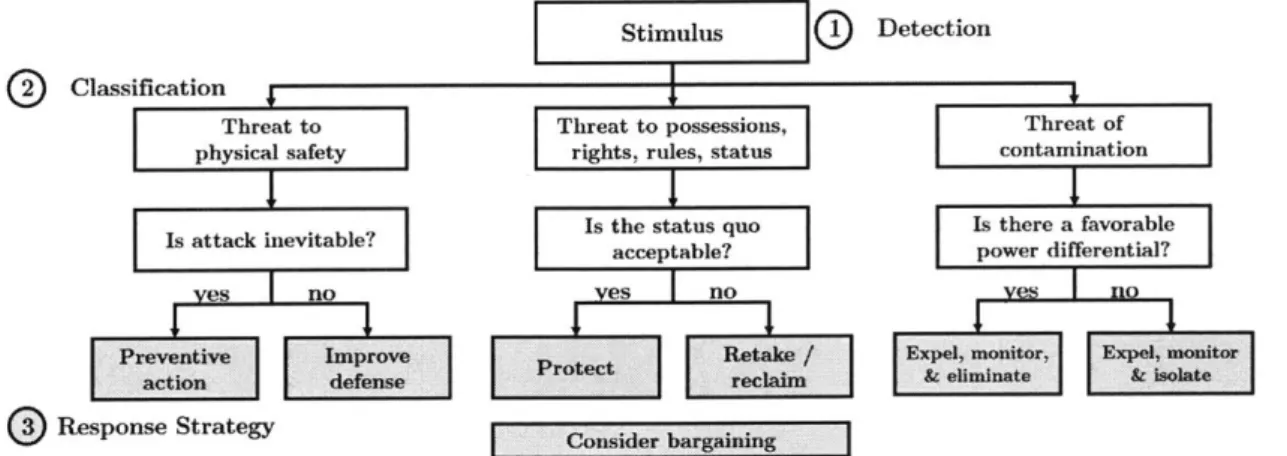
In this paper, I develop Threat-Heuristic Theory (THT), a general theory of threat perception and response that integrates findings from biology and cognitive science into an explanation of the policies people want for dealing with the dangers they perceive in the world.3 A unique and important concept within the theory is threat classification - the idea that our brains rapidly distinguish between different types of threats and formulate responses accordingly without deliberate reflection. This ability to discriminate between threat types allows our responses to be more efficient and tailored to the problem at hand. But the need to respond quickly, to avoid potential harms from coming about, means that the discrimination process is done rapidly. Hence the term "threat-heuristic". THT identifies and focuses on three types of threat in particular: threats of physical harm, threats of loss, and threats of contamination. Rather than assuming one of these types is always paramount for human beings, and thus the "real" driver of response preferences, THT posits that individuals can vary in how they classify the same target and that they can conceive of a target as posing more than one kind of threat. I refer to targets whose dangerousness has multiple dimensions as complex.
pitch in Klofstad (2015). For nuclear deterrence, see alternative mechanisms to rational choice in Jervis (1989), McDermott, Lopez, and Hatemi (2017), and Thayer (2007). For welfare policy, see M. B. Petersen (2011).
3
I refer here to one of the two definitions of "threat": "A person or thing likely to cause damage or danger" (Stevenson 2010). The other definition ("A statement of intention to inflict pain, injury, damage, or other hostile action on someone in retribution for something done or not done.") can also be studied through the lenses of biology and cognitive science, with a focus on signal and information processing (e.g., Falk and Scholz 2018), but I do not address that literature or topic here.
I present several types of evidence to build the case for Threat-Heuristic Theory in
this paper. I first introduce and synthesize findings from biology and cognitive science supporting the basic premises of THT. I then use original survey data to establish the utility of THT for issue areas within political science. With this data, I show: (1) that THT's 3-threat model captures meaningful differences in how dangers are conceived
of, including those that are highly politicized; (2) that the independent variable at the
heart of THT - threat classification - is empirically distinct from established constructs, including party identification, conservatism, and a range of trait and personality measures linked to threat perception in the literature; and (3) that threat classification can be a strong predictor of policy preferences. To gain some causal purchase on the relationship between threat classification and other constructs, one of the studies uses a nonword paradigm in which subjects classify novel dangers that do not exist. This enables me to observe threat classification for the first time, which is not possible with politically salient issues, and to establish the relationship between initial classification and constructs such as conservatism.
This paper makes several theoretical contributions to the literature. First, it provides the first significant review of recent research in biology and cognitive science on how humans deal with danger. Second, it introduces a new individual-level theory linking threat perception to the formation of policy preferences, with a psychological model that applies equally to citizens and elites. The model's flexibility in the populations to which it applies derives from its foundation in species-typical psychological processes. Species-typical processes occur in all humans and are present and operative, independent of political sophistication.4 Finally, while THT's framework shares some foundations with theories of inter-group threat in social psychology, it is a more general theory, leading to a wider range of potential applications in political science.
4For other examples of species-typical psychological processes see Kahneman (2003) and Kahneman
From a practical perspective, the theory's main contribution is to show that threat perception can be used as a way to understand why individual preferences can vary systematically over a wide range of danger-mitigating -policy options. Particularly when a danger is complex, existing theories struggle to systematically account for the ways in which preferences vary between individuals. For example, theories of immigration preference focus solely on the pro-/anti- distinction, with little ability to explain why individuals who express anti-immigrant sentiment prefer some means of restriction more than others (e.g., a border wall over visa limitations).5 By identifying policy preferences
explicitly as threat response strategies, THT can shed light on preferences specific elements within the set of possible solutions (e.g., border wall construction) using a systematic framework that applies across issue areas.
This paper proceeds in four additional sections. I first discuss the literature integrating threat perception into political science. I then outline Threat-Heuristic Theory and discuss the evidence for the theory's premises. In the third section, I show that THT core concepts are distinct from other constructs, including political ideology and personality measures. The fourth section concludes.
1.1
Threat Perception in Political Science
Threat perception is a familiar background concept in political science, and political psychology in particular.' Feeling "threatened" is an accepted prime-mover of political 'See the second paper in this dissertation, "Disaggregating Danger: Preferences for Immigration Reform in the United States" for a further treatment of this issue.
6I mean this in the sense that Adcock and Collier (2001) defined background concepts as a "broad
constellation of meanings and understandings associated with a given concept" (531). The systematized concept is the definition of "threat" stated earlier as "perception of something or someone as likely to cause damage or be dangerous," which excludes specifically the related but distinct concept of threat perception as a signaling and information problem.
behavior.7
One strand of the literature linking threat perception to politics focuses on individual-level variation in sensitivity to danger in the environment. The argument in its basic form is that variation in an outcome of interest - an attitude or behavior - is driven by variation in the perception that something is or is not dangerous and thus worth acting upon. Differences in the detection of politically salient dangers have been linked to: conservatism (e.g., Hibbing, Smith, and Alford 2014; Jost, Nosek, and Gosling 2008; van Leeuwen and Park 2009), gender (Harris and Miller 2000; McClure et al. 2004), several of the Big Five personality traits (Dallago and Roccato 2009; Sibley and Duckitt 2009), Social Dominance Orientation (Costello and Hodson 2011; Crowson, Debacker, and Thoma
2006), Right-Wing Authoritarianism (Lavine, Lodge, and Freitas 2005; Rickert 2002),
disgust sensitivity (Aaroe, Petersen, and Arceneaux 2017; Kam and Estes 2016), and dispositional fear (Hatemi et al. 2013; Lilienfeld and Latzman 2014).
A second strand of explanations focuses on the properties of the target, in addition to
those of the individual perceiver. In particular, social scientists have considered when and why humans find one another to be dangerous. As a social species, the human tendency towards groupness is often cited as introducing an "us versus them" dichotomization of the environment, with knock-on consequences for political attitudes, behaviors, and preferences. By "groupness", I mean the phenomenon identified in Tajfel et al. (1971)
by which humans exhibit ingroup chauvinism simply by virtue of being members of that
group, even if the group itself has no meaningful identity content. Social psychologists have developed theories that attempt to pinpoint the "real" sources of inter-group danger, given that chauvinism is so easily triggered (e.g., Tajfel and Turner 1979 and Social Identity Theory). Realistic Group Conflict Theory posits that competition over resources
- and material outcomes in general - drives inter-group threat perception (LeVine and
7
Feeling threatened is not equivalent to feeling fearful. I disambiguate threat from fear over the course of this paper.
Campbell 1972; Sherif et al. 1961). Symbolic Threat Theory posits that competition over non-material resources - values and beliefs - can be more significant for inter-group conflict (Kinder and Sears 1981). Intergroup Threat Theory (ITT) argues that both "realistic" (i.e., material) and "symbolic" (i.e., non-material) threats play a role intergroup conflict (Stephan and Stephan 2000; Stephan et al. 2002; Stephan, Ybarra, and Morrison
2009).8 Socio-functional theories of inter-group dynamics allow for a broader palette of
threats, drawn from a range of evolutionarily salient social problems that needed solving. The most concise presentation and testing of this approach comes from Cottrell and Neuberg (2005), which identifies ten different specific types of danger groups could pose to one another.9
Political science has been quick to integrate the 1- and 2-threat models into theories linking perceptions of intergroup threat to political outcomes. Most notable has been the integration of a non-material threat component into the political economy literature, particularly around trade and immigration preferences (e.g., Mansfield and Mutz 2009; Mayda and Rodrik 2005; McLaren 2003; Sides and Citrin 2007; Sniderman, Hagendoorn, and Prior 2004). But the theoretical treatment has been a "horse-racing" approach - an effort to pinpoint one kind of threat as the dominant influence on a given outcome (for an example in the case of immigration, see Hainmueller and Hopkins 2014). An alternative approach could take the position that and rather than or is a more plausible operator when it comes to understanding the influence of feeling threatened on human behavior.
8
1n practice, it appears that operationalization of ITT's two threat types often yields nearly equivalent effects (e.g., McLaren 2003; for a review, see Riek, Mania, and Gaertner 2006). That is, these two categories of do not distinguish different kinds of danger from one another.
9
Cottrell and Neuberg (2005) measured how European American college students evaluated the threats posed by various minority social groups to American citizens. The threats of interest were: jobs and economic opportunities, personal possessions, personal rights and freedoms, reciprocity relations (due to choice not to reciprocate), social coordination and functioning, trust violations, physical health, values inconsistent with the ingroup, physical safety, and reciprocity relations (due to inability to reciprocate). An eleventh threat (to ingroup morality) was not evaluated in the study but is integrated in the authors' theory. The authors note that their data support four threat classes (Obstacles to Ingroup Goals, Contamination to Ingroup, Endangered Group Physical Safety, and Threat to Reciprocity Relations), but note that they do not explore these relationships in depth as it was not the purpose of the study (773, 780 n. 8).
This pluralist approach is theoretically more tractable than "horse-racing" because, by definition, adaptive psychological systems co-exist in the mind at any point in time. If two systems could plausibly be at work, their simultaneous operation cannot be ruled out. Presuming the relationship of two such mechanisms to be mutually exclusive is in and of itself a strong assumption. Thus, any exploration of threat perception, if it appeals to adaptationist logic in its mechanisms, must cast a wide net to consider what it means for humans to deal with danger.
In the next section, I provide this broader perspective and generate a theory that accommodates the co-existence of multiple, adaptive systems of threat perception.
1.2
Threat-Heuristic Theory
What does it mean to determine that something in the world is (1) dangerous and (2) requires action? Danger is the possibility of suffering harm. What constitutes "harm" is essentially subjective and the scales on which people reason about danger range from the personal (affecting only the self) to the society- or species-level. Political science is largely concerned with dangers arising at the level of communities and societies, where addressing potential dangers requires coordination often manifesting as public policy, realized or merely debated. Might how humans conceive of danger have consequences for what they want to do about danger? Might these consequences include informing their
preferences for danger-mitigating policies?
In this section, I lay out a new theory that integrates recent research in biology and cognitive science regarding the species-typical systems humans have for dealing with danger. I show how this new, bottom-up model can be used to re-conceptualize how policy debates are framed when the issue area is one where danger mitigation is an ultimate objective.
1.2.1
Adaptation and Dealing with Danger
Research in biology and psychology has found that humans have psychological, neurological, and physiological adaptations to avoid or mitigate dangers in their environment. These adaptive systems are broadly concerned with detecting danger and responding to danger.
1.2.1.1 Detection
Danger detection is prediction problem; it is the challenge of anticipating potential bad outcomes before they occur. One type of outcome to be avoided is harm to the body itself. Meta-analyses of the threat detection literature in biology and cognitive science have found evidence for two body-based, "functionally distinct threat management systems, one devoted to self-protection and the other to disease avoidance" (Neuberg, Kenrick, and Schaller 2011, 143, emphasis mine; see also Schaller, Park, and Faulkner 2003). The self-protection system is concerned with violent bodily harm, either from other humans, predators, or accidents (Ohman and Mineka 2001, 483). The disease avoidance system is concerned with pathogens, both as transmitted by other humans and due to exposure in the environment (i.e., spoiled food) (Oaten, Stevenson, and Case 2009, 305-7).
These systems consist of mental processes and physiological reactions linking the perception of potential harms in the environment (e.g., a snake in the grass) to behavioral responses (e.g., jumping away) through the activation of cognitive associations (e.g., curves among straight lines equal "snake") and emotional reactions (e.g., fear). But these systems are "crudely defined" and biased towards over-detection (LoBue 2014; Neuberg, Kenrick, and Schaller 2011, 147; see also Schaller et al. 2005, 232), so more stimuli are perceived as being dangerous than objectively are dangerous (e.g., jumping at the sight of a garden hose, not a snake).
The crudeness in the definitions of these bodily-protection systems also allows for an
expansion of their domains.10 For example, sensitivity to disease and contaminants encompasses a bundle of physical cues, like unattractiveness or physical disability (Krendl et al. 2006, 12; Park, Faulkner, and Schaller 2003), as well as metaphysical constructs, like exposure to something "evil" or immoral (Nemeroff and Rozin 1994, 169-75; Siegal, Fadda, and Overton 2011, 3430). In healthy adults physical cleansing has been shown to reduce self-reported moral contamination (e.g., Helzer and Pizarro 2011; Ritter and Preston 2011), suggesting mental models of physical and metaphysical contamination have some overlap. Crude definition of these harm avoidance systems also affects our understanding of why things are dangerous. For example, human reasoning about contaminants behaves according to a precautionary folk-logic of contagion by contact, not a scientific understanding of transmission (Boyer and Bergstrom 2011, 2; Kalish
1996, 99-101; Rozin and Nemeroff 2002, 206-13; Siegal, Fadda, and Overton 2011, 3430).
Indeed, our systems for detecting contaminants may be relatively independent of our
reasoning about them (Nemeroff and Rozin 1994). The same case has been made for our
bodily self-protection system operating independently from explicit cognitive control or deliberative reasoning (Mathews, Yiend, and Lawrence 2004; Ohman and Mineka 2001). This implies that the mental processes engaged in protecting our bodies can operate largely independently of our systems for deliberative reasoning. While adaptive and efficient, this independence has profound implications for how our beliefs about what is and what is not dangerous arise in the first place.
Human sociality also extends the boundaries of our concerns beyond our own bodies. First, humans can extend concerns of physical harm to others, in part by sharing some parts of the experience of pain (e.g., Lamm, Decety, and Singer 2011; Singer et al. 2004). Second, humans also extend concerns of bodily contamination to the purity of social groups (e.g., Haidt and Joseph 2004; Leeuwen et al. 2012). Third, humans have concerns that arise primarily from sociality itself. Sociality generates possessive concepts (i.e.,
"mine", "ours"l, "yours") and rules for conduct that take possession into account (Rakoczy and Schmidt 2013, 18-19). These rules also cover non-material "assets" that nevertheless can be gained, lost, and transferred, such as rights and freedoms (Fessler 2006, 102). This implies another kind of bad outcome to be avoided: loss.
Research suggests the mental architecture for detecting threats of losing material and non-material assets may be contained within other systems for social exchange and punishment (e.g., Cosmides and Tooby 2005; McCullough, Kurzban, and Tabak 2013). Fessler (2006) suggests the protection of assets as different as land and honor engage the same evolved mechanisms for detecting and deterring transgression because they both can be vulnerable to loss or appropriation (107). Evidence for a distinction between how threats of loss and physical harm to the body are mentally processed comes from studies that isolate precautionary reasoning systems (i.e., reasoning about harm) in the brain from those responding to social contract reasoning (e.g., Fiddick, Spampinato, and Grafman 2005; Stone et al. 2002). Threats of contamination and loss can also be teased apart in the domain of moral and social violations. Violations of rights and freedoms, i.e., loss of autonomy, are distinct in their causes, and in their physiological and behavioral responses, from purity violations (Hutcherson and Gross 2011; Rozin et al. 1999; Seidel and Prinz 2013).
In sum, research into evolved systems of threat detection suggests that humans distinguish between at least three relevant types of danger in the environment which differ based on
what is threatened. The danger posed might be physical bodily harm, the loss of material
and non-material assets, or physical or intrinsic contamination.
As a number of experiments also illustrate, the target being evaluated as dangerous need not be physically present to engage these detection systems. Passively viewing images can induce startle reflexes (e.g., Vaidyanathan, Patrick, and Bernat 2008), and changes in heart rate (Courtney et al. 2010), galvanic skin response (e.g., Bradley et al. 2001), pupil
dilation (e.g., Bradley et al. 2008), and facial expression (e.g., Chapman et al. 2009). The direction to think about a target stimulus, with and without prior encounter experience, also induces these effects (for physiological responses to autobiographical memory retrieval, see Palomba, Angrilli, and Mini 1997; for the robustness of text compared to images, see Robinson and Clore 2001; Salas, Radovic, and Turnbull 2012). Taken together, it is important to note that a target danger need not be physically present, temporally recent, or directly experienced to engage psychological and physiological systems of danger detection.
Some lessons from this body of research are thus: (1) systems for detecting different types of danger co-exist in the mind and body; (2) those systems are triggered by subjective perception, which may or may not align with objective dangerousness; and (3) targets need not be present or personally experienced to trigger systems of danger detection.
1.2.1.2 Response Strategies
From an evolutionary perspective, sensitivity to different types of danger in the environ-ment is only useful if it confers a fitness gain (Orr 2009, 531). Detection is thus only the first step in dealing with a threat; appropriate response is the other (Neuberg, Kenrick, and Schaller 2010, 766).
Behavior is an obvious feature of an organism's response to danger. Each threat type leaves room for a limited set of behaviors that can reduce or mitigate dangers, depending on certain contextual conditions.' For example, there are several responses to a threat of physical harm - flight, fight, and freeze'2 - and the selection of one of these options "I do not use the term "action tendencies", which arises in the literature on emotions (e.g., Frijda 1987; R. D. Petersen 2011), because context still dictates the set of options available for danger mitigation.
1 2
Taylor et al. (2000) illustrate that females have also have a "tend and befriend" set of responses under stress, which involve nurturing and pro-social behaviors. I do not add these behaviors to the list of responses, primarily because the evidence on which Taylor et al. (2000) draws is on the broader space of stress response, rather than the response specifically to the danger of physical harm and death for
is based on context (Maack, Buchanan, and Young 2015, 117). Experimental work in animals and humans suggests escape responses ("flight") are dominant with respect to threats of physical harm, if it is possible (Blanchard et al. 2001, 768; Schmidt et al. 2008, 292-94). Only when escape is impossible and attack seems inevitable is a defensive attack ("fight") the dominant response for an individual, though the form of attack can vary by
gender in humans (Blanchard et al. 2001, 766-67).
The behavioral response to the threat of losing assets or rights is conditional on the desirability of the status quo and available resources. If loss has already occurred, aggression to reclaim what has been lost is preferred if possible. If the loss has not yet occurred (and, thus, the status quo is acceptable) defensive protection is the dominant response (Cottrell and Neuberg 2005, 773). These conditions create a situation in which satisfaction with the status quo can change over time as losses accumulate to become more unacceptable. Threats that are more binary in nature (death, contamination) do not generally have this quality. Loss threats are also unique in that there is often bargaining space. That is, it is possible that losing half of something is a better outcome than losing all of it, so negotiation is a behavioral option, particularly for the weaker side (Sell, Tooby, and Cosmides 2009).
Contaminant threats also have a contextual factor. In many cases, isolation and aversion is the dominant strategy, where measures are also taken to monitor one's own internal purity or health (Olatunji and Sawchuk 2005, 937-38). However, humans have a preference for destroying contaminants where possible (for links between this impulse and some cases of genocide, see Chirot and McCauley 2010, 81-94). Neuberg, Kenrick, and Schaller (2011) argues this elimination behavior is conditioned on extreme power differentials: "We suspect this behavioral strategy becomes more likely as those confronted by the threat perceive themselves to have a significant upper-hand - when they believe they can
oneself, which is the focus here.
effectively remove the contaminant without becoming infected in the process" (9-10). In
sum, each type of problem - each potential bad outcome - has a strategy for mitigation that relies on a distinct set of behaviors that can take a few contextual features into
account.
For tailored responses to danger to be effective, they also need to be initiated relatively quickly. Experimental evidence suggests that responses to evolutionarily relevant stimuli (e.g., snakes, angry faces) are instantiated faster than conscious awareness of the threat (Butler et al. 2007; Kahneman 2003; Krendl et al. 2006; Levenson 2003a; Lobue and DeLoache 2011; Ohman 2005; Schaller et al. 2005). Emotions seem to play a mobilizing role, linking this rapid mental processing to physical response (see also Butler et al. 2007; Darwin 1872; and Lang, Davis, and Ohman 2000; Neuberg, Kenrick, and Schaller 2011,
5).
Each type of threat has a primary emotional response: fear in the case of significant physical threats; anger in the case of loss threats; and disgust in the case of contaminant threats. Fear and physical harm have a well-documented threat/emotion correspondence (for a review, see Adolphs 2013). Disgust and contaminant threats have almost as
well-documented a correspondence (for a review, see Oaten, Stevenson, and Case 2009). Rozin et al. (1999) also show that violations of an individual's autonomy (i.e., freedoms and rights) elicit anger in cross-cultural experiments (575).
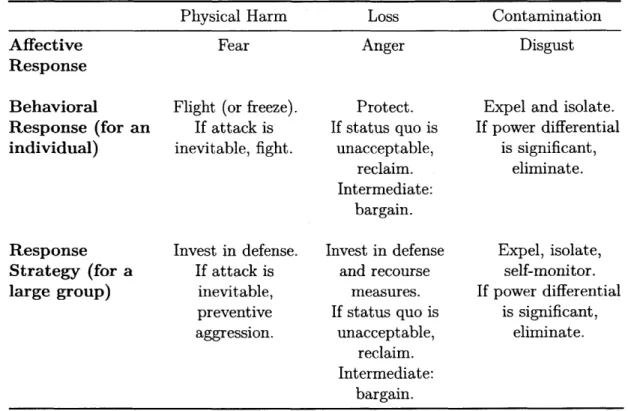
Table 1.1 summarizes the behavioral and emotional responses associated with the three threat types of interest identified in the biology and cognitive science literature (rows 1 and 2). I extend the logic of individual-level behavioral responses to hypothesize the appropriate response strategies at the level of large groups and communities (row 3), where certain options (e.g., flight) are not readily available. I treat the hypothesized response strategies (row 3) as canonical, generic policy options. That is, they are broadly the kind of solution that is required to mitigate the corresponding type of danger at the
level of large communities.
Table 1.1: Affective and Behavioral Responses Physical Harm Fear Loss Anger Contamination Disgust Behavioral Response (for an individual) Response Strategy (for a large group)
Flight (or freeze).
If attack is inevitable, fight. Invest in defense. If attack is inevitable, preventive aggression. Protect. If status quo is unacceptable, reclaim. Intermediate: bargain. Invest in defense and recourse measures. If status quo is unacceptable, reclaim. Intermediate: bargain.
Expel and isolate. If power differential is significant, eliminate. Expel, isolate, self-monitor. If power differential is significant, eliminate.
It is worth noting here that, while response strategies may have objectively or normatively problematic consequences because the detection of, and responses to, danger privilege speed over accuracy or other considerations, arriving at preferred responses is not necessarily the result of a deliberative mental process. Rather, the formation of response preferences conforms to the model of intuitive operations characteristic of "System 1" thinking (Kahneman 2003, 1452). This does not mean individuals cannot reason about their preferences or change their minds, only that the original preference need not have been developed deliberatively.
36 Affective