Publisher’s version / Version de l'éditeur:
Vous avez des questions? Nous pouvons vous aider. Pour communiquer directement avec un auteur, consultez la première page de la revue dans laquelle son article a été publié afin de trouver ses coordonnées. Si vous n’arrivez pas à les repérer, communiquez avec nous à [email protected].
Questions? Contact the NRC Publications Archive team at
[email protected]. If you wish to email the authors directly, please see the first page of the publication for their contact information.
https://publications-cnrc.canada.ca/fra/droits
L’accès à ce site Web et l’utilisation de son contenu sont assujettis aux conditions présentées dans le site
LISEZ CES CONDITIONS ATTENTIVEMENT AVANT D’UTILISER CE SITE WEB.
Canadian Journal of Civil Engineering, 15, 6, pp. 1080-1084, 1988-12
READ THESE TERMS AND CONDITIONS CAREFULLY BEFORE USING THIS WEBSITE. https://nrc-publications.canada.ca/eng/copyright
NRC Publications Archive Record / Notice des Archives des publications du CNRC :
https://nrc-publications.canada.ca/eng/view/object/?id=54b64b55-9771-49d2-8234-728d78fbc1b5
https://publications-cnrc.canada.ca/fra/voir/objet/?id=54b64b55-9771-49d2-8234-728d78fbc1b5
NRC Publications Archive
Archives des publications du CNRC
This publication could be one of several versions: author’s original, accepted manuscript or the publisher’s version. / La version de cette publication peut être l’une des suivantes : la version prépublication de l’auteur, la version acceptée du manuscrit ou la version de l’éditeur.
Access and use of this website and the material on it are subject to the Terms and Conditions set forth at
On the elasticity of ice plates
Gold, L. W.
S e r
THl
National Research
Conseil national
JJ
*
'
b
I
Council Canada
n o .
1583
de recherches Canada
c .
2- B L D G
Institute for
lnstitut de
Research in
recherche en
-- --
Construction
construction
On the Elasticity of Ice Plates
by
L.W.
Gold
Reprinted from
Canadian Journal of Civil Engineering
Vol.
15,
No. 6, December
1988
p.
1080
-
1084
(IRC Paper No.
1583)
ANALYZED
NRCC
301
86
N R C-
ClSTjL I B R A R Y
JUM
19
1989
B I B L I O T H ~ Q U E
I R C
C N R C-
ICISTI
This paper
is
being
distributed
in
reprint
farm
by
the
Institute
for
Research
in
Construction.
A
list
of building practice
and
research
publications
available
from
the
Institute
may
be
obtained by
writing
to
the
Publications
Section,
Institute for Research
in
Construction,
National Research
Council
of
Canada,
Ottawa,Ontario,
KIA
OR6.
Ce
document
e ndistribuC
sous
fonne
de t i r 6 d - ~ a r - ~ a r
1'Institut
de
recherche
en
cr-
ISde
1'Institut
porr
:
de
bitiment en
4
-the
en
constructi
i w a
NOTE
On
the elasticity of ice plates
LORNE W. GOLDlnstirltre for Research in Construction, National Research Council of Canada, Ottawa, Onr., Canada K I A OR6 Received October 23, 1987
Revised manuscript accepted June 7. 1988
The rigidity modulus is determined for simply supported, circular ice plates 0.5 and 1.23, m in diameter. Measurements for the 0.5 m diameter plates were made at - 10°C and for the 1.22 m plates in the range of -7 to -37OC. The elastic moduli and Poisson's ratio, calculated from the rigidity modulus, are in the range of 6.0- 12.0 GPa and 0.29-0.60 respectively, depending on ice type. temperature, and grain size. The plate characteristic lengths calculated from the measured values of the elastic moduli are compared with characteristic lengths determined from field measurements of the deflection of ice covers under load.
Kex words: ice, ice cover, rigidity modulus, elastic modulus, Poisson's ratio.
Le module de rigidit6 de plaques de glace circulaires, avec appui simple, de 0,5 m et 1,22 m de diametre est calculk. Les mesures des plaques de 0,5 m de diametre ont CtC effectukes
a
- 10°C et celles des plaques de 1,22 m de diametre ont CtC prises a des temperatures variant entre -7°C et -37°C. Le module d'tlasticitk et le rapport de Poisson, calculCs partir du module de rigiditC, varient entre 6,O et 12 GPa, et 0,29 et 0,60 respectivement, selon le type de glace, la temperature et la dimension des grains. Les longueurs caractCristiques des plaques calculCs a partir des valeurs mesurees du module d'ClasticitC sont comparkes aux longueurs caractkristiques dCterminCes l'aide des mesures in situ de la fleche des couches de glace soumises a des charges.Mots clks : glace, couche de glace, module de rigiditk, module d'tlasticitk, rapport de Poisson.
[Traduit par la revue] Can, 1. Civ. Eng. 15, 1080-1084 (1988)
Introduction
It has been amply demonstrated that the initial response of a competent ice cover to a load applied relatively rapidly can be assumed to be elastic (Gold et al. 1958; Eyre and Hesterman 1976; Squire et a / . 1985). There is uncertainty, however, in the
values of the moduli to be used in calculations because of their dependence on variables that include type of ice, temperature, grain size, and amount of delayed elastic strain (Traetteberg et
al. 1975; Sinha 1978, 1981, 1987).
One method to determine the elastic moduli is to measure the deflection of a plate due to an applied load. In this paper, results are presented of observations of the response of simply supported circular ice plates to a load applied at their centre. Two diameters of plates were used: 0 . 5 and 1.22 m. Measure- ments were made for temperature in the range of -7 to -37"C, and thickness in the range of 10.7 to 40.0 mm. The plate characteristic lengths calculated from the measured values of the elastic moduli are compared with characteristic lengths determined from field measurements of the deflection o f ice covers under load.
Preparation of the ice plates
The 0.5 m plates were made from ice formed on the surface of water in a large tank. Freezing was allowed to start spontaneous- ly, resulting in type S1 ice (Michel and Ramsier 1971) with large (several centimetres) and irregular grains. For this type of ice, the crystallographic C axis of each grain tends to be perpendicular to the ice surface. The plates were cut to diameter with a band saw and planed by hand to uniform thickness.
The 1.22 m diameter plates were made from ice formed in the same tank. Fine ice particles were used to initiate freezing. This resulted in columnar grained type S2 ice, with grain size of NOTE: Written discussion of this note is welcomed and will be received by the Editor until April 30, 1989 (address inside front cover).
about 2.5 mm perpendicular to the long direction of the grains at the midplane of the plate. The crystallographic C axis of the grains of type S2 ice tends to be randomly oriented in the plane parallel to the ice surface.
Experimental procedure
The 0.5 m plates were uniformly supported at their circum- ference on a steel ring of the same diameter. Water, placed with an eyedropper, was frozen between the plate and the ring to ensure uniform support. The bond between the ice and the ring was broken before load was applied to the plate.
The ring was an integral part of a rigid steel frame that included a lever by which the load was applied. A similar steel frame was constructed for the 1.22 m diameter plate tests, but the plates in this case were supported at their circumference on a 12.5 mm diameter oil-filled tube. The oil-filled tube ensured that uniform support at the plate edge was easily achieved.
Loads were applied through a ball to a small circular steel platen placed at the centre of each plate. Dial gauges of sensitivity of 2.5 x mm/div were mounted along a diameter under the plate. Deflections were measured with the gauges at the centre and at 127 mm on either side for the 0.5 m plates. They were measured relative to the centre at radii of 127, 254, and 508 mm for the 1.22 m diameter plates.
Preliminary observations showed that if the load was applied and removed within 10 s, there was a linear dependence of the deflection of the plates on load and that there was no permanent deflection due to creep. A procedure was used in which each cycle of load and unload was completed within 5 s.
For the 0.5 m plates, the rigidity modulus was calculated from the slope of the load-deflection line for the centre and for r = 127 mm. The slope was determined by applying and removing several loads of randomly selected value. For the 1.22 m plates, values of the moduli were determined from the difference between the deflections for r = 0.508 m and r =
0.127 m, and for r = 0.254 m and r = 0.127 m. This approach was necessary because the compression of the oil-filled tube by the load was not known. The dependence of the deflection on load was determined from the average deflection for four applications of the same load.
Results and analysis
The results were analyzed using the following equation which neglects the effect of shear stress and the size of the area over ,which the load is applied (Roark 1965):
where w(r) is the deflection at distance r from the centre of the plate.
The ratio of the thickness of the plate to its radius was always less than 0.1, as assumed in the development of [I]. Calculations based on equations given by Roark (1965) showed that the effect on deflection of the area of the load platen was always less than 1% of the total. As the plate returned to its original position after the removal of the load, the effect of its weight could be neglected.
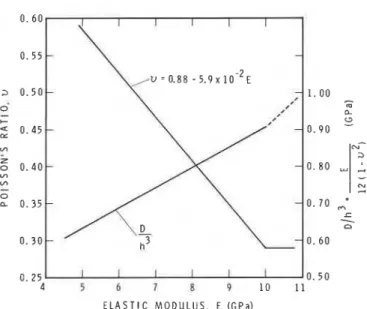
Initially, it was thought that it would be possible to determine both D and v from measurements of the deflection at more than one position of the radius, r. It was soon found that this was not practical because of the relative insensitivity of [I] to changes in Poisson's ratio. In an earlier study, a correlation was observed between the elastic modulus and Poisson's ratio for type S2 ice (Gold 1958). This correlation, shown in Fig. 1, did not appear to be very dependent on the temperature and is given by the equation:
[3] v = 0.88 - 0.59E/Eo
where Eo is a constant and equal to 10 GPa.
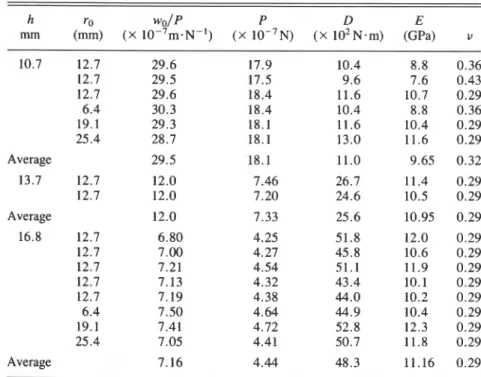
Values of D, E, and v were determined for each test. The results are presented in Tables 1 and 2 along with other relevant information. For the 0.5 m diameter plates, E and v were calculated from the measured values of D using [2] and [3]. For the 1.22 m diameter plates, an iterative process was necessary to determine the values of D, E, and v consistent with [2] and [3] and the difference between the deflections at 508 and 127 mm, and at 508 and 254 mm. The average of the two sets of values obtained for each test is presented in Table 2. Poisson's ratio for both sizes of plates was assumed to be 0.29 for all values of the elastic modulus equal to or greater than 10 GPa.
The tests using the 1.22 m diameter plates were carried out at various temperatures. In Fig. 2, the rigidity modulus divided by the plate thickness cubed is plotted against the temperature.
Shown also are the temperature dependence for E / 12 (1 - v2),
calculated from values determined for type S2 ice for uniaxial compressive loads (Gold 1958), and the results obtained by Katona and Vaudrey (1973) for a plate made from sea ice.
Discussion
Tables 1 and 2 show that the values of the elastic modulus determined for the 0.5 m diameter plates are significantly larger than the values for the 1.22 m diameter plates tested at about the same temperature. Sinha (1978) has shown that the deformation response of ice to stress can be separated into an elastic, delayed elastic, and plastic component. Investigations of the response of
0. 2 5 4 O( . ~ O I O 5 6 7 8 9 1 0 1 1 E L A S T I C M O D U L U S . E ( G P a )
FIG. 1. Relation between the elastic modulus and Poisson's ratio observed by Gold (1958) for type S2 ice.
ice to stress indicate that the delayed elastic component depends on the shear stress acting on the basal planes of each grain. These planes are perpendicular to the grain's crystallographic C axis. For the 0.5 m diameter plates, the basal planes of the grains tended to be parallel to the plate surface, and so no shear stress would be imposed on them by the applied load. In addition, theoretical work by Sinha (1979) has shown that the delayed elastic strain for a given stress and time decreases with increase in grain size. Therefore, for the large grain, type S1 ice from which the 0.5 m plates were made, one would expect that there should be little delayed elastic strain, and that the elastic moduli determined from the tests would be close to the true value for Young's modulus and the corresponding Poisson's ratio.
On the other hand, the basal planes of the grains of the type S2 ice from which the 1.22 m diameter plates were made did have a resolved shear stress on them. The average grain size for this ice was also much smaller than for the type S1 ice. The elastic modulus of the bigger plates, therefore, should be smaller and the Poisson's ratio larger due to a larger delayed elastic component. In addition, the delayed elastic strain would be primarily in the radial direction. This would cause an anisotropy in the deformation that would explain the values of Poisson's ratio in Table 2 that are larger than 0.5.
Figure 2 indicates a temperature dependence of the rigidity modulus for type S2 ice that is consistent with that observed for its elastic modulus and Poisson's ratio, but there is still insufficient information to define it with confidence. The results of Katona and Vaudrey (1973) are consistent with the lower value and stronger temperature dependence of the elastic modulus that has been observed for sea ice.
Comparison with field measurements
There is a dichotomy in attitude in the study of the mechanical properties and behaviour of ice. Those who are interested in the material have a natural desire to determine the true values of its properties and their dependence on the factors that affect them. These investigations are normally carried out under carefully controlled conditions in a laboratory.
On the other hand, individuals concerned with problems such as the bearing capacity of ice covers or ice forces on structures must make their calculations for highly variable conditions of
CAN. 1. CIV. ENG. VOL. 15. 1988
TABLE 1. Results from measurement of deflection of simply supported ice plates 0.5 m
in diameter. Load applied at centre over area of radius ro; temperature - 10°C
h ro w0lP P D E mm (mm) ( x 1 0 - ~ m . ~ - ' ) ( x ~ o - ~ N ) ( x 10'N.m) (GPa) v 10.7 12.7 12.7 12.7 6.4 19.1 25.4 Average 13.7 12.7 12.7 Average 16.8 12.7 12.7 12.7 12.7 12.7 6.4 19.1 25.4 Average
h is the plate thickness; w, is the deflection of the centre; w , is the deflection at r = 0.127 m; D is the rigidity modules; E is the elastic modules; v is Poisson's ratio.
site, weather, and type of ice. What they desire are equations and values of properties that have been demonstrated to give reasonable predictions for the purposes of design and for the normal conditions of practice. The variability that occurs in nature has dictated that the latter requirement be satisfied by an essentially empirical approach, with laboratory and field inves- tigations and theory providing guidance for the development of the equations used and the properties selected for calculations. When determining properties from field measurements, what
are obtained are the effective or apparent values for the conditions
that are present. These conditions usually include an ice-water interface at the melting point, a gradient in temperature through the ice, imperfections such as cracks and air bubbles, variable thickness and ice type, and variable impurity content. It is necessary for application of the empirical approach to have an appreciation of how dependent the predicted behaviour is on variations in these conditions. It is also important to have an appreciation of the appropriate equations to be used for the calculations and the material properties to be selected for given field situations.
10 - 2 0 - 30 -40
T E M P E R A T U R E PC)
One of the for which the of the FIG. 2. Depedence of the rigidity modulus on temperature for the
elastic moduli are required is the prediction of the maximum diameter plates: = 40
(a),
33(A),
and 32.5 (0) mm;(A)
load that can be placed safely on an ice Cover. For this problem, Katana and Vaudrey (1973) results; (---) temperature dependence for
and some ice Pressure problems, the starting point is often to E/12(1 - v2) calculated from results of uniaxial compression tests
calculate the initial deflection assuming elastic behaviour. (Gold 1958).
Wyman (1950) has shown that for elastic behaviour, the
vertical deflection of an ice cover at distance r from the centre of length given by
a load, P, applied uniformly over an area of radius c is given by 114
[51 1 = [ : ]
=[
12pg(1 - v2)The maximum deflection occurs at the centre and is given by
where ber, bei, ker, and kei are the modified Bessel functions [6] w
=
-
NOTE
TABLE 2. Rigidity modulus, D, elasic modulus, E, and Poisson's ratio, v, determined for simply supported ice plates of diameter 1.22 m and thickness, h. The load was
applied at the middle over an area of radius 12.7 mm
h T (w3 - w,)/P ( ~ 2 - WI)/P E D (mm) ("C) ( x 1 0 - 8 m . ~ - 1 ) ( x 10-~m.N-') (GPa) v ( x lo3 Nm) 40.0 -7 25.30 19.15 6.60 0.49 46.2 -8 26.70 18.80 6.35 0.50 45.1 - 15 23.50 16.25 9.33 0.33 55.8 - 26 22.75 16.15 9.75 0.31 57.5 - 37 21.25 15.55 10.39 0.29 59.7
w , is the deflection at r = 0.127 m; w, is the deflection at r = 0.254 m; w, is the deflection at
r = 0.508 m. Each value of the deflection is the average for four load applications.
-
FRESH ICE-STATIC
-
-
FRESH ICE-DYNAMIC
-
SEA ICE-STATIC SEA ICE-DYNAMIC
PLATE MEASUREMENTS GOLD
PLATE MEASUREMENTS SALINE ICE MURAT (1978) PLATE MEASUREMENTS SALINE ICE
KATONA & VAUDREY (1973)
-
-
--
-
-
314@:~h","'~
l = l 7 . 5 h m 7-
-
314@
]
1 - 1 5 . 9 h mI
-
314-
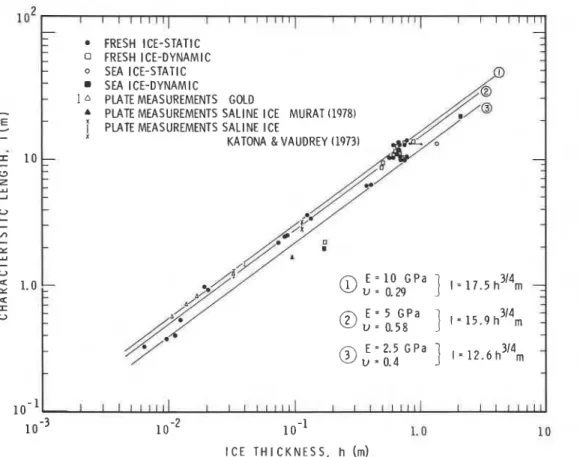
I C E T H I C K N E S S , h (m)FIG. 3. Observations of the characteristic length, 1, of ice covers of given thickness. Sources: (0) Eyre and Hesterman (1976); ( 0 ) Frankenstein (1963); ( 0 ) Gold et al. (1958); Katona and Vaudrey (1973); ( 0 ) Laidley et al. (1980); ( 0 ) Meneley (1974); (0 W) Murat (1978), Squire el al.
(1985); ( 0 0) Stevens and Tizzard (1969); ( 0 ) Sundberg-Falkenmark (1978); (W) Takizawa (1986).
It has been found for the bearing capacity problem that [4] and
[6] are reasonable descriptions of the initial deflection of the ice cover for static loads if they are applied relatively rapidly. They are a satisfactory description, also, of the deflection for loads moving at speeds less than 50% of a critical value that depends on water depth and ice thickness (Squire et al. 1985).
Equations [4]-[6] show that the properties of ice governing the initial elastic deflection of an ice cover under load are incorporated in the characteristic length, 1. Several investiga-
tions of the deflection of ice covers under both static and moving loads have been reported. In Fig. 3 the logarithm of characteris- tic lengths calculated from the results of some of the tests is plotted against the logarithm of the reported thickness of the ice cover. Plotted also are the characteristic lengths corresponding to the rigidity moduli determined from the plate tests.
Equation [5] shows that
I
is only weakly dependent on the elastic moduli in comparison to its dependence on the thickness of the ice cover. This is illustrated in Fig. 3 by the two lines that1084 CAN. I. CIV. ENG. VOL. 15. 1988
correspond to extreme values for the elastic moduli of fresh- water, type S2 ice, consistent with [3] (lines 1 and 2). Shown also is a line determined for a low value of the elastic modulus for granular ice (Traetteberg et al. 1975) and a corresponding value for Poisson's ratio (Sinha 1987). When the variability in conditions and the difficulties of making field measurements are taken into account, the agreement between the pIotted results and the thickness dependence of the characteristic length determined from extreme values for the elastic moduli for freshwater ice obtained from laboratory measurements is quite good. The same situation has not yet been achieved for sea ice. More measurements are needed of the elastic moduli of sea ice and of the characteristic length of sea ice covers of given thickness.
Conclusions
Measurement of the deflection of simply supported circular plates due to a load applied at their centre is a reasonable method for determining the rigidity modulus of ice. Great care is required when making measurements, however, because of the sensitivity of the modulus to the thickness of the plate and the time dependence of the elastic behaviour of the different ice types. The method is not so useful for determining the elastic modulus and Poisson's ratio, primarily because of the insensi- tivity of the deflections to variations in Poisson's ratio.
The elastic moduli determined for plates made from type S1 ice, with the crystallographic C axis tending to be perpendicular to the surface of the plates, were found to be close to the normally accepted true value for Young's modulus and corre- sponding Poisson's ratio. Values determined for plates made from type S2 ice, with the basal planes of grains tending to be perpendicular to the surface of the plates, were found to be temperature dependent and in the range of 10.4-4.7 GPa and 0.29-0.60 for the elastic modulus and Poisson's ratio, respec- tively. The greater range in the elastic moduli of the plates made from type S2 ice is considered to be due to the delayed elastic strain that can be expected for this ice under the conditions of the tests.
The characteristic length for ice covers of given thickness calculated from the rigidity moduli determined from the plate tests was found to be in good agreement with values determined from field observations. Current knowledge of the elastic moduli and field and laboratory measurements indicate that for elastic conditions, the characteristic length of columnar grained, freshwater ice covers is in the range of 15.9h3I4- 17.5 h3I4 m. The range for granular, freshwater ice covers extends to about
12.6h3I4 m.
More measurements are required to establish the thickness dependence of the characteristic length for sea ice, and the dependence of its elastic moduli on the conditions that can be expected in the field.
EYRE, D., and HESTERMAN, L. 1976. Report on an ice crossing at Riverhurst during the winter of 1974-76. Saskatchewan Research Council, Saskatoon, Sask., Report E76-9.
FRANKENSTEIN, G. E. 1963. Load test data for lake ice sheets. Cold Regions Research and Engineering Laboratory, U. S. Army Corps of Engineers, Hanover, NH, Technical Report 89.
GOLD, L. W. 1958. Some observations on the dependence of strain on stress for ice. Canadian Journal of Physics, 36: 1265-1275.
GOLD, L. W . , BLACK, L. D., TROFTMENKOFF, F., a n d M n ~ z , D. 1958. Deflections of plates on elastic foundation. Transactions of the Engineering Institute of Canada, 2(3): 123- 128.
KATONA, M. G., and VAUDREY, K. D. 1973. Ice engineering -
summary of elastic properties, research and introduction to visco- elastic and nonlinear analysis of saline ice. Naval Civil Engineering Laboratory, Port Huenemi, CA, Technical Report R797.
LAIDLEY, T. E., LAURENJTIUS, T. B., and HAMZA, H. 1980. A load bearing capacity test on a freshwater ice cover. Centre for Cold Ocean Resources Engineering, Memorial University of Newfound- land, St John's, Nfld., Technical Report 80-8.
MENELEY, W. A. 1974. Blackstrap Lake ice cover parking lot. Canadian Geotechnical Journal, ll(4): 490-508.
MICHEL, B., ~ ~ ~ R A M S I E R , R. 0. 1971. Classification of river and lake ice based on its genesis, structure and texture. Canadian Geotech- nical Journal, 8: 36-44.
MURAT, J. R. 1978. La capacitC portante de la glace de mer. Ph.D. thesis, DCpartement de gCnie civil, Ecole Polytechnique, Montreal, QuC.
ROARK, R. J. 1965. Formulas for stress and strain. McGraw-Hill Book Company, New York, NY.
SINHA, N. K. 1978. Short-termrheology of polycrystalline ice. Journal of Glaciology, 21(85): 457-473.
1979. Grain boundary sliding in polycrystalline materials. Philosophical Magazine A, 40(6): 825-842.
1981. Constant stress rate deformation modulus of ice. Proceedings, 6th International Conference on Port and Ocean Engineering Under Arctic Conditions, Quebec City, Que., pp. 216-224.
1987. Effective Poisson's ratio of isotropic ice. Proceedings, 6th International Symposium on Offshore Mechanics and Arctic Engineering, Houston, TX, Vol. IV, pp. 189-195.
SQUIRE, V. A,, ROBINSON, W. H., HASKILL, T. G., and MOOR, S. C. 1985. Dynamic strain response of lake and sea ice to moving loads. Cold Regions Science and Technology, 11: 123-139.
STEVENS, H. W., and TIZZARD, W. J. 1969. Traffic tests on Portage Lake ice. Cold Regions Research and Engineering Laboratory, U. S. Army Corps of Engineers, Hanover, NH, Technical Report 99. SUBDBERG-FALKENMARK, M. 1978. Load bearing capacity of ice.
Cold Regions Research and Engineering Laboratory, U.S. Army Corps of Engineers, Hanover, NY, Draft Translation 684. (Swedish Institute of Meteorology and Hydrology, Stockholm, Sweden. Series No. 1, 1963.)
TAKIZAWA, T. 1986. Response of a floating ice sheet to a moving vehicle. Proceedings, 5th International Offshore Mechanics and Arctic Engineering Symposium, Tokyo, Japan, Vol. IV, pp. 614-621.
TRAETTEBERG, A,, GOLD, L. W., and FREDERKING, R. 1975. The strain rate and temperature dependence of Young's modulus of ice. Proceedings, 3rd International Symposium on Ice Problems, Inter- national Association for Hydraulic Research, Hanover, NH, pp. 479-486.
WYMAN, M. 1950. Deflections of an infinite plate. Canadian Journal of Research, 28: 293-302.
List of symbols
plate radius
= c l l
radius of area of load plate rigidity modulus elastic modulus gravitational constant applied load