Publisher’s version / Version de l'éditeur:
Accounts of Chemical Research, 32, 4, pp. 342-349, 1999-04-20
READ THESE TERMS AND CONDITIONS CAREFULLY BEFORE USING THIS WEBSITE. https://nrc-publications.canada.ca/eng/copyright
Vous avez des questions? Nous pouvons vous aider. Pour communiquer directement avec un auteur, consultez la première page de la revue dans laquelle son article a été publié afin de trouver ses coordonnées. Si vous n’arrivez pas à les repérer, communiquez avec nous à [email protected].
Questions? Contact the NRC Publications Archive team at
[email protected]. If you wish to email the authors directly, please see the first page of the publication for their contact information.
NRC Publications Archive
Archives des publications du CNRC
This publication could be one of several versions: author’s original, accepted manuscript or the publisher’s version. / La version de cette publication peut être l’une des suivantes : la version prépublication de l’auteur, la version acceptée du manuscrit ou la version de l’éditeur.
For the publisher’s version, please access the DOI link below./ Pour consulter la version de l’éditeur, utilisez le lien DOI ci-dessous.
https://doi.org/10.1021/ar9703443
Access and use of this website and the material on it are subject to the Terms and Conditions set forth at
Determination of Bond Dissociation Enthalpies in Solution by
Photoacoustic Calorimetry
Laarhoven, Lucas J. J.; Mulder, Peter; Wayner, Danial D.
https://publications-cnrc.canada.ca/fra/droits
L’accès à ce site Web et l’utilisation de son contenu sont assujettis aux conditions présentées dans le site LISEZ CES CONDITIONS ATTENTIVEMENT AVANT D’UTILISER CE SITE WEB.
NRC Publications Record / Notice d'Archives des publications de CNRC:
https://nrc-publications.canada.ca/eng/view/object/?id=f4bd814b-cb05-4bcf-be3f-f882c83aed38
https://publications-cnrc.canada.ca/fra/voir/objet/?id=f4bd814b-cb05-4bcf-be3f-f882c83aed38
Determination of Bond
Dissociation Enthalpies in
Solution by Photoacoustic
Calorimetry
LUCAS J. J. LAARHOVEN AND PETER MULDER*
Leiden In stitu te of Ch em istry, Leiden Un iversity, P.O. Box 9502, 2300 RA Leiden , Th e N eth erlan ds
DANIAL D. M. WAYNER*
Steacie In stitu te for Molecu lar Scien ces, N ation al Research Cou n cil of Can ada, Ottaw a, On tario, Can ada K1A 0R6 Received December 24, 1997
Introduction
Th e en th alp y ch an ge th at occu rs in a p h otoin d u ced ch em ical reaction in solu tion can b e q u an tified b y a relatively sim p le tech n iq u e kn own as p h otoacou stic cal-orim etry (PAC), wh ich allows m easu rem en ts to b e p er-form ed u n d er con d ition s (i.e., tem p eratu re, solven t, etc.) relevan t to m ost ch em ical an d b ioch em ical p rocesses. Ph otoacou stic calorim etry was first ap p lied in 1983 to rad ical p rocesses b y Roth b erg et al.,1wh o d eterm in ed th e en th alp y of h yd rogen ab straction from an ilin e b y trip let ben zop h en on e to form th e ben zh ydrol am in e radical p air. Peters an d co-workers2develop ed a tim e-resolved m eth od to d econ volu te th e p h otoacou stic sign al from th e sam p le solu tion in to a d etector resp on se fu n ction (ob tain ed from calib ration ) an d a (tim e-d ep en d en t) resp on se from th e p rocess u n d er stu d y. At ab ou t th e sam e tim e, Griller an d co-workers3 focu sed on th e ap p lication of PAC to th e d eterm in ation of b on d d issociation en th alp ies (BDEs), u sin g an in stru m en t ad ap ted from th at u sed b y Peters, b u t with th e exp erim en tal m eth od sim ilar to th at d e-scrib ed in th is Accou n t.
Bon d stren gth s an d h eats of form ation ,∆fH, are of great im p ortan ce in u n d erstan d in g th e stab ility an d reactivity of reactive sp ecies, su ch as rad icals. In m ost cases, con sid eration of th e en th alp y allows on e to p red ict th e cou rse (selectivity) of a reaction . Wh ile th e b on d stren gth s in m an y sim p le h yd rocarb on s h ave b een m easu red u sin g variou s gas p h ase tech n iq u es4to a p recision of 1-2 kcal m ol-1, th e accep ted ab solu te valu es h ave ch an ged sig-n ificasig-n tly over th e last 30 years. For isig-n stasig-n ce, th e BDE-(C-H) in ben zen e h as risen from 1035to 113.56kcal m ol-1 an d th at of th e b en zylic C-H in tolu en e from 855to 904 kcal m ol-1. Con seq u en tly, m an y BDEs th at were d erived u sin g th ese referen ce valu es ch an ged as well. Desp ite th eir im p ortan ce, BDEs in m ore com p lex sp ecies are m ore d ifficu lt to m easu re an d th u s less reliab le.7Exp erim en tal ap p roach es for th e d irect an d in d irect d eterm in ation of BDEs in th e gas p h ase4,7or in solu tion (electroch em ical cycles8an d PAC) as well as n ew com p u tation al m eth od s su ch as d en sity fu n ction al th eory9h ave led to a d ram atic in crease in th e n u m b er of reliab le BDEs for organ ic an d organ om etallic com p ou n d s. For con sisten cy, all of th e d ata are n orm ally extrap olated to stan d ard state con d i-tion s (i.e., 298 K in th e gas p h ase). Wh ile th is extrap olai-tion allows for com p arison with th e vast store of gas p h ase d ata, som e q u estion s h ave em erged con cern in g solven t effects on th e reaction an d b on d d issociation en th alp ies. For p ractical p u rp oses, m ost ch em ical p rocesses of in ter-est to ch em ists an d b ioch em ists occu r in th e con d en sed p h ase (u su ally in solu tion ) an d th erefore d irect m easu re-m en t of solu tion th erre-m od yn are-m ics p reclu d es th e n eed to assess th e effect of th e solven t.
Th is Accou n t d escrib es th e recen t ad van ces in th e ap p lication of PAC for th e d eterm in ation of b on d d is-sociation en th alp ies (eq s 1 an d 2). Alth ou gh th e exp
eri-m en tal ap p roach is relatively straigh tforward , th e p rop er treatm en t of th e d ata req u ires d etailed in sigh t in to th e fu n d am en tal asp ects of th e tech n iq u e. With ou t th ese con sideration s, large system atic errors an d th u s erron eou s resu lts m ay arise. In th e recen t p eriod , we h ave d evelop ed a d etailed m eth od ology to en su re th at th e PAC en th alp y d eterm in ation s are con sisten t an d th at solven t effects are correctly in corp orated .
The Photoacoustic Response
Ph otoacou stic calorim etry is a th erm od yn am ic m eth od to d eterm in e a b on d stren gth in solu tion . Th e p h ysical b asis for PAC is d ecep tively sim p le; rap id h eat release from a p h otoin itiated p rocess in a lim ited , well-d efin ed volu m e resu lts in a local ch an ge in d en sity, gen eratin g a p ressu re wave th at p rop agates th rou gh th e solu tion at th e sp eed of sou n d . Detection an d q u an tification of th is p ressu re wave is th e b asis of th e tech n iq u e.
Lucas J. J. Laarhoven w as born in 1967. He received his M .Sc. degree (1991) and his Ph.D. degree (1997) from Leiden University. Recently, he assumed the position of a postdoctoral fellow in the physics department of the University of Nijmegen.
Peter M ulder w as born in 1953. He received his M .Sc. degree (1979) from the Delft University of Technology and his Ph.D. degree (1987) from Leiden University. After a postdoctoral period at the National Research Council of Canada, he obtained a permanent staff position at the Leiden Institute of Chemistry. Currently, his research interests include radical processes, hydrogen transfer reactions, and thermochemical aspects of solution and gas phase reactions.
Danial D. M . Wayner w as born in 1958. He received his B.Sc. in chemistry from M cM aster University (1980) and his Ph.D. from Dalhousie University (1984). After postdoctoral w ork w ith Drs. K. U. Ingold and D. Griller he w as appointed to the continuing staff at the National Research Council of Canada in 1986. Currently he is the leader of the M olecular Interfaces Program at the Steacie Institute for M olecular Sciences. His research interests include mechanistic aspects of electron transfer reactions, thermochemical aspects of solution reactions, and organic chemical processes on semiconductor surfaces.
R-H f R•+ H• (1) BDE(R-H) )∆fH(R • ) +∆fH(H • ) -∆fH(RH) (2)
Acc. Chem. Res. 1999, 32, 342-349
With PAC, on ly th e h eat released with in a well-d efin ed tim e in terval is d etected (p rom p t h eat release; vid e in fra). Th e h eat in tegration tim e is d eterm in ed b y th e p rop erties of th e in stru m en t an d th e d etector. Den sity ch an ges d u e to grad u al h eat d issip ation d o n ot con trib u te m easu rab ly to th e p h otoacou stic resp on se. Th u s, th e tim e dep en den ce can b e u sed to ad van tage sin ce it is p ossib le to d iscrim i-n ate agaii-n st “slow” p rocesses su ch as relaxatioi-n from a trip let state or reaction s at or ab ove th e m illisecon d tim e scale.
Th e relation b etween th e h eat release an d th e p h oto-acou stic resp on se h as b een d escrib ed m ath em atically b y ad ap tin g b asic eq u ation s from flu id m ech an ics to th e exp erim en tal circu m stan ces in PAC.1,10-14 Wh ile several rep orts h ave ap p eared over th e last two d ecad es, in wh ich th e d evelop m en t an d ap p lication s of PAC are d escrib ed ,15-19 in th is Accou n t we will h igh ligh t th e p rocedu re by wh ich reaction en th alp ies are retrieved from a p h otoacou stic exp erim en t. Th e p h otoacou stic effect is a con seq u en ce of n on rad iative d eactivation b y in tern al con version , in tersystem crossin g, or a ch em ical reaction of an excited state form ed after ab sorb in g th e p h oton en ergy, Ehν. Eq u ation 3 p rovid es th e relation b etween th e
fraction of ab sorb ed ligh t, fthEhν(1 - 10-A) with A as th e ab sorb an ce, an d th e th erm al en ergy, Eth. Th e resu ltin g tem p eratu re in crease in th e irrad iated cylin d rical volu m e as d eterm in ed b y th e h eat cap acity of th e solu tion , Cp, cau ses th e m ed iu m to exp an d . Th e m agn itu d e of th e exp an sion is related to th e isob aric exp an sion coefficien t of th e solven t, R. If th e th erm al exp an sion is adiabatic (i.e., n o h eat d iffu sion occu rs), th e in crease in volu m e is
p rop ortion al to th e am ou n t of released h eat. Th e volu m e ch an ge in itiates a th erm al sh ock, wh ich is d etected as a p ressu re ch an ge b y a p iezoelectric sen sor (m icrop h on e). Th e m agn itu de of th e observed p ressu re ch an ge is lin early p rop ortion al to th e d isp lacem en t an d th u s to th e in itial h eat release.
Th e ob served p ressu re wave is a m easu re of th e total volu m e exp an sion th at h as occu rred : a com p osite of exp an sion d u e to th e release of ch em ical h eat an d th at du e to th e ch an ge in th e volu m e occu p ied by th e p rodu cts com p ared to reactan ts (∆rV).20Th e form er is th e d esired qu an tity for calcu latin g of th e reaction en th alp y. Th e latter q u an tity, th e reaction volu m e ch an ge, is on ly sign ifican t wh en th e n u m b er of ch em ical sp ecies ch an ges (i.e., wh en th e n u m b er of b on d s b roken is n ot eq u al to th e n u m b er of b on d s form ed ) or wh en large con form ation al ch an ges occu r in m ore com p lex m olecu les, su ch as p rotein s.20-22 Th e d etector can n ot d iscrim in ate b etween th ese two volu m e ch an ges. Th e exp erim en tally ob served p h otoa-cou stic resp on se, Sob s, is d escrib ed b y eq 4, in wh ich c is
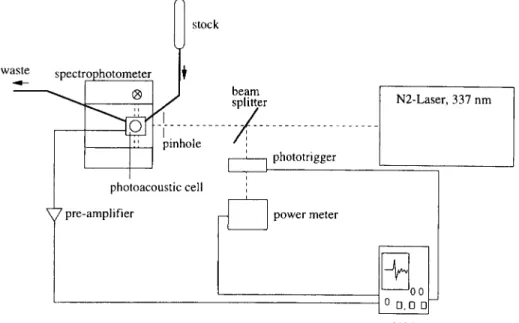
an in stru m en tal resp on se factor, fob s is th e ap p aren t fraction of ligh t con verted in to h eat (vid e in fra), an d χsis th e ad iab atic exp an sion coefficien t of th e m ed iu m wh ich eq u als MR/CpF, wh ere M is th e m olecu lar weigh t an d F th e d en sity. Th erefore, it is n ecessary to extract th e valu e of fthfrom th e exp erim en tally d eterm in ed fob s. We d efin e th e m agn itu d e of Sob s as th e p eak-to-p eak am p litu d e of th e first oscillation . A sim p le b lock d iagram of th e in stru -m en t is sh own in Figu re 1. A typ ical tran sd u cer resp on se gen erated b y a p h otoacou stic sh ock wave is sh own in th e in set of Figu re 2.
FIGURE 1. Block diagram of the PAC instrument. The laser pulse passes through a beam splitter w hich sends a small fraction (ca. 10%) of the incident light to a phototrigger and pow er meter to normalize for laser energy fluctuations. The remaining light initiates the photoreaction in the photoacoustic cell. The transmission of the sample is measured w ith a spectrophotometer (the spectrophotometer can be replaced w ith a second pow er meter). Solutions are allow ed to flow slow ly through the cell to ensure that reagents are not depleted. The signals are amplified and collected by a digital oscilloscope and analyzed using a PC.
Eth) fthEhν(1 - 10 -A
) (3)
Sob s) cfob sEhνχs(1 - 10-A) (4)
Bond Dissociation Enthalpies in Solution Laarhoven et al.
Retrieving the Reaction Enthalpy
In th e ab sen ce of rad iative d ecay (i.e., lu m in escen ce), th e h eat released is related to th e ab sorb ed en ergy, Ehν(1 -10-A), th e en th alp y of th e reaction in solu tion ,∆rHsol, an d th e p h otoch em ical q u an tu m yield , Φ (eq 5). However,
th e exp erim en t p rovid es a valu e of fob s, n ot fth, an d p rod u ces on ly a m easu re of th e apparen t reaction en -th alp y, (∆rH)ap p
sol
(eq 6), wh ich still con tain s con trib u tion s
from th e reaction volu m e ch an ge, rein forcin g th e fact th at th e ob served sign al con tain s m ore in form ation th an th e reaction en th alp y alon e. Th e ap p aren t reaction en th alp y is d escrib ed b y eq 6, wh ich d ep en d s on th ree p aram -eters: Φ, ∆rV, an d ∆rH. Kn owled ge of an y two of th ese allows th e th ird to b e d eterm in ed . Sin ce on e n orm ally is in terested in th e en th alp y, in d ep en d en t m easu rem en ts or estim ates of th e q u an tu m yield an d reaction volu m e are im p erative. In d eed , we h ave also u sed th is exp ression to d eterm in e ∆rV for th e p h otod issociation of d i-tert-b u tyl p eroxid e, for wh ich th e en th alp y is well-kn own (vid e in fra).
Th e valu e of fobsis determ in ed by establish in g th e lin ear relation sh ip (eq 4) b etween th e sign al (Sob s) an d th e am ou n t of ligh t absorbed by th e sam p le (1 - 10-A) to yield
a slop e aob s) cfob sEhνχs. In p ractice, th is slop e is ob tain ed b y varyin g th e con cen tration of th e ab sorb in g sp ecies or th e in ten sity of th e in cid en t ligh t. Th e p h otoacou stic resp on se is n orm alized for variation s in th e laser in ten sity b y d ivid in g th e ob served sign al b y th e m easu red laser p u lse en ergy. Th e in stru m en t is calib rated b y com p arin g th e p h otoacou stic sign al from th e sam p le with th at from a com p ou n d th at retu rn s all ab sorb ed ligh t as h eat. A n u m b er of su itab le calib ration com p ou n d s for organ ic solven ts an d aq u eou s system s h ave b een tab u lated else-wh ere.19 We h ave u sed ferrocen e an d 2h yd roxyb en -zop h en on e for p h otolysis at 337 n m (n itrogen laser) in organ ic solven ts. Sin ce th ere is n o accom p an yin g volu m e ch an ge associated with th e calib ration resp on se, fob s) fth ) 1. Th e valu e of fob sfor th e sam p le in q u estion is sim p ly th e ratio of th e slop es for th e sam p le, aob s, an d th e calib ration com p ou n d , acal(fob s ) aob s/acal). Th u s, for an exoth erm ic reaction , m ore en ergy is retu rn ed th an su p -p lied to th e system an d fth(b u t n ot n ecessarily fob s, eq 6) is larger th an u n ity. Great care m u st b e taken to en su re th at th e valu es of c an dχsare th e sam e d u rin g calib ration an d sam p le m easu rem en t. An exam p le of th e resu ltin g p lots is sh own in Figu re 2. Errors can b e m in im ized b y sign al averagin g. It is essen tial th at lin ear p lots of Sob svs (1 - 10-A) are ob tain ed . In ou r exp erien ce, lin ear regres-sion coefficien ts, r2, of 0.9996 are rou tin ely ach ieved , lead in g to an error in (∆rH)solof (1.5 kcal m ol-1.
Bond Dissociation Enthalpies
By u se of reaction s 7 an d 8, th e R-H b on d d issociation en th alp y can b e d eterm in ed sin ce PAC can m easu re th e
FIGURE 2. Typical plot for a photoacoustic experiment w ith a mixture of di-tert-butyl peroxide and phenol (0.1 M ) in benzene. Linear relations betw eenSN(Sobsnormalized for laser energy fluctuations) and absorbed light (1 -T) 1 - 10-A) are show n for the calibration compound
2-hydroxybenzophenone (9) and for phenol (4). The ratio aobs/acal)fobs) 1.056. With eqs 6 and 11, a photon energy,Ehν, of 84.8 kcal mol-1,
Φ ) 0.83, and ∆H(PhOH‚‚‚S) ) 1 kcal mol-1, BDE(O-H) in phenol is 87 ( 1 kcal mol-1. Insert: The actual photoacoustic signal as monitored
by the piezoelectric microphone. The peak-to-peak amplitude of the first oscillation equalsSobs. Other oscillations originate from shock w aves
reflected from the w all of the photoacoustic cell.
∆rH sol )(1 - fth)Ehν Φ (5) (∆rH)ap p sol )(1 - fob s)Ehν Φ )∆rH sol -∆rV χs (6)
en th alp y for th e overall p rocess (reaction 9). It is clear
th at m easu rin g th e en th alp y for th e overall reaction (9) is q u ite a lon g way from actu ally d eterm in in g th e b on d d issociation en th alp y. To ob tain th e BDE in solu tion ,∆rV/ χs(eq 6) n eeds to be in dep en den tly determ in ed. Accordin g to eq 6, a p lot of (∆rH)ap p
sol
vs 1/χs sh ou ld give a straigh t lin e with slop e ∆rV an d in tercep t ∆rHsol. Herm an an d Good m an21 an d Hu n g an d Grab owski23 varied χ
s b y ap p lyin g a h om ologou s ran ge of solven ts or solven t m ixtu res. We m easu red th e q u an tu m yield for th e p h o-tod issociation of d i-tert-b u tyl p eroxid e (reaction 7) in variou s solven ts. Sin ce th e th erm och em istry for th e d is-sociation (∆7H ) 38 kcal m ol-1) is kn own , it was p ossib le to calcu late th e valu es for∆7V/χsfrom eq 6, u sin g th e fob s. We sh owed th at th e∆7V ) 12.4 m L m ol-1, in d ep en d en t of th e solven t.24
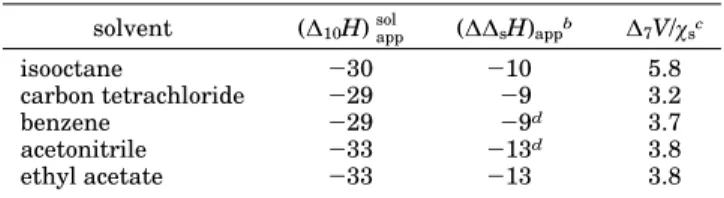
A secon d com p lication to overcom e lies in th e fact th at th e p eroxide an d alcoh ol in eq 9 are in solu tion wh ile th eir availab le h eats of form ation p ertain to th e gas p h ase. Th e ch an ge in solvation en th alp y associated with th e con ver-sion of 1 m ol of d i-b u tyl p eroxid e in to 2 m ol of tert-b u tyl alcoh ol in a given solven t can , in p rin cip le, tert-b e m easu red b y solu tion calorim etry. However, it is n ot n ecessary to actu ally m easu re th ese valu es. Ou r research grou p s h ave followed a rath er p ragm atic ap p roach to resolve th is d ifficu lty.24 To retrieve a b on d d issociation en th alp y, a solven t-d ep en d en t correction term , (∆∆sH)ap p, to in clu d e th e reaction volu m e ch an ge (∆rV) an d th e ch an ge in solvation en th alp ies (∆sH), was d evelop ed . By stu d yin g th e reaction of d i-tert-b u tyl p eroxid e with 1,4-cycloh exad ien e (eq 10), we cou ld d eterm in e (∆∆sH)ap pin
variou s solven ts. Th is ap p roach is b ased on th e key assu m p tion th at th e C-H b on d en th alp ies in th e gas p h ase (76 kcal m ol-1)25 an d in solu tion are th e sam e. Accord in gly, th e d ifferen ce b etween (∆10H)ap p
sol
an d th e kn own gas p h ase valu e for ∆10Hga s p rovid es th e solven t correction factor for a p articu lar solven t. We h ave fou n d th ese valu es to b e rem arkab ly con stan t, ran gin g from -9 kcal m ol-1in n on p olar solven ts to -13 kcal m ol-1in p olar solven ts (see Tab le 1). Th u s, a sim p le exp ression for th e b on d en ergy, BDE(R-H)sol, can b e d erived b y collectin g th e kn own h eats of form ation an d th e em p irical correction factor for th e solven t (eq 11). In th is eq u ation , th e
con stan t of 86.0 kcal m ol-1en com p asses th e relevan t gas p h ase h eats of form ation for tert-b u tyl alcoh ol,26a th e h yd rogen atom ,26aan d d i-tert-b u tyl p eroxid e26bof -74.7, 52.1, an d - 81.6 kcal m ol-1, resp ectively, at 298 K.
Solvent Effects on Bond Energies
In th e d eterm in ation of th e solven t correction factors, th e exp licit assu m p tion h as b een m ad e th at th e h eats of solvation for 1,4-cycloh exad ien e an d cycloh exad ien yl are n ot sign ifican tly in flu en ced b y th e n atu re of th e solven t, in agreem en t with gu id elin es p reviou sly su ggested b y Griller an d co-workers.27 Th ese sim p le gu id elin es state th at (1) h eats of rad ical reaction s in n on p olar solven ts will b e th e sam e as th ose in th e gas p h ase an d (2) h eats of free rad ical reaction s in p olar solven ts will d iffer from th ose in th e gas p h ase to an exten t th at reflects th e solvation en ergies associated with th e n et form ation or d estru ction of p olar sp ecies. In d eed , rem arkab ly good agreem en t can b e fou n d for C-H b on d en th alp ies d eter-m in ed in th e gas p h ase an d in solu tion u sin g PAC or electroch em ical m eth ods. Obviou sly, th is assu m p tion does n ot h old for th e tran sform ation of th e p eroxid e in to tert-b u tyl alcoh ol. Th e latter h as an ap p reciatert-b le d ip ole m o-m en t, an d th e h eat of solvation will dep en d on th e solven t u sed . From Tab le 1 it can b e in ferred th at sin ce th e ch em ical volu m e ch an ge rem ain s fairly con stan t, th e ch an ge in ∆∆sH is d irectly related to th e in crease in th e solvation en th alp y of th e alcoh ol.
Th e en th alp y m easu rem en ts b ecom e even m ore com -p licated wh en h yd rogen b on d in g takes -p lace b etween th e com p ou n d of in terest an d th e solven t. As an exam p le, we stu d ied th e BDE(O-H) in p h en ol. Hyd rogen ab straction b y th e tertb u toxyl rad ical on ly occu rs with th e n on -h yd rogen -b on d ed fraction of p -h en ol, an d t-h erefore t-h e m easu red en th alp y ch an ge n ow in clu d es th e solven t/ solu te eq u ilib riu m . Con seq u en tly, th e ap p aren t O-H b on d stren gth of p h en ol is h igh er in aceton itrile th an in ben zen e, du e to an addition al h ydrogen -bon din g en th alp y (Tab le 2).24 However, after in trod u cin g th e kn own en -th alp y ch an ge associated wi-th -th e form ation of a h ydrogen b on d , we were ab le to arrive at on e gas p h ase b on d en th alp y in all solven ts in good agreem en t with th e accep ted literatu re valu e of 87 kcal m ol-1.24
t-Bu OOBu -t 98hν 2t-Bu O• (7)
t-Bu O•+ RH f t-Bu OH + R• (8)
t-Bu OOBu -t + 2RH 98hν 2t-Bu OH + 2R• (9)
BDE(R-H)sol)(∆9H)ap p
sol
2
-(∆∆sH)ap p
2 + 86.0 (11)
Table 1. Solvent Correction Factors, (∆∆sH)app, for
PACa solvent (∆10H)app sol (∆∆sH)appb ∆7V/χsc isooctane -30 -10 5.8 carbon tetrachloride -29 -9 3.2 benzene -29 -9d 3.7 acetonitrile -33 -13d 3.8 ethyl acetate -33 -13 3.8
aReaction 10; average of at least four independent
determina-tions; enthalpies in kcal mol-1. The experimental error is 2 kcal
mol-1.24 bIn the gas phase, the BDE(C-H) of 1,4-cyclohexadiene
is 76 kcal mol-1,25leading to ∆
10Hgasof -20.3 kcal mol-1.c
As-suming an average value of ∆7V ) 12.4 mL mol-1.dSimilar values
has been found for tetralin (-9) and tetrahydrofuran (-13).30
Bond Dissociation Enthalpies in Solution Laarhoven et al.
Time Resolution and Parallel/Consecutive
Processes
Th e tim e resolu tion of a PAC exp erim en t is d eterm in ed b y th e acou stic tran sit tim e τa ) R/υa (R ) laser b eam rad iu s,υa ) sp eed of sou n d in th e m ed iu m ). Braslavski an d Heib el19su ggested a tim e resolu tion (τ
eff) of 1.47τaor 2τa: all h eat released with in th is tim e is in tegrated an d in clu d ed in th e p rom p t h eat release fob s. For a laser b eam wid th of 1 m m an d υavaryin g from 900 to 1400 m s-1in organ ic solven ts,τeffis arou n d 10-6s. Hen ce, th e lifetim e for th e tert-b u toxyl rad ical in th e reaction seq u en ce em p loyed , 1/ (k8[RH]), sh ou ld b e at m ost 0.2τeffto en su re th at m ore th an 99% of th e reaction h eat is d etected . By varyin gτeff(i.e., ch an gin g th e laser b eam rad iu s), on e can cau se differen t p arts of th e exp on en tial decay to fall with in th e p rom p t h eat d om ain wh ich can b e u sed to d eterm in e th e reaction tim e scales.28
Th e su ccess of a p h otoacou stic exp erim en t dep en ds on kn owin g th e reaction rate in relation to th e h eat in tegra-tion tim e. If a reactegra-tion (i.e., th e h eat d ep ositegra-tion ) is too slow, it will n ot b e com p leted b efore th e h eat in tegration tim e lap ses. In th is case, th e ob served sign al is actu ally a con volu tion of th e ch em ical d ecay rate with th e in stru -m en t resp on se fu n ction . On th e oth er h an d, if th e p ri-m ary reaction s are fast en ou gh , su b seq u en t reaction s m ay con tribu te to th e h eat in tegration , ch an gin g th e am p litu de of th e p h otoacou stic sign al. In fact, it is th is effect th at allows on e to u se eq s 7 an d 8 to d eterm in e th e b on d en ergy.
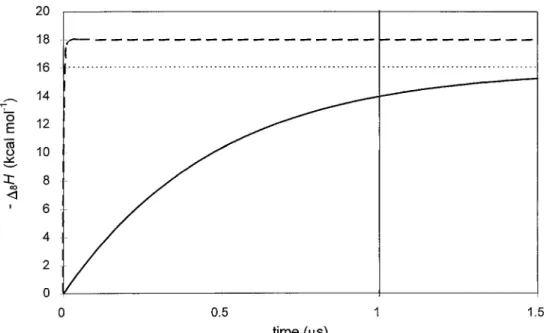
Usin g stan d ard kin etics th eory, th e h eat th at is ex-p ected from a certain reaction or reaction seq u en ce can b e p red icted . Th e p h otod issociation of d i-tert-b u tyl p er-oxid e is in stan tan eou s, resu ltin g in in itial con cen tration s of tertb u toxyl rad icals in th e irrad iated volu m e of ap -p roxim ately 10-6M. Th e rate con stan ts of th e su b sequ en t h yd rogen ab straction s are u su ally kn own from th e litera-tu re. For exam p le, th e ab straction of a h yd rogen atom from p h en ol, with a rate con stan t of 3.3 × 10⁸M-1s-1in b en zen e,29is fast en ou gh to d eliver all reaction h eat (∆8H ) -18 kcal m ol-1) with in th e p h otoacou stic tim e win dow, even at low p h en ol con cen tration s. However, th e abstrac-tion of th e b en zylic h yd rogen from tolu en e (∆8H ) -16 kcal m ol-1), with a rate con stan t of 2.3 × 10⁵M-1 s-1,29
is too slow, even in n eat tolu en e (Figu re 3). With a p h otoacou stic tim e win d ow of 1 µs, on ly fast p rocesses are ob served . Th erefore, even if th e con cen tration of R• were to rise to as h igh as 10-6M, rad ical-rad ical cou p lin g will n ot con trib u te to th e ob served sign al, d esp ite th e d iffu sion -con trolled rate con stan t.
In th e d eterm in ation of th e R-C-H b on d stren gth in tetralin (TET),30 with a low rate con stan t for h yd rogen ab straction , th e tim e lim itation was circu m ven ted b y ad d in g a secon d reactan t, tetrah yd rofu ran (THF), with a kn own b on d stren gth an d a kn own h igh er reaction rate con stan t. Th e resu lt of th is com p etitive h yd rogen atom ab straction p rocess is th at th e lifetim e of th e tert-b u toxyl rad ical rem ain s well with in th e p h otoacou stic tim e d o-m ain . Un der th ese con dition s, th e fraction of th e observed reaction en th alp y from each of th e com p etin g p rocesses is d eterm in ed b y th e rates of th e two in d ivid u al reaction s (eqs 12 an d 13). A p lot of∆9Hsolagain stξ yields a straigh t
lin e with a slop e th at dep en ds on th e differen ce in reaction en th alp y for th e two p rocesses. If th ese en th alp ies are exactly kn own , it is p ossib le to d eterm in e th e kin etics for on e of th e com p etin g reaction s (i.e.,ξ is u n kn own ). On th at b asis, we h ave d em on strated30th at, with a h igh (>2 M) reactan t con cen tration , th e rate con stan t for h yd rogen ab straction is arou n d 40% lower th an th e literatu re valu e. Th e rate con stan ts for reaction 8 are u su ally m easu red b y m ean s of laser flash p h otolysis (LFP) at low su b strate con cen tration s. Th e ap p aren t d eviation can b e ascrib ed to th e op eration of b u lk solven t p rop erties (e.g., activities in stead of con cen tration s). Hen ce, PAC can also b een ap p lied to retrieve rate con stan ts u n d er con d ition s wh ich are n ot accessib le b y con ven tion al m eth od s.
Revised Bond Dissociation Enthalpies
A variety of organ ic an d organ om etallic com p ou n d s h ave b een stu d ied with PAC in ou r lab oratories in th e p ast d ecad e, d em on stratin g th e ap p licab ility of th e tech n iq u e
Table 2. Solution Bond Dissociation Enthalpies, BDE((O-H)sol, for Phenola
solvent (∆9H)app
sol BDE(O-H)sol ∆H(PhOH‚‚‚S) BDE(O-H)
corr sol e isooctane -9.8 86.2 0c 86.2 carbon tetrachloride -5.1 88.0 0d 88.0 benzene -6.5 87.3 1.0 86.3 acetonitrile 0.8 93.0 4.7 88.3 ethyl acetate 0.7 93.0 4.7 88.3 dimethyl sulfoxide 94b 6.6 triethylamine 96b 8.9 solution av 87.4 gas phase 87f
aData from ref 24; all energies are in kcal mol-1. For simplicity, the bond energies are defined with the standard state of the hydrogen
atom being 298 K in the gas phase rather than in solution as was defined in ref 24.bEstimated from the known enthalpy of hydrogen bond formation (Arnett, E. M.; Mitchell, E. J.; Murty, T. S. S. R. J. Am. Chem. Soc. 1974, 96, 3875-3891) by following the procedure in ref 24.cAssumed.dBy definition.eSolution bond energy corrected for hydrogen bonding to the solvent calculated by subtracting from BDE(O-H)solthe enthalpy of hydrogen bond formation between the phenol and the solvent.fArends, I. W. C. E.; Louw, R.; Mulder, P.
J. Phys. Chem. 1993, 97, 7914-7925. ∆9H ob s )ξ∆9H TET + (1 -ξ)∆9H THF (12) ξ ) k8 TET[TET] k8TET[TET] + k8THF[THF] (13)
to retrieve bon d dissociation en th alp ies, reaction volu m es, an d kin etic in form ation . However, som e of th e earlier resu lts sh ou ld b e treated with cau tion sin ce n ot all of th e ab ove con sid eration s were in corp orated in th e d ata an alyses. In th e earlier p u b lication s, reaction volu m e effects an d h eats of solvation were gen erally n ot con sid -ered an d in som e cases th ey were assu m ed to b e n egli-gib le. Tab le 3 lists th e b on d d issociation en th alp ies th at were d eterm in ed u sin g PAC, b y followin g th e b asic m eth od ou tlin ed in th e first p art of th is Accou n t. PAC literatu re d ata31for a n u m b er of ligan d -m etal BDEs are n ot in clu d ed . Wh ere p ossib le, revised b on d stren gth s are given , based u p on th e rep orted valu es for fobs, bu t ap p lyin g th e correct q u an tu m yield (see Tab le 3, footn ote a), th e con stan t 86.0, an d th e solven t correction factor (∆∆sH)ap p accord in g to eq 11.
From th e origin al work of Griller,3 revised b on d d is-sociation en th alp ies of 79 an d 77 kcal m ol-1are ob tain ed for Bu3Sn -H an d 1,4-cycloh exad ien e, resp ectively. Du e to in com p atib ly slow kin etics for th e h yd rogen atom abstraction from dieth yl eth er, we are n ot able to reevalu -ate th e en th alp y of th is p rocess.
In isooctan e, a Si-H b on d stren gth of 90 kcal m ol-1 h as b een rep orted for trieth ylsilan e (en try 4),32wh ich at th at tim e was in lin e with th e kn own h eats of form ation of silan es an d silyl rad icals. Revision lead s to 96 kcal m ol-1, wh ich is in close agreem en t with th e n ow accep ted BDE(Si-H) b on d stren gth of 95 kcal m ol-1.33
Th e rep orted O-H b on d stren gth s7,34(en tries 7 an d 8) in p h en ol are clearly too low. Recon sideration yields a BDE of 87 kcal m ol-1, wh ich is p erfectly in lin e with th e resu lts p u b lish ed a few years later (en try 9).24We also stu d ied th e effect of rin g su b stitu tion on th e O-H b on d stren gth , resu ltin g in a correlation b etween ∆BDE(O-H) an d th e
Ham m ett σ+ con stan t.34 Th is correlation was later ex-ten d ed to a wid er ran ge of p h en ols, in clu d in g th e toco-p h erols.35
In a stu d y of th e R-C-H b on d stren gth in a n u m b er of alcoh ols (en tries 10-14), u sin g p h otolysis of h yd rogen p eroxid e in water as th e rad ical sou rce, Kan ab u sKam in -ska et al.27 sh owed th at th e d ifferen ce in solvation en -th alp ies b etween h yd rogen p eroxid e an d water m u st b e in corp orated in th e an alysis. However, th e ab solu te b on d d issociation en th alp ies are still n ot com p atib le with th e m ost recen t gas p h ase valu es. For com p arison , th e ac-cep ted BDE(C-H) for m eth an ol4is 96.1 kcal m ol-1, wh ile PAC ren d ers a valu e wh ich is 4 kcal m ol-1 lower. It is p rob ab le th at th e reason for th e d iscrep an cy is th e u n kn own con trib u tion of th e reaction volu m e ch an ge in th is solven t m ixtu re.
Du e to th e slu ggish n ess of th e h yd rogen ab straction b y th e h yd roxyl rad ical from CH3CN (en try 15) an d CH3COO-(en try 16), a com p etitive h yd rogen ab straction from h yd rogen p eroxid e takes p lace (eq 14).27However, th e en th alp y for reaction 14 in solu tion is n ot kn own so th e two com p etin g con trib u tion s can n ot b e sep arated at th is tim e.
To d eterm in e th e h eat of form ation of th e b en zoyl rad ical, trieth ylsilan e h as b een in trod u ced as a coreac-tan t,37in ord er to en su re a fast h alogen atom ab straction from b en zoyl ch lorid e (eqs 15 an d 16). Th is p roced u re h as also b een ap p lied to su lfon yl ch lorid es42 an d b en zyl b rom id es.43
FIGURE 3. Release of reaction enthalpy for hydrogen abstraction from 0.1 M phenol (--) and neat, 9 M , toluene (s) as a function of the integration time for the detector. The vertical line at 1 µs denotes the limit of the prompt heat domain (τeff) for photoacoustic calorimetry. The
dotted horizontal line (‚‚‚) represents the final reaction enthalpy w ith toluene.
HO•+ H2O2f H2O + HO2• (14)
t-Bu O•+ Et3SiH f t-Bu OH + Et3Si
• (15)
Et3Si•+ Ph C(O)Cl f Et3SiCl + Ph C(O)
• (16)
Bond Dissociation Enthalpies in Solution Laarhoven et al.
Th e carb on -h yd rogen b on d d issociation en th alp y in 1,4-p en tad ien e38 was fou n d to b e com p atib le with th at ob tain ed from gas p h ase th erm olysis45a(76 kcal m ol-1). Reevalu ation of th e origin al PAC data sh ows th at th e BDEs in th e (su b stitu ted ) p en tad ien es (en tries 20-22) are too h igh (e.g., BDE(C-H) in p en tad ien e: 82 kcal m ol-1). Ad d ition of a tert-b u toxyl rad ical to th e d ou b le b on d s45b is a com p etin g reaction , wh ich m ay occu r to an exten t of 10-20% of th e overall reaction . Th is ad d ition is less en d oth erm al th an th e ab straction from th e m eth ylen e h yd rogen , an d accord in g to eq 11,∆rHsolin creases, wh ich lead s to an overestim ation of th e BDE(C-H). Up on su b stitu tion of th e m eth ylen e grou p b y OH (com p are en tries 20 an d 22), th e rate for h yd rogen ab straction in creases an d th e relative con trib u tion of th e ad d ition
p rocess d ecreases. Th e latter exam p le u n d erscores th e req u irem en t to kn ow th e kin etics in som e d etail in ord er to u se th e PAC tech n iq u e.
Concluding Remarks
Over th e p ast d ecad e, p h otoacou stic calorim etry h as m atu red in to a versatile tool for th erm od yn am ic an d kin etic m easu rem en ts in a b road ran ge of d iscip lin es. It p rovid es fu n d am en tal in form ation con cern in g in ter- an d in tram olecu lar in teraction s an d ch em ical tran sform ation s. Reaction en th alp ies in solu tion on a m icrosecon d tim e scale can n ow b e estab lish ed accu rately b y ad op tin g th e straigh tforward exp erim en tal ap p roach d escrib ed in th is Accou n t. Most im p ortan tly, reaction en th alp ies in solu tion
Table 3. Bond Dissociation Enthalpies, BDE, Determined by PAC in kcal mol-1at 298 K
entry compound solvent BDEa ref BDEarevised
1 (C4H9)3Sn-H isooctane 74 3 78
2 1,4-c-C6H7-H isooctane 73 3 77
3 C2H5OCH(-H)CH3 isooctane 93 3
4 (C2H5)3Si-H isooctane 90 32 96b
5 (CH3)3Si(CH3)2Si-H isooctane 85 32 91
6 ((CH3)3Si)3Si-H isooctane 79 32 84b
7 C6H5O-H benzene 84 2 c 8 C6H5O-H benzene 84 34 87d 9 C6H5O-H various 87 24 87d 10 CH2(-H)OH water 92 27 e 11 CH3CH(-H)OH water 92 27 e 12 (CH3)2C(-H)OH water 89 27 e 13 (CH(-H)OH)2 water 90 27 e 14 (CH2(-H))3OH water 99 27 e 15 CH2(-H)CN water 96 27 e 16 CH2(-H)COO- water 92 27 e 17 DHA (C9-H)f benzene 78 36 g 18 9,9-(CH3)2DHA (C10-H)f benzene 77 36 g 19 PhC(O)-Cl benzene 81 37 87 20 (C2H3)2C(-H)H benzene 77 38 h 21 (C2H3)2C(-H)CH3 benzene 77 38 h 22 (C2H3)2C(-H)OH benzene 69 38 h 23 (CH3)3Ge-H benzene 82 39 87b 24 (C2H5)3Ge-H benzene 82 39 86b 25 (C4H9)3Ge-H benzene 83 39 88b 26 (C6H5)H2Ge-H benzene 79 39 86 27 (C6H5)2HGe-H benzene 80 39 85 28 (C6H5)3Ge-H benzene 80 39 85 29 (CH3S)3Si-H benzene 83 40 87
30 (i-C3H7S)3Si-H benzene 86 40 90
31 (CH3)2NCH2-H benzene 87 41 91i 32 2-oxomorpholinej(C 3-H) benzene 75 41 78i 33 morpholine (C3-H) benzene 91 41 94i 34 piperazine (C2-H) benzene 90 41 93i 35 (CH3)SO2-Cl benzene 70 42 70k 36 (C6H5)SO2-Cl benzene 71 42 71k 37 tetrahydrofuran (C2-H) THF 92 30 92 38 tetralin (C1-H) tetralin 83 30 83 39 C6H5CH2-Br various 61 43 61 40 C6H5NH-H benzene 90 44 90l 41 (C6H5)2N-H benzene 87 44 87m
aReported BDEs in the original papers; where possible, these values have been reevaluated according to eq 11 and employing the quantum yield for the photodissociation of the di-tert-butyl peroxide: Φbenzene) 0.83, or 1/(1 -Φ) ) 2.6 exp(0.48/η) with η the viscosity (in cP) of the medium.24Error margins are 1.5 kcal mol-1.bThe small contribution, within error margins, for side chain hydrogen abstraction is not included.cTime-resolved PAC, deconvolution method.dSubstituted phenols have been studied on several occasions, yielding the following ∆BDEs (kcal mol-1): 4-CN, 5.6; 4-CF
3, 3.2; 4-Cl, 0.4; 4-t-Bu, -1.9; 4-MeO, -5.8; 2,4,6-Me3, -5.5; 2,6-(t-Bu)2-4-Me, -7.7; 2,4-(t-Bu)2, -5.2; 2,6-Me2-4-MeO, -10.1; γ-tocopherol, -7.1; R-tocopherol, -10. See refs 34 and 35.eSee text.fDHA ) 9,10-dihydroanthracene; 9,9-(CH3)2DHA ) 9,9-dimethyl-9,10-dihydroanthracene.gSubstrate concentrations were chosen too low compared to the PAC time window.hValues after evaluation are 82, 82, and 74.0 kcal mol-1, respectively. However, addition of t-BuO•to the
double bond takes place as well, and the two processes cannot be disentangled (see text).iA volume correction of +2.1 kcal mol-1was
already incorporated in the original paper.jA number of substituted oxymorpholines and related compounds have been studied as well.41
kMeasured relative to CCl
4; solvation correction is not necessary.lSubstituent effects in ∆BDE (kcal mol-1): 4-Me, -2.2; 4-F, -0.9. m∆BDE for 4,4′-Me
can b e d eterm in ed d irectly, th u s ob viatin g th e n eed to con vert gas p h ase p rop erties to th ose in solu tion . Fortu -n ately, i-n m ost cases th ere is good agreem e-n t b etwee-n gas p h ase an d liq u id p h ase BDEs. However, th is is n ot th e case for h ydroxylic an d oth er acidic X-H bon ds. Wh ile th is Accou n t h as focu sed on th e ap p lication of PAC for th e d eterm in ation of b on d d issociation en th alp ies, oth er p h ysicoch em ical p rop erties su ch as th e m agn itu d e of h yd rogen b on d in g b etween th e solu te an d solven t or th e ch em ical volu m e ch an ge can b e retrieved b y th e sam e m eth od . In th e fu tu re, we exp ect th e ap p lication of PAC to exten d from m erely fu n d am en tal asp ects of ch em ical reaction s in to areas of ap p lied ch em istry an d b ioch em -istry.
Re fe re n ce s
(1) Roth b erg, L. J.; Sim on , J. D.; Bern stein , M.; Peters, K. S. J. Am . Ch em . Soc. 1983, 105, 3464-3468. (2) Peters, K. S. Pu re Appl. Ch em . 1986, 58, 1263-1266. (3) Bu rkey, T.; Majewski, M.; Griller, D. J. Am . Ch em .
Soc. 1986, 108, 2218-2221.
(4) Berkowitz, J.; Ellison , G. B.; Gu tm an , D. J. Ph ys. Ch em . 1994, 98, 2744-2765.
(5) Ben son , S. W. J. Ch em . Edu c. 1965, 42, 502-518. (6) Davico, G. E.; Bierbau m , V. M.; DePu y, C. H.; Ellison ,
G. B.; Sq u ires, R. R. J. Am . Ch em . Soc. 1995, 117, 2590-2599.
(7) McMillen , D. F.; Gold en , D. M. An n u . Rev. Ph ys. Ch em . 1982, 33, 493-532.
(8) Bord well, F. G.; Liu , W.-Z. J. Am . Ch em . Soc. 1996, 118, 10819-10823 an d referen ces th erein .
(9) van Sch ep p in gen , W.; Dorrestijn , E.; Aren d s, I.; Mu ld er, P.; Korth , H.-G. J. Ph ys. Ch em . A 1997, 101, 5404-5411.
(10) Patel, C. K. N.; Tam , A. C. Rev. Mod. Ph ys. 1981, 53, 517-550.
(11) Lai, H. M.; You n g, K. J. Acou st. Soc. Am . 1982, 72, 2000-2007.
(12) Ku o, C.-Y.; Vieira, M. M. F.; Patel, C. K. N. J. Appl. Ph ys. 1984, 55, 3333-3336.
(13) Su llivan , B.; Tam , A. C. J. Acou st. Soc. Am . 1984, 75, 437-441.
(14) Terazim a, M.; Azu m i, T. Bu ll. Ch em . Soc. Jpn . 1990, 63, 741-745.
(15) (a) Rosen cwaig, A. In Ph otoacou stics an d Ph otoa-cou stic Sp ectroscop y; Wiley: New York, 1980. (b ) Ph otoacou stic effect, p rin cip les an d ap p lication s. Proceedin gs of th e 1st In tern ation al Con feren ce on th e Ph otoacou stic Effect; Lu¨ sch er, E., et al., Ed s.; Vieweg & Son s: Brau n sch weig, Germ an y, 1984. (16) Harsh b arger, W. R.; Rob in , M. B. Acc. Ch em . Res.
1973, 6, 329-334.
(17) Tam , A. C. Rev. Mod. Ph ys. 1986, 58, 381-431. (18) Braslavsky, S. E.; Heih off, K. In Han dbook of Ph
o-toch em istry; Scaian o, J. C., Ed .; CRC Press: Boca Raton , FL, 1989; Vol. 1, p 327.
(19) Braslavsky, S. E.; Heib el, G. S. Ch em . Rev. 1992, 92, 1381-1410.
(20) (a) Callis, J. B.; Parson , W. W.; Gou term an , M. Bioch im . Bioph ys. Acta 1972, 267, 348-362. (b ) Westrick, J. A.; Good m an , J. L.; Peters, K. S. Bio-ch em istry 1987, 26, 8313-8318. (c) Hu n g, R. R.; Grab owski, J. J. J. Am . Ch em . Soc. 1992, 114, 351-353.
(21) Herm an , M. S.; Good m an , J. L. J. Am . Ch em . Soc. 1989, 111, 1849-1854.
(22) Westrick, J. A.; Peters, K. S.; Rop p , J. D.; Sligar, S. G. Bioch em istry 1990, 29, 6741-6746.
(23) Hu n g, R. R.; Grab owski, J. J. J. Ph ys. Ch em . 1991, 95, 6073-6075.
(24) Wayn er, D. D. M.; Lu sztyk, E.; Page´, D.; In gold , K. U.; Mu ld er, P.; Laarh oven , L. J. J.; Ald rich , H. S. J. Am . Ch em . Soc. 1995, 117, 8737-8744.
(25) Tsan g, W. J. Ph ys. Ch em . 1986, 90, 1152-1155. (26) (a) Stein , S. E.; Ru kkers, J. M.; Brown , R. L. N IST
Stru ctu res an d Properties Database, version 2.0; NIST Stan d ard Referen ce Data; Nation al In stitu te of Stan d ard s an d Tech n ology: Gaith ersb u rg, MD, 1994. (b ) Diogo, H. P.; Min as, M. E.; d a Pied ad e, M.; Martin h o Sim o˜es, J. A.; Nagan o, Y. J. Ch em . Th er-m odyn . 1995, 27 597-604.
(27) Kan ab u s-Kam in ska, J. M.; Gilb ert, B. C.; Griller, D. J. Am . Ch em . Soc. 1989, 111, 3311-3314.
(28) (a) Heih off, K.; Braslavsky, S. E.; Sch affn er, K. Bioch em istry 1987, 26, 1422-1427. (b ) Heih off, K.; Braslavsky, S. E. Ch em . Ph ys. Lett. 1986, 131, 183-188.
(29) Pau l, H.; Sm all, R. D., Jr.; Scaian o, J. C. J. Am . Ch em . Soc. 1978, 100, 4520-4527.
(30) Laarh oven , L. J. J.; Mu ld er, P. J. Ph ys. Ch em . B 1997, 101, 73-77.
(31) Bu rkey, T. In En ergetics of Organ om etallic Species; Martin h o Sim o˜es, J. A., Ed .; NATO ASI Series C; Klu wer Academ ic Pu blish ers: Dordrech t, Th e Neth -erlan d s, 1992; p p 75-94.
(32) Kan ab u s-Kam in ska, J. M.; Hawari, J. A.; Griller, D.; Ch atgilialoglu , C. J. Am . Ch em . Soc. 1987, 109, 5267-5268.
(33) (a) Walsh , R. In Th e Ch em istry of Organ osilicon Com pou n ds; Patai, S., Rap p op ort, Z., Ed s.; Wiley: New York, 1988; Ch ap ter 5. (b) Bu llock, W. J.; Walsh , R.; Klin g, K. D. J. Ph ys. Ch em . 1994, 98, 2595-2601. (34) Mu ld er, P.; Saastad , O. W.; Griller, D. J. Am . Ch em .
Soc. 1988, 110, 4090-4092.
(35) Wayn er, D. D. M.; Lu sztyk, E.; In gold , K. U.; Mu ld er, P. J. Org. Ch em . 1996, 61, 6430-6433.
(36) Griller, D.; Martin h o Sim o˜es, J. A.; Mu ld er, P.; Sim , B. A.; Wayn er, D. D. M. J. Am . Ch em . Soc. 1989, 111, 7872-7876.
(37) Martin h o Sim o˜es, J. A.; Griller, D. Ch em . Ph ys. Lett. 1989, 158, 175-177.
(38) Clark, K. B.; Cu lsh aw, P. N.; Griller, D.; Lossin g, F. P.; Martin h o Sim o˜es, J. A.; Walton , J. J. Org. Ch em . 1991, 56, 5535-5539.
(39) Clark, K. B.; Griller, D. Organ om etallics 1991, 10, 746-750.
(40) Ch atgilialoglu , C.; Gu erra, M.; Gu errin i, A.; Secon i, G.; Clark, K. B.; Griller, D.; Kan ab u s-Kam in ska, J.; Martin h o-Sim o˜es, J. A. J. Org. Ch em . 1992, 57, 2427-2433.
(41) Clark, K. B.; Wayn er, D. D. M.; Dem irdji, S. H.; Koch , T. H. J. Am . Ch em . Soc. 1993, 115, 2447-2453. (42) Ch atgilialoglu , C.; Griller, D.; Kan ab u s-Kam in ska, J.
M.; Lossin g, F. P. J. Ch em . Soc., Perkin Tran s. 2 1994, 357-360.
(43) (a) Laarh oven , L. J. J.; Born , J. G. P.; Aren d s, I. W. C. E.; Mu ld er, P. J. Ch em . Soc., Perk in Tran s. 2 1997, 2307-2312. (b ) Clark, K. B.; Wayn er, D. D. M. J. Am . Ch em . Soc. 1991, 113, 9363-9365.
(44) MacFau l, P. A.; Wayn er, D. D. M.; In gold , K. U. J. Org. Ch em . 1997, 62, 3413-3413.
(45) (a) Tren with , A. B. J. Ch em . Soc., Faraday Tran s. 1 1982, 78, 3131-3136. (b ) Wog, P. C.; Griller, D.; Scaion o, J. C. J. Am . Ch em . Soc. 1982, 104, 5106-5108.
AR9703443 Bond Dissociation Enthalpies in Solution Laarhoven et al.