Publisher’s version / Version de l'éditeur: Building Practice Note, 1988-01-01
READ THESE TERMS AND CONDITIONS CAREFULLY BEFORE USING THIS WEBSITE.
https://nrc-publications.canada.ca/eng/copyright
Vous avez des questions? Nous pouvons vous aider. Pour communiquer directement avec un auteur, consultez la
première page de la revue dans laquelle son article a été publié afin de trouver ses coordonnées. Si vous n’arrivez pas à les repérer, communiquez avec nous à [email protected].
Questions? Contact the NRC Publications Archive team at
[email protected]. If you wish to email the authors directly, please see the first page of the publication for their contact information.
NRC Publications Archive
Archives des publications du CNRC
For the publisher’s version, please access the DOI link below./ Pour consulter la version de l’éditeur, utilisez le lien DOI ci-dessous.
https://doi.org/10.4224/20377502
Access and use of this website and the material on it are subject to the Terms and Conditions set forth at
How to reduce noise transmission between homes (apartments)
Warnock, A. C. C.
https://publications-cnrc.canada.ca/fra/droits
L’accès à ce site Web et l’utilisation de son contenu sont assujettis aux conditions présentées dans le site LISEZ CES CONDITIONS ATTENTIVEMENT AVANT D’UTILISER CE SITE WEB.
NRC Publications Record / Notice d'Archives des publications de CNRC: https://nrc-publications.canada.ca/eng/view/object/?id=102023ee-531b-4f0a-9e5f-4e6edfd48156 https://publications-cnrc.canada.ca/fra/voir/objet/?id=102023ee-531b-4f0a-9e5f-4e6edfd48156
ISSN 0701-5232
National Research Conseil national
HOW TO
REDUCE
NOISE TRANSMISSION BETWEEN HOMES (APARTMENTSA.C .C. Warnock
Division of Building Research National Research Council of Canada
Noise from neighbours i s a common source of annoyance i n multi- family homes. Occasionally t h e annoyance i s s o g r e a t t h a t one occupant decides t o a l t e r t h e s t r u c t u r e t o t r y t o reduce t h e i n t r u s i v e noise. This note i s meant a s a guide t o such people. It d e a l s only with sound transmission through walls and f l o o r s between adjacent homes and not w i t h a i r c r a f t , t r a f f i c o r o t h e r e x t e r n a l noises. I n t h e l a t t e r casee, sound e n t e r s t h e home most o f t e n through t h e windows.
Improvements proposed here can be c a r r i e d out by one tenant a c t i n g alone, but cooperation from t h e neighbour i s usually very useful.
Obviously i n rented accommodation the owner would have t o be consulted before making s t r u c t u r a l changes; although r e p a i r s a r e sometimes minor and inexpensive, e x t r a c o n s t r u c t i o n could r e q u i r e some f a i r l y d r a s t i c and q u i t e expensive changes.
Sound Transmission Claes and Noiee Reduction
The amount of sound energy t h a t passes through
a
p a r t i t i o n depends on t h e frequency of t h e sound;low
frequenciesare
t r a n s m i t t e d much more e a s i l y than high frequenciee. The sound transmissioncl$ss
(STC) isa
s i n g l e number r a t i n g system which t a k e s account of these.,frequency v a r i a t i o n s and makes it e a s i e r t o d i s c u s s t h e sound traaerpiss50n performance of b u i l d i n g s t r u c t u r e s . The higher t h e STC vukber; t h e b e t t e r t h e
w a l l ;
l.e., the g r e a t e rthe
n o i s e reductionit:
X i can providebetween homes.
The amount of noise you hear i n your home depends on t h e amount of n o i s e
your
neighbour makes, t h e sound-transmitting propere'iesof
t h ecommon w a l l o r f l o o r , and the l e v e l of background n o i s e present i n your own home. A l l t h r e e f a c t o r s are important. For example:
;"
-
a q u i e t neighbour maymake
you t h i n k you have a good common wall;a
noisy neighbour maymake
you t h i n k you have a bad wall;-
i f you l i v e i n a very q u i e t home, you may be d i s t u r b e d by almost every sound even though t h e common walli s
very good;-
i f your own r a d i o o rTV
i s played o f t e n , you may not hear your neighbour (but he may hear you).F i n a l l y , the degree of annoyance is a personal r e a c t i o n and some people a r e m r e e a s i l y annoyed than o t h e r s .
Building r e g u l a t i o n s s i m p l i f y t h i s complex s i t u a t i o n by requiring a minimum value of STC f o r walls and f l o o r s and accepting t h a t some percentage of occupants w i l l s t i l l be annoyed even when the r e g u l a t i o n s a r e met. In Canada an STC value of
45
has been used i n building r e g u l a t i o n s f o r many years although a c o u s t i c i a n s would p r e f e r t o see values g r e a t e r than 50, such a s a r e common i n Europe. STC values around 60 can be achieved i n t y p i c a l homes and only r e q u i r e a l i t t l e b i t of care and a t t e n t i o n t o d e t a i l during design and construction.Two-Layer Cavity Walls
The most p r a c t i c a l form of c o n s t r u c t i o n t h a t provides good sound
i n s u l a t i o n
i s
t h e c a v i t y wall o r f l o o r formed from two l a y e r s of non-porous, heavy material. There should be no r i g i d connections between thetwo
l a y e r s and t h e c a v i t y should c o n t a i n sound-absorbing material. Each time e i t h e r the t o t a l weight/unit a r e a of t h e w a l l o r t h e d i s t a n c e between the l a y e r s i sdoubled, an improvement of about f i v e STC p o i n t s should r e s u l t .
It is very important t o have sound-absorbing m a t e r i a l i n the c a v i t y . Common e f f e c t i v e m a t e r i a l s include g l a s s f i b r e , c e l l u l o s e f i b r e o r rock wool thermal i n s u l a t i o n . A thickness of approximately 75 mm
is
enough except i n very deep cavity walls o r f l o o r s , where more can be added. The a d d i t i o n of sound-absorbing m a t e r i a l s such as cork o r carpet t o t h e o u t s i d e s u r f a c e s of - a wall reduces t h e sound transmission only s l i g h t l y and only a t highfrequencies.
To i l l u s t r a t e these b a s i c p o i n t s , Fig. 1 shows t h e l a r g e changes i n STC caused by q u i t e small changes i n c o n s t r u c t i o n of a simple
.
. wood stud andgypsum board wall. - - - -
The wall i n Fig. l b uses staggered .studs to. avoid , &id connecti ons between t h e l a y e r s of gypsum wallboard. Figure
2
shows',id
more - d e t a i l and.
two other cornon' methods of ! avoiding. r i g i d c o n n e c t i o w bestwee* the w a l ls u r f a c e s .,- R e s i l i e n t channels- a r e f o m e d f
roo
thin. , s t r i p s @.i3t,eel,'
havea
+ "2' cross s e c t i o n andare ~ o m e t i r s
:ciClled ?Zedybars, ,(Qg.,,P>*.b-
.They ?bexi commonly used i n n o i s e control'work)
andare
usually, .ava%lable @ l"ding',r- - 5 < 7
supply s t o r e s . .i -.
-:c '
-.
,
Flanking Transmission
.
.
..
'tSound t r a v a l s -between hbmea not only thtough t h e comkon wil<but
also
along more roundabout' r o u t e s such
as
those shown i n Figs,3
and 4; This5!Ys known ae flanking transmission,and
can make it very d i f f i c u l t a ttime;
t of i n d t h e r e a l reason f o r poor sound i s o l a t i o n .
,In
some,
cases, these f l a n k i n g paths transmit more sound than the d i r e c t ,path through :the - . corndPoaiwall. ,'3 L.
1) out through a window and back i n through a neighbouring window; 2 ) out through, under or around t h e edges of a door i n t o a hallway
and then i n by way of a neighbouring door;
3 ) through v e n t i l a t i o n o r h e a t i n g ducts t h a t a r e not f i t t e d with sound a t t e n u a t i n g devices.
Flanking paths a r e not always obvious, so a warning i s necessary a t t h i s point:
I f s i g n i f i c a n t sound transmission is occurring along paths o t h e r than through t h e common w a l l , then improving t h i s w a l l alone may make only a small improvement. I n some c a s e s it might be necessary t o improve o t h e r w a l l s and f l o o r s i n t h e home t o reduce noise i n t r u s i o n t o an acceptable l e v e l .
Inspection of building plans i f they
are
a v a i l a b l e , may reveal p o s s i b l e f l a n k i n g paths; i f n o t , c a r e f u l l i s t e n i n g t o i n t r u d i n g n o i s e might. Sound LeaksBefore dealing with methods t o improve walls i t i s u s e f u l t o t a l k about p o s s i b l e c o n s t r u c t i o n f a u l t s t h a t can cause a w a l l t h a t ought t o be a good sound b a r r i e r t o t r a n s m i t excessive amounts of noise. An ordinary w a l l o r f l o o r appears a t f i r s t glance t o be
a
f a i r l y . s o l i d s t r u c t u r e , without obvious holes. Stopping sound transmission however,i s very m c h l i k e c o n t a i n i n g water. As a r u l e of thumb, i f t h e w a l l i s
not w a t e r t i g h t o r a i r t i g h t , then i t i s very 1 i k e l y . t h a t sound w i l l l e a k through it. To ensure maximum performance from a w a l l o r f l o o r , a l l f i s s u r e s and cracks, no matter how small, must be well s e a l e d using a non-hardening caulking compound. A p l a c e where l e a k s a r e very comonly found is at t h e bottom of t h e wall, where t h e baseboard may.concea1 a
l a r g e uncaulked gap where t h e gypsum wallboard meets t h e floor. ,This is
one of t h e f i r s t p l a c e s t o look f o r sound leaks. A thin-bladed k n i f e can o f t e n be used a s a probe t o i d e n t i f y a l e a k i n t h i s reglion,but i t may be necessary t o remove the baseboard t o be s u r e t h a t
'thete'Ts
enough caulking behind it. Sound l e a k s c a n a l s o be h i d d e n behind>f.$r>er
A+ t l e tcovet p l a t e s ,
TV
antenna o u t l e t s , l i g h t switches, l i g h t fixture$,,,or
o t h e r s e r v i c e o u t l e t s . They can a l s o occur around duct and pipe
p e n e t r a t i o n s and sometimes through i n s e t c a b i n e t s i n ~ t a l l e d ~ b a c k - t o - b a c k between bathrooms. Many of t h e s e p l a c e s
are
hidden from viey.and can be d i f f i c u l t t o f i n d , but once a l e a k o r f l a n k i n g path has been , $ d e n t i f l e d , i t rmst be plugged w i t h non-hardening caulking i f t h e h o l e.is
small o r some s o l i d m a t e r i a l i f the holeis
large.The importance of t h e thorough use of caulking t o seal p e r i p h e r a l cracks and f i s s u r e s cannot be emphasized t o o strongly. Figure 5 shows some examples of where continuous beads of caulking should be applied.
.\ Steps t o Improvement
When noise from a neighbouring home is annoying, one of the following cases a p p l i e s .
1) The wall design i s inadequate (STC l e s s than 45) and t h e c o n s t r u c t i o n i s f a u l t y a s w e l l .
2) The w a l l design is inadequate although i t has been c o r r e c t l y constructed.
3 ) The w a l l design
is
adequate (STC more than 50) but t h e c o n s t r u c t i o ni s
f a u l t y ..
.
4 ) T h e w a l l design is adequate and t h e c o n s t r u c t i o n properly c a r r i e d out.
I n the l a s t case, annoyance u s u a l l y r e s u l t s because aeighbours a r e unusually noisy, t h e people who a r e annoyed a r e very s e n s i t i v e , t h e home where annoyance i s experienced i s unusually q u i e t , o r any combination of these. I n t h i s l a t t e r c a s e t h e r e may be l i t t l e t h a t can be done except t o move, or e x t e n s i v e l y r e b u i l d t h e house.
This n o t e provides help when improvements a r e t o be made. The f i r s t s t e p
Is
t o f i n d o u t , i f p o s s i b l e , h w t h e common w a l l o r f l o o r i sconstructed and then, from t h e information i n Tables 1 t o 3, t o e s t i m a t e i t s STC.
Once t h e p o t e n t i a l STC of t h e w a l l has been estimated, Table 4
g i v e s a rough guide f o r e s t i m a t i n g t h e a c t u a l STC based-on voice transmission between homes. This t a b l e i n c i d e n t a l l y .expresses t h e d i f f e r e n c e i n privacy provided by d i f f e r e n t c o n s t r u c t i o n s i n everyday
terms. (It may be necessary t o get h e l p from t h e neighbours t o apply t h i s table.)
A 'large discrepancy between t h e two STC values means s e r i o u s sound l e a k s o r f l a n k i n g paths.
These
should be looked i f o r and r e p a i r s drade. I n manycases
t h i s . w i l l - eolve t h e problem and may be a l l t h a tis
- - , reasonable t o do..
When a l l obvious l e a k s and f l a n k i n g paths have been d e a l t with and n o i s e i n t r u s i o n
i s st111
a problem, then t h e commonwall
o r f l o o r has t o be improved. The following s e c t i o n s g i v e some guidance on how-to do it.METHODS
FOR
IMPROVING
WALLS AND F'LOORSThe b a s i c i d e a
is
t o make t h e c o n s t r u c t i o n a s s i m i l a r a s p o s s i b l e t o one of t h e b e t t e r c o n s t r u c t i o n s i n Tables 1 t o 3.Stud Walls
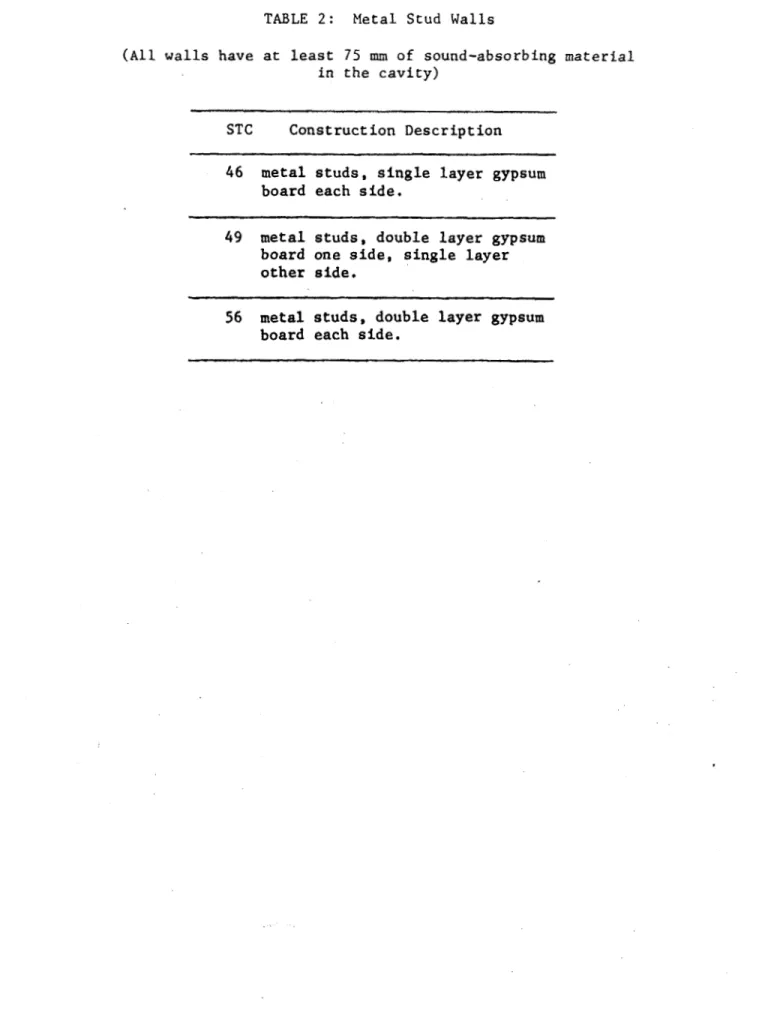
With stud walls containing a t l e a s t 75 mm of sound-absorbing m a t e r i a l i n t h e c a v i t y and constructed with e i t h e r staggered s t u d s , separate s t u d s , wood studs with r e s i l i e n t channels, o r metal s t u d s , a l l t h a t is required
i s
t o caulk a l l leaks and add e x t r a l a y e r s of gypsum wallboard to build one of the b e t t e r c o n s t r u c t i o n s i n Tables 1 o r 2. It does not matter much t o which s i d e t h e e x t r a gypsum board
is
applied. Thus, i f a design c a l l s f o r a t o t a l of four l a y e r s of wallboard, and the e x i s t i n g wall has only one on each s i d e , two more can be added t o one s i d e only. It is good p r a c t i c e , however, t o s t o p leaks on both s i d e s of the w a l l , which obviously requires t h ecooperation of your neighbour.
I n some homes, e s p e c i a l l y o l d e r homes converted t o apartments, t h e s e acceptable types of s t u d systems w i l l not have been used and there m y not be any sound-absorbing m a t e r i a l i n the cavity. I n t h i s case the best procedure i s t o remove t h e p l a s t e r o r wallboard from one s i d e and convert the wall t o one of the p r e f e r r e d types. R e s i l i e n t channels can be used o r , preferably, a s e p a r a t e s t u d s t r u c t u r e can be constructed.
The maximum number of l a y e r s of gypsum board shown i n the t a b l e s f o r s t u d walls, is four. There would st1 11 be some b e n e f i t i n adding one mre
i f desired. Thus, i f t h e o r i g i n a l c o n s t r u c t i o n has one l a y e r of board on each s i d e , another t h r e e o r f o u r l a y e r s could be added t o one s i d e .
Concrete Walls
*
Table 3 shows t h a t i t is r e l a t i v e l y easy t o get good sound i n s u l a t i o n from a block o r s o l i d concrete wall. The most common problem with concrete block walls i s missing o r inadequate caulking where the gypsum wallboard meets t h e f l o o r . This allows sound t o leak through t h e porous blocks. I f no leaks o r flanking p a t h s have been i d e n t i f i e d and i f the sound i s o l a t i o ni s
not adequate, then t h e b e s t procedureis
t o add e x t r a l a y e r s of wallboard using t h e techniques shown i n Figs. 6 t o 8. . .The method i l l u s t r a t e d i n Fig. 6 can be used on any w a l l no matter how i t is constructed. A frame t h a t does not contact t h e e x i s t i n g w a l l
is
constructed from woodz o r metal s t u d s , e'ound-absorbing m a t e r i a l
as'
plae'kd:
i n t h e c a v i t y and two l a y e r s of gypsum board a r e applied, taped, cau1ked:bnd f i n i s h e d i n t h e usual way. The disadvantage of t h i s methodis
t h e l o s s of approximately 120 mm from t h e length o r width of the room. The s t u d s i z e.
and a i r spacecan
be reauced, but t h i s reduces t h e e x t r a sound i s o l a t i o n provided p a r t i c u l a r l y a t low frequencies.Less space
is
used by t h e two methods i l l u s t r a t e d i n Figs. 7 an'd 8. I n Fig.7,
wood f u r r i n g s t r i p s a r e n a i l e d o r screwed t o t h e e x i s t i n g w a l l and r e s i l i e n t channels a r e then secured t o the f u r r i n g s t r i p s t o give a '-r e s i l i e n t connection. I n Fig. 8, t h e r e s i l i e n t channels a r e screwed d i r e c t l y t o the wall surface. This l a s t method i s not as good a s t h e previous two because t h e a i r space is smaller. There might be no improvement a t low frequencies
.
Floors
Excessive noise transmission through f l o o r s can be p a r t i c u l a r l y
d i f f i c u l t t o d e a l wlth because i n a d d i t i o n t o a i r b o r n e sound, there is a l s o the problem of f o o t s t e p s and o t h e r impact noise. Fortunately, changes made t o reduce airborne noise w i l l a l s o reduce the transmission of impact noise. It i s common knowledge t h a t adding carpet and underlay t o the walking s u r f a c e w i l l g r e a t l y reduce f o o t s t e p noise but t h i s only s l i g h t l y reduces airborne noise transmission. If the occupant i n an upper apartment does not wish t o use c a r p e t s , t h e r e I s l i t t l e t o be done t o a l l e v i a t e f o o t s t e p noise problems except t o improve the c e i l i n g .
As with w a l l s , t h e p r i n c i p l e involved with f l o o r s i s t o improve t h e c o n s t r u c t i o n by a l t e r i n g i t t o more c l o s e l y resemble t h e i d e a l , i.e., two l a y e r s of m a t e r i a l r e s i l i e n t l y connected, with sound-absorbing material i n t h e cavity.
J o i s t Floors
Figure 9 gives t h r e e examples of good f l o o r c o n s t r u c t i o n using s o l i d wood j o i s t s . The use of s t e e l j o i s t s o r wood t r u s s e s would not change t h e sound transmission s i g n i f i c a n t l y . These t h r e e f l o o r s a r e the sane i n p r i n c i p l e . M~st of t h e weight of the assembly
is
i n t h e f l o o r . This is because it is not p r a c t i c a l t o have any more than two l a y e r s of gypsum board suspended from r e s i l i e n t channels and i t is p h y s i c a l l y e a s i e r t o add heavy m a t e r i a l s on top.Y
I f a j o i s t f l o o r is judged inadequate and i f a l t e r a t i o n s can be made from both s i d e s , then i t is a s t r a i g h t f o r w a r d task t o a l t e r the c o n s t r u c t i o n so t h a t it resembles one of those shown i n Fig. 9. I f t h e c e i l i n g i sd i r e c t l y attached t o t h e j o i s t s , then i t should be removed, r e s i l i e n t
channels i n s t a l l e d and sound-absorbing m a t e r i a l added i f necessary. Gypsum wallboard
is
a f a i r l y heavy, r e l a t i v e l y inexpensive m a t e r i a l t h a tcan
be used t o add weight on f loore, but i t should be protected with a new wood s u b f l o o r on top t o avoid damage.With f l o o r systems where t h e f l o o r and c e i l i n g are r e s i l i e n t l y
connected but t h e r e
is
no sound-absorbing m a t e r i a l i n t h ej o i s t
space,
i t might be p o s s i b l e t o have sound-absorbing m a t e r i a l blown i n t o the c e i l i n g c a v i t y through small holes.I f a l t e r a t i o n s t o a j o i s t f l o o r can only be made from below, t h e b e s t approach
is
t o remove t h e e x i s t i n g c e i l i n g and a l t e r t h e f l o o r using t h e technique shown i n Fig. 9b. The gypsum board can be added t o the underside of t h e f l o o r above i n pieces conveniently s i z e d t o make working e a s i e r . Once e x t r a weight has been added t o t h e underside of t h e f l o o r , t h e c a v i t y can be p a r t i a l l y f i l l e d with sound-absorbing m t e r i a l and then up t o two l a y e r s of gypsum board can be attached t o r e s i l i e n t channels t o form t h e c e i l i n g . The assembly should be thoroughly caulked i n t h e usual way.F l o a t i n g F l o o r s
I f t h e r e i s a s o l i d connection between t h e f l o o r and c e i l i n g and a l t e r a t i o n s can only be made from above, then a d i f f e r e n t approach using a f l o a t i n g f l o o r i s necessary.
The b a s i c p r i n c i p l e of a f l o a t i n g f l o o r
is
shown i n Fig. 10. The r e s i l i e n t l a y e r reduces t h e d i r e c t t r a n s m i s s i o n of sound from the upper l a y e r s t o t h e s t r u c t u r e below. The s t i f f n e s s of t h e r e s i l i e n t l a y e r i s important. Glass o r rock wool f i b r e s h e e t s w i t h a d e n s i t y of about100
kg/$
( 6 l b / f t 3 ) g i v e a c c e p t a b l e f l o o r d e f l e c t i o n s (about 2 mm) and reduce t h e impact transmission. Other r e s i l i e n t m a t e r i a l s , such a s rubber, could be used t o g e t h e r with d i f f e r e n t sound-absorbing materials. The new s u r f a c e l a y e r should be r e l a t i v e l y heavy; f o r example, a wood subf l o o r r e s t i n g on t h e b a t t e n s , two l a y e r s of gypsum wallboard and then an upper l a y e r of wood t o p r o t e c t t h e gypsum.Concrete F l o o r s
Concrete f l o o r s are u s u a l l y t h i c k enough, and heavy enough, t o p r o v i d e r e a s o n a b l e sound i s o l a t i o n , e.g., a 1501nm s o l i d c o n c r e t e s l a b provides about STC 52. I f a n o i s e t r a n s m i s s i o n problem e x i s t s with
a
concrete f l o o r , t h e n e i t h e r a f l o a t i n g f l o o r should be added on top (Fig. 10) o r ar e s i l i e n t l y suspended c e i l i n g should be added below u s i n g t h e techniques shown i n Figs. 6 t o 8 f o r walls.
Conclusion
It is not d i f f i c u l t t o o b t a i n high values of sound i s o l a t i o n between homes. It only r e q u i r e s reasonable design and a t t e n t i o n t o d e t a i l .
Although i t is u s u a l l y more troublesome t o improve a c o n s t r u c t i o n a f t e r i t is b u i l t , i t can u s u a l l y be done, as d e s c r i b e d i n t h i s note. The c o s t , however, may be considered too high.
TABLE 1: Wood Stud Walls
(A11 walls have a t l e a s t 75 mm of sound-absorbing m a t e r i a l i n t h e c a v i t y )
STC Construction Description 49 Staggered wood s t u d s , s i n g l e l a y e r
gypsum board each side.
53 Staggered wood s t u d s , double l a y e r
gypsum board one s i d e , s i n g l e l a y e r o t h e r side.
56 Staggered wood s t u d s , double l a y e r gypsum board each s i d e .
56 S i n g l e wood s t u d s , r e s i l i e n t channel, double l a y e r gypsum board each s i d e .
56 Double wood s t u d s , s i n g l e l a y e r gypsum board each s i d e .
60 Double wood s t u d s , double l a y e r gypsum board one s i d e , s i n g l e l a y e r o t h e r side.
63 Double wood s t u d s , double l a y e r gypsum board each side.
9
TABLE 2 : Metal S t u d Walls
( A l l w a l l s have a t l e a s t 7 5 mm of sound-absorbing material i n the c a v i t y )
STC Construct i o n Description
46 metal s t u d s , s i n g l e l a y e r gypsum board each s i d e .
49 metal s t u d s , double l a y e r gypsum board one s i d e , s i n g l e l a y e r o t h e r s i d e .
-- - -
56 metal s t u d s , double l a y e r gypsum board each s i d e .
TABLE 3: Concrete Block Walls
Approximate
S i d e 1 ' S i d e 2 STC
Gypsum board d i r e c t l y
a p p l i e d As S i d e 1 Gypsum board on wood
f u r r i n g s t r i p s A s S i d e 1 52
Sound-absorbing m a t e r i a l and gypsum
board on wood f u r r i n g Gypsum board d i r e c t l y
s t r i p s a p p l i e d 5 5
Sound-absorbing
material and gypsum
board on r e s i l i e n t Gypsum board d i r e c t l y
channels a p p l i e d 5 8
-
25 mn a i r space, 40 ann
m e t a l s t u d s , sound-
a b s o r b i n g m a t e r i a l and Gypsum board d i r e c t l y
1 I
TABLE 4 : Estimating Sound Transmission C l a s s
Rat l n g Privacy A£ forded
Normal speech e a s i l y understood
Normal speech a u d i b l e but not i n t e l l i g i b l e Loud speech a u d i b l e and f a i r l y understandable
40
Loud speech audible but not i n t e l l i g i b l e45 Loud speech b a r e l y a u d i b l e 5 0 Shouting barely a u d i b l e 55 Shouting not a u d i b l e
STC
Fi
STC
STC
(aF I G U R E 1
C H A N G E S I N S O U N D T R A N S M I S S I O N CLASS
CAUSED
BY C H A N G E S I N C O N S T R U C T I O N
S O V N D A 8 S O R B I N G M A T E R I A L GYPSUM B O A R D RE G Y P S U M G Y t S U ) B O A R D . S I L I E N T C H A N N E L M A T E R I A L P S U M F I L L E R STRIP S O U N D A B S O R I I N G M A T E R I A L
\
F I G U R E 2 T n t E E M E T M O D S OF OBTAINING S T R U C T U R A L S E P A R A T I O N I N W O O D S T U D W A L L S--+ F L A N K I N G T R A N S M I S S I O N
-
D I R E C T T R A N S M I S S I O N F I G U R E 3 F L A N K I N G PATHS IN B U I L D I N G S A T T I C SPACES C FIGURE 4 F L A N K I N G I N A T T I C OR BASEMENT SPACES E R E X T E N D WALL T O R O O F OR D I V I D E A T T I C SPACE W I T H F.ULL-HEIGHT BARRIERHEADER PLATE
ATT INSULATION
GYPSUM BOARD
(a) CAULKING AT EDGE OF CEILING
GYPSUM BOARD
CAULKING
,
FLOOR
(b) .CAULKING AT BASE OF WALL
F I G U R E 5
.AYERS
LLBOARD
OR
STUDS
S O U N D
A B S O R B I N G
M A T E R I A L
FIGURE
6M E T H O D FOR I M P R O V I N G A N Y WALL
RESILIENT CHANNEL WOOD FURRING 2 LAYERS OF EXISTING GYPSUM BOAR WALL \ S O U N D A B S O R B I N G MATERIAL FIGURE 7
METHOD FOR I M P R O V I N G A WALL U S I N G FURRING A N D RESILIENT CHANNELS. N O T QUITE AS G O O D AS METHOD I N FIGURE 6 AT LOW FREQUENCIES
J-
E X I S T I N G WALL +2 LAYERS OF G Y P S U M BOARD ,RESILIENT F U R R I N G C H A N N E L.SELF -TAPPING SCRE
tifi1
FIGURE 8
M E T H O D FOR I M P R O V I N G A WALL U S I N G RESILIENT C H A N N E L S O N L Y . N O T AS G O O D AS M E T H O D I N FIGURE 7 AT L O W FREQUENCIES
2 x 2" WOOD FURRING
/
rl
SANDSOUND ABSORBING MATERIAL
RESILIENT CHANNEL 2 LAYERS OF GYPSUM BOARD ATTACHED TO UNDERSIDE OF FLOOR
MATERIAL
\
"RESILIENT CHANNELF I G U R E 9
S O M E EXAMPLES O F J O I S T F L O O R C O N S T R U C T I O N S P R O V I D I N G G O O D A C O U S T I C A L PERFORMANCE
,CAULK / F I N I S H F L O O R SOFT M A T E R I A L 2 LAYERS G Y P S U M BOARD A R O U N D EDGES T O PREVENT C O N T A C T F I G U R E 10 E X I S T I N G F L O O R A B S O R B I N G LAYER EXAMPLE OF A F L O A T I N G F L O O R