HAL Id: hal-00298171
https://hal.archives-ouvertes.fr/hal-00298171
Submitted on 22 Jan 2007HAL is a multi-disciplinary open access
archive for the deposit and dissemination of sci-entific research documents, whether they are pub-lished or not. The documents may come from teaching and research institutions in France or abroad, or from public or private research centers.
L’archive ouverte pluridisciplinaire HAL, est destinée au dépôt et à la diffusion de documents scientifiques de niveau recherche, publiés ou non, émanant des établissements d’enseignement et de recherche français ou étrangers, des laboratoires publics ou privés.
Spatial structure of the 8200 cal yr BP event in
Northern Europe
H. Seppä, H. J. B. Birks, Thomas Giesecke, D. Hammarlund, T. Alenius, K.
Antonsson, A. E. Bjune, M. Heikkilä, G. M. Macdonald, A. E. K. Ojala, et al.
To cite this version:
H. Seppä, H. J. B. Birks, Thomas Giesecke, D. Hammarlund, T. Alenius, et al.. Spatial structure of the 8200 cal yr BP event in Northern Europe. Climate of the Past Discussions, European Geosciences Union (EGU), 2007, 3 (1), pp.165-195. �hal-00298171�
CPD
3, 165–195, 20078200 events in Northern Europe
H. Sepp ¨a et al.
Title Page Abstract Introduction Conclusions References Tables Figures ◭ ◮ ◭ ◮ Back Close
Full Screen / Esc
Printer-friendly Version Interactive Discussion
EGU Clim. Past Discuss., 3, 165–195, 2007
www.clim-past-discuss.net/3/165/2007/ © Author(s) 2007. This work is licensed under a Creative Commons License.
Climate of the Past Discussions
Climate of the Past Discussions is the access reviewed discussion forum of Climate of the Past
Spatial structure of the 8200 cal yr BP
event in Northern Europe
H. Sepp ¨a1, H. J. B. Birks2,3,4, T. Giesecke5, D. Hammarlund6, T. Alenius7, K. Antonsson8, A. E. Bjune2,3, M. Heikkil ¨a1, G. M. MacDonald9, A. E. K. Ojala7, R. J. Telford2,3, and S. Veski10
1
Department of Geology, P.O. Box 64, 00014, University of Helsinki, Finland
2
Department of Biology, University of Bergen, All ´egaten 55, 5007 Bergen, Norway
3
Bjerknes Centre for Climate Research, All ´egaten 55, 5007, Bergen, Norway
4
Environmental Change Research Centre, University College London, 26 Bedford Way, London, WC1H OAP, UK
5
Department of Geography, University of Liverpool, Roxby Building, Liverpool, L69 7ZT, UK
6
GeoBiosphere Science Centre, Quaternary Sciences, Lund University, S ¨olvegatan 12, 223 62 Lund, Sweden
7
Geological Survey of Finland, P.O. Box 96, 02151, Espoo, Finland
8
Department of Earth Sciences, Uppsala University, Villav ¨agen 16, 75236, Uppsala, Sweden
9
Department of Geography, UCLA, 405 Hilgard Avenue, Los Angeles, CA 90095-1524, USA
10
Institute of Geology, Tallinn University of Technology, Ehitajate tee 5, 19086 Tallinn, Estonia Received: 13 December 2006 – Accepted: 15 January 2006 – Published: 22 January 2007 Correspondence to: H. Sepp ¨a ([email protected])
CPD
3, 165–195, 20078200 events in Northern Europe
H. Sepp ¨a et al.
Title Page Abstract Introduction Conclusions References Tables Figures ◭ ◮ ◭ ◮ Back Close
Full Screen / Esc
Printer-friendly Version Interactive Discussion
EGU
Abstract
A synthesis of well-dated high-resolution pollen records suggests a spatial structure in the 8200 cal yr BP event in northern Europe. The temperate, thermophilous tree taxa, especially Corylus, Ulmus, and Alnus, decline abruptly between 8300 and 8000 cal yr BP at most sites located south of 61◦N, whereas there is no clear change in 5
pollen values at the sites located in the North-European tree-line region. Pollen-based quantitative temperature reconstructions and several other, independent palaeoclimate proxies, such as lacustrine oxygen-isotope records, reflect the same pattern, with no detectable cooling in the sub-arctic region. The observed pattern would challenge the general view of the wide-spread occurrence of the 8200 cal yr BP event in the North 10
Atlantic region. An alternative explanation is that the cooling during the 8200 cal yr BP event took place mostly during the winter and spring, and the ecosystems in the south responded sensitively to the cooling during the onset of the growing season. In contrast, in the sub-arctic area, where the vegetation was still dormant and lakes ice-covered, the cold event is not reflected in pollen-based or lake-sediment-based 15
records. The arctic regions may therefore not always be optimal for detecting past climate changes.
1 Introduction
Abrupt climate changes are typically non-linear, taking place when the climate system is forced over a critical threshold, followed by a rapid transition to a new state (Al-20
ley et al., 2003). High-resolution records have revealed that abrupt climate changes were frequent during the last glacial when regional temperature changes of as much as 8◦C to 16◦C may have occurred in a decade or less (Severinghaus and Brook,
1998; Stocker, 2000; Alley et al., 2003; Schulz et al., 2004), but also during the early post-glacial period characterized by rapidly vanishing ice sheets (Clark et al., 2001, 25
contro-CPD
3, 165–195, 20078200 events in Northern Europe
H. Sepp ¨a et al.
Title Page Abstract Introduction Conclusions References Tables Figures ◭ ◮ ◭ ◮ Back Close
Full Screen / Esc
Printer-friendly Version Interactive Discussion
EGU versial (Schulz et al., 2004), as do their spatial expressions (Alley et al., 2003; Wunsch,
2006), although most theories invoke the role of the Atlantic meridional overturning cir-culation (AMOC) and its sensitivity to freshening of the North Atlantic surface water by increased precipitation, runoff from surrounding landmasses, and abrupt fluxes of glacial melt-water (Clark et al., 2002).
5
Many records, especially from the North Atlantic region, provide evidence of a cold event at 8200 cal yr BP that represents a unique climatic feature within the last 10 000 years in terms of magnitude and abruptness (e.g. Alley et al., 1997; von Grafenstein et al., 1998; Klitgaard-Kristensen et al., 1998; Johnsen et al. 2001; Spurk et al., 2002; Veski et al, 2004; Alley and `Ag ´ustsd ´ottir, 2005). Although it has been suggested that 10
the cooling was linked to reduced solar output (Rohling and P ¨alike, 2005), there is accu-mulating evidence that the primary cause of the cooling was a pulse a cold freshwater released by a sudden drainage of the proglacial Laurentide lakes in North America to the North Atlantic at about 8500 cal yr BP, leading to a transient freshening and cool-ing of the North Atlantic Surface Water (NADW). This probably resulted in a weaker 15
AMOC, and a consequent reduction of the northward heat transport and associated heat release in the North Atlantic region. Compelling support for this hypothesis is pro-vided by the record of Ellison et al. (2006), showing that the near-bottom flow speed of the Iceland-Scotland Overflow Water, an important component of the AMOC, declined significantly at the onset of the cold event. This is the first firm palaeoceanographic 20
evidence for a reduction of the NADW formation. This theory is supported by climate models which, in accordance with palaeoclimatic records, simulate maximum cooling in the North Atlantic region in response to the drainage of the Laurentide lakes (Alley and `Ag ´ustsd ´ottir, 2005; Wiersma and Renssen, 2006; Wiersma et al., 2006).
One of the key regions for investigating the continental-scale impacts of the 8200 cal 25
yr BP cold event is Northern Europe, located downwind of the North Atlantic Ocean. The climatic conditions there are strongly dependent on the intensity of the North At-lantic Oscillation (NAO) and the associated westerly airflow, which is related to the strength of the AMOC and to the sea-surface temperatures in the North Atlantic
(Hur-CPD
3, 165–195, 20078200 events in Northern Europe
H. Sepp ¨a et al.
Title Page Abstract Introduction Conclusions References Tables Figures ◭ ◮ ◭ ◮ Back Close
Full Screen / Esc
Printer-friendly Version Interactive Discussion
EGU rell 1995; Rodwell et al., 1999; Hurrell et al., 2003; Wu and Rodwell, 2004; Stouffer
et al., 2006). Thus, palaeoclimatic records from northern Europe can provide basis for testing potential processes associated with the 8200 cal yr BP cold event. Since the first reported occurrences of the cold event based, for example, on high-resolution pollen records (Snowball et al., 2001; Veski et al., 2004) and stable isotope records ob-5
tained from calcareous lake sediments (Hammarlund et al., 2003; Veski et al., 2004), the number of well-dated quantitative temperature reconstructions from this region has increased rapidly. This improving network of records with high time resolution now per-mits a more detailed spatial and temporal analysis of the climatic changes between 9500 to 7000 cal yr BP.
10
Here we examine high-resolution pollen-stratigraphical records produced with uni-form methodology in northern Europe along a sector that ranges from 55 to 70◦N
latitude and from 18 to 26◦E longitude and includes two significant climatic gradients:
a primary south-to-north gradient of falling temperature and a secondary west-to-east gradient of decreasing precipitation and oceanicity. We particularly aim to investigate 15
the spatial patterns of vegetational and climatic change in order to observe if the evi-dence for the cold event shows consistent features or whether there are geographical differences in the amplitude or occurrence of the event along the two climatic gradi-ents. In addition, we compare the high-resolution pollen records with other, indepen-dent palaeoclimatic records of comparable time resolution, in particular oxygen-isotope 20
records obtained on lacustrine carbonates.
2 Material and methods
There are numerous pollen diagrams available from northern Europe, but only a frac-tion of them have sufficient temporal resolufrac-tion and chronological control to allow as-sessment of climate events of 200–300 years duration. Pollen records from 12 sites 25
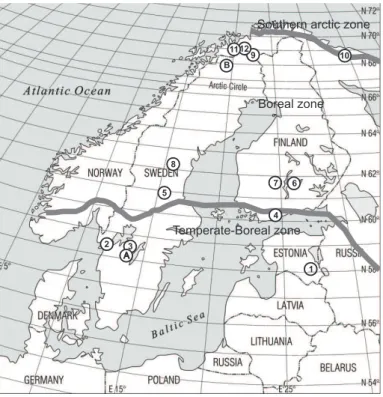
with adequate resolution and reliable chronologies were selected for this study (Fig. 1, Table 1). The number of analysed pollen samples for the last 10 000 years ranges from
CPD
3, 165–195, 20078200 events in Northern Europe
H. Sepp ¨a et al.
Title Page Abstract Introduction Conclusions References Tables Figures ◭ ◮ ◭ ◮ Back Close
Full Screen / Esc
Printer-friendly Version Interactive Discussion
EGU 57 (Lake Treh ¨orningen) to over two hundred (Lake Nautaj ¨arvi 260 and Lake Rouge
237), and the records selected have a minimum of six radiocarbon dates and in gen-eral smooth age-depth models. Two records (Lakes Nautaj ¨arvi and Rouge), have ex-ceptionally precise chronologies based on annually laminated sediments (Ojala et al., 2003; Veski et al., 2004). At all sites the pollen percentage values have been calculated 5
on the basis of the total sum of all terrestrial pollen and spore types.
In addition to the examination of individual pollen curves, pollen-stratigraphical data were used to derive a quantitative temperature record for each site for the early- to mid-Holocene. Two different temperature parameters were used in the quantitative re-constructions. July mean temperature (Tjul) was reconstructed at four sites located in 10
the northern tree-line region, whereas annual mean temperature (Tann) was estimated
for the rest of the sites located in the central or southern parts of the study area. The reason for this is that in the far north the growing season is confined to three or four summer months (MJJA) and a vegetation-based proxy such as pollen arguably pre-dominantly represents summer temperature conditions. No such generalization can 15
be made in more southern parts of Fennoscandia, however, because there the grow-ing season is considerably longer, startgrow-ing often in March or April and continugrow-ing to October (R ¨otzer and Chmielewski, 2001; Linderholm et al., 2006). In addition, winter climatic conditions are important for the distribution and regeneration of many plant species, especially those restricted to the most oceanic parts along the west coast 20
of Fennoscandia (Dahl, 1998). Thus the pollen records represent a mixture of taxa with different temperature requirements in relation to the seasons and annual mean temperature is probably a better justified climatic parameter to be reconstructed from pollen data in southern and central Fennoscandia than July or summer (JJA) mean temperature (Sepp ¨a et al., 2004).
25
Pollen-based temperature reconstructions were based on transfer functions derived from North-European pollen-climate calibration sets. These data sets are based on modern climate data from the Climate Normals period 1961–1990 and on modern pollen samples, collected from top surface sediment samples of small to medium-sized
CPD
3, 165–195, 20078200 events in Northern Europe
H. Sepp ¨a et al.
Title Page Abstract Introduction Conclusions References Tables Figures ◭ ◮ ◭ ◮ Back Close
Full Screen / Esc
Printer-friendly Version Interactive Discussion
EGU lakes. All samples were selected, collected, and analysed with standardised methods
(see Sepp ¨a et al., 2004). The Tjul records were based on 164 surface samples from Norway, 27 samples from northern Sweden, and 113 samples from Finland (Sepp ¨a and Birks, 2001). The Tann reconstructions were carried out using three different
cal-ibration subsets. Subset 1 consists of 113 samples from Finland, subset 2 includes 5
24 samples from Estonia in addition to the 113 Finnish samples (Sepp ¨a et al., 2004), and subset 3 includes 37 samples from Sweden in addition to the 113 Finnish sam-ples and the 24 Estonian samsam-ples. Table 1 indicates which subset was used for each fossil record. The transfer functions were developed using weighted averaging partial least squares (WA-PLS) regression, a non-linear, unimodal regression and calibration 10
technique commonly used in quantitative environmental reconstructions (ter Braak and Juggins, 1993; Birks, 1995, 2003). WA-PLS was implemented by the program CALI-BRATE (S Juggins and CJF ter Braak unpublished program). All terrestrial pollen and spore types were included in the models, and were square-root transformed to stabilize their variances and to maximize “the signal to noise” ratio (Prentice, 1980). The perfor-15
mance statistics of the pollen-climate calibration sets are given in Table 2. In general the statistics indicate high performance of the models relative to other corresponding models based on various biological proxy techniques (Birks and Sepp ¨a, 2004).
3 Results
To show the details of the pollen-stratigraphical changes during the 8200 cal yr BP 20
event in northern Europe, we focus on key pollen types. In northern Europe pollen types that mostly decline during the event, indicating either reduced populations and/or pollen productivity, likely caused by the cooling, are the thermophilous deciduous tree taxa, predominantly Corylus, Ulmus and Alnus. The types that usually increase are
Betula and/or Pinus (Snowball et al., 2001; Veski et al., 2004; Sepp ¨a et al., 2005;
25
Sarmaja-Korjonen and Sepp ¨a, 2007). The percentage pollen curves of Corylus and
CPD
3, 165–195, 20078200 events in Northern Europe
H. Sepp ¨a et al.
Title Page Abstract Introduction Conclusions References Tables Figures ◭ ◮ ◭ ◮ Back Close
Full Screen / Esc
Printer-friendly Version Interactive Discussion
EGU the pollen records from the tree-line region, curves are shown only for the sites that are
located in the southern and central part of the research area. Both taxa show a distinct and abrupt decline during the event at four sites, all located south of 61◦N. Corylus
especially seems to respond strongly to the sudden cooling, its values dropping at Lake Rouge, for example, from 10–15% to below 5% at 8250–8050 cal yr BP, and the decline 5
is almost equally distinct at the three other southernmost sites. The decline of Ulmus is of similar magnitude apart from the weak signal at Lake Flarken. At Lakes Laihalampi and Nautaj ¨arvi, both located north of 61◦N, Corylus does not decline during the cold
event, but there is a relatively clear decline of Ulmus at Lake Laihalampi (Fig. 2).
Alnus pollen percentage curves are shown from eight sites (Fig. 3). Alnus is
se-10
lected because it is the only thermophilous deciduous tree taxon whose pollen values continuously exceed 1% at all sites, including those at the northern tree-line. Alnus pollen is produced by two tree species, A. incana and A. glutinosa, of which the former is found up to 68◦N. The comparison of Alnus pollen records indicates a south to north
gradient. There is a clear decline of Alnus values at the southern sites, especially at 15
Lakes Rouge and Arapisto, whereas records from central Fennoscandia indicate little or no decline. Alnus pollen records from the Arctic tree-line region show no evidence of a decline.
The pollen-based quantitative Tann reconstructions for the period 9500–7000 cal yr
BP show broadly the same pattern as the key indicator pollen types (Fig. 4). The results 20
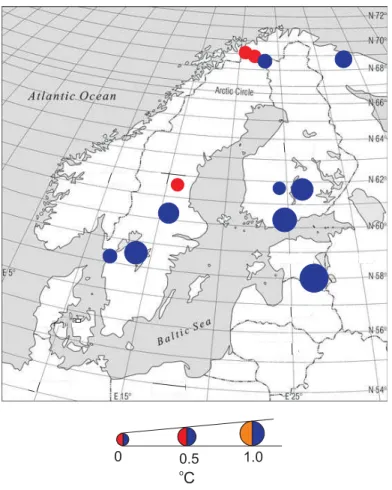
indicate a consistent cooling centred around 8200 cal yr BP at the southernmost sites, especially at Lake Rouge in Estonia, Lake Flarken in Sweden, and Lake Arapisto in Finland. At all these sites there is a temperature drop of 0.5 to 1.5◦C. The cooling
begins abruptly at about 8300 cal yr BP, lasts 200 to 300 years, and ends with a sudden temperature rise at about 8000 cal yr BP. As the age-depth models for most sites 25
were based on calibrated radiocarbon dates, it is realistic to relate the slight temporal differences between the records to the inevitable imprecision of the chronologies. In contrast, the Tann reconstructions from Lakes Holtj ¨arnen, Laihalampi and Nautaj ¨arvi,
CPD
3, 165–195, 20078200 events in Northern Europe
H. Sepp ¨a et al.
Title Page Abstract Introduction Conclusions References Tables Figures ◭ ◮ ◭ ◮ Back Close
Full Screen / Esc
Printer-friendly Version Interactive Discussion
EGU Tjulrecords from the Fennoscandian tree-line region do not provide any evidence for a
temperature change during the event. All four sites indicate a steady rise of Tjul from 9400 cal yr BP toward the mid-Holocene, with variability that is not consistent between the records. Hence, the quantitative reconstructions follow the same spatial pattern as the key pollen types, namely that there is a distinct cooling between 8300 and 8000 5
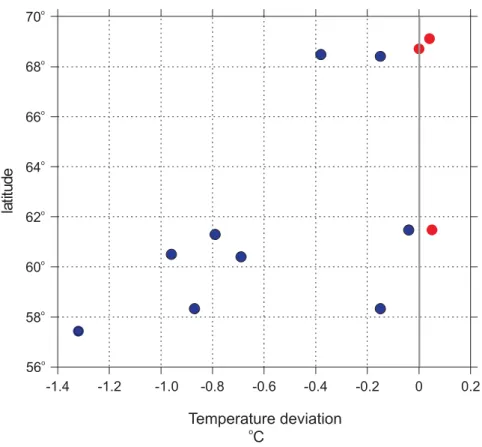
cal yr BP in southern Fennoscandia and in the Baltic countries, weak or no cooling in central Fennoscandia, and no evidence of cooling in the tree-line region of northern Europe (Figs. 5 and 6).
A synthesis of the pollen-based evidence shows strikingly that the four records where the cooling is clearest are from the southernmost sites, located south of 61◦N. Bio-10
geographically, they are located in the temperate-boreal (boreo-nemoral) zone today (Fig. 1) where the vegetation is characterized by the occurrence of nemoral ther-mophilous tree species such as Tilia cordata, Quercus robur, Corylus avellana, Ulmus
glabra, Acer platanoides, and Fraxinus excelsior. All these tree species reach their
northern distribution limits close to the border of the nemoral and boreal vegetation 15
zones. In contrast, all the records where there is no cooling at 8200 cal yr BP are from sites that are located north of 61◦N. Lakes Laihalampi and Nautaj ¨arvi are located in the
southern boreal zone, where the dominant forest type is a mixture of conifers and birch, and Lakes Tsuolbmajavri, KP-2, Dalmutladdo, and Toskaljavri are all situated within the northern ecotone of the boreal zone, with significant arctic-alpine components in the 20
surrounding vegetation.
4 Discussion
The relatively mild winter climate of northern Europe is a result of the influence of the Atlantic Ocean and the westerly airflow over the continent (Seager et al., 2002; Sutton et al., 2003). This influence is particularly strong during the positive phase 25
of the NAO with strong westerly wind, greater advection of moist air off the Atlantic and onto the continent, and high temperature and precipitation even in northernmost
CPD
3, 165–195, 20078200 events in Northern Europe
H. Sepp ¨a et al.
Title Page Abstract Introduction Conclusions References Tables Figures ◭ ◮ ◭ ◮ Back Close
Full Screen / Esc
Printer-friendly Version Interactive Discussion
EGU Fennoscandia (Hurrell et al., 2003; Kryjov, 2004; Cook et al., 2005; Jaagus, 2006).
The reverse holds true when the NAO has a negative mode and the westerly airflow is replaced by anticyclonic conditions and a predominantly continental airflow. The most probable scenario for cooling during the 8200 cal yr BP cold event in northern Europe is that the sudden flux of cold freshwater perturbed the AMOC and led to 5
lower sea-surface temperatures in the North Atlantic. As a consequence the heat transport from the Atlantic onto the continent decreased. The reason for this may have been a weaker generation of migratory cyclones and, in general, a weaker flow of mild oceanic air over northern Europe during winter, corresponding roughly with the modern low index NAO mode during the winter (Veski et al., 2004; Hammarlund et al., 2005; 10
Sepp ¨a et al., 2005). A related hypothesis suggests that the weaker oceanic airflow may have resulted from a major expansion of sea-ice cover in the North Atlantic and an associated reduction of the advection of heat from the ocean to the atmosphere (Wiersma and Renssen, 2006).
Against this background, it can be argued that the reconstructed longitudinal gra-15
dient towards a weaker signal in the North reflects realistically a geographical pat-tern of the magnitude of the 8200 cal yr BP event. The cold event may have been caused by weakened westerly circulation during winter, so that the resulting decrease in oceanicity was particularly influential south of ∼60◦N latitude and less significant
in the far north of Fennoscandia. This explanation may seem paradoxical, given the 20
presently strong influence of the North Atlantic and the NAO on the climate of north-ern Fennoscandia, particularly on the eastnorth-ern side of the Scandes Mountains (Hurrell et al., 2003). It is also inconsistent with the results of modelling studies focusing on the 8200 cal yr BP event (Renssen et al., 2001, 2002; Alley and `Ag ´ustsd ´ottir, 2005; Wiersma and Renssen, 2006), all indicating major, wide-spread cooling in the North 25
Atlantic and the eastern Atlantic seaboard in response to weakening of the AMOC. Interestingly, however, the multimodel ensemble simulation based on models ranging from the earth system models of intermediate complexity to fully coupled atmosphere-ocean general circulation models indicates that a moderately small freshwater flux of
CPD
3, 165–195, 20078200 events in Northern Europe
H. Sepp ¨a et al.
Title Page Abstract Introduction Conclusions References Tables Figures ◭ ◮ ◭ ◮ Back Close
Full Screen / Esc
Printer-friendly Version Interactive Discussion
EGU 0.1 Sv (1 Sv=106m3s−1) may lead to a strong cooling in the North Atlantic south of
Greenland but a 1–2◦C warming over the Barents Sea and the Nordic Sea east of
Svalbard and no significant temperature change on the northern Fennoscandian main-land (Stouffer et al., 2006). Similarly, a model simulation by Vellinga and Wood (2002) suggests a strong cooling especially in winter in the North Atlantic but no significant 5
temperature change in northern Fennoscandia or in the Barents Sea region.
An alternative hypothesis can also explain the observed geographical pattern in the records. Model simulations consistently indicate that the 8200 cal yr BP event was pre-dominantly a winter (DJF) and spring (MAM) event, as is also supported by the majority of palaeoclimate records from various parts of Europe (Alley and `Ag ´ustsd ´ottir, 2005; 10
Wiersma and Renssen, 2006). The tree taxa that show strong responses to the 8200 cal yr BP event, Alnus, Corylus, and Ulmus, start flowering in early spring, in central Europe often in February–March and in southern and central Fennoscandia in March– April (J ¨ager et al., 1996; Kasprzyk et al., 2004). The start of their flowering and plant development is in general dependent on air temperature (Wielgolaski, 1999; Aasa et 15
al., 2004) and if an abrupt change to cold winters and cold early springs with frequent frosts took place at the beginning of the event, it may have led to major damage to flow-ers and male catkins, resulting in reduced pollen productivity, sexual regeneration, and population sizes. This hypothesis is supported by investigations of the relationships between modern phenological phenomema and climate patterns (Kramer et al., 2000) 20
and by modern pollen monitoring studies in Europe. For example, cold weather con-ditions during winter and spring result in a reduction of the annual pollen productivity and a delay of the start of the pollen season of tree species that are favoured by high temperatures, such as Alnus, Corylus and Ulmus (Andersen, 1972; Frenguelli, 1993; J ¨ager et al., 1996; Frei, 1998; Spieksma et al., 2003; Kasprzyk et al., 2004). The clear 25
decline of the pollen percentages of these taxa may therefore reflect their phenologi-cal inability to adapt to an abrupt lowering of the winter and early spring temperatures during the 8200 cal yr BP event.
CPD
3, 165–195, 20078200 events in Northern Europe
H. Sepp ¨a et al.
Title Page Abstract Introduction Conclusions References Tables Figures ◭ ◮ ◭ ◮ Back Close
Full Screen / Esc
Printer-friendly Version Interactive Discussion
EGU markedly different climatic and phenological situation. Here winter conditions with
sub-zero diurnal mean temperatures and abundant snow remain long into April. The grow-ing season starts in late May or early June (Linderholm et al., 2006) and its duration is typically only 100–150 days. Winter temperatures can be extremely low, down to below –40◦C, and only the most frost-resistant tree species thrive, i.e. the main northern forest 5
components Pinus sylvestris, Picea abies, and Betula (B. pubescens and B. pendula) (Grace et al., 2002). For example, climate chamber experiments have shown that
Pi-nus sylvestris can tolerate temperatures as low as <–72◦C during the winter while its
needles can be lethally damaged when exposed to –10◦C during the summer (Repo,
1992; Beck et al., 2004). The continental conifer species Picea abies is also adapted 10
to cold winters as its radial growth is positively correlated with low winter temperatures and negatively correlated with high winter temperatures (M ¨akinen et al., 2000). Of the deciduous tree taxa that show strong responses to the 8200 cal yr BP event in the southern part of the study region, only Alnus grows in northern Fennoscandia, albeit not north of about 68◦N. However, Alnus incana is less sensitive to cold periods during 15
the late winter and early spring in the far north, because of phenological adaptation of the beginning of flowering, bud break, and leaf expansion, these processes taking place usually in May to June, about two months later than in the south.
If the cooling took place mostly during winter and early spring, the occurrence, re-generation, and pollen productivity of the northern-boreal tree taxa may not have been 20
significantly affected, and the lack of pollen-stratigraphical responses to the cold event may reflect largely unaltered climatic conditions during the short growing season of these taxa. Many other proxy records that are independent of vegetation patterns in-dicate a weaker signal for the 8200 cal yr BP event towards northern Fennoscandia. In western Scandinavia records based on loss-on-ignition analysis of lake sediments 25
reveal a substantial climatic perturbation and clearly decreased aquatic productivity at about 8200 cal yr BP (Nesje et al., 2001; Bergman et al., 2005). However, in northern Fennoscandia the same methods do not display equally clear evidence for a cool-ing. For example, a high-resolution reconstruction of Holocene equilibrium-line altitude
CPD
3, 165–195, 20078200 events in Northern Europe
H. Sepp ¨a et al.
Title Page Abstract Introduction Conclusions References Tables Figures ◭ ◮ ◭ ◮ Back Close
Full Screen / Esc
Printer-friendly Version Interactive Discussion
EGU changes from the Lyngen peninsula on the northwestern coast of Norway does not
show any sign of glacier growth between 8500 and 7500 cal yr BP (Bakke et al., 2005), neither does the record of bacterial magnetite from the Lyngen peninsula indicate any cold excursion during the 8200 cal yr BP event (Paasche et al., 2004). Chironomid-based temperature reconstructions from northern Finland and Sweden do not indicate 5
any cooling between 8300 and 8000 cal yr BP (Ros ´en et al., 2001; Bigler et al., 2002, 2003; Korhola et al., 2002; Sepp ¨a et al., 2002; Larocque and Hall, 2003, 2005). Simi-larly, quantitative and qualitative reconstructions from the Kola Peninsula in northwest-ern Russia do not document any cooling at 8200 cal yr BP (Jones et al., 2004). Korhola et al. (1999) and Bigler et al. (2006) report a cooler period at about 8300 to 8000 cal 10
yr BP in diatom-based Tjulreconstructions from the northwestern Fennoscandian tree-line region, but it is unclear whether these results represent summer cooling or are more related to changes in the length of the lake ice-cover season, which may be the most important climate-related feature reflected in diatom records from alpine regions (Lotter and Bigler, 2000; Sorvari et al., 2002).
15
Independent evidence of a considerable influence of winter cooling on the general cli-matic character and expression of the 8200 cal yr BP event in parts of northern Europe is provided by oxygen-isotope records obtained on fine-grained sedimentary calcite from small lakes in the study area. Although relatively few records are available, and in spite of complications arising from site-specific hydrological characteristics, some rel-20
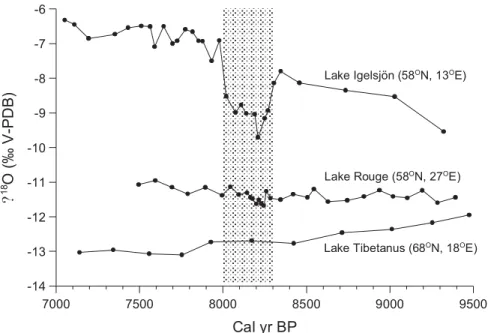
evant conclusions can be derived from such a comparison (Fig. 7). The Lake Igelsj ¨on
δ18O record from southern Sweden (Fig. 1) is sensitive to changing hydrology, with
pe-riods of18O-enrichment reflecting mainly elevated evaporation/inflow ratio of the basin under warm and dry summer conditions (Hammarlund et al., 2003). The strong isotopic response to the 8200 cal yr BP event therefore predominantly reflects an increase in 25
net precipitation during the summer (Hammarlund et al., 2005), perhaps augmented by a generally shorter ice-free season. However, as demonstrated by Sepp ¨a et al. (2005), about 40% of the decrease in δ18O during the event can be attributed to a depletion in
18
CPD
3, 165–195, 20078200 events in Northern Europe
H. Sepp ¨a et al.
Title Page Abstract Introduction Conclusions References Tables Figures ◭ ◮ ◭ ◮ Back Close
Full Screen / Esc
Printer-friendly Version Interactive Discussion
EGU to colder and longer winters. The effect of such a change in winter conditions is also
manifested as a slight depletion in18O at 8200 cal yr BP in the Lake Rouge record from southern Estonia (Veski et al., 2004), which more directly reflects δ18O of precipitation. Oxygen-isotope data of comparable resolution are not available from northern Fennoscandia, but the Lake Tibetanus δ18O record from northernmost Sweden, close 5
to the Atlantic coast (Hammarlund et al., 2002), does not reflect any climatic change at this stage. Supportive evidence of the absence of an oxygen-isotope response at 8200 cal yr BP in this part of Fennoscandia is provided by the more highly resolved δ18O record from the SG93 speleothem near the Arctic Circle in Norway (Lauritzen et al., 1999). Although interpreted differently by the authors, the SG93 record exhibits a gen-10
eral depletion in18O with time during the early Holocene, consistent with the long-term evolution of δ18O of precipitation as inferred from the Lake Tibetanus data (Hammar-lund et al., 2002). It cannot be excluded that the potential effect of a pronounced winter cooling, and an associated depletion in δ18O of precipitation, on the two latter records from northwestern Scandinavia was offset by lowered summer temperatures during 15
the event, leading to 18O-enrichment of lacustrine and speleothem calcite. However, it appears likely from these data that the weakening of the AMOC during the 8200 cal yr BP event and the associated cooling of the North Atlantic Ocean (Vellinga and Wood, 2002) induced a southward displacement of the Polar Front and the westerlies in winter (Magny et al., 2003), giving rise to a general anti-cyclonic circulation pattern 20
over northern Europe. Such a scenario may be invoked to explain the greater inferred cooling in the southern part of the study area in response to enhanced continentallity (Fig. 5), as well as parts of the stronger isotopic response in southern Sweden as com-pared to Estonia (Fig. 7), where the change was of lesser magnitude due to a relatively continental baseline climate.
CPD
3, 165–195, 20078200 events in Northern Europe
H. Sepp ¨a et al.
Title Page Abstract Introduction Conclusions References Tables Figures ◭ ◮ ◭ ◮ Back Close
Full Screen / Esc
Printer-friendly Version Interactive Discussion
EGU
5 Conclusions
The assessment of the regional impact of the 8200 cal yr BP event is based on a sur-vey of records of positive evidence in the increasingly dense network of temperature-sensitive proxy records. Such a survey is a delicate and difficult process, as the palae-orecords are typically noisy and it is difficult to distinguish regionally restricted and 5
representative anomalies. Furthermore, ignoring records with negative evidence can cause bias in such an assessment. In northern Europe, a synthesis of negative and positive evidence from pollen-based temperature reconstructions indicates a spatial pattern in the 8200 cal yr BP event, with more distinct evidence of the cooling in the Baltic countries and in southern Fennoscandia than in the central and northernmost 10
parts of Fennoscandia and adjacent areas. Given the evidence of the wide-spread nature of the 8200 cal yr BP event in the North-Atlantic region (Alley and `Ag ´ustsd ´ottir, 2005; Wiersma and Renssen, 2006), a cooling probably took place all over northern Europe, including the tree-line region, but, as the cooling was predominantly a winter and spring event, taking place before the start of the growing season or before the 15
break-up of lake ice in the north, it is not recorded in the quantitative and qualitative climate records obtained from the far north of northern Europe. However, on the basis of evidence presented here we cannot rule out a latitudinal gradient in the magnitude of the event, with a more pronounced cooling in the south and less or no cooling in the north. It may be possible to test these two hypotheses in the future by developing 20
and applying specific palaeoecological techniques such as analyses of sedimentary chrysophyte cysts (Kamenik and Schmidt, 2005; Pla and Catalan, 2005), clacoceran ephippia (Sarmaja-Korjonen, 2004), or diatom records from alpine lakes (Lotter and Bigler, 2000) as they may have the potential for reflecting the length of the winter ice-cover of the lakes, hence providing insights into the winter temperature changes during 25
the event.
If the muted response to the 8200 cal yr BP event at the tree-line sites results from the insensitivity of the palaeoclimatic records, then an important implication is that
CPD
3, 165–195, 20078200 events in Northern Europe
H. Sepp ¨a et al.
Title Page Abstract Introduction Conclusions References Tables Figures ◭ ◮ ◭ ◮ Back Close
Full Screen / Esc
Printer-friendly Version Interactive Discussion
EGU the northern tree-line regions, and in a more general sense, the cold regions of the
Earth, may not always be optimal targets for palaeoclimatic reconstruction. In these regions the biological activity is to a great extent restricted to the short growing sea-son during the summer months, whereas during the long and cold winter both terres-trial and aquatic ecosystems are dormant and therefore less sensitive to temperature 5
changes. Consequently, biological proxy techniques such as pollen and chironomid records reflect predominantly summer temperatures in these regions. The same prox-ies in regions with a longer biologically active period, such as the ecotone between the temperate and boreal zones, are more sensitive to spring, autumn and perhaps winter temperatures. The evidence associated with the 8200 cal yr BP event provides 10
therefore a prime example of the importance of site selection in palaeoclimatological and palaeoecological studies.
Acknowledgements. This study is part of the projects “High-resolution climate reconstructions
in eastern Europe”, funded by the Academy of Finland, and “Responses of boreal ecosystem carbon exchanges to changing environments in different spatio-temporal scales (REBECCA)”,
15
funded by the Helsinki University Environmental Research Centre (HERC).
References
Aasa, A., Jaagus, J., Ahas, R., and Sepp, M.: The influence of atmospheric circulation on plant phenological phases in central and eastern Europe, Int. J. Climatol. 24, 1551–1564, 2004. Alley, R. B. and `Ag ´ustsd ´ottir, A. M.: The 8 k event: cause and consequences of a major
20
Holocene abrupt climate change, Quat. Sci. Rev., 10–11, 1123–1149, 2005.
Alley, R. B., Mayewski, P. A., Sowers, T., Stuiver, M., Taylor, K. C., and Clark, P. U.: Holocene cli-matic instability: A prominent, widespread event 8200 yr ago, Geology, 25, 483–486, 1997. Alley, R. B., Marotzke, J., Nordhaus, W. D., Overpeck, J. T., Peteet, D. M., Pielke Jr., R. A.,
Pierrehumbert, R. T., Rhines, P. B., Stocker, T. F., Talley, L. D., and Wallace, J. M.: Abrupt
25
Climate Change, Science, 299, 2005–2010, 2003.
Andersen, S. T.: Influence of climatic variation on pollen season severity in wind-pollinated trees and herbs, Grana, 19, 47–52, 1980.
CPD
3, 165–195, 20078200 events in Northern Europe
H. Sepp ¨a et al.
Title Page Abstract Introduction Conclusions References Tables Figures ◭ ◮ ◭ ◮ Back Close
Full Screen / Esc
Printer-friendly Version Interactive Discussion
EGU
Antonsson, K. and Sepp ¨a, H.: Holocene temperature and forest dynamics in Bohusl ¨an, SW Sweden, Boreas, in press, 2007.
Bakke, J., Dahl, S. O., Paasche, Ø., Løvlie, R., and Nesje, A.: Glacier fluctuations, equilibrium-line altitudes and palaeoclimate in Lyngen, northern Norway, during Lateglacial and Holocene, The Holocene, 15, 518–540, 2005.
5
Beck, E. H., Heim, R., and Hansen, J.: Plant resistance to cold stress: Mechanism and environ-mental signals triggering frost hardening and dehardening, J. Biosci., 29, 449–459, 2004. Bergman, J., Hammarlund, D., Hannon, G., Barnekow, L., and Wohlfarth, B.:. Deglacial
vege-tation succession and Holocene tree-limit dynamics in the Scandes Mountains, west-central Sweden: stratigraphic data compared to megafossil evidence, Rev. Palaeobotany Palynol.,
10
134, 129–151, 2005.
Bigler, C., Larocque, I., Peglar, S. M., Birks, H. J. B., and Hall, R.: Quantitative multiproxy assessment of long-term patterns of Holocene environmental change from a small lake near Abisko, northern Sweden, The Holocene, 12, 481–496, 2002.
Bigler, C., Grahn, E., Larocque, I., Jeziorski, A., and Hall, R.: Holocene environmental change
15
at Lake Njulla (999 m a.s.l.), northern Sweden: a comparison with four small nearby lakes along an altitudinal gradient, J. Paleolimnol., 29, 13–29, 2003.
Bigler, C., Barnekow, L., Heinrichs, M. L., and Hall, R. I.: Holocene environmental history of Lake Vuolep Njakajaure (Abisko National Park, northern Sweden) reconstructed using biological proxy indicators, Vegetation History and Archaeobotany, 15, 309–320, 2006.
20
Birks, H. J. B.: Quantitative palaeoenvironmental reconstructions, in: Statistical modeling of quaternary science data, edited by: Maddy, D. and Brew, J. S., 161–254, Technical Guide 5. Quaternary Research Association, Cambridge, 1995.
Birks, H. J. B.: Quantitative palaeoenvironmental reconstructions from Holocene biological data, in: Global Change in the Holocene, edited by: Mackay, A., Battarbee, R. W., Birks,
25
H. J. B., and Oldfield, F., 107–123, Arnold, London, 2003.
Birks, H. J. B. and Sepp ¨a, H.: Pollen-based reconstructions of late-Quaternary climate in Eu-rope – progress, problems, and pitfalls, Acta Palaeobotanica, 44, 317–334, 2004.
Bjune, A. E., Birks, H. J. B., and Sepp ¨a, H.:. Holocene climate and vegetation history on a continental-oceanic transect in northern Fennoscandia based on pollen and plant
macrofos-30
sils, Boreas, 33, 211–223, 2004.
Clark, P. U., Marshall, S. J., Clarke, G. K. C., Hostetler, S. W., Licciardi, J. M., and Teller, J. T.: Freshwater forcing of abrupt climate change during the last glaciation, Science, 293,
CPD
3, 165–195, 20078200 events in Northern Europe
H. Sepp ¨a et al.
Title Page Abstract Introduction Conclusions References Tables Figures ◭ ◮ ◭ ◮ Back Close
Full Screen / Esc
Printer-friendly Version Interactive Discussion
EGU
283–287, 2001.
Clark, P. U., Pisias, N. G., Stocker, T. S., and Weaver, A. J.: The role of the Atlantic thermohaline circulation in abrupt climate change, Nature, 415, 863–869, 2002.
Cook, B. I., Smith, T. M., and Mann, M. E.: The North Atlantic Oscillation and regional phenol-ogy prediction over Europe, Global Change Biol., 11, 1–8, 2005.
5
Dahl, E.: The phytogeography of Northern Europe. Cambridge University Press: Cambridge; 297 pp, 1998.
Ellison, C. R. W., Chapman, M. R., and Hall, I. R..: Surface and Deep Ocean Interactions During the Cold Climate Event 8200 Years Ago, Science, 312, 1929–1932, 2006.
Frei, T.: The effects of climate change in Switzerland 1969–1996 on airborne pollen quantities
10
from hazel, birch and grass, Grana, 37, 172–179, 1998.
Frenguelli, G., Spieksma, F. T. M, Bricchi, E., Romano, B., Mincigrucci, G., Nikkels, A. H., Dankaart, W., and Ferranti, F.: The influence of air temperature on the starting dates of the pollen season of Alnus and Populus, Grana 30, 196–200, 1991.
Gervais, B. R., MacDonald, G. M., Snyder, J. A., and Kremenetski, C. V.: Pinus sylvestris
15
treeline development and movement on the Kola Peninsula of Russia: pollen and stomate evidence, J. Ecol., 90, 627–638, 2002.
Giesecke, T.: Holocene dynamics of the southern boreal forest in Sweden, The Holocene, 15, 858–872, 2005.
Grace, J., Berninger, F., and Nagy, L.: Impacts of climate change on tree line, Ann. Botany, 90,
20
537–544, 2002.
Hammarlund, D., Barnekow, L., Birks, H. J. B., Buchardt, B., and Edwards, T. W. D.: Holocene changes in atmospheric circulation recorded in the oxygen-isotope stratigraphy of lacustrine carbonates from northern Sweden, The Holocene, 12, 339–351, 2002.
Hammarlund, D., Bj ¨orck, S., Buchardt, B., Israelson, C., and Thomsen, C. T.: Rapid hydrological
25
changes during the Holocene revealed by stable isotope records of lacustrine carbonates from Lake Igelsj ¨on, southern Sweden, Quat. Sci. Rev., 22, 353–370, 2003.
Hammarlund, D., Bj ¨orck, S., Buchardt, B., and Thomsen, C. T.: Limnic responses to increased effective humidity during the 8200 cal. yr BP cooling event in southern Sweden, J. Paleolim-nol., 34, 471–480, 2005.
30
Heikkil ¨a, M. and Sepp ¨a, H.: A 11 000 yr palaeotemperature reconstruction from the southern boreal zone of Finland, Quat. Sci. Rev., 22, 541–554, 2003.
CPD
3, 165–195, 20078200 events in Northern Europe
H. Sepp ¨a et al.
Title Page Abstract Introduction Conclusions References Tables Figures ◭ ◮ ◭ ◮ Back Close
Full Screen / Esc
Printer-friendly Version Interactive Discussion
EGU
precipitation, Science, 269, 676–679, 1995.
Hurrell, J. W., Kushnir, Y., Ottersen, G., and Visbeck, M.: On overview of the North Atlantic Os-cillation, in: The North Atlantic Oscillation: Climatic Significance and Environmental Impact, edited by: Hurrell, J. W., Geophys. Monograph, 1–35, Americal Geophysical Union, 2003. Jaagus, J.: Climate changes in Estonia during the second half of the 20th century in relationship
5
with changes in large-scale atmospheric circulation, Theoretical Appl. Climatol., 83, 77–88, 2006.
J ¨ager, S., Nilsson, S., Berggren, B., Pessi, A.-M., Helander, M., and Ramfjord, H.: Trends of some airborne tree pollen in the Nordic countries and Austria, 1980–1993, Grana 35, 171– 178, 1996.
10
Johnsen, S. J., Dahl-Jensen, D., Gundestrup, N., Stefensen, J. P., Clausen, H. B., Miller, H., Masson-Delmotte, V., Sveinbj ¨ornsdottir, A. E., and White, J.: Oxygen isotope and palaeotem-perature records from six Greenland ice core stations: Camp Century, Dye-3, GRIP, GISP2, Renland and NorthGRIP, J. Quat. Sci., 16, 299–307, 2001.
Jones, V. J., Leng, M., Solovieva, N., Sloane, H. J., and Tarasov, P.: Holocene climate of the
15
Kola Peninsula: evidence from the oxygen isotope record of diatom silica, Quat. Sci. Rev., 23, 833–839, 2004.
Kamenik, C. and Schmidt, R.: Chrysophyte resting stages: a tool for reconstructing win-ter/spring climate from Alpine lake sediments, Boreas, 34, 477–489, 2005.
Kasprzyk, I., Uruska, A., Szczepanek, K., Latalowa, M., Gawel, J., Harmata, K., Myszkowa, D.,
20
Stach, A. and Stepalska, D.: Regional differentiation in the dynamics of the pollen seasons of Alnus, Corylus and Fraxinus in Poland (preliminary results), Aerobiologia, 20, 141–151, 2004.
Klitgaard-Kristensen, D., Sejrup, H. P., Haflidason, H., Johnsen, S., and Spurk, M.: A regional 8200 cal. yr BP cooling event in northwest Europe, induced by final stages of the Laurentide
25
ice-sheet deglaciation, J. Quat. Sci., 13, 165–169, 1998.
Korhola, A., Weckstr ¨om, J., Holmstr ¨om, L., and Er ¨ast ¨o, P.: A quantitative Holocene climatic record from diatoms in Northern Fennoscandia, Quat. Res., 54, 284–294, 1999.
Korhola, A., Vasko, K., Toivonen, H., and Olander, H.: Holocene temperature changes in northern Fennoscandia reconstructed from chironomids using Bayesian modelling, Quat.
30
Sci. Rev., 21, 1841–1860, 2002.
Kramer, K. Leinonen, I. and Loustau, D.: The importance of phenology for the evaluation of im-pact of climate changes on growth of boreal, temperate and Mediterranean forests
ecosys-CPD
3, 165–195, 20078200 events in Northern Europe
H. Sepp ¨a et al.
Title Page Abstract Introduction Conclusions References Tables Figures ◭ ◮ ◭ ◮ Back Close
Full Screen / Esc
Printer-friendly Version Interactive Discussion
EGU
tems: an overview, Int. J. Biometeorol., 44, 67–75, 2000.
Kryjov, V. N.: Searching for circulation patterns affecting North Europe annual temperature, Atmos. Sci. Lett., 5, 23–34, 2004.
Larocque, I. and Hall, R. I.: Chironomids as quantitative indicators of mean July air temperature, validation by comparison with century-long meteorological records from northern Sweden,
5
J. Paleolimnol., 29, 475–493, 2003.
Larocque, I. and Hall, R. I.: Holocene temperature estimates and chironomid community com-position in the Abisko Valley, northern Sweden, Quat. Sci. Rev., 23, 2453–2465, 2005. Lauritzen, S.-E. and Lundberg, J.: Calibration of the speleothem delta function: an absolute
temperature record for the Holocene in northern Norway, The Holocene, 9, 659–669, 1999.
10
Linderholm, H. W, Walther, A., Chen, D., and Moberg, A.: Twentieth-century trends in the thermal growing season in the Greater Baltic Area, Climatic Change, in press, 2007.
Lotter, A. F. and Bigler, C.: Do diatoms in the Swiss Alps reflect the length of ice-cover?, Aquatic Sci., 62, 125–141, 2000.
M ¨akinen, H., N ¨ojd, P., and Mielik ¨ainen, K.: Climatic signal in annual growth variation of Norway
15
spruce (Picea abies) along a transect from central Finland to the Arctic timberline, Can. J. Forest Res., 30, 769–777, 2000.
Magny, M., B ´egeot, C., Guiot, J., and Peyron, O.: Contrasting patterns of hydrological changes in Europe in response to Holocene climate cooling phases, Quat. Sci. Rev., 22, 1589–1596, 2003.
20
Nesje, A., and Dahl, S. O.: The Greenland 8200 cal. yr BP event detected in loss-on-ignition profiles in Norwegian lacustrine sediment sequences, J. Quat. Sci., 16, 155–166, 2001. Ojala, A. E. K. and Tiljander, M.: Testing the fidelity of sediment chronology: comparison of
varve and paleomagnetic results from Holocene lake sediments from central Finland, Quat. Sci. Rev., 22, 1787–1803, 2003.
25
Paasche, Ø., Løvlie, R., Dahl, S. O., Bakke, J., and Nesje, A.: Bacterial magnetite in lake sediments: late glacial to Holocene climate and sedimentary changes in northern Norway, Earth Planet. Sci. Lett., 223, 319–333, 2004.
Pla, S. and Catalan, J.: Chrysophyte cysts from lake sediments reveal the submillennial winter/spring climate variability in the northwestern Mediterranean region throughout the
30
Holocene, Clim. Dyn., 24, 264–278, 2005.
Prentice, I. C.: Multidimensional scaling as a research tool in Quaternary palynology: a review of theory and methods, Rev. Palaeobotany Palynol., 31, 71–104, 1980.
CPD
3, 165–195, 20078200 events in Northern Europe
H. Sepp ¨a et al.
Title Page Abstract Introduction Conclusions References Tables Figures ◭ ◮ ◭ ◮ Back Close
Full Screen / Esc
Printer-friendly Version Interactive Discussion
EGU
Renssen, H., Goosse, H., and Fichefet, T.: Modeling the effect of freshwater pulses on the early Holocene climate: the influence of high-frequency climate variability, Paleoceanography, 17, 1–16, 2002.
Renssen, H., Goosse, H., Fichefet, T., and Campin, J.-M.: The 8.2 kyr BP event simulated by a global atmosphere-seaice-ocean model, Geophys. Res. Lett., 28, 1567–1570, 2001.
5
Repo, T.: Seasonal changes of frost hardiness in Picea abies and Pinus sylvestris in Finland, Can. J. Forest Res., 22, 1949–1957, 1992.
Rodwell, M. J., Rowell, D. P., and Folland, C. K.: Oceanic forcing of the wintertime North Atlantic Oscillation and European climate, Nature, 398, 320–323, 1999.
Rohling, E. J. amd P ¨alike, H.: Centennial-scale climate cooling with a sudden cold event around
10
8200 years ago, Nature, 434, 975–979, 2005.
Ros ´en, P., Segerstr ¨om, U., Eriksson, L., Renberg, I., and Birks, H. J. B.: Holocene climate change reconstructed from diatoms, chironomids, pollen and near-infrared spectroscopy at an alpine lake (Sjuodjijaure) in northern Sweden, The Holocene, 11, 551–562, 2001. R ¨otzer, T. and Chmielewski, F.-M.: Phenological maps of Europe, Clim. Res., 18, 259–257,
15
2001.
Sarmaja-Korjonen, K.: Chydorid ephippia as indicators of past environmental changes – a new method, Hydrobiologia, 526, 129–136, 2004.
Sarmaja-Korjonen, K. and Sepp ¨a, H.: Abrupt and consistent responses of aquatic and terres-trial ecosystems during the 8200 cal yr cold event – a lacustrine record from Lake Arapisto,
20
Finland, The Holocene, in press, 2007.
Schulz, M., Paul, A., and Timmermann, A.: Glacial-interglacial contrast in climate variability at centennial-to-millennial timescales: observations and conceptual model, Quat. Sci. Rev., 23, 2219–2230, 2004.
Seager, R., Battisti, D. S., Yin, J., Gordon, N., Naik, N., Clement, A. C., and Cane, M. A.: Is the
25
Gulf Stream responsible for Europe’s mild winters?, Q. J. R. Meteorol. Soc., 128, 2563–2586, 2002.
Sepp ¨a, H. and Birks, H. J. B.: July mean temperature and annual precipitation trends during the Holocene in the Fennoscandian tree-line area: pollen-based climate reconstructions, The Holocene, 11, 527–539, 2001.
30
Sepp ¨a, H. and Birks, H. J. B.: Holocene climate reconstructions from the Fennoscandian tree-line area based on pollen data from Toskaljavri, Quat. Res., 57, 191–199, 2002.
vege-CPD
3, 165–195, 20078200 events in Northern Europe
H. Sepp ¨a et al.
Title Page Abstract Introduction Conclusions References Tables Figures ◭ ◮ ◭ ◮ Back Close
Full Screen / Esc
Printer-friendly Version Interactive Discussion
EGU
tation in relation to post-glacial climate dynamics in northern Fennoscandia based on pollen and chironomid records, J. Quat. Sci., 17, 287–301, 2002.
Sepp ¨a, H., Birks, H. J. B, Odland, A., Poska, A., and Veski, S.: A modern pollen-climate calibration set from northern Europe: testing and developing a tool for palaeoclimatological reconstructions, J. Biogeogr., 31, 251–267, 2004.
5
Sepp ¨a, H., Hammarlund, D., and Antonsson, K.: Low- and high-frequency changes of temper-ature and effective humidity during the Holocene in south central Sweden: Implications for atmospheric and oceanic forcings of climate, Clim. Dyn., 25, 285–297, 2005.
Severinghaus, J. P. and Brook, E. J.: Abrupt climate change at the end of the last glacial period inferred from trapped air in polar ice, Science, 286, 930–934, 1999.
10
Snowball, I., Zill ´en, L., and Gaillard, M. J.: Rapid early-Holocene environmental changes in northern Sweden based on studies of two varved lake-sediment sequences, The Holocene, 12, 7–16, 2002.
Sorvari, S. Korhola, A., and Thompson, R.: Lake diatom response to recent Arctic warming in Finnish Lapland, Global Change Biol., 8, 153–163, 2002.
15
Spieksma, F. T. M., Corden, J. M., Detandt, M., Millington, W. M., Nikkels, H., Nolard, N., Schoenmakers, C. H. H., Wachter, R., de Weger, L. A., Willems, R., and Emberlin, J.: Quantitative trends in annual totals of five common airborne pollen types (Betula,
Quer-cus, Poaceae, Urtica, and Artemisia), at five pollen-monitoring stations in western Europe,
Aerobiologia, 19, 171–184, 2003.
20
Spurk, M., Leuschner, H. H., Baillie, M. G. L., Briffa, K. R., and Friedrich, M.: Depositional frequency of German fossil oaks: climatically and non-climatically induced fluctuations in the Holocene, The Holocene, 12, 707–715, 2002.
Stocker, T.: Past and future reorganisations in the climate system, Quat. Sci. Rev, 19, 301–319, 2000.
25
Stouffer, R. J., Yin, J., Gregory, J. M., Dixon, K. W., Spelman, M. J., Hurlin, W., Weaver, A. J., Eby, M., Flato, G. M., Hu, A., Jungclaus, J. H., Kamenkovich, I. V, Levermann, A., Montoya, M., Murakami, S., Nawrath, S., Oka, A., Peltier, W. R., Robitaille, D. Y., Sokolov, A., Vet-toretti, G., and Weber, S. L.: Investigating the Causes of the Response of the Thermohaline Circulation to Past and Future Climate Changes, J. Climate, 19, 1365–1387, 2006.
30
Sutton, R. T. and Hodson, D. L. R.: Influence of the Ocean on North Atlantic Climate Variability 1871–1999, J. Climate, 16, 3296–3313, 2003.
(WA-CPD
3, 165–195, 20078200 events in Northern Europe
H. Sepp ¨a et al.
Title Page Abstract Introduction Conclusions References Tables Figures ◭ ◮ ◭ ◮ Back Close
Full Screen / Esc
Printer-friendly Version Interactive Discussion
EGU
PLS): an improved method for reconstructing environmental variables from species assem-blages, Hydrobiologia, 269/270, 485–502, 1993.
Vellinga, M. and Wood, R. A.: Global climatic impacts of a collapse of the Atlantic thermohaline circulation, Clim. Changes, 54, 251–267, 2002.
Veski S, Sepp ¨a, H. and Ojala, A. E. K.: Cold event at 8200 yr B.P. recorded in annually
lami-5
nated lake sediments in eastern Europe, Geology, 32, 681–684, 2004.
von Grafenstein, U., Erlenkeuser, H., M ¨uller, J., Jouzel, J., and Johnsen, S.: The cold event 8200 years ago documented in oxygen isotope records of precipitation in Europe and Green-land, Clim. Dyn., 14, 73–81, 1998.
Wielgolaski, F.-E.: Starting dates and basic temperatures in phenological observation of plants,
10
Int. J. Biometeorol., 42, 158–168., 1999.
Wiersma, A. P. and Renssen, H.: Model-data comparison for the 8.2 ka BP event: Confirmation of a forcing mechanism by catastrophic drainage of Laurentide Lakes, Quat. Sci. Rev., 25, 63–88, 2006.
Wiersma, A. P., Renssen, H., Goosse, H., and Fichefet, T.: Evaluation of different freshwater
15
forcing scenarios for the 8.2 ka BP event in a coupled climate model, Clim. Dyn., 831–849, doi:10.1007/s00382-006-0166-0, 2006.
Wu, P. and Rodwell, M. J.: Gulf Stream forcing of the winter North Atlantic oscillation, Atmos. Sci. Lett.,, 57–64, 2004.
Wunsch, C.: Abrupt climate change: An alternative view, Quat. Res., 65, 191–203, 2006.
CPD
3, 165–195, 20078200 events in Northern Europe
H. Sepp ¨a et al.
Title Page Abstract Introduction Conclusions References Tables Figures ◭ ◮ ◭ ◮ Back Close
Full Screen / Esc
Printer-friendly Version Interactive Discussion
EGU
Table 1. Geographical locations and references of the pollen and oxygen-isotope records dis-cussed in the study.
lat. long. calibration model reference 1 Rouge, Estonia 57◦44′ 26◦54′ T
ann-3 Veski et al. (2004)
A Igelsj ¨on, Sweden 58◦28′ 13◦44′ Hammarlund et al. (2003, 2005)
2 Treh ¨orningen, Sweden 58◦33′ 11◦36′ T
ann-3 Antonsson and Sepp ¨a (2007)
3 Flarken , Sweden 58◦33′ 13◦44′ T
ann-3 Sepp ¨a et al. (2005)
4 Arapisto, Finland 60◦,35′ 24◦05′ T
ann-2 Sarmaja-Korjonen and Sepp ¨a (2007)
5 Holtj ¨arnen, Sweden 60◦39′ 15◦56′ T
ann-3 this paper; Giesecke (2005)
6 Laihalampi, Finland 61◦29′ 26◦04′ T
ann-1 Heikkil ¨a and Sepp ¨a (2003)
7 Nautaj ¨arvi, Finland 61◦48′ 24◦41′ T
ann-3 Ojala et al. (2007) 1
8 Klotj ¨arnen, Sweden 61◦49′ 16◦32′ T
ann-3 this paper; Giesecke (2005)
B Tibetanus, Sweden 68◦20′ 18◦42′ Hammarlund et al. (2002)
9 Tsuolbmajavri, Finland 68◦41′ 22◦05′ T
jul Sepp ¨a and Birks (2001)
10 KP Lake, Russia 68◦48′ 35◦19′ T
jul this paper; Gervais et al. (2002)
11 Dalmutladdo, Norway 69◦10′ 20◦43′ T
jul Bjune et al. (2004)
12 Toskaljavri, Finland 69◦12′ 21◦28′ T
jul Sepp ¨a and Birks (2002)
1Ojala, A. E. K., Alenius, T., and Sepp ¨a, H.: Integration of the clastic-organic varve record from Finland with a pollen-based climate reconstruction for solving the Holocene seasonal temperature patterns in the high latitudes, submitted, 2007.
CPD
3, 165–195, 20078200 events in Northern Europe
H. Sepp ¨a et al.
Title Page Abstract Introduction Conclusions References Tables Figures ◭ ◮ ◭ ◮ Back Close
Full Screen / Esc
Printer-friendly Version Interactive Discussion
EGU
Table 2. The performance statistics of the pollen-climate calibration models used for producing the temperature records. RMSEP = root mean square error of prediction, R2= coefficient of determination between the observed temperature and that predicted by the model.
Model number of samples RMSEP R2 max. bias Tjul 304 0.99◦C 0.71 3.94◦C
Tann-1 113 0.91◦C 0.85 2.12◦C
Tann-2 137 0.89◦C 0.88 2.13◦C
CPD
3, 165–195, 20078200 events in Northern Europe
H. Sepp ¨a et al.
Title Page Abstract Introduction Conclusions References Tables Figures ◭ ◮ ◭ ◮ Back Close
Full Screen / Esc
Printer-friendly Version Interactive Discussion EGU 1 7 2 3
Southern arctic zone
Boreal zone Temperate-Boreal zone 6 10 9 12 11 4 5 8 B A
Fig. 1. The locations of sites (1–12) from which pollen-based temperature reconstructions used in this study have been obtained, together with sites (1, A, B) with oxygen-isotope records used for comparison (Table 1). The approximate boundaries of the main biomes in the region are shown. 1 = Lake Rouge, Estonia, 2 = Lake Treh ¨orningen, Sweden, 3 = Lake Flarken, Sweden, 4 = Lake Arapisto, Finland, 5 = Lake Holtj ¨arnen, Sweden, 6 = Lake Laihalampi, Finland, 7 = Lake Nautaj ¨arvi, 8 = Lake Klotj ¨arnen, Sweden, Finland, 9 = Lake Tsuolbmajavri, Finland, 10 = Lake KP-2, Russia, 11 = Lake Dalmutladdo, Norway, 12 = Lake Toskaljavri, Finland, A = Lake Igelsj ¨on, Sweden, B = Lake Tibetanus, Sweden.
CPD
3, 165–195, 20078200 events in Northern Europe
H. Sepp ¨a et al.
Title Page Abstract Introduction Conclusions References Tables Figures ◭ ◮ ◭ ◮ Back Close
Full Screen / Esc
Printer-friendly Version Interactive Discussion
EGU
7000 7500 8000 8500 9000 9500 7000 7500 8000 8500 9000 9500
Cal yr BP Cal yr BP
Lake Rouge Lake Rouge Lake Flarken Lake Arapisto Lake Laihalampi Lake Flarken Lake Arapisto Lake Laihalampi A) Corylus B) Ulmus % % % % % % % % 6.0 6.0 15 15 8.0 20 20 5.0 5.0 5.0 5.0 16.0 4.0 4.0 4.0 4.0 12.0 8.0 4.0 10 10 3.0 3.0 3.0 3.0 2.0 2.0 2.0 2.0 2.0 5.0 5.0 1.0 1.0 1.0 1.0 4.0
Fig. 2. Corylus and Ulmus pollen percentage curves at 9500 to 7000 cal yr BP from four sites in the southern and central parts of the study area. No records of these pollen types are shown from the sites in the far north of Europe because these thermophilous taxa do not occur there. See Fig. 1 for the locations of the sites.
CPD
3, 165–195, 20078200 events in Northern Europe
H. Sepp ¨a et al.
Title Page Abstract Introduction Conclusions References Tables Figures ◭ ◮ ◭ ◮ Back Close
Full Screen / Esc
Printer-friendly Version Interactive Discussion EGU 7000 7000 15 20 20 3.0 3.0 18 2.0 2.0 10 15 2.0 2.0 16 1.5 1.5 5 10 14 1.0 1.0 30 5 1.0 1.0 12 0.5 0.5 20 0 10 7500 7500 8000 8500 9000 9500 8000 8500 9000 9500 % % % % % % % % Cal yr BP Cal yr BP Lake Arapisto Lake Flarken Lake Rouge Lake Laihalampi LakeTsuolbmajavri Lake Toskaljavri Lake Dalmutladdo Lake KP-2
Fig. 3. Alnus pollen percentage curves at 9500 to 7000 cal yr BP from the eight sites in northern Europe. Sites on the left, showing a decline of the Alnus values at about 8300–8100 cal yr BP, are from the southern part of the study area, whereas sites of the right, with no clear decline of
CPD
3, 165–195, 20078200 events in Northern Europe
H. Sepp ¨a et al.
Title Page Abstract Introduction Conclusions References Tables Figures ◭ ◮ ◭ ◮ Back Close
Full Screen / Esc
Printer-friendly Version Interactive Discussion EGU Cal yr BP Cal yr BP Cal yr BP Cal yr BP 0 0 13.0 13.0 5.0 5.0 5.0 5.0 8.0 8.0 9.0 9.0 13.0 Tjul Tjul Tjul Tann Tann Tann Tann Tann Tann 0 0 0 0 0 0 0 -1 -1 12.0 12.0 11.0 4.0 4.0 3.0 3.0 12.0 11.0 -1 -1 -1 -1 -1 -1 -1 -2 -2 1 1 14.0 14.0 6.0 6.0 6.0 6.0 6.0 6.0 5.0 7.0 7.0 7.0 8.0 7.0 7.0 1 1 1 1 1 1 1 15.0 7000 7000 7000 7000 7400 7400 7400 7400 7800 7800 7800 7800 8200 8200 8200 8200 8600 8600 8600 8600 9000 9000 9000 9000 9400 9400 9400 9400 2 2 A) Lake Rouge B) Lake Flarken C) Lake Arapisto D) Lake Holtjärnen E) Lake Laihalampi F) Lake Nautajärvi H) Lake KP-2 G) Lake Tsuolbmajavri I) Lake Toskaljavri
Fig. 4. Pollen-based Tannand Tjulreconstructions at nine sites for the time period 9500 to 7000 cal yr BP arranged from the southernmost to the northernmost site. Original records are shown on the left hand side. The panel on the right shows the residuals after detrending the records with a third-order polynomial curve. See Fig. 1 for the locations of the sites.
CPD
3, 165–195, 20078200 events in Northern Europe
H. Sepp ¨a et al.
Title Page Abstract Introduction Conclusions References Tables Figures ◭ ◮ ◭ ◮ Back Close
Full Screen / Esc
Printer-friendly Version Interactive Discussion EGU 1.0 0.5 o C 0
Fig. 5. Map showing the geographical pattern of the temperature change. The blue colour indicates cooling and red colour warming during the 8200 cal yr BP event. The temperature deviation at the event is calculated as the difference between the mean temperature at 8350– 8050 cal yr BP and the mean for the periods 8850–8350 and 8050–7550 cal yr BP.
CPD
3, 165–195, 20078200 events in Northern Europe
H. Sepp ¨a et al.
Title Page Abstract Introduction Conclusions References Tables Figures ◭ ◮ ◭ ◮ Back Close
Full Screen / Esc
Printer-friendly Version Interactive Discussion EGU 56o 58o 60o 62o 64o 66o 68o 70o -1.4 -1.2 -1.0 -0.8 -0.6 -0.4 -0.2 0 0.2 la tit u d e Temperature deviation C o
Fig. 6. Temperature deviation during the 8200 cal yr BP event along a south-to-north gradient. Data from all 12 pollen-based records are included. The deviation is calculated by comparing the reconstructed average July mean temperature or annual mean temperature at 8350–8050 cal yr BP relative to the mean temperature of the periods 8850–8350 cal yr BP and 8050–7550 cal yr BP.
CPD
3, 165–195, 20078200 events in Northern Europe
H. Sepp ¨a et al.
Title Page Abstract Introduction Conclusions References Tables Figures ◭ ◮ ◭ ◮ Back Close
Full Screen / Esc
Printer-friendly Version Interactive Discussion EGU 7000 7500 8000 8500 9000 9500 Cal yr BP -14 -13 -12 -11 -10 -9 -8 -7 -6 ? 1 8 O (‰ V -P D B ) Lake Igelsjön (58ON, 13OE) Lake Tibetanus (68ON, 18OE) Lake Rouge (58ON, 27OE)
Fig. 7. Comparison of δ18O records obtained on fine-grained sedimentary calcite from small lakes (0.5–4 ha) in the study area, Lakes Igelsj ¨on (Hammarlund et al., 2003, 2005; Sepp ¨a et al., 2005), Rouge (Veski et al., 2004), and Tibetanus (Hammarlund et al., 2002). See Fig. 1 for the locations of the sites.