HAL Id: hal-01145855
https://hal.archives-ouvertes.fr/hal-01145855v2
Submitted on 20 Sep 2018
HAL is a multi-disciplinary open access
archive for the deposit and dissemination of
sci-entific research documents, whether they are
pub-lished or not. The documents may come from
teaching and research institutions in France or
abroad, or from public or private research centers.
L’archive ouverte pluridisciplinaire HAL, est
destinée au dépôt et à la diffusion de documents
scientifiques de niveau recherche, publiés ou non,
émanant des établissements d’enseignement et de
recherche français ou étrangers, des laboratoires
publics ou privés.
Automatic phase prediction from low-level surgical
activities
Germain Forestier, Laurent Riffaud, Pierre Jannin
To cite this version:
Germain Forestier, Laurent Riffaud, Pierre Jannin. Automatic phase prediction from low-level surgical
activities. International Journal of Computer Assisted Radiology and Surgery, Springer Verlag, 2015,
10 (6), pp.833-841. �10.1007/s11548-015-1195-0�. �hal-01145855v2�
Automatic phase prediction from low-level surgical activities
Germain Forestier · Laurent Riffaud · Pierre Jannin
Abstract
Purpose Analyzing surgical activities has received a growing interest in recent years. Several methods have been proposed to identify surgical activities and sur-gical phases from data acquired in operating rooms. These context-aware systems have multiple applications, including: supporting the surgical team during the in-tervention, improving the automatic monitoring, de-signing new teaching paradigms.
Methods In this paper, we use low-level recordings of the activities that are performed by a surgeon to auto-matically predict the current (high-level) phase of the surgery. We augment a decision tree algorithm with the ability to consider the local-context of the surgical ac-tivities and a hierarchical clustering algorithm. Results Experiments were performed on 22 surgeries of lumbar disc herniation. We obtained an overall preci-sion of 0.843 in detecting phases of 51,489 single activ-ities. We also assess the robustness of the method with regard to noise.
G. Forestier
University of Haute-Alsace, MIPS 12, rue des freres Lumiere 68093 Mulhouse France
E-mail: [email protected] L. Riffaud
Department of Neurosurgery Pontchaillou University Hospital 2 Av. du Pr Leon Bernard 35043 Rennes, France
E-mail: [email protected] P. Jannin
INSERM MediCIS, Unit U1099 LTSI University of Rennes 1
2 Av. du Pr Leon Bernard 35043 Rennes, France Rennes, France
E-mail: [email protected]
Conclusion We show that using the loccontext al-lows us to improve the results compared to methods only considering single activity. Experiments show that the use of the local context makes our method very ro-bust to noise and that clustering the input data first improves the predictions.
Keywords Surgical Process · Temporal Analysis · Prediction · Surgery
The final authenticated version is available online at:http://dx.doi.org/10.1007/s11548-015-1195-0.
1 Introduction
In recent years, Operating Rooms (ORs) have undergo tremendous changes with the increase of available tech-nology to support and assist surgical teams. One of the targeted goals is the development of context-aware sys-tems [4] that continuously monitor the activities per-formed in the ORs in order to provide an accurate and reliable support. The key challenge in developing these new methods is to process the data coming from sen-sors and real-time detection systems in order to pro-vide useful information and support decision making. This task is challenging because of the complexity of the OR environment and the high variability of surgi-cal interventions due to patient abnormalities, surgeon experience and OR specific constraints.
The field of Surgical Process Modeling (SPM) [11] targets the development of new methods that lever-age from OR activities monitoring. In this field, several methods have already been proposed to automatically detect surgical activities. These methods rely either on manual annotations by an observer [5] or on sensors present in the OR (e.g., camera) [8,12]. For example, the task performed by a surgeon can be automatically inferred by combining RFID (Radio Frequency Identi-fication) chips on instruments (for identiIdenti-fication) with accelerometers [14]. Note that phases and su
References
1. Bardram, J.E., Doryab, A., Jensen, R.M., Lange, P.M., Nielsen, K.L., Petersen, S.T.: Phase recognition during surgical procedures using embedded and body-worn sen-sors. In: IEEE International Conference on Pervasive Computing and Communications, pp. 45–53 (2011) 2. Blamoutier, A.: Surgical discectomy for lumbar disc
her-niation: Surgical techniques. Orthopaedics & Traumatol-ogy: Surgery & Research 99(1), S187–S196 (2013) 3. Bouarfa, L., Jonker, P.P., Dankelman, J.: Discovery of
high-level tasks in the operating room. Journal of Biomedical Informatics 44(3), 455–462 (2011)
4. Bricon-Souf, N., Conchon, E.: Context awareness for medical applications. Medical Applications of Artificial Intelligence p. 355 (2013)
5. Forestier, G., Lalys, F., Riffaud, L., Collins, D.L., Meix-ensberger, J., Wassef, S.N., Neumuth, T., Goulet, B., Jannin, P.: Multi-site study of surgical practice in neu-rosurgery based on surgical process models. Journal of Biomedical Informatics 46(5), 822 – 829 (2013)
6. Forestier, G., Lalys, F., Riffaud, L., Trelhu, B., Jannin, P.: Classification of surgical processes using dynamic time warping. Journal of Biomedical Informatics 45(2), 255– 264 (2012)
7. Forestier, G., Petitjean, F., Riffaud, L., Jannin, P.: Non-linear temporal scaling of surgical processes. Artificial Intelligence in Medicine 62(3), 143–152 (2014)
8. Franke, S., Meixensberger, J., Neumuth, T.: Intervention time prediction from surgical low-level tasks. Journal of Biomedical Informatics 46(1), 152 – 159 (2013)
9. Hall, M., Frank, E., Holmes, G., Pfahringer, B., Reute-mann, P., Witten, I.H.: The weka data mining software: an update. ACM SIGKDD explorations newsletter 11(1), 10–18 (2009)
10. Lalys, F., Bouget, D., Riffaud, L., Jannin, P.: Automatic knowledge-based recognition of low-level tasks in oph-thalmological procedures. International Journal of Com-puter Assisted Radiology and Surgery 8(1), 39–49 (2013) 11. Lalys, F., Jannin, P.: Surgical process modelling: a re-view. International Journal of Computer Assisted Radi-ology and Surgery 8(5), 1–17 (2013)
12. Lalys, F., Riffaud, L., Morandi, X., Jannin, P.: Auto-matic phases recognition in pituitary surgeries by micro-scope images classification. In: Information Processing in Computer-Assisted Interventions, vol. 6135, pp. 34– 44. Springer (2010)
13. Mehta, N., Haluck, R., Frecker, M., Snyder, A.: Sequence and task analysis of instrument use in common laparo-scopic procedures. Surgical endoscopy 16(2), 280–285 (2002)
14. Meißner, C., Meixensberger, J., Pretschner, A., Neu-muth, T.: Sensor-based surgical activity recognition in unconstrained environments. Minimally Invasive Ther-apy & Allied Technologies (2014)
15. Padoy, N., Blum, T., Feussner, H., Berger, M.O., Navab, N.: On-line recognition of surgical activity for monitoring in the operating room. In: AAAI, pp. 1718–1724 (2008) 16. Padoy, N., Mateus, D., Weinland, D., Berger, M.O.,
Navab, N.: Workflow monitoring based on 3d motion fea-tures. In: IEEE International Conference on Computer Vision Workshops, pp. 585–592 (2009)
17. Quinlan, R.: C4.5: Programs for Machine Learning. Mor-gan Kaufmann Publishers, San Mateo, CA (1993) 18. Riffaud, L., Neumuth, T., Morandi, X., Trantakis, C.,
Meixensberger, J., Burgert, O., Trelhu, B., Jannin, P.:
Recording of surgical processes: a study comparing senior and junior neurosurgeons during lumbar disc herniation surgery. Neurosurgery 67, 325–332 (2010)
19. Sebban, M., NockO, R., Chauchat, J., Rakotomalala, R.: Impact of learning set quality and size on decision tree performances. IJCSS 1(1), 85 (2000)
20. Shi, Y., Bobick, A., Essa, I.: Learning temporal sequence model from partially labeled data. In: Computer Vision and Pattern Recognition, 2006 IEEE Computer Society Conference on, vol. 2, pp. 1631–1638. IEEE (2006) 21. Stauder, R., Okur, A., Peter, L., Schneider, A.,
Kranzfelder, M., Feussner, H., Navab, N.: Random forests for phase detection in surgical workflow analysis. In: Information Processing in Computer-Assisted Interven-tions, pp. 148–157. Springer (2014)
22. Varadarajan, B., Reiley, C., Lin, H., Khudanpur, S., Hager, G.: Data-derived models for segmentation with application to surgical assessment and training. In: Medical Image Computing and Computer-Assisted Intervention–MICCAI 2009, pp. 426–434. Springer (2009)
23. ˇZenko, B.: Learning predictive clustering rules. Informat-ica 32, 95–96 (2008)
rgical activities are not the only interesting information to analyze. For example, Franke et al. [8] proposed a system to predict intervention time from low-level sur-gical activities.
The automatic recognition of the current phase dur-ing a surgery is of major interest for various applica-tions in the OR. For example, peri-operative systems that support medical decision have to be aware of the current phase to understand the context upon which a specific activity is performed. Depending of the cur-rent phase, similar surgical activities do not have the same semantic and the same medical goal. The phase information can also be used to improve the coordina-tion and communicacoordina-tion among the surgical team or for general monitoring purposes.
A surgery can traditionally be modeled with dif-ferent levels of granularity [11] (e.g., procedure, steps, substeps, tasks, subtasks etc.). In this paper, we target the automatic prediction of high-level surgical phases from the low-level recordings of the surgical activities that are performed by surgeons. We model these activ-ities as a triplet composed of action, anatomical struc-ture and surgical instrument (e.g., to cut the skin with a scalpel), in order to automatically infer the current phase of the surgery (e.g., the opening phase).
In this paper, we propose a method based on a de-cision tree [17] to perform the phase prediction from low-level activities. We show that a good prediction ac-curacy can be obtained by only considering the surgical activities at a given time. We then further extend our method to use the local context of surgical activities to draw a more accurate prediction of the phases. In this extension, we do not only consider the prediction from the current activity but also the predictions made from
the previous activities within a selected time window. We show that using the local context both improves the results of the prediction and increases the robust-ness with regard to noise in the data. We also show that a clustering of the input data allows us to improve the quality of phases identification, which suggests that information processing in CAI systems is critical.
Experiments were performed on a dataset of 22 lum-bar disc surgeries which is the most commonly per-formed spinal surgery world-wide. Sixty-thousand such interventions are performed every year in France [2]. An interesting feature of this type of surgery is the variabil-ity of the number of phases needed during each inter-vention. Some phases are indeed optional (e.g., hemo-statis) and some phases have sometimes to be repeated (e.g., disc removal/hemostatis). The number of phases can be difficult to predict from pre-operative informa-tion, as it depends upon the reaction of the patient to the surgery. The dataset contains 51,489 single surgical activities overall, classified into four phases.
The contributions of this paper are:
1. A system that can predict high-level surgical phases from low-level surgical activities and its extension to consider the local context of the activities.
2. An experimental study of the influence of noise in low-level activities on the prediction of high-level phases.
3. An evaluation of the influence of clustering the input data prior to phases detection on the improvement of the prediction accuracy.
2 Prediction of surgical phases
The prediction of our proposed method is based on de-cision trees [17]. This classification method has shown to be successful for the prediction of surgical phases. Bardram et al. [1] proposed a system using embedded and body-worn sensor data to train a decision tree in order to predict surgical phases. They studied sensor significance in order to identity the most important features for surgical phase prediction. Stauder et al. [21] used Random Forest (i.e., a bag of decision trees) to predict surgical phases from sensors measurement. While these methods are using sensors to predict the phases, we target in this paper the prediction of the current phase from the current surgeon’s activity. Our goal is to predict the surgical phase knowing what the surgeon is currently doing. Note that surgeons activities can themselves be derived from sensors data in specific contexts [10].
Other models like Hidden Markov Model (HMM) were also considered by Padoy et al. [15,16] for on-line recognition of surgical steps. In this work, surgical
activities were extracted using image processing tech-niques on laparoscopic camera. Similarly, Bouarfa et al. [3] used HMM with a pre-processing on the input sensor data in order to improve the detection of high-level sur-gical taks. SVM classifier was also considered by Lalys et al. [12] to detect phases and low-level surgical tasks using cameras in pituitary surgery. Varadarajan et al. [22] used HMM to recognize and segment surgical ges-tures for surgical assessment and training. Learning the topology of an HMM is however still challenging and improving this step continues to be investigated [20].
In this paper, we chose decision trees for the read-ability of the produced model (i.e., a tree). They can indeed be easily converted into decision rules that can then be discussed with medical experts. Thus, even by just analyzing manually the outputted tree, decisions can be made on the organization of the OR without im-plementing complex systems. Furthermore, the learning step can be performed offline, and the online prediction is not computationally expensive as it is linear with the number of rules. This feature can be useful if the predic-tion is implemented in the OR through wearable device (e.g., Google Glass), as their computational capabilities are limited. One drawback of using decision trees is the loss of the temporal aspect, as each prediction is only performed according to the current activity. However, this feature is quite useful when the number of phases is unknown and can be variable. In some applications, according to patient abnormalities, the number and the sequencing of the phases can be unknown. Thus, it is possible that new surgeries exhibit a phase sequencing that has never been used before. In that case, it can be difficult for an HMM to detect a phase sequencing that has not been present in the learning set. Another feature of decision trees is the possibility to stop and restart the prediction system. While HMMs generally use the past to predict the future, decision trees systems only use the present. HMM and decision trees system are thus complementary depending of the amount of available data, complexity of the temporal sequencing of the phases and computational resources available. Finally, using the local-context to draw the prediction, as proposed in this paper, allows to partially take into account the temporal aspect as it consist in using the near past.
3 Materials and Methods 3.1 Problem statement
We consider surgeries as sequences of activities that are performed by a surgeon during an intervention. Mehta et al. [13] proposed to represent surgical activities as
time
right hand activities
left hand activities
microscope use
surgical phases
approach to the disc
disectomy
hemostasis closure
(hold)(ligament)(suction tube) (remove)(ligament)(rongeurs) (remove)(disc)(forceps) (hold)(fascia)(forceps) (dissect)(nerveroot)(dissectors) (remove)(vertebra)(rongeurs) (dissect)(nerveroot)(hooks) (dissect)(disc)(hooks)
legend:
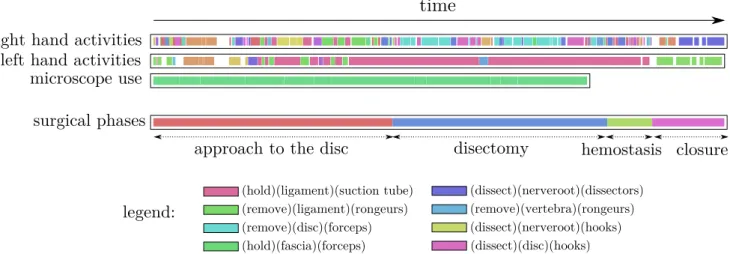
Fig. 1 Visualization of a surgery, each color corresponds to a different activity (see legend on the bottom). Our goal is to predict the phase (four phases in this example) by using the information of the activities.
triplet composed of an action, an anatomical structure and an instrument. For example, the surgeon can cut the skin using a scalpel with his/her right hand.
In this paper, we use this representation and use its formalisation introduced in [6]. Let S = {S1, · · · , SN}
be the a set of surgeries. A surgery S can be modeled as a sequence of surgical activities S =< a1, ..., an> where
ai denotes the ithactivity. An activity aibelongs to A,
the set of all possible activities, and has a start time and a stop time within the time-line of the surgery. In general, activities that are performed by both hands are recorded, as well as the use of the microscope. Thus, an activity is a vector of seven nominal values correspond-ing to:
– the triplet for the right hand ; – the triplet for the left hand ;
– a binary information on the use of the microscope. An example of activity could be {(cut, scissors, mu-scle)r, (hold, retractors, muscle)l, false}. Each surgery
is subdivided into several phases P = {p1, ..., pm} (e.g.,
closure phase) which corresponds to a high-level seg-mentation of the surgery. Each activity is performed during certain phase of the surgery. The goal of this paper is to predict the phase pj given an activity ai.
The Figure 1 presents an example of a surgery com-posed of several activities. In this visualisation, each colour corresponds to a different activity. The phases we are targeting to predict are also displayed on the figure.
To create the prediction function f : A → P that affects a phase to an activity, we used of a decision tree algorithm. In order to train this decision tree, a training set is composed of surgeries from which activ-ities and their corresponding phases are known: S =< (a1, p1), ..., (an, pm) >. Note that the use of Random
Forest as presented in [21] is not relevant in our case as
we handled a limited amount of features. Consequently, creating multiple trees with subsets of features is not likely to improve the results.
3.2 Considering the local-context information
In the problem statement, we only considered the activ-ity performed at a single instant to draw the prediction. In order to take into account the local-context of the current activity, we propose to also consider the previ-ous actions performed by the surgeon. This allows to take into account the local sequencing of the activities. Our intuition is that the current activity is related to the previously performed activities.
Let a(t) be the activity performed at time t. We consider for the prediction the set of activities from a(t) to a(t − w), w being the size of a time window we are considering which is a parameter of the method.
We analyze the w previous activities and we com-bine the probability density functions (PDF) of the pre-dictions related to these previous activities. The num-ber of bins of each PDF is equal to the numnum-ber of dif-ferent possible phases in the surgery. The PDF of an activity a (pdfa) is computed according to the class
dis-tribution (i.e., phase disdis-tribution) of the instances (i.e., surgical activities) present in the tree node used to per-form the prediction. The value pdfa(p) corresponds to
the fraction of instances of phase p in that node. Thus, the probability of each phase is computed by summing all the PDFs: ˆ p(pj|Aw) = X a∈Aw pdfa(pj) (1)
with Aw= {a(t − w), ..., a(t − 1), a(t)} the set of
prob-single activity prediction using the local-context w right hand left hand microscope phase
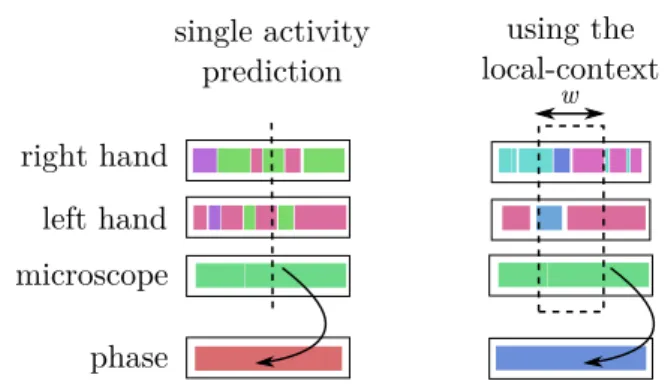
Fig. 2 Illustration of the activities used to draw the predic-tion: using a single activity (left) or the local-context (right) with the time widow w.
ability ˆp(pj|Aw) corresponds to the probability of
pre-dicting the phase pj knowing the set of previous
activ-ities Aw. The final prediction is drawn by taking the
mode, i.e., the phase having the maximum probability:
arg max
pj∈P
{ˆp(pj|Aw)} (2)
The optimal size w of the time window can be ex-perimentally found using cross-validation for a specific application. As presented later, 70 seconds gave the best results in our experiments. Note that the time window concerns the activities performed by the surgeon before the current activity that the system aim at predicting. Thus, there is no delay in the prediction, except for the first 70s of the surgery. The Figure2illustrates the two methods using a single activity and a window of local-context information.
Using the PDFs also allows to provide a confidence on the classification based on the highest probability provided by Eq.2. For example, if the mode is of 90% for a specific phase, then the system is highly confident on the prediction. Ties can appears in Eq.2if multiple phases have same maximum probability. In that case, the prediction is made randomly from the set of phases having the maximum value. Note that this specific case never happened in the experiment.
4 Experiments and Results 4.1 Dataset
We evaluate our method using clinical data composed of 22 surgeries of lumbar disc herniation which is the most commonly performed spinal surgery [2]. The data were recorded at the Neurosurgery Department of Leipzig. The surgeries involved 9 male and 13 female patients, with a median age of 52 years. These were exclusively
patients with newly diagnosed disc herniation, no pa-tient had undergone previous lumbar spine surgery which might be supposed to increase surgical difficulties due to fibrosis. The herniated disc was approached via a posterior intermyolamar route.
This procedure is composed of 4 phases: (1) ap-proach to the spine (from skin incision to the incision of the posterior longitudinal ligament or the removal of an excluded portion of the disc), (2) disc removal (from the end of the previous step to the beginning of hemostasis or closure), (3) hemostasis (this step may be not individualised if it was not performed), and (4) closure (from the end of disc removal or hemostasis to the end incision closure) [18].
Depending on patient specificities, a succession of disc removal / hemostasis phases is sometimes required. Thus, the number of phases is unknown at the begin-ning of the surgery. This element motivates the need for a method without assumption on the number of phases. This variability on the number of phases is ac-tually often present due to patient specificities. Among the 22 lumbar disc herniation surgeries of the dataset, 4 (18,2%) required only 3 phases (no need for hemosta-sis phase), 14 (63.6%) required 4 phases (one phase of hemostasis), 3 required 6 phases (13.7%) (two succes-sions of disc removal / hemostasis) and 1 (4.5%) re-quired 8 phases (three successions of disc removal / hemostasis). Each activity is labeled of the phase during which it is performed. We do not differentiate between disc removal / hemostasis that appear only once and disc removal / hemostasis that appears multiple times as their medical objective are identical.
For this surgery, the list of actions is: cut, coagulate, hold, dissect, install, remove, irrigate, sew, swab and drill. The list of anatomical structures is: skin, fascia, muscle, vertebra, ligament, duramater, nerveroot and disc. And the list of surgical instruments is: scalpel, scissors, dissectors, rongeurs, hooks, high-speed drill, suction tube, needle-holders, saline solution, retractors and forceps. Theoretically, 880 (10 × 8 × 11) different triplets could be created, which gives more that 1.5M of possible different activities performed by the surgeon at a single instant (considering right and left activities and microscope use). However, as all triplets are not present (some triplets of action, instrument, anatomi-cal structure are irrelevant), our dataset contains only 108 different triplets, leading to 23 thousands possi-ble different activities (108 × 108 × 2). The overall 22 surgeries contains 51,489 activities: 24,566 (48%) ac-tivities for the approach phase, 15,587 (30%) acac-tivities for the discectomy phase, 3,901 (8%) activities for the hemostasis phase and finally, 7,435 (14%) for the clo-sure phase. Note that these numbers of possibilities do
Table 1 Confusion matrix of the different phases obtained using a leave-one-out cross validation on the 22 surgeries.
classed as → App. Disc. Hemos. Clos. Approach 21890.0 1858.0 652.0 166.0 Discectomy 3109.0 11215.0 1165.0 98.0 Hemostasis 1537.0 1148.0 1168.0 48.0 Closure 1172.0 88.0 43.0 6132.0
not consider the coordination between the hands of the surgeon, which would adds constraints on the possible combinations.
4.2 Phase prediction using single activity
In this experiment, we only considered the single ac-tivity the surgeon is performing at a given instant to draw the prediction of the current phase. We trained the decision tree on all but one of the available surg-eries and tested the tree on the remaining one. This process was carried out for each surgery so that each one was used for learning and testing in a leave-one-out way. The evaluation were computed from the confusion matrix obtained from this process. We used as deci-sion tree the algorithm C4.5 and its implementation in Weka (J48) [9] with default parameters. On average during the leave-one-out process, the obtained decision tree had 595 leaves and 662 nodes. However, by remov-ing the leaves that do not contain instances, the tree is on average composed of only 150 rules. An exam-ple of decision tree and its corresponding rules set are provided on the companion web-page of the paper.
The Table 1 presents the confusion matrix for the four phases, rows are ground truth, columns are pre-dictions. The Table2 presents the precision, recall and f-measure (harmonic mean of precision and recall) for the four phases. The overall weighted (per class cardi-nality) precision is of 0.781, weighted recall is of 0.785 and weighted f-measure of 0.780. The Figure 3 illus-trates the prediction performed by the system on the surgery presented in Figure 1 and the actual phases (i.e., ground truth).
4.3 Phase prediction using local-context
In this experiment, we used the augmented version us-ing the local-context. In order to use this evolution of the method, the w parameter corresponding to the size of the time window has to be fixed. To set-up this pa-rameter on our dataset, we tested a range of time win-dow sizes within [0; 200] with a step of 5. We used an
Table 2 Precision, recall and f-measure according to the four different phases using a single activity.
Phase Precision Recall F-Measure Approach 0.790 0.891 0.838 Discectomy 0.784 0.720 0.750 Hemostasis 0.386 0.299 0.337 Closure 0.952 0.825 0.884 Weighted mean 0.781 0.785 0.780
Table 3 Precision, recall and f-measure according to the four different phases using local-context.
Phase Precision Recall F-Measure Approach 0.834 0.967 0.896 Discectomy 0.817 0.802 0.810 Hemostasis 0.777 0.197 0.314 Closure 0.965 0.870 0.915 Weighted mean 0.843 0.845 0.828
identical leave-out-approach as presented in the previ-ous experiment. The Figure4 illustrates the evolution of the f-measure according to the window size. We used the f-measure as it combines the information from the precision and the recall. From this experiment, we iden-tified that the optimal value of w for our application was 70. The Table 3 presents the results for the different phases with the parameter w = 70. In this experiment, the f-measure is reaching 0.828 (Table3) compared to 0.780 (Table 2) by considering only a single activity. The precision is reaching 0.843 and the recall 0.845. It is interesting to note from Figure4that the context has to stay local as using many previous activities eventu-ally reduces the quality of the prediction. Note that the method is not sensible to small variations of this param-eter as the f-measure is barely stable in the range 40 to 100 (Figure4).
4.4 Phase prediction under noisy data
Noise is an important parameter when processing surgi-cal activity data. It is often present in activities inferred from sensors data [10] and even from data captured by an observer [6]. Noise can deeply influence the quality of phases prediction. In this experiment, we evaluate how our phase prediction system is influenced by noisy data. We artificially added noise to the available dataset by randomly switching the value of a given feature of an activity under a certain probability. This noise intro-duction simulated errors in manual labelling or
detec-Approach to the disc Disectomy Hemostasis Closure prediction :
ground truth :
Fig. 3 Visualisation of the prediction of the phases for one surgery, the prediction (top) and the groundtruth phases (bellow).
0 50 100 150 200 0.78 0.80 0.82 Window size F− Measure 70 maximum: 0.828
Fig. 4 Evolution of the Precision according to different size of Window time (t). 0 10 20 30 40 50 0.55 0.70 0.85 Noise level (%) F − Measure
without local context
with local context
Fig. 5 Evolution of the F-Measure according to different level of noise in the data.
tion errors of systems using sensors data. An example of noise introduction could be to switch the instrument of an activity from scalpel to forceps. A level of noise of N % means that each feature of each activity has N % of chance to have been modified randomly. With an increasing level of noise it is becoming more diffi-cult to predict the phase as the tree has diffidiffi-culties to identity valid decision rules. The Figure5 presents the evolution of the f-measure according to different levels of noise (from 0% to 50%) for our prediction method with and without local-context information.
4.5 Phase prediction among clusters of surgeries In the previous experiments, we used the entire dataset of 22 surgeries. In this experiment, we first perform a clustering of this dataset to create groups of similar surgeries. We then apply the phase prediction systems to the surgeries present in each cluster. The influence of reducing a training set using clustering techniques before learning a decision tree has already been inves-tigated in the past [19,23]. As surgeries can exhibit im-portant differences, we are expecting to improve the
20 40 60 80 100 120 Height
Dendrogram of the surgeries
Cluster1
Cluster 2
Fig. 6 Hierarchical clustering of the 22 surgeries used in the experiment. Two clusters are visually identifiable. On the bot-tom of the tree, the sequences of right hand activities.
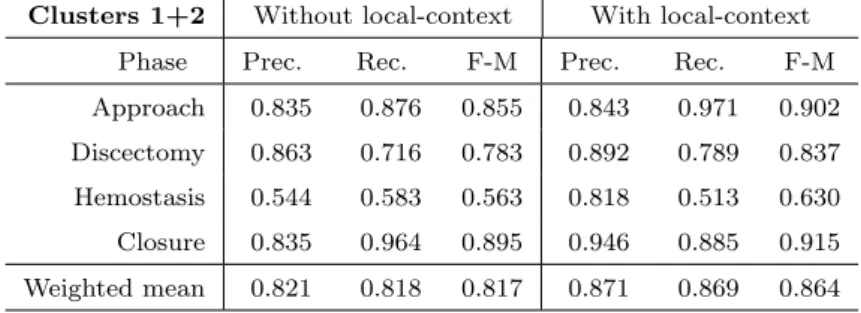
prediction results by creating clusters of highly similar surgeries. To create the clusters, we used the method-ology proposed by Forestier et al. [5,6] which relies on Dynamic Time Warping (DTW) and ascendant hierar-chical clustering. This methodology has proven its effi-ciency in creating clusters of similar surgeries [7]. The Figure6presents the dendrogram obtained from the hi-erarchical clustering process. From the analysis of this dendrogram, we identified two main clusters, named Cluster 1 and Cluster 2 and containing respectively 15 and 7 surgeries. We then applied the system for phase prediction proposed in this paper individually to each cluster. The Table4presents the results of phases pre-diction within the two clusters for the methods with and without local-context usage. The results within Cluster 1 (15 surgeries) are quite interesting as they are better than the ones obtained on the entire dataset. Without the use of the local-context, we obtained a f-measure of 0.804 compared to 0.780 using the entire dataset. When using the local-context, the results further im-proved, reaching 0.845 compared to 0.828 when using the entire datasets. The results within Cluster 2 (7 surg-eries) are however lower than using the entire dataset with a f-measure of 0.693 without the local-context and 0.720 while using it. The results of the application of the tree learned from the data of Cluster 1 to the entire dataset (Cluster 1 + Cluster 2) is presented in Table6. In this Table, the f-measure is reaching 0.864 compared to 0.828 when using all the dataset to learn the tree.
Table 4 Precision, recall and f-measure according to the four different phases, with and without the use of local-context for the two clusters of surgeries.
Cluster 1 Without local-context With local-context Phase Prec. Rec. F-M Prec. Rec. F-M Approach 0.831 0.875 0.853 0.845 0.976 0.906 Discectomy 0.823 0.770 0.796 0.853 0.840 0.846 Hemostasis 0.396 0.248 0.305 0.783 0.182 0.296 Closure 0.858 0.971 0.911 0.966 0.881 0.921 Weighted mean 0.800 0.813 0.804 0.861 0.863 0.845
Cluster 2 Without local-context With local-context Phase Prec. Rec. F-M Prec. Rec. F-M Approach 0.680 0.802 0.736 0.722 0.888 0.796 Discectomy 0.702 0.635 0.667 0.796 0.674 0.730 Hemostasis 0.518 0.207 0.296 0.526 0.184 0.273 Closure 0.858 0.857 0.829 0.898 0.869 0.883 Weighted mean 0.698 0.704 0.693 0.755 0.760 0.745
Table 5 Precision, recall and f-measure according to the four different phases, with and without the use of local-context using the tree learned on Cluster 1 applied to Cluster 2.
Cluster 2 Without local-context With local-context Phase Prec. Rec. F-M Prec. Rec. F-M Approach 0.742 0.830 0.784 0.752 0.947 0.838 Discectomy 0.818 0.578 0.678 0.867 0.640 0.736 Hemostasis 0.470 0.555 0.509 0.692 0.447 0.543 Closure 0.763 0.934 0.840 0.902 0.875 0.888 Weighted mean 0.749 0.739 0.735 0.806 0.797 0.788 5 Discussion
When using only the current activity of the surgeon (Table 1 and Table 2) the results are quite accept-able. Indeed, these results are interesting considering the very limited amount of used data (only seven fea-tures for each activity) representing what the surgeon is currently doing. The precision ranges from 0.952 for the closure phase to 0.386 for the hemostasis phase. The high precision rate for the closure phase can be explained as it is the most standardized phase of the surgery. Consequently, it is quite easy to learn a set of rules allowing to identify the activities of this phase. On the contrary, the hemostasis phase is more com-plex. First, it does not appear all the time, and sec-ond the duration of hemostasis phase is less important than the other phases of the surgery (i.e., it only repre-sents 8% of the activities of the dataset). The approach
and disectomy phases have respectively a precision of 0.790 and 0.784 which is acceptable as they are the most present phases of the dataset (respectively 48% and 30% of whole the activities). The overall recall is of 0.785 which is also a good result.
When considering the local-context of the activities (Table 3), the overall f-measure increases from 0.780 to 0.828. Almost all the results increase, especially the precisions. The precision of the hemostasis phase in-creased from 0.386 to 0.777 but its recall fell from 0.299 to 0.197. This result means that the number of activity affected to the hemostasis phase reduced but the pre-cision in the prediction increased. Thus, by considering what the surgeon did in his/her previous activities, the level of prediction errors can be reduced.
The added value of the local-context adjustment is even more visible when processing noisy data. In the Figure 5, one can see that the use of loccontext
al-Table 6 Precision, recall and f-measure according to the four different phases, with and without the use of local-context with the tree learned on Cluster 1 applied to the entire dataset.
Clusters 1+2 Without local-context With local-context Phase Prec. Rec. F-M Prec. Rec. F-M Approach 0.835 0.876 0.855 0.843 0.971 0.902 Discectomy 0.863 0.716 0.783 0.892 0.789 0.837 Hemostasis 0.544 0.583 0.563 0.818 0.513 0.630 Closure 0.835 0.964 0.895 0.946 0.885 0.915 Weighted mean 0.821 0.818 0.817 0.871 0.869 0.864
lows the method to be less impacted by noisy data. The prediction system using only the current activity sees its performance decrease linearly with the increasing level of noise, while the method using the local-context is more robust. This is explained by the fact that the method relies on the predictions performed from pre-vious activities. Thus, the influence of noise in one ac-tivity among the set of considered activities (Aw) is
reduced.
The Figure6 illustrates the clustering of the surg-eries used in the experiment. We created two clusters out of the dendrogram obtained by hierarchical cluster-ing. The results of the Cluster 1 (see Table4) are better than the results on the entire dataset (Table 2 and3). These results show that using an important number of surgeries does not necessarily improve the results. By reducing the number of surgeries (15 instead of 22), we substantially improved the results. This can be ex-plained by the fact that the surgeries present in Cluster 1 are the most similar surgeries of the dataset. Conse-quently, it is easier for the decision tree algorithm to create decision rules that are valid for these 15 simi-lar surgeries than a model for the entire dataset. How-ever, the Cluster 2 shows lower results than when using the entire dataset. This can be explained by the higher dissimilarity within the clusters, which is visible from the height of the dendrogram links in Figure 6. Fur-thermore, Cluster 2 only contains 7 surgeries and with the leave-one-out cross-validation, only 6 surgeries were used at each fold to learn a predictive model. This lim-ited number of instances and the higher variability can explain these lower results.
Table 5 shows the result of the application of the tree learned from Cluster 1 to the data of Cluster 2 (Cluster 2*). In this configuration, the f-measure in-creased from 0.693 to 0.735 without the local-context and from 0.745 to 0.788 with the local-context. This result shows that using a model learned from one clus-ter can actually improves the results when applied to other clusters. Table 6 shows the result of the
appli-cation of the tree learned on Cluster 1 to the entire dataset (Cluster 1 + Cluster 2). In that case, the f-measure is reaching 0.864 which is better than using the entire dataset (0.828). Thus, these results highlight that in building a CAI system for phase prediction, the data used for the learning step are really important and can substantially affect the results. We advice to cre-ate highly similar clusters of surgery specific to a group of surgeons before training a system. Furthermore, our experiments reveal that a model learned on a subset of the data can improve the overall prediction accuracy of the system.
Additional background knowledge could have been used to improve the results. For example, a natural or-dering of some phases (e.g., closure comes always af-ter opening) could have been used to further improve the results. However, we wanted the method to stay as generic as possible to be easily reused in other con-figurations (e.g., for other types of intervention). Not relying on a temporal model also allows the system to be paused and restarted very easily. This feature is in-teresting in multiple situations: to save battery, due to technical failure or problems in gesture recognition, etc. Moreover, due to patient abnormality or intervention specific context, the sequence of the phases can also be totally original. In this situation, not relying on a tem-poral model allows our system to be used anyway as no assumption is made on the phase sequencing. Thus, the system will work even if no data in the training set exhibits the phase sequencing of the surgery being processed. Furthermore, the system can be applied re-gardless of the number of phases in the surgery.
The low computational complexity of decision tree allows the system to be easily embedded on low powered devices present the OR (e.g., Google Glass). Further-more, decision tree can be visualized as a set of classifi-cation rules that could be used alone to take actions in the organization of the OR. Note that the source code of the methods proposed in this paper is available for
download 1 so that they can easily be integrated and compared with other systems.
The number of phases, which is currently limited to four, only partially reveals the potential of the proposed method. However, as the method is totally generic, it can be directly used to detect and predict more phases. Furthermore, as surgical procedures have multiple lev-els of granularity, our method could also be applied to detect other levels than phases (e.g., steps, substeps, etc.). The only limit is that the low-level surgical activi-ties of these different levels have to exhibit specific char-acteristics that the tree could capture. Finally, a pre-cise comparison against existing methods (e.g., HMM based) would also be needed to highlight the perfor-mance of the proposed method. The fact that we re-leased the source code of our application is a first step towards such comparison.
6 Conclusion
In this paper, we used decision trees to automatically predict high-level surgical phases from low-level activ-ities. We proposed a method which uses the local con-text of an activity to draw a better prediction than a method using a single activity. Experiments highlighted that using the local-context improves the quality of the prediction. We also performed an evaluation to assess the robustness of the method towards noisy data. The use of the local context made the method more robust to noise in the data. Furthermore, we showed that cre-ating clusters of similar surgeries could be used as a pre-processing step to improve the results of CAI phase prediction systems. Indeed, we showed that using a sub-set of 15 surgeries instead of the 22 of the entire datasub-set allowed to improve the results of the proposed meth-ods. In future work, we are planing to take into account global information on the surgery and to combine global and local contexts in order to improve the quality of the prediction. Furthermore, we are currently investigating if training the decision tree with short sequences of ac-tivities would improve the prediction results.
Acknowledgement
The authors would like to thanks all the surgeons of the Neurosurgery Department of the Leipzig Univer-sity Hospital, Germany involved in this work. The au-thors would like to thank the anonymous reviewers for their valuable comments and suggestions to improve the manuscript.
1 http://germain-forestier.info/src/ipcai2015/
Additional Material
The source code of the application is available for down-load (Java ARchive file) :http://germain-forestier. info/src/ipcai2015/.
Conflict of Interest: The authors declare that they have no conflict of interest.
Ethical approval: All procedures performed in studies involving human participants were in accordance with the ethical standards of the institutional and/or na-tional research committee and with the 1964 Helsinki declaration and its later amendments or comparable ethical standards.
Informed consent: Informed consent was obtained from all individual participants included in the study.
References
1. Bardram, J.E., Doryab, A., Jensen, R.M., Lange, P.M., Nielsen, K.L., Petersen, S.T.: Phase recognition during surgical procedures using embedded and body-worn sen-sors. In: IEEE International Conference on Pervasive Computing and Communications, pp. 45–53 (2011) 2. Blamoutier, A.: Surgical discectomy for lumbar disc
her-niation: Surgical techniques. Orthopaedics & Traumatol-ogy: Surgery & Research 99(1), S187–S196 (2013) 3. Bouarfa, L., Jonker, P.P., Dankelman, J.: Discovery of
high-level tasks in the operating room. Journal of Biomedical Informatics 44(3), 455–462 (2011)
4. Bricon-Souf, N., Conchon, E.: Context awareness for medical applications. Medical Applications of Artificial Intelligence p. 355 (2013)
5. Forestier, G., Lalys, F., Riffaud, L., Collins, D.L., Meix-ensberger, J., Wassef, S.N., Neumuth, T., Goulet, B., Jannin, P.: Multi-site study of surgical practice in neu-rosurgery based on surgical process models. Journal of Biomedical Informatics 46(5), 822 – 829 (2013)
6. Forestier, G., Lalys, F., Riffaud, L., Trelhu, B., Jannin, P.: Classification of surgical processes using dynamic time warping. Journal of Biomedical Informatics 45(2), 255– 264 (2012)
7. Forestier, G., Petitjean, F., Riffaud, L., Jannin, P.: Non-linear temporal scaling of surgical processes. Artificial Intelligence in Medicine 62(3), 143–152 (2014)
8. Franke, S., Meixensberger, J., Neumuth, T.: Intervention time prediction from surgical low-level tasks. Journal of Biomedical Informatics 46(1), 152 – 159 (2013)
9. Hall, M., Frank, E., Holmes, G., Pfahringer, B., Reute-mann, P., Witten, I.H.: The weka data mining software: an update. ACM SIGKDD explorations newsletter 11(1), 10–18 (2009)
10. Lalys, F., Bouget, D., Riffaud, L., Jannin, P.: Automatic knowledge-based recognition of low-level tasks in oph-thalmological procedures. International Journal of Com-puter Assisted Radiology and Surgery 8(1), 39–49 (2013) 11. Lalys, F., Jannin, P.: Surgical process modelling: a re-view. International Journal of Computer Assisted Radi-ology and Surgery 8(5), 1–17 (2013)
12. Lalys, F., Riffaud, L., Morandi, X., Jannin, P.: Auto-matic phases recognition in pituitary surgeries by micro-scope images classification. In: Information Processing in Computer-Assisted Interventions, vol. 6135, pp. 34– 44. Springer (2010)
13. Mehta, N., Haluck, R., Frecker, M., Snyder, A.: Sequence and task analysis of instrument use in common laparo-scopic procedures. Surgical endoscopy 16(2), 280–285 (2002)
14. Meißner, C., Meixensberger, J., Pretschner, A., Neu-muth, T.: Sensor-based surgical activity recognition in unconstrained environments. Minimally Invasive Ther-apy & Allied Technologies (2014)
15. Padoy, N., Blum, T., Feussner, H., Berger, M.O., Navab, N.: On-line recognition of surgical activity for monitoring in the operating room. In: AAAI, pp. 1718–1724 (2008) 16. Padoy, N., Mateus, D., Weinland, D., Berger, M.O.,
Navab, N.: Workflow monitoring based on 3d motion fea-tures. In: IEEE International Conference on Computer Vision Workshops, pp. 585–592 (2009)
17. Quinlan, R.: C4.5: Programs for Machine Learning. Mor-gan Kaufmann Publishers, San Mateo, CA (1993) 18. Riffaud, L., Neumuth, T., Morandi, X., Trantakis, C.,
Meixensberger, J., Burgert, O., Trelhu, B., Jannin, P.:
Recording of surgical processes: a study comparing senior and junior neurosurgeons during lumbar disc herniation surgery. Neurosurgery 67, 325–332 (2010)
19. Sebban, M., NockO, R., Chauchat, J., Rakotomalala, R.: Impact of learning set quality and size on decision tree performances. IJCSS 1(1), 85 (2000)
20. Shi, Y., Bobick, A., Essa, I.: Learning temporal sequence model from partially labeled data. In: Computer Vision and Pattern Recognition, 2006 IEEE Computer Society Conference on, vol. 2, pp. 1631–1638. IEEE (2006) 21. Stauder, R., Okur, A., Peter, L., Schneider, A.,
Kranzfelder, M., Feussner, H., Navab, N.: Random forests for phase detection in surgical workflow analysis. In: Information Processing in Computer-Assisted Interven-tions, pp. 148–157. Springer (2014)
22. Varadarajan, B., Reiley, C., Lin, H., Khudanpur, S., Hager, G.: Data-derived models for segmentation with application to surgical assessment and training. In: Medical Image Computing and Computer-Assisted Intervention–MICCAI 2009, pp. 426–434. Springer (2009)
23. ˇZenko, B.: Learning predictive clustering rules. Informat-ica 32, 95–96 (2008)