HAL Id: hal-02105102
https://hal.archives-ouvertes.fr/hal-02105102
Submitted on 5 Jan 2021HAL is a multi-disciplinary open access archive for the deposit and dissemination of sci-entific research documents, whether they are pub-lished or not. The documents may come from teaching and research institutions in France or abroad, or from public or private research centers.
L’archive ouverte pluridisciplinaire HAL, est destinée au dépôt et à la diffusion de documents scientifiques de niveau recherche, publiés ou non, émanant des établissements d’enseignement et de recherche français ou étrangers, des laboratoires publics ou privés.
Analysing plant-pollinator interactions with spatial
movement networks
Cristian Pasquaretta, Raphaël Jeanson, Christophe Andalo, Lars Chittka,
Mathieu Lihoreau
To cite this version:
Cristian Pasquaretta, Raphaël Jeanson, Christophe Andalo, Lars Chittka, Mathieu Lihoreau. Analysing plant-pollinator interactions with spatial movement networks. Ecological Entomology, Wi-ley, 2017, Entomological Networks: Ecology, Behaviour and Evolution, 29th Symposium of the Royal Entomological Society, 42 (S1), pp.4-17. �10.1111/een.12446�. �hal-02105102�
1
Analysing plant-pollinator interactions with spatial
1
movement networks
2 3
Cristian Pasquaretta1*, Raphaël Jeanson1, Christophe Andalo2, Lars Chittka3*, Mathieu Lihoreau1
4 5
1Research Center on Animal Cognition, Center for Integrative Biology, Toulouse University, CNRS,
6
UPS, France 7
2Laboratoire Evolution et Diversité Biologique (EDB), Université Toulouse III Paul Sabatier, F-31062
8
Toulouse, France 9
3Department of Biological and Experimental Psychology, School of Biological and Chemical Sciences,
10
Queen Mary University of London, Mile End Road, London E1 4NS, UK. 11
12
*Corresponding authors: 13
Lars Chittka - email: [email protected] 14
Cristian Pasquaretta – email: [email protected] 15
16 17 18
2
Abstract
19
1) Pollinators, such as bees, face the complex challenge of efficiently exploiting patchily distributed 20
floral resources across large landscapes. 21
22
2) Here we consider the utility of spatial network statistics for analysing the foraging patterns of bees 23
moving between feeding sites at various spatial and temporal scales. 24
25
3) First we explain how spatial movement networks can be derived theoretically and experimentally to 26
describe bee foraging decisions. 27
28
4) We then illustrate this approach by analysing six datasets of bumblebees and honeybees foraging 29
in arrays of artificial flowers, and showing how some specific network metrics vary predictably as 30
foragers gain experience with the spatial distribution of feeding sites. 31
32
5) We compare network analyses to more conventional statistics used to characterise bee foraging 33
movements and discuss the implications of this novel statistical and modelling approach for pollination 34
ecology research. 35
36
Keywords: bumblebees; foraging; honeybees; movement ecology; pollination; route optimization; 37 spatial networks. 38 39 40 41 42 43
3
Introduction
44
Bees play a key role in the reproduction of wild and cultured plants. Over recent years, their 45
widespread declines have raised considerable concern for food security and the sustainability of our 46
ecosystems (Goulson et al., 2015; Klein et al., 2017). Central to understanding the impact of pollinator 47
loss on plant reproduction is the foraging behaviour of bees (Thomson, 1986; Waser, 1986). Most 48
bees are central-place foragers, meaning that they collect food (nectar and pollen) to provision their 49
brood in a single nest (Michener, 2000). By exploiting plants and developing foraging routes to visit 50
them, individual bees may bias pollen flow and fashion the genetic structure of plant populations, 51
therefore calling for more research of bee spatial strategies at the individual and collective levels 52
(Ohashi & Thomson, 2009; Burkle & Alarcón, 2011; Mayer et al., 2011). 53
Historically, bees were assumed to use simple movement rules that would yield maximal 54
energy gains to exploit patchily distributed resources, such as moving between nearest unvisited 55
flowers (Ohashi et al., 2007), making short trips after encountering highly rewarding flowers (Chittka et 56
al., 1997) or keeping constant heading directions between visiting flowers (Pyke & Cartar, 1992). 57
While these rules of thumb may hold true when bees forage at small spatial scales (within an 58
inflorescence or a flower patch) mounting evidence shows that this is not the case at larger spatial 59
scales, when bees move between distant locations (flower patches or plants). In these conditions, 60
foragers of many bee species tend to develop stable foraging routes (sometimes called traplines in 61
analogy to the fixed circuits that trappers follow when examining a number of traps distributed widely 62
in space) that they follow for several hours or days (e.g. Euglossine bees: Janzen, 1971; bumblebees: 63
Heinrich 1976; Thomson et al., 1997; honeybees: Buatois & Lihoreau, 2016). This routing behaviour is 64
based on the acquisition of spatial memories encoding the location of the different food resources, the 65
colony nest site and other prominent environmental features (e.g. visual landmarks) (Collett et al., 66
2013). With training, bumblebees and honeybees can learn to find the shortest path to visit a few 67
artificial flowers (equivalent to natural flower patches) once and return to the nest (Bombus impatiens: 68
Ohashi et al., 2007; Bombus terrestris: Lihoreau et al., 2012a; Apis mellifera: Buatois & Lihoreau, 69
2016), an optimisation behaviour analogous to solving the Travelling Salesman Problem in graph 70
theory (Cook, 2012). This mathematical problem is notoriously difficult (if not impossible) to solve for 71
large graphs, because the number of possible paths increases factorially with the number of nodes in 72
the graph (e.g. 6 paths for 3 nodes, > 3 million paths for 10 nodes), and finding efficient solutions often 73
requires complex algorithms and systematic approaches (Polyakovskiy et al., 2014; Dorigo & 74
Gambardella, 2016). 75
While there is evidence that bees exhibit routing behaviour in nature (Heinrich 1976; Janzen 76
1971), to what extent these observations in simplified experimental conditions can be extrapolated to 77
the field, where individuals may interact to exploit numerous highly variable resources scattered 78
across large landscapes, is an open question. 79
Field data on such multi-destination routes among flower patches are even more complex and 80
challenging to analyse, and conventional behavioural metrics do not suffice to capture detailed 81
information about routing behaviour (Thomson et al., 1997; Makino & Sakai 2004; Makino & Sakai 82
2005; Makino 2013; Lihoreau et al., 2016). We argue that network statistics derived from graph theory 83
4
hold considerable promise to characterise these complex movement patterns at the individual and 84
collective levels, and to identify the decision rules underpinning spatial strategies. In developing routes 85
between flowers, foragers form movement networks embedded in space (Barthélemy, 2011), where 86
‘nodes’ are feeding locations (flower patches or plants) and ‘edges’ are flight paths between them (see 87
examples in Figures 1A-E) (Thomson et al., 1997; Lihoreau et al., 2016). These spatial movement 88
networks are directed, meaning that individuals move from one particular location to another 89
(movement vectors). Networks are also weighted so that the thickness of edges is proportional to the 90
frequency of movements between nodes. Because most bee species are central-place foragers, their 91
spatial movement networks also include the nest site, a specific node at which every flower visitation 92
sequence starts and ends. Therefore, in principle, an optimal movement network for a bee connects all 93
flowers and the nest using the shortest possible path (optimal network in Figure 1E). Discrete temporal 94
network analysis can then be performed depending on the time intervals with which a visitation matrix 95
is built. For instance, matrices may be developed by considering flower visits made in a single foraging 96
bout (dynamic network) or by cumulating the flower visits of several foraging bouts (static network). A 97
major advantage of network statistics is that they allow for analyses of very large spatial datasets and 98
the derivation of new empirically testable hypotheses (e.g. Perna & Latty, 2014; Jacoby & Freeman, 99
2016). Several analytical packages (e.g. igraph, sna, tnet packages in R, graph-tool in Python, 100
UCINET) and both local metrics (e.g. measures describing the level of importance of a node in a 101
network) and global metrics (e.g. measures describing the general level of connectivity of the entire 102
network) can be readily calculated to characterize space use by pollinators from an individual-based 103
point of view to measure, compare and predict their behaviour across different temporal scales. 104
In a recent field survey, Dupont et al. (2014) applied an individual-based plant-pollinator 105
network analysis to flower visitation data of different bumblebee species. The study showed significant 106
modularity in space use by bees based on plant characteristics, so that foragers tended to visit 107
patches of aggregated plants with numerous flowers and use taller plants to move from one module to 108
another (Dupont et al., 2014). Although the analytical approach developed in this study is very 109
appealing, field surveys only provide partial information about the foraging experience of individual 110
bees, the location of their nest relative to different plant patches and the temporal dynamics of their 111
foraging patterns. All these parameters are critical in determining bee foraging behaviour (Chittka & 112
Thomson, 2001). Experimental advances on model bee species, such as bumblebees and 113
honeybees, using artificial flowers delivering controlled rates of food resources combined with 114
automated movement tracking, now allow for collecting high resolution spatial and temporal data on 115
bee foraging patterns in complex, yet controlled, environments (e.g. motion detection cameras on 116
flowers: Lihoreau et al., 2016; Radio Frequency Identification (RFID): Ohashi et al., 2010; harmonic 117
radars: Lihoreau et al., 2012b; QR tags: Crall et al. 2015; 3D video tracking: Ings & Chittka, 2008). 118
Extensive recordings of individual based data using these semi-field approaches provide an 119
interesting opportunity to start examining the cognitive processes underpinning the foraging patterns 120
of bees and how they change across time in ecologically relevant conditions. 121
Here we describe how spatial network statistics can be used to analyse the foraging patterns of 122
bees both at local and global levels. We illustrate the potential of this approach for comparative analyses 123
5
by statistically comparing spatial optimisation in the movement patterns of bees of the same species or, 124
of different species across environments varying in spatial scales, number of flowers and flower 125
configurations using standard network metrics. We used published movement datasets of bumblebees 126
and honeybees of known age, foraging experience and colony origin, foraging in arrays of artificial 127
flowers in the lab and in the field. To validate the approach, we compared our results with analyses of 128
more conventional behavioural metrics used in previous studies, such as the number of re-visits to 129
flowers and overall travel efficiency (distance/number of flowers visited). 130
131
Materials and methods
132
Experimental data 133
We analysed six datasets of bee flower visitation sequences. Three datasets were obtained on the 134
bumblebee Bombus terrestris (experiment 1: Lihoreau et al., 2012a; experiment 2: Lihoreau et al., 135
2011; experiment 3: Lihoreau et al., 2012b). The three other datasets were obtained on the honeybee 136
Apis mellifera (experiments 4-6: Buatois & Lihoreau, 2016). 137
All the datasets were generated following the same general methodology and are thus 138
comparable. In all experiments bees were individually marked (coloured number tags or paint dots on 139
the thorax) and maintained in colony nest boxes (bumblebees) or hives (honeybees) equipped with a 140
transparent, colourless, entrance tube. The tube was fitted with a series of shutters to control all 141
departure and arrival of foragers at the colony. Workers collected sucrose solution (40% w/w) on 142
artificial flowers outside the colony. Flowers consisted of a blue plastic landing platform (diameter = 143
60mm) with a yellow feeding spot in the middle. Bees were initially pre-trained on a flower from which 144
they could collect ad libitum sucrose solution. Each individual was tested alone. A regular forager that 145
made at least five foraging bouts (foraging trips starting and ending at the nest colony box) in one hour 146
was selected. The crop capacity of this forager was estimated by averaging the total volume of 147
sucrose solution collected from a training flower over another three foraging bouts. The forager was 148
then tested with all test flowers placed in a specific spatial arrangement (see experimental arrays in 149
Figure 2). During the test, each flower provided the same amount of sucrose solution, chosen so that 150
the bee had to visit all flowers to fill its nectar crop to capacity before returning to the colony nest box 151
(e.g. 1/5th of the crop capacity available in each flower in an array of five flowers). Flowers were refilled
152
by the experimenter at the end of each foraging bout, meaning that any revisit to a flower within the 153
same foraging bout was not rewarding. Bees were tested for 22 to 80 consecutive foraging bouts in 154
the same array of flowers. All flower visits (when a bee landed on a flower) were recorded and used to 155
reconstruct the complete foraging history of each bee. 156
Experiments were conducted in six different arrays, varying in their spatial scale, their number 157
of flowers and the spatial configuration of flowers. Experiments 1, 2 and 4 (Figure 2A, B, D) were 158
completed in flight rooms at small spatial scales and with controlled illumination (Lihoreau et al., 2011; 159
Lihoreau et al., 2012a; Buatois & Lihoreau, 2016). Experiments 3, 5 and 6 (Figure 2C, D, E) were 160
completed in outdoor open fields at small spatial scale for experiment 5 and large spatial scales for 161
experiments 3 and 6 (Lihoreau et al., 2012b; Buatois & Lihoreau, 2016). Details about the spatial 162
6
arrangement of flowers, the number of bees tested and the numbers of foraging bouts per bee are 163 given in Figure 2. 164 165 Network analyses 166
We built spatial networks of bee foraging movements in which flowers were nodes and movements 167
were edges (Figure 1). Edges weight corresponded to the frequency of movement between flowers. 168
To describe foraging movements and compare them across experimental conditions and species, we 169
calculated three local network metrics describing the role of each flower in the bee movement network 170
and one global network metric to infer on the efficiency of the network structure. 171
172
Local network measures 173
At a local level, we calculated the “weighted clustering coefficient”, which assesses the degree to 174
which nodes tend to cluster together (Barrat et al., 2004). Here a high clustering value indicates that 175
neighbouring flowers of a given flower are themselves highly connected, i.e. frequently re-visited 176
(Figure 1B). 177
We used the “Kleinberg’s authority score” (Kleinberg, 1999) to measure the relative 178
importance of a node in a network (Figure 1C). Given A, an individual movement matrix across 179
flowers, the Kleinberg's authority score is defined as the principal eigenvector of the inverted matrix 180
t(A)*A. This metric assigns large values to flowers that are most often used, while accounting for the
181
number of visits to adjacent flowers (i.e. flowers connected by at least one edge). Therefore a high 182
Kleinberg’s authority score indicates that a specific flower is more often visited than all its neighbour 183
flowers. This may be the case, for instance, at the early stages of a route development when bees 184
often return to a reference flower from which they explore and attempt to locate new flowers (Ohashi 185
et al., 2007; Lihoreau et al., 2010; 2016). 186
We calculated the “weighted betweenness centrality”. This metric reflects the importance of a 187
node as intermediary of the network, based on the number of shortest paths connecting all pairs of 188
nodes that pass through the focal node (Opsahl 2009). In a bee movement network a high weighted 189
betweenness centrality characterises a flower that is acting as a bridge among multiple other flowers 190
(Figure 1D). 191
Because our aim was to study general trends of spatial optimization by bees across time at 192
the network level (route efficiency) and not at the node level (role played by individual flowers), for all 193
the local metrics we calculated mean values over all flowers at each foraging bout. Betweenness 194
scores were normalized following an algorithm that weights the betweenness value for the number of 195
flowers visited in the network (Freeman, 1979). Authority scores were scaled from 0 to 1. Clustering 196
coefficients vary between 0 and 1 and need no normalization. In these conditions, an optimal network 197
(in which a bee would visit all flowers once and return to the nest by travelling the shortest distance to 198
visit all flowers) and a suboptimal network (in which a bee would travel longer distances for visiting the 199
same amount of flowers) would be characterised by the maximum average betweenness of 0.5, the 200
maximum average authority score of 1, and the minimum average clustering coefficient of 0 (Figure 201
1E). 202
7
Global network measures
203
At the global level, we examined the triadic structures of the network - i.e. motifs (Milo et al., 2002), 204
which represent triadic patterns of connection between nodes in a directed network. Network motifs 205
can be representative of various biological processes such as information flow (Nandi et al., 2014), 206
resource exchange (Quevillon et al., 2015) or disease spread (Waters & Fewell, 2012). In a bee 207
movement network the analyses of network motifs might help identifying behavioural rules 208
underpinning trapline formation (Figure 1F) while allowing for unbiased comparison across different 209
datasets (Shizuja & McDonald, 2015). Whereas a detailed temporal network analysis of motifs might 210
be used to better understand the mechanisms of network functionality (Kovanen et al., 2011), here we 211
used a discrete approach by counting all the 16 possible triadic motifs to connect three flowers 212
(including the nest) observed at each foraging bout and thus not strictly related to the exact temporal 213
sequence of visits on flowers (Figure 1F). For each experiment, we compared the triadic motifs of the 214
observed bee foraging networks at each foraging bout to those of the theoretical optimal network 215
connecting all flowers and the nest using the shortest possible path. Since only two out of the 16 216
possible triadic motifs (Figure 3A-F) can be observed in the optimal movement network (Figure 1E), 217
these global measures inform us about the overall efficiency of the routes developed by bees. 218
219
Data analyses 220
221
Local network measures 222
All analyses were conducted in the statistical environment R (i.e. version 3.2.3). For each foraging 223
bout of each bee we extracted weighted clustering coefficient values, authority scores and weighted 224
betweenness centrality values of each flower, using the functions “clustering_local_w” and 225
“betweenness_w” in the tnet package (Opsahl, 2009) and the function “authority.scores” in the igraph 226
package (Csardi & Nepusz, 2006). We ran three different regression models for weighted 227
betweenness, authority and weighted clustering coefficient values using the sequential number of 228
foraging bouts, type of array (i.e. small or large spatial scale), species (i.e. bumblebee or honeybee) 229
and all the interactions among these predictors as fixed effects. We used individual identity nested in 230
experimental array as a random effect in all models. We carried out model selection for the three 231
different parameters ranking candidate models according to their Akaike Information Criterion (Akaike, 232
1985). We used beta regression for the three averaged local network measures (clustering coefficient, 233
weighted betweenness centrality and authority scores) because their values were constrained 234
between 0 and 1. We also applied a zero inflation method using the Beta Inflated (BEINF) family 235
function from the gamlss package (Rigby & Stasinopoulos 2005). Model selection of the Beta 236
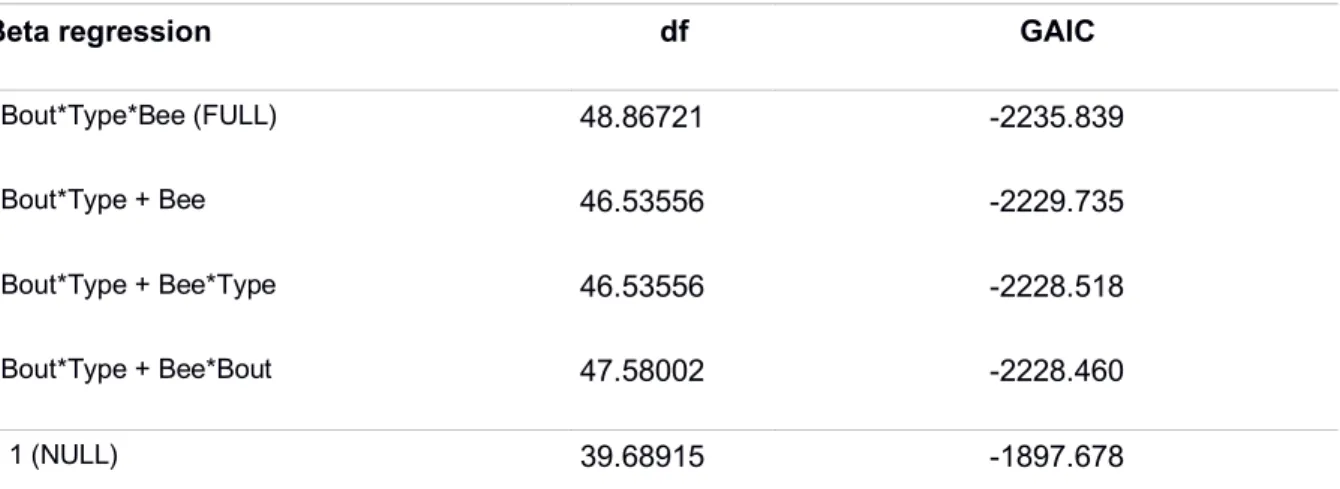
regression mixed models are shown in the supplementary materials (Tables S1, S2 and S3). Because 237
network metrics are correlated, we applied a Bonferroni correction by setting the alpha level of 238
significance at 0.017 (Tylianakis et al., 2007). 239
240 241 242
8
Global network measures
243
Motifs were calculated using the “triad.census” function in the “igraph package” (Csardi & Nepusz, 244
2006). Only two out of the 16 possible triadic motifs (motif 2 and 6: Figure 3A-F) are representative of 245
the optimal movement network (Figure 1E). Depending on the number of flowers in the array, motif 1 246
(triadic structure where the three nodes – A, B, C - have no connection among them, i.e. the empty 247
graph A, B, C) can also occur and being represented for a maximum of 7 times in a network with 7 248
flowers. Motif 2 (triadic structure with a single connection between the three nodes, i.e. A>B, C) and 249
motif 6 (triadic structure where A>B>C are all connected by two directed lines) of the optimal 250
movement network can also occur at different frequencies depending on the network size (i.e. for 7 251
flowers: 21 and 7; for 6 flowers: 12, 6; for 5 flowers: 5, 5; as indicated by red horizontal lines in Figure 252
3). We analysed the tendency of bees to modify their motifs frequency with time by applying a 253
generalized linear mixed effect model for count data (i.e. GLMM with Zero Inflated Poisson distribution 254
error) using the observed frequency for each motif and for each dataset as response variable, the 255
number of foraging bouts as predictor, and individual identity as random effect. 256
257
Other measures 258
To illustrate the benefits of using the network approach relative to more conventional analyses, we 259
also calculated non-network measures used in previous studies for assessing the ability of bees to 260
develop efficient routes (Lihoreau et al., 2011; Lihoreau et al., 2012a; Lihoreau et al., 2012b; Buatois & 261
Lihoreau, 2016). For each foraging bout of each bee we calculated the number of revisits to flowers 262
and the distance travelled (assuming straight lines between flowers) divided by the number of flowers 263
visited. Both measures of route efficiency are expected to decrease with increasing network efficiency, 264
and reach a minimum in an optimal movement network. We applied a GLMM for count data to study 265
the impact of experience (foraging bout) on the number of revisits to flowers and a linear mixed effect 266
model (LMM) for the travelled distance divided by the number of flowers visited. Both models were run 267
for each experiment using individual identity as random effect. 268
269
Results
270
Local network measures 271
The average weighted betweenness centrality increased as bees accumulated foraging experience in 272
the six experiments (estimatebout = 0.066, standard error (se) = 0.004, t = 17.11, P < 0.001), indicating
273
that individuals tended to visit all flowers at a similar frequency by the end of training (Figure 4). This 274
tendency was stronger in large spatial scale arrays (estimatesmall_array = -0.067, se = 0.005, t = -13.55,
275
P < 0.001). Interestingly, in small spatial scale arrays bumblebees showed higher average weighted 276
betweenness centrality (estimatehoneybees = -1.172, se = 0.164, t = -7.15, P < 0.001) and a tendency to
277
develop optimal networks faster (estimatehoneybees = -0.020, se = 0.008, t = -2.533, P = 0.011) than
278
honeybees (Figure 4). 279
The average Kleinberg’s authority scores also increased as bees accumulated experience in 280
the six experiments (estimatebout = 0.083, se = 0.03, t = 2.781, P = 0.004), meaning that all flowers
281
became equally important in the network. For both bee species, the average authority scores were 282
9
lower in small spatial scale arrays than in large spatial scale arrays (estimatesmall_arrays = -0.446, se =
283
0.103, t = -4.334, P < 0.001). However, honeybees had larger average authority scores than 284
bumblebees in the small spatial scale arrays (estimatesmall_arrays_honeybees = 0.582, se = 0.111, t = 5.229,
285
P < 0.001) meaning that they tended to use all possible connections between flowers equally whereas 286
bumblebees only used a few. 287
The average clustering coefficient tended to decrease with time, as bees accumulated 288
foraging experience (Figure 6). Specifically, bumblebees showed a significant decrease in average 289
clustering coefficient while honeybees maintained stable values throughout the experiments 290
(estimatebout_honeybees= 0.018, se = 0.004, t = 4.185, P < 0.001). Honeybees showed completely
291
different trend at small spatial scales, by increasing their average clustering coefficient scores with 292
experience (estimatehoneybees_small_arrays = 0.407, se = 0.148, t = 2.752, P = 0.006). This again illustrates
293
the much reduced route optimisation efficiency of honeybees in comparison to bumblebees at small 294
spatial scales (Figure 6). 295
Overall, these changes in all three local network measures were more pronounced at larger 296
spatial scales, where flowers were distant from each other and from the colony nest, both for 297
bumblebees and honeybees (Figures 4, 5 and 6). 298
299
Global network measures 300
While bees initially used the 16 possible motifs to link flowers, they gradually reduced the number of 301
motifs to only use two of them by the end of training (motifs 2 and 6), a behaviour that is characteristic 302
of route optimisation (Figure 3). This tendency was less pronounced for honeybees at small spatial 303
scales (Figures 3D and 3E). Analyses of the frequency usage of each motif confirmed that honeybees 304
at small spatial scales often presented opposite tendencies than honeybees at large spatial scales or 305
bumblebees at all spatial scales (Figure 3D: motifs 3, 7, 8 and 15; Figure 3E: motifs 4, 5, 10 and 15) 306
(for detailed motifs analysis see Table S4-S9). 307
308
Other measures 309
Conventional statistics for bee movement analyses showed trends towards a general increase in 310
movement efficiency with experience. In all experiments bees decreased the number of revisits to 311
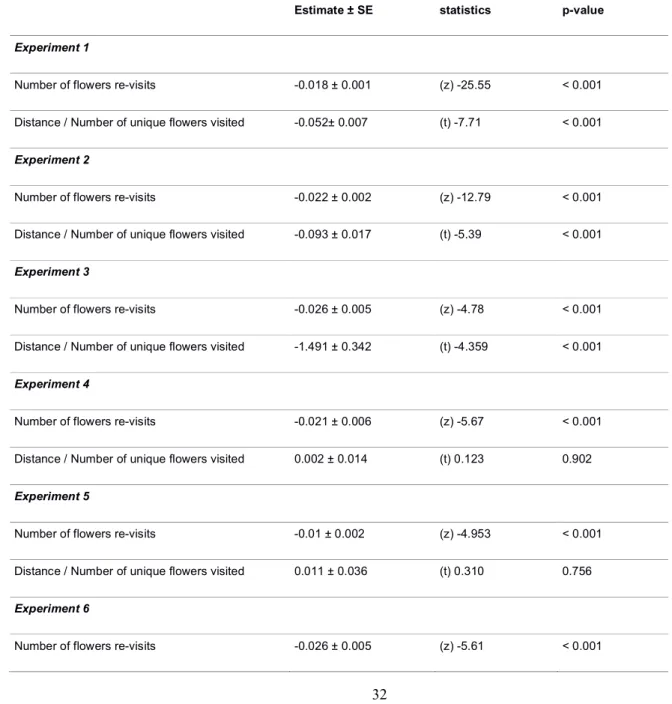
flowers as they accumulated foraging bouts (Table S10). Bees also tended to decrease their travelled 312
distance divided by the number of visited flowers, except in the case of honeybees foraging in small 313
spatial scale arrays (Table S10). 314
315
Discussion
316
Network analyses are increasingly used in behavioural and ecological research, providing a whole 317
new range of metrics to describe and model interactions between individuals and their environment 318
(Croft et al., 2008; Jeanson, 2012; Pinter-Wollman et al., 2013). In pollination ecology, this approach 319
has proved particularly powerful to describe interactions between plant and pollinator species, for 320
instance using undirected bipartite networks based on field surveys of pollinator abundance (e.g. 321
(Fontaine et al., 2006; Bascompte & Jordano, 2007; Campbell et al., 2011; Burkle et al., 2013; Coux et 322
10
al., 2016). Here we show how spatial network analyses can be developed to study the movement 323
patterns of individual bees exploiting multiple feeding locations at various spatial and temporal scales 324
in simplified experimental conditions. We argue that this approach may prove particularly helpful to 325
analyse pollinator movements in more complex and ecologically realistic experimental designs and to 326
generate new empirically testable hypotheses for pollination ecology research. 327
As illustrated above, bee movement patterns can be described in terms of local and global 328
network metrics that change predictably as individuals accumulate foraging experience. For instance, 329
in a simple situation where only one bee exploits a stable array of flowers refilled between each 330
foraging bout, both average betweenness values and average authority scores increased with time. By 331
contrast the average clustering of flowers decreased with time as bees started to develop optimal or 332
suboptimal stable movement networks. This tendency for optimisation of spatial movement networks 333
was also reflected in the dynamics of motif usage, resulting in bees increasing their usage of the only 334
two motifs representative of an optimal foraging route. Interestingly, and in accordance with previous 335
studies (e.g. Saleh & Chittka, 2007; Lihoreau et al., 2012a; Buatois & Lihoreau 2016), we found that 336
bumblebees and honeybees rarely use optimal spatial networks at small spatial scales, where the cost 337
of using a longer (suboptimal) path may be negligible. By contrast, foragers bees always used optimal 338
spatial networks at large spatial scales, suggesting that they use more complex optimisation 339
movement rules in more costly conditions. These results were confirmed with more conventional 340
statistical approaches (e.g. flower re-visits, travel efficiency), thereby validating our approach. 341
Importantly, the global network approach, based on motif analyses, brought new insights into the 342
spatial behaviour of bees. For instance the foraging patterns of honeybees were characterised by 343
frequent back and forth movements between flowers (Figure 6D - i.e. motifs 7 & 8) and 344
disproportionate usage of specific flowers or local hubs (Figure 6D – i.e. motif 4). 345
The aim of this exploratory study was to introduce spatial network analyses for characterising 346
bee movement patterns using relatively standard metrics. Further developments of this approach will 347
provide a powerful, complementary, analytical tool to conventional behavioural metrics in order to 348
inform researchers about spatial processes that are not captured by other measures. This approach 349
should focus more on global measures of path optimality (e.g. network path length, geodesic distance 350
“Wasserman & Faust, 1994”) to discriminate these different scenarios. For instance, network triads 351
give new information about specific movement routines that may be repeated within a route but that 352
are hardly detectable with current measures of sequence repeatability (Thomson et al., 1997; Ayers et 353
al., 2015). Ultimately, a major challenge for future studies will be to consider the high levels of 354
heterogeneity among flower resources that bees may face in nature, taking into account variation in 355
resource reward quantity and quality, signals, and competition among foragers in addition to spatial 356
constraints of resource locations, in order to extend our approach to field conditions. Experimentally, 357
bumblebees foraging in arrays of artificial flowers providing different nectar rewards face a trade off 358
between maximising their nectar intake rate and minimizing travel distances when developing traplines 359
(Lihoreau et al., 2011). Analyses on non-averaged local metrics could be used to capture the effect of 360
resource diversity in network formation, and bring new insights into how bees integrate memories of 361
multiple individual flowers in their spatial memory. The Kleinberg’s authority score likely informs us 362
11
about how bees use flowers as reference points relative to neighbouring flowers, perhaps to locate 363
new flowers at the beginning of route formation. The weighted clustering coefficient is a mean to 364
determine the level of connections between sub-groups flowers, a measure that should greatly vary 365
during the process of route optimisation. Other network measures, not used here, may also help 366
understand how bees change their foraging area with experience or in the face of competition (e.g. 367
modularity in Dupont et al., 2014). 368
While some of the predictions tested here may seem rather intuitive, our analysis of bumblebee and 369
honeybee movement patterns in relatively simple foraging conditions aims at illustrating how network 370
statistics could serve future research in field and semi-field conditions. Motif network analyses offer the 371
possibility to statistically compare networks to each other, either for the same individuals at different 372
stages of route formation, or between different individuals, and between different species. 373
Characterising the spatial foraging strategies of a wider range of pollinators, including wild and 374
managed species is a key challenge of pollination ecology in order to identify and compare the real 375
impact of these species on pollination services (Garibaldi et al., 2013). For instance, our preliminary 376
analysis suggests that at small spatial scales bumblebees display more efficient spatial movements 377
than honeybees. Bumblebees tended to reach a frequency of each triadic structure that would lead to 378
an optimal foraging network, whereas honeybees often showed the opposite behaviour. A possible 379
explanation is the difference of social life style between these two pollinator species. Honeybees, in 380
contrast to bumblebees, have evolved a unique food recruitment system (the waggle dance) by which 381
successful foragers communicate locational information about food resources to their nestmates upon 382
their return to the hive (Von Frisch, 1967; Dornhaus et al., 2006). These insects may thus invest less 383
in individual sampling and efficient route learning than species lacking the means to communicate 384
foraging locations, such as bumblebees (Buatois & Lihoreau, 2016). Another possibility is the 385
difference of typical foraging range between the two species. While bumblebees rarely cover more 386
than three kilometres to exploit floral resources (Osborne et al., 2008), honeybees can travel more 387
than ten kilometres within a single foraging trip (Pahl et al., 2011), suggesting that they are better 388
adapted to long flights and could start exhibiting optimisation movement patterns at larger spatial 389
scales than bumblebees. Systematic comparisons of both species across a wider range of spatial 390
scales will be needed to test these hypotheses. 391
Another key advantage of network analyses is that they allow for working on complete (raw) 392
datasets and thus reduce the risks of arbitrarily discarding important information. In the case of 393
pollinators, such approach may allow identification of specific movement patterns that occur at the 394
early stage of route learning, for instance exploration flights to locate flowers and store them in spatial 395
memory, or exploitation flights to return to familiar locations (Woodgate et al., 2016). Further 396
development of pollinator movement networks may also include detailed dynamic temporal analyses 397
of flower visitation sequences, which might reveal differential effect of the individual experience on the 398
probability to optimize the foraging route. Stochastic agent-based methods (Snijders et al., 2010) 399
recently applied to animal social networks (Boucherie et al., 2016; Pasquaretta et al., 2016), may also 400
prove useful to integrate rate of change of flower visitation sequences. New metrics could be 401
developed to estimate network efficiency in order to account for the specificity of the structure of bee 402
12
spatial movement based on individual experience. For instance, the direct integration of probability 403
values based on the spatial distances between flowers will allow for a finer calculation of local network 404
metrics which could be used to characterize the individual learning process and compare the likelihood 405
to obtain an optimal foraging route depending on the early spatial experience of the bee. Explicit 406
consideration of the nest as a specific node in the network, different from flowers, may also bring 407
useful information about bee network dynamics and efficiency. 408
For all these reasons, we believe that pollinator movement networks constitutes a highly 409
promising conceptual framework for studying plant-pollinator systems from a mechanistic point of view 410
in complement to more conventional behavioural measures. Ultimately, a comprehensive 411
understanding of bee movement patterns between plants may provide new fundamental insights into 412
pollination processes and the genetic structuralism of plant populations. The development of optimal 413
routes by individual bees between particular plants can have important and predictable effects on 414
plant reproduction and inbreeding (Ohashi & Thomson, 2009). Advances in DNA pollen analyses (see 415
Clare et al., 2013; and metabarcoding; Pornon et al., 2016) now allow identification of flower species 416
visited by individual bees during a given foraging trip. One can readily downscale the approach at an 417
intraspecific level by using pollen DNA and more variable genetic markers (e.g. microsatellite; Arif et 418
al., 2010) to identify individual plants visited by pollinators and infer patterns of pollen flow within a 419
plant population that can then be verified by paternity analyses using plant progeny genotypes for 420
these markers (Bernasconi, 2003). Coupling these approaches with existing models of bee 421
movements (Lihoreau et al., 2012b; Reynolds et al., 2013; Becher et al., 2016) will provide critical 422
information about how the foraging strategies of bees directly influence pollen transfer and plant 423
mating patterns across landscapes, and therefore a better assessment of consequences of bee 424
declines on pollination. 425
426 427
Contribution of the authors 428
ML designed and conducted the experiments; CP built and analysed the networks; CP, RJ, CA, LC 429
and ML wrote the manuscript. All authors gave final approval for publication. Authors declare no 430 competing interests. 431 432 Funding 433
CP is funded by a grant of the Federal University of Toulouse (IDEX UNITI) to CA, RJ and ML. LC is 434
supported by ERC grant SpaceRadarPollinator. ML is supported by an ANR Jeune Chercheur (ANR-435 16-CE02-0002-01). 436 437 438 439 References 440
Akaike H. (1985) Prediction and Entropy. In: Atkinson A.C., Fienberg S.E. (eds) A Celebration of 441
Statistics. Springer, New York, NY. pp. 387–410. 442
13
Arif, I.A., Khan, H.A., Shobrak, M., Al Homaidan, A.A., Al Sadoon, M., Al Farhan, A.H., et al. (2010) 443
Interpretation of electrophoretograms of seven microsatellite loci to determine the genetic diversity of 444
the Arabian Oryx. Genetics and Molecular Research, 9, 259–265. 445
Ayers, C.A., Armsworth, P. R., & Brosi, B. J. (2015). Determinism as a statistical metric for ecologically 446
important recurrent behaviors with trapline foraging as a case study. Behavioral ecology and 447
sociobiology, 69, 1395-1404. 448
Barrat, A., Barthelemy, M., Pastor-Satorras, R. & Vespignani, A. (2004) The architecture of complex 449
weighted networks. Proceedings of the National Academy of Sciences of the United States of 450
America, 101, 3747–3752. 451
Barthélemy, M. (2011) Spatial networks. Physics Reports, 499, 1–101. 452
Bascompte, J. & Jordano, P. (2007) Plant-animal mutualistic networks: The architecture of 453
biodiversity. Annual Review of Ecology, Evolution, and Systematics, 38, 567–593. 454
Becher, M.A., Grimm, V., Knapp, J., Horn, J., Twiston-Davies, G. & Osborne, J.L. (2016) BEESCOUT: 455
A model of bee scouting behaviour and a software tool for characterizing nectar/pollen landscapes for 456
BEEHAVE. Ecological Modelling, 340, 126–133. 457
Bernasconi, G. (2003) Seed paternity in flowering plants: an evolutionary perspective. Perspectives in 458
Plant Ecology, Evolution and Systematics, 6, 149–158. 459
Boucherie, P.H., Sosa, S., Pasquaretta, C. & Dufour, V. (2016) A longitudinal network analysis of 460
social dynamics in rooks corvus frugilegus: repeated group modifications do not affect social network 461
in captive rooks. Current zoology, zow083. doi: 10.1093/cz/zow083 462
Buatois, A. & Lihoreau, M. (2016) Evidence of trapline foraging in honeybees. The Journal of 463
Experimental Biology, 219, 2426–9. 464
Burkle, L.A. & Alarcón, R. (2011) The future of plant-pollinator diversity: Understanding interaction 465
networks acrosss time, space, and global change. American Journal of Botany, 98, 528–538. 466
Burkle, L.A., Marlin, J.C. & Knight, T.M. (2013) Plant-pollinator interactions over 120 years: Loss of 467
species, co-occurrence, and function. Science, 339, 1611–1615. 468
Campbell, C., Yang, S., Albert, R. & Shea, K. (2011) A network model for plant-pollinator community 469
assembly. Proceedings of the National Academy of Sciences of the United States of America, 108, 470
197–202. 471
Chittka, L., Gumbert, A. & Kunze, J. (1997) Foraging dynamics of bumble bees: correlates of 472
movements within and between plant species. Behavioral Ecology, 8, 239–249. 473
Chittka, L. & Thomson, J.D. (2001) Cognitive ecology of pollination: animal behaviour and floral 474
evolution. Cambridge University Press. New York. NY 475
Clare, E.L., Schiestl, F.P., Leitch, A. R., & Chittka, L. (2013) The promise of genomics in the study of 476
plant-pollinator interactions. Genome Biology, 14, 207. 477
Collett, M., Chittka, L. & Collett, T.S. (2013) Spatial memory in insect navigation. Current Biology, 23, 478
R789–R800. 479
Cook, W. (2012) In pursuit of the traveling salesman: mathematics at the limits of computation. 480
Princeton University Press. Princeton. New Jersey 481
Coux, C., Rader, R., Bartomeus, I. & Tylianakis, J.M. (2016) Linking species functional roles to their 482
network roles. Ecology Letters, 19, 762–770. 483
14
Crall, J.D., Gravish, N., Mountcastle, A.M. & Combes, S.A. (2015) BEEtag: a low-cost, image-based 484
tracking system for the study of animal behavior and locomotion. PloS ONE, 10, e0136487. 485
Croft, D.P., James, R. & Krause, J. (2008) Exploring animal social networks. Princeton University 486
Press. Princeton. New Jersey 487
Csardi, G. & Nepusz, T. (2006) The igraph software package for complex network research. 488
InterJournal, Complex Systems, 1695, 1–9. 489
Dorigo, M. & Gambardella, L.M. (2016) Ant-Q: A reinforcement learning approach to the traveling 490
salesman problem. In Proceedings of ML-95, Twelfth International Conference on Machine Learning. 491
Eds Morgan Kaufmann. pp. 252–260. 492
Dornhaus, A., Klügl, F., Oechslein, C., Puppe, F. & Chittka, L. (2006) Benefits of recruitment in honey 493
bees: effects of ecology and colony size in an individual-based model. Behavioral Ecology, 17, 336– 494
344. 495
Dupont, Y.L., Trøjelsgaard, K., Hagen, M., Henriksen, M. V., Olesen, J.M., Pedersen, N.M.E., et al. 496
(2014) Spatial structure of an individual-based plant-pollinator network. Oikos, 123, 1301–1310. 497
Fontaine, C., Dajoz, I., Meriguet, J. & Loreau, M. (2006) Functional diversity of plant-pollinator 498
interaction webs enhances the persistence of plant communities. PLoS Biology, 4, 0129–0135. 499
Freeman, L. (1979) Centrality in social networks conceptual clarification. Social Networks, 1, 215–239. 500
Frisch, K. Von. (1967) The dance language and orientation of bees. Harvard University press. 501
Cambridge 502
Garibaldi, L.A., Steffan-Dewenter, I., Winfree, R., Aizen, M.A., Bommarco, R., Cunningham, S.A., et al. 503
(2013) Wild pollinators enhance fruit set of crops regardless of honey bee abundance. Science, 339, 504
1608–1611. 505
Goulson, D., Nicholls, E., Botías, C. & Rotheray, E.L. (2015) Bee declines driven by combined stress 506
from parasites, pesticides, and lack of flowers. Science, 347, 1255957. 507
Heinrich, B., (1976) the foraging specializations of individual bumble-bees. Ecological Monographs, 508
46, 105-128. 509
Ings, T.C. & Chittka, L. (2008) Speed-accuracy tradeoffs and false alarms in bee responses to cryptic 510
predators. Current Biology, 18, 1520–1524. 511
Jacoby, D.M.P. & Freeman, R. (2016) Emerging network-based tools in movement ecology. Trends in 512
Ecology & Evolution, 31, 301-314. 513
Janzen, D.H. (1971) Euglossine bees as long-distance pollinators of tropical plants. Science, 171, 514
203–205. 515
Jeanson, R. (2012) Long-term dynamics in proximity networks in ants. Animal Behaviour, 83, 915– 516
923. 517
Klein, S., Cabirol A., Devaud, J.M., Barron, A.B. & Lihoreau, M. (2017) Why bees are so vulnerable to 518
environmental stressors. Trends in Ecology & Evolution, 32, 268-278. 519
Kleinberg, J. (1999) Authoritative sources in a hyperlinked environment. Journal of the ACM (JACM), 520
46, 604–632. 521
Kovanen, L., Karsai, M., Kaski, K., Kertész, J. & Saramäki, J. (2011) Temporal motifs in time-522
dependent networks. Journal of Statistical Mechanics: Theory and Experiment, 11, P11005. 523
https://doi.org/10.1088/1742-5468/2011/11/P11005 524
15 525
Lihoreau, M., Chittka, L. & Raine, N.E. (2010) Travel optimization by foraging bumblebees through 526
readjustments of traplines after discovery of new feeding locations. The American Naturalist, 176, 527
744–757. 528
Lihoreau, M., Chittka, L. & Raine, N.E. (2011) Trade-off between travel distance and prioritization of 529
high-reward sites in traplining bumblebees. Functional Ecology, 25, 1284–1292. 530
Lihoreau, M., Chittka, L., Le Comber, S.C. & Raine, N.E. (2012a) Bees do not use nearest-neighbour 531
rules for optimization of multi-location routes. Biology letters, 8, 13–6. 532
Lihoreau, M., Raine, N.E., Reynolds, A.M., Stelzer, R.J., Lim, K.S., Smith, A.D., et al. (2012b) Radar 533
tracking and motion-sensitive cameras on flowers reveal the development of pollinator multi-534
destination routes over large spatial scales. PLoS Biology, 10, 19–21. 535
Lihoreau, M., Chittka, L. & Raine, N.E. (2016) Monitoring flower visitation networks and interactions 536
between pairs of bumble bees in a large outdoor flight cage. PloS ONE, 11, e0150844. 537
Makino, T.T. & Sakai, S. (2004) Findings on spatial foraging patterns of bumblebees (Bombus ignitus) 538
from a bee-tracking experiment in a net cage. Behavioral Ecology and Sociobiology, 56, 155-163. 539
Makino, T.T. & Sakai, S. (2005) Does interaction between bumblebees (Bombus ignitus) reduce their 540
foraging area?: bee-removal experiments in a net cage. Behavioral Ecology and Sociobiology, 57, 541
617-622. 542
Makino, T.T. (2013) Longer visits on familiar plants?: testing a regular visitor’s tendency to probe more 543
flowers than occasional visitors. Naturwissenschaften, 100, 659-666. 544
Mayer, C., Adler, L., Armbruster, W., Dafni, A., Eardley, C., Huang, S., et al. (2011) Pollination ecology 545
in the 21st Century: key questions for future research. Journal of Pollination Ecology, 3, 8–23. 546
Michener, C.D. (2000) The Bees of the World. JHU Press. Baltimore 547
Milo, R., Shen-Orr, S., Itzkovitz, S., Kashtan, N., Chklovskii, D. & Alon, U. (2002) Network motifs: 548
Simple building blocks of complex networks. Science, 298, 824–827. 549
Nandi, A.K., Sumana, A. & Bhattacharya, K. (2014) Social insect colony as a biological regulatory 550
system: modelling information flow in dominance networks. Journal of The Royal Society Interface, 11, 551
20140951 552
Ohashi, K., Thomson, J.D. & D’Souza, D. (2007) Trapline foraging by bumble bees: IV. Optimization of 553
route geometry in the absence of competition. Behavioral Ecology, 18, 1–11. 554
Ohashi, K. & Thomson, J.D. (2009) Trapline foraging by pollinators: Its ontogeny, economics and 555
possible consequences for plants. Annals of Botany, 103, 1365–1378. 556
Ohashi, K., D’Souza, D. & Thomson, J.D. (2010) An automated system for tracking and identifying 557
individual nectar foragers at multiple feeders. Behavioral Ecology and Sociobiology, 64, 891–897. 558
Opsahl, T. (2009) Structure and evolution of weighted networks. University of London (Queen Mary 559
College), London, UK, pp. 104-122. Available at 560
https://toreopsahl.files.wordpress.com/2009/05/thesis_print-version_withoutappc.pdf 561
Osborne, J.L., Martin, A.P., Carreck, N.L., Swain, J.L., Knight, M.E., Goulson, D., et al. (2008) 562
Bumblebee flight distances in relation to the forage landscape. Journal of Animal Ecology, 77, 406– 563
415. 564
16
Pahl, M., Zhu, H., Tautz, J. & Zhang, S. (2011) Large scale homing in honeybees. PLoS ONE, 6, 565
e19669. 566
Pasquaretta, C., Klenschi, E., Pansanel, J., Battesti, M., Mery, F. & Sueur, C. (2016) Understanding 567
dynamics of information transmission in Drosophila melanogaster using a statistical modeling 568
framework for longitudinal network data (the RSiena package). Frontiers in psychology, 7, 539. 569
Perna, A. & Latty, T. (2014) Animal transportation networks. Journal of the Royal Society, Interface / 570
the Royal Society, 11, 20140334. 571
Pinter-Wollman, N., Hobson, E.A., Smith, J.E., Edelman, A.J., Shizuka, D., de Silva, S., et al. (2013) 572
The dynamics of animal social networks: Analytical, conceptual, and theoretical advances. Behavioral 573
Ecology 25, 242-255. 574
Polyakovskiy, S., Bonyadi, M.R., Wagner, M., Michalewicz, Z. & Neumann, F. (2014) A 575
comprehensive benchmark set and heuristics for the traveling thief problem. In Proceedings of the 576
2014 Annual Conference on Genetic and Evolutionary Computation. Eds. Christian Igel. ACM, New 577
York. NY pp. 477–484. 578
Pornon, A., Escaravage, N., Burrus, M., Holota, H., Khimoun, A., Mariette, J., et al. (2016) Using 579
metabarcoding to reveal and quantify plant-pollinator interactions. Scientific Reports, 6, 27282. 580
Pyke, G.H. & Cartar, R. V. (1992) The flight directionality of bumblebees: Do they remember where 581
they came from? Oikos, 65, 321–327. 582
Quevillon, L.E., Hanks, E.M., Bansal, S. & Hughes, D.P. (2015) Social, spatial, and temporal 583
organization in a complex insect society. Scientific reports, 5, 13393 584
Reynolds, A.M., Lihoreau, M. & Chittka, L. (2013) A simple iterative model accurately captures 585
complex trapline formation by bumblebees across spatial scales and flower arrangements. PLoS 586
Computational Biology, 9, e1002938. 587
Rigby, R.A. & Stasinopoulos, D.M. (2005) Generalized additive models for location, scale and shape. 588
Journal of the Royal Statistical Society: Series C (Applied Statistics), 54, 507-554. 589
Saleh, N. & Chittka, L. (2007) Traplining in bumblebees (Bombus impatiens): a foraging strategy’s 590
ontogeny and the importance of spatial reference memory in short-range foraging. Oecologia, 151, 591
719-730. 592
Shizuka, D. & McDonald, D.B. (2015). The network motif architecture of dominance hierarchies. 593
Journal of The Royal Society Interface, 12, 20150080. 594
Snijders, T.a.B., van de Bunt, G.G. & Steglich, C.E.G. (2010) Introduction to stochastic actor-based 595
models for network dynamics. Social Networks, 32, 44–60.Thomson, J.D. (1986) Pollen transport and 596
deposition by bumble bees in Erythronium: influences of floral nectar and bee grooming. Journal of 597
Ecology, 74, 329-341. 598
Thomson, J.D., Slatkin, M. & Thomson, B.A. (1997) Trapline foraging by bumble bees: II. Definition 599
and detection from sequence data. Behavioral Ecology, 8, 199–210. 600
Tylianakis, J.M., Tscharntke, T. & Lewis, O.T. (2007) Habitat modification alters the structure of 601
tropical host–parasitoid food webs. Nature, 445, 202-205. 602
Waser, N.M. (1986). Flower constancy: definition, cause, and measurement. The American Naturalist, 603
127, 593-603. 604
Wasserman, S. & Faust, K. (1994) Social network analysis: Methods and applications. Cambridge 605
University Press. New York. NY 606
17
Waters, J.S. & Fewell, J.H. (2012) Information processing in social insect networks. PLoS ONE, 7, 607
e40337. 608
Woodgate, J.L., Makinson, J.C., Lim, K.S., Reynolds, A.M. & Chittka, L. (2016) Life-long radar tracking 609
of bumblebees. PloS ONE, 11, e0160333. 610
18
Figure legends
Figure 1. Examples of local and global metrics calculated on a bee spatial movement network. Nodes of the network (white circles) represent flowers (F1-F6) and the colony nest (black square). Edge directions indicate individual movements between flowers and the nest. Edge thickness is proportional to the frequency of bee movements from one flower to another (i.e. edge weights). In this hypothetical network, from A to E, the forager tends to increase the number of visited flowers with experience (t0, t0 + 1, t0 + 2, t0 + n) while reducing both the number of revisits to flowers and the time needed to visit all (i.e. network optimization). Examples of local network
measures are shown (black arrows): 1) High clustering coefficient calculates the degree to which neighbours of a given node are themselves highly connected; 2) Authority score indicates the existence of highly visited nodes; 3) High betweenness centrality value counts the number of shortest paths that pass through a focal node. (F) Hypothetical network illustrating two common network motifs (red arrows) in bee movement data (motifs 3 and 6, see Figure 3).
19
Figure 2. Spatial arrangements of the artificial flowers (F1-F6) and the colony nest (black square) in the six experiments under investigation (scale is in meters). Number of bees (n) and foraging bouts (fb) are shown for each experiment. A. Experiment 1: bumblebees in the lab (Lihoreau et al., 2012a). B. Experiment 2: bumblebees in the lab (Lihoreau et al., 2011). C. Experiment 3: bumblebees in the field (Lihoreau et al., 2012b). D. Experiment 4: honeybees in the lab (Buatois & Lihoreau 2016). E. Experiment 5: honeybees in the field (Buatois & Lihoreau 2016). F. Experiment 6: honeybees in the field (Buatois & Lihoreau 2016). Spatial scales are provided for each array (i.e. SMALL or LARGE).
5 m 5 m 5 m 5 m 5 m
Bumblebee
Honey bee
A.
B.
C.
D.
F.
F5 F1 F2 F3 F4 F1 F2 F3 F4 F5 experiment 1 (SMALL) experiment 2 (SMALL) experiment 3 (LARGE) experiments 4(SMALL) experiment 6(LARGE)
F1 F2 F3 F4 F1 F2 F3 F4 F1 F2 F3 F4 F5 n = 7;fb = 80 n = 10;fb = 40 n = 7;fb = 22 to 37 5 m
E.
experiments 5 (SMALL) F1 F2 F3 F4 n = 8;fb = 29 to 32 n = 10;fb = 27 to 33 n = 4;fb = 27 to 30 F620
Figure 3. Distribution of all possible network triadic motifs across foraging bouts. For each motif, the x-axis represents the temporally ordered foraging bouts. Red horizontal lines indicate the frequency of each motif expected in the optimal network. Best fitted lines obtained from generalized linear models using foraging bouts as predictor and frequency of motif as response variable are shown for each motif along with their standard errors (blue line and shaded grey area). Significant effects of time on the frequency of each motif are highlighted with asterisks. GLMM estimates, Z-values and P-values for each motif in each experiment are available in Tables S4-S9.
5 1 2 3 4 5 6 7 8 9 10 11 12 13 14 15 16 0 5 10 15 20 1 2 3 4 5 6 7 8 9 10 11 12 13 14 15 16 0 5 10 15 20 1 2 3 4 5 6 7 8 9 10 11 12 13 14 15 16 0 5 10 15 20 1 2 3 4 6 7 8 9 10 11 12 13 14 15 16 0 2 4 6 8 1 2 4 5 6 7 8 9 10 11 12 13 14 15 16 0 2 4 6 8 1 2 3 4 5 6 7 8 9 10 11 12 13 14 15 16 0 2 4 6 8
Bumblebee
Honey bee
Motifs occurrence Motifs occurrence Foraging bouts Foraging bouts Foraging bouts Foraging bouts Foraging bouts Foraging bouts
A.
B.
C.
D.
E.
F.
1 2 3 4 5 6 7 8 9 10 11 12 13 14 15 16 Motifs experiment 4 (SMALL) experiment 1 (SMALL) experiment 2 (SMALL) experiment 3 (LARGE) experiment 5 (SMALL) experiment 6 (LARGE) 3 Motifs occurrence Motifs occurrence Motifs occurrence Motifs occurrence21
Relationship going in the opposite direction of the optimal network are numbered in red. Alpha level is set at 0.05. Spatial scales are provided for each graph (i.e. SMALL – a,b,d,e - or LARGE – c,f -, see also Figure 2).
22
Figure 4. Average weighted betweenness centrality values for each individual bee at each foraging bout. Black lines and grey shaded areas represent respectively the best fitted lines and their standard errors obtained from
zeroinflated mixed effect models built using foraging bouts as fixed effect and individual identity as random (see details in the methods). Spatial scales are provided for each graph (i.e. SMALL – a,b,d,e - or LARGE – c,f -; see also Figure 2). 0.1 0.2 0.3 0.4 0.5 0 20 40 60 80 Foraging bouts Betw eenness centr ality 0.0 0.1 0.2 0.3 0.4 0.5 0 10 20 30 40 Foraging bouts 0.0 0.1 0.2 0.3 0.4 0.5 0 10 20 30 Foraging bouts Betw eenness centr ality 0.0 0.1 0.2 0.3 0.4 0.5 0 10 20 30 Foraging bouts Betw eenness centr ality 0.0 0.1 0.2 0.3 0.4 0.5 0 10 20 30 Foraging bouts Betw eenness centr ality 0.1 0.2 0.3 0.4 0.5 0 10 20 30 Foraging bouts Betw eenness centr ality Bumblebees Honey bees A. experiment 1 (SMALL) B. experiment 2 (SMALL) C. experiment 3 (LARGE) D. experiment 4 (SMALL) E. experiment 5 (SMALL) F. experiment 6 (LARGE) Betw eenness centr ality
Optimal movement network Suboptimal movement network
23
Figure 5. Average authority score values for each individual bee at each foraging bout. Black lines and grey shaded areas represent respectively the best fitted lines and their standard errors obtained from zeroinflated mixed effect models built using foraging bouts as fixed effect and individual identity as random (see details in the methods). Spatial scales are provided for each graph (i.e. SMALL – a,b,d,e - or LARGE – c,f -; see also Figure 2).
Bumblebees Honey bees A. experiment 1 (SMALL) B. experiment 2 (SMALL) C. experiment 3 (LARGE) D. experiment 4 (SMALL) E. experiment 5 (SMALL) F. experiment 6 (LARGE)
Optimal movement network Suboptimal movement network
0.25 0.50 0.75 1.00 0 20 40 60 80 Foraging bouts A uthor ity score 0.25 0.50 0.75 1.00 0 10 20 30 40 Foraging bouts A uthor ity score 0.25 0.50 0.75 1.00 0 10 20 30 Foraging bouts A uthor ity score 0.2 0.4 0.6 0.8 1.0 0 10 20 30 Foraging bouts A uthor ity score 0.2 0.4 0.6 0.8 1.0 0 10 20 30 Foraging bouts A uthor ity score 0.2 0.4 0.6 0.8 1.0 0 10 20 30 Foraging bouts A uthor ity score
24
Figure 6. Average clustering coefficient values for each individual bee at each foraging bout. Black lines and grey shaded areas represent respectively the best fitted lines and their standard errors obtained from zeroinflated mixed effect models built using foraging bouts as fixed effect and individual identity as random (see details in the methods). Spatial scales are provided for each graph (i.e. SMALL – a,b,d,e - or LARGE – c,f -; see also Figure 2). Bumblebees Honey bees A. experiment 1 (SMALL) B. experiment 2 (SMALL) C. experiment 3 (LARGE) D. experiment 4 (SMALL) E. experiment 5 (SMALL) F. experiment 6 (LARGE)
Optimal movement network Suboptimal movement network
0.00 0.25 0.50 0.75 1.00 0 20 40 60 80 Foraging bouts Cluster ing coefficient 0.0 0.4 0.8 1.2 0 10 20 30 40 Foraging bouts Cluster ing coefficient 0.0 0.4 0.8 1.2 0 10 20 30 Foraging bouts Cluster ing coefficient 0.0 0.5 1.0 0 10 20 30 Foraging bouts Cluster ing coefficient 0.0 0.4 0.8 1.2 0 10 20 30 Foraging bouts Cluster ing coefficient 0.0 0.4 0.8 1.2 0 10 20 30 Foraging bouts Cluster ing coefficient
25
Supplementary material legends:
Supplementary materialsTable S1: Betweenness centrality model selection using the Generalised Akaike information criterion (GAIC). The three ranked best models with both FULL and NULL models are shown.
Beta regression df GAIC
~Bout*Type*Bee (FULL) 48.86721 -2235.839
~Bout*Type + Bee 46.53556 -2229.735 ~Bout*Type + Bee*Type 46.53556 -2228.518
~Bout*Type + Bee*Bout 47.58002 -2228.460
~ 1 (NULL) 39.68915 -1897.678
Table S2: Authority model selection using the Generalised Akaike information criterion (GAIC). The three ranked best models with both FULL and NULL models are shown.
GLMM Proportional model df GAIC
~Bout*Type + Bee 25.17792 524.4065
~Bout*Type + Bee*Bout 24.60263 525.0094
~Bout*Type + Bee*Type 25.71766 527.1393
~Bout*Type*Bee (FULL) 28.58996 530.3337
~ 1 (NULL) 31.60761 538.5515
Table S3: Clustering coefficient model selection using the Generalised Akaike information criterion (GAIC). The three ranked best models with both FULL and NULL models are shown.
Beta regression df GAIC
~bout*bee+bee*type 38.44953 1829.870
~bout*type+bee*bout 39.11552 1830.968
~bout*type+bee*type+ bout*bee 39.48056 1831.826
~Bout*Type*Bee (FULL) 40.46720 1833.819
26
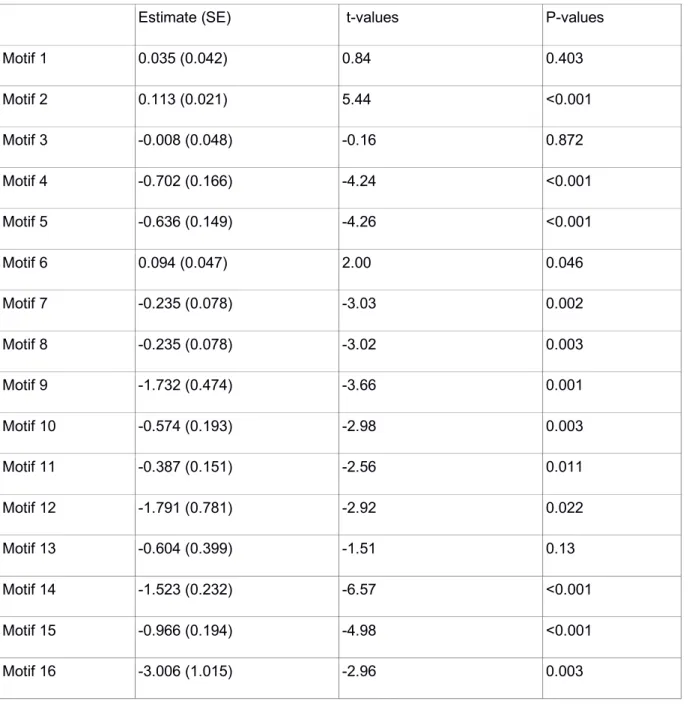
Table S4: Experiment 1 - GLMMs frequency of each network motifs and foraging bouts.
Estimate (SE) t-values P-values
Motif 1 0.035 (0.042) 0.84 0.403 Motif 2 0.113 (0.021) 5.44 <0.001 Motif 3 -0.008 (0.048) -0.16 0.872 Motif 4 -0.702 (0.166) -4.24 <0.001 Motif 5 -0.636 (0.149) -4.26 <0.001 Motif 6 0.094 (0.047) 2.00 0.046 Motif 7 -0.235 (0.078) -3.03 0.002 Motif 8 -0.235 (0.078) -3.02 0.003 Motif 9 -1.732 (0.474) -3.66 0.001 Motif 10 -0.574 (0.193) -2.98 0.003 Motif 11 -0.387 (0.151) -2.56 0.011 Motif 12 -1.791 (0.781) -2.92 0.022 Motif 13 -0.604 (0.399) -1.51 0.13 Motif 14 -1.523 (0.232) -6.57 <0.001 Motif 15 -0.966 (0.194) -4.98 <0.001 Motif 16 -3.006 (1.015) -2.96 0.003
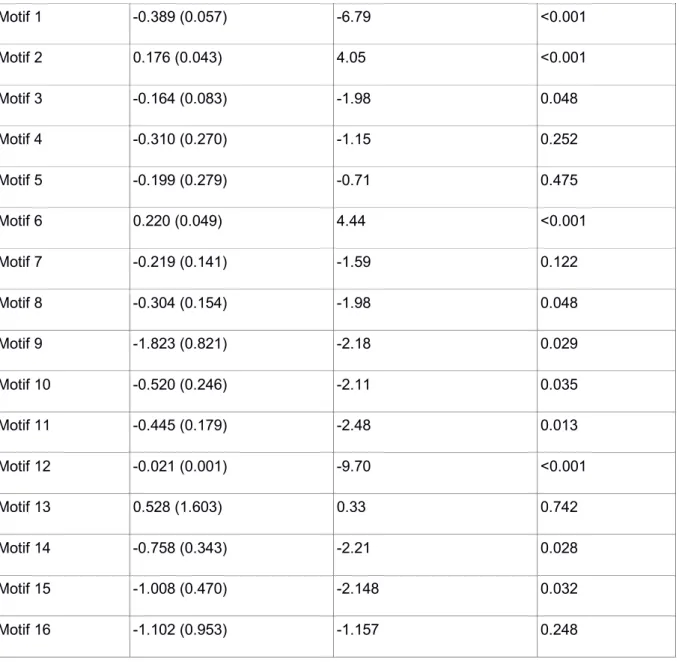
Table S5: Experiment 2 - GLMMs frequency of each network motifs and foraging bouts.
27 Motif 1 -0.389 (0.057) -6.79 <0.001 Motif 2 0.176 (0.043) 4.05 <0.001 Motif 3 -0.164 (0.083) -1.98 0.048 Motif 4 -0.310 (0.270) -1.15 0.252 Motif 5 -0.199 (0.279) -0.71 0.475 Motif 6 0.220 (0.049) 4.44 <0.001 Motif 7 -0.219 (0.141) -1.59 0.122 Motif 8 -0.304 (0.154) -1.98 0.048 Motif 9 -1.823 (0.821) -2.18 0.029 Motif 10 -0.520 (0.246) -2.11 0.035 Motif 11 -0.445 (0.179) -2.48 0.013 Motif 12 -0.021 (0.001) -9.70 <0.001 Motif 13 0.528 (1.603) 0.33 0.742 Motif 14 -0.758 (0.343) -2.21 0.028 Motif 15 -1.008 (0.470) -2.148 0.032 Motif 16 -1.102 (0.953) -1.157 0.248
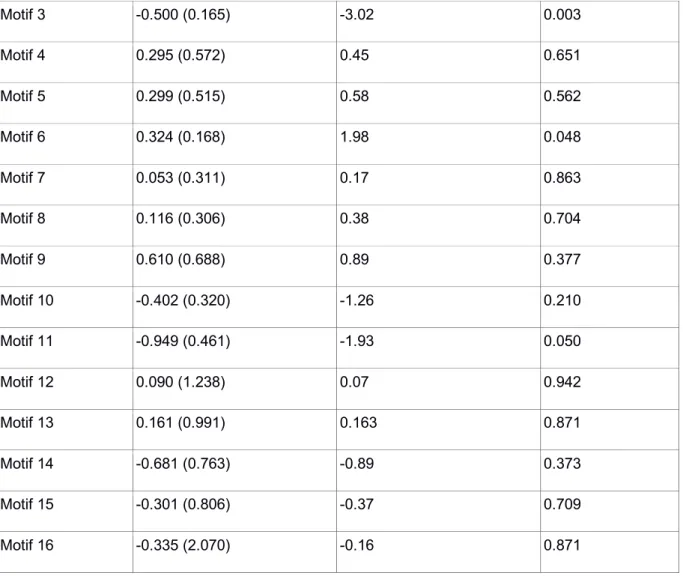
Table S6: Experiment 3 - GLMMs frequency of each network motifs and foraging bouts.
Estimate (SE) t-values P-values
Motif 1 -0.883 (0.057) -15.58 <0.001
28 Motif 3 -0.500 (0.165) -3.02 0.003 Motif 4 0.295 (0.572) 0.45 0.651 Motif 5 0.299 (0.515) 0.58 0.562 Motif 6 0.324 (0.168) 1.98 0.048 Motif 7 0.053 (0.311) 0.17 0.863 Motif 8 0.116 (0.306) 0.38 0.704 Motif 9 0.610 (0.688) 0.89 0.377 Motif 10 -0.402 (0.320) -1.26 0.210 Motif 11 -0.949 (0.461) -1.93 0.050 Motif 12 0.090 (1.238) 0.07 0.942 Motif 13 0.161 (0.991) 0.163 0.871 Motif 14 -0.681 (0.763) -0.89 0.373 Motif 15 -0.301 (0.806) -0.37 0.709 Motif 16 -0.335 (2.070) -0.16 0.871
Table S7: Experiment 4 - GLMMs frequency of each network motifs and foraging bouts.
Estimate (SE) t-values P-values
Motif 1 -0.414 (0.125) -3.31 0.002
Motif 2 -0.007 (0.098) -0.07 0.947
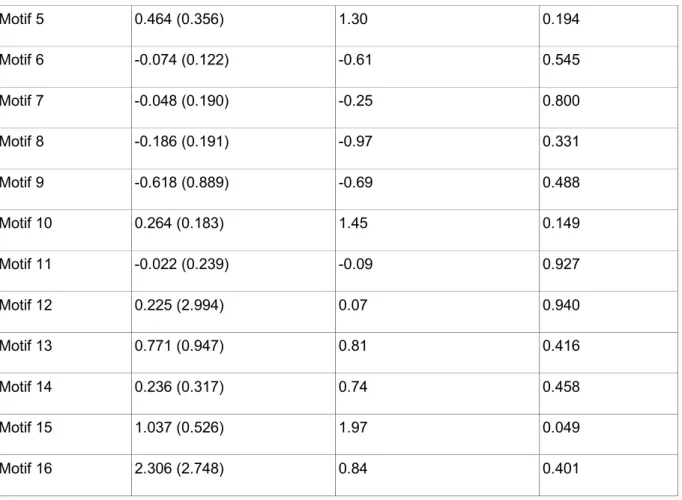
Motif 3 -0.326 (0.144) -2.27 0.024
29 Motif 5 0.464 (0.356) 1.30 0.194 Motif 6 -0.074 (0.122) -0.61 0.545 Motif 7 -0.048 (0.190) -0.25 0.800 Motif 8 -0.186 (0.191) -0.97 0.331 Motif 9 -0.618 (0.889) -0.69 0.488 Motif 10 0.264 (0.183) 1.45 0.149 Motif 11 -0.022 (0.239) -0.09 0.927 Motif 12 0.225 (2.994) 0.07 0.940 Motif 13 0.771 (0.947) 0.81 0.416 Motif 14 0.236 (0.317) 0.74 0.458 Motif 15 1.037 (0.526) 1.97 0.049 Motif 16 2.306 (2.748) 0.84 0.401
Table S8: Experiment 5 - GLMMs frequency of each network motifs and foraging bouts.
Estimate (SE) t-values P-values
Motif 1 -0.539 (0.078) -6.92 <0.001 Motif 2 -0.215 (0.083) -2.59 0.009 Motif 3 -0.114 (0.094) -1.21 0.225 Motif 4 0.277 (0.357) 0.77 0.439 Motif 5 0.045 (0.327) 0.14 0.889 Motif 6 0.112 (0.108) 1.04 0.299
30 Motif 7 0.374 (0.150) 2.49 0.013 Motif 8 0.218 (0.155) 1.39 0.163 Motif 9 0.891 (0.568) 1.57 0.118 Motif 10 0.180 (0.220) 0.82 0.413 Motif 11 -0.024 (0.166) -0.15 0.883 Motif 12 -0.024 (0.166) -0.15 0.883 Motif 13 1.195 (0.620) 1.95 0.051 Motif 14 -0.265 (0.186) -1.42 0.156 Motif 15 0.472 (0.268) 1.76 0.079 Motif 16 0.339 (0.677) 0.50 0.617
31
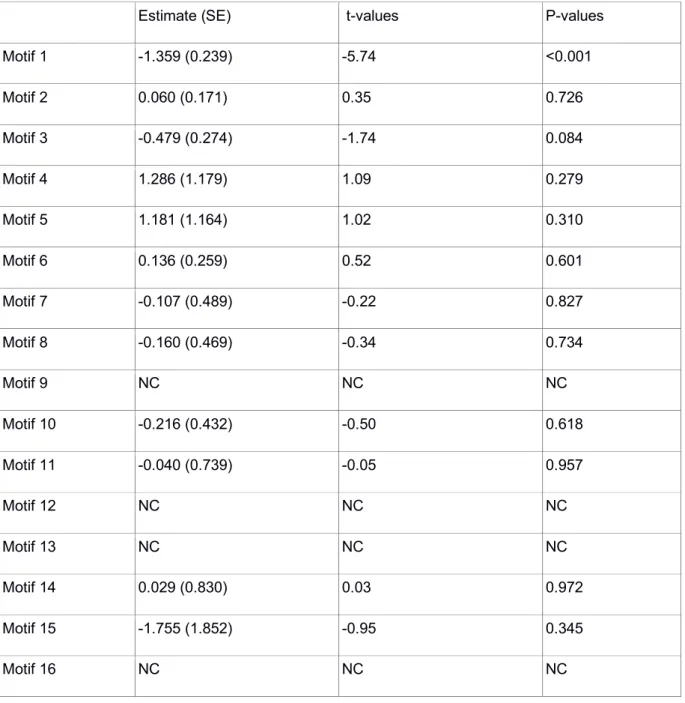
Table S9: Experiment 6 - GLMMs frequency of each network motifs and foraging bouts.
Estimate (SE) t-values P-values
Motif 1 -1.359 (0.239) -5.74 <0.001 Motif 2 0.060 (0.171) 0.35 0.726 Motif 3 -0.479 (0.274) -1.74 0.084 Motif 4 1.286 (1.179) 1.09 0.279 Motif 5 1.181 (1.164) 1.02 0.310 Motif 6 0.136 (0.259) 0.52 0.601 Motif 7 -0.107 (0.489) -0.22 0.827 Motif 8 -0.160 (0.469) -0.34 0.734 Motif 9 NC NC NC Motif 10 -0.216 (0.432) -0.50 0.618 Motif 11 -0.040 (0.739) -0.05 0.957 Motif 12 NC NC NC Motif 13 NC NC NC Motif 14 0.029 (0.830) 0.03 0.972 Motif 15 -1.755 (1.852) -0.95 0.345 Motif 16 NC NC NC