HAL Id: hal-01531169
https://hal.archives-ouvertes.fr/hal-01531169
Submitted on 1 Jun 2017
HAL is a multi-disciplinary open access
archive for the deposit and dissemination of
sci-entific research documents, whether they are
pub-lished or not. The documents may come from
teaching and research institutions in France or
abroad, or from public or private research centers.
L’archive ouverte pluridisciplinaire HAL, est
destinée au dépôt et à la diffusion de documents
scientifiques de niveau recherche, publiés ou non,
émanant des établissements d’enseignement et de
recherche français ou étrangers, des laboratoires
publics ou privés.
Towards a Spatio-Temporal Agent-Based Recommender
System
Amel Ben Othmane, Andrea Tettamanzi, Serena Villata, Nhan Le Thanh
To cite this version:
Amel Ben Othmane, Andrea Tettamanzi, Serena Villata, Nhan Le Thanh. Towards a Spatio-Temporal
Agent-Based Recommender System. 16th Conference on Autonomous Agents and MultiAgent Systems
(AAMAS 2017), ACM, May 2017, São Paulo, Brazil. �hal-01531169�
Towards a Spatio-Temporal Agent-Based
Recommender System
(Extended Abstract)
Amel Ben Othmane
Université Côte d’Azur, ADEME, Inria, CNRS, I3S
[email protected]
Andrea Tettamanzi
Université Côte d’Azur, CNRS, Inria, I3S
[email protected]
Serena Villata
Université Côte d’Azur, CNRS, Inria, I3S
[email protected]
Nhan Le Thanh
Université Côte d’Azur, Inria, CNRS, I3S
[email protected]
ABSTRACT
Agent-based recommender systems have been widely em-ployed in the last years to provide informative suggestions to users, showing the advantage of exploiting components like beliefs, goals and trust in the recommendation computation. However, many real-world recommendation scenarios, like the traffic or the health ones, require to represent and reason about spatial and temporal knowledge, considering also their inner incomplete and vague connotation. This paper tack-les this challenge, and introduces STARS, an agent-based recommender system based on the Belief-Desire-Intention (BDI) architecture. Our approach extends the BDI model with spatial and temporal reasoning to represent and reason about fuzzy beliefs and desires dynamics.
Keywords
Fuzzy spatio-temporal reasoning, RCC, Allen’s intervals
1.
INTRODUCTION
Agent-based recommender systems [9, 4, 5, 6, 7, 2, 12] have been proposed in the last years in different scenarios, e.g., the tourism, health-care and traffic ones, to provide sug-gestions to support users in the achievement of their goals. The advantage of such a kind of recommender systems is that of encoding in the system users’ beliefs and goals to return a recommendation as close as possible to their needs, with the possibility to take in also additional information like the confidence in the source. These application scenarios re-quire in addition to formalize the knowledge about the time and the location in which the action is taking place. This information often needs to be processed at the same time, as in the case of the traffic scenario where a traffic jam is iden-tified by its location and the time it is occurring during the day, and requires to encode a certain degree of vagueness. In this paper, we answer the following research question: how
Appears in: Proceedings of the 16th International Confer-ence on Autonomous Agents and Multiagent Systems (AA-MAS 2017), Das, Durfee, Larson, Winikoff (eds.), May 8– 12, 2017, S˜ao Paulo, Brazil.
This is an author-produced version of the paper.
to represent and reason about fuzzy spatial-temporal know-ledge to provide useful recommendations? To answer this question, we introduce STARS, a Spatio-temporal Cognitive Agent-based Recommender System. Based on the extension principle of fuzzy set theory [18], we define fuzzy Allen’s in-tervals [1] to model temporal knowledge, while fuzzy topo-logical relations are defined in terms of region connection cal-culus [13], where regions are represented as fuzzy sets. These two components, namely spatial and temporal information, are combined together based on the assumption that the degree to which a spatio-temporal belief is true is the min-imum between the confidence degrees of the spatial belief and temporal one, respectively. Spatio-temporal knowledge is then exploited by agents to update their beliefs following the other agents’ recommendations, with the aim to reach their goals. Up to our knowledge, STARS is the first agent-based recommender system taking into account at the some time spatial and temporal knowledge, and the vagueness and incompleteness typical of these components. Related work, e.g., [8], considers either spatial or temporal knowledge, and does not consider the fuzzy connotation of spatio-temporal knowledge, e.g., [16, 3].
2.
SPATIO-TEMPORAL BELIEF
REPRE-SENTATION AND REASONING
This work is an extension of the recommender system based on the BDI model we presented in [12, 11], where a spatio-temporal representation of beliefs and desires is pro-posed. A spatio-temporal belief is an event defined as a spatial relation holding in a temporal interval. A spatio-temporal belief consists then of a sequence of snapshots of an entity taken at specific time points: b1 at t1, b2at t2,...,
bn at tn where t1, t2, ..., tn ∈ T and b1, b2, ..., bnare
spatio-temporal beliefs concerning a moving spatial object (e.g., a car, a moving person, . . .).
2.1
Fuzzy Allen’s intervals
The 12 relations defined by Allen for simple time inter-vals [1] are generalized for modeling fuzzy time relations. Each basic relation can be defined in terms of endpoint re-lations as in [10]. Using the extension principle, a fuzzy temporal relation is defined. For example, the fuzzy
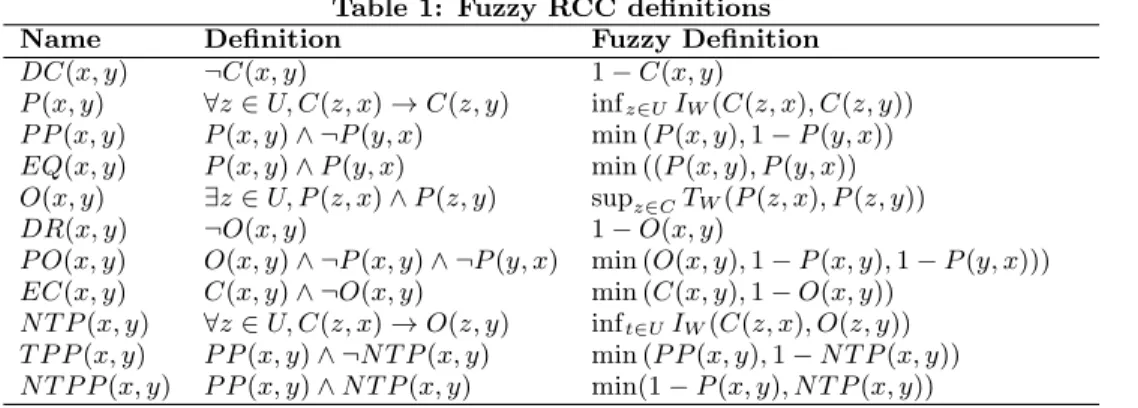
rela-Table 1: Fuzzy RCC definitions Name Definition Fuzzy Definition DC(x, y) ¬C(x, y) 1 − C(x, y)
P (x, y) ∀z ∈ U, C(z, x) → C(z, y) infz∈UIW(C(z, x), C(z, y))
P P (x, y) P (x, y) ∧ ¬P (y, x) min (P (x, y), 1 − P (y, x)) EQ(x, y) P (x, y) ∧ P (y, x) min ((P (x, y), P (y, x)) O(x, y) ∃z ∈ U, P (z, x) ∧ P (z, y) supz∈CTW(P (z, x), P (z, y))
DR(x, y) ¬O(x, y) 1 − O(x, y)
P O(x, y) O(x, y) ∧ ¬P (x, y) ∧ ¬P (y, x) min (O(x, y), 1 − P (x, y), 1 − P (y, x))) EC(x, y) C(x, y) ∧ ¬O(x, y) min (C(x, y), 1 − O(x, y))
N T P (x, y) ∀z ∈ U, C(z, x) → O(z, y) inft∈UIW(C(z, x), O(z, y))
T P P (x, y) P P (x, y) ∧ ¬N T P (x, y) min (P P (x, y), 1 − N T P (x, y)) N T P P (x, y) P P (x, y) ∧ N T P (x, y) min(1 − P (x, y), N T P (x, y))
tion df is introduced for the temporal relation d (during),
and it is defined as follows:
XdfY ⇔ (X−>f Y−) ∧ (X+<f Y+)
The corresponding degree of confidence, using the extension principle, can be expressed as:
µXdfY = min(µX−>
fY−, µX+<fY+)
All the X and Y values can be generalized to fuzzy values and represented by fuzzy triangular numbers. Based on the extension principle, we define first the confidence degrees of the fuzzy relations ≥f and ≤f in order to deduce
respec-tively those of >f, <f and =f. Suppose we have two fuzzy
intervals A and B defined by triangular fuzzy functions as follows: A = (a1, a2, a3) and B = (b1, b2, b3). By applying
the extension principle, we obtain the following fuzzy rela-tions: µA≤fB= 0 if a1> b3 b3−a1 b3−a1+a2−b2 if a1≤ b3, b2< a2 1 if a2≤ b2 (1) µA≥fB= 0 if b1> a3 a3−b1 a3−b1+b2−a2 if b1≤ a3, b2> a2 1 if b2≤ a2 (2)
From Equations 1 and 2, we obtain the confidence degree of relations >f, <f and =f as follows:
A <f B = A ≤f B ∧ ¬(A =f B),
A >f B = A ≥f B ∧ ¬(A =f B),
A =f B = A ≤f B ∧ A ≥f B.
2.2
Fuzzy topological relations
The eight binary topological predicates for simple regions presented in Randell et al. [13] are generalized for modeling fuzzy topological relations. Based on the approach proposed by Schockaert et al. [15] and the definition of the RCC rela-tions in [13], we present an approach for modelling imprecise spatial information when regions are represented as fuzzy sets. Let U be a nonempty set (representing regions) and C be a reflexive and symmetric binary fuzzy relation on it mod-eling connection. Several other topological relations can be defined based on this relation. They include the RCC8 basic relations DC, EC, PO, EQ, TPP, NTPP, and the converses of TPP and NTPP (see Table 1 for their definitions). Note
that we adopt, following [14], the Lukasiewicz t-norm Tw
and its corresponding implicator ITw to generalize standard
logical conjunction and implication. The rationale for this choice for RCC-8 is discussed in [14]. In addition, we chose this logic for its convenience, especially in the implication function. The implicator corresponding to the Lukasiewicz t-norm is defined as: ITW = min(1, 1 − x + y). In fact, the
minimum operator does not introduce any new arbitrary values, which is better suited to a qualitative treatment of uncertainty.
2.3
Fuzzy spatio-temporal belief
representa-tion and reasoning
In order to represent an imprecise spatio-temporal belief or desire such as “An accident occurred around 8 PM be-tween road A and road B” or “I want to be at work before 9 am” we combine the RCC spatial relations with Allen’s tem-poral relations. The degree to which this spatio-temtem-poral belief is true is computed using the minimum between the degrees of confidence of the spatial belief and temporal one, respectively. For representing a spatio-temporal belief, we annotate spatial formulae with temporal information. This means that a spatial formula is true during a time interval or at a specific time point. In other words, it can be written as follows:
X DCI Y , Y P OJ Z
where X and Y represent two different regions or moving objects, and I and J are time intervals. This means that X is disconnected from Y during time interval I. Similarly, Y is part of Z during time interval J .
An empirical evaluation of the proposed model in the traffic domain has been addressed using the NetLogo plat-form [17]. For more details, we refer the reader to http:// modelingcommons.org/browse/one_model/4832#model_tabs_ browse_info.
3.
CONCLUSIONS
In this paper, we have introduced the STARS agent-based recommender system where fuzzy spatio-temporal beliefs are formally represented and updated. Answering the need to represent vague spatio-temporal information to provide rec-ommendations in the traffic scenario, we define spatio-temporal knowledge annotating spatial formulae (formalized through fuzzy region connection calculus) with temporal information (formalized through fuzzy Allen’s time intervals).
Several open challenges have to be tackled as future re-search. For instance, further qualitative relations about di-rections should be introduced concerning spatial reasoning to allow the representation of a more realistic model.
REFERENCES
[1] J. F. Allen. Maintaining knowledge about temporal intervals. Communications of the ACM,
26(11):832–843, 1983.
[2] M. Batet, A. Moreno, D. S´anchez, D. Isern, and A. Valls. Turist@: Agent-based personalised
recommendation of tourist activities. Expert Systems with Applications, 39(8):7319–7329, 2012.
[3] S. Behzadi and A. A. Alesheikh. Introducing a novel model of belief–desire–intention agent for urban land use planning. Engineering Applications of Artificial Intelligence, 26(9):2028–2044, 2013.
[4] L. Cao and C. Zhang. F-trade: an agent-mining symbiont for financial services. In Proceedings of the 6th international joint conference on Autonomous agents and multiagent systems, page 262. ACM, 2007. [5] A. Casali, L. Godo, and C. Sierra. A tourism
recommender agent: from theory to practice. Inteligencia artificial: Revista Iberoamericana de Inteligencia Artificial, 12(40):23–38, 2008. [6] A. Casali, L. Godo, and C. Sierra. Validation and
experimentation of a tourism recommender agent based on a graded bdi model. In CCIA, pages 41–50, 2008.
[7] B. Chen and H. H. Cheng. A review of the applications of agent technology in traffic and transportation systems. Intelligent Transportation Systems, IEEE Transactions on, 11(2):485–497, 2010. [8] B. Jarvis, D. Corbett, and L. C. Jain. Reasoning about
time in a bdi architecture. In International Conference on Knowledge-Based and Intelligent Information and Engineering Systems, pages 851–857. Springer, 2005. [9] B. Lopez, S. Aciar, B. Innocenti, and I. Cuevas. How
multi-agent systems support acute stroke emergency treatment. In IJCAI Workshop on Agents Applied in Health Care, pages 51–59, 2005.
[10] B. Nebel and H.-J. B¨urckert. Reasoning about temporal relations: a maximal tractable subclass of allen’s interval algebra. Journal of the ACM (JACM), 42(1):43–66, 1995.
[11] A. B. Othmane, A. Tettamanzi, S. Villata, M. Buffa, and N. Le Thanh. A multi-context bdi recommender system: From theory to simulation. In 2016
International Conference on Web Intelligence (WI2016), 2016.
[12] A. B. Othmane, A. G. Tettamanzi, S. Villata, M. Buffa, and N. Le Thanh. A multi-context
framework for modeling an agent-based recommender system. In 8th International Conference on Agents and Artificial Intelligence (ICAART2016), 2015. [13] D. A. Randell, Z. Cui, and A. G. Cohn. A spatial logic
based on regions and connection. KR, 92:165–176, 1992.
[14] S. Schockaert, C. Cornelis, M. De Cock, and E. E. Kerre. Fuzzy spatial relations between vague regions. In 2006 3rd International IEEE Conference Intelligent
Systems, pages 221–226. IEEE, 2006.
[15] S. Schockaert, M. De Cock, and E. E. Kerre. Spatial reasoning in a fuzzy region connection calculus. Artificial Intelligence, 173(2):258–298, 2009. [16] M. Schuele and P. Karaenke. Qualitative spatial
reasoning with topological information in bdi agents. In Proceedings of the 2nd Workshop on Artificial Intelligence and Logistics (AILog), Lisbon, Portugal, pages 7–12, 2010.
[17] S. Tisue and U. Wilensky. Netlogo: A simple
environment for modeling complexity. In International conference on complex systems, volume 21, pages 16–21. Boston, MA, 2004.
[18] L. A. Zadeh. The concept of a linguistic variable and its application to approximate reasoning. Information sciences, 8(3):199–249, 1975.