Publisher’s version / Version de l'éditeur:
Journal of Thermal Insulation, 10, pp. 83-90, 1986-10
READ THESE TERMS AND CONDITIONS CAREFULLY BEFORE USING THIS WEBSITE. https://nrc-publications.canada.ca/eng/copyright
Vous avez des questions? Nous pouvons vous aider. Pour communiquer directement avec un auteur, consultez la première page de la revue dans laquelle son article a été publié afin de trouver ses coordonnées. Si vous n’arrivez pas à les repérer, communiquez avec nous à [email protected].
Questions? Contact the NRC Publications Archive team at
[email protected]. If you wish to email the authors directly, please see the first page of the publication for their contact information.
NRC Publications Archive
Archives des publications du CNRC
This publication could be one of several versions: author’s original, accepted manuscript or the publisher’s version. / La version de cette publication peut être l’une des suivantes : la version prépublication de l’auteur, la version acceptée du manuscrit ou la version de l’éditeur.
Access and use of this website and the material on it are subject to the Terms and Conditions set forth at
Building envelope systems with sprayed cellular insulation - A program
for developing evaluation procedures
Bomberg, M. T.; Schwartz, N. V.
https://publications-cnrc.canada.ca/fra/droits
L’accès à ce site Web et l’utilisation de son contenu sont assujettis aux conditions présentées dans le site
LISEZ CES CONDITIONS ATTENTIVEMENT AVANT D’UTILISER CE SITE WEB.
NRC Publications Record / Notice d'Archives des publications de CNRC:
https://nrc-publications.canada.ca/eng/view/object/?id=6f761155-82fe-47ca-aaf8-34a75c524df1 https://publications-cnrc.canada.ca/fra/voir/objet/?id=6f761155-82fe-47ca-aaf8-34a75c524df1S e r -
TH1
N21d
1
National Research Conseil national1528
Council Canada de recherche8 Canadac. 2 Institute for lnstitut de
BLDG Research in recherche en
.- -- -- Construction construction
Building Envelope Systems with
Sprayed Cellular lnsulation
-
A Program for Developing
Evaluation Procedures
by M. Bomberg and N.V. SchwartzReprinted from
Journal of Thermal Insulation Vol. 10, October 1986
p. 83-90
(IRC Paper No. 1528)
Price $4.00 NRCC 28876
- -
&su&
On d h i t ici les 616ments du programme de recherche parrain6 par 1'Institut de recherche en construction du Conseil national de recherches du Canada et la Division polydthane de la Sociitk des indusmes du plastique du Canada Ce programme vise B mkliorer les moyens dont on dispose pour Cvaluer et comparer la valeur en service de divers matkriaux et systkmes d'isolation thermique pour habitations. Afin d'bvaluer la valeur en service d'isolants comrne la fibre de verre, la cellulose et les produits il projeter comrne la mousse de polyun5thane pistolCe, on examinera la performance de l'enveloppe du biitiment en tant que systkme, en plus d'analyser les makriaux et composants. Le programme portera sur :
la performance themique et tnergctique.
le r6le possible de l'isolant en taut que pare-airhapem. I'interaction avec les autres composants du bstiment,
la modification de la perfmmance des ma@%tw avec le temps. -. . - - --
-
. -_-_
----
Building Envelope Systems with Sprayed
Cellular Insulation -A Program for
Developing Evaluation Procedures
M.
BOMBERG
ANDN.
V.
SCHWARTZNational Research Council of Canada Institute for Research in Construction
Montreal Road, Building M 2 4 Ottawa, Ontario, Canada KIA OR6
ABSTRACT
Components of the research program jointly sponsored by the Institute for Re- search in construction, National Research Council of Canada, and the Polyurethane Division, Society of the Plastics Industry of Canada, are described. The program is designed to improve the means of evaluating and comparing the value-in-use of various residential thermal insulation materials and systems. To assess value-in-use of insulations such as glass fibre, cellulose, and spray-applied products of which sprayed polyurethane foam is one, the performance of the building envelope as a system, in addition to analysing the materials and components, will be considered. Elements of the program will include:
thermal and energy performance,
contribution of the insulation to the air and vapour barrier performance of the en- velope system,
interaction with othcr building components, changcs in thc material performance with time.
KEY WORDS
Thermal resistance, thermal conductivity, polyurethane, cellular plastics, foam plastics, thermal insulation, aging, design thermal conductivity.
This paper was presented at T h e Society o f the Plastics Industry, Inc., (SPI) 30th Annual Tech- nicallMarketing Conference. Toronto, Canada, October 15-17, 1986. T h e paper is being pub- lished herein from the conference proceedings after review by the Editorial Board, but without the customary peer review process.
84 M. BOMBERG AND N. V. SCHWARTZ
INTRODUCTION
0
NE OF THE problems being new materials and existing materials in new applications is the difficulty of evaluating their performance under service conditions. New products are often accepted or rejected on the basis of comparison with traditional ones, a mechanism that favours less ex- pensive materials with comparable performance. Under these conditions it is difficult to get market acceptance of a new product which offers better per- formance at a higher price.Polyurethane sprayed-in-place foam insulation is an example of such a product. It has been used in major industrial applications for over twenty years, and has proved to be an effective and efficient insulation for roofs, walls, ceilings, and ventilation ducts in commercial structures. The mechani- cal and physical properties have made sprayed polyurethane foam a preferred insulation for storage tanks, pipes, and even mine shafts. It is used to insulate highway vans and railroad cars where the high cost of space dictates the use of the most efficient insulation. However, it is rarely used in residential wood frame housing since its cost per unit of thermal resistance is high when compared to other residential thermal insulations. Products such as sprayed-in-place polyurethanes can contribute to other aspects of the build- ing envelope's performance which, if properly assessed by using more com- plete techniques of evaluation, may be cost effective. With this in mind, the Society of the Plastics Industry is supporting a fellowship at NRC to study this problem.
The objective of the program is to establish techniques and procedures for assessing and comparing the value-in-use of various types of residential thermal insulation systems. Outputs from this program, in addition to these techniques and procedures, will be the result of such assessments for generic systems incorporating materials in common use or with recognized poten- tial, including sprayed-in-place polyurethane foam. During the course of the study, there will be other spin-off benefits, such as a greater knowledge of the aging characteristics of gas-filled cellular plastics and factors during the application process that will affect long-term performance.
BACKGROUND
The conventional technique for assessing thermal insulation is to deter- mine its thermal conductivity, with consideration of factors that may affect the heat transfer characteristics of the insulation in-service, such as material aging, shrinkage, and settlement. In order to derive the in-service value or value-in-use of thermal insulation materials, their contribution to the overall performance of the building envelope as well as their interaction with, and effect on, other components of the system must be considered. The perfor-
l31rildir1.q E~lvc-k~pc. Systcvns with Sprayed Cellular Insulation 85
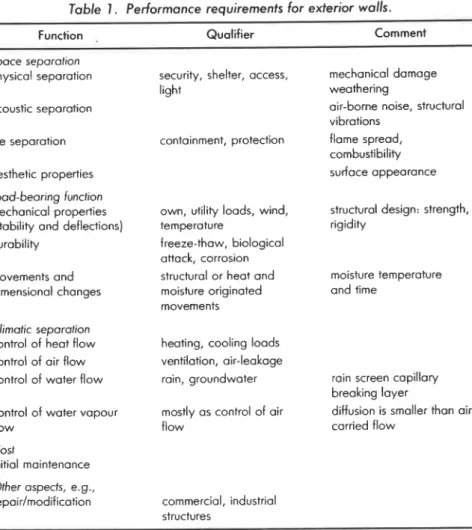
Table I. Performance requirements for exterior walls.
Function . Qualifier Comment
Space separation
physical separation security, shelter, access, mechanical damage
light weathering
acoustic separation air-borne noise, structural
vibrations fire separation containment, protection flame spread,
combustibility
aesthetic properties surface appearance
Load-bearing function
mechanical properties own, utility loads, wind, structural design: strength, (stability and deflections) temperature rigidity
durability freeze-thaw, biological attack, corrosion movements and structural or heat and dimensional changes moisture originated
movements
moisture temperature and time
Climatic separation
control of heat flow heating, cooling loads control of air flow ventilation, air-leakage
control of water flow rain, groundwater rain screen capillary breaking layer
control of water vapour mostly as control of air diffusion is smaller than air
flow flow carried flow
cost
initial maintenance Other aspects, e . g . ,
repair/modification commercial, industrial structures
mance requirements for exterior walls were summarized by Hutcheon [I].
These requirements have been grouped and are shown in Table 1. The key functions for which residential thermal insulation is a contributing element to the overall building envelope performance are discussed below.
Space Separation
O f the four functions identified under Space Separation in Table 1, only acoustic separation and separation in fire (or contribution to fire) need be considered. Thermal insulation is not an important contributor to acoustic separation, although some forms of fibrous insulation do have a small sound absorbing capacity. Acoustic separation, moreover, is not usually a general
I
issue in low-rise residential construction, but is important near airports, ma- i jor roadways, and exterior mechanical equipment. Separation in fire is an
I
I important consideration, and organic insulating materials of a combustible
nature require protection from flame.
1
Load-Bearing Function
I
Thermal insulation does not usually contribute to the load-bearing func- tion of the building envelope. In some cases, however, if a monolithic struc- ture with a sufficient long-term bond of the insulating material to the struc- tural elements could be created, the Ioad-bearing function of the insulation could be considered. In particular, it has been argued by some that sprayed- in-place foam insulation can add to the racking strength of a wall in which it is used, and that the use of this type of insulation could have an impact on the design of walls.
Climatic Separation
I
The primary purpose of thermal insulation is to control heat flow. The control of air flow is usually accomplished by other components, e.g., poly- ethylene sheet, exterior sheathing and interior finish such as drywall, while the control of water vapour flow is usually accomplished by means of a va- pour barrier such as polyethylene sheet. Most water vapour transport in and through the building envelope occurs by means of air flow as pointed out by Latta [2,3], and control of air flow will control most water vapour flow through the building envelope. Although air flow may be the key element in controlling vapour transmission, the wetting and drying capabilities of the materials within the building envelope and the effect that moisture can have on the durability of these materials also need to be considered. Some types
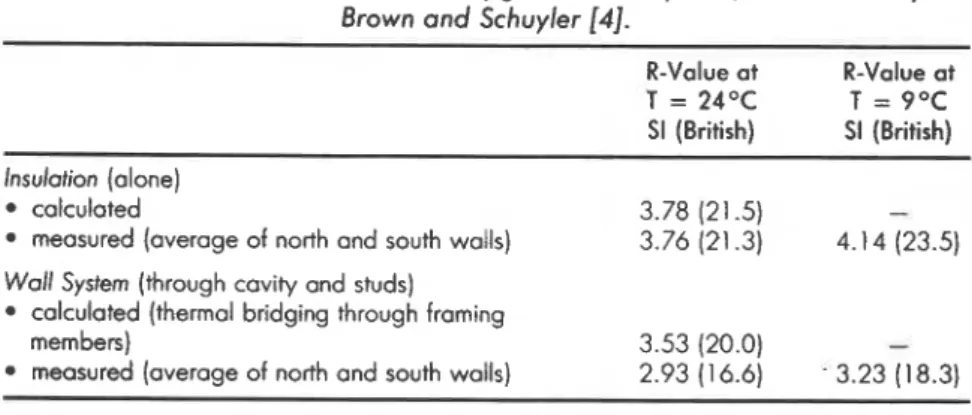
Table 2. Thermal resistance of the upgraded wall system, determined by Brown and Schuyler 141.
R-Value at R-Value at T = 24OC T = 9OC
SI (British) SI (British) Insulation (alone)
calculated 3.78 (2 1.5) -
measured (average of north and south walls) 3.76 (21.3) 4.14 (23.5) Wall System (through cavity and studs)
calculated (thermal bridging through framing
mem ben) 3.53 (20.0)
-
Building Envelope Systems with Sprayed Cellular Insulation
87
of insulation, e.g., sprayed-in-place insulation, may be able to serve all three functions, i.e., heat, air, and water vapour flow.
In the evaluation of the thermal performance of walls, the effect of thermal anomalies (i.e., multidirectional heat flow in the construction caused by ther- mal bridges or forced convective currents within the building envelope) needs to be taken into account in addition to the thermal properties of the insulation material. Table 2 illustrates one case of field measurements that show the effect of thermal bridges [4]. Mean thermal resistance measured in situ was only 78 percent of that measured in the middle of a stud space (across the insulation). While the calculated and measured thermal resis- tances of insulation agreed very well (adjusted for the mean temperature ef- fect), the mean measured thermal resistance of the wall differed significantly from the value calculated from simple models.
Until now, research on air-tightness has been concentrated on evaluation of either the whole building or on the air-retarding materials and compo- nents. Air-tightness, however, also depends on the design of building details, long-term properties of materials of construction, and on quality of work- manship, structural movements, time and conditions of service.
Cost
Fundamental to any design are the costs and the benefits resulting there- from. Some of the newer generation of insulation systems, such as polyure- thane foam, when considered on the basis of thermal resistance alone, are too expensive to compete with such traditional materials as glass fibre batts or cellulose fibre.
By considering the potential contributions of insulation to such other areas as control of air and moisture flow, and to the load-bearing function, a more accurate assessment of the in-service value of the insulation system may be arrived at.
APPROACH
A three-year cooperative NRCISPI program has been developed to find methods for measuring the contribution of various insulations to the build- ing envelope functions described above. The SPI Fellow will be acting as project manager while assisting in addressing matters specific to gas-filled plastics. The program complements activities currently underway at IRC and should lead to the development of generic techniques for assessing value-in-use of insulation systems. The elements to receive first priority in the program are control of heat, air, and moisture flow.
Later, time permitting, the issue of the contribution of sprayed-in-place insulation to racking strength might be considered.
The contribution of insulation to sound absorption by a wall system can
be measured by existing t e c h q u e s which determine a system's perfor-
mance. An evaluation of these techniques will not be part of this program. The behaviour of insulation materials in fire has been studied and is covered by existing codes and standards, and therefore will not be studied under this program.
Control of Heat Flow
A protocol for evaluation of thermal performance will be developed for exterior walls which will include the following considerations:
1. thermal bridging
2. internal convective air flow
3. aging effects (settlement, compaction, shrinkage, conductivity)
Techniques for the evaluation of heat transfer through full-scale building envelope sections that take into account the effects of thermal bridging and internal convective air flow have been developed at IRC. A project to mea- sure heat transfer through wood-frame walls is scheduled to begin in early 1987, and systems containing sprayed-in-place polyurethane foam will be evaluated as a part of this project.
Development of a computer model of long-term field performance of gas- filled cellular plastics is also underway at IRC. This model is required for an understanding of the aging characteristics of these materials and to allow the prediction of their long-term thermal conductivity.
Control of Air Flow
Current techniques for studying air flow through buildng envelopes focus on air leakage of wall sections that are unaged and are at a uniform temperature. Under this program, procedures will be developed to assess air leakage through building envelope systems under a thermal gradient, with consideration of the aging effects on the performance.
A program is currently underway at IRC to measure air flow through building details as affected by design, workmanship, aging and interaction with other building elements in order to evaluate the field performance of a construction detail.
To assess the ability of various types of insulation to act as an air barrier, a method of measuring their air permeability is required. The development of a general method of measuring the air permeability of building materials is a high priority project in thls program. Such a method may also be useful for assessing the extent of cell breakage in cellular plastics during aging.
Building Envelope Systems with Sprayed Cellular Insulation 89 Moisture Performance
Techniques to compare the performance of various wall systems subject to moisture carried by air leaks and by rain will be assessed, and techniques for assessing the effect' of the insulation on the drying of wet studs will be developed.
A method for determining the water vapor transport coefficients for glass fibre insulation has been developed and will be extended to deal with other types of insulation including cellular plastics.
Cost-Benefit Analysis
Knowledge gained from the previous elements will be provided for the assessment of the value-in-service of insulation systems. This assessment will include consideration of the costs where appropriate or feasible. It should be recognized, however, that there will also be non-quantifiable values which also need to be identified in such assessments.
CONCLUDING REMARKS
This three-year program involving input from several projects will lead to techniques for assessing the in-service value of residential insulation. These techniques will help designers and specifiers to ensure fair and equitable as- sessment of new or existing options for insulating the building envelope.
This paper is a contribution from the Institute for Research in Construc- tion, National Research Council of Canada.
REFERENCES
1. Hutcheon, N. B. "Fundamental Considerations in the Design of Exterior Walls for Buildings," National Research Council of Canada, Division of Building Research, NRCC 3057 (1953).
2. Latta, J. K. "Vapour Barriers: What Are They? Are They Effective!" Canadian
Building Digest 175, National Research Council of Canada, Division of Building
I
Research, (1976).3. Latta, J. K. "The Principals and Dilemmas of Designing Durable House Enve- lopes for the North," National Research Council of Canada, Division of Building Research, Building Practice Note 52 (1985).
4. Brown, W. C. and G. D. Schuyler. "In Situ Measurements of Frame Wall Thermal Resistance," A S H R A E Trans., Vol. 88, Part 1, pp. 667-676 (1982).
1
BIOGRAPHIESI
Mark BombergMark Bomberg, Senior Research Officer at the National Research Coun- cil, was born and educated in Warsaw, Poland. He obtained an M.Sc. in civil
90 M. BOMBERG AND N. V. SCHWAFTZ
engineering, and a D.Sc. at the Warsaw Institute of Technology. Between 1967 and 1975, Bomberg worked at the Division of Building Technology, Lund Institute ofTechnology. He then emigrated to Canada, joining the Na- tional Research Council of Canada in Saskatoon and later in Ottawa. He is responsible for the development of test methods for testing thermal insula- tion.
Norman
V.
SchwartzNorman Schwartz received his B.A. and Ph.D. in chemistry from the University of Toronto. In 1960-1961 he was European Research Associates Fellow at Oxford University. Between 1962 and 1985 he was a Research Chemist and then Senior Scientist at Dunlop Research Centre in Missis- sauga, Ontario. He became the SPI Fellow at the Institute for Research in Construction, National Research Council of Canada at Ottawa, in April, 1986.
T h i s paper i s being d i s t r i b u t e d Fn r e p r i n t form by t h e I n s t i t u t e f o r Research i n C o n s t r u c t i o n . A l i s t of b u i l d i n g p r a c t i c e and r e s e a r c h p u b l i c a t i o n s a v a i l a b l e from t h e I n s t i t u t e may be o b t a i n e d by w r i t i n g t o t h e P u b l i c a t i o n s S e c t i o n , I n s t i t u t e f o r R e s e a r c h i n C o n s t r u c t i o n , N a t i o n a l Research C o u n c i l of C a n a d a , O t t a w a , O n t a r i o ,