HAL Id: hal-00141682
https://hal.archives-ouvertes.fr/hal-00141682
Submitted on 13 Apr 2007
HAL is a multi-disciplinary open access
archive for the deposit and dissemination of
sci-entific research documents, whether they are
pub-lished or not. The documents may come from
teaching and research institutions in France or
abroad, or from public or private research centers.
L’archive ouverte pluridisciplinaire HAL, est
destinée au dépôt et à la diffusion de documents
scientifiques de niveau recherche, publiés ou non,
émanant des établissements d’enseignement et de
recherche français ou étrangers, des laboratoires
publics ou privés.
Phase separation and flux quantization in the doped
quantum dimer model on the square and triangular
lattices
Arnaud Ralko, Frédéric Mila, Didier Poilblanc
To cite this version:
Arnaud Ralko, Frédéric Mila, Didier Poilblanc. Phase separation and flux quantization in the doped
quantum dimer model on the square and triangular lattices. Physical Review Letters, American
Physical Society, 2007, 99 (99), pp.127202. �10.1103/PhysRevLett.99.127202�. �hal-00141682�
Phase separation and flux quantization in the doped quantum dimer model on the
square and triangular lattices
Arnaud Ralko,1 Fr´ed´eric Mila,2 and Didier Poilblanc1
1 Laboratoire de Physique Th´eorique, CNRS & Universit´e Paul Sabatier, F-31062 Toulouse, France
2 Institute of Theoretical Physics, Ecole Polytechnique F´ed´erale de Lausanne (EPFL), CH-1015 Lausanne, Switzerland
(Dated: April 5, 2007)
The doped two-dimensional quantum dimer model is investigated by numerical techniques on the square and triangular lattices, with significantly different results. On the square lattice, at small enough doping, there is always a phase separation between an insulating valence-bond solid and a uniform superfluid phase, whereas on the triangular lattice, doping leads directly to a uniform superfluid in a large portion of the RVB phase. Under an applied Aharonov-Bohm flux, the superfluid exhibits quantization in terms of half-flux quanta, consistent with Q = 2e elementary charge quanta in transport properties.
PACS numbers: 75.10.Jm, 05.50.+q, 05.30.-d
Understanding electron pairing in high temperature superconductors is a major challenge in strongly corre-lated systems. In his milestone paper, Anderson pro-posed a simple connection between high temperature su-perconductors and Mott insulators [1]. Electron pairs ”hidden” in the strongly correlated insulating parent state as Valence Bond (VB) singlets lead, once fried to move at finite doping, to a superconducting behavior. A very good candidate of the insulating parent state is the resonating VB state (RVB), a state with only expo-nentially decaying correlations and no lattice symmetry breaking. A simple realization of RVB has been pro-posed by Rokhsar and Kivelson (RK) in the framework of an effective quantum dimer model (QDM) with only local processes and orthogonal dimer coverings [2]. Even though the relevance of these models for the description of SU(2) Heisenberg models is not fully established, this approach is expected to capture the physics of systems that naturally possess singlet ground states (GS). Indeed, specific quantum dimer models have recently been de-rived from a spin-orbital model describing LiNiO2 [3], or
from the trimerized kagome antiferromagnet [4]. In a re-cent work, a family of doped QDMs (at T=0) generalizing the so-called RK point of Ref.[2] has been constructed [5], taking advantage of a mapping to classical dimer models [6] that extends the mapping of the RK model onto a classical model at infinite temperature. This investiga-tion has suggested that phase separainvestiga-tion into two macro-scopic constituents, an undoped phase and a phase with larger doping, could be quite generic in doped QDMs [5]. Despite their ad-hoc construction, the ”quasi-classical” QDMs of Ref.[5] are expected to reflect many features of more realistic models such as the two-dimensional quan-tum hard-core dimer-gas defined by the Hamiltonian:
H = vX c Nc|cihc| − J X (c,c′) |c′ ihc| − t X (c,c′′) |c′′ ihc| (1) where the sum on (c) runs over all configurations of the
Hilbert space, Nc is the number of flippable plaquettes,
the sum on (c′
, c) runs over all configurations |ci and |c′
i that differ by a single plaquette dimer flip, and the sum on (c′′
, c) runs over all configurations |ci and |c′′
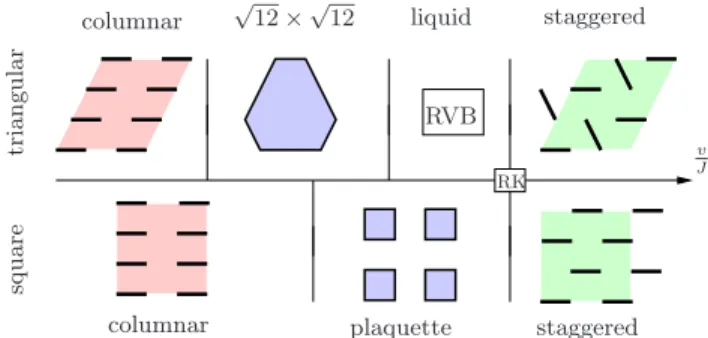
i that dif-fer by a single hole hopping (see Ref. [5] for more details). Troughout the energy scale is set by J = 1. A schematic phase diagram for the two lattices is depicted in Fig.1 in the undoped case. Remarkably, these lattices lead to quite different insulating states. Indeed, an ordered pla-quette phase appears on the square lattice immediately away from the special RK point, whereas a RVB liquid phase is present in the triangular lattice
RVB columnar columnar staggered staggered liquid v J RK sq u a re tr ia n g u la r √ 12 ×√12 plaquette
FIG. 1: (color online) Schematic phase diagrams for the tri-angular and the square lattice.
In this Letter, we investigate in details the properties of model (1) on the square and triangular lattices at finite doping. Building on the differences between the two lat-tices in the undoped case, we investigate to which extent the properties of the doped system are governed by the nature of the insulating parent state. This investigation is based on exact Diagonalisations and extensive Green’s Function Monte-Carlo (GFMC) simulations [7, 8], par-ticularly well adapted for QDM for which all off-diagonal elements are non-positive. [9].
Phase separation: At small t, it is expected that holes experience an effective attractive potential. It is
there-fore natural to first address the issue of phase separation (PS), i.e. the possibility for the system to spontaneously undergo a macroscopic segregation into two phases with different hole concentrations. We analyze the problem as a function of the hopping parameter t and hole concen-tration x = nh/N , where nhis the number of holes in the
system and N the number of sites. In order to perform a Maxwell construction (see for example [10]) we define:
s(x) = e(x) − e(0)
x (2)
where e(x) is the energy per site at doping x. This quan-tity corresponds to the slope of the line passing through e(0) and e(x). If the system exhibits PS, the energy will present a change of curvature implying s(x) to have a minimum at a critical doping xc. The fact that the local
curvature of e(x) at x = 0 is negative then implies that the two seperated phases will have x = xcand x = 0 (the
undoped insulator). In Fig.2, typical results are shown for both square and triangular lattices and for different sizes. Interestingly, PS appears in both cases, but with
0 0.05 0.1 0.15 -0.025 -0.02 3x6x6 3x8x8 3x10x10 0 0.05 0.1 0.15 -0.138 -0.136 -0.134 12x12 14x14 16x16 st (x ) ss (x ) x (a) (b) Triangular v=0.85, t=0.05 Square v=0.90, t=0.10
FIG. 2: (color online) Slope of energy density (Eq.(2)) vs doping for different sizes. (a) Triangular lattice. (b) Square lattice.
noticeable differences. While for the square lattice (lower panel) the critical hole concentration xc is roughly size
independent, there is a strong size dependence for the triangular lattice (upper panel). This size effect can be traced back to the nature of the parent undoped state. On the square lattice, the crystalline phase (for v < 1) at zero doping is very robust and for increasing size, its lo-cal order changes only weakly. On the triangular lattice, it has been shown that size effects play an important role [9], especially in the RVB liquid phase for 0.8 . v ≤ 1. Periodic boundary conditions tend to stabilize the so-called √12 ×√12 phase on small clusters, and clusters with more than 192 sites are necessary to significantly reduce finite-size effects, in particular, as in Fig.2, close
to the transition point with the crystalline phase. Hence the PS observed around x = 0.075 for the 3×6×6 cluster is not representative of the thermodynamic limit.
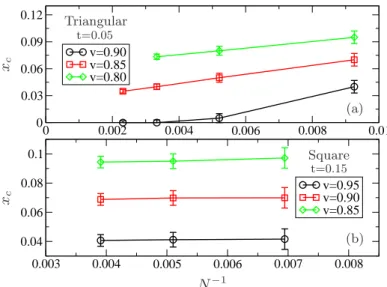
To obtain the phase diagram in the (v, x) plane, we have performed a systematic size-scaling analysis at fixed t and for various v’s depicted in Fig.3. In agreement with
0.003 0.004 0.005 0.006 0.007 0.008 0.04 0.06 0.08 0.1 v=0.95 v=0.90 v=0.85 0 0.002 0.004 0.006 0.008 0.01 0 0.03 0.06 0.09 0.12 v=0.90 v=0.85 v=0.80 xc xc N−1 (a) (b) Triangular t=0.05 Square t=0.15
FIG. 3: (color online) Scaling of the critical doping xc
de-fined by Maxwell construction with the inverse total number of sites. (a) Triangular lattice. (b) Square lattice.
the previous discussion, a significant size dependence is only present for the triangular lattice, in which case PS disappears for large clusters in the RVB phase in the vicinity of the RK point [11]. In Fig.4, we report the thermodynamic limit of xcfor the two lattices as a
func-tion of v, and for different values of t. For the square lattice, calculations have been done from the RK point down to the expected phase transition between the pla-quette phase and the columnar phase, namely v ≃ 0.6 [12]. For the triangular lattice, the range between the RK point down to the RVB-√12 ×√12 transition point at v ≃ 0.8 has been covered [9]. These results clearly demonstrate the difference between the square and tri-angular lattices. In the first case, as soon as v 6= 1, PS occurs for x < xc. Moreover, upon decreasing v,
crys-talline order strengthens and, for fixed t, it is necessary to consider a higher concentration of holes to reach a sta-ble conducting phase. Similarly, the bigger t, the lower xc. On the triangular lattice, a finite size-scaling analysis
shows that no phase separation appears down to a crit-ical value v ∼ 0.9, well above the critcrit-ical value v ∼ 0.8 below which plaquette order sets in. Although numerical limitations prevent computations for smaller v and t, our results up to the 3 × 12 × 12-site cluster provide clear ev-idence for a region of PS inside the RVB region, between v ∼ 0.8 and v ∼ 0.9.
investi-0.6 0.7 0.8 0.9 1 0 0.02 0.04 0.06 0 0.05 0.1 0.15 0.2 t=0.05 t=0.10 t=0.15 t=0.20 x x v Square Triangular
FIG. 4: (color online) Phase separation boundaries for the square and triangular lattices in the thermodynamic limit. The dashed lines correspond to the approximate location of the phase transition between plaquette and columnar phases [12] for the square lattice and between plaquette and RVB phases [9, 13] for the triangular lattice.
gate how dimer order, known to exist at x = 0, evolves under finite doping. Two scenarii are a priori possible: i) the dimer order vanishes in the stable conducting phase immediately at xc; ii) dimer order survives above xc in
a narrow region of the conducting phase. To solve this problem, we have calculated the squared order parameter D2(~k) defined by: D2(~k) = 1 N hΨ0|d(−~k)d(~k)|Ψ0i hΨ0|Ψ0i (3) along the path Γ → M → K → Γ in the first Bril-louin zone of the square lattice, using standard nota-tions, where d(~k) is the Fourier transform of the dimer operator di in the ~ux direction which multiplies a
con-figuration by 1 if there is dimer between site i and its right neighbor, and 0 otherwise. Note that this calcula-tion has not been tried for the triangular lattice since no Bragg peak is present in the RVB phase, and the algo-rithm is losing efficiency for v . 0.8 [11]. In the pure plaquette phase on the square lattice, a Bragg peak de-velops at point ~kM = (π, 0), the middle of the side of the
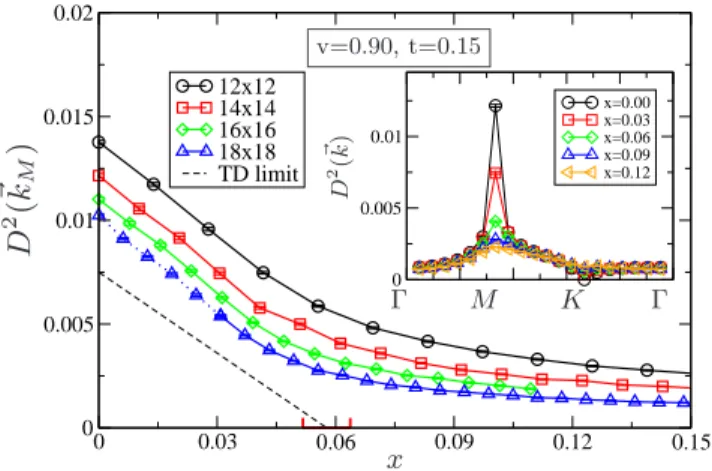
BZ. We show in the inset of Fig.5 a typical result for the squared order parameter on the 196-site cluster for differ-ent values of x. Clearly, the Bragg peak disappears upon doping. A finite size scaling of the order parameter can be performed thanks to the linear behaviour at low con-centration. Within our data, D2(~k = ~k
M) ≡ DM2 (L, x)
behaves like aLx + bL in the linear region. In this
case, one can determine rather precisely x+∞ such that
D2
M(+∞, x+∞) = 0 i.e. x+∞ is the concentration in
the thermodynamic limit where the Bragg peak vanishes. By definition, x+∞= −b+∞/a+∞≃ 0.05(8). This value,
and the linear behaviour in the thermodynamic limit, are
0 0.03 0.06 0.09 0.12 0.15 0 0.005 0.01 0.015 0.02 12x12 14x14 16x16 18x18 TD limit 0 0.005 0.01 x=0.00 x=0.03 x=0.06 x=0.09 x=0.12 D 2(~k ) Γ Γ M K
D
2(~k
M)
x v=0.90, t=0.15FIG. 5: (color online) Squared order parameter at the M point as a function of the hole concentration x and for differ-ent cluster sizes. The thermodynamic limit is depicted as a dashed line, with the corresponding error bar (see main text). Inset: Momentum dependence of the squared order parameter for the 196-site cluster (14x14).
displayed in Fig.5. If we compare x+∞to the
correspond-ing xc from Fig.4, we can conclude that the Bragg peak
indeed vanishes at xc ≃ 0.067(5) within error bars. Note
that numerical errors increase for larger clusters, and we are not able to use the same analysis for clusters larger than 256 sites (the results for the 18 × 18 cluster have not been used). Although the determination of x+∞ is
delicate, the linear behavior of D2vs x is consistent with
the physical behavior expected for the binary system of Fig.4. No dimer order is present above xc, showing that
the system is simply “conducting ”in this case.
Flux quantization: Finally, let us turn to a better char-acterization of the “conducting phase”. In the model de-fined by the Hamiltonian of Eq.(1), the holes are bosonic, and we therefore expect the conducting phase to be a su-perfluid (through Bose condensation)[14]. However, since these bosons move in a dimer environment, pair corre-lations might be present. To investigate this issue, we pierce the torus by an Aharonov-Bohm flux of strength φ = 2πξ with 0 ≤ ξ ≤ 1. The flux is simply implemented by the Peierls substitution, changing the hole hopping term into t′
= exp(±i2πξ/Lx)t, where the ± depends on
whether the hole hops to the right or to the left, and where Lx is the linear size of the system. Obviously,
the whole spectrum should be periodic in ξ with period 1. We show in Fig.6 the spectrum of the 4 × 4 cluster on the square lattice, with 4 holes. It turns out that the spectrum is rigorously periodic with period ξ = 1/2, which means that there is flux quantization in units of half the flux quantum (red curve). This was suggested quite some time ago in the context of a more general QDM by Kivelson[14], who also predicted that, in the cylinder geometry, one can in principle tunnel between
0 0.2 0.4 0.6 0.8 1 -0.55 -0.5 -0.45 q=(0,0)q=(π,0) others -0.48 -0.46 ξ E (ξ ) E (ξ ) (b) (a)
FIG. 6: (color online) Energy spectrum vs (reduced) Aharonov-Bohm flux ξ, for a 4 × 4 cluster with 4 holes at v= 0.70 and t = 1.00. (a) Torus geometry. The momenta of the two low-energy branches are specified and the complete spectrum is displayed up to ξ = 0.2. (b) The two low-energy branches for the case of a cylinder (dashed line) and including a small bond disorder (full red line).
the two branches of Fig.6 by creating finite energy vortex-antivortex excitations that are finally pulled off through the edges of the cylinder, lifting the degeneracy at the level crossing. This lifting of degeneracy is not present in our case, neither in the torus geometry, nor in the cylin-der geometry. However, this is just a consequence of the translational symmetry, which puts the two states that are degenerate at ξ = 1/4 into different symmetry sec-tors. Removing the translational symmetry by changing the amplitude of a local dimer flip indeed removes the degeneracy (upper panel of Fig.6). In that case, the flux quantization in units of half the flux quantum could in-deed be detected in an experiment in which the flux is sweeped. Thus, in our model, the ground-state energy has periodicity hc/2e, suggesting the presence of mobile pairs (or elementary particles of charge Q = 2e) in the system[10]. Note that, unlike what was recently found in a bosonic model with correlated hopping[15], these par-ticles are probably not boson pairs (although a definite proof would require the knowledge of the two particle Greens’s function not accessible with GFMC, boson pairs are unlikely, at least far enough from the phase separa-tion): From the bosonic point of view, it is the statistical flux of the dimer background that leads to the half-flux quantization. If dimers are interpreted as SU(2) electron singlets, these singlets are the physical pairs that lead to half-flux quantization.
Summary and conclusions: The numerical investiga-tion with Green’s funcinvestiga-tion Quantum Monte Carlo and ex-act diagonalizations of the doped two-dimensional quan-tum hard-core dimer model on the square and triangular
lattices has led to a number of interesting conclusions re-garding hole motion in a dimer background. Phase sep-aration is often present at low doping, as suggested by earlier investigations, but our results indicate that it re-lated to the presence of valence bond order: In the RVB phase of the triangular lattice, PS only occurs close to the plaquette phase, where short-range dimer correlations are already strong enough. Close to the RK point, doping the RVB phase leads directly to a conducting (most likely superfluid) phase. To characterize this phase, we have studied the effect of an Aharonov-Bohm flux, with the conclusion that the flux quantization is in units of half a flux quantum, consistent with the idea that the dimer background leads to effective particles of charge 2e. All these results are in qualitative agreement with the gauge theories of high Tc superconductivity in strongly
corre-lated systems [16]. Finally, let us emphasize that, thanks to the large sizes that we could simulate with GFMC, all these conclusions are essentially free of the usual finite-size limitations of the numerical investigation of strongly correlated electron models.
We acknowledge useful discussions with Federico Becca. This work was supported by the Swiss National Fund, by MaNEP, and by the Agence Nationale de la Recherche (France).
[1] P.W. Anderson, Science 235, 1196 (1987).
[2] D.S. Rokhsar and S.A. Kivelson, Phys. Rev. Lett. 61, 2376 (1988).
[3] F. Vernay, A. Ralko, F. Becca and F. Mila, Phys. Rev. B 74, 054402 (2006).
[4] M. E. Zhitomirsky, Phys. Rev. B 71, 214413 (2005). [5] D. Poilblanc, F. Alet, F. Becca, A. Ralko, F. Trousselet
and F. Mila, Phys. Rev. B 74, 014437 (2006).
[6] C. Castelnovo, C. Chamon, C. Mudry and P. Pujol, Ann. Phys. 322, 903 (2007).
[7] N. Trivedi and D.M. Ceperley, Phys. Rev. B 41, 4552 (1990).
[8] M. Calandra and S. Sorella, Phys. Rev. B 57, 11446 (1998).
[9] A. Ralko, M. Ferrero, F. Becca, D. Ivanov, and F. Mila, Phys. Rev. B 71, 224109 (2005). Ibid, Phys. Rev. B 74, 134301 (2006). F. Vernay, A. Ralko, F. Becca, and F. Mila, Phys. Rev. B 74, 054402 (2006).
[10] D. Poilblanc, Phys. Rev. B 52, 9201 (1995).
[11] For small values of t, the GFMC algorithm is no longer ergodic due to hole localization, which introduces a bias in the sampling.
[12] O.F. Syljuasen, Phys. Rev. B 71, 020401(R) (2005). [13] R. Moessner and S. L. Sondhi, Phys. Rev. B 63, 224401
(2001).
[14] S. Kivelson, Phys. Rev. B 39, 259 (1989).
[15] R. Bendjama, B. Kumar, F. Mila, Phys. Rev. Lett. 95, 110406 (2005).
[16] T. Senthil and P.A. Lee, Phys. Rev. B 71, 174515 (2005) and references therein.