A dissertation presented by
Zlatina Kostova
Supervised by
Prof. Dr. Peter J. Schulz
Co-supervisorProf. Dr. Kent Nakamoto
Submitted to the
Faculty of Communication Sciences
Università della Svizzera italiana
for the degree of
Ph.D. in Communication Sciences
Prof. Dr. Irina Todorova, Northeastern University, USA
Officially submitted to the Ph.D. committee of the Faculty of Communication Sciences, Università della Svizzera italiana, in April 2014.
SUMMARY
Chronic pain sufferers with diseases such as Rheumatoid Arthritis (RA) are a catego-ry of patients that feels stigmatized, lacking understanding and support from the sur-rounding social environment (Davison et al., 2000). The invisible and unpredictable character of RA makes it very difficult to be recognized and understood by family, friends, colleagues, and so on, and patients often complain of being treated with scepticism and distrust.
In the last 25 years, the concept of social support and its relation to health has been studied by a burgeoning literature (see, inter alia, Krokavkova et al., 2008; Helgeson, 2003; Lee et al., 2004). There is strong empirical evidence that the support that chro-nic patients receive from their environment is fundamental for the way they cope with physical and psychological suffering. Nevertheless, in the case of RA, providing the right social support is still a challenge and such support proved to be often elusi-ve and unreliable in helping patients to manage the disease (Kostova et al., 2014).
Acceptance is an important component of pain management, being associated with improved quality of life and lower levels of pain and depression. According to McCracken (2005), acceptance is not a single belief but a psychological process, dri-ven by the willingness to experience pain without trying to control and avoid it. Pa-tients able to pursue their life goals and the activities that matter to them, regardless of the pain, have better quality of life and better physical, social and emotional func-tioning (Geiser, 1992; McCracken and Eccleston, 2005; Viane et al., 2003).
There is therefore ample reason to suppose that, in facing and accepting the implica-tions of a disease like RA, patients need access to a satisfying social context on which they can rely for both emotional and practical support (McCracken, 2005; Re-venson, 1993). However, specific evidence on the link between social support and
acceptance, especially in a context like RA where that social support is harder to rea-lize, is as yet missing. There are some quantitative survey studies demonstrating a correlation between social support and acceptance (Affleck, Pfeifer, Tennen, and Fi-field, 1988; Gil et al., 1987; Osborne, Jensen, Ehde, Hanley, and Kraft, 2007). How-ever, these correlations between overall measures obscure the multidimensionality of both concepts, and the quantitative approach cannot trace the casual mechanisms along which the two are linked.
This dissertation is a collection of three papers that aim to overcome the aforemen-tioned challenges, giving both breadth and depth to explanations of the relationship between social support and acceptance among RA patients. With the first paper, we defined a ‘key moments’ model of acceptance, exploring five moments or phases that RA patients experience in order to accept and accommodate the pain in their selves and lives. We identified the diagnosis, the first phase, as a particularly difficult step among RA patients that shapes the whole process of acceptance. The second paper is focused on the concept of social support, comprehending its multifaceted character. We identified the main social support sources from patients’ point of view and the circumstances under which the reactions from these sources may hinder rather then help acceptance. While we were able to link each source of support to particular pha-ses of acceptance, identifying in which key moments the different sources do most to foster acceptance, the results were more holistic than that: the most effective sources can be helpful throughout the process. In the third paper, building on the insights of the first two, we describe and evaluate an online tool designed to be an alternative way of providing social support to chronic pain patients. Identifying both where this tool was and was not effective, we pinpoint the factors – at the level of design and at the level of the individual patients – that moderate the efficiency of online social support.
This dissertation provides theoretical and clinical advances to research on the con-cepts of acceptance and social support and the link between the two. A qualitative
approach allows us not only to consider the richness and variety of patients’ perspec-tives but also to do justice to the multidimensionality of both concepts. The findings of the dissertation have practical implications, providing health professionals with insights into the kind of support needed to help sufferers down the difficult path to-wards acceptance. From a theoretical point of view, the dissertation contributes to the field of health communication in two ways. First, via a grounded theory approach we build on existing understandings of the multi-phasic and complex process of ac-ceptances. Second, we ground the concept of social support in the model of Health Empowerment (Schulz & Nakamoto, 2005), identifying it as a fundamental factor that affects patients’ self-management behaviour.
ACKNOWLEDGEMENTS
I would like to thank to all the people who supported me during the last three years. First of all, I would like to thank to my supervisor Prof. Schulz, who believed in me, who gave me constructive ideas and who found always the way to push me, appreci-ating my progresses.
I would like to give a special thanks to Prof. Irina Todorova, who hosted me at the Department of Health Sciences at the Northeasern University, making my stay in Boston so wonderful that I didn’t want to leave at the end!
I thank and appreciate profoundly the support that I had from the doctors involved in this study, in particular to Dr. Keller, Dr. Badaracco and Dr. Salani, who patiently helped me with the preparation of some of the contents of the Website and who were so great to help me recruiting all the patients. I thank to the Lega Ticinese contro il Reumatismo for their collaboration and to all the other health professionals who were involved in the study.
I would like also to thank the Swiss National Science Foundation for having funded and thus making these studies possible.
A special thanks also to all my colleagues with whom I shared my external and inter-nal space at the Institute and who made my stay there much more pleasant.
I would like to thank to all the patients, who participated in these studies, sharing their stories with me, giving me all the energy to go ahead and who made this project possible and real.
I would like to thank to my family, who unconditionaly has been and still is always with me, wherever I am and whatever I do.
TABLE OF CONTENTS BOARD ... 3 SUMMARY ... 5 ACKNOWLEDGEMENTS ... 8 TABLE OF CONTENTS ... 9 CHAPTER I ... 13 GENERAL INTRODUCTION ... 13 Introduction ... 14 RHEUMATOID ARTHRITIS ... 15
SOCIAL SUPPORT, HEALTH AND ACCEPTANCE ... 16
THE HEALTH EMPOWERMENT MODEL ... 20
THE INTERNET AS AN ALTERNATIVE CHANNEL FOR SOCIAL SUPPORT ... 23
AIMS AND OUTLINE OF THE DISSERTATION ... 24
CHAPTER II ... 29
The process of acceptance among RA patients in Switzerland: a qualitative study ... 29 ABSTRACT ... 30 INTRODUCTION ... 32 METHODS ... 34 Participants ... 34 Recruitment and data collection ... 37 Data analysis ... 37 RESULTS ... 38 Naming the illness ... 39
Realizing the illness ... 42 Resisting the illness ... 43 Hitting the bottom ... 45 Integrating the illness ... 46 Patients’ views of acceptance ... 50 DISCUSSION ... 52 Limitations and practical implications of the study ... 55 CHAPTER III ... 57
The impact of the social support on the acceptance process among RA patients: a qualitative study ... 57 ABSTRACT ... 58 INTRODUCTION ... 59 METHODS ... 63 Participants... 63 Data collection ... 64 Data analysis ... 65 RESULTS ... 66 Family ... 67 Physicians ... 70 The external social context: significant others ... 73 DISCUSSION ... 76 Limitations of the Study and Research Implications ... 82 Practical Implications of the Study ... 83 CHAPTER IV ... 85
Can social support work virtually? Evaluation of Rheumatoid Arthritis patients’ experience with an interactive online tool ... 85
ABSTRACT ... 86
METHODS ... 89 Needs assessment and development of the website Oneself ... 89 Evaluation methods and sample ... 92 Data analysis ... 93 RESULTS ... 94 Evaluation of the study ... 94 Web related characteristics ... 95 Intrapersonal and social dimensions of the illness experience ... 99 Illness dimensions ... 102 Personality type ... 102 DISCUSSION ... 103 Limitations and practical implications of the study ... 107 CHAPTER V ... 110 GENERAL CONCLUSION ... 110 CONCLUSIONS ... 111 A definition of a model of acceptance and its complexity ... 112 The concept of social support and its integration in the acceptance process ... 117 The potential of online social support on patients’ self‐management ... 121 REFERENCES ... 131 APPENDIX ... 149
CHAPTER I
Introduction
“All your life changes: at home, as a mother, at work. It is difficult, because you are suffering from a disease that is not visible, in the sense that when someone meets you they say: you don’t have anything, you look fine! But sometimes it is so difficult even to hold a glass! People outside, even your closest ones – they cannot understand you
(…) I don’t think I will ever accept it [RA], I just learnt how to live with it.” The quotation above, from a Rheumatoid Arthritis (RA) sufferer, clearly illustrates the two main themes in this dissertation: the powerful impact that chronic pain has over patients’ lives; and the difficulty in obtaining the right form of support during the long process of learning to live with the pain and to accept the changes it enforc-es.
The impact of chronic pain diseases is not limited to pain and physical disability. There are many injurious psychological implications, causing significant losses in patients’ lives. Bury (1982) argues that chronic illness is a “biographical disruption”: living with chronic pain interrupts the basic structures of patients’ everyday life, their biography and their self-concept. The imposed limitations of chronic pain impede pa-tients’ autonomy and independence in fulfilling their roles in important life domains, such as work, family and social life. The way that patients face those losses may dif-fer: on the one hand, they may give way to resisting behaviours, becoming victims of unwinnable fights to recover their pre-pain life; on the other hand, they may become able to accept their condition as it is, trying to establish a new way of living and pur-suing their personal goals, regardless of the pain (Hayes, Strosahl, and Wilson, 1999; McCracken, 2006; McCracken, Carson, Eccleston, and Keefe, 2004; McCracken, 1999). This latter approach has been termed ‘acceptance’ and is shown in numerous studies to deliver various positive outcomes.
Acceptance is the core dependent variable for this dissertation. The core independent variable is social support. Previous research indicates that the way in which patients
deal with chronic pain, and the ease with which they accept the new limitations it imposes, is strongly influenced by the support they receive from their environment (McCracken, 2005). In this dissertation, therefore, I focus on the relationship be-tween these two concepts and variables, identifying a model of acceptance and ex-ploring how social support – both in real life and in a purpose-built online environ-ment – shapes the way in which patients learn to manage the disease.
The purpose of this introductory chapter is to set the scene for the detailed studies that follow, outlining the research context and the recurring theoretical themes. After some details about the case of RA, I review research about the relationship between social support and health, paying particular attention to the health empowerment model of Schulz and Nakamoto (2005) which provides a framework for understand-ing how social support has its positive effects. Then, to provide a backdrop to the practical component of the dissertation, I provide an initial assessment of the capaci-ty of online social support to deliver those positive effects.
Rheumatoid Arthritis
Among chronic pain conditions, Rheumatoid Arthritis (RA) is one of the most com-mon with an estimated prevalence of 1% in the world population (Wood and Brad-ley, 1986), although it is four times more frequent among women than among men. Its onset comes during a highly active period of people’s lives, between the ages of 30 and 50 (Hannan, 1996; Gordon and Hastings, 1997). The disease is characterized by progressive joint destruction and persistent, often severe pain. Its etiology is un-known and there is no cure (Gordon and Hastings, 1997). The painful nature of the disease implies serious secondary consequences such as depression, reduction of so-cial activities, job loss, and finanso-cial decline (Verbrugge and Juarez, 2008; Pleis and Lethbridge-Cejku, 2006). The “Arthritis Hurts” survey in the UK reported that peo-ple with arthritis experience greater psychological distress than those with other
chronic diseases – 68% of them reported feeling depressed, fatigued and helpless (Simmons et al., 2002).
RA is an invisible and unpredictable disease: there are no clear visible signs of the symptoms and the acute episodes of pain are variable, appearing and disappearing over time. These characteristics mean that the disease is not readily recognized and grasped by others, and so patients often feel misunderstood by those in their sur-rounding social context, being treated in some cases with scepticism and distrust (Kostova et al, 2014). In that sense, giving adequate social support to RA patients is a difficult task, and often that support proves elusive or unreliable (Werner and Malterud, 2003).
Social support, health and acceptance
The umbrella concept of social support takes in a range of aspects and dimensions. Some studies focus on the size and density of a patient’s social network, others elicit the patient’s subjective perception of social support, and still others explore the indi-vidual characteristics and cultural factors that shape willingness to give and receive social support (Strating et al., 2006; Park et al., 2013). Considering the various con-ceptualizations of social support, Suurmeijer et al. (2005) pointed out that is im-portant to make a distinction between the actual occurrence of social transactions and the satisfaction of those involved with these transactions. Supportive transactions are the objective exchange of resources, but a patient’s satisfaction with these exchanges depends on his or her needs and expectations according to the specific situation. The definition of Thoits (1982) is in line with this idea and emphasizes the importance of an individual’s own perception and evaluation of support. He considers social sup-port in terms of “the degree to which person’s needs are gratified through interac-tions with others”. More or less explicit in that definition is the notion that social support itself may not always be satisfying for patients, and in turn that it is
im-portant to understand sufferers’ specific needs and difficulties with their disease in order to provide them with the appropriate type and amount of support. This is the reason why, in this research project, we first considered patients’ point of view, ex-ploring the main difficulties they faced during the internalization of the disease in their lives and selves. We gave substantial importance to what it means to live with RA from patients’ perspectives and how they perceive the support from the external context, pinpointing what they miss as well as what helps them to face the pain.
Definitional detail aside, there is strong empirical evidence that receiving social sup-port may have both direct and moderating effects on health, increasing patients’ em-powerment and self-management skills, and buffering also the negative impact of low literacy on health (Johnson et al., 2010; Antonucci et al., 2003; Lee et al., 2006; Strating et al., 2006; Courneya et al., 2000). According to the “strain hypothesis”, so-cial support can act as a “direct agent” leading people to know that they are valued and loved, strengthening their self-esteem and, in turn, their health and well-being (Vilhjalmsson, 1993; Thoits, 1995; Eckersley, 2000). The moderating (indirect) ef-fect of social support instead entails buffering the efef-fects of stress on health. In other words, social support could act as a coping strategy that helps people deal with stress and other threats to their psychological well-being.
However, while it is clear that social support can have a powerful effect on out-comes, the existing literature leaves some questions unaddressed. First, while quan-titative studies have established a correlation between measures of social support and acceptance (Affleck, Pfeifer, Tennen, and Fifield, 1988; Gil et al., 1987; Osborne, Jensen, Ehde, Hanley, and Kraft, 2007), these have usually been moderate correla-tions (in the 0.15-0.30 range) that suggest some contingency and conditionality in the relationship between the two. One reason is that summary indices tend to combine the multiple dimensions (in terms of sources and types) of social support. It may be that some of these are more effective than others – or more effective for different
pa-tients in different phases – and this kind of detail may be more easily accessed by in-depth qualitative investigation of particular patients.
Qualitative study can also strengthen the causal inferences possible from correlation-al results. For example, while there has been extensive research focusing on spouscorrelation-al reactions and their effect on patients’ acceptance behavior (Flor et al., 1987; Lous-berg, Schmidt, and Groenman, 1992; McCracken, 2004; Romano et al., 2005; Wil-liamson et al., 1997), other studies indicate that that correlation could be inflated by reverse causality, whereby patients’ pain behavior (e.g. catastrophizing) influences perceived partner responses (Boothby, Thornb, Overduina, and Wardc, 2004; Cano, 2004; Keefe et al., 2003; Williamson et al., 1997). In any case, spouses are just one aspect or source of social support. To date there is no similarly extensive in-depth research considering the multiple aspects of social support, and how this support may impact the process of adaptation and acceptance of the disease over the time. In sum, then, quantitative studies have effectively established that there is a relationship be-tween social support and acceptance; the comparative advantage of qualitative re-search is in its capacity to trace the causal paths along which that relationship oper-ates – and sometimes malfunctions (McCracken, 2005, López-Martínez, Esteve-Zarazaga, and Ramírez-Maestre, 2006).
Meanwhile, turning to the qualitative literature (e.g. Affleck et al., 1988; Helgeson and Cohen, 1996; Strating, van Schuur, and Suurmeijer, 2006; Penninx et al., 1998; Primomo, Yates, and Woods, 1990; White, Richter, and Fry, 1992), this has focused primarily on the effect of social support on outcomes such as adjustment, adaptation, and self-management. There has been much less attention paid to acceptance per se, a significant omission because of acceptance’s role as a mediator: it is the process by which patients achieve those “ultimate” outcomes. Even where acceptance is men-tioned, it is folded into other concepts like accommodation or adjustment, or consid-ered as a trait or state rather than a process. For example, Jefferey et al. (2011) inter-pret acceptance as a set of individual beliefs and perceptions regarding pain. Afrell
et al. (2007) see acceptance as a state that patients enter and exit during their long experience of “living with pain” – they fluctuate between accepting and rejecting the aching body. Their definition of acceptance, as an indicator of how pain influence patients’ self-perception and actions, is useful but they do not trace a path of ac-ceptance from a biographical perspective. Gullacksen and Lidbeck (2004) come closer to recognizing a process, describing past, present and future as three progres-sive moments in the quest to “establish the new course of life”(p.149). Perhaps the most thorough treatment of acceptance in this context is in the study of LaChapelle et al (2008), which considers social support as a facilitator of acceptance. We build on their research by exploring the dimensionality – again, in terms of sources and types – of social support and the diverse effects of these dimensions in shaping the ac-ceptance process.
In summary, the existing literature allows us to pinpoint some crucial themes that are common during patients’ experiences of coming to terms with the pain. Nevertheless, less attention has been given on how patients actually achieve acceptance and on how social support – in all its complexity – can affect this process, positively but sometimes not so positively. In this dissertation, then, we use qualitative interviews to investigate the concept of social support and its impact on acceptance behaviour from the sufferers’ point of view, considering the multidimensionality of both con-cepts. We identify the main difficulties that patients face in accepting the disease and the main sources and types of support that play a crucial role in patients’ adjustment to the pain. These findings guided an attempt to operationalize social support in prac-tice. We created a website that meets and responds to patients’ needs as identified in the qualitative interviews, assessing to what extent online support can offer an alter-native source of social support and identifying the factors and circumstances that de-termine the efficacy of such an approach.
The Health Empowerment Model
The theoretical framework on which I based my dissertation is the model of Health Empowerment developed by Schulz and Nakamoto (2005). It considers social sup-port as a fundamental factor that can impact on psychological empowerment and health literacy – crucial elements for the way in which patients with chronic illness manage their disease (Figure 1). According to the model, the information and the support that chronic patients receive from their social sources (such as friends, rela-tives, mass media and physicians) will determine their knowledge about how to deal with the disease, making them more autonomous and responsible in managing the illness. Of course, the type of support that chronic pain patients receive can also have a deleterious impact, contributing to destructive and inefficient behaviors (Schulz and Nakamoto, 2013). Thus, in my dissertation I grounded the concept of social sup-port in the model of health empowerment, with a particular focus on its psychologi-cal component. The aim is to assess the impact of the support received by chronic patients from their significant others on the process of acceptance of the pain.
F A p r t e n N d f e l Psy Em Figure 1: He As we can pects – the ronment on tion, as disc er, since so nent, it is w Nakamoto’s derstand he formation in ease. The au literacy: dec ychological mpowerment o Relevan o Compet o Self‐det o Impact ealth Empo clearly see information the way pa cussed in m cial suppor worth briefly s model (20 alth inform n order to m uthors expa clarative kn component: nce tence termination Effects o Co be o Qu o Ph he werment M the model nal (literacy atients deal more detail b rt also has t y elaboratin 005). Impo mation; it re make decisi anded the c nowledge (t onstructive & ehaviours uality of life hysical and ps ealth status
Model and its
of health e y) and the l with the d below, is on the capacity ng on the c ortantly, this fers more t ions accord concept, dis the factual Literacy c Health Lit o D k o P k o J & destructive sychological s effects (Sc empowerme psychologic disease. The n the psycho y to improv concept of h s goes beyo to the abilit ding to the stinguishing knowledge component: teracy Declarative knowledge Procedural knowledge udgmental sk chulz&Nak ent emphasi cal effect o e main focu ological com ve the infor health litera ond simply ty to critica specific situ g three com that peopl kills kamoto, 200 izes two ma of the socia us of this di mponent. H rmational c acy in Schu the ability ally judge t tuation of th mponents of le can acqu 5) ain as-l envi- isserta- Howev- compo-ulz and to un-hat in-he dis-health uire via Social support
different information sources); procedural knowledge (the “knowing how” that guides the proper course of action); and judgmental skills (the ability to critically judge the health information in relation to one's own condition).
Turning to the concept of psychological empowerment, this entails the individual taking increased responsibility for, and playing a more active role in, decision mak-ing regardmak-ing his or her health. Spreitzer (1995), in her measure of empowerment, identifies four main constructs: (1) meaningfulness – “I feel that doing this is rele-vant for me”; (2) self-efficacy – “I am able to do this”; (3) self-determination – “I can choose between different ways”; and (4) impact – “I can make the difference”. These four propositions reflect patients’ motivation and willingness to be autono-mous and responsible actors for their own health. According to the model, together the four powerfully influence the way that patients face the disease on an everyday basis.
Acceptance centres on patients’ willingness to pursue their own goals and values re-gardless of the pain, and the concept of empowerment is also related on the perceived ability to be able to deal with and manage the disease. We can thus see some simi-larity in the two concepts, as they are both related on volitional components regard-ing the one’s ability to cope with the pain. Acceptance could be seen as one dimen-sion of empowerment, or perhaps as one means by which it is achieved. The precise causal relations between them are hard to establish but this need not trouble us here. For present purposes, the key point is that acceptance belongs squarely within the psychological component of the health empowerment model. One important way in which social support can shape that psychological component is by helping sufferers to accept the disease and its implications.
The Internet as an alternative channel for social support
As mentioned above, the nature of RA means that social support often proves to be unreliable and elusive, patients often feeling that others do not sufficiently under-stand their suffering (Werner and Malterud, 2003). RA patients feel stigmatized and accused of using their illness as an alibi to avoid responsibilities, due to the lack of visible external signs of pain. Often even family members and close friends fail to recognize patients’ internal suffering (Holloway et al., 2007; Eccleston et al., 1997).
The importance of social support for RA patients’ health outcomes, coupled with the fact that patients often feel a deficiency in that regard, has moved health policymak-ers to seek ways in which such support can be boosted. However, the most intensive forms of social support are hard to provide for reasons of cost. Attention has there-fore more recently turned to using interactive Internet tools as a source of support. There is a burgeoning literature that praises the internet as a tool of support for pa-tients with chronic conditions (Fox, 2009; Kirsch & Lewis, 2004; Payne & Kiel, 2005; Wantland, Portillo, Holzemer, Slaughter, & McGhee, 2004). Support groups have formed on the web, thereby overcoming some of the barriers to face-to-face in-teraction, such as geographical and time distances, costs and anonymity. It has been shown that patient online support groups may improve psychological, social and health outcomes providing a virtual network and health information (Eysenbach, 2004; 2006; Murray, Burns, See, Lai, & Nazareth, 2005; van Uden-Kraan, Drossaert, Taal, Seydel, & van de Laar, 2009; van Uden-Kraan, et al., 2008; Winkelman & Chun Wei, 2003). Participating online empowers patients, and therefore van Uden-Kraan, et al. (2008) in their study with patients with arthritis, fibromyalgia and can-cer found improvements in a variety of outcomes, including being better informed, feeling more confident and self-esteemed and accepting the disease. Interacting online has a positive impact on the adjustment to the illness, helping sufferers to re-frame their own illness, to develop argumentative abilities and to improve self-confidence (Ziebland and Wyke, 2012; Brashers et al., 2002; Hesse, 2005;
Caiata-Zufferey and Schulz, 2010). In sum, online support has the potential to act on both the informational and the psychological components of the model set out in Figure 1.
Given this evidence that the Internet offers a potential tool of support, and having identified patients’ specific needs, we developed an interactive online tool. This took the form of a website called Oneself. Reflecting the two major components of Schulz and Nakamoto’s (2005) model, this tool provided patients with both informa-tional support and the opportunity to be part of a virtual community sharing their problems and concerns with experts and other patients online. We used the insights that we gained from our studies on acceptance and social support to create tailored informational materials about the management of the disease, incorporating infor-mation about managing both the psychological and physical consequences of RA. The availability of health professionals online and the interactive features of the site (chat room, forum) were intended to operationalize of the emotional and practical support these patients needed.
Aims and outline of the dissertation
The main objective of this dissertation is to deepen our understanding of the relation-ship between social support and the way in which RA patients accept their illness and manage the limitations that it imposes upon them. This in itself can generate in-sights for both academic researchers and medical professionals. However, we also aim to provide specific guidance for practitioners about whether and how social sup-port and interaction can be delivered online to RA patients in a way that boosts health outcomes. To these ends, we conducted two qualitative studies and one exper-imental study exploring:
The main stages through which RA patients pass and the strategies they adopt to learn to live with the pain; and the factors shaping patients’ capacities to achieve acceptance.
The key sources and types of social support that are relevant for rheumatoid arthritis patients; and when and how those sources are important across the different phases of the acceptance process.
Whether and how social support can be operationalized online, highlighting the design factors that boost the efficacy of such support and the patients’ characteristics that shape their engagement with online tools.
This list also summarises the structure of the dissertation. It consists of three papers that are the outcome of research conducted at the Institute of Communication and Health at the Università della Svizzera italiana, Lugano (Switzerland), between 2011 and 2014.
The first paper is therefore focused on the way in which RA patients achieve ac-ceptance, exploring the main stages and key moments that shape this process. Ac-ceptance is a process whereby patients begin to make choices that maximize their quality of life, being engaged in pursuing their life goals regardless of the pain (McCracken et al., 2004). Those patients who accept the chronicity of their condition without fighting against it are more willing to find alternative ways to manage the pain and to maintain the activities that matter to them. It has been shown that ac-ceptance is an important component of pain management, being associated with im-proved quality of life and lower levels of pain and depression (McCracken & Vowles, 2006).
The paper is based on a qualitative study of in-depth interviews with 19 patients suf-fering from RA in the Italian speaking part of Switzerland. From patients’ accounts we developed a model of acceptance, identifying five main stages – which we term
key moments – in sufferers’ struggles to come to terms with the disease and to ac-commodate the limitations: naming the illness; realizing the illness; resisting the ill-ness; hitting the bottom; and integrating the illness. We identified some factors that have a particular impact over acceptance, in particular the difficulties in obtaining a prompt diagnosis that not only delayed the initiation of the acceptance process but created psychological barriers that impeded it throughout. We identified some struc-tural reasons for late diagnosis, notably patients’ and doctors’ neglect of the initial symptoms together with the clinical difficulties in diagnosing RA. Moreover, we ex-plored patients’ views of acceptance and of the illness and how these representations shape patients’ capacity to cope with the disease.
The second paper builds on the first and is based on the same set of qualitative inter-views. It is focused on the relationship between social support and the process of ac-ceptance. More specifically, we identify the key sources and types of social support that are important for RA patients in the way they face and come to terms with the disease, considering acceptance as a multistage process. The type of responses that chronic pain patients receive from their social environment (such as the family) may impact the way they face the everyday challenges of the disease (McCracken, 2005; Revenson, 1993). The surrounding environment plays a crucial role for sufferers’ willingness to hold on to their life roles and to accommodate the imposed changes. In this paper, we identified three main sources of support – family, doctors and signifi-cant others – and explored their impacts on the various key moments of the ac-ceptance process, noting also the circumstances under which those sources serve to hinder rather than to help acceptance. In particular we observed that there is a perva-sive risk either of underestimating patients’ suffering or of over-supporting, both of which prevent patients accepting the disease and developing a new ‘normal’ life. We sum these extremes up as skepticism and solicitousness and conclude that sources of social support need to find a middle way between these two extremes. Our findings about the limitations and conditionality of social support effects are useful in guiding
medical professionals – and those that they inform and advise – about how best to understand and to meet sufferers’ needs.
The third paper is based on an intervention in the form of an alternative on-line source of support, the aforementioned website Oneself. Using the insights gained from the previous two studies about patients’ support needs and their difficulties in accepting the disease, we answered those needs creating a website on which we pro-vided tailored support. The site comprised both informational components – educa-tional material based on what patients need to know in order to manage their disease on a daily basis –and a social support component with interactive features (chat room and forum) on which patients could receive emotional and practical support from ex-perts and from fellow RA sufferers.
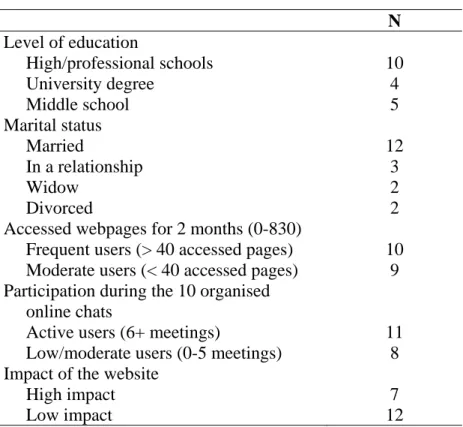
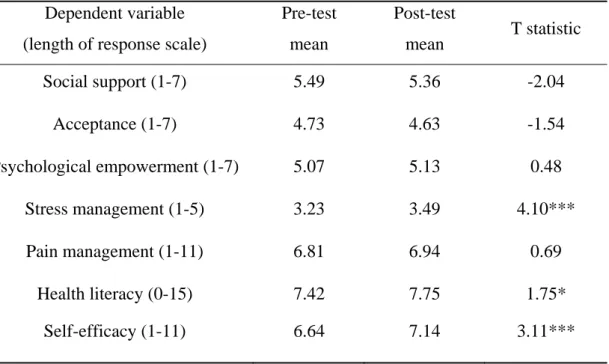
The paper is an evaluation of the Oneself tool. The aim is to understand how social support can be provided online and under which conditions such support can deliver positive outcomes for RA patients. The paper’s empirical starting-point is the in-sights gained from an experimental study that we first conducted with 154 RA pa-tients in order to evaluate the impact of the website on different papa-tients’ outcomes. This showed that Oneself generated improvements in health outcomes related to the daily and practical management of the disease (such as pain management and levels of health literacy) but was often unable to shift the deeper ‘mind-set’ variables, like acceptance, which are the main focus of the dissertation. In the third paper, then, particular attention is paid to the mixed results and the reasons for them. We con-ducted a follow-up qualitative study to clarify which are the factors that shape tients’ engagement and interaction online. In 20 semi-structured interviews with pa-tients who participated to at least some extent in the online interactions, we asked about their experiences, impressions and perceptions of this participation, and about what made them more or less engaged in sharing their problems online.
The dissertation ends with a general conclusion that discusses the main contributions of the studies on social support and acceptance, some of the limitations of the
indi-vidual papers, and the generalizability of the findings to other chronic conditions and to other contexts.
CHAPTER II
The process of acceptance among RA patients in Switzerland: a
qualitative study
Zlatina Kostova, Maria Caiata-Zufferey, Peter J. Schulz
Manuscript published:
Kostova, Z., Caiata-Zufferey, M., & Schulz, P. J. (2014). The process of acceptance among RA patients in Switzerland: a qualitative study. Pain Research and Management, 19, 61-68.
Abstract
Rheumatoid Arthritis is a chronic, painful disease with many injurious psychological effects. Acceptance is an important component of pain management, being associated with improved quality of life and lower levels of pain and depression. While studies have begun to identify the stages of acceptance, little is known about factors influencing the ease and speed with which patients pass those stages.
The goal of the study is to explore the main stages through which RA patients pass and the strategies they adopt to learn to live with the pain, identifying factors shaping patients’ capacities to achieve acceptance.
We conducted a qualitative study involving 20 semi-structured interviews with RA patients in the Italian-speaking part of Switzerland. Analysis of the data followed the precepts of grounded theory.
While finding that acceptance is anything but a smooth or linear process, we were nonetheless able to identify five main stages in patients’ struggles to accommodate the newly-imposed limitations: naming the illness; realizing the illness; resisting the illness; hitting the bottom; and integrating the illness. Diagnosis proves an especially tortuous stage in the case of RA, and the effects of delayed diagnosis continue to be felt during the subsequent stages. We also explored patients’ understanding of the notion of acceptance, and the strategies that they used to achieve it.
Diagnosis of RA is notoriously difficult. Beyond the clinical difficulties, we identified structural reasons for late diagnosis, symptoms being neglected by patients and medical professionals. Delayed diagnosis hindered the acceptance process throughout, leading to more resistant behaviour and to a struggle to achieve the right formula for acceptance – accepting the losses of pre-pain life while still pursuing personal goals.
Keywords: Rheumatoid Arthritis, acceptance process, diagnosis, integration strategies, patients’ view of acceptance
Introduction
Rheumatoid Arthritis (RA) is a chronic, disabling disease characterized by progressive joint destruction and persistent pain. RA affects people during the most active period of their lives (30-50 years), and its unpredictable and painful course often involves serious secondary consequences such as depression, reduction of social activities, job loss, and financial decline (Verbrugge, 2008; Pleis and Lethbridge-Ceijku, 2000). In particular, RA is prone to have a powerful psychological impact, evoking a variety of negative thoughts and emotions. The different ways in which patients respond to these feelings give rise to different behavior patterns(McCracken, 1999). Patients unwilling to accept the pain are prone to resistance behaviors that reduce their quality of life (McCracken et al., 2004; Hayes, 1999; McCracken and Vowles, 2006). On the other hand, patients can focus on finding a way to live with the pain that allows them to pursue the values and maintain the activities that matter to them. This distinction, and the acceptance required to achieve the latter outcome, are at the heart of this article. In addition to building on previous studies that have begun to elaborate on the process of achieving acceptance, in this article we highlight the key role played by diagnosis – itself a particular problem in the context of RA – in helping or hindering patients during that process.
In the qualitative study of LaChapelle et al(2008) among women with fibromyalgia and arthritis, acceptance was defined as “an overall attitude toward the pain experience involving acknowledgement of the chronicity of the condition and a willingness to engage in valued activities despite pain” (p. 14; see also McCracken). We can thus consider acceptance as a process whereby patients begin to make choices that maximize their quality of life. It has been shown that acceptance is not a single decision, event or belief but a process with distinct stages, each involving different realizations (LaChapelle et al, 2008). Dissecting those stages is key to
understanding how patients succeed in dealing with the implications of a disease like RA.
Acceptance is typically seen as one of a broader cluster of concepts like adjustment (McCracken, 1998; Li and Moore, 1998; Shaul), adaptation to or negotiation with chronic pain (Gullacksen and Lidbeck, 2004; Sofaer et al., 2005; Schaefer, 1995; Jeffery et al., 2011; Harding et al., 2005). From this extensive literature, we can pinpoint some common and recurring themes or stages: becoming aware of the problem and having a diagnosis; acknowledging the chronicity of the pain and the resulting losses; and establishing a new way of living. Several studies show that acceptance plays a positive role in patients’ physical, social and emotional functioning(McCracken, 1998; Geiser, 1992; McCracken et al., 2005; McCracken et al., 2005, McCracken and Eccleston, 2006; Viane et al., 2003). Those who come to terms with pain report more positive clinical outcomes, greater confidence in their coping ability, higher daily uptime, and less depression and less pain (Jacob et al., 1993; McCracken and Eccleston, 2003).
These studies highlight key themes and demonstrate the importance of acceptance for health outcomes. Yet they say more about the nature and consequences of acceptance than about how patients actually achieve it. There remains only limited information about the strategies that patients adopt to accommodate diseases, to face the changes imposed by the illness, and thus to find a way to live with it. We also know little about how patients understand and react to the notion of acceptance itself. Third, and critical in the context of RA where correct and swift diagnosis is notoriously difficult (Majithia e Geraci, 2007), there is little research into the role of diagnosis not only in giving patients awareness of their condition but influencing the ease with which they pass through the entire acceptance process. A fourth reason for further research is the well-established point that sociocultural context shapes the way in which patients comprehend and adapt to illness (Green and Thorogood, 2004; Strauss and Corbin, 2004). Since the existing literature comprises only Anglo-Saxon studies, it is useful to broaden the evidence base. Switzerland, a smaller country in continental Europe,
also allows us to assess whether and how a system of private health provision shapes the way doctors and patients deal with the disease. It is also a country in which RA is a serious problem, affecting about 1% of the adult Swiss population (www.rheuma-schweiz.ch). More generally, approximately 1.5m people in Switzerland suffer from some type of rheumatic disease and 300,000 suffer from a severe chronic form of arthritis, needing constant care. RA has generated spiraling costs for the Swiss health care system and one in four disability pensions are paid for a rheumatic pathology. In this study, then, we expand the field of RA-acceptance research to a new setting, addressing in that three core questions: (1) What are the main phases patients pass through in learning how to live with their disease? (2) What is the specific importance of the diagnosis of RA in shaping patients’ capacity for acceptance? (3) Which strategies do patients adopt to accommodate the disease in their selves and lives?
Methods Participants
We conducted a qualitative study based on 20 semi-structured interviews with RA patients (Table 1). Approval was obtained from the Ethical Committee of Canton Ticino (the Italian-speaking part of Switzerland) and informed consent was obtained from each participant prior to interview. During the transcription process, personal data were removed and fictitious names were attributed. The interviews were conducted in the Italian-speaking part of Switzerland by one of the authors (ZK). Aside from the Swiss patients, there were five Italians and one Dutch participant. Our substantive selection criteria were: i) having had an RA diagnosis for at least three years (allowing enough time for patients to undergo a process of acceptance); ii) age over 35 (for the same reason, given that RA may hit as early as age 30; and iii) the absence of any other chronic diseases. In order to maximise the variability of respondents’ experience, we selected patients of different sex, age, level of
education, and socioeconomic status. Our sample was composed of 13 women and 7 men (the disease has a four times higher prevalence among women than among men), with ages ranging from 35 to 69.
The medical definition of an early diagnosis of RA is within six months29. By that yardstick, only seven of our patients discovered the illness in time; most of the rest waited years before obtaining the correct diagnosis. The average waiting time before the diagnosis was around two years (ranging from 3 months to 10 years) and the average length of time since diagnosis was nine years (ranging from 3 to 14 years).
TABLE 1. CHARACTERISTICS OF THE PARTICIPANTS DIAG NOSIS S E X A G E NATION ALITY TIME OF DIAGN OSIS TIME BETWEEN FIRST SYMPTOMS AND DIAGNOSIS FAMILY STATUS EDUCATION RA F 35 DUTCH 7 YEARS
5 MONTHS SINGLE HIGH
-SCHOOL M 37 SWISS 3 YEARS 6 MONTHS IN A RELATIONSHIP UNIVERSITY DEGREE F 49 ITALIAN 5 YEARS
2 YEARS MARRIED MIDDLE
SCHOOL
M 49 SWISS 11
YEARS
2 YEARS MARRIED HIGH
-SCHOOL
M 50 SWISS 10
YEARS
1,5 YEAR MARRIED UNIVERSITY DEGREE
F 52 ITALIAN 14
YEARS
2 MONTHS MARRIED HIGH
-SCHOOL
M 52 ITALIAN 8
YEARS
3 YEARS MARRIED MIDDLE
SCHOOL
F 54 SWISS 13
YEARS
5 YEARS MARRIED MIDDLE
SCHOOL
F 55 SWISS 6
YEARS
2 YEARS MARRIED HIGH
SCHOOL
F 58 SWISS 10
YEARS
10 YEARS WIDOW UNIVERSITY DEGREE
F 67 SWISS 14
YEARS
4 YEARS MARRIED HIGH
SCHOOL
F 69 SWISS 8
YEARS
6 MONTHS MARRIED HIGH
SCHOOL
F 69 SWISS 9
YEARS
2 YEARS WIDOW MIDDLE
SCHOOL
M 38 SWISS 3
YEARS
3 MONTHS SINGLE UNIVERSITY DEGREE
M 42 SWISS 4
YEARS
1.5 YEAR MARRIED HIGH SCHOOL
M 53 ITALIAN 5
YEARS
6 MONTHS MARRIED MIDDLE SCHOOL
F 41 SWISS 3
YEARS
2 YEARS MARRIED UNIVERSITY DEGREE
F 40 SWISS 4
YEARS
3 MONTHS MARRIED UNIVERSITY DEGREE
F 58 SWISS 8
YEARS
1,5 YEAR MARRIED HIGH SCHOOL
F 61 ITALIAN 9
YEARS
1,5 YEAR MARRIED HIGH SCHOOL
Recruitment and data collection
Recruitment was in collaboration with the Swiss Association of Rheumatology. Three rheumatologists were asked to nominate patients that they recognized as successful in having learnt how to deal with the implications of the disease, allowing us to observe the entire process. These patients were first contacted and asked to participate by their rheumatologist; those who agreed were then contacted by the authors. Interviews, which lasted between 60 and 90 minutes each, were conducted in medical offices in the rheumatology clinics. After having introduced the aim and the modalities of the research, we asked a general question: “Would you please describe for me your experience with arthritis, starting from the first symptoms?” Using follow-up questions and probes, we explored the impact of the disease on the main domains of life such as family, work, and social life, identifying the conditions under which patients moved through the process of acceptance, and then exploring their view of that concept.
Data analysis
A grounded theory approach was used, with data collection and analysis carried out in cycles. To assist this iterative exchange, we conducted the interviews during two periods of time: Jan-Mar 2012 and Dec 2012-Jan 2013. The constant comparative method (Strauss & Corbin, 1990) was used to code interviews, link and group the identified codes into larger categories, and define more abstract concepts. These operations allowed for reduction and interpretation of large amounts of data, and continued until data saturation was achieved. Literature was used throughout the research to support the process of questioning and interpreting the data. The results discussed in this article are the outcome of this continual to-and-fro movement between empirical data and developing theory, the aim being to present findings that constitute a reasonable representation of the studied phenomenon(Mays and Pope, 1995).
Results
We distinguished five main stages through which patients passed in reaching the point of learning how to live with the disease: naming the illness; realizing the illness; resisting the illness; ‘hitting the bottom’; and integrating the illness. These passages emerged inductively in that, while the patients did not necessarily report their experiences in chronological order, the similarity of experiences across interviews allowed us to define common patterns. For example, while only one patient used the term “hitting the bottom”, when questioning others’ narratives we found not only a similar experience but that it was the culmination of resistant reactions and often the trigger for a process of integration.
Before discussing each stage in detail, we should acknowledge that any such model or structure is inevitably a simplification of complexity, a smoothing of rough edges in the data. In this case, two complexities should be noted at the outset and will recur in subsequent discussion. First, while our model captures the broad chronology, the process of acceptance is not straightforwardly sequential or linear. Patients are prone to get stuck at a particular stage and to regress to earlier stages. In addition, the stages are not distinct but may overlap: for example, patients engaged in integrating the illness may well also encounter feelings of resistance. There is also the fact that the nature of RA, with symptoms liable to recur at any point, means that patients never reach an ‘end point’ at which they are safe from the pain and hence the psychological challenges that it poses. As such, acceptance always remains a process rather than an outcome. Second, there are pronounced differences across patients in the way that they experience the five stages. A given stage might be very intense or difficult for some patients but so easy for others that they might almost be said to have skipped it altogether. One major source of those differences was the timing of diagnosis. This was therefore more than simply the first stage of the process: it also considerably affected the subsequent stages. Patients obtaining an early (and correct) diagnosis were much speedier in arriving to the final stage of
integrating the illness, and suffered little during – or even avoided altogether – the stages of realizing, resistance and hitting the bottom.
Given the importance of diagnosis, in the discussion below we also consider patients’ evidence of the causes – which went beyond the usual medical difficulties – of late diagnosis. We also identified some specific strategies that patients adopted to accommodate the disease and the new restrictions that it places upon them. Finally, confronting patients directly with the idea of acceptance, we examined their understanding of and reactions to that notion.
Naming the illness
The acceptance process was initiated by patients’ discovery of the cause of their pain. This was rarely straightforward. While a few interviewees obtained a correct diagnosis within the six months usually specified for ‘early diagnoses, most waited substantially longer. Clearly, one major reason for late diagnosis is the medical difficulty of RA diagnosis per se. But there was also evidence of the neglect of symptoms by both patients and doctors. Patients ignored their initial symptoms, attributing them to external factors such as “age”, “humidity”, or their “work”, and thus delaying the start of any acceptance process. Where patients did recognize and take symptoms seriously, they complained that GPs did not do the same but instead tended to downplay patients’ sufferings. Most patients felt accused of exaggerating their symptoms: they felt “ridiculed”, disrespected, and that their credibility had been questioned. That period of fighting for credibility without knowing the cause of pain invoked angry reactions and obviously ruled out acceptance – how could patients be expected to accept something of which they remained unaware?
In a vivid example of neglect, one male Italian patient complained that his doctor simply attributed the reported suffering to cultural background:
“Many years passed before my diagnosis…because he [the doctor] didn’t believe me (…) He told me that I was exaggerating, that I was suffering from the “illness of
the Italians”. So what does that mean: if you are Italian, you are not allowed to feel pain? (...) I felt belittled; I felt he was making fun of me (...) So I spent many years like that without knowing what I have.” (Gianni, 49, M)
This case illustrates two key points: first, the doctor’s skepticism made the patient feel distrusted and ignored; second, late diagnosis left patients in a state of such uncertainty that acceptance is very hard to attain.
Most of the patients blamed their GPs for not having done enough to discover the illness more promptly and some attributed that to the Swiss private health system. Indeed, the country’s health care system is private, and participants thought GPs feel conditioned and restricted by the health companies. In particular, they felt there may be a tendency to diagnose more common conditions rather than to undertake the further examinations that are expensive but necessary to discover RA. For one patient, the internalized anger at late diagnosis was still impeding acceptance four years later:
“She [his GP] destroyed my life (…) When I was first feeling pain, I went to the doctor, they did the blood test and she said that I don’t have anything (...) Then I went to the other one, he didn’t even do any exams, just took my hands, looked at them, and again nothing (...) So now, when I think about “acceptance” I still cannot accept the initial errors of the doctors…all my anger is about the beginning, because I am sure that if they got it since the beginning, I would not be like that now.” (Eric, 42, M)
Another patient blamed the health system for her going ten years without a correct diagnosis:
“I think family doctors feel too limited by the health assurance companies to do a lot of exams. Doctors say: let’s not exaggerate – before making lots of expensive exams, let’s do everything possible we can do, and without a lot of costs. And they are not giving you all the exams, and so you are going on with painkillers or anti-inflammatory pills, and you get worse and worse…In Switzerland they talk a lot about prevention. But prevention without many costs.” (Rosa, 58, F)
The meaning of the diagnosis stage itself depended to some extent on the length of time that it took to obtain diagnosis, and also on their age. The longer that patients spent waiting – indeed, often fighting – for a diagnosis, the more they perceived it as a relief, because it gave them certainty about their condition, legitimizing their complaints and reasserting their credibility.
“I had a moment of relief after the doctor told me: you have Rheumatoid Arthritis. Maybe it was a psychological matter, or maybe because the other doctor didn’t believe me, [but] at least I thought, ok: I have something. Because at one point it makes you doubt yourself when you are living in uncertainty for such a long time.” (Gianni, 49, M)
Conversely, patients who were younger and who had spent relatively little time awaiting a diagnosis reacted to it initially with shock, as it was a source rather than a resolution of uncertainty:
“It’s a very difficult illness; it wasn’t easy when they told me I had RA…My fears were: so, what does that mean? Does it mean that after 5 years I will be in a wheelchair? Or that maybe after 20 years I will die because of the medications’ side effects? You know, for the elderly people I think, I hope, it’s easier...because at least you expect it…when you are young, at least in my case, the diagnosis was shocking.” (Billi, 35, F)
This period of shock notwithstanding, early diagnosis was ultimately very beneficial for patients. This is true in obvious physical terms, since swift diagnosis saves at least some patients from severe joint deterioration. However, catching the disease early also had beneficial psychological effects, greatly easing the return to normal life and thus the process of acceptance. Following from the previous quote:
“…but I was quickly back to the normal life, at least they discovered it quite soon so the whole damage to mind and body is less…”
Another early-diagnosed patient confirmed that the resolution of uncertainty was fundamental for acceptance:
“The fact that you know pretty soon the name of your pain is a big step to accept it.” (Josephine, 40 years, F)
In contrast, the corrosive psychological effects of late diagnosis have already been highlighted in some of the earlier quotations. Protracted uncertainty not only delayed the initiation of the acceptance process but proved a barrier at each subsequent stage. The longer that patients waited for a diagnosis, the more severe their negative reactions: not simply anger at not being trusted by the medical profession but also broader uncertainty and self-isolation.
Realizing the illness
The second important phase of acceptance was patients’ realization that their condition is chronic and – especially for those with a more severe grade of disability – places tight constraints on their freedom in managing their lives. Patients faced the potential erosion of their roles as mothers, or partners, or as workers – all domains central to people’s identities and in which they express their most basic values. The result was a major rupture in patients’ previous normality, depriving them of freedom and independence. One female patient illustrated this very clearly, emphasizing that her whole identity as a woman was threatened by the constraints on her capacity to fulfill key life roles:
“What I miss more is my independence. I’ve always been a free and independent person, I was doing everything alone. And now you don’t feel free – I can’t do what I want, even in grocery shopping I feel limited (...) Everything changed: at home, as a mother, as a wife, at work. Your sexuality also changes with your husband. And it wasn’t easy, it was awful to go through all that. It puts in doubt your being a woman, you don’t feel nice.” (Liria, 49, F)
This ‘realizing’ stage can be seen in terms of patients developing different representations of their illness. The way sufferers perceived their disease in the post-diagnosis stage was founded on two interpretations of the illness: as an unjust
punishment and as a stigma. It is difficult to accept something that is not your own fault and the lack of any logical explanation of the causes of the disease made it an injustice in patients’ eyes – a cruel joke of destiny.
“I found a lot of anger inside of me. You think: why did this happen to me? It’s very significant as a disease; it’s not like catching a cold or something like that. If you have it already in your family, you can say, ok, it happened to me because my family has it. But when you are the first one, you say: great, so I won this in the lottery – but I’d have preferred to win €1 million!” (Marita, 41, F)
Patients also experienced their disability as an abnormality. They were ashamed and embarrassed of being perceived by others as different. One male patient tried to hide his disease, citing his fear of being stigmatized by others. Patients often felt uncomfortable at the prospect of being judged as different by others, especially in the immediate post-diagnosis period:
“At the beginning the thing is that you are not saying what you’ve got, because you don’t know how others will react (…) I was trying to hide it [arthritis]…because you are in that stage when you feel weak, right at the beginning…”(Mario, 37, M)
Resisting the illness
Facing the losses and realizing that life is not as before, some patients – especially those with a more severe grade of disability but also those who had waited longest for diagnosis – were resistant to accept the imposed limitations, and some even held out hopes that the illness may disappear. Common resistance reactions were denial, self-isolation, and struggles (usually futile) to live as before. All of these impeded the acceptance process.
As a post-traumatic reaction after diagnosis, some patients were denying its unpleasant truth:
“During the first months, after my doctor told me I had RA, I was thinking “this guy [the rheumatologist] is crazy, I don’t have anything! I was saying to myself that I
wasn’t sick. I didn’t want to accept my disease. (…) My life was changing so much and I was not feeling ready, it was not only the pain, but all my habits had to change, my emotional life. I was feeling so fragile.” (Roberta, 54, F)
Feeling imprisoned by the new restrictions and not being ready for such significant changes, patients were fighting to retain their life roles from the pre-pain days. It was difficult to accept the severe constraints on their activities in key arenas such as work and family, and patients struggled to maintain their previous way of life. One female patient described trying to sustain her previous work duties – and her lack of success in those attempts:
“I was fighting the acute episodes of pain, filling myself with painkillers, and I was going to work. I did not want to stop working, I thought I could manage it. And I acted like this for a couple of years and then I thought, no, it doesn’t work, this is not the right system for me: better stay home.” (Rosa, 58, F)
Denial was sometimes encouraged by the ephemeral character of RA symptoms, but hopes became exposed as unrealistic once the symptoms returned:
“At that time, it was one year [after] I started the medication treatment, it seemed like it [RA] was finished, it seemed to disappear! But then the doctor told me: “Listen, now it seems like the arthritis has gone, but it’s under the surface and at any moment can come back.” But I wanted to interrupt my medications and to try some alternative medicine. But then at one point I couldn’t move any more because I felt an unbearable pain in my hands and legs….so I went back to the medications.” (Giulia, 58, F)
Some of the patients faced the imposed losses with reactions of self-isolation and episodes of depression. This only reinforced their feelings of uselessness and did not help them to face the truth. This was clear from the account of a male patient who described his moments of depression after having to leave work, which for male patients emerged as their main focus of self-identification:
“I lived through two episodes of major depression...I wanted to jump off my balcony. I had to leave work, and in that period of time I felt myself like a nobody (...) Before I
was more likely to call friends, then I didn’t feel like calling anybody, because you see that nobody is calling you and at some point you think: I don’t interest anyone.” (Alessandro, 50, M)
All of the foregoing quotations are from patients who waited more than eighteen months for diagnosis (Table 1). Those obtaining early diagnosis told much less dramatic stories about their coming to terms with the disease, and none spoke of anything approaching depression or significant psychological harm. This is not to say that their physical symptoms were minor or easily manageable; rather, it seems that the long wait for diagnosis makes it more difficult for patients subsequently to cope with that news.
Hitting the bottom
Consistent with our argument that swift diagnosis spares patients the worst psychological effects of RA, there is little to say here about those who obtained early confirmation of their disease. For most of our patients, however, there was a climactic moment when they realized that previous resistance reactions were unworkable. Reaching back for their previous life rather than accepting the reality of their illness made patients into victims of the disease, which in turn induced reactions of resignation, passiveness, self-pity and anger. These feelings tended to culminate in a moment of hitting the bottom which was an important turning point in the acceptance process. Realizing that their fights were not only unwinnable but were also endangering their valued roles and activities served as a major trigger for patients to change strategy in dealing with the illness. One patient graphically described this moment when, having given in to the pain, she was so passive that she was unable even to fulfil her role as a mother. She also illustrates how this moment provided the motivation to change:
“It was the worst period of my life, I just gave up...I couldn’t even go to the bathroom on my own – my husband would carry me, put me in the bath and wash me.
I felt like I was 80 years old. During that time I had my little baby and the first six months I hit the bottom, I couldn’t even hold him…I was so demoralized, everything made me angry and I didn’t want to do anything about it. When you hit the bottom, when I really hit the bottom, I said to myself: I cannot let this illness beat me, I have to fight it! At one point I said: now stop! I will beat this illness! It’s like when you touch the bottom of a swimming pool – you touch the bottom, then instantly give a push and you go up.” (Liria, 49, F)
The realization that there is no other alternative, that one cannot fight the illness but accept it as part of oneself, was an important condition of acceptance. As one patient starkly put it:
“Either you commit suicide, or you accept it and wait to die without doing it yourself.” (Viara, 69, F)
Although few early-diagnosis patients could really be said to have ‘hit the bottom’, they nonetheless also experienced trigger factors that made them aware of the irreversibility of the situation and pushed them to change. For one patient, that moment of change was the realization that changes in her body were threatening her personally valued sporting activities:
“I was watching myself getting bigger and bigger. I was not doing my sports in the first two years, because of the pain. I feel the pain anyway when I am doing sports now, but at one point you say: ok, if I always did sports and if I miss doing it, even if now I have this illness, I want to start again! At one point I said: enough already! I am not going to put on weight anymore. And it was the same for everything else…” (Billi, 35, F)
Integrating the illness
“Hitting the bottom”, and the realization there is no alternative to living with the disease, was the turning point for the patients to change their behaviour. They then started to develop personal strategies which allowed them to manage the implications